







Abstract
This study fills a gap in the literature by exploring the utility of contemporary courtroom theoretical frameworks—uncertainty avoidance, causal attribution, and focal concerns—for explaining decision-making in specialized domestic violence courts. Using data from two specialized domestic violence courts, this study explores the predictors of prosecutorial and judicial decision-making and the extent to which these factors are congruent with theoretical frameworks often used in studies of court processing. Findings suggest that these theoretical frameworks only partially help explain decision-making in the courts under study. A discussion of the findings and implications for future research is provided.
Courtroom decision-making in domestic violence (DV) cases is highly understudied, especially when compared with studies assessing courtroom decision-making for other—primarily felony—offenses. This is not particularly surprising; DV is often disposed of as a misdemeanor and there have been relatively few empirical attempts to assess decision-making for misdemeanor offenses (see Leiber & Blowers, 2003 for a discussion), despite the large number of criminal cases disposed of within lower courts (Feeley, 1979). DV, however, is unique compared with other misdemeanors in a number of ways. For one, it is the most common violent offense to come to the attention of the criminal justice system, with more than 8 million DV-related incidents reported to police annually (L. W. Sherman, 1992). Second, the intimate nature of the victim–offender relationship in DV cases has historically been presumed to pose significant barriers to processing these cases through the criminal justice system (Black, 1976; Garner & Maxwell, 2009). Finally, scholars (e.g., Epstein, 1999) have criticized traditional courts for their inability to effectively respond to DV cases.
Over the past few decades, many jurisdictions throughout the country have established specialized DV courts as more innovative mechanisms of responding to DV (Tsai, 2000). These problem-solving courts are uniquely designed to respond to DV cases through separate court calendars, dedicated (i.e., assigned) judges, and other specialized components of the court process (Labriola, Bradley, O’Sullivan, Rempel, & Moore, 2009). Many of these courts operate under a therapeutic jurisprudence approach with a focus on offenders’ rehabilitation and accountability and concern for victims’ experiences (Winick, 2000). Recently, scholars have suggested that specialized DV courts are one of the most prevalent problem-solving courts in the United States (Cissner, Labriola, & Rempel, 2013), with more than 200 throughout the country (Keilitz, Guerrero, Jones, & Rubio, 2000; Labriola et al., 2009; Winick, 2000).
Despite their growing numbers, research on decision-making within these courts is limited and there has been virtually no attempt to frame this line of inquiry within three contemporary theoretical frameworks commonly used in studies of general court processing: uncertainty avoidance theory (Albonetti, 1986, 1987), causal attribution theory (Albonetti, 1991), and focal concerns theory (Steffensmeier, Ulmer, & Kramer, 1998). This study attempts to explore the utility of these theoretical frameworks for understanding prosecutorial and judicial decision-making in two specialized DV courts and provide insight into the robustness of broader theoretical frameworks to explain decision-making in more specialized, non-felony courts.
Theoretical Frameworks for Understanding Courtroom Decision-Making
Prosecutorial Decision-Making
Uncertainty avoidance theory was initially developed to explain how prosecutors exercise discretion in light of high levels of uncertainty surrounding the criminal court process and persons’ (e.g., victim, witness, and jury) behavior (Albonetti, 1986, 1987). According to the theory, prosecutorial success is generally measured by obtaining a larger ratio of convictions to acquittals, so prosecutors go forward with cases most certain to result in conviction. Given that prosecutors have an incomplete knowledge base to predict outcomes (e.g., future court decisions, recidivism), they develop “structures that have in the past proven to operate satisfactorily. Over time, decision making is routinized for the purpose of reducing uncertainty in achieving a successful outcome” (Albonetti, 1986, p. 625). Thus, prosecutors are able to make decisions based on available information that help reduce uncertainty in achieving successful outcomes (i.e., conviction). Although perceptions of uncertainty are influenced by legal factors (e.g., prior record, weapon use), extralegal sources of uncertainty such as perceptions of victim/witness credibility and cooperation and victim–defendant relationships are especially salient.
Judicial Decision-Making
The basic tenets of uncertainty avoidance theory were integrated with attribution approaches, establishing causal attribution theory as a framework to help explain judicial decision-making (Albonetti, 1991). According to Albonetti (1991), judges have an interest in controlling crime and predicting future criminal behavior; however, they often do not have sufficient information needed to make appropriate decisions on cases. To manage this uncertainty, judges utilize available case information to predict offender recidivism. Judges establish “patterned responses” to cases based on attributions developed from stereotypes surrounding defendant characteristics (e.g., race, gender), case factors (e.g., weapon use), and similarities to other cases (Albonetti, 1991); consequently, both judicial preconceptions of higher risk defendants and predictions regarding the likelihood of defendants’ future offending are affected.
Steffensmeier et al.’s (1998) focal concerns theory expanded upon Albonetti’s (1991) work to highlight three focal concerns that guide judicial decision-making: (a) perceptions of defendants’ blameworthiness, (b) goals of protecting the community, and (c) practical constraints associated with their decisions.
Blameworthiness refers to a defendant’s culpability for the offense and the harm imposed on the victim; such indicators may include offense severity and extensive criminal history (Steffensmeier et al., 1998). To address the second focal concern—protection of the community—judges attempt to predict a defendant’s risk to re-offend. According to Steffensmeier et al. (1998), judges must make decisions despite not having all of the necessary, relevant information (i.e., high levels of uncertainty); therefore, to make predictions about offender risk of recidivism, judges rely on attributions garnered from the type of offense, offender criminal history, and case characteristics. As such, defendants who commit serious offenses, who have extensive criminal records, and whose demographic characteristics are similar to offenders overrepresented within criminal justice populations (e.g., male, minority, young) may be perceived as likely to re-offend (Steffensmeier et al., 1998).
Finally, judges must be cognizant of external factors that affect their decision-making, including organizational concerns and the practical constraints and social costs of incarcerating defendants with certain needs and/or responsibilities. Thus, judges may consider the effects their decisions have on institutional and community correctional agencies and be aware of the ability of defendants to serve their sentences and the effects on defendants, including “the disruption of ties to children and other family members” (Steffensmeier et al., 1998, p. 767).
Recently, scholars have suggested that the uncertainty avoidance, causal attribution, and focal concerns theories apply to courtroom decision-making more broadly. For example, researchers have identified that prosecutors are affected by a unique set of focal concerns that bear some resemblance to those guiding judicial decisions (e.g., Holleran, Beichner, & Spohn, 2010; L. O. Sherman & Johnson, 2010; Spohn, Beichner, & Davis-Frenzel, 2001; Ulmer, Kurlychek, & Kramer, 2007). According to Spohn et al. (2001), although prosecutors weigh legal factors into their decisions and are concerned with the constraints and consequences of their decisions, prosecutors’ concerns are primarily focused on the likelihood of conviction. Thus, a combination of legal and extralegal factors may affect their decision-making. Likewise, uncertainty avoidance has been discussed within the context of judicial decision-making.
The Utility of Dominant Theoretical Frameworks in Specialized DV Courts
Although some studies of courtroom decision-making involving DV cases have been framed within the context of the aforementioned theories (Bond & Jeffries, 2014; Felson & Pare, 2007; Romain & Freiburger, 2013; Wooldredge & Thistlethwaite, 2004), to my knowledge, these efforts have been limited to traditional court settings and have not been extended to specialized DV courts. The degree to which these theoretical frameworks are useful for understanding decision-making in less traditional court contexts is unclear (e.g., Hartley, Maddan, & Spohn, 2007; Ray & Dollar, 2013). A number of arguments can be made to either support or refute the utility of these theories for understanding decision-making in specialized DV courts.
In support of their applicability in DV courts, it should be noted that despite the inherent structure in specialized DV courts, they still operate under the same concerns about avoiding uncertainty while encouraging efficiency and speedy case processing (Mirchandani, 2005). This technocratic justice approach is certainly characteristic of traditional courts as criminal court caseloads have continued to rise and concerns about processing cases have increased. It also reflects an important facet of many specialized DV courts’ philosophies (Davis, Smith, & Rabbitt, 2001; Eckberg & Podkopacz, 2002). As noted by Mirchandani (2005), efficient and effective management of DV cases is vital in light of concerns about victims’ safety.
Furthermore, the importance of assessing a defendant’s blameworthiness and concerns for maintaining the protection of the community—or in such cases, the victim—could be even more apparent in specialized DV courts given the nature of the offense. Over the past few decades, the widespread attention placed on DV cases and “the passage of legislative mandates for criminal sanctions symbolizes public contempt for the actions of persons who are violent toward adult partners” (Fagan, 1996, p. 4). This may be particularly true in jurisdictions that have established more innovative approaches to combating DV, including the use of specialized DV courts. Because court actors are likely cognizant of the expectations of the surrounding community and keenly aware of the damage DV causes to families and the broader community, they may base decisions accordingly. Furthermore, scholars have identified that the risk for DV re-offending is a substantial concern, as rates can be very high (Cattaneo & Goodman, 2005). Thus, strong arguments can be made for the applicability of broader theoretical frameworks to explain decision-making among prosecutors and judges in specialized DV courts.
On the contrary, structural differences between specialized DV courts and traditional courts may affect the extent to which contemporary theoretical frameworks apply in specialized DV courts. In more traditional court settings, court actors may believe that the uncertainty associated with DV cases outweighs other considerations surrounding the importance and severity of these incidents. In addition, court actors may treat cases between intimate partners more leniently out of concern about victim/witness management (Albonetti, 1986), due to beliefs that there are “a number of mitigating circumstances common to crimes between intimates” (Albonetti, 1991, p. 254), and because of perceptions that such incidents are “situational, rather than enduring” occurrences (Albonetti, 1991, p. 254). Furthermore, scholars have suggested that if court actors view these cases as private “crimes of passion,” then they may assign less culpability to offenders and perceive them to be less of a danger to the broader community (Bond & Jeffries, 2014; Felson & Pare, 2007). Some scholars have argued that those in traditional courts often process DV cases with very little understanding of the “social and psychological dynamics” (Epstein, 1999, p. 39) of these incidents, and this lack of knowledge affects both their decisions as well as their perceptions of victims (Epstein, 1999; Keilitz et al., 2000).
In specialized DV courts, cases are prioritized and it is more likely that dedicated court actors work within the courts, and some may receive more formal training or exposure to the legal and psychological issues surrounding DV than those in traditional settings (Karan, Keilitz, & DeNaro, 1999; Keilitz et al., 2000; Labriola et al., 2009). They may be more likely to understand the unique and complicated dynamics in DV cases and the evidentiary issues common in these cases. For example, according to theory, concerns over victim credibility (e.g., victim provocation) should reduce the odds of prosecution (Albonetti, 1986). This point may be problematic for processing DV cases in more traditional contexts, as scholars have noted an increase in dual arrests—incidents in which both parties are arrested—over the past few decades as a result of the proliferation of mandatory arrest laws for DV incidents (e.g., Hirschel & Buzawa, 2002; Martin, 1997). Individuals working within specialized DV court contexts may be better able to understand the increase in such cases and disentangle the dynamics leading to these incidents.
Likewise, the emphasis on uncertainty based on the victim–defendant relationship should be reduced in specialized DV courts as all cases involve parties who are known to each other. It is plausible, however, that victims with closer degrees of intimacy with their defendants (e.g., current cohabitants) would be less apt to proceed with prosecution than victims in less intimate relationships with their defendants (e.g., former cohabitants), perhaps as a result of being more financially dependent or fearing greater reprisal from defendants (e.g., Felson, Messner, Hoskin, & Deane, 2002; Wolf, Ly, Hobart, & Kernic, 2003). Two unique factors common in specialized DV courts—vertical prosecution and coordinated responses—may make them better able to deal with barriers to victim cooperation.
Vertical prosecution—an approach in which a case is assigned to one prosecutor for the entire court process—is quite common in DV courts (Labriola et al., 2009). Such an approach may be particularly useful for prosecutors to build a rapport, maintain contact, obtain victims’ trust, and make victims feel more comfortable and more satisfied that their needs and safety are prioritized by the criminal justice system (Labriola et al., 2009). Specialized DV courts may also be more likely to adopt a coordinated community response approach to DV (Labriola et al., 2009) in which victim advocacy organizations, intervention programs, family agencies, and law enforcement agencies work together to respond to the needs of victims and hold defendants accountable for their behavior. Increased coordination between law enforcement officials and specialized DV courts may better provide prosecutors with the information needed to obtain a conviction, regardless of victim cooperation. In turn, law enforcement agencies whose officers work closely with DV courts may be more pro-active in their duties and better trained in DV cases, thereby allowing them to more easily identify primary aggressors and adopt enhanced evidence collection techniques (Gover, Brank, & MacDonald, 2007; Harrell, Newmark, Visher, & Castro, 2007). Service providers and victim advocates can provide victims with information that might otherwise serve as barriers to victim participation in court proceedings; this crucial component of the coordinated community approach helps distinguish specialized DV courts from more traditional court processing (Epstein, 1999; Gover et al., 2007; Keilitz et al., 2000). As a result, the extent of uncertainty surrounding prosecutorial decisions may be reduced.
Theory also suggests that when judges attribute more blame to a defendant and view him or her as a greater risk to the community, the likelihood of punitive decisions (e.g., incarceration) increases (Steffensmeier et al., 1998). Incapacitation would lower the risk of a defendant immediately harming the community. In specialized DV courts that adopt rehabilitative philosophies, treatment—not punishment—is often underscored (Winick, 2000). As a result, judges in specialized DV courts might hold sentencing philosophies more supportive of batterer treatment than incapacitation, even for defendants viewed as particularly culpable for their offense. Judges may perceive that batterer treatment programs are especially pragmatic for future conflict resolution rather than simply incarcerating an individual.
This study adds to the growing literature devoted to understanding the function of specialized DV courts. Specifically, it moves beyond existing research by exploring the extent to which theories often discussed in general court processing research can be applied in specialized DV courts. Specific attention will be paid to the role that extralegal and legal factors identified by the aforementioned frameworks play in affecting decision-making in specialized DV courts.
Taken together and based on the previously described assumptions of these theoretical frameworks, the likelihood of prosecution, conviction, and severe punishment should be highest in cases involving indicators of severity (e.g., injured victims, weapon use), defendants with more extensive criminal histories, more evidence implicating the defendant in the offense, defendants with characteristics that are overrepresented within both criminal justice and DV-offender populations (e.g., youth, minority, and male; Holtzworth-Munroe, Smutzler, & Bates, 1997; Steffensmeier et al., 1998), and defendants with more distant levels of intimacy. If these factors are robust predictors of prosecutorial and judicial outcomes, they should explain decision-making in both DV courts examined in this study.
Method
Data and Sample
The data for this study were drawn from two specialized misdemeanor criminal domestic violence (CDV) courts located in bordering counties—County A and County B—within a Southeastern state. DV is considered an act that causes physical harm or injury, an attempt to commit an act that causes physical harm or injury, or a threat to cause physical harm or injury to one’s household member with the apparent ability to do so under the circumstances and which would reasonably create a fear of imminent danger. Household members are current or former spouses, persons who have a child in common, or current or former opposite sex cohabitants. This state has mandatory arrest and “no-drop” policies (i.e., victims cannot freely drop charges against their offender).
County A is larger and more racially diverse than County B. According to the 2000 U.S. Census, County A’s population was more than 320,000 residents and approximately 50% were Caucasian, with the remainder identifying as a minority group (i.e., 45% African American). County B was home to a little more than 215,000 residents and close to 85% identified as Caucasian. In County A, during the years under study, a few dedicated DV prosecutors were responsible for prosecuting all cases, and multiple magistrate judges rotated sitting in on the DV court and hearing cases. In County B, one dedicated prosecutor worked in the court and one judge heard DV cases in the court.
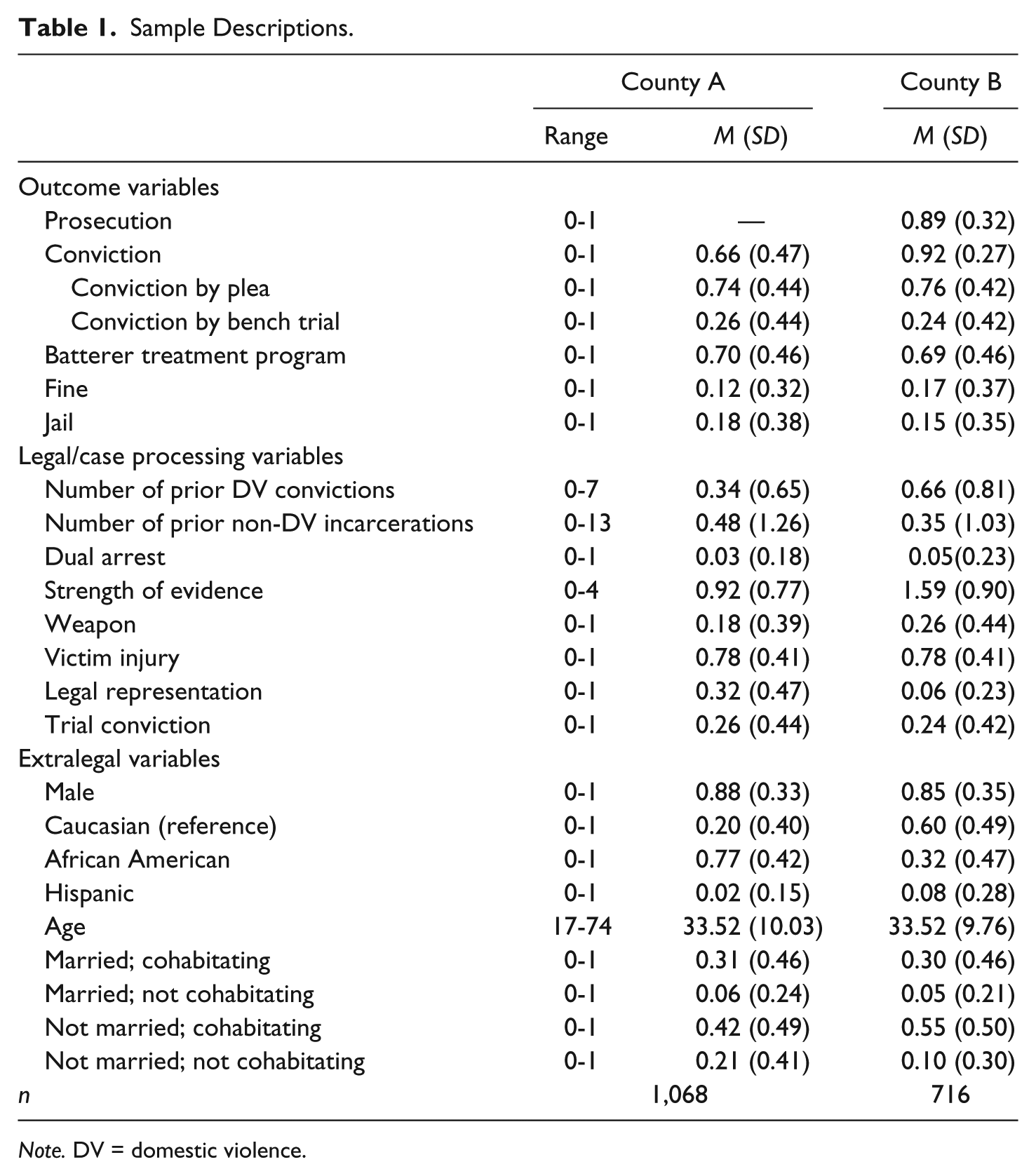
The sample for this study consisted of all defendants charged with misdemeanor DV and whose cases were disposed of between January 1, 2004, and December 31, 2006, resulting in a sample size of 1,170 defendants and 862 defendants in the County A and County B CDV Courts, respectively. 1 After listwise deletion of missing cases, the samples were reduced to 1,068 and 716 defendants processed in County A and County B, respectively. There were no significant differences (p ≤ .05) on any of the outcome measures or predictor variables between the final within-county samples and the samples without cases removed. Table 1 displays the descriptive statistics for the county-specific samples. Data for this study were retrieved from a number of official data sources, including court files, prosecutor files, local police incident reports, local arrest warrants, and state law enforcement records.
Sample Descriptions.
Note. DV = domestic violence.
Measures
Dependent variables
The outcome measures included in this study are displayed in Table 1. Prosecution was defined as a dichotomous measure, indicating whether the case was prosecuted or dismissed by the prosecutor (0 = case was dismissed; 1 = case was prosecuted). Two measures of judicial decision-making were assessed. Due to this study’s focus on court actor decision-making, the conviction decision was only modeled for cases that went to trial (0 = defendant was not convicted; 1 = defendant was found guilty at bench trial). 2 The sentencing decision was modeled for defendants who were prosecuted and convicted—regardless of the mode of conviction—and was reflected by a categorical nominal variable, which included a sentence mandating the defendant to attend a batterer treatment program, 3 pay a fine, 4 or a jail sentence. 5 Only the batterer treatment program included a mandated rehabilitative component.
Predictors
Table 1 also lists the predictors that were selected for inclusion based on availability during data collection, theoretical relevance, and inclusion in other studies that may support rival explanations for courtroom decision-making. Multicollinearity was not an issue.
Legal and case processing factors
Because an extensive criminal history may indicate that a defendant exhibits a more “stable disposition” (Albonetti, 1991, p. 251) toward criminality, greater blameworthiness, and a greater threat to the community (Albonetti, 1986, 1987, 1991; Steffensmeier et al., 1998), two criminal history variables were included: number of prior DV convictions and number of prior non-DV incarcerations. Dual arrest was coded as a dichotomous variable reflecting whether both the defendant and victim were arrested during the same incident (0 = no; 1 = yes). Theoretically, a court actor may view dual arrest cases as mitigating the blame placed on the defendant because the responding police officer(s) found that both parties contributed to the incident or could not determine the primary aggressor in the incident (see Albonetti, 1986, 1987; Steffensmeier et al., 1998). Because uncertainty avoidance theory (Albonetti, 1986, 1987) suggests that cases with more corroborating and physical evidence will result in less uncertainty surrounding defendants’ guilt or innocence, strength of evidence was included as an additive scale reflecting the number of types of evidence available during case processing (witness statement(s), victim statement, photographs of injuries and/or scene, and physical items taken from the scene). The scale ranges from 0-4, where higher values reflect more types of evidence available during case processing.
A measure of weapon use (similar to Kingsnorth & Macintosh, 2007, 0 = no weapon used or threatened to be used, 1 = gun/knife/blunt object/other used or threatened to be used) was included as it may indicate a defendant’s “stable disposition” toward engaging in violent crime (Albonetti, 1991, p. 251). Cases involving the use of bodily weapons, such as hands or feet, were coded as 0. Victim injury refers to whether the police or the victim noted any injury to the victim (0 = no, 1 = yes). Defendants in cases where victims were injured may be perceived as more culpable for their offenses (Steffensmeier et al., 1998). A dichotomous measure indicating whether a defendant retained or was appointed legal representation was also included (0 = defendant represented him or herself; 1 = formal legal representation) to control for the extent to which the courtroom work group and maintenance of courtroom relationships may affect case processing (Eisenstein & Jacob, 1977). Finally, because mode of conviction has been identified as having theoretical importance and a relevant factor for understanding future court outcomes (e.g., Johnson, 2003), a measure of trial conviction was included to distinguish between convictions yielded from pleas and from bench trials (0 = convicted by plea; 1 = convicted by trial).
Extralegal factors
Because research has identified that young, minority, male defendants are treated most harshly in the courtroom and are perceived to be most likely to re-offend (e.g., Spohn & Holleran, 2000; Steffensmeier et al., 1998), this study controlled for these demographics. Male was coded as a dichotomous variable (0 = female, 1 = male). Defendant race/ethnicity was tapped by three dichotomous race/ethnicity categories: Caucasian (reference category; 0 = no, 1 = yes), African American (0 = no, 1 = yes), and Hispanic (0 = no, 1 = yes). Defendant age was a continuous measure with higher values reflecting older defendants. Finally, to assess whether different forms of intimate relationships received disparate treatment by court actors (Albonetti, 1986, 1987), four dichotomous measures were included: married and cohabitating (reference category; 0 = no, 1 = yes); married and not cohabitating (0 = no, 1 = yes); not married and cohabitating (0 = no, 1 = yes); not married and not cohabitating (0 = no, 1 = yes).
Statistical Analyses
Prosecutorial decision-making was modeled for all defendants. In both courts, the conviction decision was assessed for all defendants whose cases were not dismissed by the prosecutor and whose verdict was determined at bench trial. The sentencing decision was assessed for all convicted defendants, regardless of the mode of conviction. 6
All analyses were conducted using SPSS software. Logistic regression techniques were used to model the prosecution and conviction decisions. Multinomial regression analyses were used to predict the sentencing decision where the outcomes of receiving a fine or a jail sentence were compared with receiving a sentence mandating the defendant to attend a batterer treatment program. Separate analyses were conducted by county. Following prior research, because of the jurisdictional differences in court processing between the courts (Spohn & Holleran, 2000), this study did not attempt to analyze between-court variations in the magnitude of predictor variables on the outcomes or empirically assess differences in decision-making between the courts. Instead, examining processing of cases through the two DV courts allows for a more advanced assessment of the extent to which contemporary theoretical frameworks are applicable in specialized DV courts.
Results
Table 1 displays the results of the rates of prosecution, conviction, and sentencing in both specialized DV courts. During the years under study, a countywide policy restricted prosecutors in County A from dropping DV cases except under extreme circumstances. In County B, no such policy restricted prosecutorial discretion; approximately 11% of cases were dismissed by the prosecutor during the years under study (89% were prosecuted). Roughly 66% and 92% of prosecuted cases ultimately resulted in a conviction in County A and County B, respectively. In both counties, approximately 70% of convicted defendants received a suspended sentence which mandated completion of a batterer treatment program.
The first columns in Table 2 display the results of the decision to prosecute in County B. Recall, County A policy precluded prosecutors from dismissing cases—except under extreme circumstances—prior to the case being brought before the judge during the years under study; thus, no analyses could be conducted predicting prosecutorial decision-making in County A. Legal and case processing variables explained most of the variation in the decision to prosecute a defendant in County B. Defendants with a greater number of prior non-DV incarcerations and defendants with more evidence against them were more likely to be prosecuted than defendants with less extensive criminal histories and with less evidence against them. Defendants with legal representation were less likely to be prosecuted. There was no impact of any other legal or case processing predictors on prosecutorial decision-making. Only one extralegal factor affected prosecutorial decision-making: male DV defendants were more likely to be prosecuted than female DV defendants.
Logistic Regression Models Predicting the Prosecution and Conviction Decisions.

Note. The only cases in the above conviction analyses are those whose final case disposition was determined by the judge at trial (e.g., does not include those defendants who pled guilty or nolo contendre). DV = domestic violence.
Caucasian is the reference category.
Married and cohabitating is the reference category.
p ≤ .05. **p ≤ .01.
The middle and end columns of Table 2 display the results of the judicial conviction decision. Among defendants in County A, the only variable to significantly affect the odds of a trial conviction was the presence of an attorney, such that defendants who were represented by an attorney were less likely to be convicted than defendants who represented themselves at trial.
In County B, there were also few significant predictors of the conviction decision. Defendants with a greater number of prior DV convictions were more likely to be convicted. Defendants whose victims were also arrested in the same incident were less likely to be convicted than defendants who were the sole perpetrators. No other legal, case processing, or extralegal factors exhibited significant effects on judicial decisions to convict.
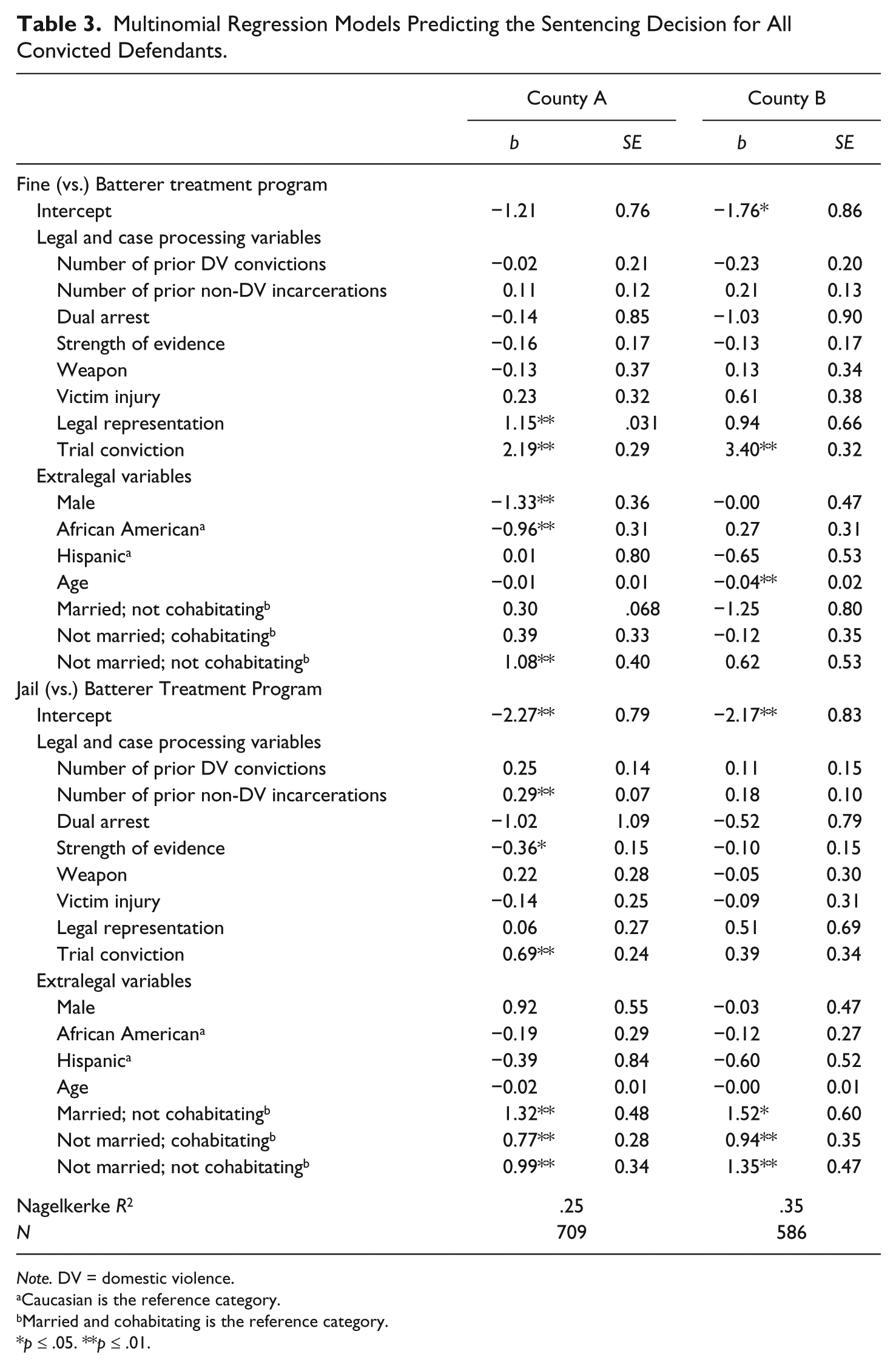
The results of the multinomial analysis of sentencing decision are displayed in Table 3. The top portion of the table provides the comparison between receiving a fine and a batterer treatment program. The bottom portion of the table displays the results comparing the likelihood of receiving a jail sentence relative to a batterer intervention program. Overall, being convicted by trial was significant for both comparisons and in both courts; defendants who were convicted at trial were more likely to receive a fine (both counties) or jail time (County A only) relative to being mandated to attend a batterer intervention program. In both courts, defendants who were married to and cohabitating with their victims had the lowest risks of receiving a jail sentence (relative to a batterer treatment program). In County A, defendants who were neither married to nor cohabitating with their victims were more likely to receive a fine. No other similarities across the counties existed.
Multinomial Regression Models Predicting the Sentencing Decision for All Convicted Defendants.
Note. DV = domestic violence.
Caucasian is the reference category.
Married and cohabitating is the reference category.
p ≤ .05. **p ≤ .01.
County-specific effects existed. Legal factors affected the sentencing decision in County A. Defendants with legal representation were more likely than those who represented themselves to receive a fine compared with batterer intervention program, but legal representation did not affect the decision to impose a jail sentence relative to a batterer treatment program. Furthermore, defendants with more extensive prior criminal histories were more likely to receive a jail sentence than a batterer intervention program. Defendants whose cases had more pieces of evidence were less likely to receive jail relative to a batterer intervention program.
In terms of extralegal factors, in County A, males and African Americans were less likely than females and Caucasians, respectively, to be sentenced to pay a fine than attend a batterer intervention program. The only extralegal factor to influence the sentencing decision in County B was age: older defendants were less likely than younger defendants to receive a fine over a batterer intervention program.
Discussion and Conclusion
This study sought to advance scholarly efforts to understand decision-making in specialized DV courts by assessing the extent to which theoretical frameworks often applied in general court research are useful in specialized DV courts. The findings from this study lend only partial support for applying general theories commonly used in studies of courtroom decision-making to specialized DV courts. A more detailed discussion follows.
Prosecutorial Decision-Making
The first goal of this study was to assess the utility of extant theoretical frameworks for explaining prosecutorial decision-making in specialized DV courts. Although some of the tenets of uncertainty avoidance theory and focal concerns theory were supported, others were not. First, roughly 90% of all DV cases were fully prosecuted in County B, which is contrary to what might be expected by the theoretical frameworks under study and a stark contrast to the low rates of prosecution historically reported in traditional court settings. Still, recent studies have suggested that rates of prosecution vary by jurisdiction (Garner & Maxwell, 2009; Klein, 2004).
Consistent with theoretical expectations, some factors were supportive of efforts to reduce uncertainty in decision-making. Specifically, defendants whose cases carried more evidence and who had more extensive criminal histories were particularly likely to be prosecuted. Both factors may signal to prosecutors that there is less uncertainty regarding the suspect’s culpability in the offense and an increased likelihood of conviction. Furthermore, an extensive criminal history may elicit a greater perception that the defendant poses a threat to the community (Albonetti, 1987; Spohn et al., 2001; Ulmer et al., 2007) and the victim.
Inconsistent with theoretical predictions, however, were other legal and extralegal factors. In this study, victim–defendant relationship and dual arrest were included to reflect assessments of victim/witness management and victim credibility. There was no impact of the specific level of intimacy between victims and defendants on prosecutorial decisions. This finding is largely consistent with most prior research on DV case processing (Hirschel & Hutchinson, 2001; Kingsnorth, Macintosh, Berdahl, Blades, & Rossi, 2001; Schmidt & Steury, 1989; Worrall, Ross, & McCord, 2006; but see, Dawson & Dinovitzer, 2001; Kingsnorth et al., 2002) and suggests that DV is aggressively prosecuted in specialized courts regardless of the victim–defendant relationship. The current study also did not uncover any significant effect of dual arrest on prosecutorial decision-making. The null finding may be driven by potential differences in the way dual arrest cases are viewed for male and female defendants. Over the past few decades, the number of women who have been arrested for DV has increased as a result of mandatory arrest laws (Hirschel & Buzawa, 2002); however, scholars argue that the motivations for each party’s use of violence, may vary (e.g., females acting in self-defense; Feder & Henning, 2005), and these differences may influence courtroom decision-making. There is some evidence that suggests that the increase in dual arrests—particularly for female defendants—has implications for prosecutorial decision-making (Henning & Renauer, 2005; Kingsnorth & Macintosh, 2007). Future studies should expand upon this area of research (Hirschel & Buzawa, 2002).
The legal factors predicted by uncertainty avoidance theory and/or focal concerns theory (e.g., offense severity) to increase certainty of conviction and support perceptions of culpability were not consistently supportive of the frameworks. For example, the failure of the effects of weapon use or victim injury to reach statistical significance may reflect prosecutorial awareness that DV cases do not require that the defendant use an object as a weapon or a victim be injured to qualify as DV; instead, prosecutors are likely aware that DV cases often involve the use of bodily weapons (e.g., hands), coercive controlling behaviors, and verbal threats to place a victim in fear for his or her safety. It may also be that cases involving extreme (i.e., deadly) weapon use and severe injury to the victim are outside the purview of the two courts under study, as these cases may be more likely to be classified as felonies in this state, and would not be processed within the two misdemeanor specialized DV courts.
In sum, although some of the effects of legal variables stipulated by uncertainty avoidance and focal concerns theory to be associated with prosecutorial decision-making were supported in this study, some key factors specific to DV cases (e.g., victim–offender relationship, offense severity indicators) were not.
Judicial Decision-Making
The second goal of this study was to assess the extent to which theoretical frameworks apply to judicial decisions in specialized DV courts. Support for the theories was mixed. In both courts, an overwhelming majority of defendants were convicted of DV. This finding is contrary to what might be expected in more traditional courts, where judges may view violence between partners simply as a situational incident (Albonetti, 1991). In addition, nearly 70% of convicted defendants in both courts received the opportunity to attend a batterer treatment program; these findings support the therapeutic function of many specialized DV courts (Winick, 2000).
Consistent with the extant research on court processing, some indicators of blameworthiness and culpability did appear to influence judicial decisions in both counties. The most consistent theoretically relevant case processing predictor was the effect of being convicted by trial. As Johnson (2003) discusses, focal concerns theory would hypothesize that defendants who go to trial are treated more harshly than those who enter a plea, because “going to trial likely signifies a lack of remorse and rehabilitative potential, which translates into increased severity at sentencing.” (p. 480). This rationale is consistent in the current study as defendants who went to trial were less likely to receive the opportunity to attend a batterer treatment program; they may be perceived as less likely to benefit from rehabilitation efforts.
Less supportive overall of the attribution and focal concerns perspectives were the effects of other legal and case processing measures (e.g., dual arrest, offense severity, defendant criminal history) that could be theoretically relevant to perceptions of offense culpability, danger to the community (and perhaps more specifically, the individual victim), and concerns about dispositions toward future violence (Albonetti, 1986, 1987, 1991; Hartley et al., 2007; Steffensmeier et al., 1998). Although these findings are less intuitive, they may simply signal differences in the way judges—like prosecutors—in specialized DV courts view these defendant and case characteristics. Or it may simply be that judges in DV courts look for indicators other than those controlled for in this study on which to base their perceptions of culpability and predictions regarding defendants’ risk of re-offending. This will be discussed more below.
This study also failed to find support for theoretical predictions that extralegal characteristics, particularly defendants’ age, sex, and race, affect judicial decision-making; findings did not indicate substantial main or interactive (results not shown) effects of age, race, or defendant sex on judicial decisions. However, recall, defendant sex did significantly affect prosecutorial decisions to fully prosecute a case. Thus, the effect of defendant sex may be most prominent at the earlier stages of court processing (see also, Dawson & Dinovitzer, 2001; Henning & Feder, 2005; Worrall et al., 2006) and be more associated with disentangling relationship dynamics and concerns over factual guilt. The largely uniform treatment of defendants in the two courts may in part reflect the nature of the courts, training of judges, and possibly, a greater amount of information provided to the judges from DV investigators, prosecutors, and victim advocates present in the courts as part of coordinated community responses to DV.
Nevertheless, the effect of marital/cohabitation status on judicial decisions in these courts was consistent in both counties and warrants discussion. In the current study, defendants in both counties who were married to and cohabitating with their victim were less likely to receive a jail sentence relative to a batterer treatment program. These findings might suggest that judges perceive these defendants to be more likely to remain in intimate relationships with their victims and would be most likely to benefit from the batterer treatment program and less likely to benefit from serving jail time without being given the opportunity to address their behaviors (also see Hartman & Belknap, 2003). Following the focal concerns perspective, scholars have hypothesized that judicial decisions may reflect concerns about practical constraints placed on a family if the defendant is either temporarily removed from the home (e.g., economic concerns, Bond & Jeffries, 2014) or the familial ties that might be affected if the defendant does not receive the rehabilitation that he or she needs. It is plausible this is occurring here, as well. However, Bond and Jeffries (2014) also noted “for victims of domestic violence, the incarceration of their abuser may provide a much needed respite from the violence, a sense of short-term security, and an opportunity to heal” (p. 867). Thus, the interaction between relationship status and other factors is important for future research to assess.
It is also possible, although untestable with the current data, that the results might reflect the presence of victims in court and their preferences regarding sentencing; it is possible that victims who are married to and cohabitating with their defendants would prefer to stay in their relationships and request that the defendant be given the opportunity to attend the treatment program. In a study by Camacho and Alarid (2008), victims of DV who were married to the defendant “had more at stake in the relationship” and were often in favor of the defendant being given the opportunity to attend counseling (p. 298). If this was the case in this study, it could indicate that judges are helping promote victim empowerment by taking victims’ wishes about sentencing into consideration. In sum, although some of the assumptions of the theoretical frameworks appeared to drive decision-making in specialized DV courts, the findings do not indicate complete congruency.
Factors Limiting the Utility of Extant Frameworks
Contemporary courtroom theories may not be wholly supported in these two courts for at least three reasons. First, the cases under study are misdemeanor, not felony, cases. They are further limited to only one type of offense—misdemeanor DV—which inherently reduces the variation in offense severity which would typically guide court actors’ perceptions regarding culpability and risk to the community. Second, specialized courts appear to have structural differences both in terms of court actor composition and philosophies which guide court processing. Judges and prosecutors in specialized DV courts are exposed to DV cases on a more consistent basis, may receive additional training on the dynamics of DV cases, and may be more aware of the difficulties in processing them (Labriola et al., 2009). They may be especially aware of the barriers to victim cooperation, evidence, and legal arguments that may mitigate defendants’ blame and reduce the odds of full case processing in more traditional courts (e.g., Harrell et al., 2007). Because of their positions in the DV courts, court actors may develop more innovative strategies for increasing prosecution and conviction rates (e.g., increased victim services and coordination of service providers). Finally, although in traditional courts, more blameworthy defendants may be perceived as deserving of the most punitive treatment, in specialized courts, similar defendants may be viewed as deserving of the opportunity to attend a treatment program in hopes of addressing some of the behaviors that may have contributed to the DV arrest. Service providers are often present in court and help hold defendants accountable to court sanctions by providing compliance reports.
Based on the findings of this study, it appears that although some predictors assumed by the aforementioned theoretical frameworks to be highly predictive of decision-making were relevant, there are many points of divergence that limit the utility of contemporary theoretical frameworks for explaining decision-making in the two specialized courts under study. Given the growing number of DV cases reported and entering the system (Catalano, 2007; Ostrom & Kauder, 1999) and the increased number of specialized DV courts established nationwide, it is important to understand what guides prosecutorial and judicial decisions in these cases. Extant theoretical frameworks are a useful starting point for understanding processing in these cases, but researchers must also consider other factors unique to DV cases that may affect decision-making in these cases. For example, court actors may have access to information from victims’ advocates that detail levels of coercive control or past, unreported DV, which may be particularly indicative of the dynamics and long-term relationship dynamics that stem beyond the current incident. Qualitative assessments by way of observations and interviews with decision-makers operating in specialized DV courts cases may be particularly useful to determine what guides decision-making in DV cases (see, for example, Gover, MacDonald, Alpert, & Geary, 2003; Hartman & Belknap, 2003; Labriola et al., 2009) and inform future quantitative analyses.
Similarly, it is important for future research to consider how differences across specialized DV courts may affect decision-making in these cases. Researchers at the Center for Court Innovation have discussed how DV courts across the country are guided by varying goals and procedures (Labriola et al., 2009) and such differences affect offender outcomes (e.g., recidivism, Cissner, Labriola, & Rempel, 2015); it stands to reason, then, that these differences have implications for decision-making and in understanding the factors most salient in decision-making in different contexts. Across-jurisdiction differences did exist in the current study (e.g., multiple judges and prosecutors versus solo judge and prosecutor), and it is quite plausible that these differences affected decision-making. For example, a separate area of research has explored how and why judicial characteristics (e.g., sex, race) might affect decision-making (e.g., Johnson, 2006; Spohn, 1990; Steffensmeier & Britt, 2001); having multiple judges and prosecutors certainly lends the possibility of variation in decision-making. Unfortunately, an analysis exploring these differences was beyond the scope of this study.
Although this study contributes to the literature on court processing of DV cases, there are some limitations worth mentioning. First, there may be generalizability issues. This study relied on data from two specialized misdemeanor DV courts in one state; the extent to which the results generalize to felony DV cases and courts in other states is unknown. In addition, this study did not explore decision-making in other types of cases (i.e., non-DV) in these jurisdictions; thus, it is possible that the two jurisdictions under study may also have high prosecution and conviction rates and similar sentencing patterns for other types of offenses and not necessarily follow the assumptions of the theoretical frameworks discussed above. Similarly, this study did not make direct comparisons with decision-making in DV cases processed in more traditional court settings; future research should expand upon this line of inquiry (and see Peterson, 2004).
In addition, all data were taken from official records, and despite efforts to obtain the most complete data, potential limitations still arise. For example, the data could not identify which past non-DV criminal histories involved prior violent offenses. Prior violent behavior is a better indicator of violent dispositions or may reflect prior DV histories that were coded as other types of violent crimes. Also, this study could not control for potentially relevant factors that past research and theory have identified as important for decision-making: victim cooperation and presence in court, and/or victim wishes regarding case processing (Bechtel, Alarid, Holsinger, & Holsinger, 2012; Dawson & Dinovitzer, 2001; Kingsnorth & Macintosh, 2004), defendants’ stakes in conformity (Dinovitzer & Dawson, 2007; Henning & Feder, 2005; Wooldredge & Thistlethwaite, 2004), victim and defendant substance use (Steffensmeier et al., 1998), and witnesses (Albonetti, 1986, 1987), among others. Information on these factors was not uniformly included in the data collected in both courts, precluding their inclusion in this study. Finally, because of statistical reliability concerns, this study did not control for the selection processes inherent in court processing.
Despite these limitations, this study adds to the literature on specialized DV courts and moves beyond existing research to explore the utility of theoretical frameworks commonly used in felony courts to understand decision-making in misdemeanor DV courts. Although the findings of this study suggest that existing theoretical frameworks did not wholly apply to the processing of cases in the two specialized DV courts under study, additional research is needed to address this line of inquiry in light of the number of DV cases entering the criminal justice system and the increase in innovative approaches used to respond to these cases.
Footnotes
Acknowledgements
The author would like to thank the two anonymous reviewers for their insightful feedback and suggestions for improving this article. In addition, the author thanks Terance D. Miethe, Emily M. Wright, and Melissa Rorie for their comments on earlier versions of this article.
Declaration of Conflicting Interests
The author(s) declared no potential conflicts of interest with respect to the research, authorship, and/or publication of this article.
Funding
The author(s) received no financial support for the research, authorship, and/or publication of this article.