







Abstract
The purpose of this qualitative study was to investigate factors influencing the adoption of an effective bystander-based sexual violence prevention intervention. High schools participating in a cluster-randomized controlled trial that found significant declines in sexual violence over time and with full implementation were invited to adopt this program (Green Dot) at no cost. Three emergent themes arose from interviews with 10 intervention implementers. These findings have implications for researchers, practitioners, and high school administrators and may facilitate future program marketing efforts and the development and testing of strategies for targeted dissemination of this and other bystander programs for violence.
The epidemic of sexual violence on college campuses has received considerable attention in recent years. As a result of the Violence Against Women Reauthorization Act of 2013 and Jeanne Clery Act (Clery Center, 2019), which bolster efforts to address sexual violence in higher education, more college students will be exposed to primary prevention programming. However, the Centers for Disease Control and Prevention (CDC) reports that more than 40% of female victims of completed rape report initial victimization before age 18 and 28% of male victims experience rape before age 10 (Black et al., 2011), leading some to argue that prevention programs should begin earlier to reach those at risk of violence before it occurs (Basile, 2015; Lundgren & Amin, 2015; Morrison, Hardison, Matthew, & O’Neil, 2004). To comprehensively address sexual violence, efficacious programs targeting initial perpetration and victimization must be identified and adopted at the same rate as those focused on secondary or tertiary responses (Lee, Guy, Perry, Sniffen, & Mixson, 2007), yet few rigorously tested evidence-based strategies exist to prevent sexual violence (DeGue et al., 2014).
Sexual violence prevention strategies have historically focused on individual-level behavior change, such as raising awareness, changing attitudes, and reducing risk behaviors among groups most likely to be victimized (e.g., women, college students). These approaches, which typically expose recipients to information in single sessions, have failed to demonstrate significant and persistent changes in sexual violence over time (Basile, 2015). This ineffectiveness has prompted researchers to explore more comprehensive violence prevention programs that target interpersonal, community-level, and societal-level influences. Such approaches might incorporate information about potential perpetrators of violence, focus on initiatives to improve campus safety, and/or attempt to change social norms. Action-oriented programs, including those that provide participants with opportunities to learn and practice skills that enable them to identify and appropriately respond to instances of sexual violence, have also been recommended (Basile, 2015; Lonsway et al., 2009).
The bystander approach to violence prevention is a skills-based strategy that holds significant promise to change social norms as it cuts across multiple levels of the environment (e.g., individual, interpersonal, community, and societal level; Banyard, Moynihan, & Plante, 2007; Banyard, Plante, & Moynihan, 2005; Berkowitz, 2002). Bystander interventions target entire communities as change agents as opposed to individual perpetrators or victims and equip bystanders with knowledge and skills required to confront social norms that condone violence and engage in safe and positive intervention behaviors (Coker et al., 2016; Cook-Craig, Millspaugh, et al., 2014). Bystanding in this context includes taking a stand against behaviors that perpetuate harmful norms and/or intervening to stop or diffuse potentially unsafe situations. Examples include directly confronting a potential victim or perpetrator or creating a distraction to interrupt a situation that might lead to abuse or violence.
Green Dot is a primary prevention bystander-based program that uses the power of peer and cultural influences to reduce violence. Green Dot relies on Rogers’s (2003) Diffusion of Innovation Theory to spread the concept of active bystanding through peer groups, which promotes approaching all individuals within a given community as potential bystanders who can play a role in preventing violence rather than as potential victims or perpetrators. Originally developed for college populations, Green Dot programming consists of short motivational speeches emphasizing the importance of bystanding and more intensive trainings for popular opinion leaders (e.g., student athletes, sorority and fraternity members, students in honorary societies and leadership roles) that teach bystanding skills (Coker et al., 2011). Green Dot has demonstrated efficacy in reducing violence victimization and perpetration among college samples (Coker et al., 2015).
In recognizing that sexual violence prevention programming should be initiated earlier than college, key stakeholders throughout the Commonwealth of Kentucky undertook a community-engaged process to build statewide capacity to prevent sexual violence among high school students (see Cook-Craig, Millspaugh, et al., 2014, for an overview). Given Green Dot’s efficacy in preventing violence among college populations, this program was chosen as the intervention strategy. Green Dot was adapted for high school populations and its impact was examined in a cluster-randomized controlled trial (RCT) within 26 Kentucky high schools (see Coker et al., 2017). Compared with control schools, schools implementing Green Dot had significantly reduced frequency of sexual and interpersonal violence perpetration and victimization (Coker et al., 2017).
After the trial, evaluators and intervention implementers presented the study’s findings to schools in both conditions and provided the opportunity for schools to continue to adopt Green Dot at no cost. Costs associated with program implementation and evaluation are often cited as barriers preventing the adoption of evidence-based programs by targeted organizations (Glasgow & Emmons, 2007; Ribisl, Leeman, & Glasser, 2014). However, despite the program being offered free of cost, with evidence demonstrating efficacy to reduce sexual violence, close to 40% of schools involved in the trial chose not to implement Green Dot. Furthermore, there was a considerably lower rate of adoption among schools originally assigned to the control condition. It remains unclear why these schools chose not to adopt and implement the program. Experts suggest this may be due to a tendency for researchers to focus on identifying and evaluating evidence-based violence prevention programs, as opposed to conducting translational research about how to move efficacious programs into practice (Fagan & Mihalic, 2003; Noonan et al., 2009; Ribisl et al., 2014).
The burgeoning field of implementation science offers various frameworks, theories, and models that can help explain why organizations, such as schools, may or may not adopt and implement evidence-based programs (Bauer, Damschroder, Hagedorn, Smith, & Kilbourne, 2015). The Conceptual Framework of Organizational Adoption (Frambach & Schillewaert, 2002) and Diffusion of Innovation Theory (Rogers, 2003) are two relevant examples. Together, these frameworks suggest that adoption is predicated on both the characteristics of the organization (including the organization itself and individuals within the organization) and perceived characteristics of the innovation. The research-to-practice gap has been partly attributed to a failure to identify and understand characteristics of organizations and innovations that influence their adoption and implementation (Bauer et al., 2015); still, information is lacking on contextual factors that influence organizational adoption of efficacious programs when barriers such as cost are removed (Fagan & Mihalic, 2003). Furthermore, few studies examine the perspectives of individuals responsible for program implementation, although they often hold valuable insight into organizational- and innovation-level factors that can influence program uptake. The purpose of the current study was to discern why some schools involved in the cluster RCT evaluating Green Dot chose to adopt the program, while others did not, with a particular emphasis on understanding barriers and facilitators given the notably lower adoption rate among control schools. We chose to explore these issues from the perspective of intervention implementers. This information can inform the identification of specific attributes associated with program adoption that can be targeted and addressed to improve end users’ (i.e., school leadership and administration) willingness and readiness to adopt violence prevention programming—a critical step in ensuring institutionalization of successfully tested interventions.
Method
Study Setting and Context: RCT to Evaluate Green Dot in Kentucky High Schools
Kentucky’s state sexual violence coalition, community representatives from the 13 regional Rape Crisis Centers, and researchers from the University of Kentucky collectively decided to implement and evaluate the Green Dot program in the high school setting. This initiative began in 2005, growing out of a multi-year, stakeholder-driven process aimed at enhancing Kentucky’s capacity to prevent perpetration of sexual violence statewide. Green Dot was chosen as the intervention strategy because it met the priorities identified by state and local stakeholders during the strategic planning process. Specifically, it was bystander-based; able to be implemented in various settings and adapted for use with multiple populations; and was hypothesized to work across all levels of the socioecological environment (Cook-Craig, Millspaugh, et al., 2014). Funding to evaluate Green Dot as a primary prevention strategy for the prevention of sexual violence in the high school setting was then sought and awarded in the form of a 5-year, US$2 million CDC cooperative research agreement (CDC U01CE001675).
The language, media, curriculum content, and examples used in the college version of Green Dot were modified to ensure cultural and developmental relevance to high school students (Cook-Craig, Millspaugh, et al., 2014). Forty-six high schools in Kentucky expressed interest in participating in the evaluation and 36 met the inclusion criteria. Of these, two schools in each of the 13 rape crisis center regions (n = 26) were selected and randomized via simple randomization to either the intervention or control (wait-list) condition. From 2009-2014, a cluster RCT design was used to evaluate the efficacy of Green Dot to prevent sexual violence and other forms of interpersonal violence in these 26 high schools (see Coker et al., 2017, and Cook-Craig, Coker, et al., 2014, for a detailed description of sampling and methods). Students in both the intervention and control schools were surveyed at baseline (2010) and annually through 2014 (Coker et al., 2017). Green Dot was implemented in intervention schools (n = 13) by trained rape crisis center educators (hereafter, implementers). In addition to intensive training on effective delivery of program content, as rape crisis center employees, the Green Dot implementers were also clinically trained to respond to instances of sexual violence. This dual training in both violence prevention and intervention is a unique aspect of Green Dot that distinguishes it from other sexual violence or dating violence prevention programs (e.g., Safe Dates, Bringing in the Bystander) that use teachers or peer facilitators to deliver program content.
Post-RCT Program Adoption Efforts
Compared with control schools (n = 13), schools receiving Green Dot had significantly reduced frequency of unwanted (i.e., physically forced, coerced, or drug/alcohol-facilitated) sex, sexual harassment, physical and psychological dating violence, and reproductive coercion over time and with full intervention implementation (Coker et al., 2017). At the end of the research trial and when the intervention was proven to have a sustained reduction in multiple forms of sexual and interpersonal violence, intervention schools were invited to continue Green Dot and control schools were offered Green Dot for the first time. Study findings were made available to the public and the schools through a statewide press conference. Evaluators from the University of Kentucky additionally provided personalized letters to each principal involved in the trial thanking them for their participation and outlining the study results. Implementers were provided with “principal packets” that contained a one-page research summary, an infographic, and a link to a YouTube video explaining the findings. To encourage adoption, implementers and researchers met with principals to present the information and ask whether they would consider implementing Green Dot, free of cost. As mentioned previously, 10 of the 26 schools involved in the evaluation chose not to adopt the program after being approached.
The Current Study
To discern why some schools chose to adopt Green Dot after participation in the RCT and others did not, we chose to interview rape crisis center educators who were responsible for implementing the program in high schools. Due to their dual roles as advocates and educators, they held specific expertise in program implementation and maintained a sustained presence in high schools that facilitated frequent contact with staff, administrators, and students, which in turn provided them with specific, contextual knowledge about schools’ willingness to adopt Green Dot.
Design
We undertook a qualitative descriptive approach to explore intervention implementers’ perceptions of barriers and facilitators to high schools’ adoption of the Green Dot program after participation in the cluster RCT. Qualitative descriptive research studies seek to understand an issue or a process from the perspectives of those involved (C. Bradshaw, Atkinson, & Doody, 2017) and are appropriate when a straightforward description of the phenomenon under study in participants’ own words is desired rather than a highly theoretical or abstract rendering of the data imposed by the researcher (Sandelowski, 2000). Our sample included intervention implementers given that their prolonged engagement in the high schools afforded them frequent opportunities to interact with various stakeholders responsible for or affecting program adoption (e.g., community members, school administration, teachers, students). Although high school administrators, students, and other researchers can provide important information influencing the goals of this research, this data collection was beyond the scope of this study. The perspectives of these groups will be important areas for exploration in future work.
Participant Recruitment
Maximum variation and snowball sampling were used to select a purposeful sample of implementers employed in Kentucky’s 13 regional rape crisis centers. Maximum variation sampling is a recruitment approach that involves seeking cases that are unique or have significant variability between them, and is useful for discovering patterns that emerge across a wide range of diverse participants (Palinkas et al., 2015); therefore, new and established implementers were eligible for inclusion and targeted for recruitment as long as they had a role in Green Dot implementation in the high school setting, either during or after the trial. Implementers working in both rural and urban areas in different parts of the state were sampled to capture maximum variation in location. In addition, we included implementers who spoke with principals and high school personnel to encourage Green Dot adoption post-RCT as well as implementers who were not involved in those discussions and who implemented Green Dot only after adoption decisions were made. Snowball sampling, a popular qualitative recruitment approach, consists of asking participants to identify other cases of interest that have similar experiences (Palinkas et al., 2015). We used snowball sampling by asking participants whether they knew other implementers who might be willing to participate in an in-depth interview. Implementers were recruited via email solicitation and sign-ups at a program implementation committee meeting. Of the 22 implementers approached, 10 agreed to participate in an interview.
Data Collection
The first author (D.M.D.) arranged face-to-face interviews with each consenting implementer at the location of their choice. Before participating in the interview, a cover letter describing the study was provided and implementers were read a consent script that described their rights as participants in the study. Implementers were given the opportunity to ask questions and provide informed consent to participate in the interview before proceeding. The first author (D.M.D) conducted all interviews. All interviews were audio recorded with participant permission and ranged from 39-130 min. Participants were provided with a US$25 gift card as a thank you for their time. All study procedures were approved by the West Virginia University Institutional Review Board (IRB Protocol No. 1505694087).
A semi-structured, open-ended interview guide facilitated each interview. Semi-structured and open-ended interviews are common in qualitative descriptive research (C. Bradshaw et al., 2017), as they facilitate in-depth exploration and rich discussion of key issues while allowing participants to freely express their thoughts and perceptions (Doody & Noonan, 2013; Sandelowski, 2000). Guiding questions focused on (a) implementers’ roles and responsibilities in the research trial (or posttrial), (b) their perceptions of staff and student attitudes toward the intervention, (c) dissemination of positive study findings from the RCT to schools, and (d) perceived barriers and facilitators related to intervention adoption at the end of the trial. Audiotapes were transcribed verbatim by a paid professional transcriptionist and all identifying information was removed. To maintain participant confidentiality given the relatively small number of consenting implementers, demographic characteristics of these participants were not collected.
Data Analysis
To facilitate data analysis and enhance validity, an audit trail (i.e., a written account of all important research activities and decisions) was maintained (Creswell & Miller, 2000). The audit trail contained extensive field notes, or memos, that recorded reflections on preliminary ideas and coding decisions as relationships among data categories began to emerge (Creswell & Miller, 2000). NVIVO 10.0 was used to facilitate data management and analysis. All transcripts were coded independently by D.M.D. and K.H. using inductive, conventional content analysis (Hsieh & Shannon, 2005), which began with a thorough reading of all transcripts, followed by iterative, open coding wherein each segment of text was assigned a label. Codes were then sorted, split, and/or collapsed into categories, and reviewed and organized into a hierarchical structure. Both coders met frequently to review and organize the coding structure and agree upon a final set of main categories that were further organized into emergent themes. This approach to intercoder agreement is recommended by qualitative methodologists as it preserves the interpretive process inherent to qualitative inquiry and analysis (Guest, MacQueen, & Namey, 2012; Saldaña, 2013). A third party was available to resolve discrepancies, but D.M.D. and K.H. were able to reach simple consensus on all analytical decisions. Member checking, which involves providing participants with a summary of study findings, was employed to validate and verify that our interpretations of the participants’ responses were accurately captured (Shenton, 2004). After data analysis, all participants were contacted via email and asked to view and comment on an analysis summary which included the final emergent themes and selected quotes. They were also provided with a draft of this article to read and were encouraged to provide feedback. Five participants responded to the inquiry and three provided feedback, mostly consisting of recommendations to clarify quotes or key concepts, which was incorporated into the final version.
Results
Of the 26 schools involved in the trial, 77% of intervention schools (n = 10) and fewer than half of control schools (45%; n = 6) chose to adopt Green Dot at the time of data collection. For six of the 10 implementers participating in this study, the intervention school they worked in adopted Green Dot, while the control school declined. Three implementers’ intervention and control schools chose not to adopt and one implementer worked in an intervention and control school that both decided to adopt (Table 1). Three primary themes emerged from implementer interviews related to their perceptions of schools’ decision-making in adopting Green Dot after the RCT. Each theme is described in detail, accompanied by illustrative quotes from multiple implementers. The first theme “Priorities: High, Low, and Competing” included instances where implementers described schools’ multiple and competing priorities balanced against recognizing violence as a problem for students in the school. The second theme, “The Value and Process of Research” was identified from discussions surrounding the impact that the research process itself had on subsequent adoption of Green Dot. Codes and categories related to conducting research within the school setting, schools’ participation as an intervention or control site, and how well researchers and implementers communicated study findings to school administrators were included within this theme. The final theme, “The Messenger Matters” was developed based on implementers’ perspectives of the importance of relationship building and gaining buy-in before and during the research process to better engage with schools and “market” the intervention post-RCT.
Implementer Involvement in 5-Year Research Trial and Subsequent Adoption Decisions of Intervention and Control Schools.
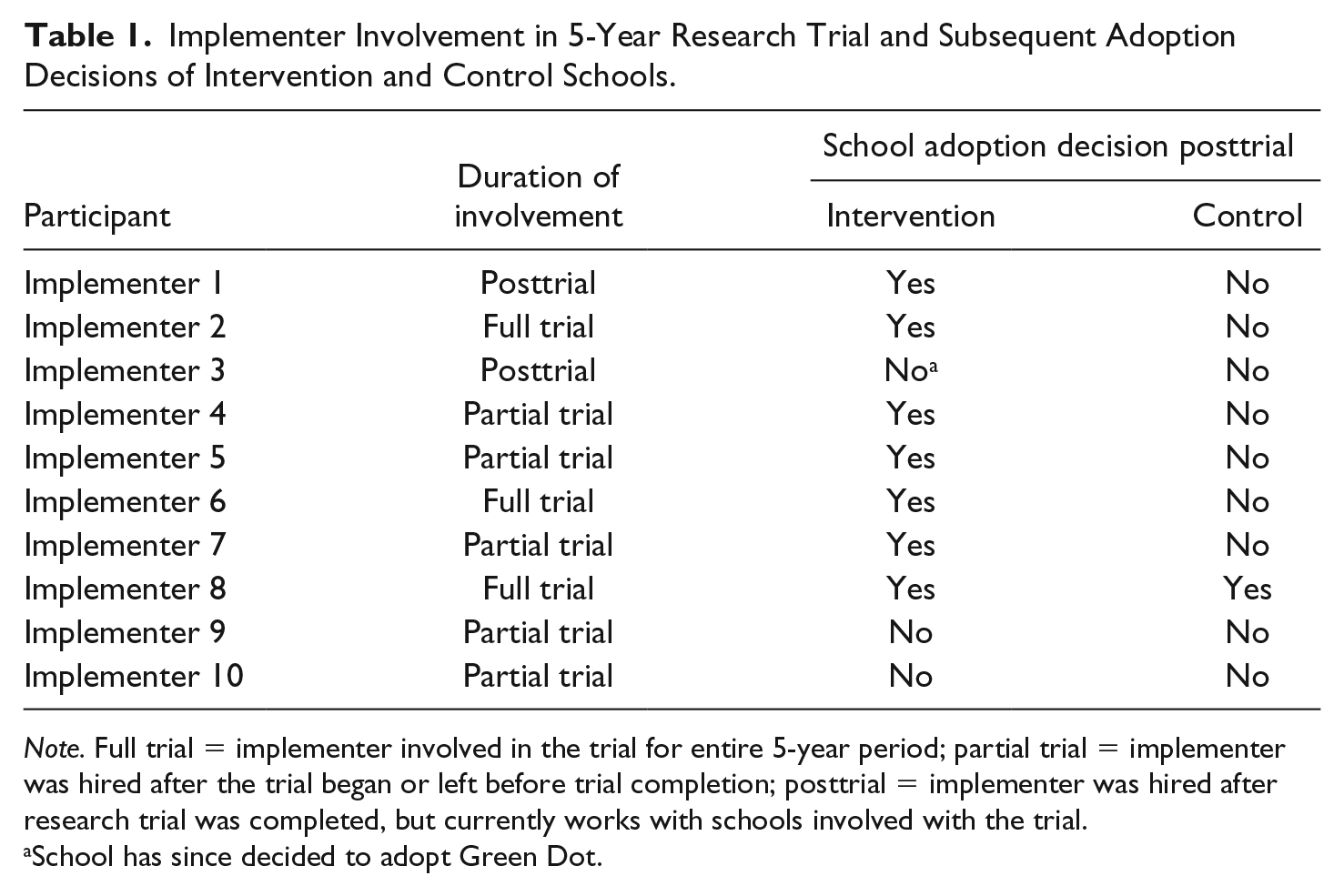
Note. Full trial = implementer involved in the trial for entire 5-year period; partial trial = implementer was hired after the trial began or left before trial completion; posttrial = implementer was hired after research trial was completed, but currently works with schools involved with the trial.
School has since decided to adopt Green Dot.
Theme 1: Priorities: High, Low, and Competing
When implementers were asked what might influence schools’ willingness to adopt Green Dot, a theme of “priority” clearly emerged. Specifically, various implementers perceived that the schools and communities in which they worked viewed sexual violence prevention as either a high priority or a low priority issue, and that this prioritization either facilitated or provided a barrier to adoption and implementation of Green Dot. Furthermore, implementers described multiple competing priorities that schools must manage that make prioritization of violence prevention programming challenging. Three subthemes emerged within the overall theme of Priorities: “Focus on Test Scores,” “Checking the Box,” and “Denial and Stigma of Sexual Violence.” Each of these subthemes will be described below.
Subtheme: Focus on test scores
Implementers perceived that school officials who recognized that violence prevention could create a more favorable learning environment were more likely to adopt the program. However, for some schools, it appeared that competing demands related to academics made Green Dot delivery and adoption challenging, even if support for the program was high. Notably, pressures related to student performance on standardized tests were listed as perceived barriers to intervention adoption in more than half of the interviews. An implementer and former schoolteacher said, “School is not a school anymore. It’s teach the test” (Implementer 3). When asked about schools’ reasons for nonadoption, another implementer shared, “Maybe [for] some of them it’s not priority . . . what’s priority is test scores. And we don’t help with test scores, to them.” She continued, They just don’t see it [sexual violence prevention] as a priority. I don’t know how they could see it as a priority when they have all of this other pressure . . . cause I really do think they want their students to be happy, safe, healthy, all of that. Like they really do want that, but when they have all these other pressures you know that gets pushed to the back burner. (Implementer 1)
Implementers recounted how the emphasis on standardized testing made it difficult for them to negotiate time for Green Dot training and data collection during class time because school administrators believed time out of class would negatively impact test scores. Another implementer from a school that chose not to adopt Green Dot stated, “It’s that time out of classroom, instructional time taken away. Everybody is so caught up in testing scores and teachers being fired because their grades aren’t good enough” (Implementer 9).
Even when presented with the positive results of the trial, several schools did not adopt Green Dot because it took away from class time. One implementer who worked in intervention and control schools that both decided against adoption stated, Yeah, I think it’s why [they said no to Green Dot]—actually both schools—because when I talked to our control school, you know, he [the principal] was like these [results] are wonderful but, you know, test scores. . . . If your test scores aren’t here or you don’t have this much class time then you’re losing funding and you’re not going to do this. So he was all about it but he’s like I just can’t. (Implementer 10)
Half of the implementers revealed that some schools were “taken over by the state,” which involves the Commonwealth of Kentucky assuming governance of academically low-performing schools. Implementers discussed how schools subjected to state takeovers were disproportionately located in disadvantaged, urban areas where violence prevention programs were needed: It’s not that Green Dot is bad. That’s not why they say no. It’s usually they’re too busy with other things. One of our schools—because [it’s] fairly urban around here—one of those schools has been taken over by the state and that’s happened in a couple other areas in Kentucky I know where they weren’t doing well academically. . . . So they’re a little busy, like being audited and all of that so they don’t have time for Green Dot. (Implementer 1)
Subtheme: Checking the box
Some implementers perceived that school administrators were accustomed to what they referred to as “one and done” or “one-shot deal” prevention education, which might involve a 1-hr presentation on healthy relationships implemented once per year. Implementers suggested that schools may prefer this type of programming as an efficient way to “check the box” to meet educational requirements. One implementer said, “I mean this whole check a box, we just need to check a box is such an issue . . . they’re used to a one-shot deal” (Implementer 9). Implementers questioned whether meaningful reductions in violence could be realized with programs that do not emphasize relationship building or target changes in social norms. One implementer stated that when she discusses program adoption with school officials, she poses the question, “Do you want people to stop being hurt or do you want to check a box?” (Implementer 2). School administrators with a preference for less time-intensive programs appeared less likely to adopt Green Dot because of the emphasis placed on relationship building and prolonged engagement within the school. An implementer said, They’re just so busy. I mean you go in saying that you need all this access with students when they’re used to a “one and done.” There’s a lot that I think use violence prevention education as a checkbox, especially colleges do that. Like “oh an online, right?” (Implementer 1)
Implementers sympathized with the increasing pressure schools were under to perform well academically, but some challenged the idea that more class time was the key to improve learning and achieve higher test scores. They discussed how more time in class for students affected by violence and bullying does not address the root problem and therefore will not be conducive to improving academic achievement. One implementer said, “But students don’t miss school if they’re happy and they’re healthy and they can see and they’re not being abused at home, you know what I mean?” (Implementer 1). Another stated, They’re continually giving less and less class time or less and less willing to give up class time. . . . And there seems to be a disconnect—students in their seats physically does not necessarily mean students are mentally or emotionally in their seats, and if they have a safe environment at home, at school, then they’re more likely to do well when they’re in those seats. (Implementer 6)
Implementers perceived that school officials who recognized the link between students’ feelings of safety and success in school were more likely to accept Green Dot. They reported trying to convey this message in their “sales pitch” to emphasize Green Dot’s importance. One implementer stated, They want to keep those scores up and so that’s the main thing they’re worried about. And I tried having those conversations around “well, your students aren’t going to be able to perform at that level if they’re going through this dating violence situation,” or whatever the circumstance is. (Implementer 4)
Subtheme: Denial and stigma of sexual violence
Some implementers also perceived that the extent to which school personnel acknowledged violence as a problem within their own schools and communities was associated with prioritization of violence prevention programming and subsequent Green Dot adoption. Several implementers discussed how violence was a taboo subject and suggested some communities were “in denial” about its magnitude. One implementer said, sarcastically, “If you don’t talk about it, it’s not going to happen” when discussing why schools might not adopt Green Dot. She went on, It’s the, “oh, we don’t want to talk about those kind of things,” cause you know there’s not sexual assault or domestic violence going on anywhere, you know. Yeah, I know it’s on the front page of the newspaper but we don’t talk about it, you know. (Implementer 9)
A few participants also perceived that some schools might not adopt Green Dot because they do not want to be viewed as a school that has high rates of violence. One implementer stated, The implementation school acted like they didn’t have a problem with violence but that’s a lie and everybody will tell you that’s a lie. I mean, any school will say we don’t have a problem with bullying, we don’t have a problem with violence, and I think that’s just to say, you don’t want it out there that your school is violent. Who wants to go to a school that’s full of violence? (Implementer 8)
Almost all implementers made distinctions between how violence was perceived in rural and urban areas. For example, implementers observed that schools in more affluent, predominantly White communities, and those in suburban or rural areas were more reluctant to accept that violence, especially sexual violence, was affecting their students. In addition, implementers discussed the importance of terminology and thought that terms such as interpersonal violence were more socially acceptable than sexual violence. One participant stated, It [Green Dot] was not just sexual violence but all different types of violence, which is important if you’re trying to get into a school because when you say sexual violence they usually shut the door on you. (Implementer 8)
Another said, In some areas it wasn’t really cool to talk about sexual assault . . . in more rural areas . . . but if you talk about bullying that’s okay. If you call it a bullying program that’s okay. So I think the stigma of sexual assault and dating violence is still culturally not accepted as an issue that we want to get behind. (Implementer 2)
Implementers revealed that schools located in rural communities were more accepting of programs that targeted bullying: They are really in denial about dating violence and they are insanely in denial about sexual violence. If bullying wasn’t a part of the Green Dot program I really don’t know if they would let us in. . . . Bullying/harassment is really what gets us in the door. That’s what gets them to talk to us because they see that as a problem. That’s what people are actually reporting. That’s what parents care about. A lot of the other things, especially in really rural counties, they are in complete denial about. (Implementer 1)
Conversely, schools located in disadvantaged, urban areas with perceivably higher rates of violence were more receptive to Green Dot: It’s kind of like one of the trickier areas that they’re like we don’t really want to announce that things happen here. You know, we’re still pretending like these things don’t happen in our schools. But I work with another school who’s very high poverty. They’re just like yeah we’ve got issues, help us. So it’s different ten miles away. . . . That’s why [they] were so excited about this because [city name] has an urban school, low-income students. It’s really, really urban, high poverty, parents not at home, parents in jail. Those schools are almost easier to work with because they recognize it’s a problem and they have pregnant sixth graders. (Implementer 1)
In an effort to illustrate the broad impact of violence, during one phase of Green Dot trainings, students are given the opportunity to anonymously report how they have been affected by different types of violence and abuse. An implementer described, I tell you the thing what I believe shifts people the most in the training . . . the training connection is intense, it’s really intense. It is like how many of you in here have been directly impacted by child abuse, stalking, bullying, sexual assault or dating violence? And there were anonymous clickers. I’ve never seen anything less than 75 percent. (Implementer 2)
Some implementers described sharing the anonymous prevalence data with principals and teachers in an effort to increase awareness of what students in their schools are experiencing, and that these data are a powerful tool in influencing buy-in and adoption: So I’ll even try to show that, you know, this is your students. This is your students, right here. This isn’t from another school 100 miles away. This is your school . . . and so giving that to the school and saying this is your students and what they’re going through on a daily basis I think had some influence. (Implementer 4)
Theme 2: The Value and Process of Research
This theme included discussions related to the impact and perceptions of the research process on subsequent adoption of Green Dot. While the majority of implementers were able to meet with school administrators to review the information packet explaining the findings from the research trial, some reported having difficulty scheduling meetings with principals, especially among schools that seemed hesitant to adopt. Still, most school personnel had positive reactions to the study findings: “The high schools have been impressed by the research. Like when I went to [school name] and pitched this I think I had a much easier time because I have this research backing me up” (Implementer 1). When asked about the principals’ reaction to the information, another implementer stated, . . . there was a lot of words in that so I don’t know if they read through it all. When I had my meeting I just hit mainly on the graphics that they had provided and a little bit of research language. But I don’t know if they went back and read it or anything. I think the YouTube video probably did more. I mean it was a long video. So I don’t know if they even watched through the whole thing. (Implementer 6)
One implementer doubted that the principal of the intervention school she worked in read the personalized letter describing the results but stated that school staff were impressed with the findings. Some implementers perceived that principals who were already leaning toward nonadoption were unlikely to be swayed by the research.
The interviews indicated clear implementer perceptions that intervention schools were more likely to see the benefits of Green Dot and thus were more likely to adopt at the end of the trial. When asked what could be done to encourage schools involved in research studies to adopt evidence-based programs in the future, implementers mentioned the importance of continual engagement, especially for those in control conditions. Several implementers suggested retreats or social events for control schools as a way to maintain relationships.
One of the strongest facilitators of program adoption was the extent to which schools felt engaged with and empowered by their role in the research trial. One implementer had success recruiting schools for inclusion at the beginning of the trial by emphasizing that they had been chosen to be a part of “historic research.” She discussed how framing the message in this way led participants to feel privileged and valued. When reporting the findings back to schools, she further empowered them by acknowledging how administrators,’ teachers,’ and students’ individual participation in the trial resulted, collectively, in significant reductions in violence. She stated, “When we received the research results in 2014, I came back and said ‘This is what we did here, and if you think that high school kids aren’t changing the world they are’” (Implementer 2).
For schools involved in the randomized trial, the nature of the research design itself emerged as a perceived barrier to Green Dot adoption, especially within control schools. Implementers acknowledged the value of research to establish an evidence-base for the high school version of Green Dot as well as the need to effectively translate programs into real-world settings. However, they noted challenges inherent in this process: It’s [the research] lots of hoops that people are having to jump through, and I don’t blame administrators for being like we can’t do this, like this is really difficult what you’re asking of us. . . . And so I think it’s interesting when the worlds of research and practice collide, like ultimately one of the purposes of research is to ensure that things go smoothly in the real world and that real world practices are effective. But research is not the real world . . . it’s difficult. (Implementer 6)
They also discussed how intervention schools may have “gotten tired of seeing us” after all of the speeches, trainings, surveys, and extra Green Dot activities. The research process was described as both labor- and time-intensive, and specific elements of the study—namely, survey data collection and complying with IRB requirements—emerged as barriers that implementers felt affected principals’ adoption decisions. One implementer said, “We surveyed those students out like crazy” (Implementer 4). Another described two principals’ reactions to the presentation of positive findings after the trial: And so once the thing [the trial] was complete and the information was presented to the two principals they were just like “Ugh . . . we are so done, we are so tired,” because we were in there so much for the surveys. (Implementer 9)
Most implementers attributed control schools’ decisions not to adopt to the schools’ only involvement being in data collection without receiving the benefits of the intervention. One participant said, “At our control school, we weren’t really in there, so I could see where he [the principal] could have a disconnect, because all he saw was surveys. He didn’t see anything else” (Implementer 5). Another added, “And the control school, all they had were the surveys and they were like ‘shoo we’re done—don’t come bug me anymore because we did our surveys’” (Implementer 8). Other implementers discussed how the surveys became synonymous with the Green Dot program, although no elements of the program were delivered in control schools: They just sort of saw the surveys as an intrusion because they didn’t really see the fruits of it, like their students weren’t really benefitting. They were being asked questions that some of the teachers didn’t like or felt some of the questions were intrusive. They just didn’t want the program anymore. Like you took up a lot of class time for these surveys and they associated Green Dot with the surveys and not with what the actual program was so they just didn’t want it anymore. (Implementer 7)
Another implementer said, “I mean it was just survey overload. There was definitely survey fatigue by the end of the project” (Participant 5). Finally, implementers discussed how control schools were usually “on the back burner” (Implementers 1, 5) because they were not the schools where Green Dot was being implemented and they naturally received less attention. Implementers may have visited control schools only once per year; thus, they did not have the opportunity to build strong relationships and engage with school personnel and students. Several implementers attributed the lower rates of adoption among control schools to this issue.
Theme 3: “The Messenger Matters”
The importance of gaining buy-in and building relationships emerged as another important theme related to Green Dot adoption. Both intervention delivery and evaluation data collection took place during school hours, requiring significant buy-in from schools for successful implementation. At the trial’s end, adoption of Green Dot was dependent upon the extent to which buy-in was obtained and relationships were built and maintained throughout the study period. While principals (and, in some cases, superintendents) were identified as the most important gatekeepers for Green Dot adoption post-RCT, implementers discussed how support from school staff, teachers, parents, community members, and students was critical.
To this end, multiple implementers believed that the best way to improve program adoption was to use the strategy responsible for Green Dot’s effectiveness: the Diffusion of Innovations model. In the Diffusion of Innovations model (Rogers, 2003), a message diffuses through a given community via popular opinion leaders, which underscores importance of having gatekeepers and insiders as program champions. One implementer emphasized the significance of the messenger when she said, “When we try to do professional trainings with doctors . . . about the importance of screening, they wouldn’t want to attend a training from the staff here. They want to hear from another doctor” (Implementer 6). Implementers were cognizant of the fact that principals want to hear from other principals regarding Green Dot’s positive impact in their schools, and some suggested if control school personnel could have connections with and hear feedback from schools who were receiving the intervention, this may facilitate adoption. Implementers felt this was especially important for schools with principal turnover; they suggested encouraging the outgoing principal to put in a good word about Green Dot to the new principal: “Like before the other principal leaves if you [an implementer] could say something like, ‘Could you mention something to the new principal about how important this program is?’” (Implementer 8).
Most implementers reported minimal contact with principals after program adoption and instead worked with other school personnel to deliver Green Dot. The majority of implementers worked directly with Family Resource and Youth Service Center Coordinators (FRYSCC; pronounced “Friskies”). An implementer explained, The principals are really, really busy. Most principals that I’ve worked with or heard about from other schools, you have the initial meeting and then they pass you off to either a counselor or a FRYSCC. The principal is like either no, we’re not interested, or yeah, fine, here work with the counselor. . . . In most of those schools I think people will say it was the counselor that was a really big piece of who they would contact, their kind of liaison, their ally in the school. (Implementer 1)
An implementer described how FRYSCCs helped obtain buy-in from others in the school system: I think really it all begins with the Youth Service Center . . . if you can connect with the Youth Service Center person and get them onboard then more than likely—because all of the teachers go to them too—they will get the teachers onboard, and it’s just like a chain reaction. (Implementer 3)
Implementers believed that administrators were more likely to be “bought in” to Green Dot at the end of the trial when the program was noticeably diffused through the school. To facilitate diffusion, implementers held separate Green Dot trainings for teachers and involved various school personnel: I tried to work with everyone there. Even like the janitors and stuff. . . . I would make them bags and take it to them and so, and they would help me put up stuff, so even from that standpoint, I could tell from them that you know they thought it was good . . . and the lunch ladies . . . I always give them stuff too. (Implementer 4)
In addition, the importance of consistency and having a sustained presence in the schools, even beyond program trainings and research requirements, was discussed as a factor influencing eventual program adoption.
Several implementers emphasized that “the messenger mattered” to obtain buy-in for Green Dot delivery and in subsequent discussions about program adoption after the trial. Specifically, implementers were required to “wear many hats” in carrying out their responsibilities, many of which fell outside the scope of counseling and advocacy typically required of rape crisis center employees. Implementers had to be interactive, dynamic, problem solvers, and, most importantly, persuasive communicators. Participants compared their role with a salesperson and that meetings to discuss Green Dot adoption were akin to business meetings where they “pitched” ideas or products. Other implementer qualities that facilitated relationship building and, in turn, increased the likelihood schools would adopt the intervention included having positive energy and excitement about the program and being open, honest, and friendly. One implementer stated, “You have to be excited about it before you can get anybody else excited about it” (Implementer 3).
For some implementers, persuasive communication was not as important as creating genuine, personal connections. A portion of Green Dot includes implementers sharing their “connection stories,” which requires them to speak to groups of students and staff about their motivations for working in the violence prevention field. During one interview, an implementer shared her connection story and stated, I tell this whole story to make a safe place for me to be vulnerable because if I’m not vulnerable I can’t ask them to be vulnerable. If I’m not honest I can’t ask them to be honest. (Implementer 1)
Another implementer called her connection story “really gripping.” She described connecting with students surrounding issues of sexual violence as “her driving force,” stating, “If I don’t connect with this person that means people are still going to get hurt” (Implementer 2). Finally, staff turnover at both schools and Rape Crisis Centers was also described as a factor influencing school decision-making to adopt or discontinue intervention programming. Given the lower wages provided for service workers, such turnover, however regrettable, was unavoidable and therefore not separately reviewed in this report.
Discussion
The three major themes (“Priorities: High, Low, and Competing,” “The Value and Process of Research,” and “The Messenger Matters”) and subthemes that emerged from interviews with Green Dot implementers shed light on barriers and facilitators to program adoption after 26 Kentucky high schools participated in a 5-year RCT, where effectiveness in reducing violence victimization and perpetration was demonstrated. If taken to scale, Green Dot has the potential to make a substantial public health impact; however, program promise hinges on end users’ decisions to adopt the program. Uncovering ways to influence adoption of efficacious programs is required to bridge the gap between research and practice in the violence prevention field. This study adds to the current literature on research translation and implementation science by providing information about how violence prevention programs that are developed and tested in high school settings might be successfully disseminated to increase their adoption.
The Conceptual Framework of Organizational Adoption (Frambach & Schillewaert, 2002) and Diffusion of Innovation Theory (Rogers, 2003) will be used to interpret our findings within the context of program adoption literature. Organizational Adoption theory posits that the characteristics of the organization (i.e., size, structure, and innovativeness) predict adoption (Frambach & Schillewaert, 2002). Diffusion of Innovation Theory suggests attributes of programs that influence adoption include relative advantage, compatibility, complexity, trialability, and observability (Rogers, 2002, 2003). Figure 1 illustrates how each of the themes and subthemes map onto the theoretical constructs from the Conceptual Framework of Organizational Adoption (Frambach & Schillewaert, 2002) and Rogers’s (2003) Diffusion of Innovation. A discussion of how each of these constructs relate to the emergent themes follows.
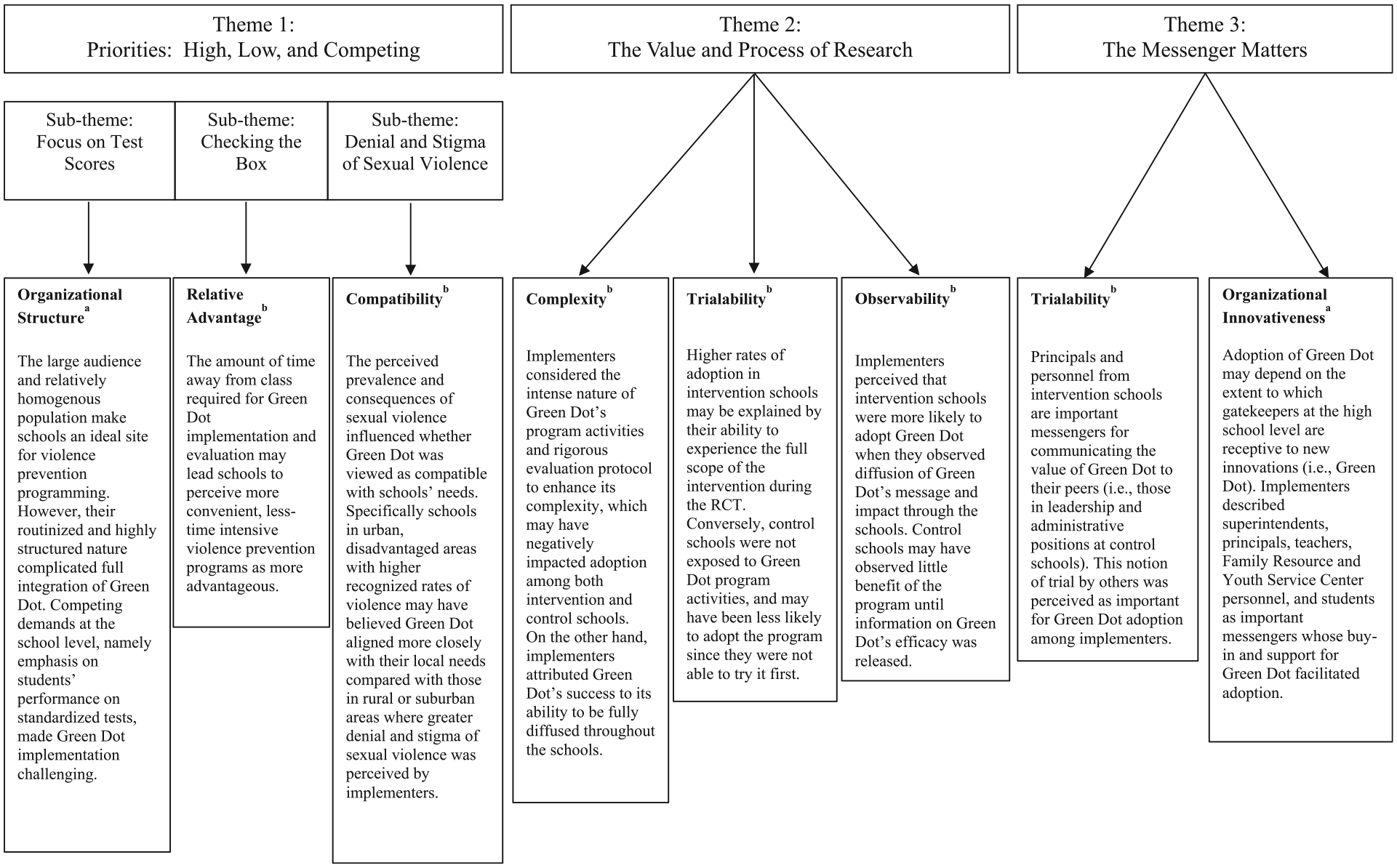
Themes and subthemes from interviews with Green Dot implementers mapped onto organizational adoption and diffusion of innovation theory constructs influencing adoption.
Beginning with Organizational Adoption theory, no clear patterns emerged throughout the interviews regarding school size and willingness to adopt, but school structure appeared to affect adoption. The ability to reach a large base of students makes high schools popular, efficient sites for prevention programming, yet their routinized and highly structured nature makes integration difficult (Fagan & Mihalic, 2003). Work by Fagan and Mihalic (2003) highlights challenges inherent in introducing violence prevention programs into school settings; they report schools’ increasing reluctance to adopt some prevention programs because they take time away from academics and preparation for standardized tests. As described in the subtheme of “Focus on Test Scores” within the main theme of “Priorities,” implementers echoed these concerns and cited time out of class for Green Dot delivery and data collection as barriers to adoption. Schools that had more success integrating Green Dot and/or survey activities into their infrastructure appeared to view Green Dot more favorably and may have been more likely to adopt. Similarly, organizations’ innovativeness—or the degree to which they are receptive to new innovations—is positively correlated with program adoption. As reported in the theme, “The Messenger Matters,” implementers spoke strongly about the need to build and foster relationships to facilitate schools’ “buy in” and receptiveness toward Green Dot. Previous research on program adoption in school settings has shown upper-level administrators (i.e., superintendents and principals) are ultimately responsible for adoption decisions, but support from teachers and other mid-level school personnel can influence senior-level decision-making (Fagan & Mihalic, 2003). Implementers discussed how intraorganizational support via Family Resource and Youth Service Center personnel, teachers, and students facilitated adoption. Rogers (2002) has stressed the importance of using champions, usually mid-level officials in an organization, for the promotion of preventive innovations. However, our findings also support previous research demonstrating that school-based violence prevention programs are not likely to be adopted if the principal is not supportive, even in the presence of a strong champion (Fagan & Mihalic, 2003).
Perceived characteristics of the innovation itself (i.e., Green Dot) are also likely related to adoption. According to Diffusion of Innovation Theory, an innovation’s relative advantage, compatibility, complexity, trialability, and observability may affect adoption (Rogers, 2002, 2003). Relative advantage refers to the extent that one innovation is superior to other options and is the most important predictor of innovation adoption. The time between program delivery and ability to detect meaningful differences in behavior change after prevention programs are implemented can be quite long, often resulting in low relative advantage and slower adoption rates (Rogers, 2002). Implementers reported substantial variation in schools’ perceptions of the relative advantage of Green Dot. For example, within the theme of “Priorities,” many noted schools’ prioritization of class time and standardized testing over violence prevention activities. As such, principals and teachers may have perceived more convenient, less time-intensive violence prevention programs as advantageous, which relates to the subtheme of “Checking the Box.”
Implementers also described Green Dot’s compatibility—or the degree to which the program was perceived as aligning with needs and values of high schools—as a salient factor in adoption decisions. The subtheme, “Denial and Stigma of Sexual Violence” illustrates how Green Dot’s message may have been incompatible in schools and communities that failed to acknowledge sexual violence as a problem. Schools in urban, disadvantaged areas appeared more likely to believe Green Dot fit with their local needs compared with those in rural or suburban areas where discussion of the magnitude of violence was less prevalent. Some schools that perceived Green Dot was compatible with their needs were taken over by the state for low academic performance, preventing adoption in some cases. This scenario underscores the importance of examining environmental factors and other negative externalities as potential mediators of program adoption (Frambach & Schillewaert, 2002). Implementers recommended emphasizing connections between academic achievement and violence prevention to increase Green Dot’s perceived compatibility with schools’ priorities.
In some cases, Green Dot’s complexity—or perceived difficulty to understand or use—may have been a barrier to adoption, especially in control schools. As described within the theme, “The Value and Process of Research,” implementers referred to program activities, including speeches, trainings, and selection of popular opinion leaders, as “a lot of work” and expressed that the rigorous survey procedures compounded Green Dot’s complexity. For some control schools, surveys became synonymous with Green Dot, resulting in nonadoption due to survey fatigue in more than one instance. Communicating to participants and adopters involved in research trials with wait-list controlled conditions about which activities represent research and those that are fundamental to the intervention is critical, as schools are more likely to adopt new programs that are well specified (Rohrbach, Ringwait, Ennett, & Vincus, 2005).
The extent to which end users are able to pilot test an intervention (i.e., trialability) also predicts adoption. Echoed in discussions included within the theme “The Value and Process of Research,” schools in the intervention arm of the trial had the unique opportunity to experience the full scope of Green Dot before deciding to adopt, which may have accounted for higher rates of adoption in intervention versus control schools. Trials of innovations by others, wherein peers try an innovation and then recommend it to others, can be effective in enhancing adoption, especially if the peer is a popular opinion leader (Rogers, 2002; Rohrbach et al., 2005). Implementers brought forth this notion of trial by others when discussing that principals in intervention schools might be able to influence other schools to adopt the program by “put[ting] in a good word,” which was included in the theme, “The Messenger Matters.”
Finally, the observability of positive benefits as a result of using an innovation affects adoption. Within the theme, “The Value and Process of Research,” most implementers mentioned the nature of the research process as a potential barrier to adoption. They also recognized that data on the program’s efficacy would be critical for subsequent adoption. Rohrbach and colleagues (2005) found that research on effectiveness was the only significant program-related correlate of adoption of an evidence-based high school substance use prevention curricula. Therefore, emphasizing Green Dot’s efficacy can potentially increase adoption by influencing the program’s observability. Strategic dissemination of the trial’s results may also affect relative advantage, as few sexual violence prevention programs have demonstrated efficacy in reducing violence in RCTs (DeGue et al., 2014). For intervention schools, Green Dot’s observability was not only visible after the trial—implementers described the process through which program adoption was enhanced by Green Dot’s noticeable diffusion throughout the schools during implementation. Intervention schools were continually exposed to Green Dot activities, marketing materials, and positive word of mouth about the program, but because control schools were purposefully blinded to all program elements, they perceived little benefit until the end of the trial when findings on Green Dot’s efficacy were released.
It is important to note that the aforementioned perceived characteristics of the innovation (e.g., relative advantage, trialability, observability, etc.) are likely different for end users participating in research trials compared with those approached to adopt once program efficacy has been established. As reflected in Table 1, the majority of intervention schools chose to adopt Green Dot while most control schools declined. Program implementers in this study attributed those decisions, at least in part, to schools’ participation in the research trial and described how attitudes toward the program differed between intervention and control schools. It is unknown whether school staff and administrators, such as principals (who hold the ultimate decision-making authority), agree with implementers’ perspectives regarding the role of research in influencing adoption decisions; however, others have noted that efficacy trials with higher levels of researcher-imposed structure, including routine fidelity assessments and ongoing data collection activities, may be perceived as burdensome for some high schools (C. P. Bradshaw, 2015; Flay, 1986). Nevertheless, the information provided in this article is unique, as most schools approached to adopt Green Dot or other programs do not have research experience prior to being offered programming. Thus, for both control schools and new schools being approached to consider adoption, trial by others, including program champions and popular opinion leaders, might positively impact the observability of Green Dot’s advantage.
Linkage systems responsible for connecting end users with the program to be adopted (also known as “suppliers”) also play a significant role in adoption decisions (Frambach & Schillewaert, 2002). Implementers highlighted the importance of their roles as messengers and using persuasive communication to attain buy-in, cultivate relationships, and encourage adoption. Unlike some prevention curricula that use teachers to deliver program content, the Green Dot linking agents (i.e., Rape Crisis Centers and implementers) were also responsible for intervention delivery and played a pivotal role in influencing subsequent program adoption. Green Dot implementers are also unique in that they have dual training and expertise in both violence prevention and intervention. Free access to prevention specialists with clinical training in violence intervention and follow-up care is an incentive for high schools considering Green Dot adoption that should be emphasized in program marketing efforts.
Limitations
These findings should be interpreted within the context of this study’s strengths and limitations. Most studies on this topic are quantitative and aim to identify variables that best predict adoption of innovations. Qualitative methods allow for a more nuanced exploration into the various contextual factors surrounding a specific phenomenon and can provide a foundation for future studies to better operationalize determinants of adoption in this field. Several steps were taken to ensure trustworthiness of our findings, including performing member checks, memoing, maintaining an audit trail, and using two, independent coders (Shenton, 2004). These methods enhance this study’s methodological rigor and increase the likelihood that a credible understanding of the issues has been gleaned from the data. The purpose of qualitative research is not to generalize findings but to provide an interpretation of events; still, the findings reported here are from the viewpoint of a small sample of implementers and are not intended to be generalizable to all Green Dot implementers. Sandelowski (1995) notes that a sample size of 10 is often adequate to achieve saturation (i.e., where no new information emerges with additional interviews) in small studies. While we are confident that the themes reported here reached saturation, we did not achieve enough variability in implementers’ experiences with schools to stratify our results based on schools’ adoption decisions. Most consenting implementers worked with intervention schools that chose to adopt Green Dot and control schools that declined. Additional interviews with implementers who worked with control schools choosing adoption and intervention schools that declined may yield similar or disparate findings. Furthermore, there are several other voices missing in this study and lack of triangulation of data sources is a noted limitation. All implementers interviewed were still involved in Green Dot implementation at the time of data collection. Attempts were made to reach former implementers, as they might offer different perspectives, but none were included in the final sample. Principals, who emerged as the ultimate decision-makers regarding adoption, are also not included in this study, nor are the viewpoints of school staff, teachers, or students as this data collection was beyond the scope of the current research. Thus, it should be noted that the barriers and facilitators to Green Dot adoption reported here are filtered through implementers’ unique perspectives and they are subject to their own biases and subjective interpretations. Further triangulation of perspectives from other key stakeholders is necessary to ensure a more comprehensive understanding of factors related to Green Dot adoption.
Implications
This study has important implications for researchers, practitioners, and school administrators. It should be noted that unlike college settings, there is no requirement that high schools provide violence prevention programming or information to students. Thus, to maximize effective translation of evidence-based prevention programming, researchers must consider the full continuum of program institutionalization, from adoption to maintenance. Findings from this study indicate that key stakeholders (i.e., researchers, implementers, community members, and high school personnel) should work together to determine school readiness to adopt programs as well as their capacity to implement program components with fidelity and continue over time. To this end, quantitative assessments could be carried out with school administrators to assess schools’ prioritization of violence prevention, which may predict successful adoption, implementation, and/or maintenance. In addition, it is clear that intervention implementers and practitioners must cultivate buy-in and build relationships with schools for adoption and successful program implementation. Green Dot uses the popular opinion leader approach to diffuse a message of nonviolence throughout a given community; this approach may also be effective for leveraging buy-in: Researchers and practitioners can work as advocates on behalf of the program to identify local champions within schools or communities to help make key connections, build relationships, and spread the word about program effectiveness. Finally, while rigorous research design cannot be compromised for the sake of reducing the burden of data collection on participants, it is important to acknowledge that schools or sites that are part of the control arm in research studies may need different or bolstered approaches to gaining buy-in post-research and prior to program uptake and continuation. Again, the popular opinion leader approach may be useful, as implementers in our study recommended that principals of schools that received Green Dot reach out to those in the control condition to discuss the program’s positive impacts and encourage adoption.
Conclusion
Data from this study provide new insights into adopters’ perspectives of program importance and feasibility when two significant barriers to program adoption—cost and evidence of intervention effectiveness—were eliminated. This post-evaluation research can assist program marketing efforts in concert with delivering evidence about program efficacy. Future studies should work to identify methods to increase adoption and implementation of Green Dot and facilitate the development and testing of strategies for targeted dissemination of this and other bystander programs for violence.
Footnotes
Declaration of Conflicting Interests
The author(s) declared no potential conflicts of interest with respect to the research, authorship, and/or publication of this article.
Funding
The author(s) disclosed receipt of the following financial support for the research, authorship, and/or publication of this article: Research reported in this publication was supported by the National Institute of General Medical Sciences of the National Institutes of Health under Award Number 5U54GM104942-04. The content is solely the responsibility of the authors and does not necessarily represent the official views of the National Institutes of Health.
