







Abstract
This study analyzes whether the degree of right-wing authoritarianism and social dominance orientation influence the blame placed on a woman who is the victim of an acquaintance rape. The participants read a rape scenario and responded to three questionnaires about the blame of the victim, right-wing authoritarianism, and social dominance. The results show that greater blame was attributed to the victim when the participants scored high in right-wing authoritarianism or social dominance. They also reveal an interaction between both variables: participants who scored high in both right-wing authoritarianism and social dominance attributed the greatest blame to the victim.
Introduction
The concept of political ideology constitutes an important area of research within social psychology and political psychology (Jost et al., 2009). This construct serves as a variable in predicting attitudes and behaviors related to diverse social issues, among which stand out the expression of different forms of prejudice (Duckitt & Sibley, 2007). Traditionally, based on Adorno et al. (1950), it was argued that individuals have social and political beliefs and attitudes that are highly correlated and that can be seen as a single dimension with extremes on the left and on the right. The left is associated with the search for equality and the fostering of social changes, while the right is associated with defending inequality and traditionalism (Bobbio, 1996). However, certain researchers suggest that this “left-right” continuum is inadequate for describing the nature of political ideologies (Feldman & Johnstone, 2014). There is significant theoretical and empirical evidence of the multidimensionality of political ideology. Duckitt’s (2001) dual process model of ideology and prejudice utilizes the concept of right-wing authoritarianism (RWA) proposed by Altemeyer (1981, 1988), and the concept of social dominance orientation (SDO) proposed by Pratto et al. (1994), as ideological variables that underpin political ideology.
RWA and SDO
From a psychosocial perspective, RWA is not perceived so much as a stable characteristic of personality (Hodson & Dhont, 2016), but as an ideological variable sensitive to context and factors such as social identity (Stellmacher & Petzel, 2005) and values (Feldman, 2003). RWA is an ideological dimension that primarily expresses a social conservatism (Jost et al., 2009). RWA defends the need to maintain social traditions. This need is expressed in both the acceptance of and submission to those institutions or persons who are considered to be established authorities, and the rejection of groups that violate traditional values (Altemeyer, 2004; Kreindler, 2005). Altemeyer (1981) defined RWA as a construct composed of three attitudinal elements: (a) submission to authority, which refers to a high degree of submission to and acceptance of the statements and actions of authorities, which are perceived as fully legitimate in society; (b) conventionalism, which is a high level of adhesion to the traditional values and norms approved by society and its legitimate authorities; and (c) authoritarian aggression, defined as hostility or a violent predisposition toward those who are different, toward those who violate social norms, and toward those who are perceived to be sanctioned by legitimate authorities. Various studies have found a high correlation between the RWA scale developed by Altemeyer (1998) and prejudice, discrimination, and hostility toward different out-groups (Duckitt & Sibley, 2010). Persons high in RWA are prejudiced against groups that are perceived as threatening social order, stability, and security (Duriez & Van Hiel, 2002). Research in this area (e.g., Altemeyer, 1998; Whitley, 1999) suggests that RWA tends to be closely related to attitudes of homophobia, religious ethnocentrism, and benevolent sexism. Individuals who score high on RWA have attitudes in defense of traditional social roles and socially accepted customs and support right-wing political parties that emphasize law and order and defend religious and traditional values (Duckitt, 2001). These persons are sensitive to threats to security and reject those groups that appear to challenge the social order (Duckitt & Sibley, 2007).
Regarding the relationship between RWA and the transgression of norms, it has been found that the authoritarian desire for social control is a consequence of the fear of social disorder. Persons with a marked tendency toward RWA are particularly concerned about the harm that individuals and groups that deviate from the norms and values of the in-group can cause (Kreindler, 2005). In addition, Kreindler (2005) has shown that individuals who strongly identify with the in-group believe that adherence to norms is very important and will sanction those who place the conservation of those norms in danger. High scores in RWA reflect a desire for the establishment and maintenance of order, control, and social stability, and for the traditional values of the society or group to which the individual belongs. Right-wing authoritarians express prejudices toward groups that are perceived to be culturally different and socially threatening (Altemeyer, 1998; Lippa & Arad, 1999).
SDO refers to the degree to which an individual is in favor of unequal, hierarchical intergroup relations, oriented toward the dominance of one of society’s social groups, establishing the basis for the formation of prejudices and conservatism (Pratto et al., 1994). SDO is defined as an ideological dimension that produces a general attitude or orientation toward intergroup relations, whereby participants who obtain high scores in SDO tend to defend and maintain policies that reinforce the hierarchies and asymmetries of power between groups and individuals, and prefer the superiority and control of their in-group over different out-groups (Sidanius & Pratto, 1999). In accordance with the theory of social dominance, Sidanius and Pratto (1999) maintain that the different forms of oppression based on groups (e.g., racism, ethnocentrism, classism, sexism) are specific cases of a more general tendency of human beings to form and maintain hierarchies on the basis of groups. SDO reflects the tendency of individuals to classify social groups along a superiority–inferiority dimension and to favor policies that maintain social inequality. SDO is an individual variable that focuses on a general tendency in favor of myths and stories that legitimize the expansion of the hierarchy and support group inequalities in opposition to egalitarian postulates. Studies carried out in this field have found positive correlations between SDO and conservative beliefs, such as ethnic prejudices, economic and political conservatism, and a preference for right-wing parties (Pratto et al., 1994; Sidanius et al., 1996). The desire to maintain the superior position of the in-group on the part of individuals who score high in SDO leads them to denigrate, in particular, members of the out-group who support equal rights (e.g., feminists, organized ethnic minorities, groups that defend homosexuals) to reinforce their own status. Stereotypes play the role of legitimizing myths that people high in SDO use as a means for justifying their negative attitudes (Sidanius & Pratto, 1999). Research in this area (e.g., Altemeyer, 1998; Whitley, 1999) suggests that SDO tends to be closely related to racism and hostile forms of sexism, as well as to perceptions of intergroup competition and the need for superiority.
Relationship Between RWA and SDO
Numerous studies have examined the relationship between RWA and SDO (Duriez et al., 2005; Passini, 2008; Whitley, 1999). Some have concluded that RWA and SDO are relative independent predictors of prejudice (Altemeyer, 1996; Duriez & Van Hiel, 2002). These studies have demonstrated the existence of an authoritarianism-based prejudice, conceptualized as an uncritical acceptance of prejudicial statements by authorities toward specific out-groups, and a dominance-oriented prejudice conceptualized as hierarchical intergroup relations. RWA focuses on submission to in-group authority figures independent of whether they advocate intergroup dominance; however, SDO focuses on domination over out-groups regardless of what authority figures think. Importantly, RWA and SDO are complementary predictors of prejudice and together they explain 50% of variance in prejudice (Hodson & Dhont, 2016).
Other studies have demonstrated that RWA and SDO are differently related to values (Duckitt, 2001; Duriez et al., 2005). According to Schwartz’s theory of values (Schwartz, 1992), RWA is negatively associated with hedonism, stimulation, and self-direction, and positively associated with traditions, conformity, and security. SDO is negatively associated with universalism, benevolence, and tradition, and positively associated with power, achievement, hedonism, and stimulation. According to Duckitt (2001), these differences between RWA and SDO in terms of values confirm the existence of two types of prejudice: one type of prejudice based on authoritarianism (driven by fear and the feeling of being threatened, obeying the authorities of the in-group), and one type based on social dominance (driven by the struggle for power and domination). This distinction supports the idea of Lippa and Arad (1999) that authoritarianism is related to the preservation of in-group norms, whereas SDO presents a route to superiority and power. As Whitley (1999) holds, “authoritarianism is an intragroup phenomenon, whereas SDO is an intergroup phenomenon” (p. 127).
The relationship between RWA and SDO is sensitive to cultural differences (Duriez et al., 2005; Passini, 2008). In countries where strong ideological contrasts exist (e.g., Great Britain and Spain), ideology tends to be organized on a left-right continuum. In these countries, individuals who place themselves on the left score low on RWA and SDO, while those who define themselves as on the right score high on RWA and SDO. In contrast, in countries with less ideological contrast (e.g., the United States and Poland), RWA and SDO scores are often independent of each other (Duckitt, 2001).
Recently, Altemeyer (2004) found that people who score high on both RWA and SDO are in fact the most prejudiced in a society. Altemeyer (2004) reported that “Double Highs” (those people who scored in the top quartile on both RWA and SDO) tended to score more highly on measures of prejudice than people who scored high solely on either RWA or SDO. These persons are submissive to traditional authority and conservative, but they also support hostile postures toward out-groups, justifying this hostility by sustaining a favorable orientation to intergroup hierarchical relations. Passini (2008, 2015) maintains that these individuals defend an authoritarian aggressiveness, in opposition to authoritarian submissiveness. Individuals with authoritarian submissiveness tend to be traditionalist, conservative, and religious. They protect themselves from risk and threat and tend not to be dominant. In contrast, individuals with authoritarian aggressiveness attitudes “are not only submissive to authority, but also support hostility toward other groups. They tend to have a high SDO, and their negative attitudes towards other groups are justified by an orientation supportive of hierarchical groups relations” (Passini, 2008; p. 53). Van Hiel and Mervielde (2002) showed that people high in SDO tended to score high on those RWA items more related to authoritarian aggression, while they scored low on RWA items referring to authoritarian submission and conventionalism. The multidimensional structure of authoritarianism (authoritarian submission, authoritarian aggression, and conventionalism) can imply that authoritarian individuals vary in their degree of acceptance of these related attitudes and that there are differences between them.
RWA, SDO, and Perception of Rape
As Süssenbach et al. (2017) state, “a plethora of research has demonstrated that humans actively interpret their reality in accordance with their attitudes, world views, and their cultural background” (p. 2324). Different research has analyzed the relationship between certain ideological variables and perception of rape (Anderson et al., 1997; Aosved & Long, 2006; Ferrão & Gonçalves, 2015). Specifically, several studies have focused on the relationship between rape myth acceptance (RMA) and RWA (Gerger et al., 2007; Hockett et al., 2009) and obtained average correlations between RMA and RWA (Canto et al., 2014; Süssenbach & Bohner, 2011). Bohner et al. (1998) defined rape myths as descriptive or prescriptive beliefs about rape (its causes, context, consequences, aggressors, victims, and their interaction) which serve to negate, trivialize, or justify sexual violence exercised by men against women. These stereotypical beliefs about rape, the victims, and the aggressors, sustained in gender stereotypes (Peterson & Muehlenhard, 2004), make raped women feel they are discriminated against, and as such, doubly blamed. According to Lonsway and Fitzgerard (1994), the most common myths about rape include the belief that women commonly lie about rape and the belief that only certain types of women are raped, who, in the latter case, are held responsible for being raped. Consequently, this latter myth has different functions for men and women (Payne et al., 1999): Men tend to use it to justify or minimize their responsibility in the sexual aggressions they commit, and women tend to use it to deny their own vulnerability. In general, individuals who have high levels of RMA are more likely to attribute blame and responsibility to a victim, grant higher credibility to a perpetrator, and perceive lower responsibility for that perpetrator.
Attitudes toward rape are closely linked to gender stereotypes, especially to those aspects that are related to the sexual behavior of women and men (Burt, 1980). Thus, women are stigmatized for openly engaging in sexual practices, while men are valued for engaging in such conduct (Milhaussen & Herold, 1999). These gender stereotypes regard women as sexual objects whose function is to satisfy the sexual needs of men (Brownmiller, 1975). This justifies sexual assault against women if they do not consent to sexual intercourse when the man considers it appropriate.
Theoretically, right-wing authoritarianism is related to RWA through conventionalism, as women who transgress traditional gender roles, highly valued by authoritarian individuals, become acceptable targets for punishment, that is, for authoritarian aggression aimed at their nonconformity (Süssenbach & Bohner, 2011). Thus, right-wing authoritarians to a great extent blame women who are raped by an acquaintance with whom they had previously flirted because these women break with the demands rooted in the traditional feminine gender role that urges them to be chaste and sexually inhibited.
Different studies have found a relationship between RMA and SDO (Hockett et al., 2009; Süssenbach & Bohner, 2011). Studies that have analyzed the relationship between SDO and RMA have shown a medium to high connection between these variables (e.g., Gerger et al., 2007; Hockett et al., 2009). In accordance with a feminist perspective on rape, Süssenbach and Bohner (2011) argue that these data support the assumption “that rape and rape myths are a form of male dominance aimed at maintaining existing power hierarchies in which men dominate over women” (p. 376). In agreement with this, it is to be expected that individuals who score high in SDO more often blame women who are raped after flirting with the aggressor, as this behavior implies that these women have not upheld the traditional gender stereotype and have not accepted the behavioral norms stemming from the situation of domination that women suffer in their relations with men.
In a recent study carried out by Canto et al. (2018), participants with higher RWA and SDO scores blamed the woman who was a victim of acquaintance rape more. But there was no effect from the interaction between RWA and SDO on the blaming the victim variable, so the effect of RWA on victim blaming (VB) was not modified by SDO. In the study, no significant correlation between RWA and SDO (r = .016) was found. Other studies have concluded that there is variability in the possible relations between these two variables in function of a series of cultural variables (Duriez et al., 2005; Passini, 2008; Whitley, 1999). It is to be expected that individuals who score high on scales measuring RWA and SDO, that is, individuals who can be categorized as favorable to an authoritarianism of an aggressive character (Passini, 2008), are more likely to blame a woman who is a victim of acquaintance rape. In other words, individuals who are less supportive of freedom and equality are more hostile toward women who transgress traditional gender stereotypes with sexual behaviors they consider to be inappropriate, that is, that challenge conventional norms and the subordinate status of women in relation to men.
Objectives and Hypotheses
As mentioned, different studies have focused on the influence of ideological variables (RWA and SDO) on RMA. In this study, we want to see whether RWA and SDO influence the degree of guilt assigned to a woman raped by an acquaintance. The objectives are as follows: (a) examine whether the degree of RWA and SDO influences the blaming of the victim in a rape scenario, and (b) examine whether the interaction between RWA and SDO influences how much the victim is blamed. The following hypotheses were formulated:
Method
Participants and Procedure
A total of 205 persons (88 men and 117 women) between the ages of 18 and 45 voluntarily participated in this study. The average age was 20.41 (SD = 3.86). The participants were students at the University of Malaga (Spain) in the Faculty of Psychology and Speech Therapy. The questionnaires were answered collectively and anonymously in students’ classes during approximately 20 min. The researchers instructed respondents to respond to all the items individually. Respondents were informed that their answers would be anonymous and that there would be absolute confidentiality in the treatment of their data. At the end of the questionnaires, participants read a statement explaining the goals of the study and they also had the opportunity to request an additional oral explanation.
Measures and Rape Scenario by an Acquaintance
Participants read a scenario detailing an acquaintance rape and completed the questionnaires in the following order.
Acquaintance rape scenario
We used a brief vignette developed for this research. Participants were informed of a news story regarding a rape that had been published in the online version of a national newspaper: The incident took place in a city on the east coast. A.R.P., a resident of the village Altea, went to a discotheque with some friends. There she met E.L.P. He worked some weekends in public relations at the discotheque. At the venue, they were becoming close, kissing and having drinks over several hours. At 5 o’clock in the morning, A.R.P. told her friends she was going home and that E.L.P. was giving her a ride. On the way to her house, E.L.P. took a detour and began to kiss her. After a few moments, A.R.P. asked him to stop and to take her home. At that moment, E.L.P. took her by force and obligated her to have sexual relations with him. That same night, A.R.P. reported what had happened to the police.
VB Questionnaire
In line with the study by Calhoun and Townsley (1991), the participants had to respond to three issues regarding the victim: (a) evaluate how much responsibility could be assigned to the woman for what had happened, (b) evaluate how guilty the woman was for what had happened, and (c) evaluate the extent to which the woman had provoked the incident. The assignment of blame presupposed a judgment of responsibility, which, in turn, presupposed an attribution of cause. Each question was answered using a 7-point Likert-type scale (where 1 = not at all and 7 = totally). Higher scores indicate higher levels of VB. A global VB score was obtained from the mean of these three items. A Cronbach’s alpha of .94 was obtained.
Questionnaire regarding RWA
The questionnaire used to measure RWA was the Spanish version by Núñez-Alarcón et al. (2011) of the one developed by Manganelli-Rattazzi et al. (2007). This questionnaire consists of a reduced version of the RWA scale (Altemeyer, 1998). It is composed of 14 items with a Likert-type scale format (1 = strongly disagree; 7 = strongly agree). Higher scores indicate higher levels of RWA. A Cronbach’s alpha of .90 was obtained.
Questionnaire regarding SDO
To measure SDO, the Spanish version (Silva-Ferrero & Bustillos, 2007) of the scale developed by Pratto et al. (1994) was used. This scale consists of 16 items with a Likert response scale (1 = strongly disagree; 7 = strongly agree). Higher scores indicate higher levels of SDO. A Cronbach’s alpha of .87 was obtained.
Sociodemographic data
The participants were asked to indicate their gender, age, and the degree for which they were studying.
Results
SPSS (version 21.0) was used to carry out the statistical analysis. To examine the differences based on the gender of the participants on VB, RWA, and SDO, we carried out a Student’s t test. To examine the impact of RWA and SDO on VB, we carried out a multiple regression analysis.
Addressing the scores obtained based on gender, the results of the t test do not show significant differences in VB (Mmen = 1.73; SD = 0.80; Mwomen = 1.50; SD = 0.86; t = 1.53; p =.126), or in RWA (Mmen = 2.39; SD = 0.90; Mwomen = 2.52; SD = 0.71; t = −1.00; p =.314). However, significant differences in SDO were obtained: men (M = 2.56; SD = 0.82) scored higher than women (M = 2.14; SD = 0.67; t = 3.32; p =.001; r = .21). VB correlated positively with RWA (r = .43; p =.01) and with SDO (r = .42; p = .01). A positive correlation was obtained between RWA and SDO as well (r = .46; p = .01).
Regarding the multiple regression analysis (Table 1), RWA and SDO were used as predictor variables and VB (R2c = .267; F(2, 203) = 34.16, p = .001) as the criterion variable. Preliminary analyses indicated that the predictor variables lacked multicollinearity. Variance inflation factor (VIF) value was 1.38. We entered RWA and SDO in Step 1, and the interaction between RWA and SDO in Step 2. We found two significant main effects on VB. Participants blamed the victim more if they (a) were high (rather than low) in RWA, β = .31, t = 4.65, p = .001, and (b) high (rather than low) in SDO, β = .21, t = 3.03, p = .003. There was an interaction between RWA and SDO, β = .17, t = 2.64, p = .009. To understand the RWA × SDO interaction, we followed the process suggested by Aiken and West (1991). Test of simple slopes revealed that the SDO of the participants predicted VB when they scored high in RWA (+1SD), β = .50, t = 5.33, p = .001, but not when they scored low in RWA (−1SD), β = .15, t = 1.15, p = .142. In other words, when participants accepted the postulates of SDO to a greater degree, they blamed the victim more only when they also scored high on RWA (Figure 1).
Multiple Regression Analysis of Blaming of Victim.
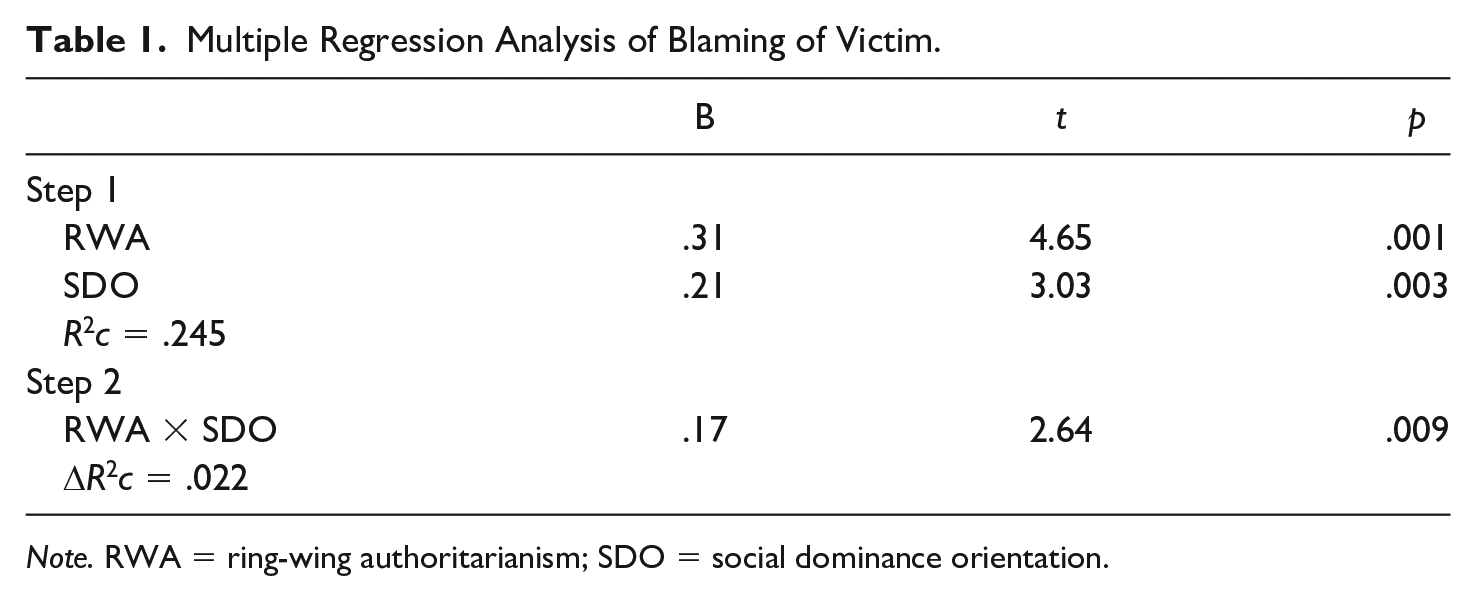
Note. RWA = ring-wing authoritarianism; SDO = social dominance orientation.
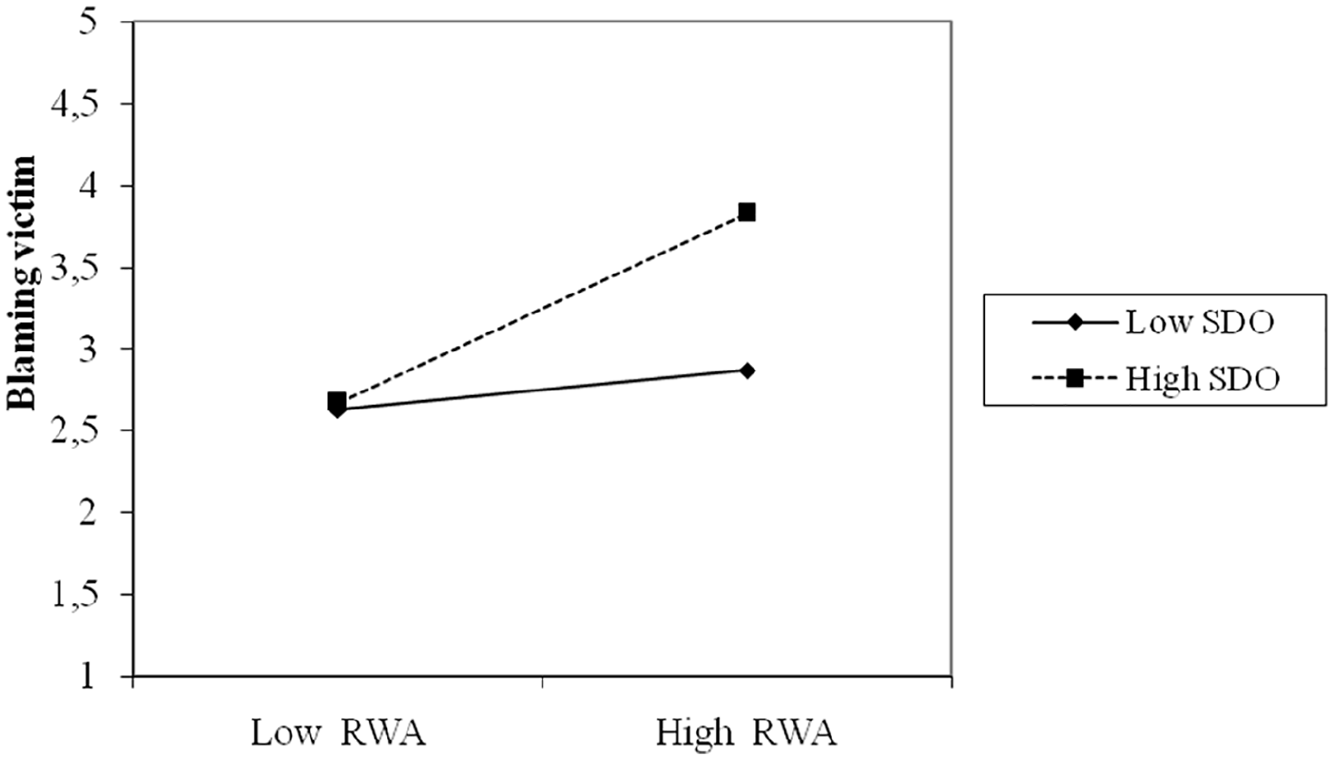
Interaction between RWA and SDO on blaming of victim.
Discussion
The aim of this research was to examine whether blaming a female victim of rape depended on ideological variables (RWA and SDO) and on the interaction between them. The results confirmed our hypotheses. The participants with higher scores in RWA or SDO attributed greater blame to the woman who was a victim of rape (Hypothesis 1 and Hypothesis 2), and the participants with higher scores in both RWA and SDO attributed the greatest level of blame to the woman raped (Hypothesis 3).
Previous studies have found that RWA is related to the degree of blame attributed to a woman rape victim. Not only does RWA predict the acceptance of myths about rape (RMA) as an ideological variable that justifies these myths (Canto et al., 2014; Süssenbach & Bohner, 2011), but we also find that in situations of acquaintance rape suffered by women, RWA is a variable that predicts the degree of blame attributed by observers to the woman (Canto et al., 2018). People who accept right-wing authoritarian ideology hold prejudices against out-groups as threats to the established social order and also harbor hostile attitudes toward members of the in-group who fail to uphold the norms and customs of their own group, such as traditional gender roles (Sibley et al., 2007). These individuals perceive the world as a threatening and dangerous place, and they are strongly motivated to see the social order, group cohesion, and security maintained. Therefore, they are prejudiced against groups that are perceived as threatening. This includes realistic threats (e.g., economic decline) as well as symbolic threats to the collective and culture (Stephan & Renfro, 2003). Persons with high scores in RWA prioritize conformity and adherence to the hierarchical structure of the in-group (Altemeyer, 1998). A woman raped after flirting with her aggressor engaged in behavior contrary to the traditional female role; thus, according to authoritarian logic, she is deserving of the received aggression for her nonconformity and unconventional behavior (Süssenbach & Bohner, 2011).
This study also confirms the relationship of SDO with the degree of blame assigned to a woman rape victim, as has been found in other studies (Canto et al., 2018; Gerger et al., 2007; Hockett et al., 2009). SDO reflects competitive-driven motives for dominance, superiority, and power over other groups (Duckitt, 2001, 2006). Persons high in SDO are prejudiced against groups that are perceived as socially subordinate and low in status and power. These groups must be devalued to maintain and justify social hierarchies and intergroup dominance (Sidanius & Pratto, 1999). Groups that challenge social inequalities elicit SDO-motivated prejudice because individuals high in SDO perceive the world as a competitive jungle (Duckitt, 2001). This perception can involve zero-sum beliefs; that is, the belief that the more an out-group obtains, the less that is available for one’s own group (Esses et al., 1998). And as Asbrock et al. (2010) stated, “such directly competing groups also present a (realistic) threat to social order and stability, and in certain cases should therefore also elicit RWA-drive prejudice” (p. 327).
SDO is an ideological variable which reflects acceptance of the superiority of the in-group over other groups (Sidanius & Pratto, 1999). People who accept these beliefs further accept legitimizing myths about the superiority of men over women (e.g., sexism) and, as such, defend sexist attitudes that place women in a subordinate situation (as reflected in the traditional stereotype of the female gender). As Sibley and Overall (2012) assert, high-SDO men (and, to a lesser extent, high-SDO women) dislike women who are seen as directly competing with men for status and power within society. SDO is also related to sexist attitudes, because it portrays women as objects of desire that reflect men’s status and power in relation to other men. A woman who has suffered a rape after first flirting with the aggressor (although she has rejected his sexual advances) should not, according to the logic of SDO, have violated the conduct dictated to her by the traditional stereotype of the female gender, or rejected the sexual advances of the aggressor once relations began. Hence, the participants who score high in SDO blame the victim more in such circumstances.
Our study also shows that the participants who score higher in both RWA and SDO are those who most attribute blame to the victim (Hypothesis 3). When participants score low in RWA, it does not influence the score they obtain in SDO. However, when they score high in RWA, it does impact the score they obtain in SDO. The individuals who score high on both variables perceive the victim as more to blame in the case of acquaintance rape.
In contrast to other studies that did not find a relationship between RWA and SDO (Canto et al., 2018), this study does find a relationship between these two variables. As it is based on a sample of Spanish university students, where a clear ideological organization on a left–right continuum exists (Canto, 2005), this would explain the high correlation found between RWA and SDO. Right-wing individuals obtain high scores in RWA and SDO and left-wing individuals obtain low scores on both variables. Therefore, there will be individuals in the sample with a marked conservative ideology, who perceive the world as a dangerous place in which there is a struggle for power and the maintenance of hierarchy. Individuals who would not only submissively accept the orders of authority, but would also accept to a good degree hostility toward groups considered to be threatening the socially existing status hierarchy (Passini, 2008), could hold prejudices toward specific groups, perceiving them as threats to conventional values (intragroup threat) and as a threat and challenge to existing intergroup hierarchical relations (intergroup threat). Thus, for individuals who score high in RWA and SDO, the unacceptable behavior of a woman, in not following the traditional established gender stereotype regarding the sexual modesty demanded by conventional values, merits punishment. These persons are not only submissive toward authority but also support conduct that is hostile toward a woman who, having flirted with an acquaintance and permitting initial minimal sexual contact, was subsequently raped by that acquaintance. Blaming the rape victim in such a case reflects a prejudice toward women who challenge the status quo and marked aggression as a form of control over them. Prevention programs that have been developed to raise awareness about RMA should attempt to deconstruct the attitudinal and ideological structure that underlies these myths (e.g., sexism, RWA, SDO), giving particular attention to those individuals who defend postulates rooted in RWA and SDO, as they are the ones who most blame women in cases of acquaintance rape.
Limitations and Future Research
It is important to bear in mind that our research sample is composed of young university students and the scores obtained in RWA and SDO have been relatively low. Future research should examine the relationships between the RWA, SDO, and VB variables using a sample not composed of young, middle-class university students, and analyze the arguments used by individuals who score high in RWA and SDO when they interpret the rape suffered by a woman and they place greater blame on her.
In this study, we have related the increase of VB (in subjects who score high in RWA and SDO) with the breach of the traditional female role by the sexual behavior of the victim. Futures studies should compare the degree of VB in two rape scenarios, one where the victim violates the traditional female role with their sexual behavior and another one that does not include that behavior. This would allow analysis of people with high scores in RWA and SDO who blame the victim more regardless of her sexual behavior.
In this study, we have only considered the degree of blame attributed to the victim. Future studies should include whether the acceptance of the postulates of RWA and SDO also impact the guilt of the aggressor. The greater blame attributed to the victim can be accompanied by a greater degree of exoneration of the rapist. The relationship between the two ideological variables (RWA and SDO) with the blame attributed to the aggressor should be considered to determine how both variables are related to the blame attributed to the victim and influence the arguments used by individuals who score high in RWA and SDO to justify the behavior of the aggressor.
We have not found a difference between men and women in RWA and VB, but we have found one in SDO. No effect was found in the interaction between sex and these ideological variables regarding VB. Future studies should analyze if differences exist in the way in which RWA and SDO influence the perception of guilt attributed to the rape victim based on the sex of the participants. Various studies (e.g., Abrams et al., 2003; Viki & Abrams, 2002) have found differences based on gender in the use of sexism for justifying the attribution of guilt to a woman who has been raped. These studies found that the acceptance of benevolent sexism was used by women to justify blaming the rape victim, but men more often used hostile sexism. Future research should examine if women are more likely to use submission to authority based on RWA to justify VB (intragroup conventionalism), while men might be more likely to use SDO (intergroup hostility).
Christopher and Mull (2006) showed the existing relationship between RWA and SDO with the types of sexism proposed by Glick and Fiske (1996). Although RWA predicted benevolent sexism to a greater degree and SDO predicted hostile sexism, it would be necessary to know the type of sexism most adopted by individuals who score high in RWA and SDO in regard to the degree of blame they assign to a woman rape victim. We might expect those individuals to score high on hostile sexism, as the prejudice and hostility aimed at victims of acquaintance rape who have transgressed the traditional gender stereotype would be reflected in a greater degree of blame attributed to the victim and, therefore, meriting the aggression. Future research could analyze if there is some degree of relationship between these types of subjects and the perception of other types of violence against women by their partners or ex-partners.
Conclusion
There is an important line of research that analyzes the ideological variables that influence the perception and interpretation of violence exercised against women in the form of rape (Anderson et al., 1997; Aosved & Long, 2006). Despite the physical and psychological harm produced by rape, there are many women who do not report their rape to authorities for fear of how those in their immediate environment will react, as they fear they may be blamed by their families, friends, and partners. The majority of survivors disclose their assault to at least one person (Ahrens et al., 2007). If women knew they would receive social support, the probability that they would report a rape to the police would increase and their recovery would begin sooner. The reaction of individuals who have knowledge of a rape is an important factor of support for the victim and this reaction depends on how the rape is interpreted. Hence, it would be important to analyze the impact of the contextual factors of the rape (e.g., type of relationship between victim and aggressor), the ideological factors of the observer, and the interaction between both types of factors. In this study, we have shown that a greater degree of blame is attributed to the victim in a case of acquaintance rape by persons who score high in both RWA and SDO, persons who could be referred to, based on Passini (2008), as aggressive authoritarians (in contrast to submissive authoritarians).
RWA and SDO independently encourage prejudice toward certain groups. RWA is sensitive to groups that challenge and threaten the social order, and SDO is sensitive to groups that challenge intergroup hierarchical relations. Persons who score high on both RWA and SDO are the most prejudiced (Altemeyer, 2004) in combining submission (to authority) and domination (toward those who challenge hierarchies) as the foundations of prejudice. These data might be used to develop prevention programs that explain how prejudice toward the female rape victim increases when individuals are extremely conservative, scoring high on both RWA and SDO.
Footnotes
Declaration of Conflicting Interests
The author(s) declared no potential conflicts of interest with respect to the research, authorship, and/or publication of this article.
Funding
The author(s) received no financial support for the research, authorship, and/or publication of this article.
