







Abstract
One of the goals of the Violence Against Women Act (VAWA) was to improve law enforcement responses to sexual and domestic violence by providing funding to expand prevention, enhance investigations, and increase victim services. Since VAWA’s enactment, police responses to these crimes have evolved, including officer responses to victims and offenders, and various agency operations. This article highlights some noteworthy changes in law enforcement related to facilitating victim reporting, enhancing victim advocacy and services, crime reduction and investigative tools, supplementing personnel and training, and encouraging multiagency collaborations as a result of VAWA.
Domestic violence incidents constitute approximately 8% of total calls for service that police agencies receive (Police Executive Research Forum, 2015). However, not all victims report intimate partner violence (IPV) to law enforcement. According to the Bureau of Justice Statistics (Reaves, 2017), nationwide, police are notified in approximately half of nonfatal domestic violence incidents. One of the most common reasons cited for not reporting to the police is that victims view it as a personal matter (Reaves, 2017). This is problematic as without intervention, the violence may continue, and more personal responses, such as a victim leaving the abuser, may even increase the severity of the violence (J. C. Campbell et al., 2003).
Historically, common law provided that “a husband, as master of his household, could subject his wife to corporal punishment or ‘chastisement’ so long as he did not inflict permanent injury upon her” (Siegel, 1996, p. 2117). Consequently, until the 1970s, the American legal system treated domestic violence differently than other assault cases and rarely intervened in cases of martial violence (Siegel, 1996). This legal inaction perpetuated various societal misconceptions about domestic violence, such as the notion that it should remain a family matter, it is precipitated or provoked by the victim, and victims would leave or prosecute their abusers if they wanted the abuse to end (MacManus & Van Hightower, 1989).
The perception that domestic violence is a private situation that should be outside the purview of the criminal justice system influenced how law enforcement historically handled these cases. In this vein, there are three main responses from law enforcement for domestic violence cases: 1) nonintervention, 2) mediation, and 3) arrest. For example, many law enforcement agencies had specific policies that they would not intervene unless a witness specifically saw the assault, while others would not even respond to domestic violence calls for service (Corcoran & Allen, 2005; MacManus & Van Hightower, 1989). Thus, the likelihood of arrest in domestic violence cases was frequently low (Buzawa & Austin, 1993; MacManus & Van Hightower, 1989). As public awareness of the extent and severity of domestic violence increased beginning in the 1970s, law enforcement agencies began implementing mediation policies. However, this response was criticized as it led to a decrease in legally justified arrests (Oppenlander, 1982). Consequently, arrest soon replaced crisis intervention as the preferred response beginning in the 1980s. In 1984, the U.S. Attorney General recommended warrantless arrest as the default response to domestic violence situations, and over the course of the next decade, pro-arrest policies such as preferred arrest, presumption of arrest, and mandatory arrest proliferated among local law enforcement agencies.
Preferred arrest (and presumption of arrest) policies suggest that arrest is the preferred response to domestic violence. If the officer has probable cause, they are encouraged to make an arrest, but they can use their discretion to consider all aspects of the case to determine the most appropriate law enforcement response (Exum et al., 2014). Mandatory arrest policies, on the contrary, remove officer discretion and require the officer to make an arrest as long as they have probable cause (Dugan, 2003). Increased arrest of suspects of domestic violence has been found to reduce repeated violence following police intervention (Sherman, 1992; Sherman & Berk, 1984). Other changes, such as the hearsay exception of “excited utterances,” which allows a victim’s statement in a time of great stress to be admissible at trial, have also provided more resources to prosecute domestic violence offenders (Saltzburg, 2015). Overall, these widespread policy changes were associated with increased police responses and reductions in domestic violence and IPV (Dugan, 2003).
Although there was a general shift into the 1980s and 1990s that increased and standardized police response to domestic violence prior to the passage of the Violence Against Women Act (VAWA) in 1994, there was little coordinated multiagency effort to respond to violence against women, including forms of sexual violence, domestic violence, and stalking (Forde et al., 2002). This lack of a consistent and comprehensive approach made it difficult for local law enforcement to effectively investigate and prevent domestic and sexual violence (Aday, 2015). Accordingly, VAWA aimed to improve law enforcement responses to sexual assault and IPV nationwide by “enhanc[ing] investigations and prosecutions of offenders” and “provid[ing] for a number of grant programs to address the issue of violence against women from a variety of angles including law enforcement, public and private entities and service providers, and victims of crime” (Sacco, 2015, p. 2).
The purpose of this article is to examine how VAWA has changed law enforcement responses to violence against women, including domestic violence and sexual assault in three major areas: 1) law enforcement response to victims, 2) law enforcement response to offenders, and 3) law enforcement agency operations. Although there have been limited comprehensive evaluations of VAWA’s effects, this article highlights some of the noteworthy changes in law enforcement related to facilitating victim reporting, enhancing victim advocacy and services, promoting crime reduction and enhanced investigations, supplementing personnel and training, and encouraging multiagency collaborations. We begin with a discussion of VAWA’s effects on law enforcement as a whole.
VAWA Effects on Law Enforcement
Upon its enactment (and subsequent reauthorizations), VAWA sent the message to law enforcement officers and the criminal justice system that domestic and sexual violence is a serious problem in need of urgent national attention (Fine, 1998; Forde et al., 2002). VAWA sought to strengthen criminal justice responses to crimes against women. It has provided discretionary grant funding for law enforcement agencies to respond aggressively to gender-based violence (Forde et al., 2002). This funding has largely been administered by the Office on Violence against Women (OVW) under the U.S. Department of Justice and has focused in three main areas: 1) prevention, 2) investigations and prosecutions, and 3) victim services (OVW, 2020; Sacco, 2015).
Created in 1995, the OVW works to develop the national plan to reduce violence against women and strengthen services for victims of domestic (and dating) violence, sexual assault, and stalking (OVW, 2020). Since 1995, the OVW has awarded more than US$8.1 billion in grants to local, state, and tribal governments; courts; nonprofits; community organizations; schools (including higher education); and state and tribal coalitions. OVW administers this funding through 19 grant programs: four formula programs with requirements specified in the legislation and 15 discretionary programs with parameters, eligibility, and outcomes created by the OVW (2020).
The highest spending program funded by VAWA is through Services, Training, Officers, and Prosecutors (STOP) grants (Aday, 2015). STOP grants require funding to be used by local law enforcement agencies in any the following areas: “training for law enforcement or prosecution; special law enforcement or prosecution units; policy development for law enforcement or prosecution; development of data and communication systems; direct victim services; programs addressing stalking; or grants to [Native American] tribes” (Aron & Newmark, 1999, p. 235; see also Forde et al., 2002; OVW, 2020). These grants aim to improve law enforcement operations in a number of fundamental areas, including providing officer training, updating and improving agency policies, protocols, and services, and/or enhancing data collection systems to more effectively coordinate the response of law enforcement to reduce violence against women (Siskin & Domestic Violence Policy Division, 2001).
Another major funding program that supports law enforcement responses to violence against women is the Arrest Program (Grants to Encourage Arrest Policies and Enforcement of Protection Orders). This program encourages state, local, and tribal governments to prioritize efforts to address violence against women and work with other local stakeholders to develop a community-based response to the problem (Boba & Lilley, 2009; Siskin & Domestic Violence Policy Division, 2001). This can include implementing mandatory or pro-arrest programs for domestic and dating violence, improving training on domestic and dating violence, and strengthening advocacy and service programs for victims of IPV (Siskin & Domestic Violence Policy Division, 2001).
VAWA’s effects are summarized in Table 1 and in the sections that follow and can best be categorized in terms of its effects on 1) law enforcement response to victims, 2) law enforcement response to offenders, and 3) law enforcement agency operations.
Summary of VAWA Effects on Law Enforcement From Pre- to Post-VAWA.
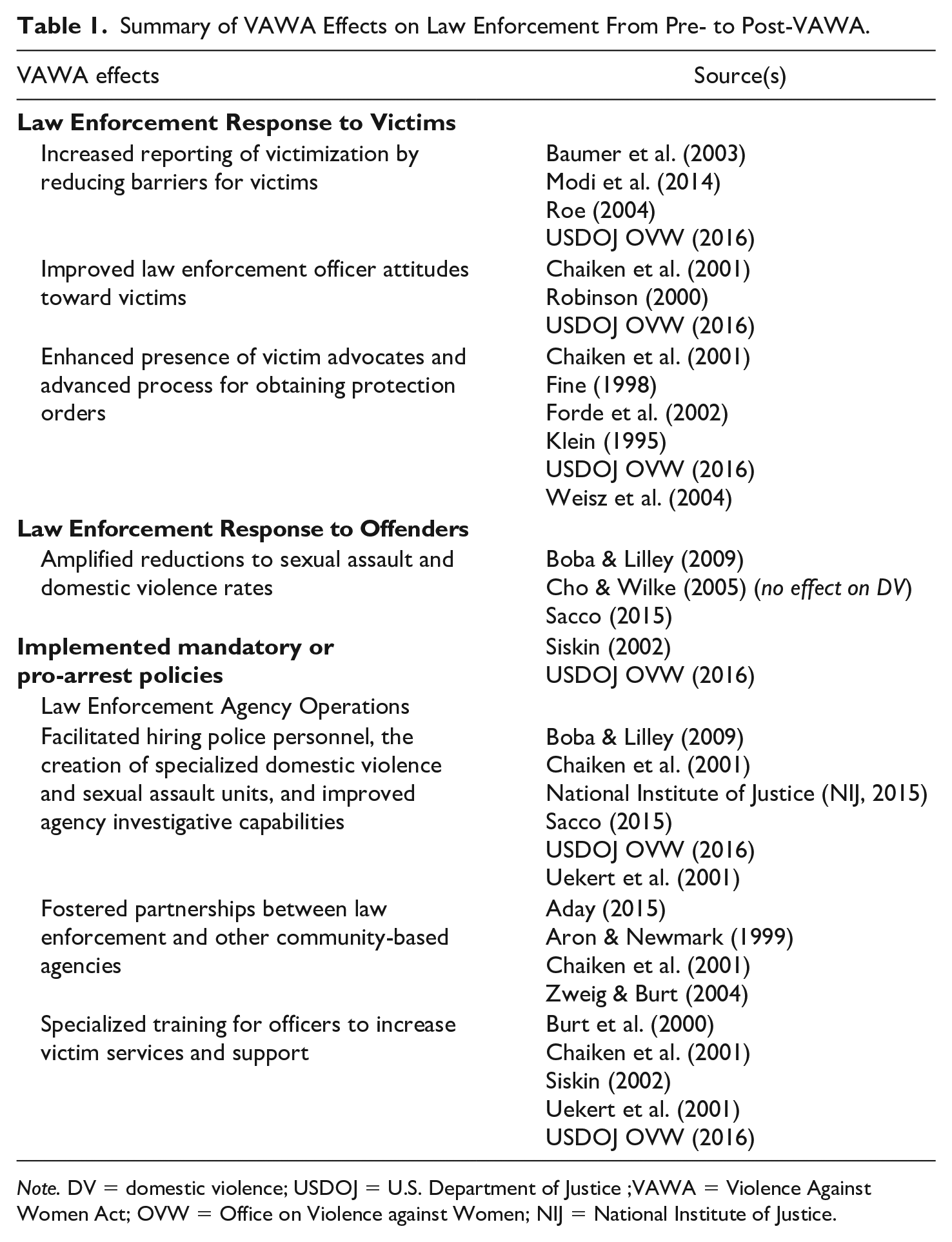
Note. DV = domestic violence; USDOJ = U.S. Department of Justice ;VAWA = Violence Against Women Act; OVW = Office on Violence against Women; NIJ = National Institute of Justice.
Law Enforcement Response to Victims
The majority of gender-based violence is never reported to law enforcement, and as such, most crime data sources, such as the Uniform Crime Report (UCR) and the National Incident-Based Reporting System (NIBRS), severely underestimate the magnitude of the problem (Moore Parmley, 2004; Roe, 2004). This is an area that VAWA aimed to address by encouraging local and state government agencies to remove the barriers that exist for individuals to report their victimization to law enforcement (Roe, 2004). For example, beginning in the mid-1990s, sexual assault reporting to police has accelerated and increased for assaults where the victim knew or was acquainted with the offender (Baumer et al., 2003; Modi et al., 2014). Law enforcement agencies have also enacted several practices to facilitate reporting and provide support for victims of sexual assault and IPV, such as conducting investigations and follow-up investigations in-person, encouraging victim safety, offering shelter planning, providing victims with necessary services, and thoroughly describing protection orders and the process for obtaining them (OVW, 2016).
Other procedural changes to encourage reporting include 1) holding law enforcement agencies responsible for paying for the collection of forensic evidence (such as sexual assault evidence collection kits); 2) prohibiting victims from being charged for filing criminal charges or serving protection orders; 3) allowing victims the right to be heard at pretrial release hearings; 4) implementing mandatory restitution for victims of sexual assault and domestic violence; 5) permitting pretrial detention for federal sexual assault and interstate domestic violence cases; and 6) clarifying that a victim’s sexual history would “generally” not be admissible at trial (Roe, 2004). These legal changes have helped to decrease the stigma of victimization and reduced victim blaming toward sexual assault and domestic violence survivors.
At its inception, VAWA was intended to change public attitudes toward sexual assault and domestic violence victims (Roe, 2004; Sacco, 2015). As a consequence, one important area of law enforcement that has changed is officer attitudes and perceptions of female victims of sexual assault and domestic violence. The OVW (2016) indicated that officers may have perceived intimate partner rape and assault as “not real rape” or the “victim’s fault” (p. 19). Studies have demonstrated, though, that these views can be changed. For example, research shows that officers who were hired prior to VAWA’s passage did change their views on domestic violence. They considered arrests to be an appropriate law enforcement response and no longer viewed domestic violence as a private matter in which police should not get involved (Meyer-Emerick, 2002; Robinson, 2000).
Chaiken and colleagues (2001) reported that actively working with victim service providers allowed first-responding officers to better understand victims of domestic violence. This was especially important in helping officers comprehend why a victim would stay with a perpetrator of domestic violence and why victims may not fully cooperate in police investigations (Chaiken et al., 2001). This attitudinal change persisted even after the officers had discontinued their close working relationship with the community victim service provider (Chaiken et al., 2001).
Because of VAWA, police agencies have hired victim advocates to work within their departments to provide services for victims and coordinate the adjudication process (Chaiken et al., 2001; Weisz et al., 2004). For example, Weisz and colleagues (2004) found that, victims of domestic violence who received advocacy services at a police precinct in Detroit found the services helpful, although they did not feel safer as a result. Interestingly, even in police agencies that do not house victim advocates but rather use them on a referral basis, VAWA grant funding has allowed for better identification of victims, more targeted connections with service-providers, and improvements to the process of obtaining an order of protection (USDOJ OVW, 2016).
Through VAWA, orders of protection granted in one state received full faith and credit, making them enforceable in all other states (Fine, 1998; Forde et al., 2002; Klein, 1995). Computerized databases of these orders of protection became accessible to law enforcement to assist officers in determining the validity of out-of-state orders to ensure they were being properly enforced (Fine, 1998). In addition, VAWA provided dedicated funding to assist specific victim populations, such as female college students, women in rural communities, minorities, and Native American women (Forde et al., 2002; Luna-Firebaugh, 2006). Each of these populations may have unique experiences (e.g., prevalence, lack of services), distinct causes (e.g., historic trauma, poverty, isolation), and may require more specialized assistance from law enforcement (see Jones, 2008; Pruitt, 2008; Sorenson, 1996).
Law Enforcement Response to Offenders
Since the mid-1990s, violence against women, along with violent crime in general, has largely decreased in the United States (Modi et al., 2014; Moore Parmley, 2004). Relatedly, some research has suggested that declines in sexual assaults can be attributed to VAWA. For example, Boba and Lilley (2009) estimated the effects of VAWA funding on rape and aggravated assaults to determine the crime-reduction effects of the legislation. They determined that even when controlling for downward violent crime trends in the 1990s, VAWA grants were associated with reductions in both rape and aggravated assault offending over time (Boba & Lilley, 2009). The specific mechanism, however, such as the removal of potential offenders through mandatory arrest policies, the enhanced training for law enforcement officers, the deterrent effect of increased severity and likelihood of criminal penalties, or improved victim support and follow-through, was not able to be identified as the predominant motivator for this decline (Boba & Lilley, 2009).
From 1993 to 2013, the rate of severe IPV against women also declined by 63% from approximately 5.7 to 2.1 per 1,000 women aged 12 years and older (Sacco, 2015). These crime rate declines may have been influenced by various other factors and thus cannot be fully attributed to VAWA. In fact, Cho and Wilke (2005) reported that the enactment of VAWA did not exert a unique time-lagged effect on reducing domestic violence incidents or increasing domestic violence arrest rates. However, this may be largely attributable to the declines that had already started to take place in domestic violence in the 1970s and the spread of mandatory arrest policies in domestic violence cases originating in the 1980s (Cho & Wilke, 2005).
VAWA funding was also provided to state and local agencies to implement mandatory or pro-arrest policies and improve tracking and data collection for domestic violence (Siskin & Domestic Violence Policy Division, 2001). Although mandatory arrest policies had existed in states prior to the passage of VAWA, the Act specifically encouraged states to adopt pro-arrest policies and allowed for domestic violence cases to proceed even without the cooperation of victims (Siskin & Domestic Violence Policy Division, 2001). And, although prior research has suggested that arrest may have a modest deterrent effect on recidivism (see Maxwell et al., 2002), OVW (2016) reported that mandatory and preferred arrest laws and policies might actually disempower victims by neglecting their best interests and produce disproportionate arrest rates of marginalized populations (see also Roe, 2004).
For example, police departments that do not require officers to determine the primary aggressor can result in officers arresting victims who physically resist or fight back, and increase the likelihood for “dual arrests” where both parties are arrested (Hirschel & Buzawa, 2002; USDOJ OVW, 2016). The deleterious consequences that can result from a victim being labeled and treated as an offender can include loss of employment, loss of child custody, financial hardship, and future unwillingness to report subsequent victimization (Hirschel & Buzawa, 2002). Even more damaging, in states with mandatory arrest laws research shows they have higher rates of female intimate partner homicide, possibly suggesting the potential for more extreme violence when arrest is the likely outcome (Dugan et al., 2003). In addition, in states where mandatory arrest laws are present, research indicates third-party witnesses are less likely to report domestic violence (Dugan, 2003).
Law Enforcement Agency Operations
Beyond the way that officers respond to victims and offenders, VAWA funding has influenced the way law enforcement agencies operate. VAWA grants have enabled law enforcement agencies to hire more personnel, create specialized multiagency task forces, and allocate specific resources to sexual assault and domestic violence cases and their prevention (Chaiken et al., 2001; OVW, 2016). However, there is not an equal distribution of funds dedicated to sexual assault and domestic violence responses. An evaluation of the STOP grant program revealed that funds were disproportionately allocated to address domestic violence compared with sexual assault, and nearly “93% of law enforcement and prosecution STOP projects . . . focused primarily on domestic violence,” while only 7% focused solely on sexual assault (Burt et al., 2001).
VAWA funding has also allowed law enforcement agencies to create specialized units, such as crisis intervention teams, to address IPV and sexual assault. These special units received additional resources to improve the investigation of domestic violence and sexual assault by having dedicated officers to follow-up with victims and build cases against offenders (Uekert et al., 2001). The use of crisis intervention teams has been found to result in a significantly greater number of arrests in family violence cases (Corcoran & Allen, 2005). Victims who interacted with detectives from a specialized domestic violence unit in Wisconsin reported greater satisfaction with the detectives and were more willing to seek assistance from law enforcement officers in future victimizations compared with those served by general law enforcement officers (Uekert et al., 2001). Furthermore, the implementation of a specialized domestic violence unit in Ohio reportedly reduced the number of felony domestic violence cases that prosecutors dropped to misdemeanors, and increased the conviction rates for domestic violence (Uekert et al., 2001).
Subsequent evaluations showed that specialized police unit investigations led to more prosecutions for IPV and domestic violence compared with general law enforcement personnel investigations (Boba & Lilley, 2009). The OVW (2016) cited numerous examples where VAWA funding increased the number of domestic violence cases and trial success rates. Beyond the creation of these specialized units, VAWA funding has also enhanced the investigative capabilities of local law enforcement agencies. Specifically, Sacco (2015) indicated that grants distributed since 2013 have expanded funding to strengthen forensic responses to sexual assault investigations.
VAWA funding facilitated some jurisdictions, such as Wayne County (Detroit), Michigan and Houston, Texas, to analyze thousands of previously unsubmitted sexual assault kits (SAKs) on cold cases (NIJ, 2015; OVW, 2016). Although the researchers did not examine the effects of testing these SAKs on arrests and prosecutions, the funding allowed for important understanding of issues with testing procedures for SAKs and future responses. Using samples of 1,600 previously untested SAKs in Wayne County and 500 previously untested SAKs in Houston over 29 years, researchers examined why these SAKs were not submitted or analyzed (R. Campbell et al., 2015; Wells et al., 2016). Reasons included a lack of protocols for submissions, budget cuts, victim-blaming beliefs by police, turnover in leadership, and a lack of victim advocacy services (R. Campbell et al., 2015; Wells et al., 2016). Furthermore, this research showed that a Combined DNA Index System (CODIS) “hit” was just as likely if the sexual assault was stranger-perpetrated or nonstranger-perpetrated, suggesting that law enforcement should submit all SAKs, even if the suspect is known, due to possible connections to other cases (R. Campbell et al., 2015; NIJ, 2015; Wells et al., 2016).
Another consequential change in the response to violence against women stemming from VAWA involves the increased partnerships and collaborations between law enforcement and social services agencies, victim advocates, the courts, health care agencies, including those providing mental health services, and other community-based agencies (Aday, 2015; Chaiken et al., 2001). Prior to VAWA, communication and collaboration between police and other organizations were hindered due to “different missions, histories, philosophical orientations, and bureaucratic, financial, and legal constraints” (Aron & Newmark, 1999). In a preliminary evaluation of grants in 12 states in 1996, many stakeholders involved in the STOP planning and advising thought that, while challenges remained, VAWA funding had fostered an environment for mutual understanding and inclusivity (Aron & Newmark, 1999). Zweig and Burt (2004) contended that these collaborations facilitate law enforcement responses that are more effective and improve victim services.
A final aspect of law enforcement operations that has changed as a result of VAWA is an unprecedented increase in training of police officers (and other criminal justice officials), which can increase the quality of service that victims and survivors receive (Burt et al., 2000; Forde et al., 2002; Siskin & Domestic Violence Policy Division, 2001). For example, Chaiken and colleagues (2001) reported that VAWA allowed for “cross-training” where advocates and law enforcement officers received training on the same educational materials presented in a collaborative way (p. 19). The training programs often included facilitators from different disciplines and were able to be more innovative in their educational approach (Uekert et al., 2001). OVW (2016) reported that officers who received specialized training on sexual assault and domestic violence were most likely to appropriately arrest perpetrators of these assaults. These operational changes within local police agencies allowed for more resources, better community partnerships, and more focused training to assist in responding to sexual assault and IPV against women.
Final Thoughts and Directions for the Future
The multifaceted approach that VAWA takes in addressing domestic violence and sexual assault is commendable. It recognizes the complexity of addressing gender-based violence and the need for comprehensive approaches that hold offenders accountable and provide services for victims. An integral component of this comprehensive approach involves law enforcement and, since its inception in 1994, VAWA has encouraged an aggressive and victim-centered approach to policing sexual assault and domestic violence. In doing so, VAWA has consistently advocated for a collaborative response involving law enforcement, victim services, local agencies, and researchers. It is the role of law enforcement in these larger collaborative efforts in addressing sexual assault and domestic violence on which we focus our concluding thoughts.
This article summarized the effects of VAWA in changing the way law enforcement responds to violence against women, specifically responses to victims, responses to offenders, and agency operations. Our review suggests that law enforcement agencies have used funds provided by VAWA to support a wide variety of prevention and intervention efforts. These grants have allowed agencies to develop innovative programs, expand their investigatory capabilities through personnel and specialized units, address the unique needs of high-risk and marginalized populations, and integrate trauma-informed approaches to interviewing and investigating. What is evident, however, is that not much is known regarding the effectiveness of these efforts. Methodologically rigorous evaluations, including process and outcome, should become standard practice. Likewise, most grantees are individual agencies and, as such, evaluations of their efforts are isolated to a single city or county. Paralleling the recognized importance of collaborations between law enforcement, local government agencies, and victim service providers within a city/county, multiagency collaborations in the form of evaluations of efforts across jurisdictions are crucial. These programs can be compared in terms of the effectiveness of specific components as well as how the community context impacts both process and outcomes. In doing so, we can begin to understand the impact of VAWA nationwide and develop models of police practices for other agencies to adopt and/or adapt.
The DOJ highlighted the importance of these larger systematic efforts to collect and disseminate data in guidance issued for addressing gender-based violence in 2015. They urge agencies to examine the extent to which domestic violence and sexual assault are underinvestigated, both in comparison to other crimes and for different populations. This is important because despite the accomplishments of VAWA, victims report apprehension in calling the police. Victims’ concerns center on police response: whether police will believe them, treat them with compassion, and hold their offenders accountable (Logan & Valente, 2015). The use and transparency of data can build trust in communities by improving law enforcement response and accountability in addressing sexual assault and domestic violence. The Police Data Initiative is an example of an innovative effort to leverage data to facilitate collaborative problem-solving to address crime (Police Foundation, n.d.). It could be relevant to addressing violence against women. VAWA has supported data collection, and prioritizing data improvements in the future is warranted (Sacco, 2019).
A large impetus for VAWA was the recognized need to change public attitudes toward sexual assault and domestic violence to remove the stigma surrounding this victimization and ultimately to reduce its occurrence. Forums, roundtables, and guidance from the federal government and criminal justice agencies consistently acknowledge how misconceptions and bias hampers appropriate law enforcement response (e.g., DOJ, 2015; Martinson & Gamache, 2016). This underscores a vital aspect of VAWA and that is to provide support for law enforcement training. This is an area where strong partnerships between researchers and agencies can lead to best practices. Research continues to examine attitudes and beliefs that place blame on victims or mitigate responsibility for offenders. This research can inform training programs for law enforcement.
Likewise, victim advocates and service providers understand how the criminal justice system works and have a unique role in serving victims in and out of that system. Recommendations for police from victim service providers mirror those from federal taskforces, agencies, and research; understanding the severity of sexual assault and domestic violence, recognizing how trauma impacts victims, and addressing bias are necessary for improving law enforcement response (Coker et al., 2015). Many law enforcement agencies collaborate with local victim service providers; VAWA funding can support these partnerships and provide resources to expand services and training.
Law enforcement is an important piece of a comprehensive approach to addressing sexual assault and domestic violence. Their priorities have the potential to shape public opinion of the seriousness of gender-based violence and how police response impacts victims’ safety and well-being. A number of changes have occurred in law enforcement’s approach to sexual assault and domestic violence since VAWA’s inception in 1994. Notwithstanding, there still are a number of fruitful avenues to better leverage VAWA’s resources in order to be able to more critically evaluate its effects on a myriad of outcomes, most notably a reduction in the occurrence of sexual assault and domestic violence. In the future, it is important that VAWA-funded initiatives prioritize and continue to support multiagency and multijurisdiction collaborations in general and researcher–practitioner partnerships in particular (NIJ, 2011). This approach will likely yield the best “bang for the buck” in terms of identifying VAWA effects, gauging the replicability and generalizability of its effects, and assisting with the formulation of evidence-based practices and “what works” for addressing the issues that are at the very core of VAWA legislation as originally intended and revised.
Footnotes
Declaration of Conflicting Interests
The author(s) declared no potential conflicts of interest with respect to the research, authorship, and/or publication of this article.
Funding
The author(s) received no financial support for the research, authorship, and/or publication of this article.