







Abstract
The purpose of this study was to examine, via testimonial data, resistance strategies used to thwart a sexual assault among slum-dwelling Kenyan adolescent girls (N = 678) following their participation in an empowerment self-defense program (IMpower). The majority (58.2%) of perpetrators were strangers; there were no differences in resistance strategies used between strangers versus known perpetrators (83.8% used verbal strategies, 33.2% used resistance strategies, 16.7% ran away, and 7.9% used distraction). Associations between resistance strategies and perpetrator tactics, number of assailants, location of the assault, and the presence of a bystander were also examined.
Sexual assault is a global public health crisis that disproportionately impacts girls and women. Some of the highest rates of sexual assault in the world are in Sub-Saharan Africa, including Kenya (Buiten & Naidoo, 2016). Indeed, research suggests that 33% of Kenyan girls will be raped by the time they reach 18 years of age (Avert, 2018) and that 18% of girls residing in informal settlements of Nairobi are raped each year (Sarnquist et al., 2014). Although perpetrators are solely responsible for all acts of sexual assault and comprehensive prevention initiatives are needed that target potential perpetrators as well as individuals who witness situations of sexual assault (i.e., bystanders), initiatives are also needed to reduce girls’ and women's likelihood of experiencing a sexual assault victimization (Orchowski et al., 2020).
As such, researchers and practitioners have developed empowerment self-defense programs (see Hollander, 2018 for definition) that teach girls and women skills to prevent sexual assault, and evaluations of these programs document reductions in rates of attempted and completed sexual assault victimization among girls and women (Edwards et al., 2021; Hollander, 2014; Hollander & Cunningham, 2020; Orchowski et al., 2020; Senn et al., 2015, 2017; Siller et al., 2021), including girls in Nairobi, Kenya (Sarnquist et al., 2014; Sinclair et al., 2013). To date, however, we know very little about the types of strategies that girls use to resist a potential sexual assault following participation in empowerment self-defense classes. Furthermore, research is needed to better understand resistance strategies that girls use as a function of perpetrator tactics given that we are not aware of any research on this topic among Kenyan girls and in light of criticisms that empowerment self-defense programs place girls and women in risky situations or indiscriminately harming others (Hollander, 2009). The purpose of the current study was to address these gaps in the literature among adolescent girls residing in informal settlements in Nairobi, Kenya following their participation in IMpower, an empowerment self-defense program with demonstrated effectiveness in reducing rates of sexual assault victimization among adolescent girls (Sarnquist et al., 2014; Sinclair et al., 2013).
The IMpower program is a six-session (12-hr) empowerment self-defense program for girls ages 10–20. The IMpower program teaches girls to identify risk, say “no” and talk their way out of trouble, and if “no” is not respected, girls learn physical skills to resist a sexual assault. Additionally, girls engage in feminist shout-outs (group chants such as “I’ve got my spirit. I can defend myself. I am worth defending”) and other activities to reinforce the messages that they are worth defending. To date, the IMpower program has been implemented and evaluated (via cluster randomized control trials) in high-risk environments (e.g., informal settlements) in Kenya and Malawi. Results from these trials suggest that the IMpower program leads to reductions in sexual assault victimization and increases in efficacy to resist a sexual assault and self-defense knowledge as well as reductions in pregnancy-related school dropout (Baiocchi et al., 2017; Decker et al., 2018; Sarnquist et al., 2014, 2016). Furthermore, IMpower has been shown to be cost-effective; the program costs $1.75 (USD) for each rape prevented compared to $86 (SD) for one post-rape visit to a Nairobi hospital (Sarnquist et al., 2014). Although a recent trial of IMpower in Nairobi did not find that the program reduced the incidence of sexual assault (Kerr-Wilson et al., 2020), these findings should be interpreted with caution due to officially documented concerns regarding the methodology of the study (Sarnquist et al., 2021).
More recently, IMpower was implemented and evaluated among middle and high school girls on an Indian reservation in the United States. Results demonstrated 80% reductions in sexual assault victimization and 26% reductions in sexual harassment victimization (Edwards et al., 2020). In addition to the outcome evaluation, researchers also conducted a process evaluation with results demonstrating that acceptability was high among program participants and community stakeholders. More specifically, program participants noted that they liked the program overall and/or liked components of the programming specifically (e.g., learning self-defense techniques, feeling empowered, the instructors, and bonding with their peers). Among community stakeholders, all expressed an overall positive impression of the program, felt that the program had a positive impact on girls' confidence and self-awareness, and appreciated that girls learned to use refusal skills.
The mechanisms through which IMpower reduces sexual assault victimization include the acquisition of effective self-defense skills as well as efficacy, or confidence, to resist a potential attacker (Baiocchi et al., 2017; Decker et al., 2018; Sarnquist et al., 2014). Although perpetrators are solely responsible for committing acts of sexual assault, research unequivocally shows that girls and women who engage in forceful resistance strategies (e.g., screaming, running away) are more likely to thwart a potential sexual assault than girls and women who engage in non-forceful resistance strategies (e.g., cry, freeze; Dardis et al., 2018; Gidycz et al., 2006). Indeed, a meta-analysis found that resistance of any form was associated with an over six times greater likelihood of thwarting a sexual assault victimization (Wong & Balemba, 2016). Furthermore, research suggests that girls and women who use forceful resistance strategies report fewer psychological and physical symptoms following a victimization experience than do girls and women that do not use forceful resistance strategies (Dardis et al., 2018).
Research has also examined how girls' and women's resistance strategies vary as a function of perpetrator tactics (e.g., verbal coercion, physical force) as well as situational characteristics (e.g., victim–perpetrator relationship), although to the best of our knowledge, none of this research has been specific to Kenyan adolescent girls. In general, research with adult women from high-income countries suggests that women match their resistance strategies to perpetrator tactics, known as the parity thesis (Dardis et al., 2018; Edwards et al., 2014; Gidycz et al., 2008). Research also suggests that women are less likely to use forceful resistance strategies when the perpetrator is someone they know versus a stranger (Dardis et al., 2018; Logan et al., 2015). Regarding situational factors, research suggests that as the number of assailants increase, women's use of forceful resistance decreases (Dardis et al., 2018; Woodhams & Cooke, 2013). Conversely, research is mixed regarding the presence of bystanders and the types of resistance strategies used by women (Clay-Warner, 2003; Dardis et al., 2018; Skogan & Block, 1983).
In sum, research suggests that IMpower (Sarnquist et al., 2014; Sinclair et al., 2013) and other empowerment self-defense programs (Edwards et al., 2021; Hollander, 2014; Hollander & Cunningham, 2020; Orchowski et al., 2020; Senn et al., 2015, 2017; Siller et al., 2021) lead to reductions in sexual assault victimization. However, we are not aware of any research that has examined girls' specific resistance strategies in situations of sexual assault victimization following participation in an empowerment self-defense program. Furthermore, we are not aware of any research to date outside of high-income countries that has examined how girls' use of resistance strategies vary as a function of perpetrator tactics, the victim–perpetrator relationship, the presence of a bystander, and the presence of multiple assailants. The purpose of the current paper was to address these gaps in the literature. More specifically, we examined (a) sexual assault resistance strategies among Kenyan adolescent girls who were successful in thwarting a sexual assault victimization following their participation in IMpower and (b) how girls’ resistance strategies are associated with perpetrator tactics and relationship and situational characteristics. Given the exploratory nature of the current study, we proposed no a priori hypotheses.
Method
Procedures
Following participation in the IMpower program, girls were asked, “Would anyone like to tell your story about how you used skills to stop a sexual assault?” Girls were told that their participation in the testimonial was completely voluntary and that the purpose of filming the testimonials was to share girls' perspectives on the programming with others. No additional instructions/information were provided. There were no incentives offered for participating in the testimonial. Interested girls left the classroom and a film crew (i.e., trained locals in Nairobi) video recorded their testimonials in a private location. The film crew consisted of approximately 10 trained individuals who resided in Nairobi. Although some of the film crew were program facilitators, it was rare that they were the same individuals who did programming with the girls that they recorded.
On average, testimonials lasted 2–3 minutes. Whereas some girls provided their stories in English, other girls provided their stories in Swahili (that were subsequently translated by a researcher fluent in Swahili). Although guardian permission was not sought, girls who provided testimonials signed a release form allowing for the sharing of their testimonials. Given that these data were not planned to be used for researcher purposes and the data provided to the researchers were anonymous, institutional review board approval was not needed. Institutional review board approval was not needed.
Participants
Participants were 678 girls who successfully thwarted a sexual assault victimization experience following participation in IMpower. The 13 girls who reported that they were not successful in preventing the sexual assault were excluded from the paper. Of note, there was no clear pattern regarding victim–perpetrator relationship, location of the assault, and so forth distinguishing these girls from the larger sample of girls who did successfully thwart a sexual assault. For girls who shared multiple sexual assaults in their testimonial (n = 11), we focused on the first one disclosed. On average, girls were 15.57 years old (SD = 20.3; range = 11–20). Also, 293 girls (43.2%) did not disclose their age in the testimonial. All girls who participated in the IMpower program resided in one of five informal settlements (i.e., Huruma, Kibera, Dandora, Mukuru Kwa Reuben, Kawangware/Kwa Njenga) in Nairobi, Kenya.
Data Analysis
A research assistant (third author) under the supervision of a faculty member who conducts empowerment self-defense research (10th author) viewed all of the testimonials and noted in an Excel file all of the resistance strategies that girls reported using as well as all other information that girls provided during the testimonial (e.g., age, place of residence, perpetrator tactics, situational characteristics of the assault, victim–perpetrator relationship). Next two faculty who research empowerment self-defense (the first and 10th author) created higher-level classifications of codes in consultation with the lead developer of IMpower (Lee Paiva, not an author on this paper). For example, the 39 resistance strategies mentioned by girls, were grouped into verbal resistance strategies, physical resistance strategies, distraction, and running away. First, we present descriptive statistics of study variables followed by inferential analyses (i.e., correlations and chi-squares) to examine the associations between girls' resistance strategies and perpetrator tactics, victim–perpetration relationship, and situational characteristics.
Results
Relationship Characteristics
Regarding victim–perpetrator relationship, of the testimonials that contained this information (N = 595), most perpetrators were strangers (n = 346; 58.2%), followed by a peer (n = 109; 18.3%), neighbor (n = 74; 12.4%), friend (n = 30; 5.0%), relative (n = 14; 2.4%), boyfriend (n = 13; 2.2%), teacher (n = 4; 0.7%), shopkeeper (n = 3; 0.5%), ex-boyfriend, (n = 1; 0.2%), and gangster (n = 1; 0.2%).
Situational Characteristics
Of the testimonials that contained information about the location of the sexual assault situation (N = 585), the majority occurred on a path (n = 404; 69.1%) followed by a private residence (n = 118; 20.1%), public transportation (n = 22; 3.8%), at school (n = 15; 2.6%), at a shop (n = 13; 2.2%), at a social gathering (n = 10; 1.7%), at church (n = 2; 0.3%), or in a car (n = 1; 0.2%). Specific to the number of assailants, of the testimonials that contained this information (N = 665), most situations involved one perpetrator (n = 577; 86.8%), although 13.2% (n = 88) of situations involved anywhere from two to five perpetrators. Furthermore, 30.8% (n = 173) of girls said that the assault happened in the presence of someone else. Among girls in the presence of others during the assault, 61.3% (n = 106) of girls said that someone tried to help them. Also, 61.1% (n = 250) of the assaults happened during the day, and 38.9% (n = 159) of the assaults happened at night (409 girls did not mention in the testimonial the time of day during which the assault happened).
Perpetrator Tactics
Table 1 displays the types of tactics used by perpetrators as reported by the girls. The number of tactics used by perpetrators ranged from one to five (M = 1.75, SD = 0.91). The number of verbal/intimidation tactics used by perpetrators ranged from zero to four (M = 1.00, SD = 0.88); overall 62.3% of the sample reported that the perpetrator used verbal/intimidation tactics. The number of physical tactics used by perpetrators ranged from zero to three (M = 0.75, SD = 0.57); overall 68.0% of the sample reported that the perpetrator used physical tactics. Finally, 32.0% (n = 211) of perpetrators used verbal tactics only, 32.6% (n = 215) of perpetrators used physical tactics only, and 35.4% (n = 233) of perpetrators used verbal and physical tactics.
Perpetrator Tactics.
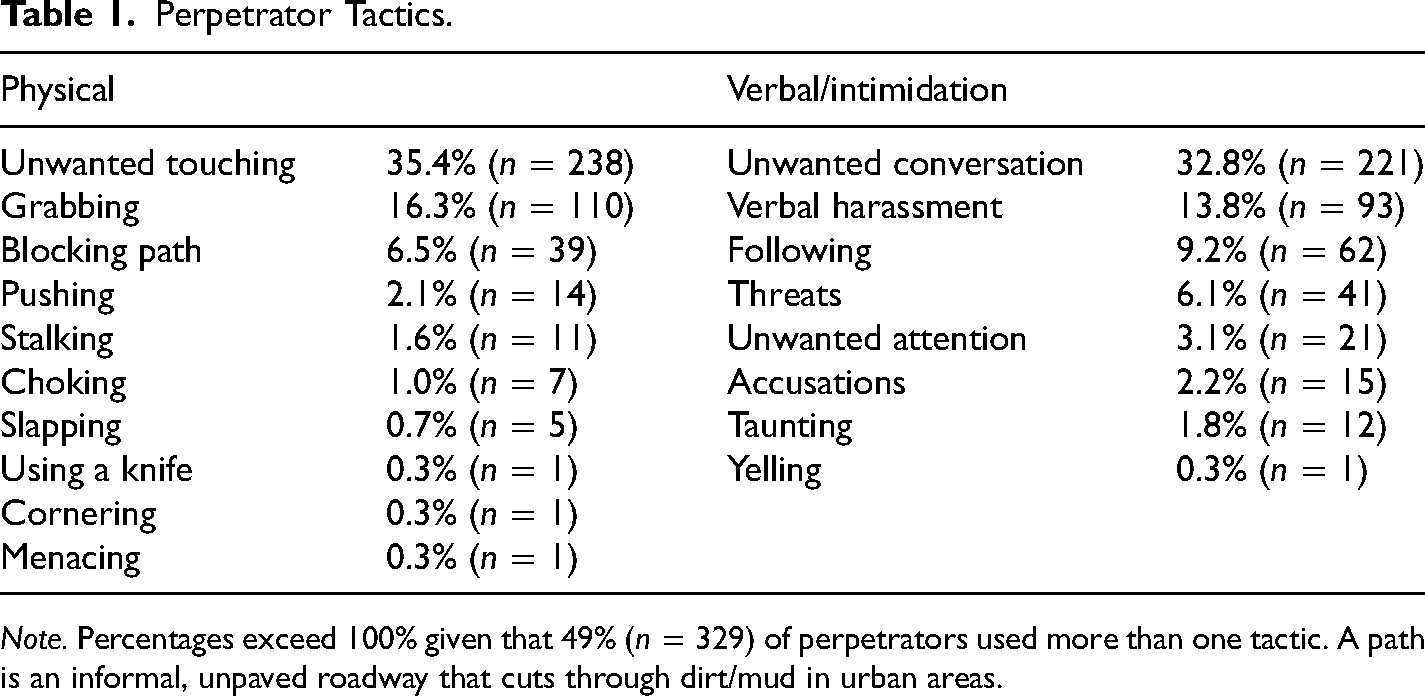
Note. Percentages exceed 100% given that 49% (n = 329) of perpetrators used more than one tactic. A path is an informal, unpaved roadway that cuts through dirt/mud in urban areas.
Resistance Strategies
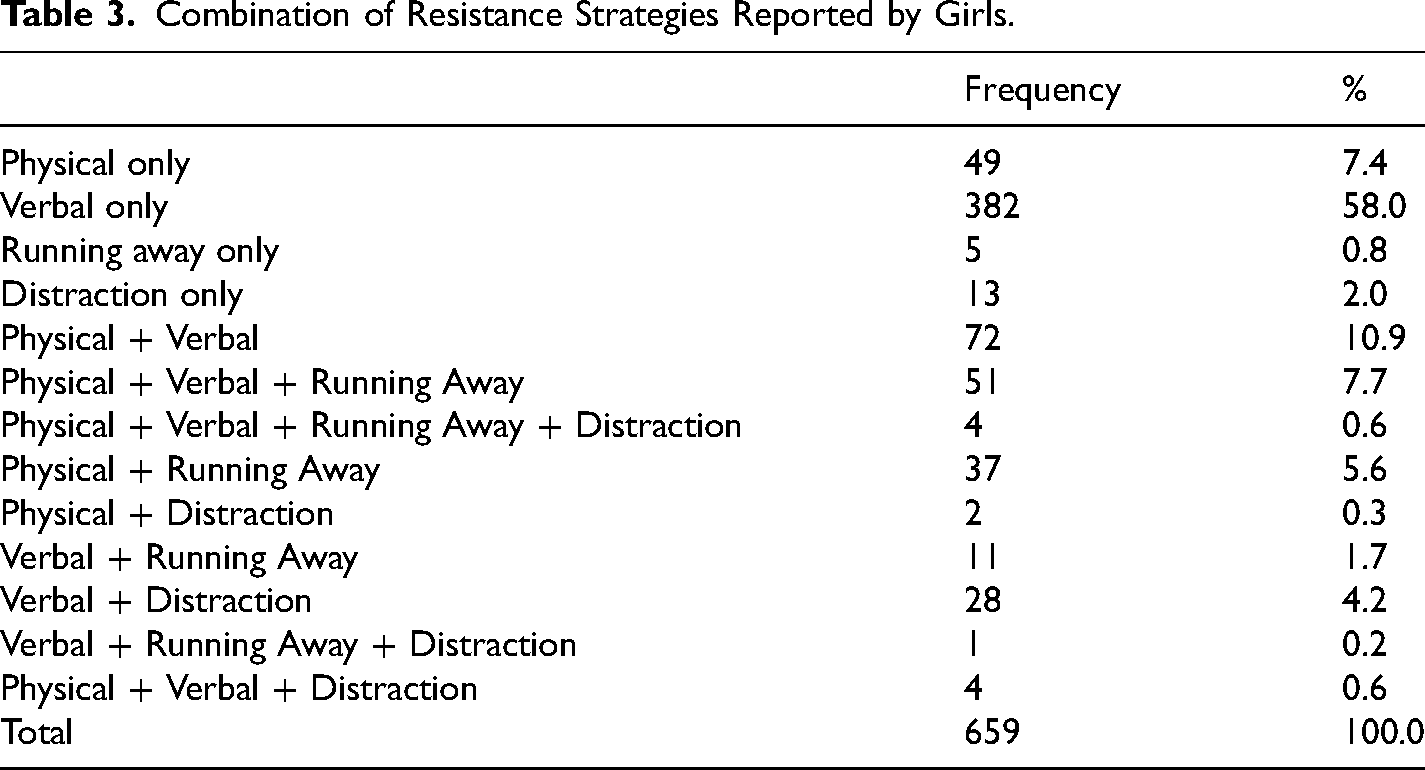
Table 2 displays the types of resistance strategies used by girls. The number of any resistance strategies used by girls ranged from one to five (M = 2.01, SD = 1.08). The number of verbal resistance strategies ranged from zero to five (M = 1.28, SD = 0.89); overall 83.8% of the sample reported that they used verbal resistance strategies. Of note, all verbal resistance strategies reported by girls were assertive (e.g., yelling “No,” telling the perpetrator to leave them alone). No participants reported using passive forms (e.g., crying, pleading with the perpetrator) of verbal resistance. The number of physical resistance strategies ranged from zero to five (M = 0.42, SD = 0.80); overall 33.2% of the sample reported that they used physical resistance strategies. Nearly 1 in 10 (7.9%) of girls reported using distraction (i.e., make a scene, be loud and obnoxious), and 16.7% of girls reported that they ran away. Table 3 displays all possible combinations of resistance strategies reported by girls.
Girls’ Physical and Verbal Resistance Strategies.
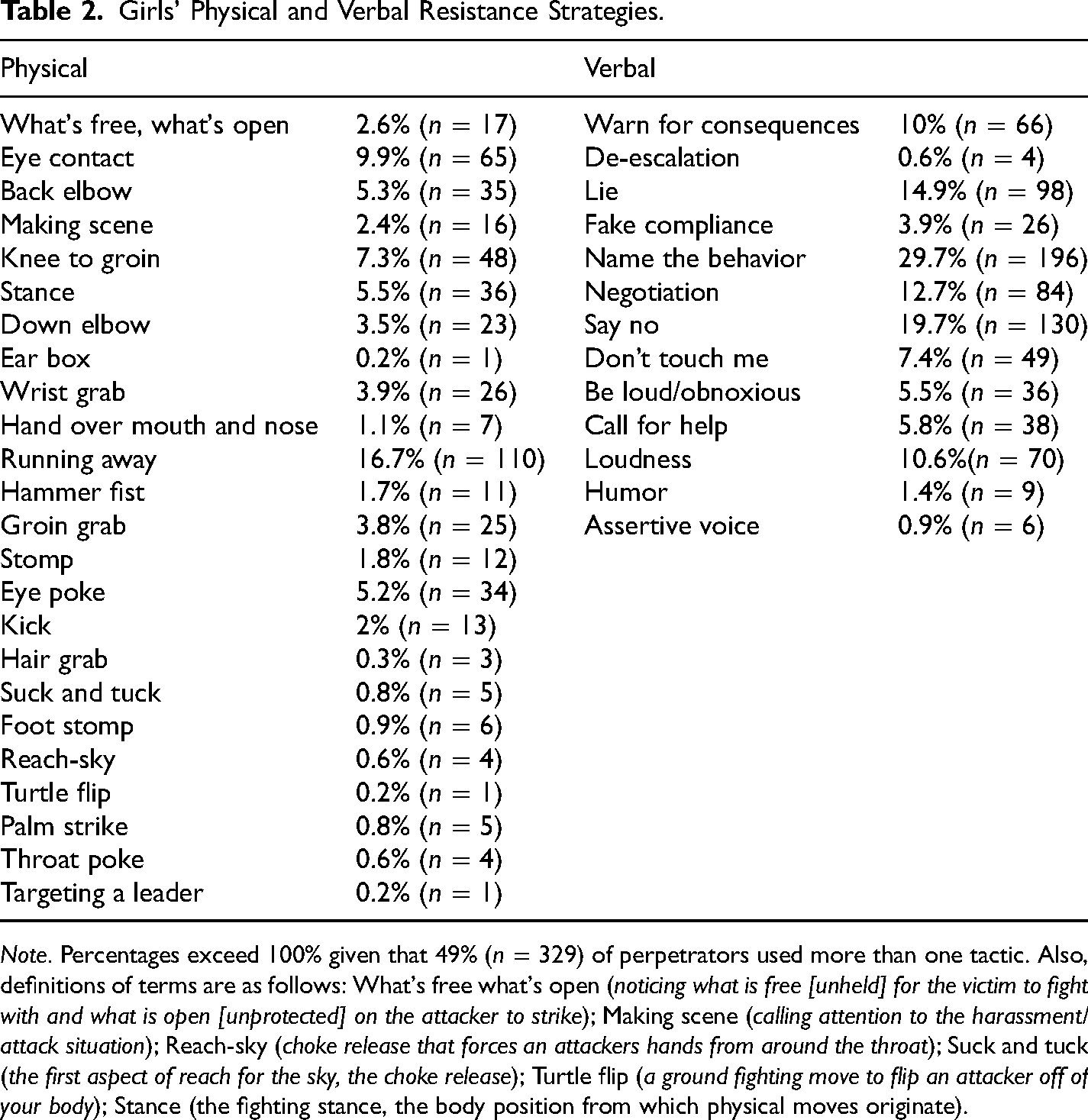
Note. Percentages exceed 100% given that 49% (n = 329) of perpetrators used more than one tactic. Also, definitions of terms are as follows: What's free what's open (noticing what is free [unheld] for the victim to fight with and what is open [unprotected] on the attacker to strike); Making scene (calling attention to the harassment/attack situation); Reach-sky (choke release that forces an attackers hands from around the throat); Suck and tuck (the first aspect of reach for the sky, the choke release); Turtle flip (a ground fighting move to flip an attacker off of your body); Stance (the fighting stance, the body position from which physical moves originate).
Combination of Resistance Strategies Reported by Girls.
Resistance Strategies as a Function of Perpetrator Tactics
The number of perpetrator tactics used was positively correlated with the number of girls' resistance strategies used (r = .31, p < .001). Perpetrator's use of verbal/intimidation tactics was positively associated with girls' use of verbal resistance (r = .16, p < .001) and unrelated to girls' use of physical resistance (r = .01, p = .84), distraction (r = .01, p = .88), and running away (r = .03, p = .42). Perpetrators' use of physical tactics was positively associated with girls' use of physical resistance (r = .30, p < .001) and running away (r = .21, p < .001), and unrelated to verbal resistance (r = −.04, p = .29) and distraction (r = −.03, p = .48).
Resistance Strategies as Function of Victim–Perpetrator Relationship
For this analysis, due to some cell sizes being small, the victim–perpetrator relationship variable was recoded to (0 = known, 1 = stranger). Results suggested that the victim–perpetrator relationship was unrelated to verbal resistance (X2 = 0.06, p = .80), physical resistance (X2 = 2.21, p = .14), distraction (X2 = 1.15, p = .285), and running away (X2 = 0.57, p = .33).
Resistance Strategies as a Function of Situational Characteristics
For this analysis, due to some cell sizes being small, the number of assailants variable was recoded to (1 = one assailant, 2 = two or more assailants). Girls were less likely to use physical resistance strategies when there were two or more assailants compared to when there was one assailant (X2 = 4.19, p < .05). The number of assailants was unrelated to verbal resistance (X2 = 0.11, p = .75), distraction (X2 = 1.31, p = .25), and running away (X2 = 1.72, p = .19).
Girls were more likely to use verbal resistance (X2 = 5.64, p < .05) and less likely to report running away (X2 = 7.88, p < .01) in the presence of a helpful bystander. The presence of a helpful bystander was unrelated to physical resistance (X2 = 0.00, p = .99) and distraction (X2 = 0.27, p = .61).
Discussion
The purpose of the current study was to examine the rates and correlates of resistance strategies used to thwart a sexual assault among Kenyan adolescent girls following their participation in IMpower, an empowerment self-defense program with demonstrated effectiveness in reducing rates of sexual assault. Contrary to criticisms that empowerment self-defense programs lead to women to be overly confident, put themselves in risky situations, and/or indiscriminately harming others (Hollander, 2009), results in this study showed that the majority of girls successfully thwarted a sexual assault without the use of physical resistance and that girls were strategic in the resistance strategies that they selected. For example, when perpetrators used verbal tactics, girls responded with verbal strategies. Furthermore, girls increased the number of resistance strategies used as perpetrators increased the number of tactics used, again suggesting that girls were deliberate in the resistance strategies that they used.
In addition to examining how girls' resistance strategies strategically varied as a function of perpetrator tactics, we examined how the victim–perpetrator relationship as well as situational characteristics of the attempted sexual assault related to girls' resistance strategies. The victim–perpetrator relationship was unrelated to the types of resistance strategies used. This finding is contrary to research that suggests that women are less likely to use forceful resistance strategies when the perpetrator is someone they know versus a stranger (Dardis et al., 2018; Logan et al., 2015). One likely explanation for this finding is that the IMpower program helps girls to overcome barriers to responding forcefully when the perpetrator is someone they know versus a stranger. Indeed, in the IMpower program girls practice resistance strategies across a variety of scenarios, including scenarios that include when the perpetrator is someone that girls know (e.g., friend, family member).
Another notable finding that emerged is that over half of the girls who provided testimonials reported that the perpetrator was a stranger. This finding is inconsistent with findings from trials of IMpower which documented, via anonymous surveys, that 10% of perpetrators were strangers (Sinclair et al., 2013). It is likely that girls were less likely to participate in the testimonials when the perpetrator was someone that they knew, especially considering the survey data suggesting that the majority (52%) of perpetrators were boyfriends, who likely attended the same school as the girls participating in the testimonials. As a reminder, although the testimonials happened in a private location outside of the classroom, they did happen at school. Thus, the extent to which the testimonial data generalize to all girls who have participated in the program, especially those attacked by someone known to them, is unknown.
Whereas girls’ use of resistance strategies were unrelated to the victim–perpetrator relationship, some forms of resistance strategies were related to the number of assailants and the presence of a helpful bystander. Interestingly, girls were less likely to use physical resistance when there were multiple assailants, compared to girls when there was a single assailant. Research suggests that the likelihood of injury is greater when there are multiple assailants compared to a single assailant (Wong & Balemba, 2016). As such, girls may have been less likely to use physical resistance strategies in situations of multiple assaults due to fear of injury. It is worth nothing that no girl in the current study mentioned in her testimonial that she was injured as a result of using forceful resistance strategies. Finally, the IMpower program emphasizes that the best strategy is the one to preserve life, and in some situations not using forceful resistance strategies may be most suited to promoting this goal.
Also, the presence of a helpful bystander demonstrated interesting associations with girls’ use of resistance strategies. Girls who provided testimonials were less likely to run away in the presence of a helpful bystander which suggests that the bystander, along with the girls' use of verbal resistance (also related to the presence of a helpful bystander), was sufficient to thwart the sexual assault. The presence of a helpful bystander was unrelated to physical resistance, which is notable as it might be expected that the presence of a helpful bystander would be inversely related to physical resistance. The finding that the presence of a helpful bystander was unrelated to distraction among girls is perhaps explained by the fact that a helpful bystander was engaging in direct intervention, thus reducing the likelihood that distraction would be a needed strategy.
Another notable finding of the current study is that girls who provided testimonials were able to list 39 specific resistance strategies that they used to thwart a sexual assault. The strategies that they named were identical, in most cases, to the exact language used to describe the strategies in the IMpower classes. Consistent with the elaboration likelihood model's focus on central route processing (Petty & Cacioppo, 1986), these findings suggest that the components (e.g., role plays, high-skilled female facilitators who were also from informal settlements) of the IMpower program had a powerful impact on girls' ability to recall and effectively used the strategies that they learned to thwart a sexual assault.
Despite the important information gleaned from the current study, several limitations should be noted. First, only girls who successfully thwarted a sexual assault were included in the testimonials. Future research is needed to understand the experiences of girls who were not able to thwart a sexual assault following their participation in the IMpower program. Even though some girls were not able to thwart a sexual assault following their participation in the IMpower program, they could have benefited in other ways. Indeed, research suggests that empowerment self-defense programs reduce self-blame and psychological distress in girls and women subsequently victimized following program participation (Gidycz et al., 2015; Mouilso et al., 2011; Orchowski et al., 2020).
Other limitations include the lack of a standardized interview script, which may help to explain that large amount of missing data. Along these lines, girls who did not label their experience a sexual assault may have been less likely to participate in the testimonials given that the message to participate in the testimonials included the term sexual assault. In other words, girls would have to publicly identify as a victim/survivor to participate in the testimonials which likely led to selection bias and limits the generalizability of the findings. Thus, future research should consider conducting more systematic exit interviews with girls, both who did and did not successfully thwart a sexual assault as well as girls who may not have labeled their experience as a sexual assault, following their participation in such programs. This may also help to explain the finding that the majority of girls discussed thwarting sexual assaults perpetrated by strangers given that girls and women are less likely to label unwanted sexual experiences a sexual assault if they are perpetrated by someone known versus unknown to them (Littleton & Henderson, 2009; Orchowski et al., 2013), although most of this research is with women in the United States.
Also, the temporal sequencing of the strategies that girls used and the ways in which these strategies influenced subsequent perpetrator tactics is unknown (based on the nature of the general question asked of girls), which is another important area for research. Furthermore, when others were present, a slight majority of bystanders did something to help thwart the sexual assault. However, the testimonials were lacking sufficient detail to be able to code for what bystanders did specifically to thwart the sexual assault, which also represents an important avenue for future research. Finally, over half of the girls were assaulted by strangers (compared to only 10% of girls in other trials), and thus, all findings should be considered with that important caveat in mind.
Notwithstanding the limitations of the current study, there are several important implications for practice. First, these data highlight the impact that empowerment programs have on reducing sexual assault among adolescent girls and provides data that refutes criticisms (e.g., ineffectiveness, harmful to girls) of empowerment self-defense (Hollander, 2009). Along these lines, the findings from this study further support that the majority of sexual assaults can be thwarted by the use of verbal resistance alone, suggesting that teaching girls verbal resistance skills is a critical component, if not the most important, of empowerment self-defense classes, which is the case for the IMpower program. Although comprehensive prevention efforts are needed that exist at all levels of the social-ecological model, these data further underscore that empowerment self-defense is a critical component of comprehensive, primary prevention (Orchowski et al., 2020).
Footnotes
Declaration of Conflicting Interests
The author(s) declared no potential conflicts of interest with respect to the research, authorship, and/or publication of this article.
Funding
The author(s) received no financial support for the research, authorship, and/or publication of this article.

Correction (February 2023):
The paper has been updated with a few changes in the Methods section.