







Abstract
Intimate partner violence (IPV) affects all communities, but immigrant communities can be distinctively more vulnerable. This study explores the coping strategies of 10 immigrant Middle Eastern Immigrant Survivors of IPV in the United States. A phenomenological design was utilized to explore Middle Eastern immigrant IPV survivors coping strategies. The study participants had similar and different experiences with formal resources and informal help-seeking behaviors. These study results recommended that there is a considerable need for future research to extend the study of this population as well as an urgent need to increase accessible resources to empower immigrant IPV survivors.
Introduction
Intimate partner violence (IPV) affects all societies, and globally 35% of women have experienced either physical and/or sexual IPV or nonpartner sexual violence; 38% of murders of women were committed by intimate partners (WHO, 2013). One study (Smith et al., 2017) reported that 23 million women (19.1%) in the United States have been raped and 45 million women (37.3%) have experienced some form of sexual violence, physical violence, and/or stalking by an intimate partner at some point in their lives. Even though IPV affects all of human society, immigrant communities can be distinctively more vulnerable (Choi et al., 2016). In the United States, more than 43 million people live as foreign-born, and approximately 1.2 million people migrated from the Middle East and North Africa as of 2016 (Cumoletti & Batalova, 2018).
Violence against women is prevalent in Middle Eastern countries (Boy & Kulczycki, 2008), and IPV is a pervasive issue within immigrant and refugee communities. Many immigrants and refugee women who have experienced IPV encounter language and legal rights difficulties, and other barriers associated with adjusting themselves to a new culture (Runner et al., 2009). One study found that immigrant women are at a greater risk of experiencing domestic violence and the majority of the women who have experienced IPV reported that violence increased in their homes after moving to the United States (Erez et al., 2009). Research by Amanor-Boadu et al. (2012) focused on significant predictors of withdrawing from an abusive relationship for immigrant and nonimmigrant women who had experienced IPV. The study revealed that immigrant female survivors had significantly more risk related to legal issues, financial issues, and social and physical harm than nonimmigrant female survivors. Survivors and female immigrants are likely to face a lack of social and family support, language barriers, and unfamiliarity with the legal system in society (Ozturk, 2020). Also, IPV can cause severe mental, social, economic, and physical consequences for immigrant survivors (Ozturk et al., 2019).
Women utilize varying strategies to minimize the effects of IPV. Coping is utilized to minimize or tolerate internal and external difficulties of a stressful situation and applies to a variety of cognitive and behavioral strategies (Lazarus & Folkman, 1984). When a stressful situation happens, emotion-focused coping applies to cognitive and behavioral strategies for the purpose of improving or dealing with the emotional response and problem-focused coping applies to dealing with stress and attempts to shift the stressful situation (Lazarus & Folkman, 1984).
In the literature, studies exist about coping among IPV survivors. The study was conducted to concentrate on the utilization of domestic violence services among Arab immigrant women (Kulwicki et al., 2010). The study affirmed that Arab-American survivors of IPV hesitated to seek help due to cultural differences and lack of English language skills, while some of the survivors avoided asking help from shelters due to culturally incompetent services. Also, Arab-American female IPV survivors were fearful of a lack of confidentiality among service providers (Kulwicki et al., 2010). The study also highlighted that immigration status and financial situation were significant factors associated with survivors electing to stay in or leave an abusive relationship.
Immigrant women can utilize different resources to seek help. For instance, South Asian and Hispanic immigrant women called the police to stop violence from their spouses, while African and Mexican immigrant women utilized social service agencies and hospitals to survive IPV (Fuchsel, 2012; Sarpong, 2015; Ting, 2010; Yingling et al., 2015). Typically, immigrant women are even more likely to share their abusive experience with someone whom they can trust and who can provide emotional support (Ahmad et al., 2013). Also, seeking advice and emotional support from other social networks and having faith in God have played a significant role in the capacity to survive IPV (Ahmad et al., 2013; Hamza, 2010). In addition, Flasch and colleagues (Flasch et al., 2017) conducted a study among IPV survivors who had overcome abusive relationships and created violence-free lives for themselves. One of the study results was that many of those survivors become advocates for themselves and others and found paths to reclaim their identities to enhance their strengths and life quality (Flasch et al., 2017).
Significance of the Study
Middle Eastern women experience IPV at a significant rate; also, immigration can cause stresses in their lives such as poverty, discrimination, racism, and unemployment (Szaflarski & Bauldry, 2019). There are numerous studies focusing on immigrant populations in the research literature; however, there are few research studies and limited knowledge regarding Middle Eastern immigrant female IPV survivors and their coping strategies.
As a result, this study aimed to advance knowledge and greater understanding of Middle Eastern female immigrant survivors coping strategies. Focusing on Middle Eastern immigrant women IPV survivors enables their voices to be heard and brings their needs into practice and increases awareness of the existence and needs of this vulnerable population in the literature for scholars, making it an invaluable addition. In addition, understanding Middle Eastern immigrant IPV survivors coping strategies will aid researchers and providers in developing and implementing prevention and intervention strategies for IPV immigrant survivors.
Method
Research Design
This qualitative study aimed to explore the coping strategies related to experiences of IPV with Middle Eastern immigrant women in the United States. The research question was “How do Middle Eastern immigrant women survivors of IPV cope with IPV in their lives?” A phenomenological approach was used to guide this qualitative inquiry.
Moustakas (1994) explained that phenomenology focused on describing how and what people have experience as a particular phenomenon and it seeks to understand people's experience (Creswell, 2013; Moustakas, 1994). Qualitative researchers utilize the phenomenological approach to discover, understand, and interpret a phenomenon from people who have experienced the phenomenon itself (Wilson, 2015). The researcher's role as a scientist is to collect data from participants who have explained the phenomenon, analyze the data, and describe the essence of the lived experiences (Khan, 2015).
This phenomenological study involves exploring various coping strategies of IPV survivors among Middle Eastern immigrants in the United States. The phenomenological approach provides readers an opportunity to hear each participant's lived experiences including the realities of the lived experiences of IPV survivors and the coping strategies that they used to survive IPV. This approach provided an opportunity to examine the significant themes of Middle Eastern immigrant IPV survivor experiences and contemplate “what” and “how” participants utilized of coping strategies.
Participant Selection
Criterion sampling, a type of purposive sampling strategy, was used for this study (Moser & Korstjens, 2018). The criterion on which selection was based included those likely to possess the knowledge we sought, women IPV survivors from a Middle Eastern country who were immigrants to the United States. Participants living in any of the 50 states in the United States were eligible. Specific eligibility requirements for participants were (a) heterosexual Middle Eastern immigrant female survivors of IPV in the United States; (b) being at least 18 years old; (c) having had experienced physical, psychological, emotional, or sexual abuse in a past time or currently by their husband or male partner; and (d) could speak and understand English or Turkish. Given the difficulty of recruiting participants for this population, it was challenging to obtain an adequate sample size for this study to achieve saturation. The study relied on the definition of saturation as provided by Glaser and Strauss (2017) meaning saturation was judged to have been achieved when no additional information emerged in the data, an empirical standard unique to each study. Saturation occurs once a scholar is not able to obtain new information in the interviews (Mason, 2010). The resulting sample for this current study consisted of 10 Middle Eastern female immigrant IPV survivors who met the eligibility criteria.
Procedures for Recruitment
Before study implementation, the study began after receiving ethical committee approval from the Institutional Review Board (IRB). We developed a research flyer for the recruitment process. The research recruitment flyer included a description of the study's purpose and how the interview would be conducted, as well as the primary researcher information, including the researcher's email and google phone number. Also, one of us initiated contact with nonprofit organizations, agencies, and shelter that provided services to any foreign-born individual who were dealing with domestic violence and sexual assault. Only two agencies agreed to distribute recruitment flyers after the survivors left the agency. In addition, snowball sampling was utilized for this study. Snowball sampling techniques can help the researcher to reach participants via social networks of identified individuals (Lewis-Beck et al., 2004). Six participants were recruited through the snowball sampling technique. We also used online resources, Facebook and Instagram, to reach out to potential participants. Qualitative researchers often utilize online sources to collect data for qualitative studies (Im & Chee, 2012). Utilizing social media assisted us in finding four of the study participants.
Data Collection
In this study, confidentiality, safety, security, and privacy were the first priorities for the primary researcher and potential participants. To minimize the risk of physical and psychological harm, the researcher met with potential participants in secure locations to ensure privacy for the meetings, for example, a public library, coffee shop, and anywhere the participants felt comfortable. Additionally, videocall meetings were conducted for the long-distance participants. To collect the data, the researcher conducted two individual semistructured interviews focused on data collection that lasted about 60–90 min, depending on the participants’ responses, and a third interview took place for member checking if the participant agreed. Member checking is a form of verifying participants’ responses (Birt et al., 2016).
The first interview was about building a relationship and talking about the interview questions, and the second interview was a follow-up interview to be able to cover all of the questions and gather more in-depth information. The third interview was offered for the purpose of member checking with four participants. Four of the 10 participants agreed to engage in a member-checking interview. The four participants who were interviewed a third time for member checking had the opportunity to review their data file, and a file that showed how their data had been coded. Primary researcher asked the participants “is this what you meant”? The participants replied “yes” or elaborated for clarification. The four participants agreed with the codes and coding. None of the four provided any additional elaboration or clarification.
Data Analysis
In qualitative research, data analysis includes coding, categorizing, and creating meaningful interpretations of data related to the phenomenon (Englander, 2012; St. Pierre & Jackson, 2014). The data were analyzed using thematic analysis. A line-by-line coding of the interview transcripts was conducted to find emerging themes from the data (Braun & Clarke, 2006; Saldaña, 2016). During the coding process, based on the phenomenological approach, the primary researcher began open coding via NVivo 12 to immerse herself in the data. Braun and Clarke (2006) suggested that scholars should work systematically through the whole body of data to give full and equal attention to each data, and what follows demonstrates the implementation of that advice.
The data analysis procedure was based on Moustakas’s (1994) modified version of the Stevick-Colaizzi Keen method of analysis. The following steps guided this proposed study data analysis:
The first step was obtaining a full description of the first author's own experience of the phenomenon (Moustakas, 1994) to begin to understand each participants’ lived experience of intimate partner violence and their coping strategies. Open coding came next and the first author went through each of the participant's responses and we developed significant statements and phrases about participants’ experiences with IPV and coping strategies (Moustakas, 1994) with the first author beginning the process and reviewing them with the second author. After we engaged in an open coding process, formulated and related “meaning units” among participants, and clustered the meaning units (Moustakas, 1994, p. 122), we described the meaning units as common meanings, those similar descriptions/ideas/concepts which were reported by participants. After synthesizing the meaning units and merging into themes, we described the textures (a kind of narrative description) of the participants’ lived experiences and coping strategies with the first author beginning the process and the second author reviewing the process. The textural description means a verbatim description of the participants’ lived experiences and gives the “what” of the experience in the phenomenological study (Moustakas, 1994). Then, we explored the meaning of intimate partner violence from each participant and developed structural descriptions (Moustakas, 1994), again with the first author originating the descriptions and a review by the second author. In this case, the structural description meant to write deeply about “how” participants coped with abuse in their lives and lived experiences. Four of the participants validated their interview codes including coded parts of transcripts through member checking. The member checking process allowed the researchers and participants to engage with data together and check codes and participant responses to enhance trustworthiness (Giorgi, 2012).
The NVivo 12 software was used to code and organize the large data set (approximately 220 single-spaced pages). Open coding was used to thoroughly explore the data and avoid missing any relevant results. The research question itself guided the creation of meaning units, in this context meaning units were related to coping strategies. Ultimately the work resulted in one codebook that included labels and descriptions of the codes.
Establishing Trustworthiness
Trustworthiness is a way for researchers to ensure for themselves and readers that their research results are worthy to be considered useful, which can be established through credibility, transferability, dependability, and confirmability (Lincoln & Guba, 1985). Various methods were used to ensure quality and trustworthiness in this study, including debriefing, creation of an audit trail, and member checking to support the validity of the study (Creswell, 2013; Savin-Baden & Major, 2013).
Result
In this study, a phenomenological approach was used to explore participants’ lived experiences of Middle Eastern female IPV survivors coping strategies. For this qualitative study, a phenomenological approach was used to explore how the participants utilize coping strategies to manage the after-effects of the IPV experience. The research question was “How do Middle Eastern immigrant women survivors of IPV cope with IPV in their lives?.” The research questions led to data coding through the data analysis process NVivo 12. A total of 10 participants voluntarily enrolled in the study and participant characteristics are presented in Table 1.
Participant Characteristics
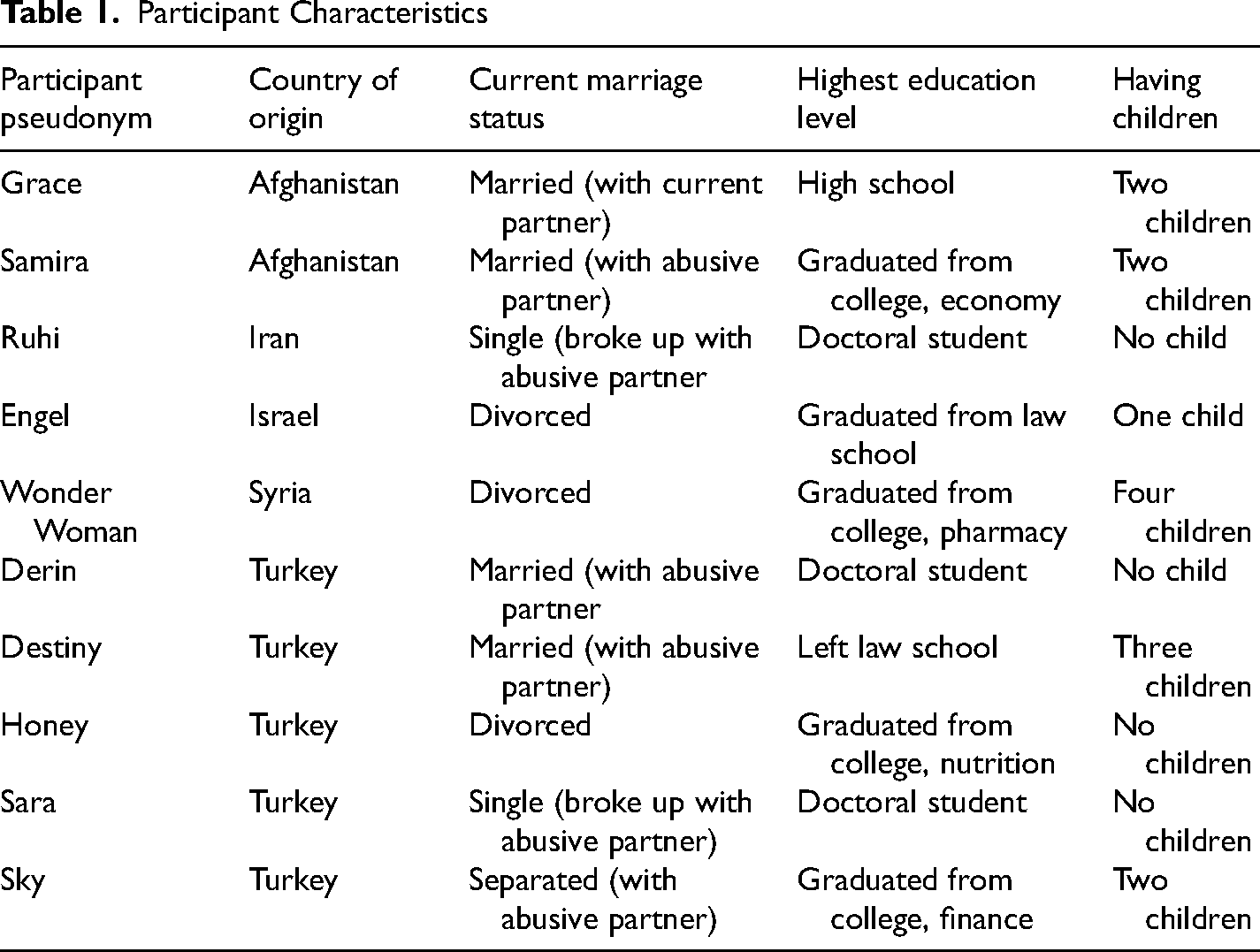
Ten female Middle Eastern immigrant IPV survivors met the eligibility requirements and voluntarily participated in this study. The participants’ ages ranged from 31 to 74. They were originally from Turkey, Syria, Israel, Afghanistan, and Iran. Only three of them were still married with their partner; the other participants were either divorced or separated. Three of them were PhD students and five of them graduated from college. One participant graduated from high school and one participant could not finish her law degree because of moving in state. Two of them were retired, six of them currently work or study, and two of them did not work.
Category 1: Formal Coping Strategies
In this study, the participants explained multiple ways to use formal coping strategies. The participants discussed the benefits and challenges with accessing these services for themselves.
Theme 1: Seeking professional help: Four participants reported that they went to a therapist to relieve the effects of IPV. Destiny stated that “I went to private counseling to unload myself, my head, my thoughts, and get a little better, and so I stayed confident.” Sky and Wonder Woman mentioned that seeking professional support helped them to get through the relationship.
On the other hand, Ruhi explained why she hesitated to go to see a therapist. She stated that she did not want to report her partner to the therapist. She was hesitant to ruin his career or life. She said that: My first thought was, if I go to talk to professionals, they will ask for his information. Because I was kind of protective of him, unfortunately…I was afraid that maybe they will ask, or they will push me to give his name. So, I avoided seeing a counselor.
Theme 2: Calling Police and court involvement: Two of the participants called the police to seek help. Honey reported that she called 911 seven times. She had different experiences with police intervention in different states. Honey stated that, “When I was in Alaska, I did not do anything, the police and other professionals did everything for me.” However, Honey mentioned that when she was in Florida, even though she called the police, the police did not do anything. Honey also reported that she stayed in a domestic violence shelter after she left the house. She reported that a social worker and counseling service helped her to understand her rights, explaining slowly and clearly. She also mentioned that she participated in group therapy sessions to share her experience with other IPV survivors.
The participants had different experiences calling the police (911) in the United States. One participant, Ruhi, shared a positive experience with the police. When she called the police, Ruhi felt that she had the power to kick her partner out of the country. However, she just asked the police to protect her and get her back her house. Ruhi stated that: Living in the United States, and having that day when I called 911, I felt I could do anything—I can kick him out, in America. I felt powerful and I knew that he was scared because of that … I felt really free, based on United States laws that give women rights and power here. I remember that day, calling 911. The officer saw tears in my eyes. I felt really peaceful. I felt like they were protecting me.
Theme 3: Having trusted friends: The participants stated that talking with their friends and families, having faith, and having hobbies were common informal coping strategies for them. Ruhi reported that having a trusted friend helped her through the process. She said that her friend helped her a lot during this time. She also said that she hesitated to tell her family about the abuse, because she did not want them to worry about her. For others, family was a major source of support. Sky mentioned that her family was always supportive of her and she shared that having someone there for her was a relief. Wonder Woman reported that her mother and her relatives were very supportive to her. Destiny said that “I got my mother's love all the time and prayers.”
Theme 4: Keep themselves busy and have hobbies: Some participants mentioned that keeping themselves busy aided in coping, as well. Sara mentioned that her coping strategies were to keep doing what she was doing and to have faith. Sara said that: So, my healing process was totally “me.” Getting back on track and doing what I wanted to do… It was a lot of hopelessness. Finding myself through that hopelessness; and in terms of coping, I think the only way that I could cope was the hope that I had in me, and my faith.
Also, Destiny mentioned that ignoring her husband and trying to do what she should do at home—to avoid making him angry—was another strategy for her. In addition, Destiny mentioned that she started painting to help herself escape from her negative feelings and thoughts. In addition, Wonder Woman mentioned that she did exercise and played tennis to escape her negative feelings. Wonder Woman said that: I started swimming in the summertime. So, exercise played a big role in helping me stay busy. I realized that I love, I have a passion for cooking. So, I learned how to make macaroni and I started making them and I started other things.
Theme 5: Having Faith: Participants Derin, Grace, and Engel mentioned that having faith and praying to God were coping mechanisms.
Destiny indicated that: I realized that God has a plan for everything he has created. We are put in this universe to be tested by God, with our patience, with our goodness, with our abilities, coping with things; evilness, whatever. So that we can get some grace.
In addition, Grace stated that believing God gives her hope and makes her strong. Grace stated that “I prayed a lot. I remember I cried and begged God to help him to stop fighting with me.” In the interview, Engel started the interview with a Hebrew song, and she reported that she was a meditation trainer and doing yoga to keep her spiritually strong and feel peaceful. Engel stated that: Believing in God and asking His help is a necessity for human beings. So that helped tremendously in hard times because there is somebody that, even though you do not see Him, you know Him. You believe in Him, and you have faith.
Discussion
The findings from this study contribute to the literature about Middle Eastern immigrant IPV survivors’ coping strategies. Middle Eastern immigrant women IPV survivors shared their stories, their coping strategies, and their experiences of living in the United States. In this study, the participants reported that they utilized various services when the violence escalated, such as calling police, seeking help from the domestic violence shelter, and counseling, as well as relying on their faith. These findings about this special population (Middle Eastern U.S. immigrant women IPV survivors) agree with other existing research findings that focused on other populations, including research that revealed that survivors seek help in abusive relationships when the violence is severe and gets worse (Macy et al., 2005; Nurius et al., 2011). Liang and colleagues (2005) identified the help-seeking behaviors of survivors of IPV. Their study explored that women's intentions of help-seeking depended on individual, family, cultural, and economic influences. Utilizing formal and informal social support has been demonstrated to increase survivor's mental health, as well as their willingness to seek help from formal resources to stay safe (Liang et al., 2005).
In this study, most of the participants responded that they received support from their trustworthy friends and families and that they prayed to God. Existing literature focused on other populations confirmed that the support of friends and relatives is a key protective factor associated with improved mental health outcomes among IPV survivors (Astin et al., 1993; Carlson et al., 2002; Gondolf & Fisher, 1988). In this study, participants identified religion and faith as playing a significant role when they experienced IPV. Participants reported that faith helped them continue to fight against the challenges in their life. This result was also consistent with previous research that showed how having faith and religion can provide women with the strength to survive IPV (Khan, 2015; Mahapatra & DiNitto, 2013. Additionally, another study also revealed that praying to God is one of the methods among IPV survivors to reduce their anxiety and worries (Bhandari, 2018).
Among IPV survivors, those who have received tangible and emotional support may suffer less negative psychological effects of their partners’ abuse, such as depression, anxiety, suicide attempts, and PTSD (Liang et al., 2005). Research has revealed that having social support might affect a survivor's mental health by moderating their well-being, or by mediating the relationship between violence and mental health (Arias et al., 1997; Thompson et al., 2000). In this study, participants indicated that they shared their abusive experiences and received emotional support from their friends or families, which helped them cope. Most of this study's participants reported that they felt comfortable talking to friends and some relatives about their situation. One participant highlighted that her best friend helped her during her recovery and that having emotional support from a close friend protected her from deep depression and from feeling alone.
On the other hand, formal support can influence the physical safety of the survivors. Women who have received professional support and used domestic violence services are twice as likely to be free of IPV compared to women who did not receive professional support (Sullivan & Bybee, 1999). In the study, one participant reported that she stayed in a domestic violence shelter after she left her house. She expressed that she felt that she was safe because of this experience. While formal supports have been shown to help increase safety for survivors of IPV, some survivors hesitate to access domestic violence services due to the potential costs of services, as well as due to stigma, impact on family reputation, and threats on their lives (Fleury et al., 1998; Goodkind et al., 2003; Lempert, 1997). In this study, one participant mentioned that she was hesitating to consult with a divorce lawyer because of the cost. Also, one participant opined that the agency should provide services in another language, such as Turkish. Understanding why survivors do or do not choose to seek help from professional services is important to consider when assessing a service's quality, cultural competence, and accessibility, and this study confirmed that need.
Challenges and Barriers
Previous research shows that women who lived in a minority group as immigrants often found themselves at the intersection of numerous inequalities and encountered additional issues, including a higher risk of violence (Thiara & Gill, 2010). Encountering those challenges and barriers affected participants’ decisions to seek help. The significant barriers for Middle Eastern immigrant female IPV survivors included having fear of losing child custody, language barriers, financial dependency, and fear of deportation.
In this study, even though most of the participants were well educated, they had to learn English when they came to the United States. One participant identified that the language barrier affected her ability to understand the policy in the United States so that she could know how to represent herself when she attended court and had to speak in front of the judge. This is one of the common challenges posed by IPV experiences intersecting with being an immigrant. This finding is consistent with other studies involving immigrant women with other nationalities and languages. Similar research has shown that immigrant women in Canada are accepted as dependent on their partners, even if the women and men have equal job skills and education qualifications (Guruge et al., 2010). Such cultural norms can facilitate an abusive partner's control. Previous studies have also highlighted that services and service providers need to address language barriers to better serve immigrant survivors (Bhuyan & Velagapudi, 2013; Reina et al., 2014).
This study reveals that Middle Eastern immigrant females face acculturative stress factors including less communication with their family, not having trusted friends, and feeling as if they do not belong in this culture. Previous studies have shown that other immigrant populations have similar experiences. One study revealed that immigrants from Mexico face a multitude of challenges and acculturative stressors related to low self-esteem, symptoms of depression, and intention of suicide (Gonzales et al., 2002). Understanding the challenges and barriers faced by Middle Eastern immigrant female IPV survivors contributes to existing literature and reinforces the value of listening to immigrant women to be able to develop appropriate programs for this population.
Implications
With regard to the problem definition, we must attempt to understand the Middle Eastern immigrant women IPV survivors coping strategies from their own perspectives. This study provides one approach for researchers to explore the patterns of help-seeking by this population, from both formal and informal supports, as well as the effects of IPV on these women's lives and the methods of coping that they have used to survive. It is crucial that we understand the processes by which they choose specific forms of help to cope with IPV. Additionally, it is critical that we explore Middle Eastern immigrant women's challenges and barriers as immigrants in the United States.
This study can be a resource for researchers, policymakers, and professionals to learn and understand IPV issues regarding women who came from Middle Eastern countries and offer resources to others as they craft and research specialized interventions and prevention. Future studies can use this study as a basis for understanding the Middle Eastern immigrant female IPV survivors’ coping mechanisms. Future studies can evaluate the concepts of women's coping strategies and the effectiveness of those coping strategies, as well as the impacts that immigration to the United States can have on a woman's life. In addition, this study can provide information for researchers to discuss the similarities and differences among populations in terms of the resources utilized to cope with IPV and the process of help-seeking.
Limitations and Future Research Suggestions
One of the most prominent challenges was connecting with agencies and receiving approval from them to recruit the participants. This challenge served as a significant limitation in that heterogeneity of country of origin could have been wider than it was. Another challenge was that English is the second language for the primary researcher as well as the participants. Interviews were conducted in English and Turkish, so it was possible that the researcher might have lost some of the meaning of what the participants wanted to convey in the cases where the participants did not speak Turkish.
This study population included Middle Eastern immigrant female IPV survivors in the United States. The research subjects were 10 Middle Eastern immigrant women IPV survivors from various states in the United States. Future research might concentrate on the same population but in a different area or broader geographic location to increase the number of participants and thereby obtain more information. Additionally, the participants in this study had been in the United States for at least 2 years. Future studies could concentrate on newly arrived immigrant IPV survivors who had experiences in their own countries before moving to the United States. A comparative study of survivors, juxtaposing Middle Eastern immigrant women in their own country, and women who were originally from the Middle East but migrated to the United States and experienced violence in the United States, could provide a different perspective on seeking help, coping, and lived experience of violence.
This was a qualitative study. It may be beneficial to conduct a mixed method or quantitative study related to Middle Eastern immigrant female IPV survivors’ coping strategies and lived experiences. This study focused on the Middle Eastern immigrant female IPV survivors coping mechanisms that they used to survive. Future studies could be more focused on Middle Eastern immigrant female IPV survivors’ needs as immigrants and as IPV survivors. This study included heterosexual women; future research can extend to explore same gender relationships or transgender relationships among Middle Eastern immigrant IPV survivors.
Additionally, future researchers can continue to focus on effective prevention and intervention programs and tools to empower Middle Eastern immigrant women and survivors of IPV. Also, future studies could be focused on the immigration process and other stressors and mediating factors in the Middle Eastern immigrant household. This study did not focus on IPV survivors’ mental health issues; future studies could concentrate on mental health issues to contribute to existing literature.
Conclusion
Overall, this study explored the Middle Eastern immigrant female IPV survivors coping strategies as well as their challenges and strengths as immigrants. The most significant finding of this study was that the findings from this study aligned with findings from other research of other populations. An important note had to do with the satisfaction that participants experienced with research participation. Some professionals may believe that talking about past trauma could be aversive for research participants, but for the participants in this study, that was not the case. In summary, the results suggest there is a considerable need for future research to extend the study of this population, as well as an urgent need to increase accessible resources to empower abused immigrant IPV survivors in the United States.
Footnotes
Declaration of Conflicting Interests
The author(s) declared no potential conflicts of interest with respect to the research, authorship, and/or publication of this article.
Funding
The author(s) received no financial support for the research, authorship, and/or publication of this article
