







Abstract
In recent years, there has been increased attention regarding the impact of the media on individuals’ perceptions of the criminal justice system, specifically focusing on the CSI effect and forensic evidence. In order to expand this area of research, this article focuses on the impact and interaction of crime-related media-watching habits and victim gender on perceptions of blameworthiness and punishment of both victims and aggressors in sexual assault cases. As expected, results supported the hypothesis that increased media-watching contributed to more stereotypical perceptions of sexual assault cases. However, slight variations observed in blameworthiness and punishment based on victim gender were nonsignificant. Implications for future research are discussed.
Research has shown that, in general, people use media sources to learn about different topics (e.g., Bandura, 2001; Gerbner et al., 1980) and that what we watch on television influences our perceptions of the real world, specifically those of the criminal justice system (Acquaviva et al., 2020; Cole & Dioso-Villa, 2007; Elmore et al., 2021; Podlas, 2012; Schanz & Salfati, 2016). This has been highlighted in research examining the CSI Effect, or the theory that crime-relevant media can affect consumers’ perceptions of forensic evidence (e.g., Durnal, 2010; Ferris, 2011; Schanz & Salfati, 2016; Stinson et al., 2007). While there have been mixed results regarding verdict decisions (e.g., Cole & Dioso-Villa, 2007; Shelton et al., 2007), the majority of research suggests that potential jurors are expecting what they see happen in TV crime dramas regarding forensic evidence to be what happens in real-life (Ferris, 2011; Schanz & Salfati, 2016; Shelton et al., 2007). For example, viewers expect forensic evidence to be available at every crime scene, to always be analyzed and to be analyzed quickly, and that all police departments have easy access to advanced technology for analysis (Cole & Dioso-Villa, 2007; Schweitzer & Saks, 2007). Since it has been shown that media watching can impact one element of the criminal justice system (e.g., expectations of forensic evidence), it is also necessary to determine if it can affect perceptions of other elements as well, specifically, perceptions of blame and deservingness of punishment in sexual assaults.
In portrayals of sexual assault, the media often presents a dramatized, stereotypical version that contributes to differing perceptions of the victim and aggressor by the public. Stereotypical sexual assaults are often argued as “real rape,” and involve a stranger committing an assault at random in a public, but deserted, area (DuMont et al., 2003). Most media sources, especially television dramas, portray the stereotypical “ideal” or “real” rape victim as a White woman who is physically resistant toward her offender, and the stereotypical aggressor as a man or boy (DuMont et al., 2003; Parrott & Parrott, 2015). A stereotypical victim does not deviate from the public's expected appearance, reputation, or response of a sexual assault victim (Randall, 2010). These victims are portrayed as nice, conservative in their appearance and actions, and physically resistant toward their unknown assailant (Scully & Marolla, 1984).
For example, in the popular song Blurred Lines, the lyrics suggest that a woman saying “no” really means she is saying “yes,” because women are subject to the sexual desires of men, regardless of their own consent. In the novel, The Bluest Eye, the victim is blamed for loving the aggressor and contributing to their own sexual assault (Jenkins, 2020). Finally, in the film, Fifty Shades of Grey, rape is a justified act if the victim and perpetrator experience feelings for one another or are part of a relationship; the victim is subtly blamed for rape because “real rape” is not associated with a loving relationship (Jenkins, 2020).
The media has come to be a main source of people's knowledge of sexual assault (Acquaviva et al., 2020). More than 94% of college-aged participants attribute their knowledge of the general elements of sexual assault cases to the media, with more than 91% of these participants able to name a specific sexual assault case from media coverage alone (Acquaviva et al., 2020). Media sources of sexual assault awareness and knowledge for these participants included news sources such as Yahoo and CNN; social media sources such as Twitter, internet blogs; and television shows such as Law and Order: SVU (Acquaviva et al., 2020). It is likely that most people who engage with a variety of media will likely conclude that all sexual assaults are similar to those portrayed in said media.
In addition to the media, the gender of a sexual assault victim can also contribute to differing perceptions of sexual assault (Schuller et al., 2010). Views on the gender of the victim are often dependent on the gender role attitudes of an individual. Traditional gender role attitudes depict women as emotional, weak, and vulnerable (Schuller et al., 2010) and men as strong, sexual, and powerful (Davies & Rogers, 2006). These are exacerbated when media sources regularly use selective language, misleading information, and victim blaming based on or involving victim gender (e.g., rape myths; Easteal et al., 2015). Rape myths frequently shown and emphasized in the media inform viewers of false perceptions of blame and accountability based on gender.
This is particularly true in the United States, where reports on its own sexual assault cases are portrayed in a way that minimizes the true problems behind the nature of the sexual assault and focuses on individual characteristics such as victim gender (Patil & Purkayastha, 2015). With victim gender being heavily emphasized in the media, it becomes an important factor in shaping public perceptions of sexual assault. This article examines hypotheses focused on the interaction between media watching and victim gender on perceptions of the blameworthiness and deservingness of punishment of the victim and of the aggressor.
Blameworthiness
As previously stated, the majority of media sources show rape in a stereotypical context, and that portrayal impacts the implied appropriate level of blame toward the victim. Stereotypical victims are portrayed in the media as more credible and deserving of criminal justice intervention (Randall, 2010). However, if victims do not fit the stereotype, the public tends to be more drawn toward blaming them (Braganza, 2020). Portraying a victim that lacks any of the stereotypical traits (e.g., they have more than one sexual partner, they engage in drug use, they do not resist, they know the aggressor, etc.), results in the aggressor believing that they can justify their actions, and places at least a portion of the blame on the victim (Scully & Marolla, 1984). This tendency to blame and disbelieve the victim is especially prevalent in social media, as shown in the Steubenville High School rape case against Trent Mays and Ma’lik Richmond in which social media was used to support the two athletes and joke about the victim (Nagy, 2017). Additionally, since media consumers expect scientific evidence to be provided in every case, people often disbelieve and blame victims in rape cases without forensic evidence (Shelton et al., 2007).
Victim blame can be exacerbated differentially based on the content of the media sources individuals are interacting with on a regular basis. In a study on heterosexual men from a public university, Wright and Tokunaga (2015) found that if media objectifies women and promotes women as sex objects, the viewer will also likely do the same and justify the actions of an aggressor against women. If an individual is listening to music, reading books, and/or watching films that facilitate rape myths, the individual is likely going to believe that there is truth behind those rape myths and blame the victim for the assault (Merken & James, 2019; Patil & Purkayastha, 2015; Wright & Tokunaga, 2015).
The blame placed on sexual assault victims also varies based on the gender of the victim. The stereotypical gender identity of a sexual assault victim is a woman. Women victims are closely scrutinized, with blame falling heavily on them when their character, credibility, or behavior does not fit that of a stereotypical victim (Spears & Spohn, 1997). For example, jurors tend to view women victims who use drugs, go to bars by themselves, and interact with multiple sexual partners as less credible and more blameworthy (Spears & Spohn, 1997). Similarly, behaviors of women victims are sometimes perceived as indicators that they secretly wish to engage in sexual assault behaviors, thereby increasing overall victim blame (Hockett et al., 2016). This is increasingly likely if the perceiver of the sexual assault endorses traditional gender role attitudes (Black & McCloskey, 2013).
However, victims who are men are often viewed as more blameworthy than those that are women, unless the women's behavior goes against traditional gender role norms (e.g., Abbey et al., 2001; Davies et al., 2009; Schuller & Hastings, 2002; Wall & Schuller, 2000). Due to gender role stereotypes for men, it is expected that a man should be able to fight and escape from a sexual assault incident. This is especially true in cases where the aggressor is a woman; men are expected to want to engage in sexual activities with women at any point in time, regardless of the circumstances (Davies & Rogers, 2006). Men victims also experience more blame when they or their sexual assault possesses stereotypical feminine characteristics. For example, homosexual men are blamed more than heterosexual men in sexual assault cases (Davies et al., 2009). As a result, the gender of a sexual assault victim can impact perceptions of the validity of the sexual assault and attributions of blame when these gender roles are either affirmed or violated (Black & McCloskey, 2013; Kotanen & Kronstedt, 2019).
In contrast, blame on the aggressor tends to be more dependent on the information, pictures, videos, and testimony about the victim that is portrayed in news articles, social media, and television programming (Braganza, 2020). Based on a study on sexual objectification on a sample of 64 men from a Belgian university, if a victim is sexually objectified via media coverage, meaning that their body is focused on in images, the public tends to blame the aggressor less frequently (Bernard et al., 2015). Similarly, aggressor blame is also often dependent on the amount of victim blame. In a sexual assault case with a woman victim, the aggressor is less likely to be blamed for the crime when the woman victim behaves in a counter-stereotypical way (e.g., is provocative, not very emotional, intoxicated, has multiple sexual partners, knows aggressor; Kotanen & Kronstedt, 2019; McKimmie et al., 2014). Contrarily, conclusions from a study on aggressor gender and blame from a sample of both men and women university students indicate that men who assault women often receive the most blame, compared to women who assault men, and both men and women who commit sexual assault against a victim of the same gender (Russell & Kraus, 2016). Men are not stereotypical victims in general, so the aggressor(s) in those cases will experience less blame (Russell & Kraus, 2016).
Punishment
In contrast to the stereotypical “real rape” scenario, aggressors in sexual assault cases are often known to the victim (Martin et al., 2007). However, the media rarely portray or highlight reports of an aggressor other than a stranger sex offender. As national media increasingly highlights reports of stranger sex offenses, the use of incarceration and the length of sentences for perpetrators who commit sex offenses has increased, as seen in Florida between 1995 and 2011, despite crime rates remaining relatively stable (Cochran et al., 2021). The media, in its inaccurate portrayals of sexual assault, chooses to highlight responsibility and consequences for strangers rather than known aggressors. As a result, the public tend to behave in line with that trend as well. According to Randall (2010), aggressors who share an intimate relationship with the victim are not viewed as punishable by law because their victims are expected to consent to sex. In one study of mostly women, Caucasian, middle-aged Pennsylvania residents, the majority of participants recommended more punitive punishment and more consistent use of the sex offender registry when the perpetrator of the sexual assault was a stranger (King, 2019). Additionally, while many individuals empathize with specific stories presented in the media through the #MeToo movement, they also refuse to believe other stories of sexual assault that do not fit a “real rape” stereotype, thus minimizing the responsibility of the aggressor(s) (Acquaviva et al., 2020).
The gender of a victim also contributes to differing views on punishment. When the victim is a woman, it is often perceived as her responsibility to prevent sexual assault, rather than the perpetrator's responsibility to not commit the crime (Kotanen & Kronstedt, 2019). In these cases, perpetrators may never face punishment because the woman did not take the expected precautions to prevent her own victimization (Kotanen & Kronstedt, 2019). In general, a victim is expected to physically resist their attacker, and if they do not resist, many individuals believe that the perpetrator should receive a more lenient sentence (Black & McCloskey, 2013). There is a double standard for women victims and men aggressors; for example, if an assaulted woman is intoxicated, she is deemed at least partially responsible, whereas an intoxicated man aggressor will likely use intoxication as a mitigating factor (Kotanen & Kronstedt, 2019).
However, in acquaintance rape cases in which the victim fits the stereotypical image of a sexual assault victim (e.g., is a woman), views of the defendant are more negative, views of the victim are more positive, and the defendant is believed to be guilty more often, as shown from responses from a large sample of participants in one community, ranging in age from 18 to 64 (McKimmie et al., 2014). Opposite effects are often found when the victim is counter-stereotypical, or a man (McKimmie et al., 2014). These patterns are also present in cases of partner violence, in which cases with women victims are associated with higher charges and longer sentences for the perpetrator (Mitchell et al., 2009). Longer prison sentences are also recommended in cases where the victim is a woman, and the perpetrator is motivated by violence, rather than being motivated by sex, as shown in a sample of majority women undergraduate students (Mitchell et al., 2009). Women are expected to protect themselves from sexual activity, and that viewpoint contributes to varying levels of punishment for the aggressor.
Attributions of responsibility also tend to be exacerbated in those with traditional gender role attitudes. According to a study on both men and women university students studying psychology, individuals with traditional gender attitudes were less likely to believe that a perpetrator of sexual assault should be arrested, convicted, and sentenced harshly compared to individuals with more liberal attitudes (Black & McCloskey, 2013). In fact, many defendants and their legal teams often use stereotypical gender attitudes to create a more favorable label for themselves; for example, men who are labeled as “hard workers” and women who are labeled as “good mothers” are often viewed as more worthy of a lenient sentence (Gathings & Parrotta, 2013). Women in general often receive more lenient sentences, because they are often viewed by judges as less dangerous and less likely to recidivate, which can also be linked to traditional gender roles of women being more reserved and weak and men being more tempered and strong (Spohn & Beichner, 2000).
Research on punishment for the victim is limited in scope, but the literature does show that media portrayals often give victims false hope regarding expectations of the criminal justice system (Lonsway & Archambault, 2012). For example, media sources have suggested that the rates of reporting, prosecution, conviction, and incarceration of sexual assault cases have all increased in the last 2 decades, but data sources from federal agencies show very little, if any, change in any of these factors over that time period (Lonsway & Archambault, 2012). According to the Uniform Crime Report data from 1960 to 2009, reporting increased from the 1960s to the 1990s, followed by a decrease in the early 2000s that has since remained stable, with National Crime Victimization Survey data showing a slight increase from 1995 to 2008 of 32% to 41% of sexual assaults being reported. Though federal data sources like these have limitations, they show more accurate statistics compared to the reports in the media (Lonsway & Archambault, 2012). Those victims who decide to report often begin with high expectations of the criminal justice system only to experience disappointment when their case does not fit the stereotype and their aggressor does not face any kind of punishment for their actions (Spohn, 2020; The Criminal Justice System: Statistics, n.d.).
Study Aims
The goal of this article is to explore how people's media-watching habits interact with the gender of the victim in a sexual assault scenario to impact perceptions of blameworthiness and deservingness of punishment for both the victim and the aggressor. Based on prior research, we hypothesize that with increased media consumption, people will respond more in line with stereotypical portrayals of sexual assault situations.
Method
Sample
In order to determine how media-watching habits and victim gender influenced perceptions of victim and aggressor blameworthiness and punishment, 355 participants were recruited via Amazon's MTurk (www.mturk.com) and surveyed online via Qualtrics. Previous research has validated the use of MTurk in survey research by demonstrating advantages over traditional college student samples while producing similar quality results (e.g., Buhrmester et al., 2011; Chandler & Shapiro, 2016; Landers & Behrend, 2015). All participants consented to participate in the survey and were compensated US$4.50 for their time. Each participant was randomly assigned to one of four conditions based on victim gender. Participants with responses that were determined to be statistical outliers for their media-watching habits were eliminated (6% of the original participant pool) 1 , resulting in a final sample of 322 participants.
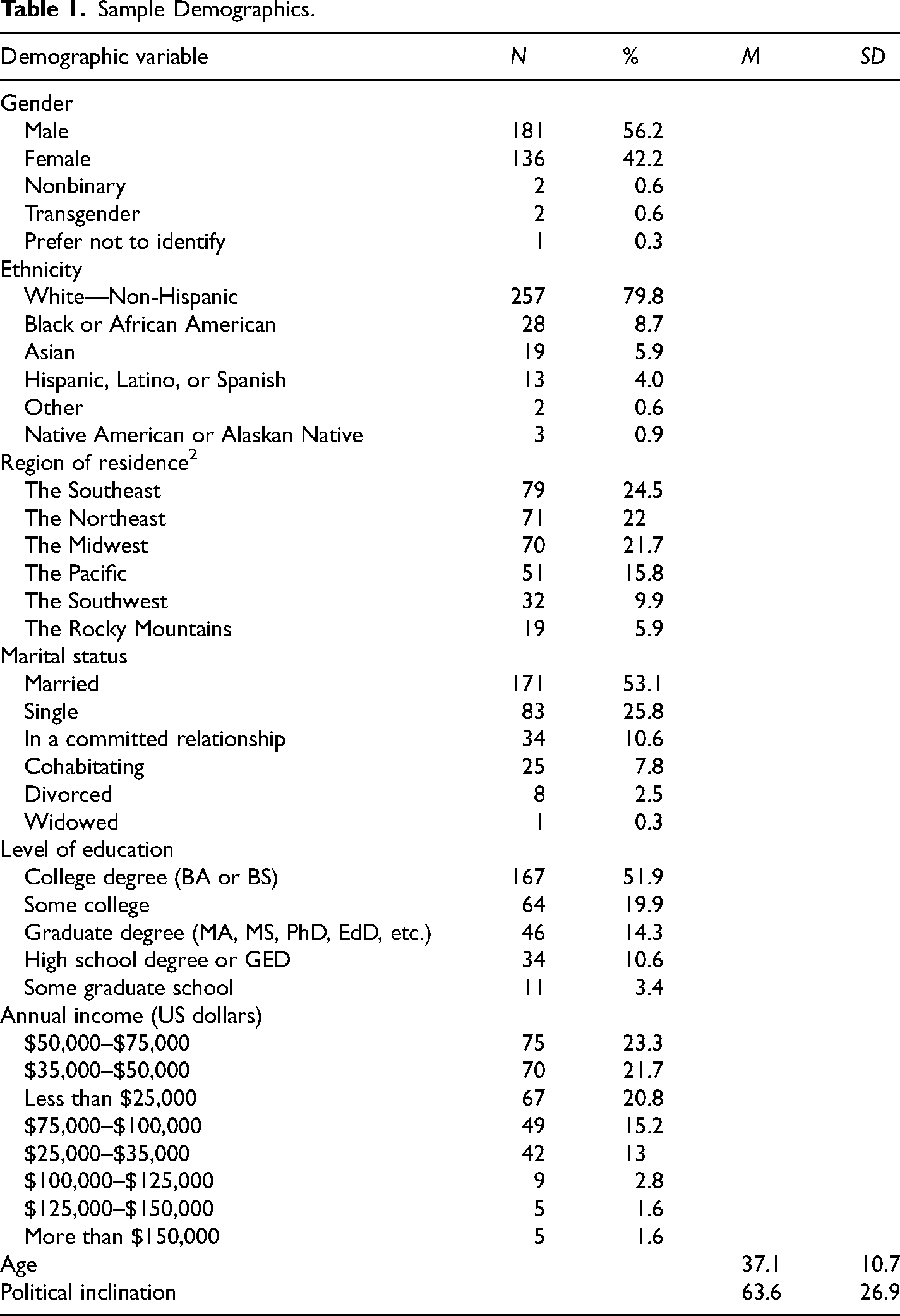
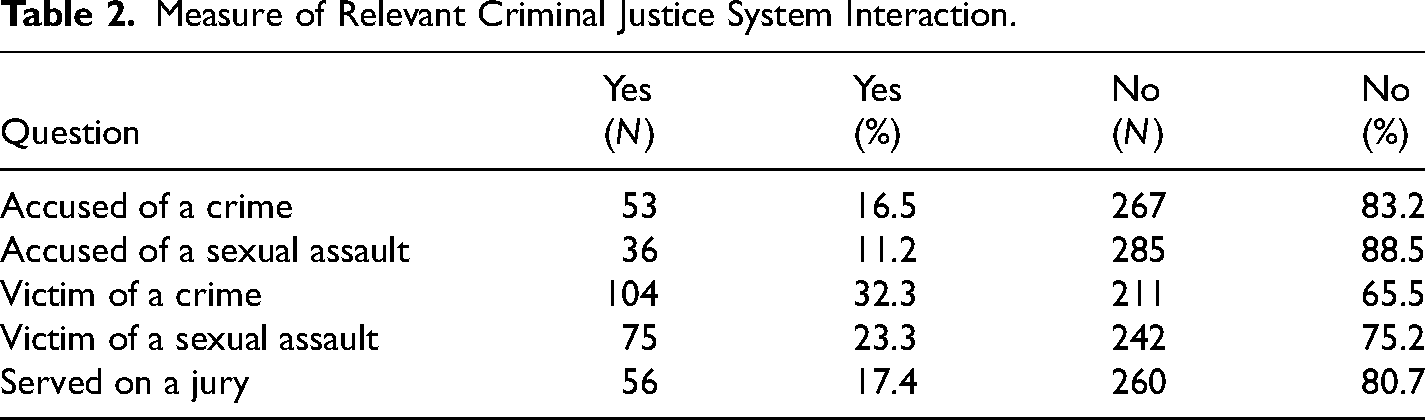
Demographics of the final sample are detailed in Table 1. All participants were U.S. citizens. Most participants were male (56.2%), white (79.8%), married (53.1%), and had a college degree (51.9%). The median age was 34 years old, with a range of 19 to 70 years old. Most participants reported residing in either the southeast (24.5%) or the northeast (22%) regions of the United States and the majority (94.1%) of participants reported an annual income of less than US$100,000 with about half (55.6%) making less than US$50,000. Participants reported their political inclinations as somewhat moderate but leaning liberal with a mean value of 63.61 and a median value of 68 on a scale from 0 (super conservative) to 100 (super liberal). In terms of prior experience with the criminal justice and/or legal system (see Table 2), the majority denied being accused of a crime (82.9%), specifically of sexual assault (88.5%), and being a victim of a crime (65.5%), specifically of sexual assault (75.2%). The majority also reported never having served on a jury before (80.7%) highlighting the participants’ lack of interaction with the systems being addressed in this study.
Sample Demographics.
Measure of Relevant Criminal Justice System Interaction.
Materials
The survey that participants completed consisted of five main sections: informed consent, a measure of media watching habits, a vignette, a measure of blameworthiness and punishment for the victim and the aggressor, demographics, and a debrief. On average, it took participants 16.6 min to complete.
In line with past research looking at the CSI Effect (e.g., Schanz & Salfati, 2016; Shelton et al., 2007), to measure the participants’ media-watching habits, they were asked to report how many hours per week they watched true crime shows, true crime documentaries, fictional crime shows, and/or crime dramas. The CSI effect literature has shown that how much relevant media a person is exposed to is more impactful than the type of media (e.g., Cole & Dioso-Villa, 2007; Schanz & Salfati, 2016). Therefore, both true crime and fictional portrayals of crime were included to ensure that all relevant media that the participants watched was captured.
To determine how the second independent variable, victim gender, impacted participants’ perceptions of victim and aggressor blameworthiness and punishment, all participants were randomly assigned to view one of four versions of a vignette consisting of a depiction of a sexual assault between an aggressor and victim who knew each other, with no mention of the gender of the aggressor so as not to confound the main variable of interest. This type of scenario was chosen because of its prevalence in real-world statistics of sexual assaults (Adams-Clark & Chrisler, 2018; Merken & James, 2019). The four versions of the vignette differed with respect to the gender of the victim, with each vignette describing the victim as either female, male, transgender, or nonbinary and using the corresponding pronouns. The vignette was as follows: Jesse, a 22-year old [victim gender] was at a party with some friends. While at the party, Jesse was dancing with friends. While dancing, Jesse's crush came up to talk to and dance with [appropriate pronoun]. After some time, Jesse's crush invited [appropriate pronoun] to get some fresh air outside. While they were outside and talking, Jesse's crush leans over and kisses Jesse. At first, Jesse is fine with that, but the situation starts to escalate quickly. Jesse's crush starts touching Jesse in places [appropriate pronoun] does not want. Jesse says no multiple times, but is not listened to. When [appropriate pronoun] crush starts to take off [appropriate pronoun] pants, Jesse again says no and tries to get away. Instead, Jesse is pushed up against a wall, and [appropriate pronoun] crush starts to have sex with [appropriate pronoun]. Throughout this, Jesse is asking [appropriate pronoun] crush to stop, which does not happen. When it's over, Jesse's crush thanks [appropriate pronoun] and goes back in to the party.
To assess the participants’ perceptions of the blameworthiness and deservingness of punishment, they were asked to report their agreement on a scale of 1 (not at all agree) to 7 (very much agree) with six statements, three about the victim and three about the aggressor. The statements included, “The [offender/victim] is partly to blame for this incident,” “The [offender/victim] is fully to blame for this incident,” and “The [offender/victim] should be punished for this incident.” To measure blameworthiness, a summary score of the questions about blame was summed according to the target (e.g., victim or aggressor), resulting in two summary scores, one for the victim and one for the aggressor, both ranging from two to 14. To measure the deservingness of punishment, each statement resulted in its own score, one for the victim and one for the aggressor, both ranging from 1 to 7.
At no point in the study materials is the incident in the vignette labeled as a sexual assault. Additionally, neither the phrase, “sexual assault” nor any of its synonyms or euphemisms were included in the study materials. This was done intentionally so as not to influence the participants’ perceptions of the victim and the aggressor in any way. How a person defines an incident as a sexual assault is an independent perception of the participants and the goal of this study was not oriented toward the evaluation of that perception.
Participants’ demographics were also assessed by requesting participants report their gender identification, age, ethnicity, geographical location, marital status, level of education, annual estimated income, and political inclination on a scale of 0 (Super Conservative) to 100 (Super Liberal). Participants were also probed regarding their previous interactions with the criminal justice and/or legal systems as either victims, offenders, or jurors. These demographics were measured to ensure an appropriate representation of the population from the sample.
Procedure
All materials and procedures were approved by the authors’ institution's Institutional Review Board. As previously stated, participants were recruited through Amazon's MTurk and the survey was distributed through Qualtrics. Upon initiation of the survey, participants were presented with an informed consent document. Once they consented, they were then presented with the media-watching habits measure. Participants were then randomly assigned to read one version of the vignette (where the victim was either described as female, male, transgender, or nonbinary) and then responded to the six questions regarding blameworthiness and deservingness of punishment of the victim and the aggressor. Participants were also asked to explain their dis/agreement with the statements overall via open-ended responses. Participants then filled out the questions about their demographics. They were then debriefed, thanked for their participation, and presented with a code to receive their compensation via MTurk.
Results
Four multiple regression models were run to analyze the impact of victim gender and media-watching habits on the four dependent variables: victim blameworthiness, offender blameworthiness, victim deservingness of punishment, and offender deservingness of punishment. Media-watching habits were measured continuously while gender was measured categorically. Therefore, victim gender was dummy coded for these analyses, with the victim being described as female being the reference group as it is the most stereotypical scenario in sexual assaults (Merken & James, 2019). For all four models, all of the relevant statistical assumptions were evaluated and met.
Victim Blameworthiness
Multiple linear regression analysis was used to develop a model for predicting victim blameworthiness from victim gender and participants’ media-watching habits. Table 3 details the basic descriptive statistics and regression coefficients. On average, victim blame was low (M = 4.91; SD = 3.92) but there was moderate variation in responses. Only media-watching habits had significant zero-order correlations with victim blameworthiness and significant partial effects in the full model. The two predictor model was able to account for 11.9% of the variance in victim blameworthiness, F(4, 317) = 147.28, p < .05, R2 = .35, 95% CI [0.23, 0.44].
Multiple Regression With Descriptives Predicting Victim Blameworthiness.
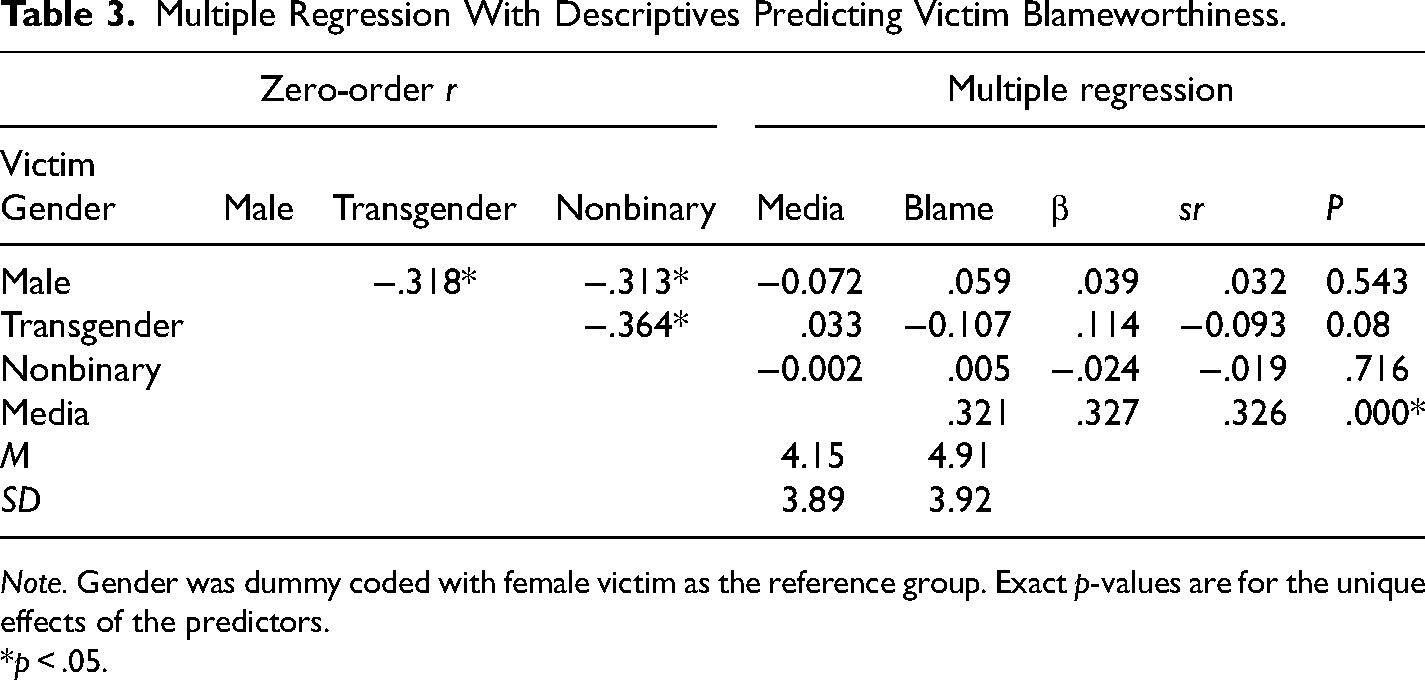
Note. Gender was dummy coded with female victim as the reference group. Exact p-values are for the unique effects of the predictors.
*p < .05.
Based on this analysis, victim gender did not have an impact on participants’ perceptions of blame toward the victim, but their media-watching habits did. For every 3.9 hours that participants watched crime-related media (e.g., one standard deviation of watching habits), their perception of victim blameworthiness increased by 1.27 units on the agreement scale (ranging from 2 to 14 with higher scores indicating higher levels of blame). Interestingly, despite a nonsignificant overall impact, the beta weights for victim gender were positive for male victims (i.e., they were blamed more than females) and negative for transgender and nonbinary victims (i.e., they were blamed less than females), indicating differential, albeit, nonsignificant variation in victim blameworthiness by gender.
Offender Blameworthiness
Multiple linear regression analysis was also used to develop a model for predicting offender blameworthiness from victim gender and participants’ media-watching habits. Table 4 details the basic descriptive statistics and regression coefficients. Overall, offender blameworthiness was high (M = 12.00; SD = 2.41). Only media-watching habits had significant zero-order correlations with offender blameworthiness and significant partial effects in the full model. The two predictor model was able to account for 4.1% of the variance in offender blameworthiness, F(4, 317) = 3.368, p < .05, R2 = .20, 95% CI [−0.18, −0.05].
Multiple Regression With Descriptives Predicting Offender Blameworthiness.
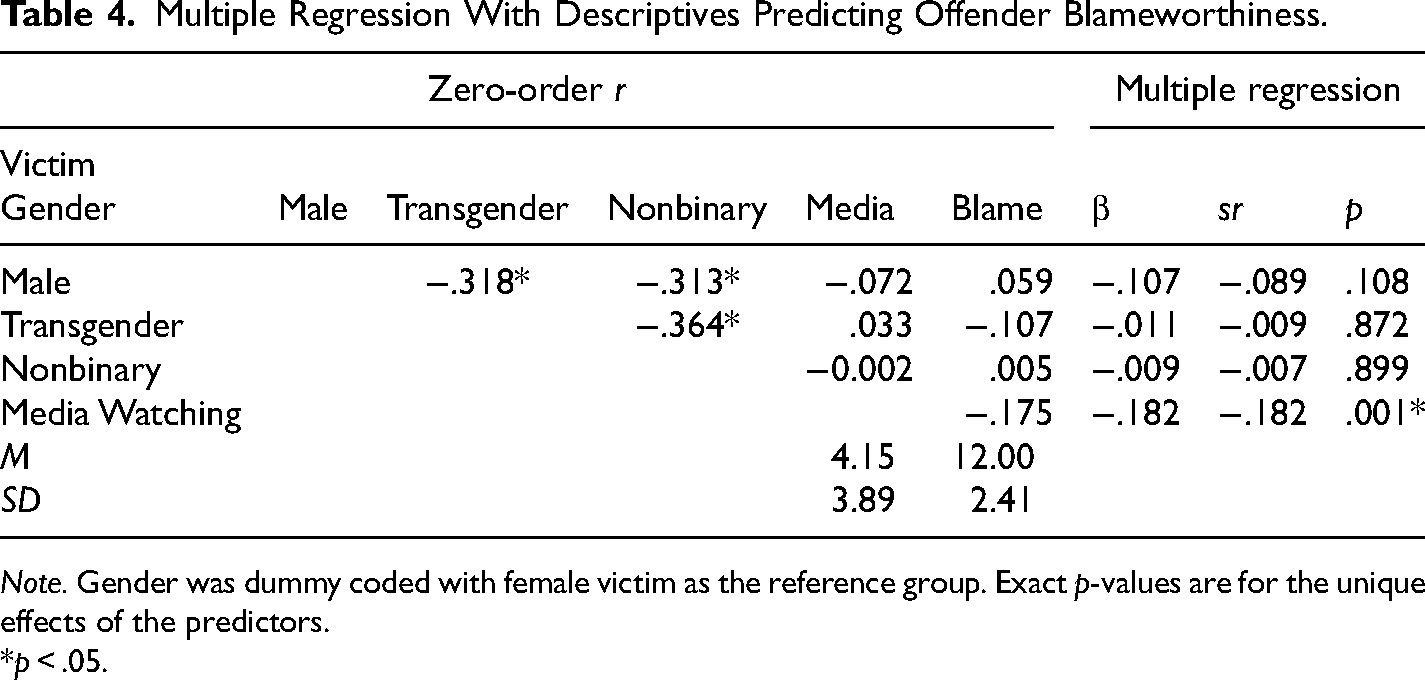
Note. Gender was dummy coded with female victim as the reference group. Exact p-values are for the unique effects of the predictors.
*p < .05.
Based on this analysis, victim gender did not have an impact on participants’ perceptions of blame toward the aggressor, but their media watching habits did. For every 3.9 hours that participants watched crime-related media, their perception of offender blameworthiness decreased by 0.44 units on the agreement scale (ranging from 2 to 14 with higher scores indicating higher levels of blame). Regardless of which gender the participants viewed, perceptions of offender blameworthiness did not significantly change. However, the beta weights were negative for all victims, indicating a nonsignificant trend toward decreasing offender blameworthiness overall.
Victim Deservingness of Punishment
Multiple linear regression analysis was again used to develop a model for predicting victim deservingness of punishment from victim gender and participants’ media watching habits. Table 5 details the basic descriptive statistics and regression coefficients for the model. Overall, victim deservingness of punishment was moderate (M = 8.64; SD = 1.53). Only media-watching habits had significant zero-order correlations with victim deservingness of punishment and significant partial effects in the full model. The two predictor model was able to account for 13% of the variance in victim deservingness of punishment, F(4, 317) = 11.841, p < .05, R2 = .36, 95% CI [0.09, 0.18].
Multiple Regression With Descriptives Predicting Victim Deservingness of Punishment.
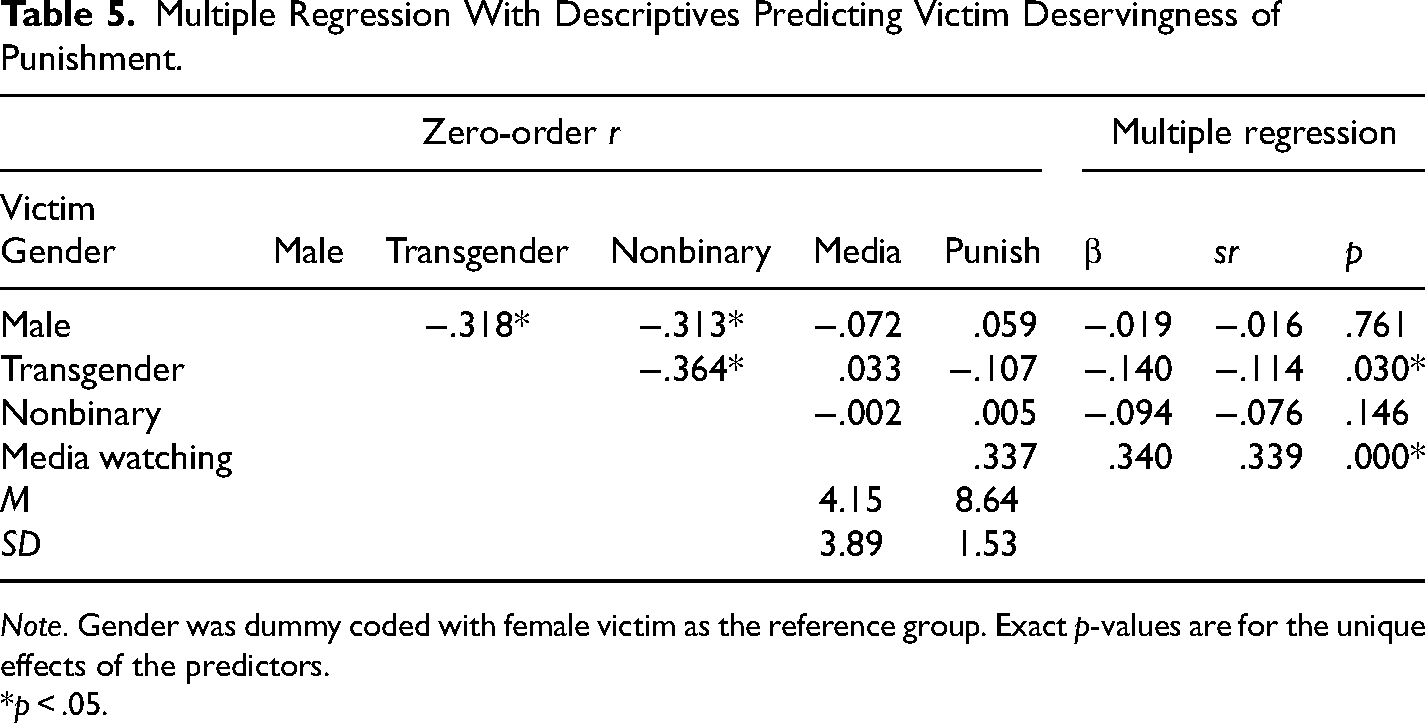
Note. Gender was dummy coded with female victim as the reference group. Exact p-values are for the unique effects of the predictors.
*p < .05.
Based on this analysis, victim gender did not have an impact on participants’ perceptions of deservingness of punishment toward the victim, but, as seen in previous analyses, their media-watching habits did. For every 3.9 hours that participants watched crime-related media, their perception of victim deservingness of punishment increased by 0.52 units on the agreement scale (ranging from 2 to 14 with higher scores indicating higher levels of deservingness of punishment). Regardless of which gender the participants viewed, perceptions of offender blameworthiness did not significantly change. However, the beta weights were negative for all victims, indicating a nonsignificant trend toward decreasing deservingness of punishment toward male, nonbinary, and transgender victims in comparison to female victims.
Offender Deservingness of Punishment
Multiple linear regression analysis was lastly used to develop a model for predicting offender deservingness of punishment from victim gender and participants’ media watching habits. Table 6 details the basic descriptive statistics and regression coefficients of the model. Overall, offender deservingness of punishment was high (M = 12.81; SD = 1.81). Again, only media-watching habits had significant zero-order correlations with offender deservingness of punishment and significant partial effects in the full model. The two predictor model was able to account for 4.8% of the variance in offender deservingness of punishment, F(4, 317) = 3.988, p < .05, R2 = .22, 95% CI [−0.15, −0.05].
Multiple Regression With Descriptives Predicting Offender Deservingness of Punishment.
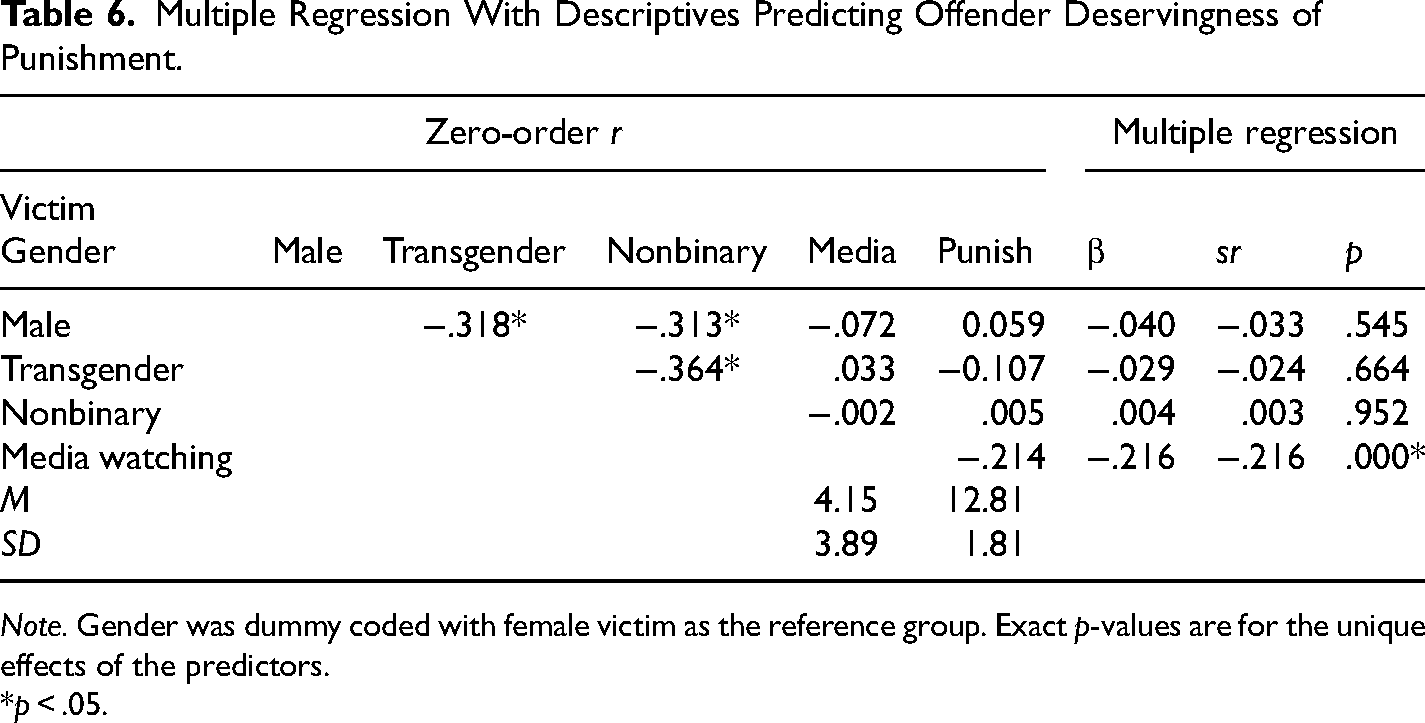
Note. Gender was dummy coded with female victim as the reference group. Exact p-values are for the unique effects of the predictors.
*p < .05.
Based on this analysis, while victim gender did not have an impact on participants’ perceptions of the deservingness of punishment toward the aggressor, their media-watching habits did. For every 3.9 hours that participants watched crime-related media, their perception of offender deservingness of punishment decreased by 0.39 units on the agreement scale (ranging from 2 to 14 with higher scores indicating higher levels of deservingness of punishment). Perceptions of offender deservingness of punishment did not significantly change by victim gender. However, the beta weight was positive for nonbinary victims (i.e., the aggressor was deemed more deserving of punishment than when the victim was female) and negative for male and transgender victims (i.e., the aggressor was deemed less deserving of punishment), indicating a nonsignificant trend toward variation in deservingness of punishment for aggressors by the gender of their victim.
Discussion
The purpose of this study was to determine whether media-watching habits and victim gender influenced perceptions of victim and aggressor blameworthiness and deservingness of punishment. Across the four dependent variables of victim blame, offender blame, and the deservingness of punishment for the victim and the offender, media-watching habits had small but significant impacts on all four, accounting for 4% to 13% of the variance in each of the models. Media-watching habits, overall, had a larger impact on perceptions of the victim than perceptions of the aggressor. Therefore, regardless of the target, what people watch for their entertainment informs and influences their perceptions of real-world, criminal-justice-related situations. This was particularly true of perceptions of the victim, with 11% to 13% of the variance being accounted for by the participants’ media-watching habits. This not only validates past research on social learning (e.g., Bandura, 2001; Gerbner et al., 1980) and media's influence on perceptions of forensic evidence (Cole & Dioso-Villa, 2007; Durnal, 2010; Ferris, 2011; Schanz & Salfati, 2016; Stinson et al., 2007), it also shows that this phenomenon is potentially more widely applicable than previously shown.
Media-watching habits showed their largest impact on victim blame. Findings indicated that the more media an individual engaged in, the more likely they were to blame the victim. This is likely explained by media sources often showing stereotypical portrayals of sexual assault in which rape myths are used to blame the victim (Bohmert et al., 2018). While consent was verbally denied in the vignette, it does not describe the victim physically resisting the aggressor's actions, which contradicts the stereotypical victim scenario. As a result, victim blame would be high, as the scenario was not stereotypically obtained and/or denied. These types of portrayals have been common in the media for decades and are likely a significant source of knowledge for the demographic population in this study (Acquaviva et al., 2020). The majority of participants in this study had a college degree and engaged in a wide variety of media. Given that and the fact that colleges and universities, in their own crime-relevant media, tend to focus on rape and sexual assault (Bohmert et al., 2018), this sample was likely inundated with stereotypical portrayals of sexual assault.
Findings also indicated that more time spent engaging with media predicted an increased belief that the victim deserved punishment. This is likely due to media sources often using selective language to establish distance between the crime and the perpetrator of the crime, leaving the victim vulnerable to the belief that they are responsible for and deserve punishment as a result of the assault (Easteal et al., 2015). Media also tends to use traditional gender roles to perpetuate rape myths and increase victim responsibility; actions such as objectifying the victim may create a barrier between aggressor and victim and lead to greater perceptions of victim deservingness for punishment on the part of the viewer (Wright & Tokunaga, 2015). This study's findings further support the idea that media displaying stereotypical portrayals will lead to more victim blame and increased perceptions of the victim's deservingness of punishment.
Lastly, findings showed that media-watching habits had a smaller but significant effect on both aggressor blame and deservingness of punishment. Specifically, the more media a person watched, the less likely they were to blame the aggressor and deem the aggressor deserving of punishment. This suggests that aggressors are held less responsible for sexual assault than victims, despite being the perpetrators in the offense. This confirms past research (e.g., Bohmert et al., 2018; Braganza, 2020; Kotanen & Kronstedt, 2019; Nagy, 2017) as well as expands upon it showing that this phenomenon occurs regardless of victim gender.
However, in contrast to past research (e.g., Black & McCloskey, 2013; Davies et al., 2009; Kotanen & Kronstedt, 2019; Merken & James, 2019; Russell & Kraus, 2016), victim gender did not have a significant impact on victim and aggressor blameworthiness and deservingness of punishment. While there was variation by gender in the beta-weights, that variation was not significant. This could be because the sample consisted of slightly more men than women. Research has shown that traditional gender roles are more likely to be held by men, differentially impacting the perceptions of victim and aggressor blameworthiness and deservingness of punishment (Black & McCloskey, 2013; Schuller et al., 2010). Additionally, men are more likely to justify the aggressor's actions than women (Wegner et al., 2015). Since the gender of the aggressor was left ambiguous in the vignette, it is possible that some of the men participants assumed the aggressor was a man and identified with the aggressor, increasing justification and victim blame.
It is also possible, however, that victim gender was found to be nonsignificant because it serves as a proxy for attitudes that are better captured or informed by people's media-watching habits. Past research has suggested that the influence of victim gender is a manifestation of one's belief in stereotypical gender roles (Black & McCloskey, 2013; Schuller et al., 2010; Wright & Tokunaga, 2015). Since media, particularly that which details criminal activity, tends to portray stereotypical gender roles, especially in its depictions of sexual assault (Black & McCloskey, 2013; Braganza, 2020; Easteal et al., 2015; Jenkins, 2020; Merken & James, 2019; Patil & Purkayastha, 2015; Wright & Tokunaga, 2015), it is possible that media is the framework through which all perceptions, including those related to the victim and the aggressor, are processed.
Implications
Despite recent cultural movements trying to combat this narrative (e.g., #MeToo, and Times Up!), the media is still portraying significant numbers of incidents of stereotypical sexual assaults (Easteal et al., 2015; Nagy, 2017; Patil & Purkayastha, 2015). As a result, people's personal beliefs regarding perceptions of the victim and aggressor in a sexual assault are unlikely to change, regardless of the cultural movements attempting to do so. Consumers will continue to engage in this media and continue to internalize these portrayals and use them as guides when they encounter similar scenarios in real-life. Unfortunately, this means that victims of sexual assault will also continue to face barriers in the aftermath of their assault. They will continue to be discredited, blamed, and held responsible for the prevention of sexual assault. Not only does this likely negatively impact their recovery, but it could also negatively impact the investigation and adjudication of the assault. When victims are not believed, determined to be “unreliable,” or blamed for their assault, investigations stop, and adjudications of aggressors are nonexistent.
These potential outcomes are even more likely when considering that finding that the gender of the victim itself was not a significant influence on participants’ perceptions of blameworthiness and deservingness of punishment of the offender and victim as has previously been found (e.g., Black & McCloskey, 2013; Davies et al., 2009; Kotanen & Kronstedt, 2019; Merken & James, 2019; Russell & Kraus, 2016). This implies that people's personal beliefs are not independent of their media engagement; that their personal beliefs are significantly informed by their media engagement. Therefore, to change the trends of sexual assault victim blaming and aggressor action justification in the general public, the focus of interventions and cultural movements may be better centralized on the informant(s) of people's personal beliefs: the media and its portrayal of gender. By advocating for a change in the way media portrays victims and their gender, or gender in general, perceptions of blame and punishment may be more effectively and efficiently transformed. However, until the media portrays more accurate depictions of sexual assault, this study suggests that this phenomenon will likely continue.
Limitations
The use of MTurk for recruiting participants for this study does have limitations. While MTurk gives researchers the ability to gather reliable data quickly and efficiently and multiple studies have shown MTurk to produce better samples than typical convenience samples, MTurk still may not be representative of the entire population. In addition, the individuals who participate in a study have likely participated in many other studies, and if they are expecting a certain experiment or certain questions, that may alter their responses. This may have contributed to the lack of impact of gender if participants were answering questions to cater to what they believed to be “correct” for a specific vignette.
Additionally, media-watching habits were operationalized to be inclusive. However, this decision could be a limitation as it meant that the impact of different types of media (e.g., crime dramas vs. true crime documentaries) could not be determined. While both types of media are designed for entertainment purposes and therefore, use some degree of artistic license in their portrayals, it is possible that there may be differential impacts of watching fictional crime dramas and true crime documentaries. Future research should examine if there are any differential impacts of watching based on the type of crime-relevant media.
Lastly, while qualitative explanations were sought from the participants, they were not requested by variable. For example, after the four questions regarding blame and punishment, two other questions were asked about perceptions on other topics, and then participants were asked to explain their judgments. As a result, the qualitative explanations could not be separated out by variable. Future research should provide more specific opportunities for participants to explain their judgments to gain more insight into why/how they attribute blame and the deservingness of punishment.
Conclusion
Overall, these findings contribute to a pattern of increased media watching meaningfully contributing to the cultivation of people's personal beliefs and attitudes, specifically those regarding the blameworthiness and deservingness of punishment for the victim and aggressor. Future research should focus on elucidating the mechanism behind media watching habits’ influence on people's personally held beliefs and attitudes as well as expand the focus to other characteristics of the crime situation. This study suggests that it is possible that people are using media as a general information source for a wide variety of criminal justice-related knowledge. As a result, it is essential to understand how what people watch for entertainment purposes can influence their perceptions and how those perceptions can influence their behavior, particularly in high-stakes situations such as criminal justice investigations and adjudications.
Footnotes
Declaration of Conflicting Interests
The author(s) declared no potential conflicts of interest with respect to the research, authorship, and/or publication of this article.
Funding
The author(s) received no financial support for the research, authorship, and/or publication of this article.
