







Abstract
A report entitled Say Her Name: Resisting Police Brutality against Black Women underscores the paucity of research examining police violence toward Black women. This study focused on how valuing a White police officer and symbolic racism moderate reactions when the officer fatally shoots a Black or White woman during a traffic stop. At high levels of officer valuing, symbolic racism was positively associated with perceptions the victim presented a threat to the officer, but negatively associated with support for punishing the officer and perceived victim compliance; these associations were stronger when the victim was Black relative to White. At low officer valuing levels, there was no variability in the link between symbolic racism and the outcome variables as a function of victim race. Implications for bias in judicial outcomes for the victim and officer are discussed.
Police violence against Black women is marginalized in the public's understanding of American policing. … For decades, Black women have been targets of police violence and brutality. –Dr. Keisha N. Blain
In March 2020, White plainclothes police officers fatally shot Breonna Taylor, a 26-year-old Black woman, in her Louisville apartment during a wrongfully executed drug operation. In October 2019, a White police officer fatally shot Atatiana Jefferson, a 28-year-old Black woman, in her home after she looked out her window to determine the source of a disturbance in her yard. An analysis of police shooting statistics reveals that being Black is one of the greatest risk factors for being an unarmed victim of a police shooting (Ross, 2015). Thus, social scientists have given significant attention to examining factors that influence White police interracial violence against Black men, including examinations of how stereotypical beliefs about Black men (i.e., violent, criminal, threatening) influence decisions of White individuals in simulated police videogames to shoot a Black or White target (see Correl et al., 2002; Glaser & Knowles, 2008). Recent research has begun to focus on factors that might impact the responses of Black (Johnson et al., 2020) and White (Johnson & Lecci, 2020a, 2020b) Americans to police violence against Black men (e.g., victim-directed empathic responding). Cooley, Brown-Ianuzzi, and Cottrell (2019) report that relative to social conservatives, social liberals perceived more racism in the police shooting of a Black man. Moreover, priming White privilege increased perceived racism in these events, regardless of political ideology. In addition, Cooley, Brown-Ianuzzi, Lei, and Cipolli (2019) found that implicit and explicit racial prejudice predicts lower perceived guilt for a White officer who killed a Black man.
There is clear evidence that Black women face systematic mistreatment in the criminal justice system. The imprisonment rate for Black women is approximately 1.7 times the rate for White women in America. Black girls are 3 times as likely as their White peers to be imprisoned (The Sentencing Project, 2022). In San Francisco, California, Black women comprise 5.8% of the population but constituted 45.5% of women arrested (Males, 2015). Notably, in her seminal review of police violence against Black women in America, Jacobs (2017, p. 41) posits that “State violence against Black women is long-standing, pervasive, persistent, and multilayered, yet few legal actors seem to care about it.”
One critical limitation in the social psychological literature is the minimal empirical attention examining police violence toward Black women. The central goal of the present study was to shed greater light on factors that might influence reactions to innocent Black women who suffer from deadly police mistreatment. Black scholars (Collins, 2000) and contemporary social activists (Blain, 2020; Moore, 2015) contend that negative stereotypes, which can be traced to exploitation during the Antebellum Period, make it difficult for Black women to obtain justice for police violence, in particular, and in the criminal justice system, in general. These stereotypes include beliefs that Black women have elevated masculinity, are more likely to be sexually promiscuous (Rosenthal & Lobel, 2017), and most relevant for the current study, are threatening and violent (Ghavami & Peplau, 2013; Thiem et al., 2019). Not surprisingly, racial and ethnic minority women are more likely to experience more forms of police violence relative to White women (Edwards et al., 2019; Fedina et al., 2018). Consequently, a recent African American Policy Forum report entitled Say Her Name: Resisting Police Brutality against Black Women sheds some light on grave consequences that can result when there is minimal media and empirical attention addressing the incidence and consequences of police violence against Black women. The authors contend that the failure to demand accountability for Black women who are victims of police violence “leaves Black women unnamed and thus under-protected in the face of their continued vulnerability to racialized police violence” (Crenshaw et al., 2015, p. 3).
In the limited empirical research examining police violence toward Black women, Brown-Ianuzzi et al. (2021) explored factors that may influence perceptions of bias and unequal treatment. Specifically, they report that the degree to which a woman is perceived as feminine predicted greater levels of perceived victim pain, less blame to the victim, and diminished beliefs that the police officer's use of force was justified when the victim was White (but not Black). The present study builds upon this research by examining how characteristics of the observer, victim, and officer interact to influence biased perceptions. In particular, in the case of a fatal police shooting, we examined how symbolic racism (i.e., subtle and less direct racial prejudice) among Whites and valuing a police officer (i.e., liking him, caring about his welfare, see Batson et al., 2007) interact with the race of a female victim (Black, White) to influence beliefs that the victim was a threat to the officer and complied with the officer's directives, and support for charging the officer with a crime. We focused on excessive use of force by a White male police officer based on evidence that they are the most likely perpetrators of police violence, even after accounting for the fact that White males comprise most of the police force (Harvard Political Review, 2017).
Symbolic Racism and Violence Against Black Americans
Symbolic racism theory suggests that attitudes of White Americans who hold prejudicial attitudes toward Black Americans are based, in part, on the beliefs that Black Americans are not doing what Americans should do to succeed, such as hard work (i.e., anti-Black antipathy), and tending to rely on assistance from the government or other entities (Sears, 1988; Sears & Henry, 2003). The bulk of symbolic racism research focuses on the extent that it predicts policy attitudes across racial and nonracial domains. For example, symbolic racism was more likely to predict attitudes toward policies concerning racial integration of schools and hiring of Blacks than support for gay rights and military defense spending (Kinder & Sanders, 1996). In addition, evidence shows that symbolic racism was positively associated with support for punitive crime policies and opposition to preventative crime policies (Green et al., 2006) and negatively associated with perceptions that police officers typically engage in discriminatory treatment of minorities (Matsueda & Drakulich, 2009).
A review of the PsycINFO database indicates a dearth of research focused on the association between symbolic racism and reactions to police violence directed at Black women. This lacuna in the literature is surprising given that racial prejudice is linked with all forms of violence directed against Black Americans, including rape and physical assault of Black women (Brown et al., 2013; West, 2002). Black women in America have endured gendered racism, which is a form of gender and racial oppression that intersect to create difficult experiences for women who occupy multiple subordinate roles (Essed, 1991). Gendered racism can lead to a number of deleterious outcomes for Black women, such as poorer relationship satisfaction (Fisher & Coleman, 2017) and wage disparities relative to White men and women (NPWF, 2020). During the COVID-19 pandemic, gendered racism has been linked to placing Black women at greater risk for COVID-19 infections and decreased access to resources that mitigate the deadly impact of the virus (Laster-Pirtle & Wright, 2021). We build on critically important research focused on prejudice toward Black women by examining the degree to which these racial prejudices play a role in reactions to incidents involving a Black woman who is victimized by a White perpetrator. An assessment of this issue seems crucial because citizens are often called upon to serve on juries, and prejudices may influence their judicial decisions which can lead to profound consequences. For example, in cases of White police officers involved in minority-directed violence, persons serving on the jury could be asked to decide whether the officer should be formally charged (indicted) and convicted of criminal behavior. In sum, we seek to directly address the lacuna in the psychological literature involving the role of racial prejudice on societal reactions to police violence against Black women.
Valuing a White Officer in Cases of Minority-Directed Violence
Of the Black women killed by a police officer between 2015 and 2021, none of the 100 officers involved in these cases have been convicted (Tubman et al., 2022). Some legal practitioners suggest that the conviction rate for these officers may be due, in part, to the tendency for White Americans to show a favorable bias toward police officers who commit violent attacks against unarmed minorities. For example, in the infamous case involving police officers who beat Rodney King, a Black man, in the streets of Los Angeles, one prosecutor suggested that White jurors who acquitted the four White officers valued those officers and “protected them against the onslaught of the unwashed poor” (Appleson, 1992, p. 1). Decety and Cowell (2015) contend that such conflicts between fairness and justice occur when there is extreme valuing of a specific individual. Moreover, Batson et al. (2007) suggest that such valuing of an in-group member may lead individuals to “feel protective toward the person … and think about how this person is affected by events in his or her life” (Batson et al., 2007, p. 65). They further contend that valuing tends to increase vigilance for events that might adversely affect the person's welfare. Bloom (2017) suggests that negative treatment of an outgroup member occurs because observers may accentuate the pain and misery an outgroup member could have caused for the in-group member.
Race plays a critical role in perceptions of police officers. Relative to Black Americans, White Americans are consistently more likely to hold more positive views of police and report greater confidence that police will protect them from violent crime (Brunson, 2007; Hagan et al., 2006; Johnson et al., 2017; McCarthy, 2014; Strickler & Lawson, 2022). Surprisingly, there has been little examination of the impact of valuing on intergroup processes and interactions, especially in the context of policing. Specifically, we were interested in how valuing a police officer might influence reactions toward the violent actions of that officer. Given the status of police in society and legal structures supporting police officers, an examination of valuing seems especially relevant. In related research, Johnson and Lecci (2020a) found that White Americans’ empathy for a White police officer after he shot an unarmed Black man predicted diminished support for punishing that officer. We build on this research by directly examining the role of valuing and race of the victim in our assessment of reactions to police violence directed at a woman. One critical issue for the current study involves the question as to why there might be variability in valuing an officer subsequent to his killing of a Black woman. Certain individuals may perceive the officer as a killer of an innocent woman and thus hold the view that he is not worth valuing. Alternatively, others may value the officer because they believe his actions reflect efforts to protect society from an undesirable element or threat. Both possibilities were clearly illustrated following the 2014 incident wherein Darren Wilson, a White police officer, shot and killed Michael Brown, a Black man. Some Americans perceived Darren Wilson as a murderer (Rosenberg, 2014; Taylor, 2014), whereas others hailed him as a hero (Seitz-Wald, 2014; Whitley, 2014).
The Present Study
There has been limited research on the extent that prejudice-related individual differences among White Americans predict their reactions to minority-directed police violence and the offending officer after the violence has been committed. In directly addressing this lacuna in the literature, we utilized a Person (individual differences in symbolic racism) × Person (individual differences in officer-directed valuing) × Situation (victim race) approach. We propose that high valuing of a White police officer who is facing social and legal sanctions for fatally shooting a Black woman might cue racial prejudice and spur decisions that serve to protect him. On the other hand, at low officer valuing, there should be minimal motivation to engage in any form of protection toward the officer. Moreover, because this study was conducted in the wake of national and international condemnation of police violence toward Breonna Taylor, George Floyd, and other Black Americans, it is likely that social norms to avoid appearing prejudiced (McDonald & Crandall, 2015) may be extremely salient in a situation involving violence committed by a White police officer against an unarmed Black woman. Thus, it is expected that reactions among low-valuing participants would be driven by motivations to engage in socially acceptable and nonprejudiced reactions (O’Brian et al., 2010). To examine these questions, participants who identified as White completed a measure of symbolic racism and read a story describing an incident wherein a White police officer fatally shot an unarmed Black or White woman and rated the extent they valued the police officer. Thus, we employed a Victim Race (Black, White) × Continuous Variable (symbolic racism) × Continuous Variable (officer valuing) design. Participants provided a variety of responses to the incident, including the degree to which they believed the victim had threatened the officer's well-being and complied with the officer's directives, and the degree to which they supported criminally charging the officer.
Based on the rationale cited above, it was expected that when the officer was highly valued: (a) the positive association between symbolic racism and perceived victim threat (Hp1) would be greater when the victim was Black (relative to White), and (b) negative association between symbolic racism and perceived victim compliance (Hp2) and symbolic racism and support to criminally charge the officer (Hp3) would also be greater when the victim was Black (relative to White). However, at lower levels of officer valuing, the interaction between symbolic racism and victim ethnicity was not expected to reach significance for any of the outcome variables.
Method
Participants
The participants were 185 White (112 male, 73 female) persons in the United States. The average age was 37.75 (SD = 10.99, range 23–81). They received financial compensation ($4.00) for their participation. Participants were recruited using the crowdsourcing website Amazon Mechanical Turk (MTurk) and were presented with informed consent information. Their highest level of education completed was secondary school (N = 17), some college (N = 43), completed college (N = 106), and completed postgraduate degree (N = 19). Their income levels were less than $15,000 (N = 14), between $15,000 and $45,000 (N = 69), between $45,000 and $90,000 (N = 83), and above $90,000 (N = 19). All responses were confidential. To ensure the quality of the data, participants had to report an MTurk reputation score of 0.95 or greater (Chandler & Shapiro, 2016) and correctly answer numerous attention checks (i.e., correctly identifying the race of the victim). This project was approved by the Institutional Review Board at Western Washington University.
Materials and Procedure
Participants completed the eight-item symbolic racism scale (Sears & Henry, 2003). An example of an item is “It's really a matter of some people not trying hard enough; if Blacks would only try harder, they could be just as well off as Whites.” The response scale varies across items to minimize response bias. Some items use a 4-point response scale, from 1 = strongly agree to 4 = strongly disagree, whereas others use a 4-point scale, from 1 = all of it to 4 = not much at all. Reliability was excellent, α = .83. To address the possibility that symbolic racism might be confounded with conservative political ideology, participants also reported their political ideology (1 = very left leaning to 5 = very right leaning), which was used as a covariate in the analyses.
Participants were informed that the study examined how individuals make decisions about various life events. They read a story involving a White male police Sergeant who pulled over either a Black or White woman, named Rachel Wilson, who had just driven through a fairly wealthy predominately White neighborhood. This story mirrors a police shooting incident involving a Black individual who was pulled over and reached for relevant documents in the car's glove compartment (Edwards, 2015; Halas, 2014). The story included the following information. The woman did not live in the neighborhood but was taking a shortcut home. Video recorded by the Sergeant's bodycam showed he first asked the woman why she was in the neighborhood. The woman responded in a very loud voice, “Why did you stop me?” He responded by telling her to “stop being so aggressive” and to calm down, and stated he patrolled the area regularly and did not recognize her car. As she complied with the Sergeant's command to get out of the car, she made a quick movement toward the glove compartment, and the police officer yelled, “Don’t do it!” As she opened the glove compartment, he opened fire with his gun and shot her 5 times, fatally killing her. The bodycam video showed the woman was reaching for her vehicle registration and insurance information, as both were in her hand. A search of the car showed that she did not have a gun in the glove compartment or in the car. Later, at the police station, the police officer expressed remorse about what had happened. He said he had felt extremely threatened when she reached for the glove compartment and assumed she was reaching for a gun.
After reading the story, participants indicated the degree to which they valued the officer. The officer-directed valuing measure (adopted from Batson et al., 2007) was assessed by averaging participant responses to two items regarding the White police officer (Spearman-Brown = 0.80) that were rated on a 7-point scale (1 = not very much to 7 = extremely): “How likeable do you find Sergeant Billy Reynolds?” and “How much do you care about the welfare of the Sergeant Billy Reynolds?” Consistent with Johnson and Lecci (2020), which included an assessment of empathy after the officer shot the Black man, we took a special effort to assess valuing the officer after individuals were presented with information concerning the fatal shooting incident. This approach maximized ecological validity by mirroring procedural steps in the justice system wherein jurors typically have no direct or personal knowledge or access to information about the officer before the shooting occurred. Perceived victim threat was assessed with four items asking about the extent participants were certain that the officer (a) believed that the victim was sending threatening signals, (b) was justified in believing that the victim presented a threat when she reached into the glove compartment, (c) felt threatened by the victim, and (d) was justified in believing that the victim may have been reaching for a gun. Reliability was excellent, α = .82. Perceived victim compliance was assessed by an item asking about the extent to which participants were certain that the victim complied with the officer's directives. Support for criminally charging the officer was assessed by an item asking about the extent to which participants believed the officer should be criminally charged (i.e., indicted) for his actions.
Power
A sensitivity analysis with the simglm package (Lebeau, 2019) in R (R Core Team, 2013) revealed that the study had approximately 80% power to detect a three-way interaction effect size of 0.4 (significance level = 0.05). This sample size is similar to or exceeds those in past research examining societal reactions to minority-directed physical violence (e.g., Johnson et al., 2020). To assess whether the sample size affected the reliability of the analyses, we employed precision estimation. Precision estimation is a statistical technique that quantifies the extent to which a given sample size allows for the accurate estimation of regression parameters (Schweder & Hjort, 2016). Results of 10,000 simulations indicated that N = 185 would result in an average deviation of the sample estimate from the true parameter of the three-way interaction of 0.16, yielding a precision range of ±0.16 with 95% confidence.
Statistical Analysis Plan
Analysis of the Hypothesized Interaction. Because officer valuing and symbolic racism are continuous variables, PROCESS Model 3 was run (Hayes, 2018) to determine the significance of the Victim Race (Black, White) × Officer-Directed Valuing × Symbolic Racism interaction. PROCESS is an SPSS macro that executes path analysis-based moderation and mediation analysis using bootstrapping measures with 10,000 samples.
Probing the Interactions. The PROCESS Macro Model 3 provides a method to examine the significance of the expected interaction between victim race and symbolic racism at the 16th (i.e., low), 50th (i.e., moderate), and 84th (i.e., high) percentiles of officer-directed valuing. This allowed us to directly test our central expectations.
Results
Establishing the Independence of Officer-Directed Valuing and Symbolic Racism From the Effects of Victim Race
The overall effect of victim race did not reach significance for officer-directed valuing, t(183) = 1.72, p = .090, η2 = .016, or symbolic racism, t(183) = .47, p = .641, η2 = .001. Thus, it can be concluded that random assignment eliminated any systematic difference between the conditions in terms of officer-directed valuing and symbolic racism. All variability in degrees of freedom is due to missing values for all analyses.
The skewness of the variables of interest was as follows: perceived compliance (−0.21), perceived threat (−0.23), and criminal charges endorsement (−0.39). Figure 1 shows the histograms for these variables.
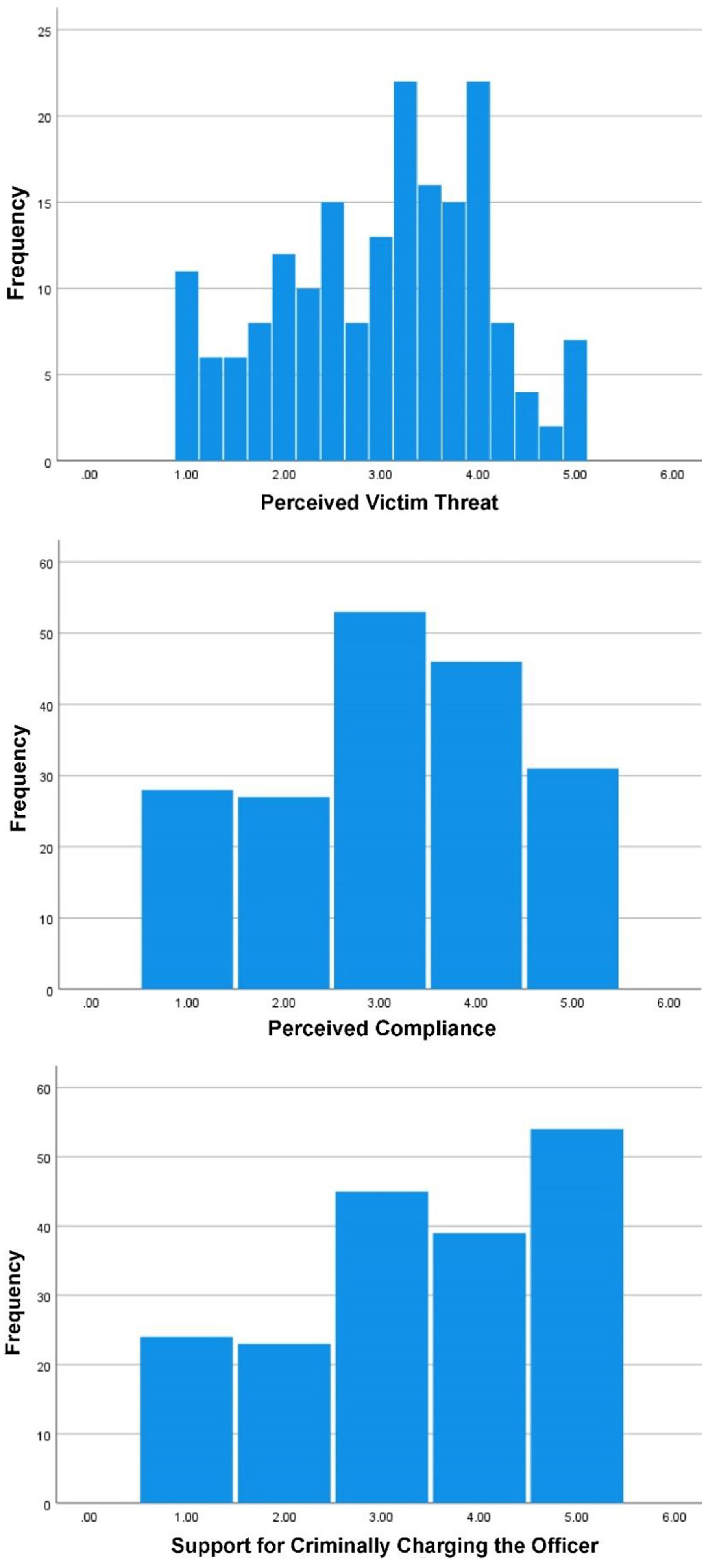
Histograms for Perceived Victim Threat, Perceived Compliance, and Support for Criminally Charging the Officer.
Perceived Victim Threat to Officer
The first set of analyses examined whether valuing the officer was associated with perceiving the victim as a threat to the officer's well-being (M = 2.98, SD = 1.04). Hp1 states that at higher (but not lower) levels of officer valuing, the positive association between symbolic racism and perceived victim threat should be greater when the victim is a Black woman relative to a White woman. Consistent with this hypothesis (see Figure 2), a PROCESS Model 3 analysis revealed the victim Race × Officer-Directed Valuing × Symbolic Racism interaction reached significance for perceived victim threat to the officer, ΔR2 = 0.025, F(1, 177) = 10.31, p = .001, B = −0.51, 95% CI [−0.83, −0.20]. In more direct support of our expectations, at high levels of officer valuing (84th percentile of officer valuing), the Victim Race × Symbolic Racism interaction reached significance, B = −0.83, F(1, 177) = 7.03, p = .008. The positive association between symbolic racism and the perceived threat was stronger when the victim was a Black woman relative to a White woman. When the officer was minimally valued (16th percentile of officer valuing), the Victim Race × Symbolic Racism interaction also reached significance, B = 0.72, F(1, 177) = 5.63, p = .018. Unexpectedly, the positive association between symbolic racism and perceived threat was greater when the victim was a White woman relative to a Black woman. This finding may indicate that persons scoring high in symbolic racism may have attempted to suppress racist views and instead show an anti-White bias.
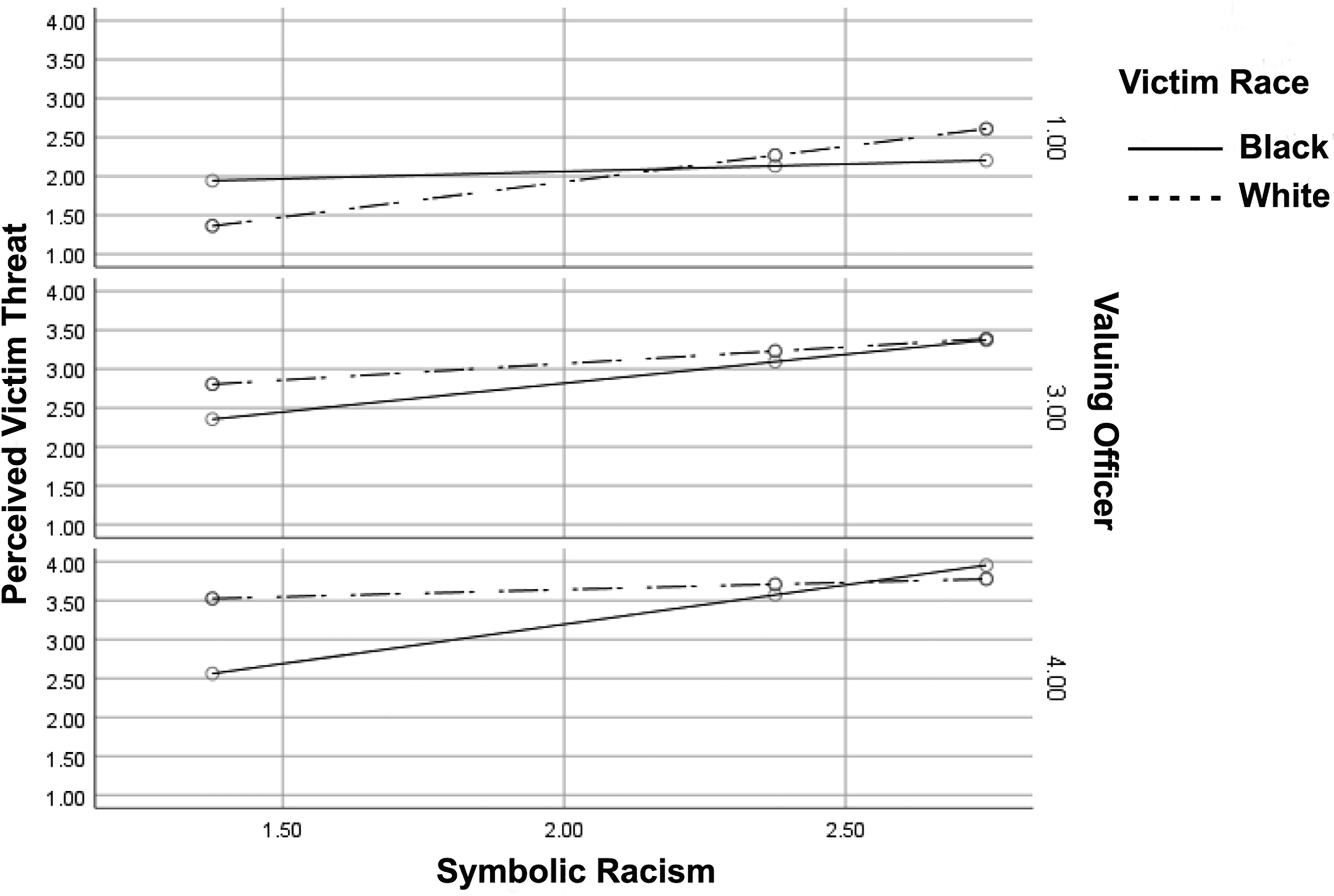
Perceived Victim Threat to the Officer as a Function of Symbolic Racism, Valuing the Officer, and Victim Race.
After controlling for political ideology, the Victim Race × Officer-Directed Valuing × Symbolic Racism interaction remained significant, ΔR2 = 0.022, F(1, 176) = 9.21, p = .002, B = −0.49, [−0.80, −0.17].
Perceived Victim Compliance With Officer
The second set of analyses examined how valuing the officer was associated with perceiving that the victim complied with the officer (M = 3.10, SD = 1.28). Hp2 states that at higher levels of officer valuing, the negative association between symbolic racism and perceived victim compliance should be greater when the victim is a Black woman relative to a White woman. Consistent with this hypothesis (see Figure 3), a PROCESS Model 3 analysis revealed that the Victim Race × Symbolic Racism × Officer-Directed Valuing interaction reached significance for perceived victim compliance, ΔR2 = 0.037, F(1, 177) = 7.65, p = .006, B = 0.77, 95% CI [0.22, 1.32]. When the officer was highly valued, the Victim Race × Symbolic Racism interaction reached significance, B = 1.14, F(1, 177) = 4.47, p = .036. The negative association between symbolic racism and the perceived compliance was stronger when the victim was a Black woman relative to a White woman. When the officer was minimally valued, the Victim Race × Symbolic Racism interaction also reached significance, B = −1.17, F(1, 177) = 4.93, p = .028. Consistent with the perceived threat findings, the negative association between symbolic racism and perceived victim compliance was greater when the victim was a White woman.
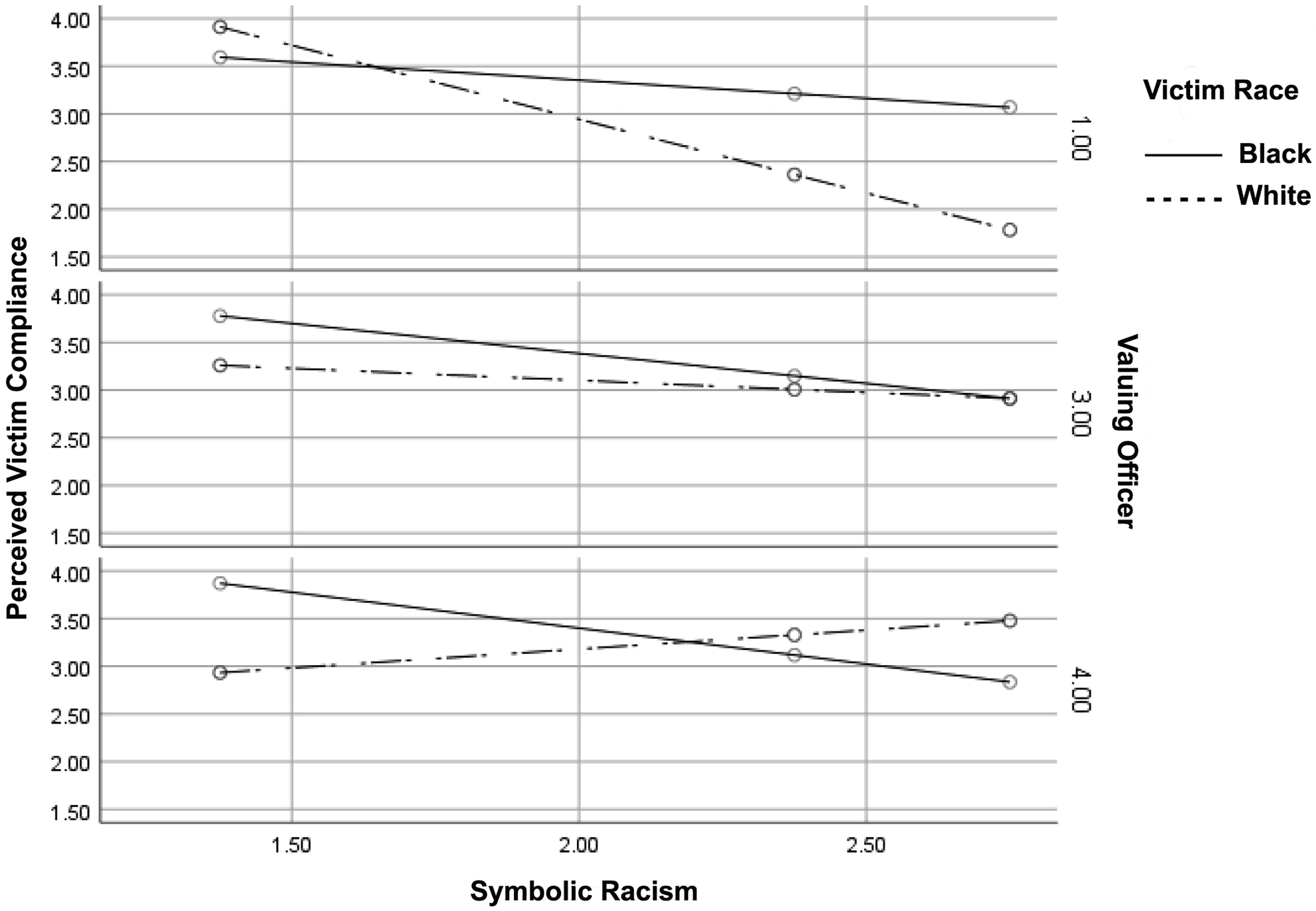
Perceived Victim Compliance With Officer as a Function of Symbolic Racism, Valuing the Officer, and Victim Race.
After controlling for political ideology, the Victim Race × Officer-Directed Valuing × Symbolic Racism interaction remained significant, ΔR2 = 0.034, F(1, 176) = 7.06, p = .008, B = 0.75, 95% CI [0.19, 1.30].
Support for Criminally Charging the Officer
The third set of analyses examined how valuing the officer was associated with support for charging the officer with a crime (M = 3.4, SD = 1.36). Hp3 states that at higher levels of officer valuing, the negative association between symbolic racism and criminal charges endorsement should be greater when the victim is a Black woman relative to a White woman. Consistent with this hypothesis (see Figure 4), a PROCESS Model 3 analysis revealed the Victim Race × Officer-Directed Valuing × Symbolic Racism interaction reached significance for criminal charges endorsement, ΔR2 = 0.027, F(1, 177) = 6.44, p = .012, B = 0.70, 95% CI [0.16, 1.25]. When the officer was highly valued, the Victim Race × Symbolic Racism interaction reached significance, B = 1.08, F(1, 177) = 4.06, p = .045. The negative association between symbolic racism and criminal charges endorsement was stronger when the victim was a Black woman relative to a White woman. When the officer was minimally valued, the Victim Race × Symbolic Racism interaction did not reach significance, B = −1.02, F(1, 177) = 3.84, p = .052.
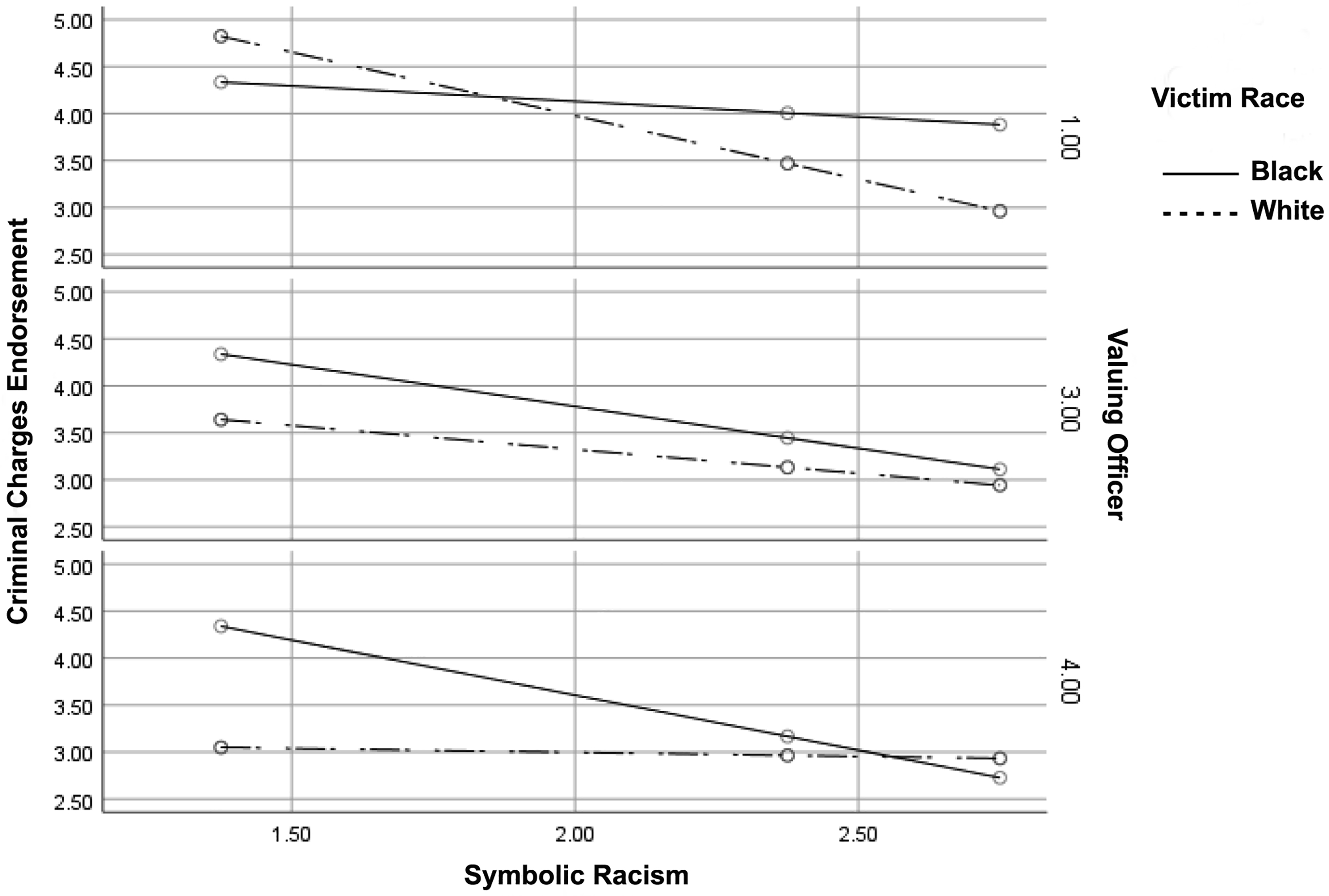
Support to Criminally Charge the Officer as a Function of Symbolic Racism, Valuing the Officer, and Victim Race.
After controlling for political ideology, the Victim Race × Officer-Directed Valuing × Symbolic Racism interaction remained significant, ΔR2 = 0.025, F(1, 176) = 5.92, p = .016, B = .68, 95% CI [0.13, 1.23].
Discussion
According to an African American Policy Forum report entitled Say Her Name: Resisting Police Brutality Against Black Women, the minimal empirical research and media attention focusing on incidences and consequences of police violence against Black women leaves them unnamed and thus under-protected in the face of their continued vulnerability to police violence (Crenshaw et al., 2015). Consequently, the report calls for greater empirical attention to all forms of police violence against Black women. Consistent with our Person (individual differences in symbolic racism) × Person (individual differences in officer-directed valuing) × Situation (victim race) theoretical framework, the present findings revealed that White participants’ dominant group member reactions to the police killing of an unarmed Black woman are influenced by an interplay of symbolic racism and valuing of the offending police officer. When the White officer was minimally valued, White participants did not express prejudicial feelings towards the Black victim (and even sometimes appeared biased against the White victim). However, when the officer was valued, racial prejudice predicted both adverse actions directed toward the Black woman victim and supportive reactions directed toward the officer. Specifically, the positive association between symbolic racism and victim-blaming reactions was greater when the victim was Black (compared to the White victim); and the negative association between symbolic racism and support for criminally charging the officer (i.e., officer-directed punitive reactions) and perceived victim compliance was greater when the victim was Black (compared to the White victim). The findings are especially noteworthy when we consider evidence that racial and ethnic minority women experience more forms of police violence relative to women from other ethnic groups (Fedina et al., 2018; Ritchie, 2017; Willingham, 2018). Clearly, there is a pressing need for greater empirical analysis of societal reactions to police violence against Black women (Crenshaw et al., 2015).
Importantly, the findings demonstrate that both unfavorable reactions directed at a Black woman who is a victim of police violence as well as favorable reactions directed toward the perpetrating White officer are not inevitable. These effects only occurred when there was clear valuing of the White police officer among participants who strongly endorsed symbolic racism beliefs. These results suggest that future work should focus on the role of contextual factors and dominant group member prejudice-related individual differences. For example, an assessment could evaluate whether reactions to police violence directed at a woman might vary as a function of whether the victim possesses traits stereotypically associated with Black women (e.g., aggressive, sexual). In addition, given that research shows certain Black Americans (i.e., those who minimally identify with their ethnicity) report unfavorable reactions toward Black victims of police violence (Johnson et al., 2020), future research assessing whether valuing the police officer might interact with individual differences (i.e., ethnic identity) among Black Americans and members of other ethnic groups to influence reactions to police violence against a Black woman seems warranted.
Extending Symbolic Racism and Prejudice Research
The bulk of research examining symbolic racism has focused on the extent it predicts policy attitudes (Kinder & Sander, 1996; Sears et al., 1999). In the limited research on symbolic racism and crime-related reactions, Green et al. (2006) showed symbolic racism predicts support for punitive crime policies and opposition to preventative crime policies. Further, Matsueda and Drakulich (2009) found that symbolic racism is negatively associated with perceptions that police officers typically engage in discriminatory treatment of minorities. However, prejudiced and stereotypical beliefs have been associated with all forms of violence against Black Americans. The present examination provides a direct examination of the association between symbolic racism and reactions to minority-directed violence. Given the considerable debate concerning civil unrest in the wake of police violence against specific Black women (e.g., Breonna Taylor, Sandra Bland), these current findings are especially relevant.
While symbolic racism has been linked to race-related policy support (Kinder & Sanders, 1996; Sears et al., 1999) and diminished beliefs that White police officers engage in discriminatory treatment towards minority group members (Matsueda & Drakulich, 2009), there has been limited research on factors that might moderate the impact of symbolic racism on subsequent race-related reactions. We addressed this lacuna in the literature by demonstrating that the link between symbolic racism and victim-directed and officer-directed reactions to police violence was moderated by the extent that White participants valued the offending officer. Finally, the current study focused on the role of positive reactions (i.e., valuing) to the police officer after he shot and killed a Black woman. However, other “postshooting” responses may have implications for whether symbolic racism or other individual differences predict victim-directed and officer-directed reactions. For example, many Americans report emotional distress and strong negative reactions (i.e., anger, disgust) toward an officer who is associated with the victim's death. It is possible that, like with minimal degrees of officer valuing, high levels of officer-directed anger and/or emotional distress could minimize the likelihood that symbolic racism will predict victim-directed and officer-directed reactions in a police shooting incident. Future research examining these questions is warranted.
Legal Policy Implications
The present study has legal policy implications as the findings provide a greater understanding of factors that influence how White individuals react to both the victim and harm-doer in cases of a White police officer perpetrating violence on a Black victim. Specifically, our primary outcome variables were all directly related to legal decision-making processes most pertinent to cases involving White police officers using excessive force with Black victims.
First, perceived victim threat is especially relevant because the U.S. Supreme Court standard regarding the acceptable use of lethal force by police officers is referred to as “objective reasonableness.” The central tenet of this standard is that lethal force is permissible when the officer “has probable cause to believe that the suspect poses a significant threat of death or serious physical injury to the officer or others” (Madar, 2014, p. 1).
Second, perceptions of victim compliance are relevant because a central issue associated with an array of outcomes (e.g., legal, citizen satisfaction) in response to police encounters concerns the extent that the individual is perceived to have complied with the officer's directives (McCluskey, 2003; McCluskey et al., 1999). Moreover, in cases of police violence against a Black unarmed victim, a central factor that influences societal reactions involves the extent that the victim was reported to have complied with officer's directives (Januta et al., 2020; Savage, 2020).
Third, criminal charges endorsement has direct implications for understanding factors that might influence whether prospective jurors would “reward” (i.e., reduce punitive responding) or “penalize” (i.e., increase punitive responding) White police officers who commit violence against unarmed minority group members. Moreover, these societal legal reactions could be utilized by “potential” police perpetrators of minority-directed violence to gauge “societal sanctioning” of their harmful actions. More generally, Gracia and Herrero (2007) suggest that a third party's strong beliefs and concomitant actions such as support for criminal indictment creates a climate of social intolerance toward unwarranted violence that will likely diminish the likelihood of future occurrences of similar forms of violence.
In sum, the current findings illustrate that policy makers should give greater consideration to the extent that participants’ racial prejudice, officer-directed valuing, and victim race influence prospective jurors’ reactions to police violence toward an unarmed Black woman. Importantly, none of these variables should be relevant to the final legal decision-making process, as the central variables of significance should be limited to the facts in any given case. However, the current findings clearly suggest that these “extrajudicial” (i.e., not directly related to the facts of the case) factors could impact the decisions of jurors, judges, and investigative panels, and should therefore be more closely considered by commissions to establish best practices. It is also important to note that in the legal system, variables that might influence prospective jurors’ reactions could have direct implications for considerations in the jury selection process (i.e., voir dire). This suggests that attorneys and judges could focus on selecting individuals who do not endorse symbolic racism beliefs and have “neutral” perceptions of the officers to minimize biases in favor of the White officer and against the Black victim. Future research might focus on methods that attorneys and judges could use to efficiently screen potential jurors for such beliefs and incorporate the approach in the juror selection process.
Limitations and Conclusions
This study has several limitations. First, the study design included one manipulated independent variable (race of the woman) and two subject variables (symbolic racism and officer valuing). Future research could extend this approach by priming with prejudicial or discriminatory information, which could provide an additional test of the effects. Second, the study employed written scenarios, whereas more vivid recreations of the incident using video or audio might provide greater experimental realism. Third, social desirability effects are a concern in studies examining racially sensitive issues. Fourth, participants were recruited using MTurk, and the sample may be less representative than national probability samples. As such, the findings may not generalize to all persons in the United States. Because this was an online study, we could not control the situation in which participants completed the measures. However, participants were required to have a strong MTurk reputation score in order to participate, which is commonly used to ensure a quality sample. Participants were also required to answer numerous attention check items correctly. Finally, in the scenario, the officer was male and the victim was female. Research is needed to examine in more detail how gender and the race of those involved may influence responses, and consider members of other ethnic groups.
In conclusion, this study demonstrates how a combination of factors can lead to heightened blame directed at a Black woman and reduce support to criminally charge a police officer. Like Breonna Taylor, who was killed when officers raided the wrong apartment, each of these factors was out of the victim's control in the present study. One notable consequence of blaming a woman victim and deciding not to indict the officer could be that the case would not advance to trial. Given that the present study examines a situation involving a fatality, might such effects be even more substantial if the Black woman had only been wounded? We hope that future researchers will give greater empirical attention to these pressing and consequential issues.
Footnotes
Declaration of Conflicting Interests
The author(s) declared no potential conflicts of interest with respect to the research, authorship, and/or publication of this article.
Funding
The author(s) disclosed receipt of the following financial support for the research, authorship, and/or publication of this article: This project was supported by funding from the Office of Research and Sponsored Programs and the Department of Psychology at Western Washington University.
