







Abstract
Heavy episodic drinking (HED) and hookups are risk factors for college women's sexual assault (SA). Black women engage in these behaviors less frequently than White women. We prospectively examined HED and hookups as mechanisms of incapacitated SA (ISA) and other SA (OSA) risks for Black and White first-year college women and sociocontextual factors that may contribute differentially to risk. In mediation analyses, Black women's less frequent HED predicted lower ISA. SA characteristics (e.g., setting) also differed by race. Mechanisms and types of assault risk may not be the same for all college women, an important consideration for intervention efforts.
Sexual assault (SA) is prevalent among college students (Fedina et al., 2018). SA includes a range of unwanted sexual experiences ranging from unwanted touching to rape and can result from the use of verbal coercion, physical force, or taking advantage of the victim's incapacitation (Koss et al., 1987). It is estimated that about 20% of women will be sexually assaulted by the time they leave college (Muehlenhard et al., 2017), and such assaults are linked to numerous deleterious outcomes including depression and anxiety (Carey et al., 2018), academic impairment (Jordan et al., 2014), and revictimization (Messman-Moore & Brown, 2006). Black women experience campus-based SA at rates similar to White women (McQuiller Williams et al., 2016; Mellins et al., 2017); yet, the mechanisms of SA risk may differ. The college SA literature to date has focused largely on risk for White women, and as a result, far less is known about risk factors for SA among Black college women. Efforts to address this gap in the literature are needed in order to better understand how SA risk unfolds for Black college women and to appropriately target these factors in intervention.
Drinking and Sex: Risk Factors for SA
Alcohol use is widely prevalent on college campuses (SAMHSA, 2016; Schulenberg et al., 2017) and has been strongly implicated in SA (see Lorenz & Ullman, 2016; Testa & Livingston, 2018 for reviews), with half of college SA incidents occurring when the victim or perpetrator is under the influence of alcohol (Abbey et al., 2004; Testa, 2002). Heavy episodic drinking (HED; i.e., 4+ drinks on one occasion for women) in particular is a major risk factor for SA in this population (Lorenz & Ullman, 2016; Parks et al., 2008; Testa & Livingston, 2018). There are several, possibly co-occurring reasons why HED may be linked to greater SA risk, including greater exposure to risky settings (e.g., parties where men are intoxicated; Read et al., 2021) and HED's association with other risky behaviors that predict SA, such as casual sex (Claxton et al. 2015). Further, at the acute level, intoxication impairs a woman's ability to recognize and respond to SA risk (Davis et al., 2009; Testa et al., 2006), and women who drink to incapacitation (i.e., passed out or unable to resist or consent; Testa et al., 2003) are vulnerable to victimization on these occasions by predatory men (Testa et al., 2009).
Casual sexual activity, such as “hooking up,” has also been linked to SA (Franklin, 2010; Harrington & Leitenberg, 1994; Testa et al., 2019; Tyler et al., 2017; Walker et al., 2011). Hookups (i.e., casual sexual encounters involving people not in a relationship; Paul et al., 2000) may be a risk factor for SA because they typically occur in private, isolated locations and often involve minimal communication about sexual intent, which can lead to misinterpretation of intent or embolden men to go further than women have explicitly consented (Lovejoy, 2015). Hookups are often facilitated by drinking (Claxton et al., 2015) and occur in conjunction with drinking contexts (Garcia et al., 2019). In fact, interest in hooking up predicts college drinking and frequenting of drinking settings, which are believed to facilitate casual sexual encounters (Hone et al., 2020; Testa & Hone, 2019). Hookups are particularly ubiquitous among younger college drinkers (Clapp et al., 2006), which may help to explain the finding that first-year college women are at greater risk for SA than older students (Cranney, 2015; Krebs et al., 2016).
SA Risk Factors and Race
As noted, drinking—especially HED—is a robust risk factor for college SA. There is substantial variability in college women's drinking, and at least some data suggest that some of this variability may be explained by race. For example, compared with Black students, White students report higher lifetime and likelihood of past 30-day alcohol use (Ames et al., 2010; Barton et al., 2019), consume more drinks per week (Clarke et al., 2013), and engage in more HED (McCauley et al., 2009; Peralta & Steele, 2009). Perhaps related to these lower levels of heavy alcohol consumption, some evidence suggests that Black women are less likely to experience incapacitated SA (ISA) both during (McCauley et al., 2009) and prior to (Littleton et al., 2013) college, though findings have been mixed (Gilbert et al., 2019; Krebs et al., 2009). Though Black women's lower rates of HED may be protective against ISA, it is unknown whether they are at less risk of SA overall or of other types of SA.
Hookups are another SA risk factor that may differ for Black and White women, although empirical literature on this topic is sparse. Though clearly linked to SA in White women, lower rates of hookups have been reported in Black college women, and this may mean reduced risk for this population. For example, one study of nearly 18,000 undergraduates (Allison & Ralston, 2018), found that Black women were less likely to hook up than White women. This corroborated earlier, smaller studies that demonstrated a similar pattern (Owen et al., 2010; Thomson Ross et al., 2015). Though some studies have reported greater rates of hookups in non-White compared with White students, these studies did not consider Black women separately (Berntson et al., 2014; Tomsich et al., 2013). Recent data point to hookups as an intervention target for reducing SA risk (Testa et al., 2020). If hookups are not a risk mechanism for SA for Black women, this could compromise intervention efficacy. Though it stands to reasons that lower rates of hookups among Black women would mean that this is not a SA risk pathway for this population, we are aware of no studies that have examined this question.
Race and SA: Alternative Risk Factors
Black women are less likely to engage in risk factors such as heavy drinking and hooking up, and yet they do not appear to be at lower risk for SA during college than White women. Some studies have reported comparable rates of attempted and completed SA between Black and White women (McQuiller Williams et al., 2016; Mellins et al., 2017; Sinozich & Langton, 2014), and others find Black women to be at greater risk, especially during the first college year (Caamano-Isorna et al., 2021). This leads to the question of whether there are facets of SA risk for Black women that typically are not the focus of examinations of campus-based assault.
For example, though much of college SA can be attributed to incapacitation, some is perpetrated by means that do not involve alcohol, such as verbal coercion and physical force. This was evident in one study of nearly 1,000 college women, which assessed type of victimization by race. In this study, though Black women reported lower rates of incapacitated rape (Gross et al., 2006), they also reported significantly greater rates of SA due to verbal and physical force, relative to White women.
It is also possible that Black women's SA risk may differ from White women's in their relationship to the perpetrator. Hookups are a common context for SA. Although Black women appear less likely than White to hook up, it is possible that they experience more victimization from men who are not hookup partners, such as boyfriends or strangers. Lower levels of alcohol involvement in Black college women (Clarke et al., 2013) may also point to differences in who is most likely to perpetrate SA against Black women. Several studies—including studies of Black college women (Lindquist et al., 2013)—indicate that sexual violence perpetrated by a romantic partner (Abbey et al., 1996; Gilbert et al., 2019) or someone the victim knows well (Ullman et al., 1999) is less likely to involve alcohol. Thus, for Black women, SA may be less likely to occur during a drinking occasion and more likely in the context of an interaction with an intimate partner.
The Present Study
Both Black and White college women are at risk for SA. HED and hookups have emerged as strong predictors of SA in college women. As such, they have been identified as potential targets for preventive intervention. Yet, the majority of research on these risk pathways has been conducted in predominantly White samples. At least some evidence suggests that these risk factors function differently for Black women and that there are other relevant risk factors for Black women that have not been well-studied. As such, the mechanisms by which Black and White women are at risk may be different. This has important implications for intervention.
Accordingly, with this study, we sought to take an initial step in examining SA risk among Black and White women, with the goal of explicating unique vs. shared sociocontextual risk processes. To this end, we tested a model (see Figure 1) in which race predicts HED and hookups, which in turn predict SA. To address inconsistencies in findings regarding race and college SA (Coulter et al., 2017; McQuiller Williams et al., 2016; Mellins et al., 2017; Sinozich & Langton, 2014), we considered SA that involved alcohol (ISA) separately from SA perpetrated through tactics that did not involve alcohol (other SA; OSA). We examined these pathways in the first college year, a period of peak SA risk (Krebs et al., 2009). An important contribution of this study is that we focused specifically on Black women (and not White vs. non-White, as has been done in prior work).
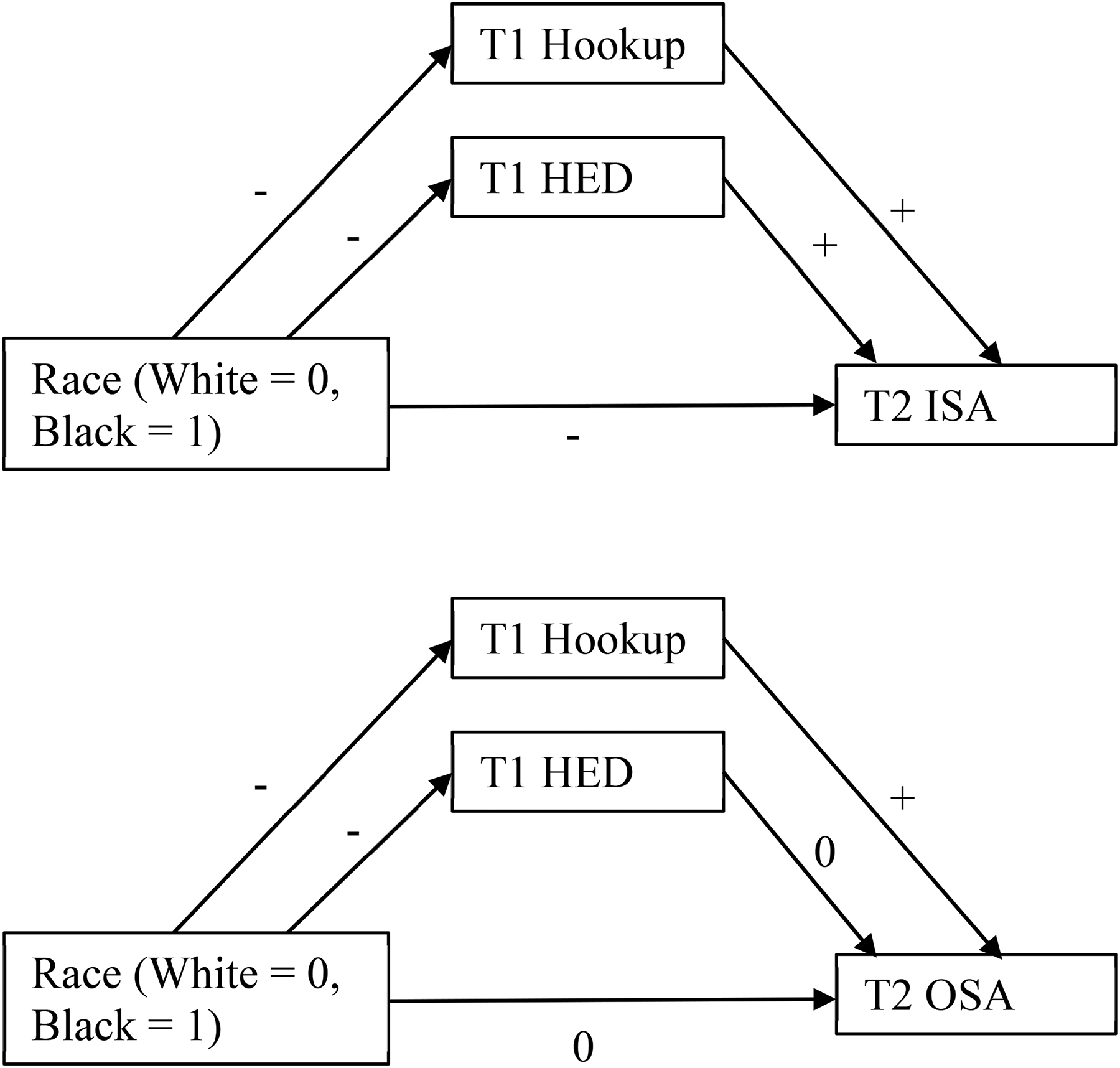
Hypothesized Model of Heavy Episodic Drinking and Hookups as Mediators for the Relationship Between Race and Sexual Assault.
We posited that the effects of race on ISA would be mediated via HED and hookups. Based on prior research, HED and hookups were expected to positively predict college ISA. We hypothesized that White women would engage in greater time 1 (T1) HED and hookups compared with Black women and that these would be positively associated with time 2 (T2) ISA. In other words, Black women's lower engagement in risky behaviors would reduce their risk of ISA. We also considered the indirect effect of race on verbal/physical assault (i.e., OSA). Given that HED was not expected to be positively associated with other types of SA, we did not expect an indirect effect of race via HED to emerge when OSA was the outcome. In contrast, only hookups were expected to predict OSA.
Examination and comparison of the characteristics of the specific SA experiences of Black compared with White women (e.g., tactics, perpetrator, and alcohol use) may help to understand the discrepancy between lower frequency of engagement in known risk factors and a lack of consistent findings regarding college SA. Thus, we also explored the characteristics of SA incidents reported by Black and White students. We hypothesized that SA incidents reported by White women would be more likely to involve alcohol use (by self and by perpetrator) and to follow a party or other social event than incidents reported by Black women. Conversely, we expected that SA incidents reported by Black women to be more likely to include a romantic partner as perpetrator compared with those reported by White women.
Method
Participants
Incoming first-year college women, ages 18–19 at a large, public Northeastern university (N = 1,203), received an email invitation to participate in a two-part, longitudinal survey about their beliefs, substance use, and sexual behaviors. Names and contact information was obtained from the university registrar, and only included students who had a permanent US address. Women indicated interest in participating by clicking a link included in the email. Of the 806 students who started the survey, those who did not make it to the final page of the first survey (n = 46) were removed from all analyses. In total, 760 students (63% response rate) completed the first survey. Participants who identified as a race other than Caucasian or African American
1
1 or did not provide an answer (n = 234) were removed from these analyses, which left a total of 526 participants. Of those participants, N = 451 (retention = 85.7%) completed the T2 follow-up survey. Race was not related to attrition [
Procedure
The first web-based survey was administered in September of 2018 (T1). The follow-up survey was in November (T2). Data from this study come from a larger intervention study on hookups and SA (Testa et al., 2020). All procedures were approved by the Institutional Review Board.
Measures
Race
Participants were asked, “How would you describe your ethnic background?” Only participants who responded with “Caucasian” and “African American” were included in these analyses (referred to as “White” and “Black,” respectively, henceforth). Participants who responded “Asian,” “Native American,” “Middle Eastern,” “Mixed,” or “Other” (n = 228) or did not respond (n = 6) were excluded.
SA Experiences
SA was assessed using a brief version of the Revised Sexual Experiences Survey (R-SES; Carey et al., 2015; Testa et al., 2019, 2020). The current 12-item measure crossed 3 tactics (i.e., verbal pressure, physical force, and incapacitation) with 4 outcomes (unwanted contact, attempted intercourse, intercourse, oral sex/sex acts). At T1, participants were asked about SA experienced since age 14. The survey at T2 contained identical questions but asked participants to identify types of assault since entering college.
Heavy Episodic Drinking
Those who endorsed consuming at least one drink per month were asked about frequency of HED [“On average, on how many days in a month (out of 30) do you drink 4 or more drinks?”], as well as drinking to intoxication [“On average, on how many days in a month (out of 30) do you drink enough alcohol to feel drunk or intoxicated?”]. The values for these two correlated (r = .87) items were Winsorized at the 97th percentile to reduce the potential influence of outliers while retaining ordering (Tabachnick et al., 2007). The items were averaged to create an HED frequency construct, following previous work (Testa & Livingston, 2009). Women who reported no drinking (n = 173, 32.9%) were coded 0.
Hookups
Hookups were defined as “a sexual encounter between strangers, friends or acquaintances—people not in a relationship with each other.” This included behaviors from kissing to sexual intercourse (Paul et al., 2000). Participants were asked, “How many hookups have you had since you started college?” Responses were open-ended and Winsorized at the 97th percentile.
Characteristics of College SA Incidents
Participants who reported one or more experiences on the R-SES during the first semester of college (N = 63) answered a series of questions regarding the characteristics of the experience.
Data Analysis
Data were analyzed using SPSS v. 26. Differences in SA and risk factors were assessed using one-way ANOVAs and χ2 tests. Given the preliminary nature of this study, we focus on effect sizes, as theses can shed light on risk mechanisms to target in future studies. Effect sizes were assessed by calculating Cohen's d. Mediation analyses were conducted using Model 4 of the SPSS Hayes Process Macro. Due to the dichotomous nature of the outcome variables (i.e., SA), the model was estimated using logistic regression. Race (i.e., White vs. Black) was entered as the independent variable, risk factors (i.e., HED and hookups) both entered as mediators in each model, and the assault variable (i.e., ISA or OSA) were entered as the dependent variable. Because prior SA is a strong predictor of future assault (Walker et al., 2019), all models controlled for the effect of T1 SA on T2 SA. Some women reported both OSA and ISA experiences at T2 (n = 11). They are included in analyses of both ISA and OSA. Due to evidence of a reciprocal nature of risk factors and SA (Testa & Livingston, 2000), models also controlled for the effects of prior SA on HED and hookups. All models also controlled for the randomly-assigned intervention, which was not significant in any models and hence is not depicted. Effect sizes of each indirect effect are indicated by the R-square of the “a” path and, given the dichotomous outcome, the odds ratios (ORs) of the “b” path of each mediation model (Chen et al., 2010; Draper, 2020). In χ2 tests, we assessed differences in the characteristics of SA events experienced by White vs. Black first-year college women. We adopted a more stringent p value to minimize family-wise error (i.e., .01). All effect sizes were assessed using Cramer's V.
Results
Prevalence of SA and Risk Behaviors
Table 1 presents comparisons (i.e., ANOVAs and χ2 with effect sizes) for Black vs. White women on SA, alcohol use, and hookups. Findings support the hypothesis that Black women engage in less frequent HED in the first weeks of college [F(1, 524) = 18.52, p < .001] compared with White women. Effect sizes were moderate (Cohen's d = 0.55 and 0.74, respectively). The difference between Black and White women on hookups was not significant at T2. White women were significantly more likely than Black women to report overall SA (since age 14) at T1 (36.3% vs. 23.6%) but not at the end of the first semester at T2 (14.3% vs. 14.5%). White women were also more likely to report ISA at T1 (17.2% vs. 4.2%) and marginally so at T2 (5.3% vs. 1.61%). There were no differences in overall T2 OSA (Black = 14.5%; White = 11.6%). OSA experiences involved either verbal or forcible tactics, the former being much more common than the latter, with White women reporting more forcible experiences than Black women at T1 and T2.
Comparison of Black vs. White College Students.
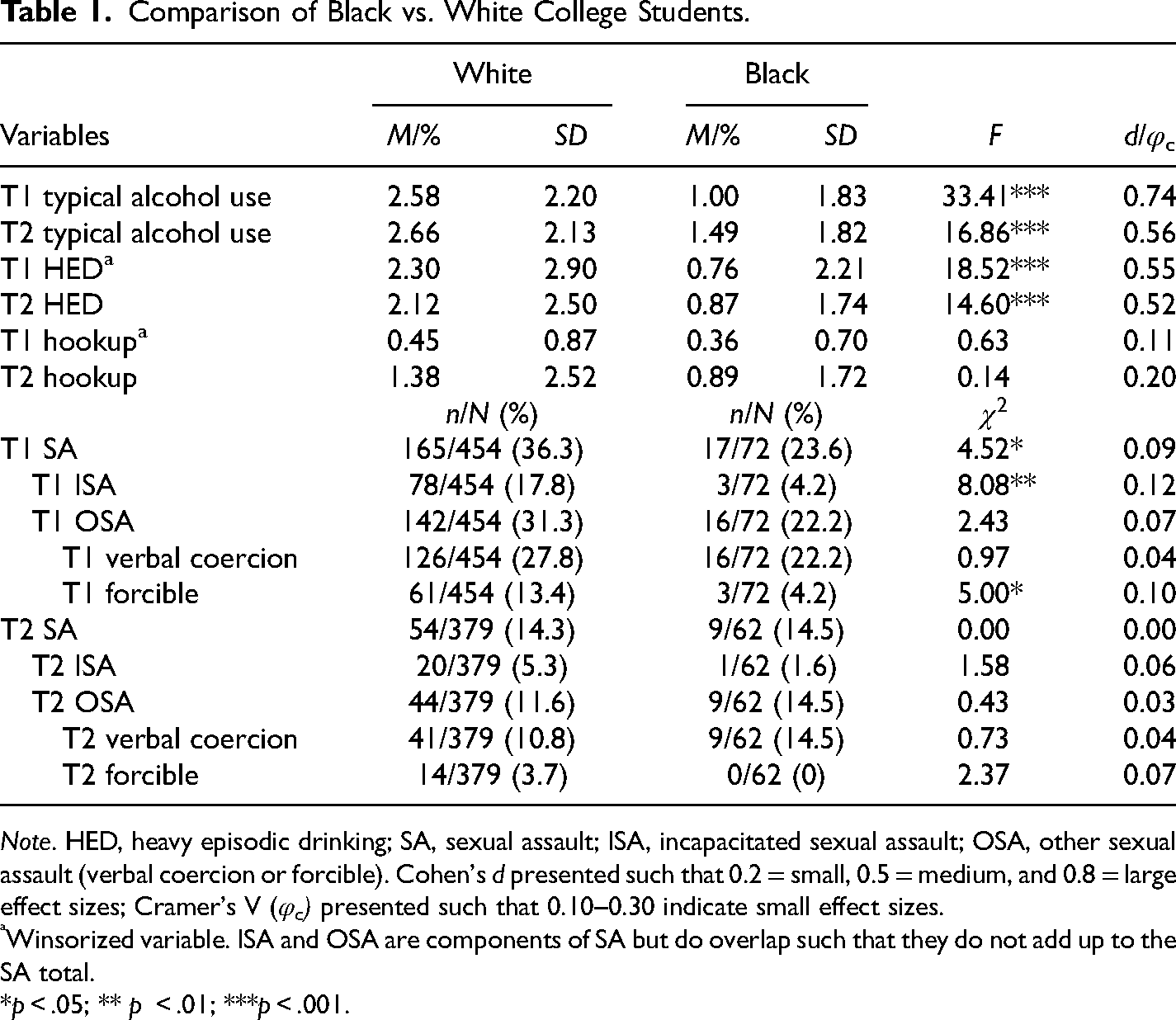
Note. HED, heavy episodic drinking; SA, sexual assault; ISA, incapacitated sexual assault; OSA, other sexual assault (verbal coercion or forcible). Cohen's d presented such that 0.2 = small, 0.5 = medium, and 0.8 = large effect sizes; Cramer's V (φc) presented such that 0.10–0.30 indicate small effect sizes.
Winsorized variable. ISA and OSA are components of SA but do overlap such that they do not add up to the SA total.
*p < .05; ** p < .01; ***p < .001.
Hypothesis 1: Mediation
All direct and indirect effects are reported with coefficients, standard errors, and bootstrapped 95% confidence intervals (CI) (see Table 2). Consistent with hypotheses, there was a significant indirect effect of race on ISA via HED. Black women reported less frequent T1 HED than White women [b = −1.45, standard error (SE) = 0.38; 95% CI (−2.20, −0.69)], and more frequent T1 HED predicted increased risk for T2 ISA [b = 0.18, SE = 0.07; 95% CI (0.05, 0.32)]. As hypothesized, there was a significant indirect effect of Black race on T2 ISA mediated via T1 HED [b = −0.27, SE = 0.11, 95% CI (−0.49, −0.06); see Table 2] and R2 and OR values of the direct paths indicate a small effect of HED on ISA, controlling for race (OR = 1.18).
Mediator Model Predicting Time 2 Incapacitated Sexual Assault (ISA) and Other Sexual Assault (OSA) for Black vs. White Women.
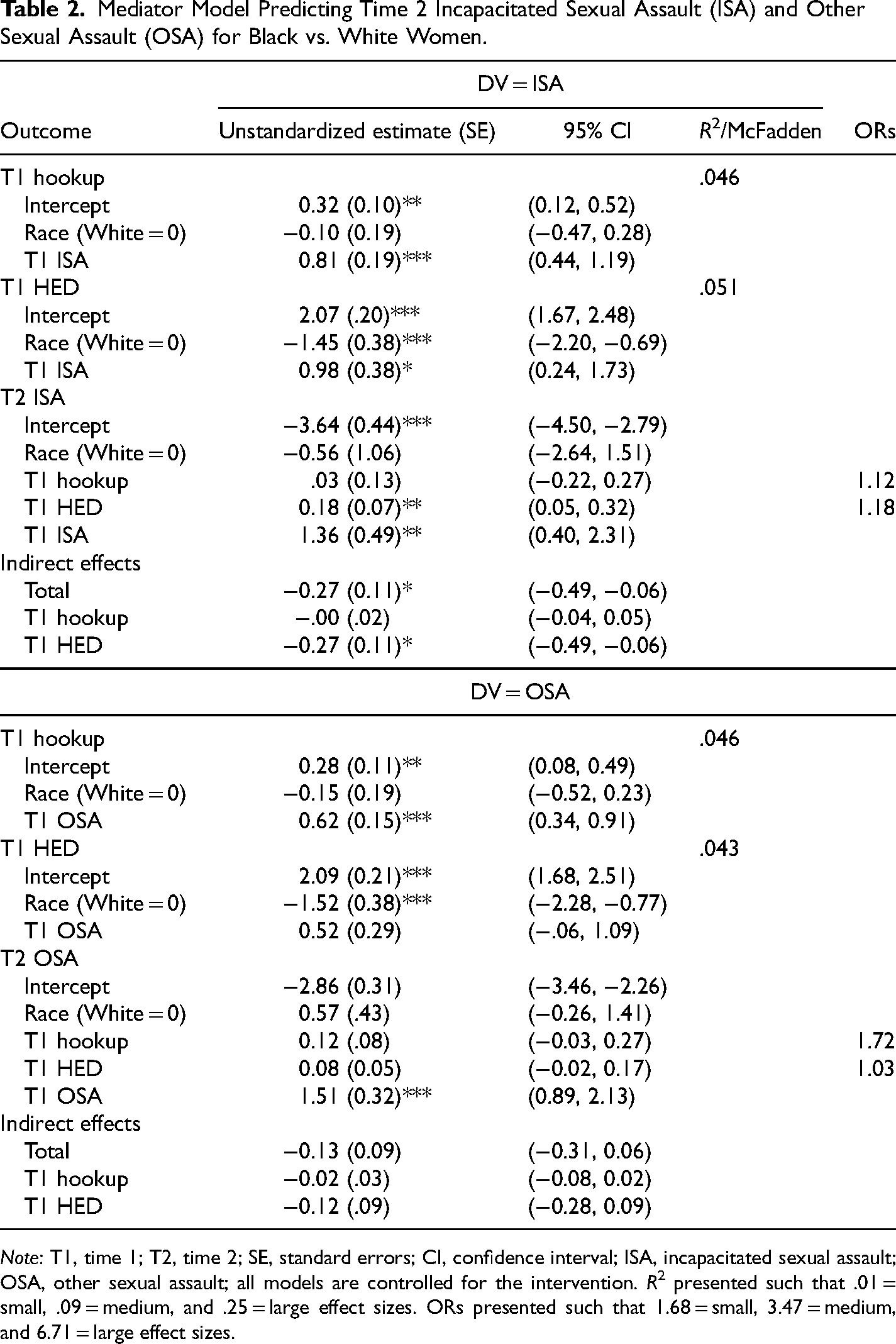
Note: T1, time 1; T2, time 2; SE, standard errors; CI, confidence interval; ISA, incapacitated sexual assault; OSA, other sexual assault; all models are controlled for the intervention. R2 presented such that .01 = small, .09 = medium, and .25 = large effect sizes. ORs presented such that 1.68 = small, 3.47 = medium, and 6.71 = large effect sizes.
There was no indirect effect of T1 hookups on the relationship between race and T2 ISA, and race was not a significant predictor of hookups. Contrary to our hypothesis, hookups did not predict T2 OSA nor did they predict T2 ISA. The only significant predictor of T1 hookups in each model was T1 ISA and T1 OSA, suggesting a potential relationship between precollege SA and hookups during the first semester of college.
The direct effect of race on ISA was not significant. Additionally, T1 ISA significantly predicted HED and hookups, suggesting a reciprocal relationship between risk factors and assault. For OSA, the only significant predictor was prior OSA. There was no indirect effect of Black vs. White race on T2 OSA via HED nor hookups (see Table 2). As hypothesized, in all models, precollege ISA and OSA were significant predictors of first-semester SA.
Hypothesis 2: Characteristics of SA Experiences
For women who reported SA at T2 (n = 54 White, n = 9 Black), we compared the characteristics of these events across Black and White women (see Table 3). As expected, there were differences in substance use prior to the assault, such that Black women reported that their perpetrators were less likely to have been drinking (
Characteristics of Sexual Assault Events
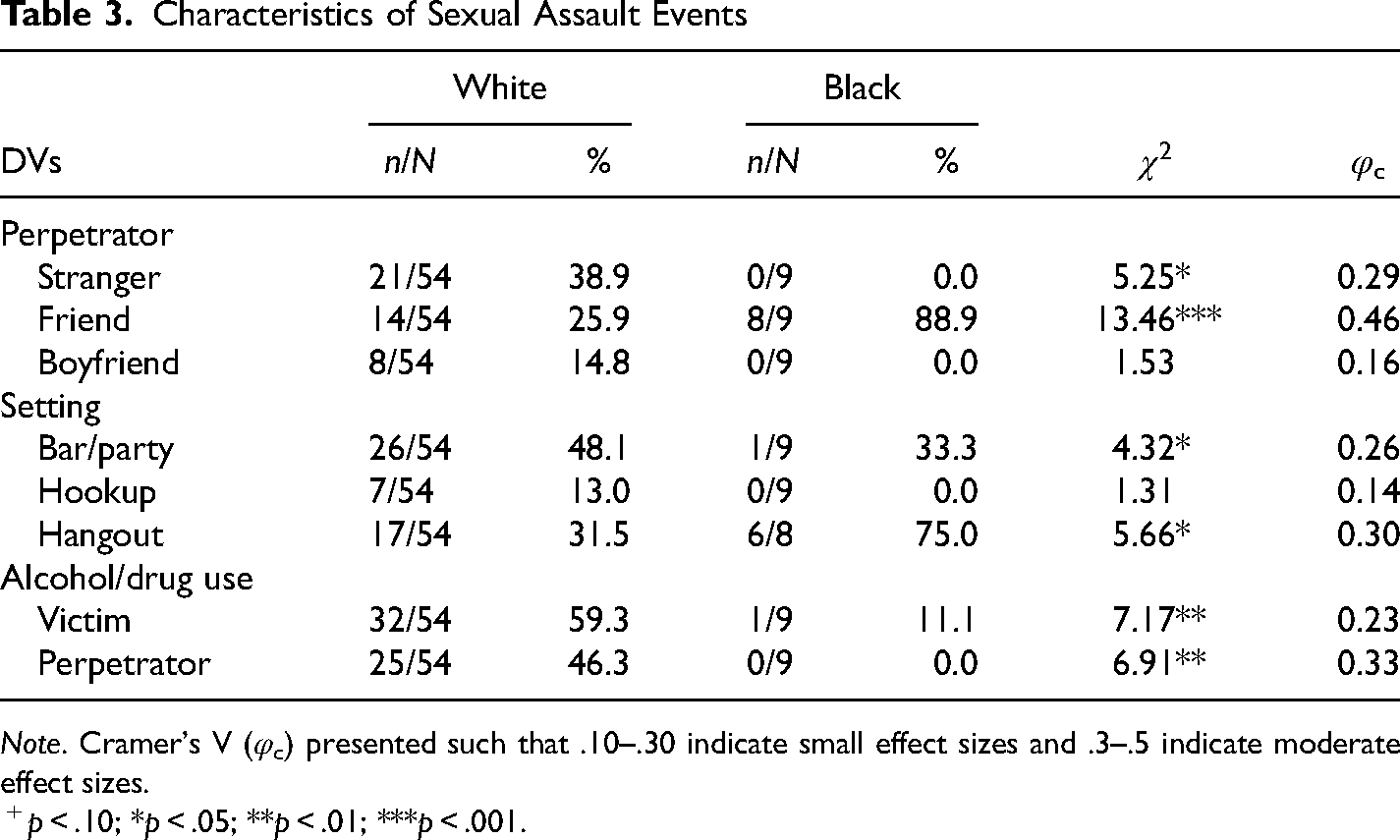
Note. Cramer's V (φc) presented such that .10–.30 indicate small effect sizes and .3–.5 indicate moderate effect sizes.
+ p < .10; *p < .05; **p < .01; ***p < .001.
Discussion
The current study was the first to our knowledge to examine relationships between SA, known predictors of SA (i.e., alcohol and hookups), and race (White and Black) in college women. The study's prospective design is unique and advantageous for mediation analyses in order to establish temporality among alcohol, hookups, and SA and also advances the literature, as no other studies to our knowledge that examine these variables include more than one timepoint. Much of the prior research on college SA risk has not explicitly examined how risk may differ for Black and White women. This study represents an initial effort to address this limitation, pointing to several next steps for future research. We observed several differences in patterns of HED, hookups, and SA by race. We also identified other previously unexamined risk factors for SA that may differ by race. Though preliminary, our findings suggest the importance of considering unique dimensions of risk for Black and White women when developing SA interventions.
We found partial support for the hypothesis regarding the mechanisms of first-semester ISA risk for Black and White women. As predicted and consistent with prior work (Clarke et al., 2013), Black women reported fewer days of HED than White women. It was expected that Black women's lower ISA would be a function of lower HED. Mediation analyses supported that hypothesis: Black women drank less, and in turn, lower HED was negatively associated with ISA. This corroborates prior data indicating that Black women tend to drink less than White women and, consequently, experience less ISA (Krebs et al., 2011). Thus, lower levels of drinking in Black women appear to serve as a protective factor, reducing their vulnerability to ISA, the most common type of SA among college samples. Although the differences in Black and White T1 and T2 ISA were not significant, reflecting the small number of assaults occurring within a single semester, there was a tendency for Black women to report fewer instances.
Given the strong association between HED and hookups (Claxton et al., 2015) and evidence that hookups predict alcohol-related SA (Messman-Moore et al., 2013), we hypothesized that hookups would also mediate the relationship between race and ISA. Yet contrary to our hypothesis, hookups did not predict ISA nor did Black women report significantly fewer hookups than White women. This could have been due to the limited time in which hookups were assessed (i.e., first 2 weeks of college) and the fact that SA is a fairly low base rate event.
Additionally, we found no evidence that HED or hookups contributed to OSA experiences during the first semester of college. This is consistent with Gilbert et al.'s (2019) finding that verbal coercion and physically forced assault tend to be used instead of rather than in addition to incapacitation in college. They also found that acquaintances and not partners were more likely to commit ISA than non-ISA. These findings suggest that incapacitated and nonincapacitated assault experiences have different predictors. Thus, while increased HED predicted White women's ISA in the current study, it did not predict an increased risk of OSA. For this, the only predictor was prior victimization, suggesting continuing vulnerability over time.
We expected and found differences in the characteristics of SA experiences reported by Black and White first-year college women, though caution is warranted in interpreting these findings, given the low base rates of SA. As predicted and consistent with some prior data (McCauley et al., 2009), Black women and their perpetrators were less likely than White women and their perpetrators to be using alcohol and/or other drugs at the time of assault. Our data did not support the hypothesis that Black women would experience more SA perpetrated by boyfriends but found instead that Black women's SA incidents were more likely to be perpetrated by friends. The literature on friend perpetration is sparse, and more research is needed. Given that a substantial portion of SAs are committed by friends, this is an important gap in the knowledge base. It is plausible that more research may reveal a specific risk pathway for Black women and other groups whose lower drinking rates makes ISA less relevant. Our study and observed effect sizes offer a first insight into this important question. Yet this is only a first step. More research is needed to better understand the social contexts that predict SA risk for Black women.
Future Research and Clinical Implications
The current findings suggest that conclusions from the extant literature centered around the drinking, hookup, and SA experiences of White women may not generalize to Black women. Findings that lower HED predicts lower ISA suggest that Black women's lower HED is protective against victimization involving alcohol, consistent with prior research (Krebs et al., 2011). However, despite lower rates of HED and comparable hookup rates with White women, Black women appear just as vulnerable as White women to experience SA not involving incapacitation, pointing toward the need for intervention tailored to nondrinking circumstances. Although reducing HED has shown promise as a means of preventing college SA (Denhard et al., 2020; Testa et al., 2010), our findings suggest that this approach is not likely to be effective for most Black college students, whose drinking levels are already low. Prevention programs that address SA vulnerability factors more broadly this differential risk (e.g., risk perception, Senn et al., 2015) may be warranted.
Differences in SA experiences by race also indicate the importance of attending specifically to race in data analysis. Much of the current alcohol and SA research includes race only as a covariate, if it is included in models at all (Norris et al., 2021; Zinzow & Thompson, 2015). This is a significant omission that may have led to inaccurate conclusions about the nature of SA risk for Black women. Further, it is plausible that risk factors differ by other demographic factors that have not been explored. Future research should be cautious about analyzing diverse samples and extrapolating findings from homogenous samples to the general population.
Limitations and Future Directions
While the current findings provide new and important knowledge to the field, this study has several limitations that must be considered. The first is that while the racial composition of the sample reflected that of the university from which the sample was drawn, the relatively low number of Black women in the sample and the relative brief period of assessment and follow-up (i.e., the past 2 weeks, past 3 months to assess hookups and SA) all could compromise statistical power for comparisons of interest. This limitation highlights the importance of future work that can be conducted at universities with large racial minority student populations, or perhaps across multiple universities, over longer periods of time.
As noted, our study's longitudinal design was a strength in that it helped establish temporal precedence between risk factors and SA experiences. Yet, we could not disentangle acute temporal associations between these risk factors and SA. Future research will benefit from designs that assess event-level risk on different SA types for college women of different racial identities, providing a more granular depiction of these associations (Read et al., 2021; Yeater et al., 2022).
The original data set did not include a question about socioeconomic status (SES). This constrains interpretation of the current findings in two ways. The first is that race, particularly Black vs. White race, is highly associated with SES in the United States due to a myriad of historical and ongoing social and political factors that disadvantage Black Americans (Williams et al., 2016). As such, it is unclear whether differences between Black and White women are attributable to race, and not SES. Second, alcohol use is associated with SES (e.g., Humensky, 2010). Thus, it is plausible that findings regarding the role of HED in Black women's SA risk are driven by SES.
Finally, this is one of the first studies to date to isolate understudied risk factors and mechanisms of risk for SA among Black college women. Importantly, we focused specifically on Black women to delineate their unique risk for SA. In doing so, we took an important step forward in not combining races to analyze “White vs. other.” Race and racial identity are complex and have their own complex relationships with SA and risk factors; the inclusion of every possible group is not possible in a single study. As such, we view this study as an important starting point. Similar research is also needed for women of other racial and ethnic backgrounds, as well as for groups within races (e.g., Hispanic and non-Hispanic Black women).
Conclusion
The purpose of the current study was to take an initial step toward better understanding mechanisms of SA risk for Black college women, whose experiences are often not represented in the extant literature. The current study supports prior research that Black women engage in less frequent HED than White women, which appears to decrease their risk of ISA but not OSA or SA overall. Additionally, Black women reported assaults that were characteristically different than those White women reported. Our findings suggest that future research on college SA and assault prevention programs on college campuses should seek to identify SA risk factors that may be particularly relevant for Black (and non-White women more broadly) and develop prevention programs better targeted to these specific vulnerabilities within these populations.
Footnotes
Declaration of Conflicting Interests
The authors declared no potential conflicts of interest with respect to the research, authorship, and/or publication of this article.
Funding
The author(s) disclosed receipt of the following financial support for the research, authorship, and/or publication of this article: This research was funded by grant R34AA024854 from the National Institute on Alcohol Abuse and Alcoholism and Office of the Director, National Institutes of Health (NIH). Research reported in this publication was supported by the National Institute on Alcohol Abuse and Alcoholism of the NIH under award number T32AA007583 to the University at Buffalo.
