






Abstract
Developments in digital technologies might provide limitless ways to reshape humanity's very existence, but also open up what we term “bounded limitless” opportunities for digital gender–sexual violations (DGSV). That is, “limitless” opportunities for men to sexually violate women within the inherent “boundedness” of digital technological infrastructures and architectures. Building on the existing interdisciplinary feminist scholarship, we explore the gendered disbenefits, specifically some of the ways in which digital technologies provide men with “bounded limitless” opportunities to perpetrate DGSV in physical and virtual times and spaces, and the implications for women, their bodies, and gender–sexual relations more broadly.
Modern Technologies and Future Possibilities
Recent developments in artificial intelligence (AI; e.g., ChatGPT, Stable Diffusion) and other visual and sensory technologies (e.g., extended reality [ER]) seem to take us closer to realizing the metaverse, first depicted by Stephenson (1992), in his novel Snow Crash, and the multimedial and pervasive transformations of social media. Although the metaverse is not yet with us, it has been loosely defined as: … the post-reality universe, a perpetual and persistent multiuser environment merging physical reality with digital virtuality. It is based on the convergence of technologies that enable multisensory interactions with virtual environments, digital objects, and people such as virtual reality (VR) and augmented reality (AR). Hence, the Metaverse is an interconnected web of social, networked immersive environments in persistent multiuser platforms. It enables seamless embodied user communication in real-time and dynamic interactions with digital artifacts. (Mystakidis, 2022, p. 486)
The future existence of the metaverse has been presented as the “next big thing” offering limitless possibilities to create, develop, communicate, and interact across times and spaces, between digital virtual environments, and between the physical and digital worlds (Hackl et al., 2022). For some, it will provide limitless ways to reshape humanity's very existence (Ning et al., 2023). Despite the metaverse not yet existing, much of the groundwork technologies that would be needed have already been laid, in the form of, for example, AR, VR, AI, ER, and artificial general intelligence. Such technologies, and moreover, their interconnections, are presented as offering limitless ways to access and store information and develop, communicate, and transmit information (Breunig, 2016) with limitless benefits for business, learning, health, and social interaction (Russell, 2022). By contrast, we focus on some of the abuses of those technologies that are currently known.
What often underlies the technological developments outlined above is an “innovation paradigm” where the development of technologies is seen as predominantly beneficial and progressive (Sveiby et al., 2012). For example, technological innovation tends to view new contexts through the prism of past successes. Proinnovation biases and ideologies frame innovation as beneficial for humanity through efficiency and equitability. These can permeate all levels from people's individual uses of these technologies to workplace practices, the development of legislation, and (inter)national economic policies to enhance competition and political power.
The potential disbenefits of these technologies, not least their violating and potentially violating uses, are often obscured because data collection and measurements lag, for political and commercial reasons, among others. The implications for many people are profound, life changing, and often gendered (Stavropoulou & Jones, 2013). Concerns about the potential negative effects of these technologies are now publicly voiced by some of the creators of AI (Taylor & Hern, 2023) suggesting a pause on development, although these commentaries rarely address the gendered dimensions of such questions.
Literature Review
Digital Gender–Sexual Violations
The current “innovation paradigm” toward a possible future metaverse easily obscures and overlooks concerns about the increasing prevalence of various forms of digital gender–sexual violation (DGSV). 1 These include, for example, image-based sexual abuse and “revenge porn” (Hall & Hearn, 2017, 2019; Hearn & Hall, 2019, 2021), “upskirting” (Hall et al., 2022), deepfake pornography (Maddocks, 2020), cyberflashing (McGlynn, 2022), hacking and sextortion (Woodlock et al., 2020), and sexual spycamming (Hall et al., 2023), among others (see Paradiso et al., 2023 for a systematic review). Victim-survivors report experiencing a host of negative effects. These include humiliation, shame, and embarrassment with intimate partners, family, friends, work colleagues, and in public; sexual shame and sexual problems; body image issues; education and employment disruptions; concerns for personal safety; becoming paranoid and hypervigilant, and having trust issues, with sometimes fatal consequences (McGlynn & Rackley, 2017). Thus, while different forms of DGSV and their impacts are often acknowledged, viewing them through an “innovation paradigm” highlights them as issues that can be addressed through legislation and the development of technological safeguards (Farrell et al., 2023). However, because of the complexity and diffusiveness of DGSV, we argue for a more informed, less obscured, and more concerted and comprehensive view of digital technological innovations and how to address them.
While around half of the men and women in several surveys have reported experiencing some form of digital violation, unlike men, women report experiencing predominantly misogynistic and sexual violations, with prevalence rates between 50% and 90% (Amnesty International, 2017; Dixon, 2024; Snaychuk & O'Neill, 2020). The possibilities and potential harm of such practices are extended and intensified by the use of both legal and illicit versions of digital software, such as vector graphics (e.g., anime), raster graphics (e.g., memes), image overlay (e.g., AR, VR, and ER), AI-generated text to image and image to image (e.g., chat boxes), and 2D and 3D synthetic images (e.g., avatars, holograms, and deepfakes; Attwood, 2009; author cite). Such intensifications of digital violations are also gendered and often sexualized. They create more space and opportunities across time for men to violate women.
The impacts are experienced by individual women but also, more broadly, by women as a group, who not only learn that the physical world is saturated with abuse of women but also that the digital world is too. Thus, violation may be physical, direct, and material, or represented, indirect, and discursive. As such it may be material discursive, albeit in somewhat different ways, in offline, online, and offline/online violence and violations. Complicating matters further, it may also occur in talk and writing about and images of violation (Hearn et al., 2023). It is the diffusiveness and complexity of men's violence and violations of women in these multiple shifting contexts that we aim to capture in the term DGSV.
Bounded Limitlessness
The concept of limitlessness invokes notions of infiniteness, beyond current and existing boundaries and limits, something that is immeasurable, inexhaustible, and cannot be fully known. For digital technologies, limitlessness tends to be conceptualized as the infinite possibilities for people to communicate, interact, create, share, store information, and use technological applications, despite the limits to technological infrastructures and architectures such as availability, connectivity, connectivity speeds, network compatibilities, and user skills (Hechler et al., 2020). Limits also stem from the imagination and skills of the user, which themselves might be limited by socio-cultural norms and practices (i.e., violation tends to follow heteronormative and patriarchal patterns), and the availability of and access to the technologies, including across various global digital divides. Thus, building on such earlier conceptualizations as bounded rationality (Simon, 1957) and bounded emotionality (Mumby & Putnam, 1992), we further develop the term “bounded limitlessness” in the concluding discussion to reflect the sense that opportunities may appear limitless, as well as the awareness that they are not infinite. The term, “bounded limitlessness,” also evokes notions of limits or boundaries, particularly those of time, space, bodies, relationships, and of violation itself, which are the focus of this paper. In particular, we examine the implications of “bounded limitlessness” for DGSV, now and in possible futures.
So, while modern technologies are sometimes represented as providing wide-ranging, even limitless, benefits for all (Hackl et al., 2022), feminist scholars show they adversely impact women in particular in gendered–sexualized ways; thus, alongside the provision of what some see as limitless benefits to humanity, modern technologies may instead provide potentially limitless gendered disbenefits to some of humanity. Building on the existing interdisciplinary scholarship on DGSV, gender violations, and gender inequalities more broadly, in this paper, we explore these gendered disbenefits, specifically some of the ways in which technologies provide limitless opportunities to perpetrate DGSV. While those opportunities are available to everyone who has access to such technologies, it is largely men, although not all men, who exploit them. In highlighting the limitlessness of DGSV, we are not arguing against these technologies or even a possible future metaverse, but rather we headline the need to consider more fully the potential negative gendered implications and violations, with a focus on those against women.
Method
The concept of limitlessness, and its various synonyms, is not new although it seems to have been applied to digital technologies only relatively recently. To explore the use of this concept, we undertook a broad scoping style bibliographic search (Arksey & O’Malley, 2005). We explored peer-reviewed academic literature from 1993 when the World Wide Web (WWW) was launched until April 2023 when we carried out our search. We searched Academic Search Complete, PsycINFO, Scopus, and Google Scholar. We combined search terms for limitlessness (e.g., infinity, beyond boundaries, immeasurable, and inexhaustible), with search terms for related technologies (e.g., digital, online, and virtual), broad terms similar to DGSV (e.g., cyberviolence, image-based sexual abuse, and tech-facilitated gender–sexual violence), and terms for specific known forms of DGSV (e.g., “revenge pornography,” “upskirting,” and “sexual deepfakes”) (Hall et al., 2023; Hearn & Hall, 2021). We also undertook Google searches for nonpeer-reviewed gray literature and media sources. This generated a total of 131 results.
We undertook an inductive thematic analysis of the results as this method is not aligned with a specific epistemological, theoretical, or methodological perspective, making it flexible to the multidisciplinary nature of the literature in our search results (Braun & Clarke, 2006). Using Braun and Clarke's (2006), six analytical steps we initially read the papers becoming familiar with the texts before generating initial codes using NVivo related to our search terms. Discussions between the three authors suggested that technologies provided perpetrators with limitless opportunities to abuse technologies that extended across times and spaces, impacting victim-survivors’ bodies, and gender–sexual relationships more broadly. These were our preliminary themes. However, it was also evident that we should remain cautious of whether the use of the term limitlessness was indeed indicating absolute limitlessness or instead a sense of limitlessness (e.g., Mammen et al., 2022; Hechler et al., 2020). The term “bounded limitlessness” reflects this. Thus, our further discussions identified the following themes related to “bounded limitlessness” in the literature, as summarized in Table 1.
Limitlessness Theme Table.
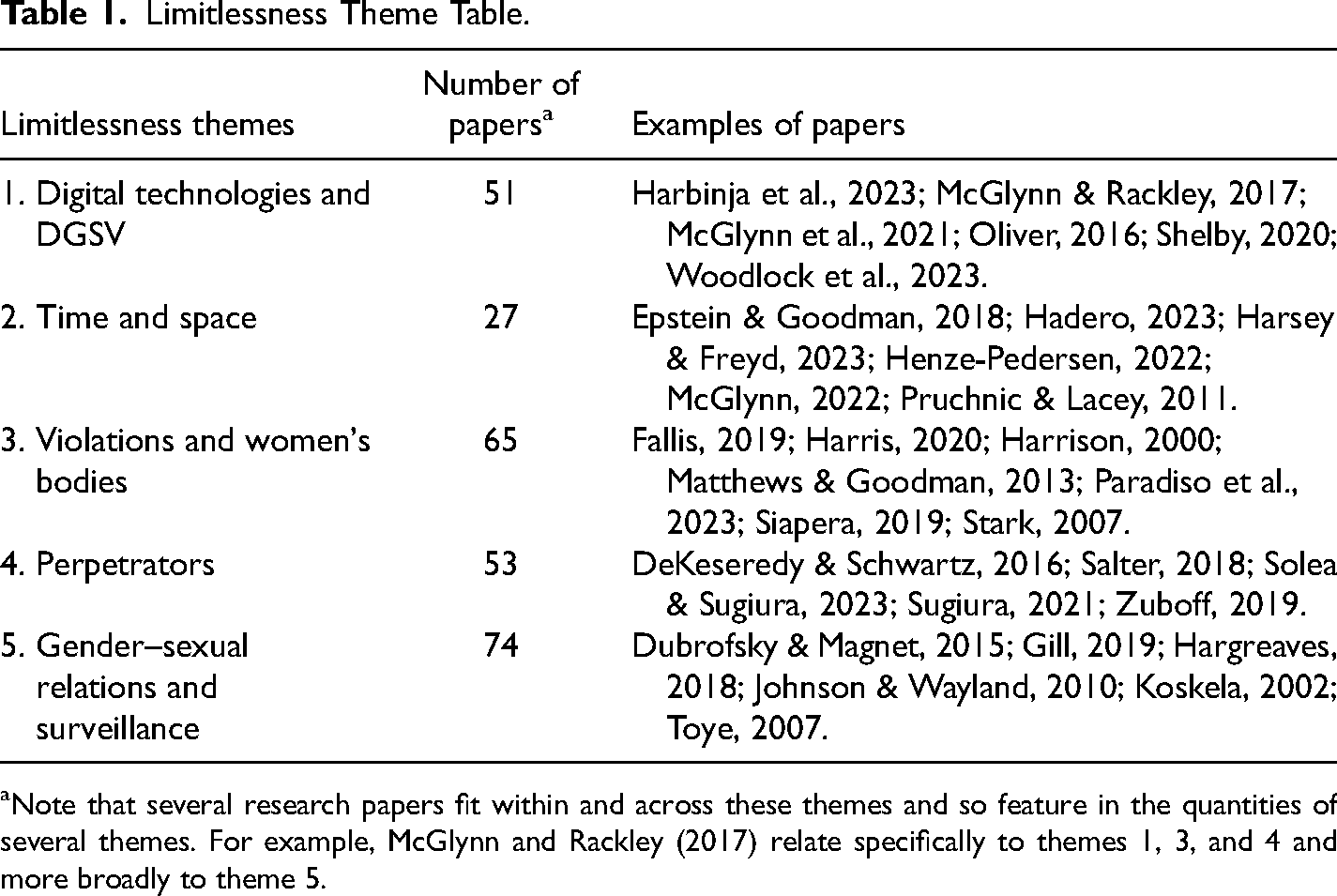
Note that several research papers fit within and across these themes and so feature in the quantities of several themes. For example, McGlynn and Rackley (2017) relate specifically to themes 1, 3, and 4 and more broadly to theme 5.
Having conducted an inductive thematic analysis not aligned with a specific theoretical framework, we constructed a feminist theoretical framework from the themes in order to discuss the “bounded limitlessness” of DGSV. This was far from straightforward. For a start, it entails engaging with theories and research literature on the gendered–sexual nature and configurations of violations in digital environments that have material world impacts: violences as well as violations. Disciplines such as sociology, psychology, and technology are themselves diverse in their foci, terminologies, methodological, and theoretical approaches. Thus, a multidisciplinary and multitheoretical approach is needed. Our theoretical framework is built on the long tradition of feminist theory, practice, and research on gender–sexual violences and violations (e.g., MacKinnon, 1993), recognizing pervasive gender power relations, intersecting with further dimensions of inequality. We are attuned in particular to the interrelatedness of these with digital technologies at multilevels as they might manifest in, for example, the interfaces between violating actions in digitalized environments, material–virtual body integrity (e.g., a violated image may be experienced bodily), and the psychosocial impacts. Thus, our theoretical framework incorporates the interfaces of digitalization and boundaries and boundarylessness, and gendered-sexual boundaries, and their contradictory character. Boundaries are often paradoxical social realities—sometimes all too real in terms of more or less fixed inclusions and exclusions of some people, yet also needing problematization and deconstruction, an aim of our paper. Thus, our broad, multidisciplinary, multilevel, feminist theoretical framework is in keeping with insights from technofeminism (Shelby, 2020).
Findings
Our analysis of the existing literature identified five key themes for considering how the concept of limitless can be applied to DGSV in terms of the technologies themselves; time and space; violations and women's bodies; perpetrators; and in terms of gender–sexual relations and surveillance. We discuss each of these in turn below.
Limitlessness, Digital Technologies, and DGSV
Digital technologies have emerged through “waves of computing” from mainframe computers, the WWW, the Internet of People (IoP), the Internet of Things (IoT), and today, to AI (Rahman et al., 2023). These “new waves” indicate various shifting technological limits (e.g., infrastructures and architectures) (Hechler et al., 2020). These limits will always, in different ways, be a feature of digital technologies. However, the limitlessness of digital technologies becomes more salient by focusing on the intersections between gender, sexuality, violations, digital technologies, and their applications. For example, these digital technologies provide limitless opportunities for men's surveillance of women as a digital panopticon (Katyal & Jung, 2021; Koskela, 2002, 2003). We focus on two particularly insidious forms of men's limitless opportunities for the sexual surveillance of women: the use of digital cameras and the use of digital software for image manipulation.
The spread and ease of use of miniaturized digital cameras for use in home security and entertainment, and those built into mobile phones, tablets, and desktop computers for everyday communication, provide limitless opportunities for perpetrators to watch, photograph, and record women in public and private, and physical as well as digital contexts (Katyal & Jung 2021; Koskela, 2002, 2003). Miniature cameras have been used to photograph and record women either partially or fully naked (e.g., toileting, showering, changing, tanning, and sunbathing), to capture the contours of their clothed genitals or other intimate body parts in their everyday activities (author cite), and to record them during intimate sexual encounters (Bender-Baird, 2016; Gill, 2019). Perpetrators have hacked into digital cameras on mobile devices, hidden miniature cameras in physical locations, or captured images and recordings of women while on the move (e.g., “upskirting,” author cite). Those images and recordings can be broadcast live or uploaded to the Internet by almost anyone from across the globe for (un)known others to view at their leisure.
Although some women may have limited, controlled, or no access to technology, they can still be violated if perpetrators have access (Helsper, 2021; Mammen et al., 2022). A quick search of the Internet shows women have been photographed and recorded in India (Times of India, 2021), Thailand (Petpailin, 2023), Egypt (Egypt Today, 2021), Russia (Frodsham, 2016), Uganda (Kirunda, 2021), Peru (Aitken, 2022), Pakistan (Parhlo, 2020), and many others.
Perpetrators have limitless opportunities to anonymously disseminate those images and recordings to (un)known others via the Surface Web (Hipp et al., 2017) and the Dark Web (Henry & Flynn, 2019), such as social media platforms (e.g., X), dedicated DGSV websites (e.g., The Candid Zone) (author cite), pornographic websites (e.g., PornHub, 2023), discussion boards (e.g., Reddit), and imageboards (4Chan). There are limitless possibilities for them to be consumed, traded, and distributed, as well as for them to be manipulated to create avatars, deepfakes, replicas, and holographs (Maddocks, 2020). For would-be perpetrators lacking the technical skills to use these advanced technologies, there is a range of websites where other perpetrators provide advice and guidance (e.g., Unstable Diffusion, PromptHero, MrDeepfakes) (author cite). In this way, digital technologies provide limitless opportunities for men’s sexploitation of them, through surveillance and image editing (Koskela, 2002, 2003). This raises important questions about whether these technologies inherently lend themselves to exploitation for DGSV and whether more equitable digital technologies could be developed.
“Built-in” Intersectional Gendered Power Relations
Digital technologies are far from neutral in terms of power: they embody intersectional gendered power relations already “built-in” to their structures, functions, and deployments. More specifically, the roots of some platforms are in men's abuse of women. For example, Oliver (2016, pp. 8–9) reminds us that social media technology was borne out of sexist attitudes and practices toward women on college campuses. Mark Zuckerberg invented Facebook “to post pictures of girls for his college friends to rate and berate” when he was in a fraternity; Evan Siegel, the inventor of Snapchat, sent messages “referring to women as ‘bitches,’ ‘sororisluts,’ to be ‘peed on’ and discussed getting girls drunk to have sex with them”; and Sean Rad and Justin Mateen, founders of Tinder that was introduced on colleges campuses, were involved in a sexual harassment complaint in which Mateen was accused of sending the President of Marketing “sexist messages calling her ‘slut’, ‘gold digger’ and a ‘whore.’”
Moreover, we can also understand the use of digital technologies to perpetrate DGSV as “a question of distribution of material resources” and a way of excluding women from the tech sector (Siapera, 2019, p. 22). Siapera (2019, p. 21) argues that, just as witch-hunting helped restructure society from feudalism to industrial capitalism, so too online misogyny serves to exclude women “from accessing and controlling the means of production and from socio-economic participation in the emerging new formation … techno-capitalism.” Digital technologies, or indeed, technologies in general, are not developed in a vacuum but reflect and reproduce the social, structural, and cultural power dynamics of the society from which they emanate (Perez, 2019); thus, there is scope to develop digital technologies with in-built protection against exploitation for DGSV (Floridi et al., 2020).
Limitlessness, Time, and Space
Physical and digital spaces are ubiquitous. The uses of physical world spaces are more limited due to physical and geographical barriers such as borders and boundaries, people's access and proximity, social norms about and restrictions on their use, and the times and ways people can interact in them. Digital spaces, however, do not have the same spatio-temporal or socio-cultural limitations. As long as a perpetrator has connectivity and a device, they can harm women from almost anywhere, and at any time. Unlike tangible materials in the physical world (e.g., photographic stills and video reels), digital images (e.g., selfies) are easily editable, with limitless opportunities to harm (Pruchnic & Lacey, 2011). With increasing broadband speeds, harmful materials can be anonymously distributed instantaneously to (un)known digital spaces and times, to (un)known others for further (un)known DGSV. For example, a woman living in Australia found an image from her social media page had been stolen by unknown others in unknown spaces and times, turned into deepfake pornography, and distributed to (un)known websites, across the globe for (un)known others’ possible (re)uses (Hadero, 2023). Moreover, the distribution of images and texts has the potential to alter perceptions across time and space.
DGSV and altering perceptions
Like physical interactions, those in digital spaces influence how people think about the past, present, and future. Attempts to alter perceptions of past events, aiming to influence current and future perceptions and behaviors, are nothing new. For example, blaming victim-survivors of sexual violations—“I blame therefore it was”—is a well-established perpetrator strategy. Harsey and Freyd (2023, p. 1) refer to this as the DARVO strategy of “deny, attack, reverse victim and offender … denying their involvement in wrongdoing, attack[ing] their victims’ credibility, and argu[ing] that they are the real victims.” Digital technologies, however, provide limitless opportunities for perpetrators (and others) to alter perceptions by manipulating digital material en masse to (un)known others in a multitude of spaces and times. This DARVO strategy was successfully employed by former US President Trump, in relation to charges of sexual assault brought against him (which were upheld) (McGreal, 2023) as well as in relation to Johnny Depp's defense of Amber Heard's accusations.
Two years before the 2022 Depp–Heard defamation trial, the judge in the Depp–News Group Newspapers Ltd defamation trial ruled that there was sufficient evidence for 12 of the 14 allegations published by News Group Newspapers Ltd, that Depp had acted violently toward his former wife (UK Courts and Tribunals Judiciary, 2021). However, before the judge had declared the 2022 trial verdict, there was an exponential increase in gifs, memes, and other social media posts and comments of the trial depicting Depp sympathetically and Heard unsympathetically, and in the number of people across the globe declaring Heard guilty of lying about her experiences and of perpetrating violence (Brockbank, 2022). In this case, the DARVO strategy altered perceptions of the past (Depp and Heard's behavior toward each other) to influence future events (the 2022 trial verdict), and extended the space in which the trial was discussed, to the virtual as well as the global world. Following the 2022 trial, there has been a rise of revisionist, misogynistic, and homosocial digital materials—such as #FalseAccusationsRuinLive; #MenToo; #savemen; #GenderBiasedLaws; and #MenAreVictimsToo—aimed at altering perceptions and undermining victim-survivor accounts of sexual violations, and the credibility of women in general. This is also a well-documented strategy of men's groups such as TheRedPill and Men Going Their Own Way (Hoffman et al., 2020; Sugiura, 2021).
The limitless opportunities to alter perceptions may increase victim-survivors’ concerns about having their stories believed, doubted, or dismissed (Epstein & Goodman, 2018). And, with digital materials always present for anyone at any time to view (Penny, 2013), victim-survivors may have to live with the ghosts of the past as “part of the present atmosphere of everyday life” (Henze-Pedersen, 2022, p. 194). Fake and doctored videos and other technologically constructed realities could emerge ad infinitum, so, for the victim-survivor, there is potentially no end to the abuse, no point at which they can be satisfied there will not be more videos, comments, and new realities emerging, because the material survives beyond any action taken against it by platforms. This sense of limitlessness may cast a shadow over the victim-survivor's life and create the need for perpetual vigilance (McGlynn, 2022).
Limitlessness, Violations, and Women's Bodies
Physical bodies
The relationship between technologies and men's sexual violations of women's bodies has a long history from the body used as a technology to inflict physical assault, and verbal abuse, to watching, stalking, leveraging situations, applying pressure, and other forms of control, often combined with other purpose or nonpurpose built technologies (Harris, 2020). The impact on victim-survivors can be physical, psychological, and emotional. Many victim-survivors report experiencing longer-term impacts from psychological and emotional violations as a result of lowered self-confidence and self-esteem, and damage to their reputation and social relationships (Stark, 2007). The psychological and emotional harms from DGSV may be more diffused, and limitless, partly because of victim-survivors’ uncertainties about how their images are being violated, by whom, who has seen them, and what the possible social implications are.
Moreover, the dissemination of DGSV means that the representation of the victim-survivor and her reputation can be besmirched in the eyes of limitless viewers. For example, a deepfake depicting her engaging in sexual acts could be circulated to limitless people (including those she knows and those she does not know) who are likely to believe that she engaged in those acts. If she did not want to be depicted in this way, it is likely highly damaging both to her own self-identity and to her reputation. Fallis (2019, p. 625) refers to this as an epistemic threat: “The main epistemic threat is that deepfakes can easily lead people to acquire false beliefs. That is, people might take deepfakes to be genuine videos and believe that what they depict actually occurred.” Even if the victim-survivor thinks viewers will not believe the video is of her body, being depicted in a deepfake can give the sense that she and her body are being considered in sexualized ways, that she is being objectified by limitless viewers. Thus, the damage to the victim-survivor's person and reputation, whether they are high-profile public individuals or not, is intensified by these advanced technologies.
Detached and altered bodies
Unlike with physical fleshy bodies, sexual violations of bodies in digital spaces are limitless. Digital technologies allow perpetrators to move from passive viewers to active participants and creators of digital bodies, through the manipulation of images to fulfill their sexual desires. Images of women's bodies can now be detached, undressed, altered (e.g., skin tone, body hair, contours, and body parts), made to perform a range of sexual acts that may or may not resemble physical world capabilities (e.g., phantasmic sex) (Matthews & Goodman, 2013), and have embodied experiences driven by the desires of perpetrators (e.g., enjoyment, pain) (De Ruiter, 2021). Those images may also take on further distorted forms (e.g., as aliens, animals) (PornHub, 2023), and even images of deceased bodies can be resurrected and reimagined in the creation of “post-mortem avatars, deepfakes, replicas, holographs, or chatbots” (Harbinja et al., 2023, p. 1). Those images can be traded, exchanged, and reimagined in limitless nonlinear, or spatio-temporal-related ways, providing perpetrators with limitless possibilities to experience sensuality, enchantment, domination, and experimentation with almost anyone, “real” or imagined (Obrador-Pons, 2007). In contrast to 2D sexualized images that still limit perpetrators’ desires to some degree by rendering women “docile and lifeless” (Harrison, 2000, p. 489), 3D digital image technologies provide perpetrators with additional limitless opportunities to create women's feelings and sensual dispositions as a reflection of the perpetrators’ own desires (Obrador-Pons, 2007).
The outcomes for women are not only limitless possibilities to be subjected to surveillance and loss of privacy and personal freedoms, but also to become separated from their bodies and from themselves, to be simulated and represented by (un)known others and violated in limitless ways. For example, when an image of one's face is supplanted onto a representation of another person's body and that body is digitally manipulated to engage in sex acts and/or to express emotions of pleasure or pain, the experience of abuse might be confusingly disembodied. Whose body is being abused? To what extent does the body—or the face—reflect or represent the person? Even if the victim-survivor recognizes that it is not her body engaging in those sexual acts, she may feel harm to her bodily identity; she might feel shame, embarrassment, and self-consciousness, all of which may resonate with oppressive cultural norms about women's bodies that lead to high rates of women's dissatisfaction with their bodies. McGlynn et al. (2021, p. 550) report that victim-survivors’ experiences of image-based abuse “was embodied – experienced in and through their bodies, altering their sense of bodily integrity, and their corporeal, social and sexual subjectivity.” The victim-survivor might (or might not) be confident that the body depicted is not hers but other viewers are unlikely to make that distinction and so are likely to have the false belief that it was, in fact, the victim-survivor who engaged in those sexual acts. Thus, the violation even if it is inflicted on a detached, altered body, can be experienced in complex and intense ways.
Limitlessness and Perpetrators
The majority of humans on the planet use the internet. As of April 2023, there were around 5.3 billion users—67% and nearly 62% of the males/females, respectively (Petrosyan, 2024). Social media use has increased by nearly 30% since the start of the COVID-19 pandemic in 2020, and the most used mobile app is YouTube, indicating the enduring popularity of videos. Research shows high rates of viewing porn among men, particularly younger men; around a third of UK men say they watch pornography at least once a week (Kirk, 2022). The high rates of social media and pornography use, together with the common practice of sharing images and links to sites and the active encouragement by some sites to market and trade nonconsensual images (DeKeseredy & Schwartz, 2016), suggest that large numbers of men might be exposed to, or actively engage in, DGSV. Thus, we are experiencing a normalization of DGSV, and some forms of hegemonic masculinities are closely related to (D)GSV. For example, the popularity of the manosphere and misogynistic influencers such as Andrew Tate (notorious for his misogynistic comments and currently under investigation on charges of human trafficking and rape) is raising concerns that boys and young men are (re)producing regressive masculinities that condone and encourage violence against women (VAW) and girls (Solea & Sugiura, 2023).
The limitlessness of potential perpetrators is bounded, of course, by the numbers of men (and women) with access and desire to visit sites where DGSV is posted, although many may encounter DGSV without deliberately seeking it out. For victim-survivors though, the potential perpetrators of abuse—people who view, distribute, and comment upon nonconsensual, harmful, sexualized depictions of them—can feel limitless. As the depictions are likely to remain accessible in some form, even if action is taken to remove them by the platform, victim-survivor, or any other agent, not only current but also future generations of perpetrators could add to the victim-survivor's sense of limitless viewers, adding to the harm she endures.
Limitlessness, Gender–Sexual Relations, and Surveillance
Men's sexual desires and fantasies across borders
At the heart of DGSV are men's attempts to exert power and control over women in digital contexts across borders, or trans(national) patriarchies (Hall et al., 2023). Power and control are disproportionately accrued to men through the gender stereotyping of digital technologies that conflate men and masculinities with technologies (Salter, 2018). Bray (2014, p. 370) notes that this “translates into everyday experiences of gender, historical narratives, employment practices, education, the design of new technologies, and the distribution of power across a global society in which technology is seen as the driving force of progress.” This has given rise to new forms of competition between men at macro-, meso-, and microlevels, not just to gain power and control through technological mastery, but also newer forms of power and control over women's bodies (Berdahl et al., 2018).
The limitless opportunities for DGSV allow men to reimage their sexual relations with women through voyeurism or to engage with a represented or simulated ‘real’ or imagined woman of their choice in order to fulfill their own sexual desires and fantasies. This not only amplifies the sexual commodification of women's bodies but does so in previously unimaginable ways.
Such developments are no doubt connected to wider tensions in gender–sexual relations whereby influencers such as Tate encourage boys and young men to aspire to the misogynistic treatment of women. A recent YouGov poll (Smith, 2023) found that, while only 6% of Britons have a positive view of him, 26% of 18–29-year-old men hold favorable views of him, compared to 7% of women of the same age. These tensions in gender–sexual relations also manifest in differences in young men’s and women's political affiliations. For example, Cooper and Campell's (2023, p. 17) analysis of voting patterns and polls in the United Kingdom shows that [i]n their attitudes to both economics and society, young women are significantly more progressive than young men.” In fact “a startling finding from [their] research is that on the question of giving equal opportunities to women, young men are less liberal than older men.
Limitlessness provides further, amplified opportunities to (re)enforce and normalize harmful gender–sexual stereotypes about sex, intimacy, sexual acts, and men's perceptions of entitlement to do as they wish to women's bodies. It also provides newer possibilities to distort, violate, and control women's bodies and their sexual desires, through men projecting their sexual desires onto women's digitalized bodies, presenting and framing their own desires as ‘what women want’ (SumOfUs, 2022). This not only has impacts on women in digital spaces but in the physical world too. For example, a recent US survey (Herbenick et al., 2020) found that 21% of the 18–60-year-old women sampled reported being choked during sex, having their face ejaculated upon (32%), and being subjected to aggressive fellatio (34%), with 20% of men admitting to choking their sexual partner. The authors found a statistically significant association between these behaviors and the use of pornography and linked the rise to the increasing prevalence of sexual choking in various forms of pornography. In another study (Herbenick et al., 2021), 58% of female college students reported being choked during sex, and although they found it alarming, some said they also found it exciting. Thus, DGSV can change gender–sexual relationships and dynamics in the physical world too, with newer forms of sexual violation becoming normalized for both men and women further entrenching the sexual commodification and “pornografication” (Attwood, 2009), or “ mainstreamification” of women's bodies for men's sexual consumption (Brown, 1981; Empel, 2011). As digital technologies further converge toward the metaverse (Mystakidis, 2022), newer more immersive, opportunities for DGSV are likely to emerge, further blurring the physical/digital and gender–sexual relations and dynamics and contributing to the sense of limitless DGSV.
Intensifications of surveillance
The limitless forms of and opportunities to commit DGSV also significantly intensify digital surveillance. Writing about “surveillance capitalism,” Zuboff (2019) details how technology has been hijacked by the economic imperative to create a global means of behavior modification; data about our every move, interest, concern, routine, and connection are collected in order to extract economic profit. Similarly, in what she terms “surveillance patriarchy,” women and girls are monitored, and their body parts are evaluated, mocked, insulted, objectified, and used for sexual gratification as a means of reinforcing, reasserting, and enhancing male dominance. Johnson and Wayland (2010, cited in Hargreaves, 2018, p. 23) describe surveillance as a set of practices that gather and collect data about individuals or entities, with or without their knowledge or consent, for purposes of an analysis which sorts those individuals or entities on the basis of their behavior or characteristics.
The purpose of surveillance is to gather such information in order to influence people's behavior or characteristics.
While “surveillance is generally used to identify a systematic and focused manner of observing” (Dubrofsky & Magnet, 2015, p. 3), the term is also applicable to the actions of individuals or groups of men who engage in such activity voluntarily rather than on behalf of institutions by, for example, creating and sharing sexualized images of women. Such actions impact not only the women whose images are taken, created, and/or shared but all women who risk being violated and thus change their behaviors accordingly. Both the individual and the wider social harms result from the process of internalized surveillance. Mulvey's (1989) “male gaze” and Foucault's (1975) “panopticon” alert us to processes of internalized discipline whereby women engage in self-surveillance. Hargreaves (2018, p. 179) refers to this as “a new, digital male gaze” whereby women become increasingly conscious of the possibility of surreptitious scrutiny through, for example, “being upskirted” and adapt their behavior and/or appearance to protect themselves.
Digitalized images of women's bodies (or body parts) provide the currency of “surveillance patriarchy” or what Toye (2007) refers to as the “patriarchal panopticon.” These representations of real or simulated women and girls’ naked or clothed bodies, engaging in simulated sexual acts, are disseminated and recreated by individuals and groups of men who use digital technologies, as well as social media and websites, to share images. The platforms and social media companies that allow the posting, sharing, and consumption of such images are also key agents in this surveillance patriarchy. Surveillance of women's bodies then is conducted both by institutions and organizations, on the one hand, and by nonaffiliated individuals and groups, on the other, acting in a voluntary, unofficial capacity. These developments can be seen as an extension of longer-established sexist media images impacting on VAW, rape myths, and abusive behavior, which is the subject of long-established literature and debate (e.g., Boyle, 2005; Fox et al., 2013).
Surveillance is also a key feature of intimate partner abuse and advanced technologies aid perpetrators who seek to monitor their (ex)partners. Indeed advanced technologies such as the IoT technologies in smart objects, houses, and other buildings provide extended, limitless opportunities for perpetrators to surveil (ex)partners as part of a strategy of coercive control. A survey by Women's Aid (2022) found that as well as controlling women's access to technologies, perpetrators also used them to monitor women and a quarter of respondents reported perpetrators using smart devices to “gaslight” them. The perpetrator’s actions included, for example, using location tracking apps to monitor women and using smart devices to listen to or record them. A feature of intimate partner abuse can be the extensive control perpetrators exert over their (ex)partners; this control can feel limitless when advanced technologies give abusers digital access to every aspect of women's lives, from bank accounts, social media accounts, computers, laptops, and other devices, to household arrangements, for example, controlling when the lights and heating go on or off. Afrouz (2023, p. 919) describes the “sense of omnipresence [that] led victims to feel that abusers controlled every aspect of their lives”; the use of advanced technologies to surveil women after separation also “lessened victims’ hope to disconnect themselves from abusers.”
The limitless possibilities for surveillance, whether framed as admiration (e.g., “upskirting”) (author cite), specifically intended to harm (e.g., “revenge porn”) (author cite), or as part of intimate partner violence have similar outcomes for women. They produce seemingly limitless disempowering restrictions on their privacy and personal freedoms, not only for those women who experience these forms of DGSV but for all women who fear such violations.
Discussion
Developments in digital technologies clearly have many benefits, providing users with enhanced opportunities to create, develop, communicate, and interact across virtual and physical times and spaces (Hackl et al., 2022). Whether these developments eventually allow us to experience a fully realized metaverse remains to be seen. However, such developments have also provided men with previously unthought-of opportunities to perpetrate sexual violations of women. As we have shown, digital technologies provide perpetrators with limitless opportunities to enact their sexual desires and imaginations with almost any woman anywhere in the world, socio-cultural norms and practices, or their technological skills. Once a perpetrator has obtained or created an image they are free to represent the victim-survivor's body in any way they desire. Perpetrators have varied and limitless opportunities for DGSV that challenge traditional notions of time linearity and spatial constraints, producing a sense of perpetrator omnipresence for victim-survivors and the possibility that all women may become a victim-survivor with concomitant behavioral changes in both the virtual and physical worlds. Thus, while digital technologies are always likely to be “bounded” in terms of the user's access to them, their uses, functions, applications, and interconnectivities, as we have shown, they also provide men with new, limitless opportunities to commit (D)GSV sexual violations; we term this “bounded limitlessness.”
More specifically, we urge scholars in relevant fields (ranging from violence, gender, and sexuality studies to political science, policy studies, and social policy, to business studies, internet, media and digital studies, and studies of computer–human interaction) to take these questions as of increasing, serious rather than marginal(ized) concern. This may mean, for example, routinely examining whether new technological developments are—or could be—used for perpetrating DGSV, as well as considering their benefits. It may also mean further examination and analysis of the inherently gendered technological developments, due, in part, to the dominance of men in the various technology-related sectors, and how these gendered dynamics can be changed. For those working in this sector—developers, designers, and web managers—as well as social media companies, there is similarly an urgent need to recognize and address the limitlessness of DGSV. New technological developments should be routinely assessed in terms of their potential to be used to perpetrate DGSV and built-in safeguards should be incorporated at the design stage rather than as later adaptations.
There are also implications for organizations and personnel in the VAW sector. A sense of limitlessness compounds victim-survivors’ experiences and their likely sense of powerlessness in the face of men's DGSV. Acknowledging and addressing this sense will be an important part of supporting victim-survivors to recover and move on from their experiences. The VAW sector is also at the forefront of prevention campaigns and of driving policy and political responses. The concept of limitlessness could be incorporated into their work to help convey the extent and depth of DGSV's impacts on potential and actual victim-survivors as well as on gender–sexual relations.
Similarly, legal responses to DGSV, which have to date been found wanting (McGlynn & Rackley, 2017), would be improved by the recognition that the “bounded limitlessness” of such violations exacerbates their impacts and the seriousness of the offenses. We hope that scholars, digital technology designers, policy-makers, legislators, educators, practitioners, and others working in this field, as well as women, men, and other gendered and less/nongendered identities, will consider this concept so that digital technologies and their affordances will become safer for all people. This applies to studying the shifting limits of current new technologies, their gendered impacts and potential impacts, and critically considering future trends and scenarios in terms of the possible uses of changing technologies for DGSV.
Footnotes
Declaration of Conflicting Interests
The authors declared no potential conflicts of interest with respect to the research, authorship, and/or publication of this article.
Funding
The authors received no financial support for the research, authorship, and/or publication of this article.
Notes
Author Biographies
 ; Email: m.hall@kimep.kz).
; Email: ruth.lewis@northumbria.ac.uk).
; Email: hearn@hanken.fi).