







Abstract
Young adult females face alarming rates of sexual victimization, with a growing concern about cybersexual harassment in the digital age (prevalence ranging from 4.6% to 70% in university female students), depending on sexual harassment parameters evaluated, different methodologies used, or sample characteristics. However, no studies so far assessed the cybersexual harassment from professor to their students. Thus, we developed and validated the Cyber Sexual Harassment Scale-Professor Student (CSHS-PS) to assess virtual sexual harassment by professors towards their students. A sample of 1,249 participants aged 18–40 was used for exploratory and confirmatory factor analyses. The CSHS-PS demonstrated a two-factor structure, capturing “Unwanted Interaction” and “Sharing with Others.” Reliability and validity were confirmed, showing promise for assessing online sexual harassment in academia. This scale contributes to understanding and addressing this prevalent issue, especially among younger women, in educational settings, providing a valuable tool for research and practice.
Adolescent and young adult females aged 15–24 suffer the highest rates of sexual victimization, including harassment (WHO, 2024). The prevalence of this type of violence is high in multiple contexts (Jouriles et al., 2022; Jud et al., 2023; Li et al., 2023). However, as adolescents increasingly use social media platforms, they become more vulnerable to new forms of sexual victimization (Pedersen et al., 2023). Cybersexual harassment (CSH) is understood as a series of sexually aggressive or harassing images or texts delivered through digital media (Henry & Powell, 2018; Madigan et al., 2018). Its prevalence is also high (Salazar et al., 2023). However, it is difficult to frame this into a range as survey methodologies are not always standardized; sometimes, a single item assesses only one type of CSH; sometimes the samples are underage, sometimes older, sometimes mixed, sometimes university students, and sometimes simply adults. This results in a prevalence ranging from 4.6% to 70% (Henry & Powell, 2018); however, studies have usually obtained rates close to 50%. Furthermore, there is less research on this topic than on face-to-face sexual harassment (Muñoz-Fernández et al., 2023). In addition, there is a lack of systematic and standardized assessment methods for evaluating cybersexual harassment (Reed et al., 2020; Salazar et al., 2023).
Sexual violence is a problem that is not excluded from the academic environment and is present in all its forms (Chowdhury & Fileborn, 2020). Institutions of higher education have become unsafe places where sexual violence is prevalent, through different acts and in a recurring manner, either by people with higher ranks, i.e., professors, or by colleagues or peers Smit and Du Pless (2011). Especially in non-Western, industrialized, rich, quality educational systems with low analphabetism rates, and democratic countries, transactional sex or sexual harassment is common among university professors and students (Eller, 2016). Although sexual harassment from professors toward their students is not a well-studied area, in Latin America (Bermúdez, 2014; Moreno et al., 2007), it seems to be a common phenomenon. In Chile, the prevalence of sexual violence among undergraduate female students was 19.8% (Saldarriaga et al., 2021; Schuster et al., 2016). Colombia had similar rates (Castaño-Castrillón et al., 2010). In fact, 75% of Latin American universities included institutional policies to reduce this practice between 2015 and 2018 (Linhares et al., 2021). However, there is no prevalence data on this phenomenon where the aggressor is the teacher, and the victim is a student of the teacher.
While there are well-established scales for assessing sexual harassment, such as the Sexual Harassment Survey (Hallways, 2001), there is no standard scale for cybersexual harassment and it is often measured with only one or two items, which can lead to less reliable estimates (Henry & Powell, 2018). Despite this, very interesting scales have recently emerged. To date, there are six scales that have been used to assess this issue. (1) The Cyber-Sexual Experiences Questionnaire (Schenk, 2008) and (2) an unnamed interview used in Egypt (Arafa et al., 2017), but these have not been validated. (3) The Measure of Cybersexual Harassment in organizations (Ritter, 2014), which has been properly validated, but its items are unique to a workplace setting. (4) The Technology-Facilitated Sexual Violence Victimization Scale (Powell & Henry, 2016) has been used to assess gender-based harassment and unwanted sexual attention in online spaces. However, although it theoretically assesses harassment in one of its factors, this factoring has not been empirically tested. (5) The Online Sexual Harassment Scale (Buchanan & Mahoney, 2022) is a brief 12-item scale that assesses two factors and has been properly validated. However, this scale emphasizes general harassment and is difficult to adapt to a specific context. Another option is the Multidimensional Cyber-Sexual Harassment Experiences and Attitudes Scale for Victimization (MCSHEA-V), which has been validated in the United States (Wheeler, 2022). It is a 43-item validated scale that has followed a parallel development to the one presented here, but again it is difficult to adapt to an academic context. However, to our knowledge, there is no validated test that assesses online sexual harassment between teachers and students in an academic context. Thus, it is necessary to have a standardized, validated instrument to assess this phenomenon accurately, to better understand its implications.
Method
An instrumental study was conducted to achieve the proposed objective. A total of 1,249 female Colombian college students participated by completing a newly developed cybersexual behavior scale tailored to student-professor relationships, administered through an online survey methodology.
Sample
A total of 1,249 female undergraduate students or recently graduated took part in this study. Inclusion criteria were being over the age of 40, being a female or a woman, being an undergraduate student or having been an undergraduate student in the last five years, and wanting to participate in the research (informed consent included). Exclusion criteria were not having answered at least 90% of the Cyber Sexual Harassment Scale-Professor Student (CSHS-PS), omitting socio-demographic information that did not allow verification of the inclusion criteria, being of non-Colombian nationality and not residing in Colombia, not being able to read or write, and not having signed the informed. This sample was randomly divided into two groups; data from one group (403) were used for exploratory factor analysis (EFA) and data from the other group (806) were used for confirmatory factor analysis (CFA). In the sample collection, the Andean region of Colombia had the highest participation rate with 951 (76.10%) responses, followed by the Pacific region with 141 (11.20%) responses, the Caribbean region with 131 (10.40%), the Orinoco region with 16 (1.80%), and the Amazon region with 10 (0.80%). The mean age of the participants was 23.09 years (SD = 3.96), and the age at which they entered university was 18.13 years (SD = 2.53). On average, participants reported having 6.4 sexual partners (SD = 7.27). Most of the sample was cisgender, but some were: trans men (n = 2, 0.2%), trans women (n = 6, 0.6%), queer (n = 8, 0.6%), or gender fluid (n = 8, 0.6%). Of these, 792 (63.4%) were heterosexual, 435 (34.7%) identified as bisexual, 10 (0.8%) as exclusively homosexual, and 11 (0.90%) as asexual. Finally, most of them were single: 1,006 (80.87%).
Procedure
A pilot study with 40 students assessed item comprehension and identified potential issues. Following minor modifications, the finalized scale was prepared on the Survey Monkey platform for virtual distribution. The online questionnaire included an informed consent form, outlining the study's exclusion criteria. These criteria were also incorporated into the survey to ensure the removal of ineligible participants. The first page emphasized voluntary participation, and the principal investigator's email address was provided for inquiries or concerns. Sampling was conducted through online social networks using a promoted post, employing convenience and purposive methods. Participants voluntarily completed the survey and provided informed consent in compliance with Colombian scientific research regulations. The data collected are original and not drawn from any preexisting database.
Instruments
Ad hoc battery of socio-demographic questions: Questions were asked about age, sex (male, female, intersex), gender (male, female, trans man, trans man, trans woman, queer, gender fluid, other), year of study, sexual orientation (exclusively heterosexual to exclusively homosexual on a seven-point scale, plus asexual) and the university degree studied.
The CSHS-PS has 12 items that measure the frequency of sexual harassment that occurs through electronic communication. All items are answered on a frequency scale with four alternatives: never, once, twice, three, or more times. Psychometric properties can be consulted in the results section. The CSHS-PS was developed in accordance with the Standards for Educational and Psychological Testing (American Educational Research Association et al., 2014), the guidelines of the International Test Commission (2016), and relevant literature on test development and adaptation such as Almanasreh et al. (2019). In the first phase, a definition of cybersexual harassment was established from the literature review conducted as a set of sexually aggressive or harassing images or texts delivered through digital media (Reed et al., 2020). Derived from this definition and following the recommendations of Reed et al., three factors were identified as constituting it: Receiving unwanted sexual messages/images, unwanted sexual solicitation, unwanted requests for sexual content, and sharing sexual messages/images without permission. The final 12 items presented here are intended to represent the three dimensions and have been reviewed by experts. An example item is: “Has a professor ever pressured you to have virtual sexual conversations when you didn't want to?”
Criterion Validity Testing
Sexual Experiences Questionnaire (SEQ): The SEQ scale by Fitzgerald et al. (1988), modified by Reddy & Murdoch (2010) and validated in Colombia (Gonzalez-Ferrer et al., 2025), was used. This questionnaire consists of 18 items, with Likert-type response scales in the Colombian version of “never,” “once,” “twice,” and “three or more times.” The items assess the frequency with which university women have been exposed to everyday situations with sexual implications in three dimensions: sexual coercion, sexual hostility, and unwanted sexual attention. The Cronbach alpha in this study was .91.
Data Analysis
The sample was randomly divided to perform the exploratory factor analysis (EFA) with one-third and the confirmatory factorial analysis (CFA) with the remaining two (EFAn = 403; CFAn = 806). For the EFA, 19 different methods were used to determine the number of factors to be extracted. Two-dimensional factorization was justified by the largest number of methods (including Kaiser, parallel analysis, and optimal coordinates). EFA was performed on the Pearson correlation matrix using a weighted least squares (WLS) estimation method with an oblimin rotation. For CFA, the maximum likelihood robust (MLR) method was used on the correlation matrix. The fit of five different models was analyzed: unifactorial and four different bifactorial models. Indicators of goodness of fit were RMSEA, CFI, and TLI, with RMSEA less than 0.06 and CFI and TLI greater than 0.90 considered goodness of fit. The criterion validity of the CSHS-PS was calculated using Pearson's correlation with the SEQ as an external validity measure.
All analyses were conducted in R (R Core Team, 2022). Specifically, the packages psycho (Revelle, 2022), lavaan (Rosseel, 2012), and nFactors (Raiche & Magis, 2020) were used.
Ethical Statement
This article is based on a project reviewed and approved by an ethical committee. All subjects signed an informed consent form, which was maintained throughout the research. Participation was voluntary and anonymous.
Results
First, the dimensionality of the scale was explored (see Table 1). A three-factor structure was expected to meet the definition of the construct used (unwanted solicitation, unwanted sending, and unwanted sharing). However, the two-dimensional option was advocated by most estimation methods, including some of the most widely used (optimal coordinates, parallel analysis, Kaiser criterion). In any case, the three-factor solution has been explored, which resulted in an impractical solution. Therefore, we will defend the two-factor option, where it seems that the unwanted request for private material and the sending end up merging into one factor, which we have called “Unwanted Interaction.” The other factor, “Share with Others,” remains as expected, except for the absence of item 9, which was placed in the first factor. In any case, except for this inconsistency, the structure is consistent with the theory and useful from a practical point of view. We therefore proceed to confirm it in an independent subsample.
Exploratory Factorial Analysis.
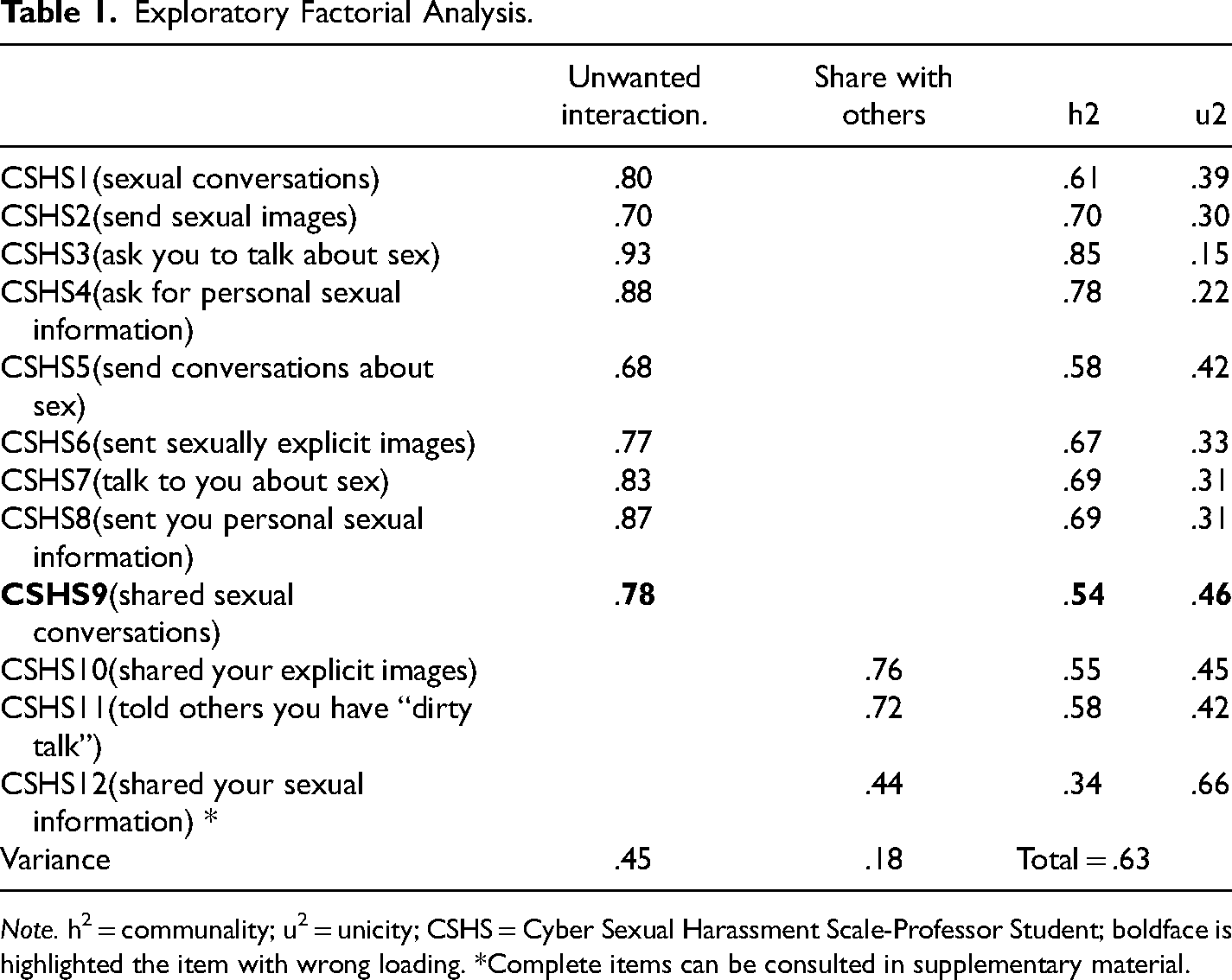
Note. h2 = communality; u2 = unicity; CSHS = Cyber Sexual Harassment Scale-Professor Student; boldface is highlighted the item with wrong loading. *Complete items can be consulted in supplementary material.
Table 2 shows the fit indices of the five models tested. In general, a good fit is observed for all models. Both the one-factor model and the two-factor model (regardless of the factor on which item nine loads). These differences of thousandths in the indicators lead us to accept the theoretical definition of the construct to finally defend a dimensionality. Therefore, despite having two alternatives that also show an optimal fit, we have decided to defend the two-factor structure with item 9 loading within the share with others factor, see Figure 1.
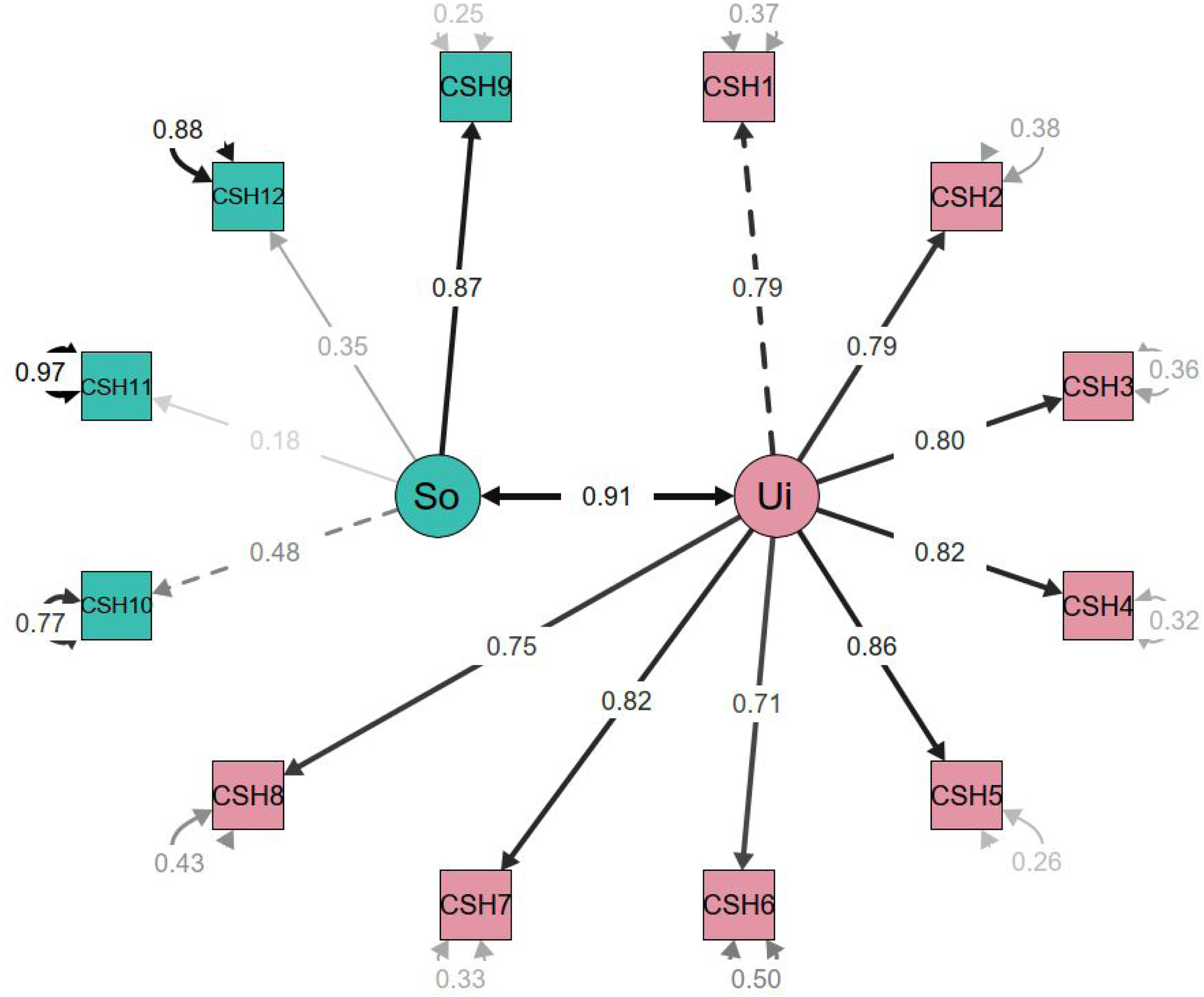
Path diagram of the chosen CFA model for the scale.
Fit Indexes and Statistic Information of Five Proposed Models.
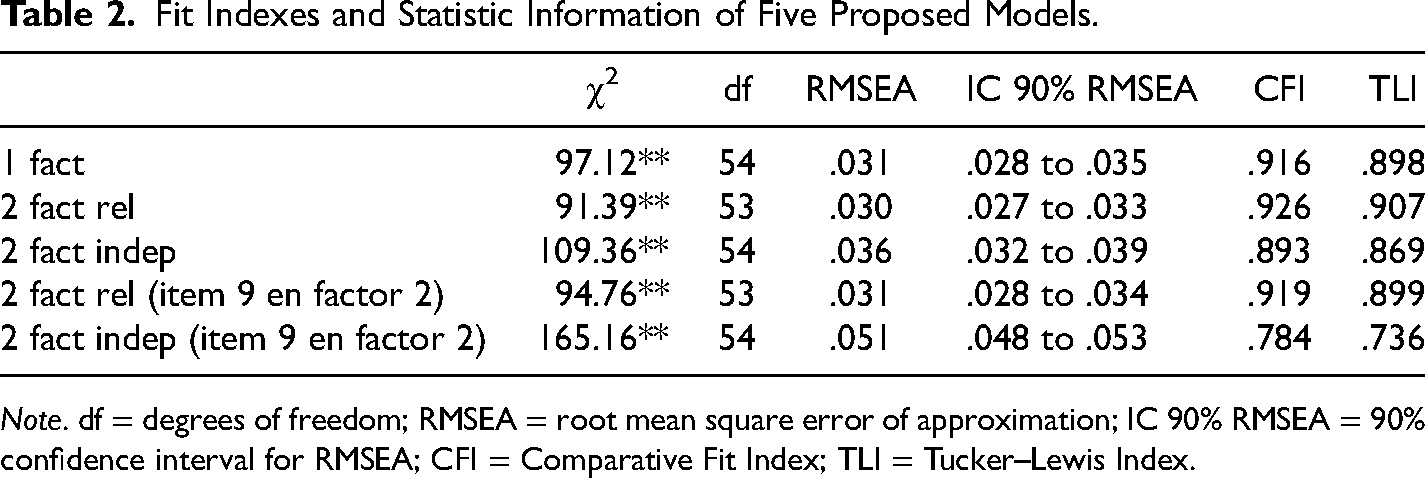
Note. df = degrees of freedom; RMSEA = root mean square error of approximation; IC 90% RMSEA = 90% confidence interval for RMSEA; CFI = Comparative Fit Index; TLI = Tucker–Lewis Index.
Next, we evaluated some of the psychometric properties of the items. As can be seen in Table 3, the means of the responses are low, which would indicate a low prevalence of this phenomenon, but the SDs suggest some variability so that although it is a rare phenomenon, it does occur in some cases. In addition, the reliability and consistency of the items are adequate.
Some Psychometric Properties and Statistical Information of the Items and Subscales.
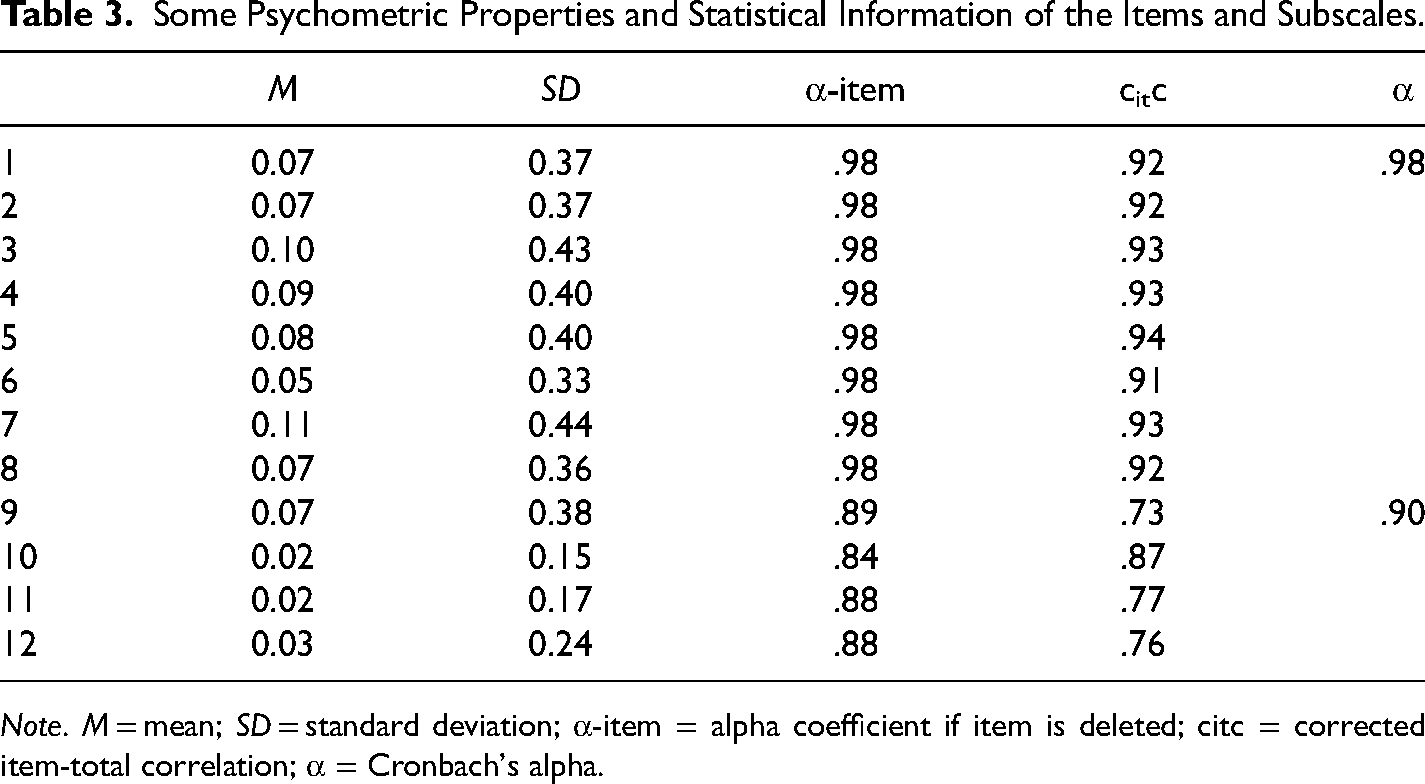
Note. M = mean; SD = standard deviation; α-item = alpha coefficient if item is deleted; citc = corrected item-total correlation; α = Cronbach's alpha.
Finally, some indicators of external validity with respect to one criterion are presented. Table 4 shows the correlations between the subscales of the Sexual Experiences Questionnaire and those of the Cyber Sexual Harassment Scale. The correlations were generally moderate, significant, and positive.
Correlation Matrix of the Current Scale and the Criteria.
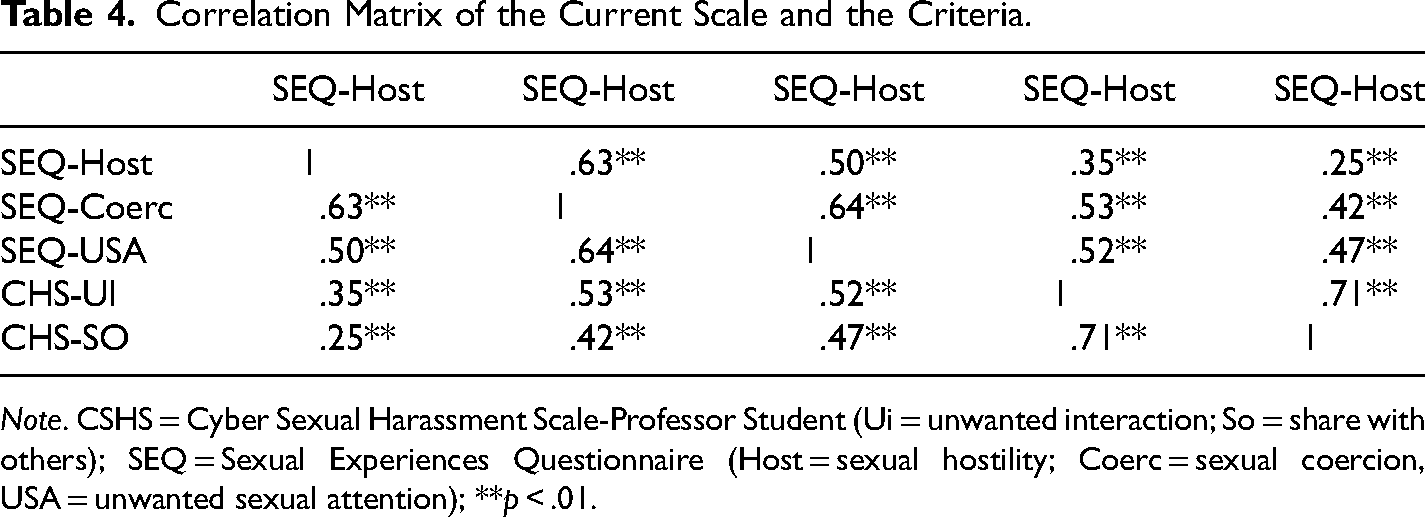
Note. CSHS = Cyber Sexual Harassment Scale-Professor Student (Ui = unwanted interaction; So = share with others); SEQ = Sexual Experiences Questionnaire (Host = sexual hostility; Coerc = sexual coercion, USA = unwanted sexual attention); **p < .01.
Discussion
The Cyber Sexual Harassment Scale-Professor Student appears to be a promising scale for assessing virtual sexual harassment by a professor to his or her students. Its two dimensions correctly capture the components of both the unwanted sharing of sexual material virtually (unwanted interaction) and the sharing of this material with others without consent (sharing with others). The scale is also shown to be reliable and valid. Thus, this scale joins the two more recently created scales: the Online Sexual Harassment Scale (Buchanan & Mahoney, 2022) and the Multidimensional Cyber-Sexual Harassment Experiences and Attitudes Scale for Victimization (MCSHEA-V; Wheeler, 2022) as suitable alternatives to assess online sexual harassment, a highly prevalent problem in technological societies. However, the present study represents the first validation in the Spanish language and the first scale that focuses on an academic context of asymmetry such as professor-student.
The factor analyses, both exploratory and confirmatory, deviated from the theoretically expected three-factor dimensionality. It would be expected that the behaviors of sending unwanted sexual material and solicitation would almost always be related. This phenomenon is known as transactional nude solicitation (Ringrose et al., 2022a, 2022b) and is common in other contexts. For example, in the British context, 75.8% of girls had received a dick pic and 74% of girls had been asked for a nude picture (Ringrose et al., 2022a, 2022b). In our results, it appears that these two behaviors are so closely related that the items have saturated into a single factor. Moreover, this factorization was confirmed a posteriori in an independent subsample with adequate fit indicators. The reliability of the scales, as well as the psychometric properties of the items, are adequate and allow the scale to be used for both practical and research purposes. It is true that the prevalence of this practice does not appear to be very high, but the impact it may have on the health of female students has not yet been evaluated. In addition, online harassment is associated with a higher prevalence among younger women and less proximity to the aggressor (Cuenca-Piqueras et al., 2020). Thus, on the one hand, university women—who tend to be younger—would be at greater risk of experiencing this type of harassment. However, on the other hand, professors are individuals who are known and close to the victims, which could reduce the incidence of this type of behavior (Scarduzio et al., 2018). Thus, future research should explore the impact of this type of harassment on the health of female students, in addition, as we were able to observe in the present research, there is a moderate association between suffering sexual harassment by a teacher in person and virtually. Therefore, the evaluation of the impact on health should include the interaction between both types of harassment.
This study had several limitations. The present study was conducted in a specific cultural and educational context; therefore, we urge caution in using it in this context without appropriate adaptation and validation. CSHS-PS validation did not include a direct comparison with existing scales or measures of sexual cyber harassment, so the findings may not be generalizable to broader populations or different cultural contexts. In addition, although the scale can be completed by both males and females and does not depend on a specific gender for the aggressor, the majority of aggression in this study was from male professors to female students.
Despite these limitations, the Cyber Sexual Harassment Scale-Professor Student (CSHS-PS) represents a significant advancement in understanding and assessing online sexual harassment of university students by their professors. This psychometrically sound scale identifies two key dimensions of harassment—Unwanted Interaction and Sharing with Others—offering a focused tool distinct from existing measures that target other populations or contexts (Buchanan & Mahoney, 2022; Wheeler, 2022). The findings highlight the occurrence and complexity of cyber harassment in academia, emphasizing the importance of addressing this issue and paving the way for targeted research and interventions in educational settings.
Supplemental Material
sj-docx-1-vaw-10.1177_10778012251319306 - Supplemental material for Design and Validation of the Cyber Sexual Harassment Scale-Professor Student
Supplemental material, sj-docx-1-vaw-10.1177_10778012251319306 for Design and Validation of the Cyber Sexual Harassment Scale-Professor Student by Claudia Pineda-Marín, Pablo Vallejo-Medina, Alejandro Guillén-Riquelme, Jenniffer Gonzalez-Ferrer and Adrian Montesano in Violence Against Women
Footnotes
Declaration of Conflicting Interests
The authors declared no potential conflicts of interest with respect to the research, authorship, and/or publication of this article.
Funding
The authors disclosed receipt of the following financial support for the research, authorship, and/or publication of this article: This work was supported by the Convocatoria posdoctoral UOC.

Supplemental Material
Supplemental material for this article is available online.
Author Biographies
References
Supplementary Material
Please find the following supplemental material available below.
For Open Access articles published under a Creative Commons License, all supplemental material carries the same license as the article it is associated with.
For non-Open Access articles published, all supplemental material carries a non-exclusive license, and permission requests for re-use of supplemental material or any part of supplemental material shall be sent directly to the copyright owner as specified in the copyright notice associated with the article.
