






Abstract
This article investigates women's experiences of gender-based violence (GBV) and migration, using data from a quantitative survey of migrant women in France. Breaking down their life trajectories into three phases—before, during, and after migration, we show how these elements intertwine, and even mutually reinforce one another. First, women who experienced different forms of GBV in their country of origin were more likely to make a more complex migration journey. Second, long journey, requiring multiple means of transportation and crossing multiple countries, in particular Libya, considerably increase the risk. Third, migrant women in France face a high risk of GBV independently of the complexity of their migration journey. Women's experiences of violence and migration can thus be understood as entangled.
Introduction
Since the closing years of the twentieth century, as women have made up a growing proportion of migration flows, researchers have increasingly been driven to study the specificities of women's migration and how it has changed over time (Dannecker, 2005; OECD, 2004; Oishi, 2005; Parson, 2010; Piper, 2003). It is in this context that a body of research on the widespread phenomenon of gender-based violence (GBV) in the lives of migrant women has developed (Araujo et al., 2019; Freedman et al., 2022a; Gonçalves & Matos, 2016; Innes et al., 2024; Thiara et al., 2011). Both quantitative and qualitative studies have shown that such acts of violence are central to the biographies of migrant women, who experience GBV both before and after migration, as well as on the migration journey itself. But while these women's trajectories of migration and violence are intimately linked, it can be difficult to bring out the logic of the interconnections between the two (Araujo et al., 2019; Giesbrecht et al., 2024). Violence can motivate women's migration, while both the migration journey and their situation in the destination country can also expose them to violence. The two types of experiences thus seem to be intertwined to the point of mutual reinforcement.
Here, by breaking down the life trajectories of migrant women into three periods—before migration, during the migration journey, and in the destination country—we seek to understand the interrelations between violence and migration. Specifically, we seek to answer three questions, and investigate three associated hypotheses. Research has shown that women's experiences of GBV can motivate them to migrate (Cook Heffron, 2019; Freedman, 2015; López Ricoy et al., 2022; Obinna, 2021; Parson, 2010). But do these experiences of violence also complicate their migration journey? Women who experience family or intimate partner violence are likely to enjoy less financial and material support from their personal networks in moving to another country, while the effects of GBV on their mental and physical health may make them more vulnerable. On both of these grounds, we hypothesize that GBV before migration may tend to complexify women's migration journey. Second, while various studies have shown that women are among the populations most at risk of GBV on migration routes (Freedman, 2016a; Keygnaert et al., 2012; Obinna, 2021; Pickering & Cochrane, 2013; Sahraoui, 2020; Schmoll et al., 2011; WRC, 2016), do specific characteristics make migration journeys particularly dangerous for women? We may hypothesize that movement through particular areas, or the use of particular means of transport, increases the risk of GBV that women face during migration. Third, studies have highlighted the vulnerability of migrant women, and particularly those in an irregular situation, to violence in destination countries (Freedman et al., 2022b; Giesbrecht et al., 2024; Menjívar & Salcido, 2002; Reilly et al., 2021; Vasil, 2024). But is this vulnerability accentuated by difficulties encountered on the migration journey itself? Our third hypothesis is that particularly complex migration journeys may make settlement in the destination country more difficult and lead to precarious living conditions, reflected in a concomitant increase in the risk of GBV after arrival.
Focusing on migrant women from various countries of origin living in France, the objective of our article is to improve the understanding of the interrelations between experiences of violence and migration by answering these three questions and investigating our hypotheses about the answers.
European and French Context
During the first half of the 2010s, the war in Syria, followed by the arrival in Europe of people fleeing the region, marked a turning point in European migration policy (Phillimore et al., 2022). European Union member states, speaking of a “migration crisis,” pushed for limits on migration. As European governments tightened the conditions of entry to the continent (Cusumano, 2019), researchers spoke instead of a “reception crisis” (Rea et al., 2019; Rosenberger & Müller, 2020; Seethaler-Wari & Yanasmayan, 2023). These new European migration policies contributed to the deterioration of migrants’ living conditions during their migration journey and in European countries, including France (Davies et al., 2017; Pinelli, 2018; Tazzioli, 2020), particularly for women (Canning, 2019; Freedman, 2017; Freedman et al., 2022b). Negative impacts of international restrictions on movement have also been observed in other world regions (Menjívar & Abrego, 2012; Obinna, 2021; Simmons et al., 2015; Vasil, 2024).
Over the course of the 2010s, successive French governments contributed to these effects as they sought to “secure” the country's borders (Freedman, 2018). And yet, in 2019, France was far from being one of the European countries with the most immigrants relative to the population 1 : at 13%, the country is close to the European average, behind countries such as Germany and Belgium (Beauchemin et al., 2021). In line with its colonial history, almost half of immigrants in France come from African countries, particularly the Maghreb: i.e., Algeria, Morocco, and Tunisia (Mainaud & Raynaud, 2021). Although the presence of immigrants from other European countries is lower than it was during the twentieth century, it remains considerable: in 2020, a third of immigrants living in France were of European origin. Finally, while immigration from Asia and the Middle East remains more limited, it evolved during the 2010s, and in 2020 15% of immigrants to the country were from these regions. In terms of flows, since the beginning of the twenty-first century, approximately equal numbers of women and men have arrived in France. And in 2020, almost two thirds of new arrivals were from Africa (Breton et al., 2023).
In France, data on migrant women's experiences of GBV drawn from representative population samples are rare, and where they exist, the samples are often small, limiting the robustness of the results (Brown et al., 2020; Jaspard et al., 2002; Khouani et al., 2023; Thiara et al., 2011). In this context, convenience samples are commonly used in France (Andro et al., 2019; Engliz-Bey et al., 2019; Khouani et al., 2023; Pannetier et al., 2018; Petruzzi et al., 2019) as in other countries (Gonçalves & Matos, 2016; Hazen & Soriano, 2007; Jonker et al., 2019; Keygnaert et al., 2012; Nam et al., 2022). Figures on the prevalence of GBV among migrant women living in France vary considerably between surveys depending on whether they use representative or convenience samples, as well as the sampling method where the survey is not representative of the general population.
Method
Sample and Procedure
The database used in this article is part of a broader research project: Rights and Health of Isolated Migrant Women Housed in Hotels (DSAFHIR). This project was spurred by observations in France and elsewhere in Europe on the difficulties facing homeless migrant women in accessing health care, particularly in the areas of sexual and reproductive health (EN-HERA!, 2009; Vandentorren et al., 2016). In this context, the project has two objectives: identifying obstacles hindering access to sexual and reproductive health care and services for these women, and testing different types of interventions aimed at facilitating that access. This project, carried out by the Centre de recherche de l’Institut de démographie of Paris 1 Panthéon-Sorbonne University and the Observatoire du Samusocial de Paris, is a mixed methods intervention study carried out in two phases. The method of the study has been reported elsewhere in more detail (Poncet et al., 2019). The first phase, in April and May 2017, consisted of a quantitative survey of migrant women, combined with pilot interventions in sexual and reproductive health. The second phase, eight months later, was devoted to evaluating the pilot interventions, with a return to interview the women on the interventions they had experienced in the first phase. Independent ethical overview and approval was granted by the relevant ethics committee (Comité de protection des personnes Ouest 6) on March 30, 2017 (CPP reference number: IDRCB number 2016-A02005-46). The protocol was also registered with the CNIL (Commission Nationale de l’Informatique et des Libertés—the board responsible for enforcing data protection legislation) on October 2, 2017, in compliance with regulations concerning the collection and analysis of personal data (CNIL reference number: 2034475).
The sample was constituted non-randomly in three steps. First, a geographical zone was selected. The choice was made to limit the survey to the Île-de-France region, which consists of Paris and the immediately surrounding areas. This region has a large emergency accommodations system, facilitating the task of locating and contacting migrant women living in precarious conditions. Public authorities and NGOs finance nights in hotels, which thus serve as emergency shelters for the homeless, including migrant women with or without children. Living conditions in these hotels are often difficult: the living spaces are often too small for the families accommodated in them, and the facilities basic or even unsanitary. To take into account differences in access to care, the Île-de-France region was broken down into three zones: an urban zone, with a dense public transport network and a large number of healthcare services; a semi-urban zone, further from public transport; and a rural zone, with much lesser transport access.
In the second step, starting from a complete list of the hotels in these three zones used as emergency accommodations, five hotels were chosen in each zone, ensuring that three criteria were met in each case. A sufficient number of women had to be accommodated in the hotel; they had to be accommodated long-term, in order to ensure that sufficient time was available for the health interventions; and exchanges with the management had to be sufficiently easy, in order to limit problems of access to the study participants and avoid reprisals. Finally, in the third step, women aged at least 18 who were present in the hotel when the interviewers visited were invited to take part in the research project. This sampling method allowed the project to capture a diversity of living conditions and situations of access to care among migrant women in the region. While it does not allow to generalize the results to all migrant women living in France, it does reveal a variety of trajectories for homeless migrant women.
In total, 580 women were invited to complete the quantitative survey questionnaire in the first stage of the project and 469 women did so, a participation rate of 80.9%. The interviewers who administered the questionnaire were exclusively women. To increase the participation rate, the interviewers spoke languages other than French. The interviews were conducted in 10 different languages that the interviewers, apart from French, English, and Russian, knew because of their migratory origins close to those of the interviewees: English, Arabic, Armenian, Bambara, French, Georgian, Kabyle, Romanian, Russian, and Soninke. 2 The women were interviewed in the hotel they were residing in, generally in their room or in a common room in the hotel, in the absence of their partner or other adults, but sometimes in the presence of young children. After providing informed consent, they completed the quantitative survey. The questionnaire asked about their sociodemographic and health characteristics, their migration and residential history, their reproductive history, their relationship to sexuality and contraception, their access to health care and services, and their experiences of violence. The analyses presented here were conducted on the resulting data: we do not mobilize the second database collected eight months later, nor the qualitative data collected during this research project.
Measures
Sociodemographic Characteristics
The DSAFHIR database includes information on a series of sociodemographic characteristics. These include country of origin (West Africa; Central and East Africa; Maghreb, North Africa, Middle East; Eastern Europe and the Commonwealth of Independent States; other European Union, mainly Romania and Bulgaria; other countries), age, marital status (married; divorced; widowed; never married), conjugal status (cohabiting couple; non-cohabiting couple; single), number of children (zero; one; two; three or more), the child (ren)'s year(s) of birth, level of education (less than secondary school diploma or equivalent; secondary school diploma or equivalent; at least some post-secondary education), administrative situation in France (resident status—permanent resident status or non-permanent resident status; no resident status) and monthly resources per consumption unit in the household (in relation to the level of the French minimum income allowance in 2017: none or €0; from €1 to €499; €500 or more). Finally, questions were used to assess the participants’ level of fluency in French (good; intermediate; poor).
Characteristics of the Migration Journey
The DSAFHIR survey also provides information on broad characteristics of the participants’ migration journeys: the start and end dates of migration, the number and names of the countries crossed, the people with whom the respondents migrated (alone; with at least their spouse; other situation), and the means of transport they used (airplane; boat; small boat; private car; bus or coach; train; on foot).
Violence-Related Variables
As the research project focuses on migrant women's health, and in particular on their sexual and reproductive health, it was necessary to inquire about their experiences of violence. The links between these dimensions of health and GBV in women are well documented in the research literature (Bacchus et al., 2018; WHO, 2013). An entire module of the survey questionnaire was devoted to questions about the participants’ experiences of GBV throughout their lives. While the answers provide relatively little information on the context of these experiences, they have the merit of distinguishing those that occurred before, during, and after migration, using the exact same formulations in each case. This allows GBV to be situated in relation to migration, which is not the case in all research on the subject (Araujo et al., 2019). For each type of violence reported by the respondents, the interviewers asked whether it had taken place in their country of origin, during the migration journey, and/or in France. They also asked about the perpetrator(s) in each case: partner or ex-partner, family member, friend, military personnel or police, landlord/lady or hotelier, social worker, healthcare personnel, a lodger or resident in the hotel, a smuggler, or a stranger in a public space. Finally, there was a question about the degree of severity that the respondents associated with each form of violence they had experienced, and whether they had talked about it with another person.
Three forms of GBV were covered in the questionnaire: psychological, physical, and sexual. Four questions concern GBV that can be considered psychological: Has anyone ever confiscated your identity documents, destroyed your identity documents, or blackmailed you using your identity documents? Has anyone ever stolen or damaged your things, or stolen your money? Has anyone ever insulted you or verbally abused you? Has anyone ever forced you to work without paying you, paying you very little, or controlling your money?
3
Three questions concern physical GBV: Has anyone ever threatened you with words and/or physically, with or without a weapon? Has anyone ever physically attacked you with or without a weapon, hit you, or tortured you? Has anyone ever locked you up or deprived you of your freedom?
Finally, one question on sexual GBV was included: Has anyone ever sexually assaulted you, or forced you to have sexual relations that you did not want?
They were also asked to characterize the perpetrators, which allows the reported experiences to be divided into seven different contexts: intimate partner violence (IPV) 4 , family violence 5 , violence by military and law enforcement personnel, violence in the context of accommodation (grouping together acts carried out by hosts and by other occupants), violence committed by professionals (social workers, care personnel), violence committed by smugglers, and violence in public spaces.
The information at our disposal does not allow us to identify every situation of violence as gender-based or not. However, the literature on migrant women presented in the introduction shows that the violence they suffer is often gender-based. This is particularly true of domestic violence, sexual violence and, to a lesser extent, family violence, including female genital mutilations (Andro & Lesclingand, 2017). Violence against homeless women in France is also described as gender-based (Loison & Perrier, 2019). We therefore use the term GBV to refer to all violence suffered, without excluding that it may (also) be based on race, age, or socio-economic status.
This module of the survey devoted to GBV allows us to grasp the “continuum of sexual violence” in the lives of migrant women. The concept of the “continuum of sexual violence” was developed by Liz Kelly (Kelly, 1988) not to designate a scale of violent acts sorted by their level of gravity, but to recognize the extent and variety of violent acts in women's lives. In recent years, it has been used to understand migrant women's multiple experiences of GBV (Krause, 2015; Phillimore et al., 2022; Roupetz et al., 2020). By distinguishing violence according to the moment of its occurrence—before, during and after migration—as well as its form and place of application, it is possible to account for its extent in the lives of migrant women, and thus to grasp the continuum of violence that marks their biography.
Data Analysis
The statistical analyses were conducted using SAS 9.4. We classify women as lifetime victims of GBV if they answered “Yes” to at least one of the eight questions about different types of violence presented above. The analyses begin with descriptive statistics on the sociodemographic characteristics of the women in the sample and on the characteristics of their migration. Bivariate analyses are then used to investigate the place of GBV in the lives of women with different types of migration journeys. They are followed by Pearson chi-square tests to investigate the statistical associations between these variables. Finally, to study these associations in more depth, multivariate analyses are used: one polytomous logistic regression model and two dichotomous logistic regression models. Adjusted odds ratios and 95% confidence intervals are calculated, and statistical significance assessed using Wald tests. The control variables differ for each regression model. For the first, we chose variables that previous studies have shown to be associated with the difficulties that individuals encounter on their migration journey (Freedman, 2016b; Grotti et al., 2018): age at migration, and the relationship between the timing of the birth of the first child and the start of the migration journey. For the second regression, we chose variables that, according to the literature, are associated with experiences of GBV during the migration journey (Freedman, 2016b; Grotti et al., 2018; Kastner, 2010; Reques et al., 2020): (not) crossing Libya, solo migration (vs. migrating with a partner or with others), and having her first child before, during, or after migration. Finally, for the third regression, we chose variables that previous studies have shown to be associated with experiences of GBV both in general (Ørke et al., 2018; Sanz-Barbero et al., 2019; Walker et al., 2019; Yakubovich et al., 2018) and specifically for migrant women in destination countries (Cook Heffron, 2019; Giesbrecht et al., 2024; Kim et al., 2017): previous experiences of GBV (in the country of origin and during the migration journey), age, time since arrival in France, level of fluency in French, monthly income per consumption unit, and administrative status.
Results
Sample Characteristics
In line with administrative data on migration in France (Breton et al., 2023), more than two thirds of the women in the sample came to France from Africa or the Middle East, principally West Africa (Table 1). But a substantial number—about a quarter of the sample—came from European countries, whether within or outside the EU. Ethnic statistics are the subject of much debate in France (Simon, 2015). While it is not uncommon to ask about respondents’ country of birth and nationality, questions on the origins of parents and grandparents are highly restricted, and those on skin color and ethnicity do not exist. Compared with other countries such as the USA or Canada, the information available in France on these subjects is less extensive. To get around this problem, we consider the respondents’ country of origin as a proxy for ethnic and racial characteristics. For example, we assume that women from African and Middle Eastern countries are mostly perceived as black or Arab and suffer racial discrimination. Similarly, those from Eastern European countries are likely to suffer other forms of discrimination, particularly those considered “Roma” (Powell & Lever, 2017). The mean age of the participants at the time of the survey was 33.7 (SD = 8.9). While most had never married (44.1%), the majority had a partner at the time of the survey (59.0%), cohabiting or not. They had a mean of 2.3 children (SD = 1.4), and the overwhelming majority (94.7%) had at least one child. Most had little formal education or income: nearly six in 10 had not completed a secondary school diploma or any equivalent, and nine in 10 lived on either €0 or under €500 per month. In terms of administrative status, nearly half (49.9%) had no residency permit, while among those who did have one, in 41.3% of cases it was temporary (97 out of the 235 who had some form of resident status). Most (55.4%) began their migration between the ages of 18 and 30, and had been in France between one and five years (54.8%).
Characteristics of the Migrant Women in the Study Sample (N = 469).

Mainly Romania and Bulgaria.
23 missing values.
The €500 threshold is approximately equal to the base value of the revenu de solidarité active (RSA) in 2017. The RSA is a social welfare benefit that provides a minimum income to individuals without employment. In comparison, the minimum monthly wage for full-time employment in France in the same year was €1,350.
Migration Journeys and GBV
The aim of this study is to understand the links between women's migration trajectories and their experience of GBV. We aim, in particular, to understand the extent of the impacts of GBV on migration, and vice versa. To do so, we began by creating an indicator of difficulties on the migration journey, drawing on previous work by colleagues using the same database (Andro et al., 2019). This indicator can take three values (Table 2): 1 = direct, 2 = complex, 3 = very complex. Journeys were classified as “direct,” and thus relatively trouble-free, if they took less than 15 days and involved either one or two means of transport. They were classified as “complex” if they took less than 15 days but involved more than two modes of transportation; or if they took more than 15 days and involved only one or two modes of transport, or crossed no more than a single country. Finally, journeys were classified as “very complex” if they lasted 15 or more days, involved more than two means of transport and crossed at least two countries. Less than two thirds (61.0%) of the respondents arrived in France following a direct migration journey, nearly a third (31.1%) following a complex journey, and under a tenth (7.9%) after a very complex journey.
Characteristics of the Three Types of Migration Journeys Identified in the Study Sample (N = 469).

We then constructed indicators of GBV that distinguish acts of violence in terms of their timing (before, during, or after migration), their form, and the context of their occurrence. A large majority (74.6%) of these migrant women had experienced GBV in their lifetimes, particularly in their country of origin (51.8%) and in France (50.1%) (Table 3). Most GBV before migration was psychological (70.4%) or physical (61.1%) (Figure 1). Although the reported frequency of sexual violence is lower, this type of violence was also very common (38.3%). This pre-migration GBV was most likely to take place within the family (42.4%), in an intimate partner relationship (32.1%) and in public spaces (27.6%), and to a lesser extent at the hands of military or law enforcement personnel (17.7%) (Figure 2). The proportion of women who experienced GBV during their migration journey was lower, but still high (16.0%) (Table 3). GBV during migration was most likely to be psychological (84.0%), but physical (53.3%) and sexual (24.0%) GBV were also widespread (Figure 1). The main perpetrators are smugglers (34.7%), people encountered in public spaces (30.7%), military and law enforcement personnel (24.0%), and, to a lesser extent, intimate partners (13.3%) (Figure 2). Finally, the respondents were almost as likely to have experienced GBV in France as in their country of origin, but these experiences were more likely to consist of psychological violence (87.2% vs. 70.4%) (Figure 1), and the majority were committed by strangers in public spaces (50.2%) (Figure 2). A large proportion had also suffered GBV at the hands of an intimate partner (30.2%), and, to a lesser extent, in the context of accommodations (16.6%) and within the family (15.3%).

Prevalence of Violence by Form and Timing in Relationship to Migration.

Prevalence of Violence by Context and Timing in Relationship to Migration.
Prevalence of Violence Across the Migration Trajectory (N = 469).

After constructing these indicators of GBV and the difficulty of the migration journey, we tested our initial hypotheses. For analyses of GBV broken down by the form of violence or the context of its occurrence, the numbers of individuals in each group are smaller. For our bivariate analyses, we maintain the distinction between forms and contexts of violence. But to improve the robustness of our multivariate analyses, we investigate the general prevalence of GBV before, during, and after migration without distinguishing between its different forms and contexts.
GBV Before Migration Complicates Migration Trajectories
First, we wanted to determine whether women's experiences of GBV in their country of origin at least partly explain the difficulty of their migration journey.
Our bivariate analyses highlight statistically significant differences in pre-migration GBV depending on the degree of complexity of the migration journey (Table 4). While less than half of the women who reported a direct migration journey had experienced GBV before their departure (47.2%), the proportion among those with a complex journey was more than half (54.1%), while among those with a very complex journey it was more than three quarters (78.4%) (p < 0.01). Furthermore, the three types of migration journeys are associated with different forms of GBV (p < 0.001 or p < 0.5). Women who had a direct journey to France were most likely to report psychological violence (32.5%), but also physical (26.6%) and, to a lesser extent, sexual (14.3%) violence before departure. Among women with complex journeys, a similar proportion reported pre-migration psychological (39.7%) and physical (35.6%) GBV, and while the proportion who reported sexual violence was lower, it was nonetheless high (26.7%). Finally, nearly two thirds of women with very complex journeys reported experiencing physical violence (62.2%), more than half psychological violence (54.1%), and more than a third sexual violence (35.1%) before departure. In sum, the more complex was women's journey, the more likely they are to have suffered different forms of GBV before they left. The contexts where women experience these acts of violence also vary depending on the characteristics of their migration journey. First, women with complex or very complex migration journeys were more often subjected to violence by military or law enforcement personnel. And second, those with a very complex journey reported far more IPV and family violence.
Prevalence of Violence Before Migration by Type of Migration Journey.
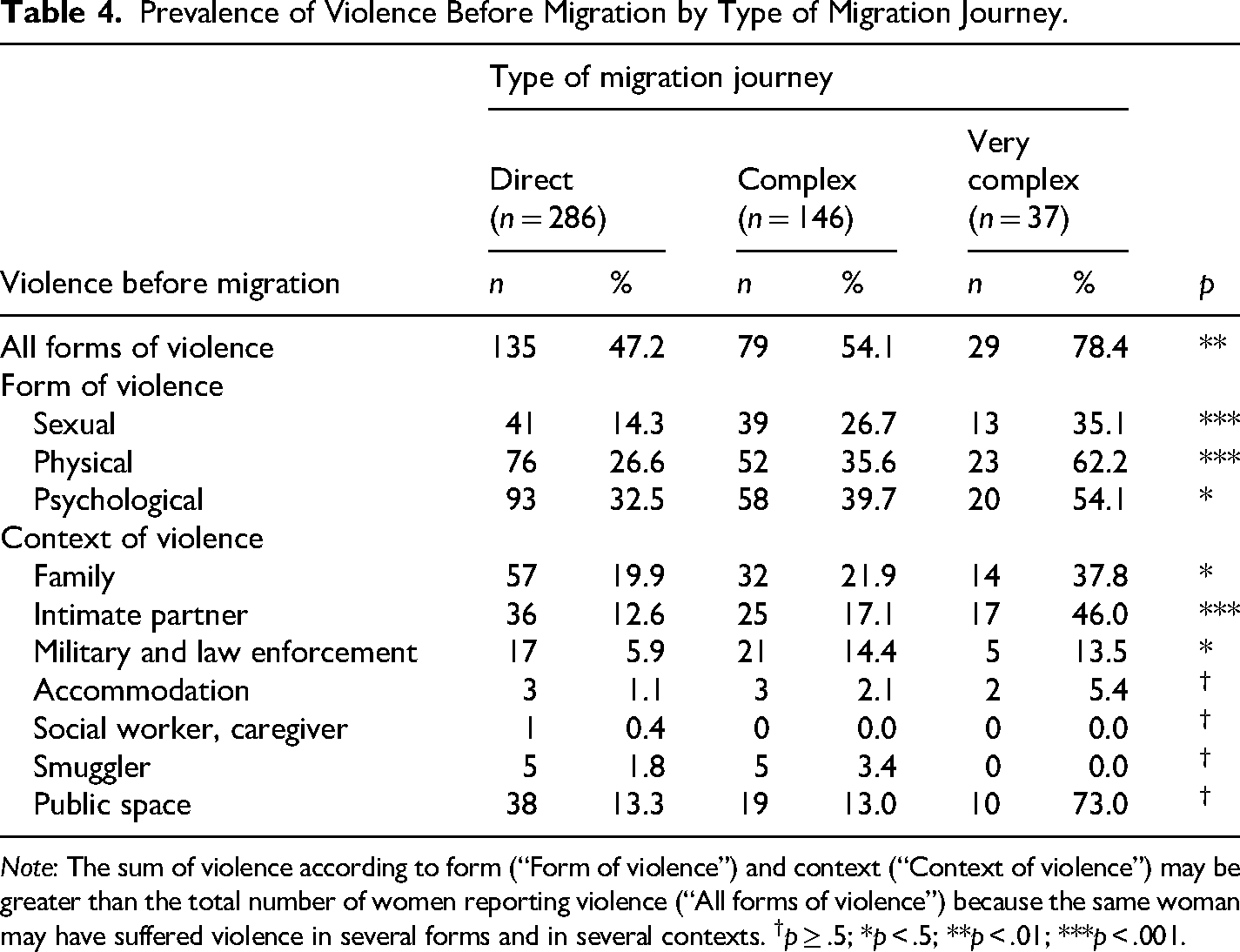
Note: The sum of violence according to form (“Form of violence”) and context (“Context of violence”) may be greater than the total number of women reporting violence (“All forms of violence”) because the same woman may have suffered violence in several forms and in several contexts. †p ≥ .5; *p < .5; **p < .01; ***p < .001.
Multivariate analyses allow us to study how experiences of GBV in the country of origin contribute to the difficulties women encounter as they migrate, while taking into account other characteristics that are also statistically associated with the complexity of the migration journey. To do this, we use polytomous logistic regression (Table 5). In this analysis, the likelihood that women who experienced GBV in their country of origin would have a complex migration journey rather than a direct one is no longer significantly different (OR = 1.3, 95% CI = 0.8, 1.9, p > .05). However, they are significantly more likely to have had a very complex journey rather than a direct one (OR = 3.7, 95% CI = 1.6, 8.5, p < .01). The probability of facing major difficulties during the migration journey also increases if women become mothers before or during migration rather than afterward. For women who had their first child after arrival, the odds of a complex journey (OR = 0.3, 95% CI = 0.2, 0.6, p < .001) or a very complex journey (OR = 0.1, 95% CI = 0.0, 0.6, p < .05) rather than a direct one were far lower.
Adjusted Odds Ratios of Type of Migration Journey by Experience of GBV Before Migration and Other Characteristics of Migration (Polytomous Logistic Regression).
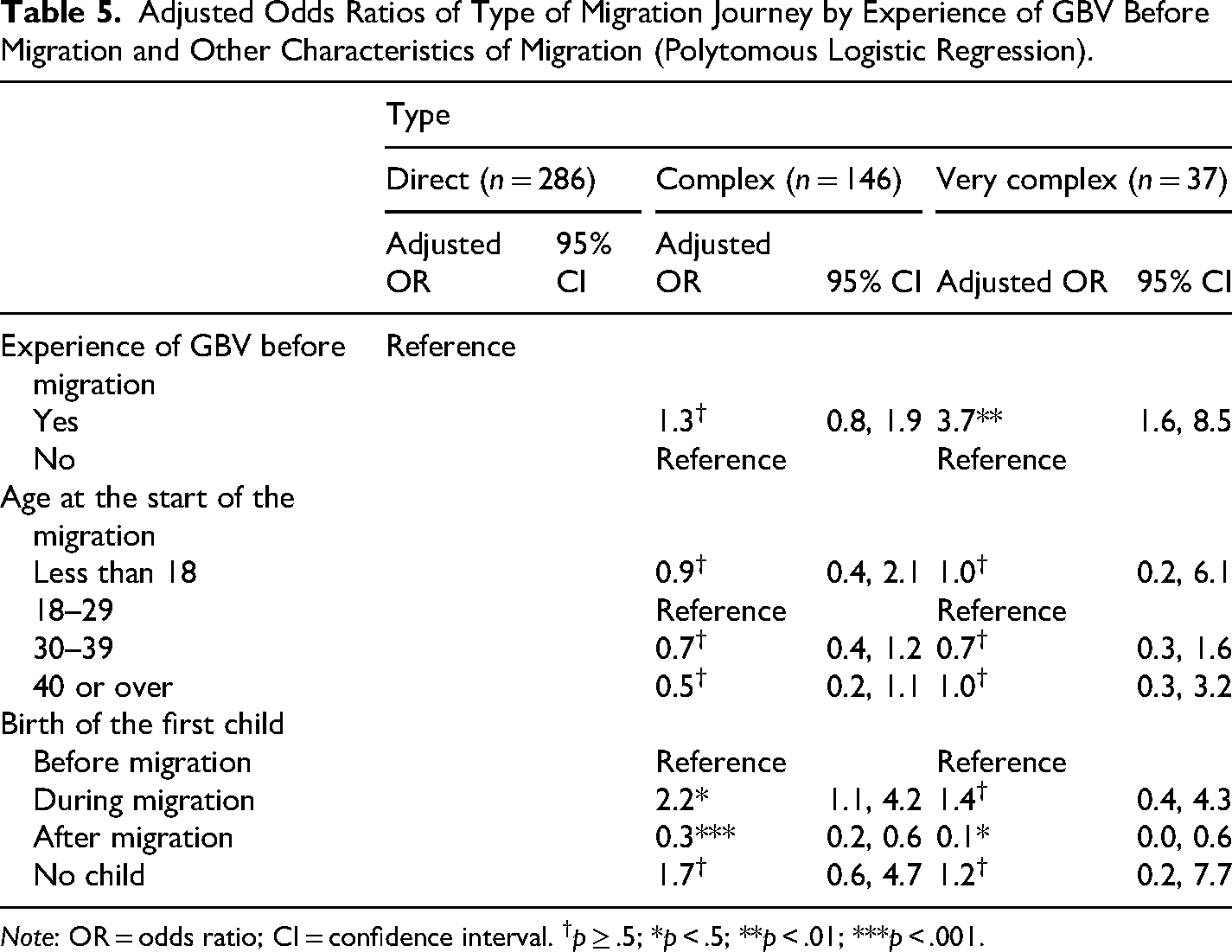
Note: OR = odds ratio; CI = confidence interval. †p ≥ .5; *p < .5; **p < .01; ***p < .001.
Complicated Migration Journeys Increase the Risk of GBV Along the Way
Next, we wanted to determine whether there is an association between the complexity of migration trajectories and women's risk of experiencing GBV on the journey.
Our initial bivariate analyses show a significant association between difficult migration journeys and a higher prevalence of GBV (Table 6). While fewer than one in 20 women with a direct journey experienced GBV along the way (3.5%), the proportion was more than quarter among those with a complex journey (28.8%) and nearly two thirds among those with a very complex journey (62.2%) (p < .001). Members of the groups with more complex journeys predominantly experienced psychological (22.6% and 59.5%, respectively) and physical (13.0% and 40.5%) GBV during the journey. But more than a fifth of women with a very complex migration journey also experienced sexual GBV along the way (21.6%). In terms of contexts, women with complex and very complex trajectories were most likely to suffer violence at the hands of smugglers (8.2% and 32.4% respectively) or in public space (6.2% and 29.7%). Women with a complex migration journey were more likely than others to experience IPV along the way (6.2%), while those with very complex trajectories were disproportionately likely to suffer violence at the hands of military or law enforcement personnel (32.4%).
Prevalence of Violence During Migration by Type of Migration Journey.

Note: The sum of violence according to form (“Form of violence”) and context (“Context of violence”) may be greater than the total number of women reporting violence (“All forms of violence”) because the same woman may have suffered violence in several forms and in several contexts. The sum of violence by context (“Context of violence”) may be less than the total number of women reporting violence (“All forms of violence”), because a few women did not specify the context of the violence. †p ≥ .5; *p < .5; **p < .01; ***p < .001.
Our analyses are completed by a dichotomous logistic regression model explaining the (non-)occurrence of GBV during the migration journey (Table 7). The risk of experiencing GBV during migration increases massively with the complexity of the migration journey (complex: OR = 9.3, 95% CI = 4.3, 20.0, p < .001; very complex: OR = 36.0, 95% CI = 13.2, 98.1, p < .001). It is also strongly linked with the crossing of Libya in particular (OR = 3.9, 95% CI = 1.6, 9.6, p < .01).
Adjusted Odds Ratios of GBV During Migration by Characteristics of the Migration Journey (Dichotomous Logistic Regression).
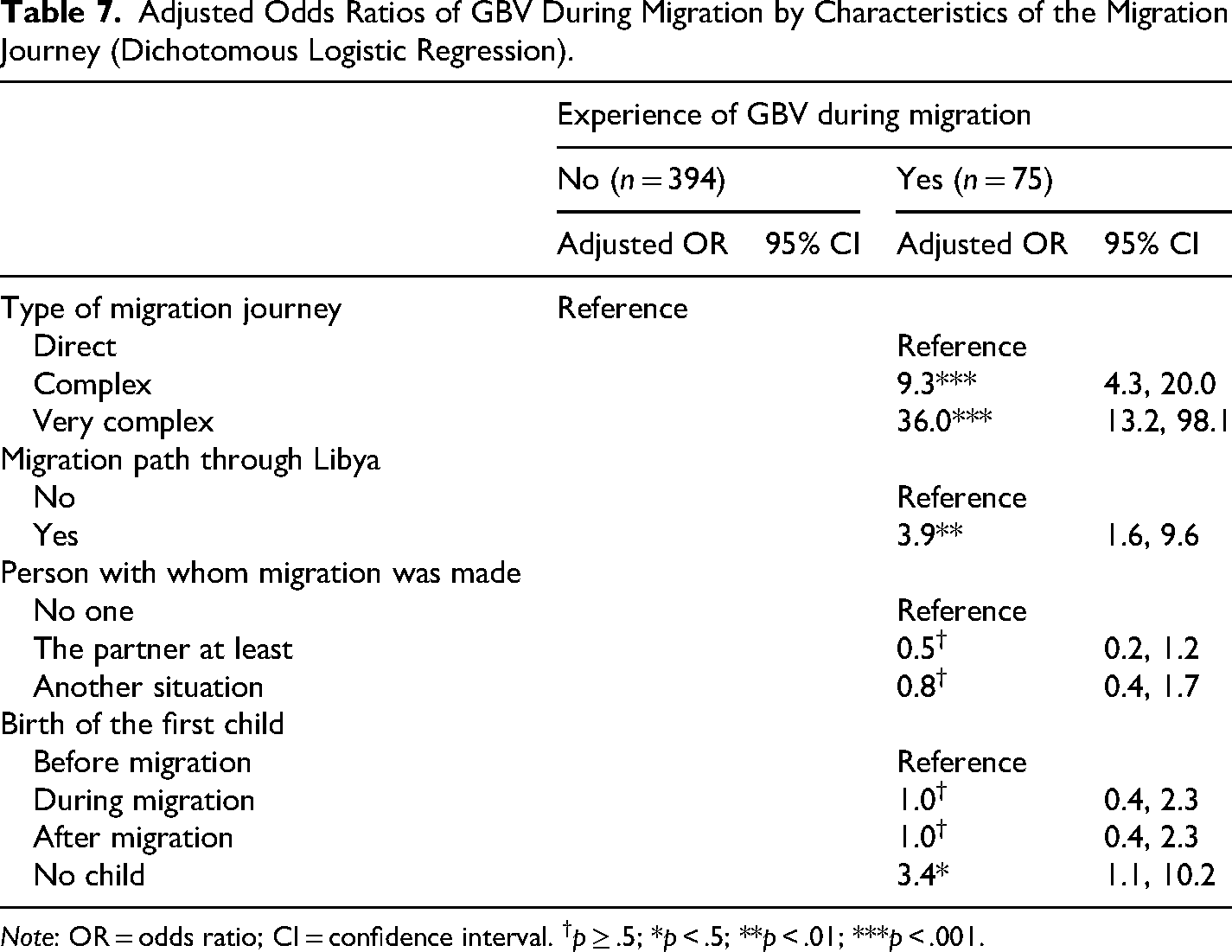
Note: OR = odds ratio; CI = confidence interval. †p ≥ .5; *p < .5; **p < .01; ***p < .001.
In France, the Prevalence of GBV is High and Independent of the Complexity of the Migration Journey
Our final aim was to determine whether difficulties women encounter during their migration journey increase the likelihood that they will experience GBV in the destination country, in this case France.
Bivariate analyses do not reveal any link between the two (Table 8). In other words, difficult migration journeys do not seem to be associated with greater likelihood of GBV, in general or of any specific kind, in France. Regardless of their type of migration journey, around half of the migrant women in our sample reported experiencing GBV in France (50.7%, 49.3% and 48.7%, p > .05), which corresponds to the proportion in the sample as a whole after migration. The distribution of these experiences is described in the section on Migration journeys and violence.
Prevalence of Violence in France by Type of Migration Journey.

Note: The sum of violence according to form (“Form of violence”) and context (“Context of violence”) may be greater than the total number of women reporting violence (“All forms of violence”) because the same woman may have suffered violence in several forms and in several contexts. †p ≥ .5; *p < .5; **p < .01; ***p < .001.
Our multivariate analyses, based on a dichotomous logistic regression model, confirm these results (Table 9): women who experienced a complex or very complex migration journey were not more likely to experience GBV in France. However, the analyses did show that other factors influence this risk. This is true in particular of experiences of GBV in the country of origin, which increase the probability of (re-)victimization in France (OR = 2.1, 95% CI = 1.4, 3.1, p < .001). The length of time that migrant women have been in France is also associated with this likelihood. The probability of experiencing GBV tends to increase with time spent in the country (less than one year relative to more than five: OR = 0.3, 95% CI = 0.2, 0.7, p < .01). Level of fluency in French is also associated with the occurrence of GBV, but not necessarily in the expected direction: the lower the women's level of French, the less likely they were to report experiencing GBV in France (OR = 0.4, 95% CI = 0.3, 0.7, p < .01). This result should be understood in light of the predominantly reported forms of violence. In France, migrant women mainly report experiencing psychological GBV. A detailed analysis of these acts (presented in Appendices 1 and 2) shows that in just under three quarters of cases they consist of insults or verbal abuse (71.2%), and that the perpetrators in half of these instances are people in public spaces (48.6%). As this psychological GBV is most likely to take place in French, mastery of the language presumably facilitates its identification and reporting.
Adjusted Odds Ratios of GBV in France by Type of Migration Journey, Previous Experience of Violence and Living Conditions in France (Dichotomous Logistic Regression).

Note: OR = odds ratio; CI = confidence interval. †p ≥ .5; *p < .5; **p < .01; ***p < .001.
Discussion
The lives of the migrant women surveyed by DSAFHIR are marked by GBV. Over half experienced GBV in their country of origin (51.8%), 16.0% during their migration journey, and 50.1% in France after their arrival. The most prevalent form of GBV is psychological (70.4%, 84.0%, and 87.2%, respectively before, during, and after migration), but physical GBV (62.1%, 53.3%, and 36.6%) and sexual GBV (38.3%, 24.0%, and 25.5%) are also widespread at all times relative to the migration journey. GBV thus occurs throughout the lives of migrant women. But how are the experiences of violence and migration related? To what extent are they interconnected? Our statistical analyses offer answers to these questions.
First of all, previous research has shown that GBV motivates women to migrate (Cook Heffron, 2019; Freedman, 2015; López Ricoy et al., 2022; Obinna, 2021; Parson, 2010). We demonstrated that in addition, these experiences partly shape the characteristics of the migration journey. Our results show that experiences of GBV before migration can be added to the series of factors known to complexify women's migration journeys, in particular having children. Thus, the risk of having a very complex migration journey rather than a direct one is more than three times higher for women who report GBV in their country of origin than for those who do not (OR = 3.7, 95% CI = 1.6, 8.5, p < .01). The characteristics of the pre-migration violence against these women shed light on this result. It took place predominantly in the family (42.4%) and intimate partner (32.1%) context. Family members and intimate partners are important resources for migration (Boyd, 1989; Creighton & Riosmena, 2013; Palloni et al., 2001; Toma & Vause, 2013). It is likely that women whose family members or intimate partner commit GBV against them are unable to access these support networks—all the more so if their migration is motivated by the violence itself—and that this loss of key resources complicates their migration journey.
Furthermore, while migration in general increases women's risk of experiencing GBV (Freedman, 2016a; Keygnaert et al., 2012; Obinna, 2021; Pickering & Cochrane, 2013; Sahraoui, 2020; Schmoll et al., 2011; WRC, 2016), some trajectories are more dangerous for them than others. The risk that a woman in our study population would experience GBV during migration was approximately 10–35 times higher if she reported a complex (OR = 9.3, 95% CI = 4.3, 20.0, p < .001) or very complex (OR = 36.0, 95% CI = 13.2, 98.1, p < .001) migration journey rather than a direct one. Long journeys, requiring multiple means of transportation and involving the crossing of multiple countries, thus increase women's exposure to the risk of GBV along the way. Crossing certain countries is particularly dangerous for women. This is notably the case of Libya (OR = 3.9, 95% CI = 1.6, 9.6, p < .01), where, as previous research has shown, migrant women face very difficult living conditions (Oun et al., 2017; Reques et al., 2020; UNSMIL & UN Human Rights Office, 2016). Although this country is a key gateway on the Central Mediterranean Route—one of the most popular migratory routes from Africa to Europe, the harshness of its migration policy is regularly denounced by international organizations, the media and scientists. Human rights are violated, and it is not uncommon for migrants to be enslaved, abducted, and sold. They are often imprisoned or locked up for long periods, during which they are subjected to various forms of violence. Migrant women are then particularly exposed to sexual violence. Contrary to GBV experienced before and after migration, which takes place in large part in the private spheres of family and intimate partnerships, GBV against women during their migration journeys takes place outside the personal sphere. It is committed above all by smugglers (34.7%), strangers in public spaces (30.7%), and military and law enforcement personnel (24.0%). The biographies of migrant women thus highlight the “continuum of GBV” that faces them (Krause, 2015; Phillimore et al., 2022; Roupetz et al., 2020), these acts unfold throughout their trajectories, and in the various contexts of their lives. Indeed, both before and after their migration, than during the journey itself, these women suffer a variety of acts occurring in different contexts and taking different forms. While they are subjected to the most common forms of violence—insults, theft, physical threats, etc.—they are also confronted with the most serious forms of violence. While they suffer the most common forms of violence—insults, theft, physical threats, etc.—they are also confronted with less frequent acts that are more strongly sanctioned by the law-trafficking, repeated rape, exposure to mass murder, etc. Applying the concept of continuum to the lives of migrant women underlines the fact that all these acts form a coherent whole, and that it is not enough to denounce the most serious, but rather all those they suffer. This notion also shows that, for women, the migratory experience exacerbates GBV.
Lastly, we wanted to determine whether difficult migration journeys themselves increase the risk of GBV in France. The results suggest that the two are independent of each other. Migrant women face an elevated risk of GBV within France regardless of the complexity of their migration journey (complex: OR = 1.0, 95% CI = 0.6, 1.6, p > .05; very complex: OR = 1.0, 95% CI = 0.4, 2.3, p > .05). Exposure to GBV in France thus does not seem to be influenced by the particularities of the journeys that migrant women take to reach France. It is, however, associated with other characteristics of their biography. First, experiencing violence before migration increases the risk of experiencing it afterwards (OR = 2.1, 95% CI = 1.4, 3.1, p < .001). This result likely specifically concerns IPV, for two reasons. First, IPV represents a large and very similar proportion of acts of GBV before (32.1%) and after (30.2%) migration. And second, research has shown that IPV is often a long-term pattern in victims’ lives (Ørke et al., 2018): either because the same partner commits violence against them over the course of multiple years (here, both before and after migration), or because there is a substantial risk of re-victimization (here, of a violent partner in the country of origin being followed by another in the destination country). Moreover, qualitative interviews with the women in the sample—which we did not use for this article but which we discussed with the people who made them—show that some left their homes precisely because they were victims of intimate partner violence. Research has shown that the socioeconomic situation of these women in destination countries makes them particularly vulnerable to this type of violence (Giesbrecht et al., 2024; Kim et al., 2017; Raj & Silverman, 2002). Second, France itself seems to be dangerous for these women, as the probability of GBV increases both with time spent in the country and with increasing fluency in the French language. But the last of these results is best understood in the light of the characteristics of post-migration GBV. It consists largely of insults and verbal abuse from people in public spaces. Increased mastery of French likely allows migrant women to better understand this type of GBV in France, which may be motivated at once by the victims’ identities as women, as often racialized migrants, and as homeless people.
By looking at migrant women's different experiences of violence, and distinguishing the moment of their occurrence in relation to migration, our analyses reflect the high probability of revictimization among these women over the course of their lives. On the one hand, they declare acts which, in part, take place over time and are rarely unique: IPV, of course, but also family violence. On the other hand, the precariousness of their living conditions, partly the result of migration policies, makes them particularly vulnerable to violence in public spaces and by military personnel or police.
Our study focuses solely on migrant women living in France, and moreover in the Île-de-France region, but our results can be generalized to other European capitals of former colonizing countries. Indeed, women arriving in Belgium, Spain, Italy, or Portugal, for example, are more or less from the same areas as those coming to France: mainly from Africa and Middle East, and to a lesser extent from Eastern Europe. 6 So, in part, they flee the same countries, take the same migratory routes and face the same difficulties entering European soil. While we show that these women's biographies shape their paths of violence as much as their migrations, the common features of their experiences lead us to believe that our findings apply to migrant women living in other European countries.
Finally, although the data used are from 2017, our analyses remain as relevant as ever. The increasing hardening of European and French migration policies continues to worsen the living conditions of migrants, both during the migratory journey and once they arrive in France or Europe in general (Canning, 2019; Davies et al., 2017; Freedman, 2017; Freedman et al., 2022b; Pinelli, 2018; Tazzioli, 2020). This hardening is fueled in particular by the growing spread of extreme right-wing ideas hostile to migration among European leaders. In this context, for example, over the past decade, solidarity with migrants has been increasingly criminalized (Dadusc & Mudu, 2022). In addition, other exceptional events have been used to fuel these political choices: for example, the Covid-19 epidemic, which led to restrictions on entry to certain territories (Stierl & Dadusc, 2022), or the war in Ukraine, which led European countries such as France to compete with migrants by facilitating, to a certain extent, Ukrainian access to their territory (Freedman et al., 2022b).
Limitations
Our research has some limitations that should be noted. First, the cross-sectional nature of the data means that caution is needed in attributing causality to the relationships between the variables. While our quantitative survey has the advantage of situating GBV within women's migration journeys, conclusions drawn from the logistic regressions, in particular on the relations between explanatory variables and those we are seeking to explain, must be formulated with care. This is true particularly as the participants are women who survived potentially very deadly migration journeys (Black, 2020; Fargues, 2016). A second limitation is our small sample size. First, it prevented us from applying multivariate analyses to GBV distinguished by form and context/perpetrator. Second, it increases the size of confidence intervals, which for some logistic regression models are relatively large, potentially calling into question the robustness of some of the results. Nonetheless, the fact that so many of our results are statistically significant despite the small sample size underscores their strength. Third, despite the implementation of a sampling method aimed at surveying migrant women with a variety of backgrounds, the use of hotels serving as emergency accommodations to locate the respondents meant that the survey reached women who have been given a room, often women with children, a public considered to be a priority, whereas associations report a growing number of homeless women, with or without children. Moreover, women who are hosted by someone are invisible. A sampling method that also sought to reach migrant women through services that some are more likely to use (such as hot meal distribution, street outreach to the homeless, certain health and social care services, etc.) could help to diversify the range of women included. Finally, the relatively narrow range of questions asked about GBV in the survey is a limitation. While the survey has the advantage of distinguishing experiences before, during, and after migration, with identically worded questions in each case, it provides relatively little information on their context. Previous research on GBV, and in particular on IPV, has emphasized the importance of contextualizing these experiences in order to understand their specificities and their place in women's lives (Dobash et al., 1998; Johnson, 2008).
Research Implications
Following in the line of previous studies on the widespread experience of GBV in the lives of migrant women (Gonçalves & Matos, 2016), our study offers insights into the interrelations between these experiences and the different phases of the experience of migration itself. It does so separately for different periods in relation to the migration journey. In a context where increasingly repressive migration policies at the French and European levels are contributing to the deterioration of migrants’ living conditions (Canning, 2019; Davies et al., 2017; Freedman, 2017; Freedman et al., 2022b; Pinelli, 2018; Tazzioli, 2020), our findings highlight the need to more precisely document the trajectories of women arriving on the continent, in order to better understand the evolving logics of women's migration and the place of GBV in the lives of women migrants.
Policy Implications
While it is difficult to study how GBV against migrant women has evolved with changing migration policies over time, it is very likely that, with the deterioration of their living conditions during the migration journey and in the destination countries induced by increasing restrictions on access to European territory, their vulnerability and resulting exposure to GBV has also increased. The high prevalence of GBV among the migrant women who participated in this survey should alert political decision makers and spur them to concretely evaluate the effects of their decisions on the experiences of migrants, and not only on immigration rates. Furthermore, while previous research has emphasized the failures of European countries in their reception of migrant women who are victims of GBV (Canning, 2019; Freedman, 2015; Freedman et al., 2022b), our results highlight the need to take into account the specificities of women's migration, and in particular the role of GBV, in developing reception policies. In this context, migrant women must have quick access to a housing, more than an accommodation, but also to social and health care services that are adapted to their needs. Finally, while the high rates of GBV facing these women in their countries of origin must be recognized, it is equally important to recognize that they are particularly exposed to the risk of such violence in France.
Conclusion
The biographies of migrant women offer a clear illustration of the concept of the continuum of GBV: violence takes various forms in the different spheres of their lives and across their trajectories. Experiences of violence and migration can thus be understood as entangled. Breaking their lives down into three periods—before, during, and after migration—can help us understand how these experiences interact, and sometimes reinforce each other. Our analyses and results highlight the need to better document the trajectories of migrant women, in order to improve our understanding of their exposure to GBV, and in particular of the role of migration experiences and the policies that shape them.
Footnotes
Acknowledgments
We would like to thank the rest of the DSAFHIR research team for designing and carrying out the survey, and all the women who responded.

Funding
Financial support for the DSAFHIR survey came from the French Agency for project-based Research Funding (ANR) and the Sanofi Espoir, HRA Pharma, and Macif foundations. The research presented in this article received funding from the ANRS Emerging infectious diseases (ANRS MIE).
Declaration of Conflicting Interests
The authors declared no potential conflicts of interest with respect to the research, authorship, and/or publication of this article.