







Abstract
This article makes a novel contribution to the literature on the impacts of intimate partner violence (IPV) through a qualitative study across specific spaces in Ghana and Pakistan, namely home, work, religious institutions, and marketplaces. We argue that women's ability to capitalize on the symbolic and material value of place is crucially mediated by violence. We further argue that the impacts of IPV in relation to use of space are intensified by the threat of re-perpetration and the stigma associated with IPV. The article thus contributes a spatial analysis to the understanding of the costs of IPV, including the complex dynamics of IPV beyond the domestic space.
Introduction
Research on violence against women and its varied impacts has expanded in recent years to include not only health impacts, but also social and economic impacts (e.g., Duvvury et al., 2023; Raghavendra et al., 2017; Vyas et al., 2023). Such research has been essential to advance our understanding of women's experiences, to appreciate the wide-ranging costs 1 of violence, and to explore how best to mitigate the negative impacts of violence. Research on the impacts of intimate partner violence (IPV) has tended to focus on incidents and their outcomes, with earlier research often exhibiting implicit assumptions that IPV is confined to the home or private sphere (Meth, 2003). Less research has been conducted on understanding the ways in which IPV may manifest and impact across a variety of physical spaces or the differential impacts that may result. In identifying the “locations” of violence, however, there is a need to also deepen understanding of the ways in which such locations may also reflect different kinds of social, economic and symbolic significance and, in some cases, differential status and opportunity. Consequently, the identification and investigation of the locations in which violence occurs is not merely a form of risk assessment but rather contributes to an understanding of the broader social and economic costs of violence.
IPV is a pervasive public health and human rights issue. Forms of violence include psychological, emotional, physical, sexual, economic, and coercive control (WHO, 2012); these are typically understood as gender-based in the sense that they are underpinned by gender dynamics of power and control (Boyle, 2019). The spatialities of IPV are under-studied (Bows & Fileborn, 2020), and of immense importance when considering the multiple impacts of this form of violence.
Anthropology and geography have provided means of dissecting the concepts of space and place to allow for a more nuanced understanding of the importance of location. While space is understood as a concept of physical geography denoting location, “place is what gives a space meaning, ‘personality’, and a connection to a cultural or personal identity. It is the culturally ascribed meaning given to a space” (Zaleckis et al., 2023, p. 29). For example, the home is often symbolically related to the domestic, family, and refuge; the workplace with independence and empowerment; religious institutes with safety and peace; marketplace with interaction and exchange—although, notably, these symbolisms may also be critiqued and unpacked and are constituted both socially and temporally. Each of these locations include both a physical space and are also places—they are valuable due to their symbolic meaning and the ways in which they connect individuals together through different forms of engagement. This emphasis on place and spatialities has underexplored value for understanding the impacts of violence against women (VAW). Because, places have different symbolic meanings, violence within them will have different impacts. For instance, violence or fear of violence in public places may result in women withdrawing and reducing their participation in public life including opportunities to build social capital, while violence in the workplace may result in the loss of work, income, and job opportunities. Consequently, the ways and the spaces in which IPV spills out beyond the home to occur in various spaces (Duvvury et al., 2023) and the “costs” of violence that incur, are important and underlooked area of research on VAW.
Research on VAW has identified that in response to the ever-present threat of men's violence, women are required to negotiate how they engage with space and place in the attempt to minimize risk and evade social stigmas (Pain, 1991; Valentine, 1989; Vera-Gray & Kelly, 2020). This may include avoiding locations or changing the use of space to reduce risk. The emotional, intellectual, and physical labor involved in this negotiation is itself a draw on women's resources but also has the potential to limit their capacity to accumulate economic, cultural, and social capital, particularly in places with significant social value. Yet, the role of place in costs of violence research has been under-examined. To address this gap, we develop a spatial analysis of sociological thinking on capital, to consider the costs of IPV through a novel lens. To do this, we analyzed the data from 56 interviews with women who have experienced IPV and 16 focus groups with women in Ghana and Pakistan to deepen understanding of the role of place, including the home, workplace, religious institution, and marketplace, on the costs of IPV.
Literature Review
The Social Impacts of IPV: Capital Development
Women's empowerment has been widely recognized as a requirement for thriving democracies and sustainable, equitable development. VAW is known to be a barrier to achieving empowerment. This near-universal understanding is evidenced through the UN's 2030 Agenda and Sustainable Development Goal 5 (SDG 5) on Gender Equality (United Nations, 2015). Empowerment for women has been described as the “process by which women gain power and control over their own lives and acquire the ability to make strategic choices” (United Nations Commission on the Status of Women[UNSCW], 2002). The UN has proposed that empowerment has five key components: women's sense of self-worth; their right to have and to determine choices; their right to have access to opportunities and resources; their right to have power to control their own lives, both within and outside the home; and their ability to influence the direction of social change to create a more just social and economic order, nationally and internationally (EIGE, 2016). IPV limits empowerment directly through violence, including coercion and control, economic violence and the control of resources, and physical injuries that prevent mobility and participation. Indirectly, IPV also acts as a barrier to empowerment through the secondary physical and psychological health consequences that reduce women's self-esteem and produce shame and social stigma. Research has documented some of these impacts, including the long-term impacts on earning potential and chronic functional illnesses in survivors of IPV (Dillon et al., 2013; Vara-Horna et al., 2023). Recent research has also begun to identify the impact on women's leadership and political participation as a result of IPV (Duvvury et al., 2021). These impacts all address a key point—VAW carries a cost, to women, their families and societies.
This “cost” can be conceptualized as the loss of potential capital accumulation, be it social, cultural, or economic capital. Here, capital is understood broadly, as “accumulated labor (in its materialized form or its ‘incorporated’ embodied form)” (Bourdieu, 1986, p. 241) and further that this capital acts as resources that can be drawn upon to overcome constraints and increase the “chances of success for practices” (p. 15). Bourdieu (1986) identifies three forms of capital—economic, social, and cultural—while other authors have expanded this to include religious capital, emotional capital, and political capital among others (e.g., Nica, 2022; Watts & Munir, 2024; Yang & Chen, 2016) though these may be seen as sub-fields within social capital. Regardless of the number or type of capital, the same process and outcome is evident—labor (in whatever form) accumulates resources which may be mobilized to one's advantage, for instance, to have the capacity to make strategic choices and act on them. That is, to be empowered. In this article, we draw on Bourdieu's conceptualization of capital to explore the social impacts of IPV.
The impact of IPV on the production of capital has been considered in some research recently (Gilroy et al., 2020; Moulding et al., 2023). Missing from this analysis however is a recognition of the spatialities of IPV. As feminist geographies outline, access to places and usage of space to accumulate capital is socially and culturally differentiated and stratified, not least of which along gendered lines. For instance, women were historically excluded from public workplaces in much of the world, creating spaces that were primarily, or exclusively, male (Gqola et al., 2024). The private sphere has also been framed as a place dis-associated with the production of economic capital, but which is recognized for its production of social capital through familial and other intimate relations (Federici, 1975; Guha et al., 2022). We thus argue that a full understanding of the way in which IPV impacts women's capital development requires a spatial analysis.
Spatialities of IPV
The spatialities of gender-based violence are both essential to understanding and neglected outside of the field of geography (Bows & Fileborn, 2020). In this article, we use the term spatialities to talk about the relationship between space and society (Browne et al., 2024). Space, as noted by Hayward (2012, p. 441), is “a product of power relations, cultural and social dynamics, [and] everyday values and meanings” (cited in Bows & Fileborn, 2020, p. 300). Spaces, whether buildings or sites, come into being through the inscription of meaning onto them by people. As Monnet (2011, p. 2) notes, the “human ability to symbolize is used by groups and individuals to produce symbolic places, to influence the construction of collective identities, and to legitimize the exercise of an authority.” Spaces are both designed and constructed through the exercise of social relations to privilege male superiority and to regulate and control of women's bodies (Bows & Fileborn, 2020; Valentine, 1990). Nowhere is this more marked than in the gendered production of distinctions between “public” and “private” spaces. Public spaces are typically produced as masculine, heteronormative, and white (Bell et al., 1994, quoted by Bows & Fileborn, 2020). Across multiple different politics and cultures, male power, and privilege is reenacted and reinforced in locally constituted ways through everyday practices in place, naturalizing specific located patriarchal cultures in specific places (Datta, 2016). Datta (2016, p. 179) argues that, in India as in most contexts, gendered violence is enacted in spaces in such a way that each individual incident reifies what she dubs a genderscape of hate. VAW thus produces spaces and is further enabled by those spaces.
Feminist research on violence and feminist geographies in particular, call into question the sharp distinction between public and private (Blunt, 2005; Bows & Fileborn, 2020). Social and cultural geographers challenge the near universal association of woman with the home, whereby “that place called home is frequently personified by, and partakes of the same characteristics as those assigned to, Woman/Mother/lover” (Massey, 2001, p. 10). Feminist scholars argue that rather than being private and uninflected by wider dynamics, the homeplace is symbolically produced as deeply gendered within nation and empire (Blunt, 2005), alongside other, multi-scalar levels and locations.
While binary imaginaries of space as public/private and masculine/feminine have been robustly critiqued by feminist scholars, gendered differentiation of space and place persist, with real consequences for how VAW is understood and addressed (or not). These include the traditional reticence of government interference in the home, including challenges to the recognition and prosecution of IPV (Schneider, 1991).
Similarly, the symbolic gendering of places such as workplace and marketplaces as public and correspondingly masculine has resulted in pillared approaches to the examination of gender and gender roles within each place, overlooking the inherent connections created through social relations between them. Consequently, much of the literature that looks at IPV, either ignores the significance of place of violence altogether or assumes IPV “to be taking place in a formal material space known as the home” (Meth, 2003, p. 4). Feminist geographies of violence draw attention to the necessarily embodied impacts of IPV (Fluri & Piedalue, 2017; Sweet & Escalante, 2017), meaning that even violence that is limited to the homeplace impacts bodies as they move elsewhere in the world. Sweet and Escalante (2017) propose the use of “visceral geography” to connect the bodies affected by VAW to spaces and environments, and “linked social, economic and political systems” (Sweet & Escalante, 2017, p. 595). Furthermore, research demonstrates clearly that IPV is committed and threatened in many places beyond the home (Kelly et al., 2014).
A spatial analysis presses us to consider, then, the impacts of supposedly “private” violence such as IPV in the different spaces and locations that victim-survivors move between. In this article, we consider the impacts of violence through a spatial lens, an essential and to date overlooked approach to theorizing the costs and impacts of IPV. We argue that the locations in which violence occurs are differentiated in terms of their potential for the production of forms of capital. 2
The engagement required to build capital of various kinds happens within specific places that convey more or less importance to the engagement. For instance, inviting someone to one's home may build a social connection, and consequently contribute to network building and thus the accumulation of social capital more effectively than a meeting in an office building. Another example may focus on the role of the marketplace. In many locations, including both Ghana and Pakistan, markets are not only a geographical space in which economic exchange occurs, but are also the location in which personal relationships with others outside the family take place, where information is exchanged, and where public performances often occur (both political and cultural). Further, they are places in which women may take on particular roles of authority and respect as market “queens”, traders, and political actors (Frimpong Boamah et al., 2020, p. 4). Consequently, the market offers the potential of increasing economic, cultural, and social capital—to those who are free to access it and engage with its offerings. Indeed, the places which hold social importance to us, which include the home, the workplace, and public spaces for social interaction, are also places that offer the potential for the production of social, political, and economic capital.
Beyond Direct Impacts: Safety Work and Stigma Work
Understanding the costs of IPV thus requires an understanding of the ways in which women make use of space, and how they experience violence and its impacts within specific places. However, the pervasive presence of gender-based violence in both private and public spaces requires adaptations, restrictions, and self-regulation of those most vulnerable to violence, particularly women (Pain, 1991; Valentine, 1989; Vera-Gray, 2018). “Safety work” is the term used to refer to the burden of adaptations and self-regulations that women make in response to the threat of ongoing perpetration (Vera-Gray & Kelly, 2020). Following Liz Kelly, Fiona Vera-Gray (Sharp-Jeffs et al., 2018, p. 14) describes “safety work” as “the range of modifications, adaptations, decisions that women take often habitually in order to maintain a sense of safety in public spaces.” Kelly's concept has been developed, most significantly by Fiona Vera-Gray, as it relates to street harassment, but women also employ safety work in response to IPV (Kelly et al., 2014).
In addition to navigating the risks of perpetration, victims and survivors navigate normative spaces that are produced through gendered performances (Datta, 2016). IPV is a subject of considerable stigma (Overstreet & Quinn, 2013), rendering women in violent relationships as non-normative, and positioning women in space as “failed” or socially unacceptable. It is not only the harm of direct violence and the risk of re-perpetration that women navigate, but also the social discrediting that comes with the patriarchal stigma associated with victimization for violence, and the consequences of violence (e.g., divorce/single motherhood/familial rejection) (Overstreet & Quinn, 2013). As Vera-Gray and Kelly (2020, p. 221) highlight, safety work is done, not only to minimize the potential of victimization, but also the risk that they will be blamed for their victimization. Similarly, in the case of IPV, stigma work is the work required to manage the risk of social discrediting associated with the status loss of being a victim-survivor. Safety work and stigma work are an indirect impact of the pervasiveness of violence, and are a cost borne by women. These impact journey in places and spaces with the embodied victim-survivor, manifesting differently depending on the space.
In this article, we trace social impacts of IPV on women in Ghana and Pakistan, through the conceptual lens of capital making a unique contribution to the literature. We look at the ways in which IPV impacts women's ability to accumulate resources—economic, social, relational, and cultural—which may be mobilized to expand their ability to make choices. The article makes two key theoretical contributions to the emerging literature on the social impacts of VAW. First, a spatial analysis is required in order to generate a thorough understanding of the multiple ways in which IPV impacts on women's accrual of social capital. And second: that understanding the social impacts of IPV must analyze not only direct impacts, but also the impact of safety work and stigma work, labor that is required in gendered spaces. We elaborate on this argument through our analysis of women's ability to generate capital in key spaces noted in a large mixed-method study on the costs of violence, which we go on to introduce now.
Methodology
This article presents a thematic analysis of qualitative data from a larger mixed-method research study funded by The Department for International Development, UK, on the impacts and costs of Violence against Women and Girls (VAWG). The study investigated the social and economic costs of VAWG in Ghana, Pakistan, and South Sudan (2014–2020), as part of the What Works to Prevent Violence against Women and Girls program (for further methodological detail see Asante et al., 2019; Ghaus et al., 2019). This article focuses on qualitative data gathered in Ghana and Pakistan.
Conceptual Framework
This article draws from key concepts across the fields of sociology and social geography. Bourdieu's sociological concept of capital, as defined in the literature review, presents a terminology to explain how the loss or “cost” that women experience due to violence or threat/fear of violence—that is, the potential to accumulate capital or resources of various types—is accrued due to violence. To understand the cost of IPV in relation to social capital, we develop a spatial analysis of capital accumulation as it occurs in the everyday lives of victims-survivors. Through this approach we hypothesize an impact pathway whereby the changes women experience in relation to their use of space, due to direct violence, safety work or stigma, reduces the opportunities to accumulate capital. This loss or “cost” of IPV limits the resources women can mobilize to leave abusive relationships and increase empowerment.
Context
Both Ghana and Pakistan are lower-middle income countries and score “very poor” on the Gender Equality Index: Ghana in 103rd place and Pakistan at 123rd out of 144 countries in 2022 (EM2030, 2022, p. 19). IPV is reported as a common occurrence in both Ghana and Pakistan. Research estimates that over 36% of women have experienced IPV in Ghana (Dickson et al., 2024) and over 33% in Pakistan (Shaikh, 2024). In both countries, resources for women experiencing violence are limited and the vast majority of women in Ghana (Rohn & Tenkorang, 2023) and Pakistan (Hadi, 2020) do not seek formal support when experiencing IPV. Consequently, personal resources—an outcome of the accumulation of forms of capital—are critical for women seeking to leave violent relationships (Heron et al., 2022; Matjasko et al., 2013). This positions the accumulation of capital in a complex ongoing relationship with IPV, since IPV both reduces opportunities for capital development, and increases women's reliance on their various forms of social capital to survive and even escape IPV.
In the case of Pakistan, structural gender norms have a significant impact on women's use of space. Women in rural areas are largely expected to remain within the environs of the home, with little uptake of formal paid work and restricted use of public spaces for socialization (CDPR, 2017). In Ghana, women move in public spaces relatively freely, with traditions of women working in markets, the service industry, agriculture, and other sectors (World Bank Group, 2024). These two countries thus provide an opportunity for a rich understanding of the costs of IPV relating to capital accumulation and place.
Recruitment and Data Collection
Interviews and participatory focus group discussions were conducted in both countries: the sample size is presented in Table 1. Recruitment drew from 3,000 quantitative surveys conducted in each country, which applied a sampling frame and included a re-contact question for a follow-up interview (see Asante et al., 2019; Ghaus et al., 2019). The sample used in the analysis presented in this paper includes in-depth interviews with women who had experienced violence; and women-only Focus Group Discussions with women who had and had not experienced violence. The data generated aimed to understand the “costs” of various forms of VAW, including tangible and intangible costs.
Sample Size for the Quantitative and Qualitative Surveys 2016.

Local research partners at the Institute of Statistical Social and Economic Research (ISSER) at the University of Ghana, and Social Policy and Development Centre (SPDC) Pakistan organized and undertook the interviews and FGDs in the relevant language. Transcripts were then translated into English.
Analysis
For the purposes of this article, thematic content analysis was used to analyze the interviews and FGDs with a focus on spaces and places identified through a participatory mapping exercise conducted in FGDs. We coded references to specific places identified in FGDs as important to daily life, for instance: workplaces; public spaces; schools; community groups; religious communities and places of worship. Drawing on this spatial coding, we analyzed how violence was described and interpreted as it affected women in and through those places, focusing specifically on IPV.
Ethics
This project was attended to the ethical considerations of informed consent, confidentiality, anonymity, and participant safety. Ethical approval was granted for the overall project by the Research Ethics Committee of the University of Galway and locally by the appropriate national body. In Ghana, the University of Ghana's Ethics Committee for the Humanities granted ethical approval, while in Pakistan, ethical approval for the study was granted by the National Bioethics Committee of Pakistan.
Limitations
The larger research project, from which the data was drawn, focused on the economic and social impacts of a wide range of forms of VAW. In this article, we are thus exploring the data through a different framework than was its original intent. While this provides new and compelling results, the breadth of responses is more limited than in relation to the original qualitative research questions. Further studies with a specific focus on IPV, capital accumulation, space and place are thus recommended.
We do not claim to offer generalizable findings. The analysis presented in this paper provides potential direction for the study of the social impacts of violence: the importance of its spatialities; and the resulting costs to individuals and societies of IPV. Further, they present the voices of women themselves, helping to translate their specific experiences, through comparison and amalgamation, into a deeper understanding of the impact of IPV on use of space, place, and capital accumulation.
Women's Use of Space in Ghana and Pakistan
In participatory focus group discussion in Ghana and Pakistan, women were asked to map (see Figures 1 and 2) places commonly utilized by women in their community. Places which women commonly visited in both locations included the home, school, workplaces, markets/shopping centers, religious institutions, and health centers/hospitals. These locations were identified by women in urban and rural locations and in both the older (30 years old +) and younger (18–29) age groups, and in both Pakistan and Ghana. Other locations identified by women included salons/parlors, homes of relatives and, in Ghana, beaches and clubs.
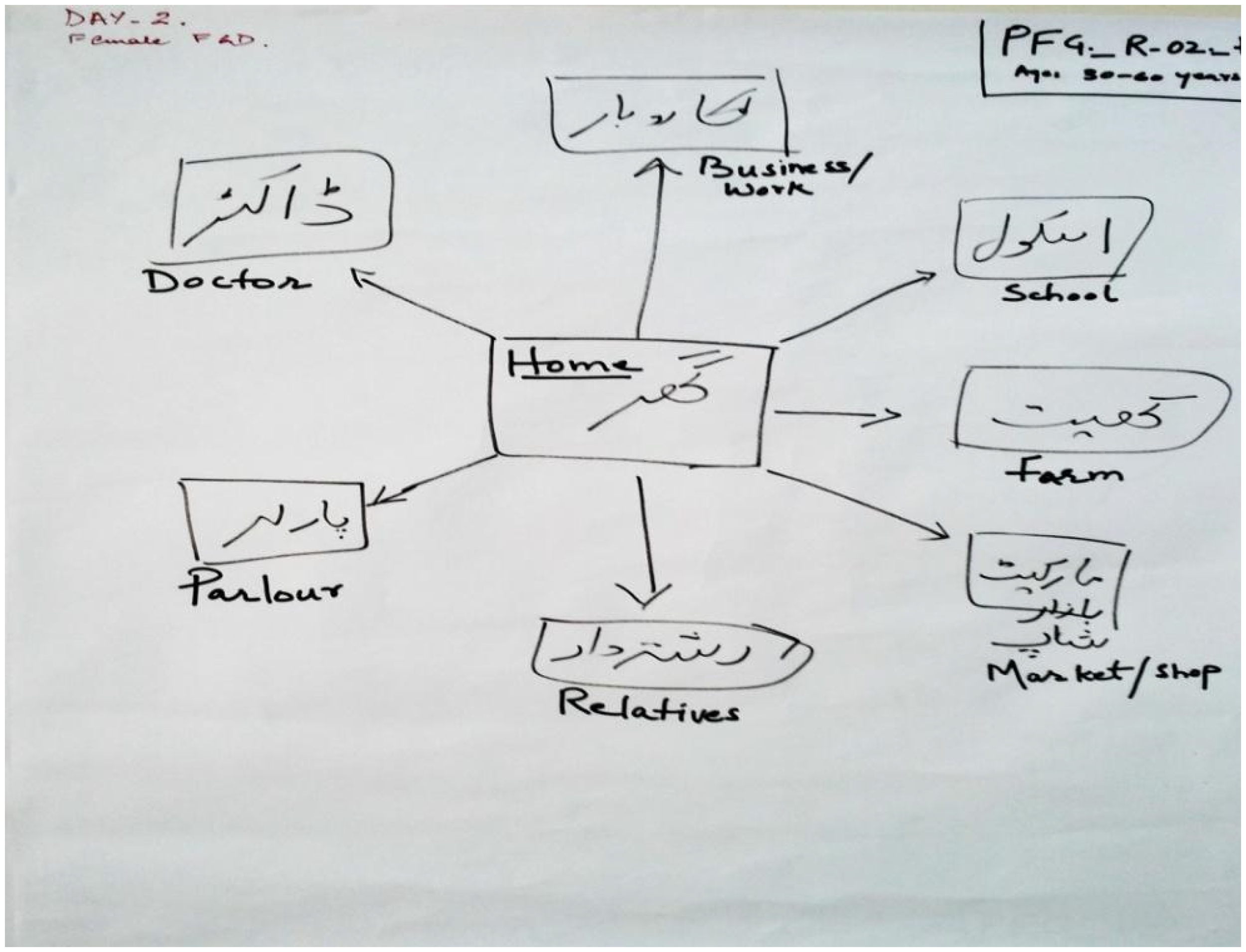
Locations Women and Girls Visit in a Regular Week, Pakistan.
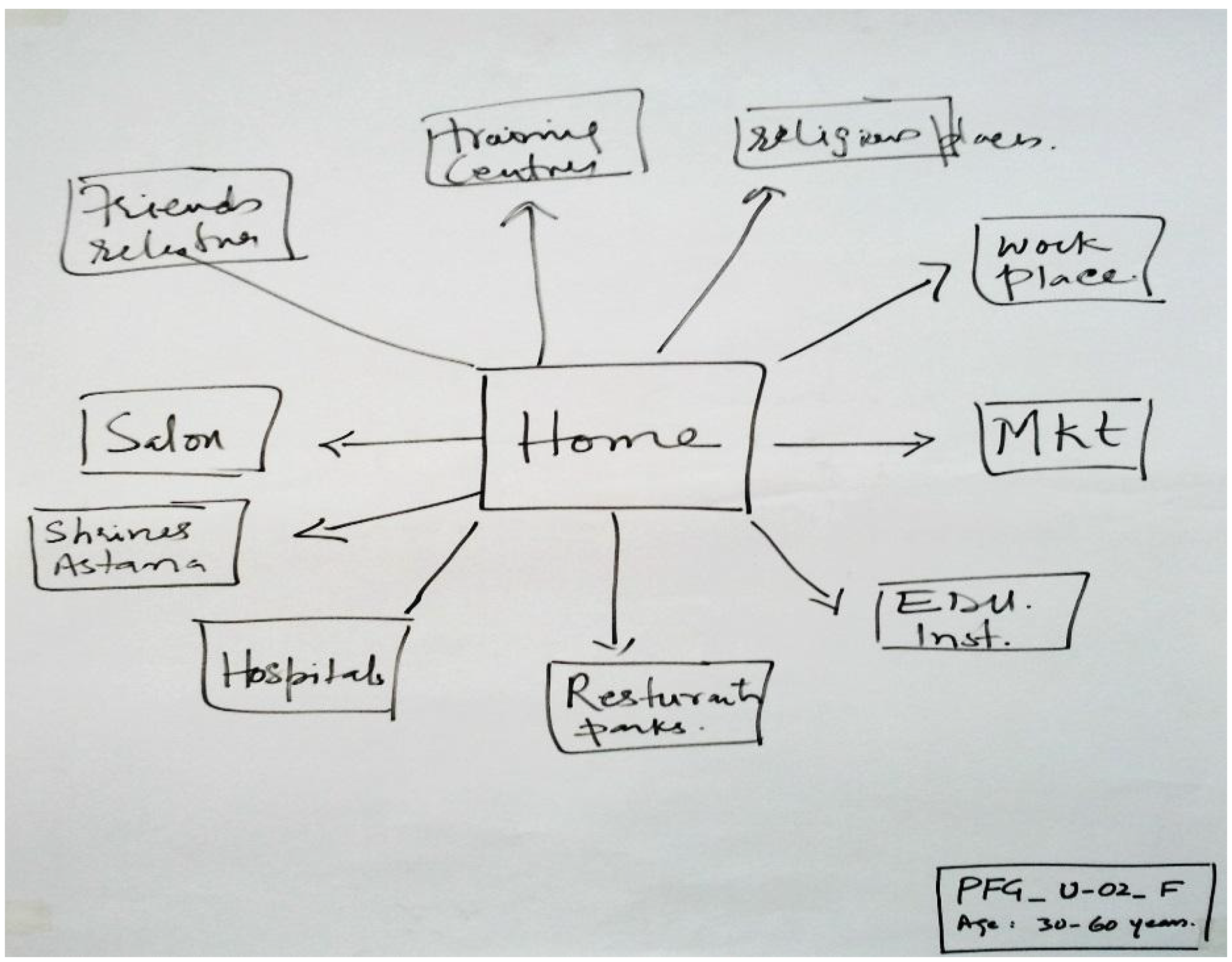
Locations Women and Girls Visit in a Regular Week, Ghana.
These maps and the discussions that surrounded their creation indicate the value of particular places in women's lives. The home held a place of prominence among all participants, with workplaces, religious institutions and public venues, such as the market or shopping center, following. In Pakistan, women's movement outside the home was significantly constrained. Women in Pakistan, in this study, thus navigated significant social restrictions on their use of space, even before IPV was considered as a factor.
In the discussions, using these maps, participants identified how partners’ behavior changed women's use of space. These spaces hold important positions in the lives of participants both symbolically and materially. In the following sections, we examine the ways in which women identify the impact of IPV within the key spaces of their lives.
Experience of Violence in Different Spaces
Among those places that participants identified as commonly used by women, we have focused on four key locations that hold potential for capital accumulation in the context of Ghana and Pakistan: the home; the workplace; religious institutions; and the public market. Below, we examine the data relating to the experience of IPV and these places. By examining discussions about spaces and places as they afford safety, possibility, and risk, we identify the ways in which IPV affects the accumulation of capital in different spaces. Notably, women identified spaces as offering both potential for safety and the accumulation of capital and as places where capital accumulation is negatively affected by IPV.
Violence and the home
Of all the places examined, the home is the most iconic symbol of femininity, domesticity, and peace. It can be thought of, perhaps romantically, as a refuge from the outside world and a location in which women might be afforded a measure of autonomy and responsibility, even in contexts where their lives are constrained outside the home. The home was a particularly salient location for women in Pakistan where opportunities to work and socialize outside the home were limited, especially in rural areas, rendering the domestic as the primary space in which women interacted with the wider world, and the domestic space as infused with wider power dynamics (Blunt, 2005). In this context, homeplaces afforded opportunities to build capital through family networks and home-based productive practices (Ahmed, 2020) and were also spaces in which violence could undermine that potential.
From the interviews, three themes emerged in relation to the use of space within the place of the home and the impact of IPV on the production of capital therein. First, belonging in the home is itself threatened as an aspect of violence, with threats or actions taken by perpetrators to force (or threats to force) the woman from the home. This risk is high in Pakistan, where women have few property rights. In this quote from Pakistan, a participant highlights the power of an abusive husband to force his wife out of the home: Often, women are afraid of telling others about the acts of violence by their husband. They have a fear that if their husband knew about it [that is, the woman's disclosure], he might not allow them to stay in the house and send them out. (12, Rural, Pakistan)
A second theme that emerged is that women will change their use of the home due to risk of violence, for instance, leaving the home or confining themselves within certain rooms. These spatial modifications in behavior limit women's ability to make use of the home for productive activities, whether social or economic. My husband is very nice but he cannot control his anger. When he is angry he has no control over his actions. Sometimes he even hits me. But later he realizes what he did was wrong. He says to me ‘when I am in this mood, you stay quiet or go to another room’. (04, Urban, Pakistan) [W]hen I ever I realize that he wants to beat me up, I leave the house so that he will not find me, otherwise he will injure me. (1198, Urban, Ghana)
This shift in understanding of the home is not confined to the woman experiencing violence, but others in the community who are aware of the violence also demonstrate an altered perception of that home, resulting in less potential for the development of capital through home-based interactions: If a man beats his wife then other people avoid sending their children to the house of such person. If a man does wrong, people ignore it but they do not spare women. (Urban, Pakistan)
Despite the negative impacts experienced within the home by survivors of IPV, it is notable that for many the central importance of the home to women persists. This is particularly evident in Ghana where women are more likely to have freedom of movement or be in the home by themselves—women discussed finding moments of peace and freedom within the home when partners were absent, as described here: So the moment I see him coming home, I get scared. When he is away, I am free. The moment I realize he is at home, I get scared. (885, Rural, Ghana)
The home-place is the location where important resources that can be translated into capital are often produced, including the extension of family relations and social networks based on friendship and kinship. This social capital, described by Bourdieu (1986) as interpersonal relationships that facilitate action, is critical for women to negotiate safety and leave violent relationships. Friendship and support networks are forms of social capital that can mobilize to support women experiencing violence (Nolet et al., 2021). However, these potential resources are fundamentally undermined by IPV. The safety work undertaken by women in anticipation of IPV in the home (avoiding certain rooms, making themselves quiet and small) is an additional barrier to this capital accrual. As the homeplace is often a social place—where family and friends visit, and new acquaintances may be made—IPV also impacts on the capacity to build capital through social networks.
Violence and the workplace
Working outside the home not only offers the potential to accumulate economic capital (notwithstanding exploitative work relationships that often exist) but also affords space to engage with others and build social and cultural capital in the form of friendship and work networks, social standing, and improved status. Where the workplace is outside the home, women may gain increased independence in their movements.
In Pakistan, few women in the study engaged in paid work outside the home, but many were economically active nonetheless, with the home and the workplace blending. Some women noted that they were required to stop working by their husband which ultimately led to increased dependence on their spouse and a restriction in the places they frequented and their ability to exercise choice. I used to make chapattis (bread) to earn. Husband did not like it and often get annoyed. Due to this I stopped doing that. When I was earning I have money to spend by my choice and …could buy a few little things for children and myself. Now I cannot do this which is a problem. (01, Rural, Pakistan)
In Ghana, the majority of women engaged in some kind of productive work for income. However, women experiencing IPV noted the ways in which their partners interfered in their workspaces in various ways. For some women participants involved in enterprise with their partners, the partner-controlled finances and the woman's access to the workplace. Other women who ran their own business or worked for others noted that their partner could disrupt their work by coming to their workplace and abusing them there. He was not getting the chance to hurt me [because she left home whenever he got angry], until one day when I went to do this pedicure business… I was pregnant when it happened. He gave me a blow on the face… (1198, Urban, Ghana) If we had any form of misunderstanding, he does not care who is here, he can come here (hair dressing salon) and create a scene. (1116, Urban, Ghana) When I got a job and leave home to work, I do not know how he feels; he behaves in ways that made me eventually lose the job. (1148, Urban, Ghana) ooh so for instance if it [IPV] happens at home, even if I have to open my shop (hairdressing saloon) I don’t, I am always in the room. I don’t feel comfortable getting out because it makes me feel shy. (1116, urban, Ghana)
Nevertheless, workplaces were often identified by women in both Ghana and Pakistan as a place in which they could exercise agency and create “distance” between themselves and abuse. Women described the value they placed on their workplace both for the economic independence it enabled, and also as a means of escaping violence. Being at work for some women provided a few hours each day to be away from their partners and form valuable relationships outside the family home. What helped me was when my brother got me the job at [area of city] as a cook. The job really helped me. I had an escape. (887, Rural. Ghana) I work as domestic maid and my earnings only support us in meeting our both ends need. I have started working as a domestic maid for the last year or so, when I left my husband's house [following acts of violence]. (07, Rural, Pakistan)
Women in both countries provided many examples of their partners forcing them to leave their jobs, interfering in their workspaces, controlling their earnings, and so forth—all well-established aspects of violence and control (see MacGegor et al., 2022, for overview). The workplace is in many ways the most obvious physical location of capital development, understood as basic economic capital. In this research, it was clear that women also placed a value on the social networks and personal esteem that came from paid work. IPV impinged directly on the workplace at times, as when an abusive partner denied a woman the right to go to work or attacked her in the workplace. Of note, where incidents at work occurred, women did not discuss receiving assistance from employers or clients—although quantitative research undertaken as part of this study found that about 15% of employees reported spending time supporting colleagues in cases of violence in Ghana (Asante et al., 2019) and 14% in Pakistan (Ghaus et al., 2019) in formal businesses. Rather, participants in the qualitative data focused on embarrassment, losing clients, and losing financial means as a result of the impact of violence on the workplace. They referenced the social norms (sometimes described as “gossip”) that tolerate violence, and which stigmatize speaking out against violence, or even recognizing that it was ongoing; forcing them to tolerate the situation or lose face in the workplace.
Violence and religious institutions
Religion plays an important social role in both Ghana and Pakistan. Religious institutions, primarily Christian Churches in Ghana and Mosques in Pakistan, are generally perceived as places of safety and refuge. They are also normatively acceptable places for women to attend. For women in Ghana the Church as a safe space and a place in which social connections, through groups and choirs, were formed, was a very clear theme that emerged from interviews and discussions. In Pakistan, attending for religious teachings was identified as a reason for women to be away from the homeplace for a short time but no further associations with the production of capital were mentioned.
Participants in Ghana indicated strong identifications with the Church as a space of safety. In interviews and FGDs it was noted that men would not abuse women in a church and it thus provided physical safety. Some women explained that they attended Church services to escape violence or find peace, with one woman—a survivor of IPV—explaining how she slept in the local Church to avoid physical violence from her spouse. So I go to spend the night in our church temple sometimes. Some time back, I was not sleeping at home. I spend the night at church and the next morning, I go to take care of my grandfather and move over to the shop to work. I could sleep peacefully at church. (1129, Urban, Ghana)
Religious institutions also offered the potential to create networks with others to protect and support women. For instance, one woman in Ghana described how she befriended a person who worked in the local police Domestic Violence Unit though the church choir. When her husband threatened her with violence, she would warn him that she would tell this friend of the violence if he abused her. While this relationship, forged through the place of the Church, provided support and respite from violence, conversely, others noted how religious teachings encouraged them to remain within abusive relationships. For some, social networks built through the church affiliation did not produce capital that permitted greater choice and freedom but undermined this due to patriarchal norms about gender roles and the family. In such situations, the role of gossip within the often tightly knit church community created further pressures on women who did not want to be seen by others as a “bad wife.” The avoidance of stigma thus undermined the potential of capital accumulation through the spatialities of the religious institution.
Violence and public spaces
For many women in Ghana, public spaces, such as the market and shopping center, were places in which freedom could be realized. In Ghana, some women indicated that their partners would not abuse them in public places and thus offered a measure of safety. For others in Ghana, the fear of being publicly abused and the accompanying stigma or gossip was sufficient for women to close off such spaces to themselves. As described below, abuse that occurs in public, or is threatened, risks whatever social capital has been accumulated by casting a stigma on the victim. My husband will then [after going to choral practice] accuse me of having extra marital affairs with them, he will hit and verbally abuse me. He would be shouting and calling me names such as prostitute, useless woman and other ones I can’t say in public. It was a whole lot of things. He disgraced me in public by insulting me. (887, Rural, Ghana) She will not be able to go there. She will fear that the man will show up over there to disgrace her. It is a market where a lot of people are found. If he shows up over there, the woman will feel bad so she will not go there, so that she will save herself of the disgrace. If she wants something from the market, she will send someone. (Rural, Ghana)
The interviews and FGDs in Ghana also identified a link between IPV, stigma and leadership where violence became public knowledge (whether occurring in public or private space). Several women noted that if it was known that there was violence in a relationship, the woman could not take on or hold positions of leadership in the community as she would be seen as “unwise” for finding herself in a position of victimhood.
In Pakistan, the restriction on engaging in public spaces was expressed as either a form of abusive controlling behavior or simply a matter of social norms. My husband says that it is not a custom that a woman goes out. I go shopping with my mother. I do not go out for pleasure and enjoyment. I have been to Community Meeting place only 4 times in my five years marriage period. (05, Rural, Pakistan) It is also said by husbands as well as by elders that if you go out without telling your husband or without his permission then anything can happen to you, otherwise you are safe. So we have to keep this mind. This is also a torture. (04, Rural, Pakistan)
Public spaces provide the scope for capital accumulation via economic activity, social networking and building community status through organizing and leadership. Similar to religious spaces, the public space can work in contradictory ways, both to enable resistance and to reinforce abusive power dynamics. Participants frequently drew attention to the prevalence of gossip, judgment and social stigma in the public space, all of which demanded women to self-regulate, engage in safety work and stigma avoidance, and diminished their ability to accrue capital. As Datta (2016) notes, these performances, perceptions, and portrayals of gender reconstitute spaces themselves to normalize violence.
Accumulation, Violence, and Space: The Costs of IPV in Spatial Context
Women's empowerment is dependent on their ability to accrue forms of capital across multiple spaces and places. In Ghana and Pakistan, this study gives a picture of the spaces that feature prominently in the lives of women who participated in the research, going beyond the homeplace to include workplaces; religious gathering spaces and places of worship; and the public space of the market.
Each of the places considered—the home, workplace, religious institute, public space/market—has the potential for the accumulation of capital. This capital provides a resource from which women can draw to meet their needs. Yet, IPV subverts this potential, resulting in a weakened ability to accumulate capital—consequently costing women, their families and society. Additionally, IPV can force women to draw on their existing social capital for protection and survival—potentially further depleting it. In this article, we explored the spatialities of IPV and capital accumulation for women in Ghana and Pakistan. We note that these spatialities hold contradictions in place: in the context of IPV, spaces such as the workplace or religious spaces can be both sources of capital in the form of social support and increased autonomy and also places where social capital is diminished through IPV. We offer this analysis to demonstrate how women make use of space, including but not exclusive to the home, and some of the spatialized ways that the impacts of IPV ripple far beyond the domestic home-space.
In this study we see the way the home can be transformed from an imagined place of peace and refuge to a prison in the context of IPV. Women describe confining themselves in certain parts of the house or trying to remain quiet and un-noticeable within the home as part of their safety work to try and reduce risk. For some women, the home was avoided where possible—sleeping instead in Churches or the homes of friends—effectively distancing themselves from the risk, but also the benefits, of the home as place. The community function of the homeplace—crucial for the maintenance of social networks—was similarly compromised for women in this study once the presence of violence was known. An impact in itself, this also demanded further stigma work, as an additional reason why women would conceal the presence of violence in their homes.
The workplace emerged as an especially important place where IPV reaches into women's lives, and where victims and survivors discussed navigating violence as part of day-to-day working practices. Although it was more common for women in Ghana to work outside the home than for those in Pakistan, in both countries, women described ways in which they generated their own incomes—and also ways in which abusive partners prevented or limited them from doing this. In some cases, when they attended their workplace, they experienced sabotage, threats, or even direct attacks by violent partners—resulting in a constant awareness of risk and threat, and safety work to address and minimize this. These findings are especially important in light of the paradox that it was at work that many women described finding the opportunity to regain their sense of self and escape the impact of abusive power and control at home.
Outside the home, whether in work, or at church or the market, IPV impacts on women's capabilities in other spaces in three primary ways. First, women are directly at risk or under control in those spaces (as when an abusive partner denies them the freedom to meet friends or family, attend work, markets or public meetings; or when a perpetrator threatens them, directly attacks them, and/or sabotages their actions in the workplace). Second, women experience social stigma in those spaces (e.g., not being patronized by clients who prefer not to cause a scene/invoke disgrace), and adapt themselves to avoid this stigma, including by appeasing their abusers. Thus, and finally, violence has a secondary impact through the resources and effort required to negotiate both the direct risk and the associated stigma here described: women are left with less capacity to advance themselves through the accumulation of various types of capital.
Conclusion
A spatial analysis of the impacts of violence is essential to destabilize the underlying causes of IPV—patriarchal gender norms and gender inequality. IPV acts in multiple ways to undermine women's capacity for the accumulation of various forms of capital – and thus their ability to challenge the very system that makes them vulnerable. Changes in the use of space have similarly been identified in developed contexts, including the UK (kelly et al., 2014) and Ireland (Forde & Duvvury, 2021). However, across multiple contexts, the “costs” of such changes to the use of space and engagement with place have been under-theorized and under-examined.
Through a synthetic theoretical approach drawing together Bourdieu's concept of capital with feminist geographies of violence and fear, this paper makes an important contribution to our understanding of the costs of IPV. By investigating the pathway through which changes in the use of space as a consequence of IPV limits the capacity of women in Ghana and Pakistan to make use of the potential value of the home, the workplace, religious institution and public spaces such as markets, we identify how various forms of capital accumulation associated with place are undermined by violence. Using women's own stories, we see how women are denied the use of space by violent partners or restrict their use of space in their safety-work to avoid risk. Equally important, the restricted use of space and place was also an outcome of stigma work—providing clear evidence of how cultural gendered norms continue to blame women for the violence they experience by partners. The data presented demonstrates how women nonetheless continue to draw on social capital within spaces in an informed and differentiated manner to navigate and survive violence. The outcome of all these processes constrains women's capacity to build capital of all kinds; the same capital that is required to reduce risk, escape violent relationships, and challenge the underlying gender inequality that provides the structure in which violence operates. This article does not explore the way in which these actions reconstitute spaces themselves as sites of normalized violence, which we suggest is a fruitful avenue for further research on the social costs of IPV and VAW.
Although the study draws on data from Ghana and Pakistan, our analysis of the mechanisms through which capital accumulation in places of symbolic significance is reduced through IPV, may also be applicable to other regions of the world, and suggests the importance of further research on this topic. This paper has attempted to address a gap in knowledge relating to the impacts of IPV and spatiality, suggesting new avenues for research on the costs of VAW. For policy makers, a recognition of the impacts of IPV in spaces outside the home can lead to more targeted policies, programs, and interventions to prevent incidents of IPV and mitigate its impact.
Footnotes

Funding
The authors disclosed receipt of the following financial support for the research, authorship, and/or publication of this article: This work was supported by the UK Department for International Development What Works to Prevent VAWG: Economic and Social Costs of VAWG (grant number PO6638).
Declaration of Conflicting Interests
The authors declared no potential conflicts of interest with respect to the research, authorship, and/or publication of this article.