






Abstract
This research aimed to investigate how men's experiences of witnessing their fathers’ violence toward their mothers are associated with their levels of patriarchal belief. The study sample comprised 361 Turkish men. The mean patriarchal belief score was 127.92 ± 45.95, and the mean score for witnessing fathers’ violence against mothers in childhood was 12.18 ± 3.40. Positive and significant relationships were found between patriarchal belief levels and witnessing paternal violence during childhood (p < 0.05). These findings demonstrate that exposure to domestic violence influences patriarchal attitudes and emphasize the importance of education, economic empowerment, and social awareness efforts to promote gender equality.
Introduction
Individuals are shaped by the sociocultural environment in which they grow up, including prevailing norms, values, and expectations that influence their roles and behaviors within society (Palomino-Suarez & Garcia, 2025). This identity, shaped by the patriarchal order, attempts to determine their place in society, much like a dress is put on an individual. This patriarchal structure, which has been in effect for approximately 5000 years, has been the leading force in constructing gender roles. The patriarchal system restricts women to the private sphere (home and family) and dominates men in the public sphere (politics, labor, homeland protection, cultural life) (Ali & Naylor, 2013; Korkmaz & Baser, 2019). This structure, which eliminates gender equality, legitimizes the sexist structure in society as a natural consequence of the biological difference between men and women (Yaraman, 2009). In many societies, the devaluation of women and the marginalization of women more than the male gender pave the way for all kinds of harm to women (Dursun, 2020). Especially in the family environment, unhealthy relationships and violence between spouses due to gender inequality and patriarchal structure affect the children raised in the family. The emotions children experience when witnessing such events negatively affect their future lifestyles and relationships. According to social learning theory, a child who sees their father's violence against their mother may internalize it by perceiving their mother as weak and powerless. In addition, boys can imitate this situation by learning it (Aydin et al., 2015; Kaptanoglu, 2013).
Current research also reveals that individuals who witness domestic violence in childhood develop more stereotyped and patriarchal-based attitudes toward gender roles (Bendezu-Quispe et al., 2024; Genc & Turhan, 2022; Islam et al., 2017). Bendezu-Quispe et al. (2024) reported that individuals who grow up in violent family environments are more likely to legitimize or reproduce violence later in life (Bendezu-Quispe et al., 2024). Similarly, Islam et al. (2017), in Bangladesh, reported that men who witnessed paternal–maternal violence in childhood were significantly more likely to perpetrate violence against their partners in adulthood (Islam et al., 2017). In the case of Turkey, Genc and Turhan (2022) reported that women who witnessed domestic violence had difficulties in healthy partner selection and conflict resolution skills, even though they avoided violent relationships in adulthood (Genc & Turhan, 2022).
All these findings reveal that violence within the family has lasting effects not only at the individual level but also at the social level; therefore, domestic violence is a significant problem that negatively affects the general health of society and the quality of social relations. Giving an egalitarian aspect to the gender attitudes of men, which hurt their own and women's lives, taking effective measures against violence, and ensuring that children grow up in a healthy family environment, is a critical and necessary approach in terms of women's and children's health and public health (Ucan & Baydur, 2016). On this basis, this study aims to reveal the patriarchal belief levels of Turkish men who witnessed their fathers’ violence against their mothers during childhood.
For this purpose, answers to the following questions will be sought throughout the research:
− What is the level of Turkish men witnessing the violence inflicted by their fathers on their mothers during childhood? − What is the patriarchal belief level of Turkish men? − Is there a significant relationship between Turkish men witnessing the violence inflicted by their fathers on their mothers during childhood and their patriarchal perspective and gender equality attitudes? − Is there a difference between Turkish men's levels of patriarchal beliefs in terms of their sociodemographic characteristics and witnessing the violence inflicted by their fathers on their mothers during childhood?
Method
Type of Research
This study was conducted with a cross-sectional design.
Study Population and Sample
The study population consists of men aged 18 years and older who are Turkish and speak Turkish. Since the scales used in the study have not been used in any previous study, the population size was taken into account when calculating the sample size. The study population comprised individuals aged 18 years and above residing in Turkey. Other inclusion criteria for the study are as follows: not having a known physical, cognitive, or psychiatric disorder; being able to understand and complete the questionnaire independently; and providing informed consent. Individuals who reported having a known severe physical, cognitive, or psychiatric disorder, as well as participants who did not complete the questionnaire fully, were excluded from the study. In studies with a population of 100,000,000, the sample size was 322 for p = .3 and q = 0.7, with an α = 0.05 significance level and a 0.05 sampling error (Yazicioglu & Erdogan, 2011). The study findings were analyzed using G*Power 3.1, and the expected confidence intervals for the “Patriarchal Beliefs Scale” were determined. The confidence interval was calculated with α = 0.05; the power of the test (1-β) was 0.95; the effect size was d = 0.1780790; and the total number of participants was 343. The results revealed that 361 participants were sufficient for the sample.
Data Collection
In collecting the study data, online collection is preferred to make it accessible to men across all regions of Turkey and to ensure participant anonymity, facilitating self-reporting (Ozusaglam et al., 2009). The research data were collected online between 15 May and 20 July 2025 via a questionnaire developed by the researchers. Data were collected via an online self-report survey. Participants were reached through social media platforms and online communication networks using a convenience sampling method. The survey link was shared on a voluntary participation basis. The data collection tool used in the study consisted of the Personal Information Form, the Patriarchal Beliefs Scale (PBS), and the Scale of Witnessing Father's Violence against Mothers in Childhood. It took an average of 15 min to complete the questionnaire.
Personal Information Form
The Personal Information Form consists of 16 questions, including open-ended and multiple-choice items. The form includes questions about age, marital status, education level, family type, having children, occupation, income status, social security, presence of any illness, decision-making process in the family, domestic responsibilities, father's perpetrating violence against the mother, and the type of violence perpetrated. This form was developed by researchers in accordance with the literature (Basar & Demirci, 2018; Kekec & Dikmen, 2025).
Patriarchal Beliefs Scale
The scale developed by Yoon et al. in 2015 was adapted into Turkish by Bayrakceken et al. (2021) (Bayrakceken et al., 2021; Yoon et al., 2015). The scale consists of 35 items and three subdimensions. The subdimension is men's institutional power (e.g., I feel more comfortable if the country's economy is managed by a man.), women's inborn inadequate characteristics (e.g., girls have less opportunity to go to school than boys), and gender roles (e.g., women are more likely to do housework than men are: women should take more responsibility for housework than men are). The scale is a 7-point Likert scale (1 = Strongly disagree, 2 = Disagree, 3 = Somewhat disagree, 4 = Neither agree nor disagree, 5 = Somewhat agree, 6 = Agree, 7 = Strongly agree). There are no reverse-scored items in the scale. Scores on the scale range from 35 to 245. Higher scores indicate that patriarchal beliefs are more dominant. The Cronbach's alpha value for the Turkish adaptation was found to be 0.96 (Bayrakceken et al., 2021). The Cronbach's alpha value of the scale in this study is 0.965.
Scale of Witnessing the Domestic Violence of Father Toward Mother in Childhood
The scale that assesses witnessing fathers’ violence against their mothers during childhood was developed by Aydın et al. (2015). The scale consists of a total of 10 items and two subdimensions. The subdimensions are Verbal and Minor Physical Violence (e.g., My father hit or kicked something by getting angry at my mother) and Severe Physical Violence (e.g., My father strangled my mother). The scale has a three-point Likert scale (1 = Not experienced, 2 = Sometimes experienced, 3 = Experienced), and there are no reverse-scored items. A minimum score of 10 and a maximum score of 30 can be obtained from the scale. For the original scale, the Cronbach's alpha internal consistency coefficient was calculated as 0.917 (Aydın et al., 2015). The Cronbach's alpha value of the scale in this study is 0.898.
Data Evaluation
The suitability of the data for normal distribution was evaluated by examining the skewness and kurtosis values. In the literature, skewness and kurtosis values within ±2 are considered sufficient for a normal distribution (George & Mallery, 2010). Since the values obtained in this study met these criteria, the data were normally distributed (PBS: Skw = −0.107, Ku = −0.393; Scale of Witnessing the Domestic Violence of Father Towards Mother in Childhood (SWDVFTC): Skw = 1.564, Ku = 1.222). The demographic data obtained from the study are presented as frequency and percentage distributions. In addition, the analysis of scale scores, categorized by participant demographic characteristics, used a t-test for two-group comparisons and a one-way ANOVA for three- or more-group comparisons. The relationships among the scores obtained from the scales were analyzed via Pearson correlation analysis. p < 0.05 was considered statistically significant.
Ethical Dimension of the Research
During the research process, the Declaration of Helsinki was followed. Approval was obtained from the relevant committee (Date: 12.02.2025, Number: 536.43.17). The first question in the online form was designed to confirm that participants agreed to participate in the study, and informed consent was obtained in this way.
Results
The mean age of the individuals who participated in the study was 29.08 ± 9.22 years. Among the participants, 52.6% were single or divorced, 58.7% had no children, 52.1% had a bachelor's degree or higher, 63.2% lived in a nuclear family, and 45.4% were workers/self-employed. The majority stated that their income was equal to their expenses (44.9%), they had social security (76.2%), and they did not have any disease (77.3%) (Table 1).
Mean Scale Scores According to the Sociodemographic Characteristics of the Participants.
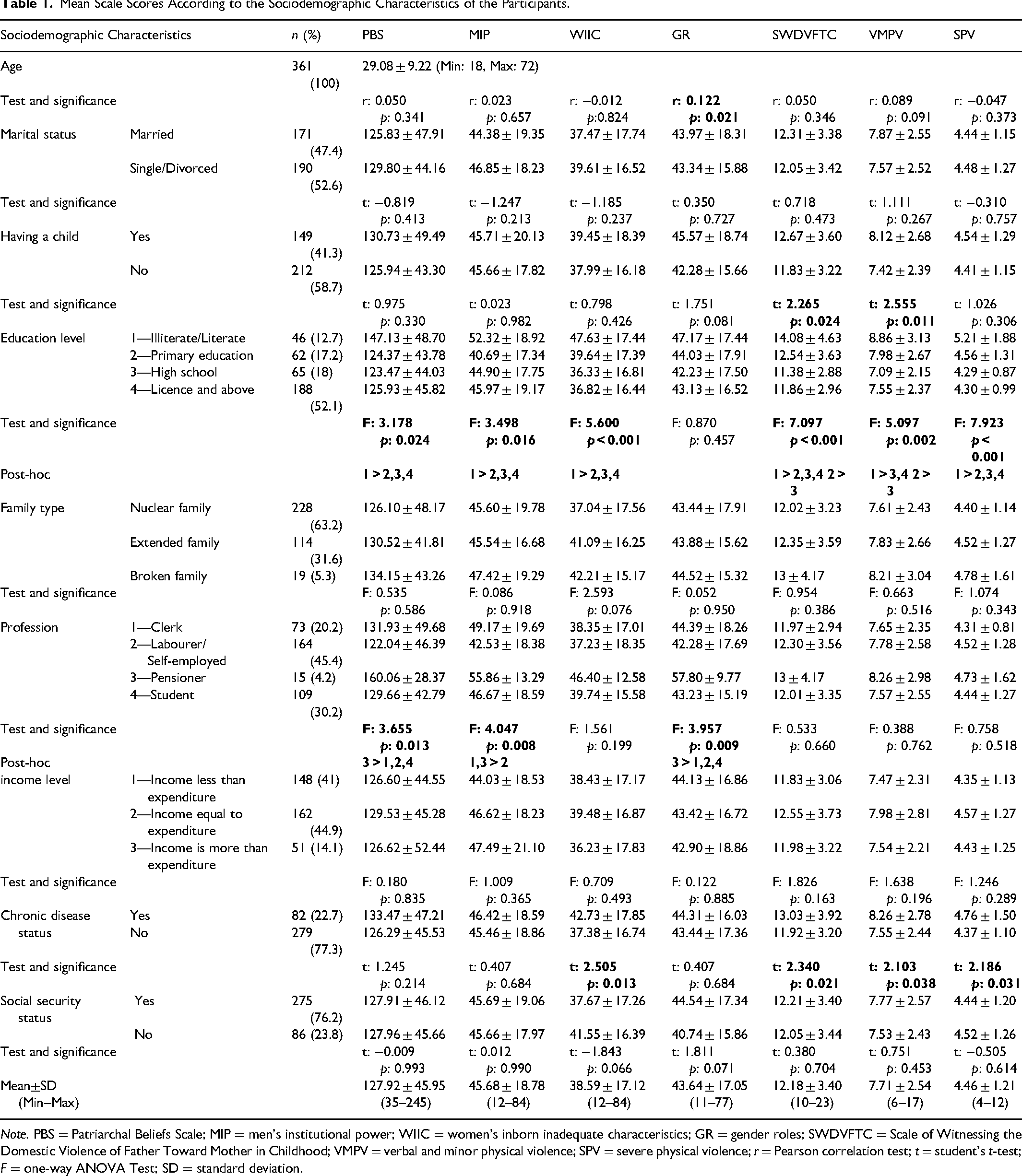
Note. PBS = Patriarchal Beliefs Scale; MIP = men's institutional power; WIIC = women's inborn inadequate characteristics; GR = gender roles; SWDVFTC = Scale of Witnessing the Domestic Violence of Father Toward Mother in Childhood; VMPV = verbal and minor physical violence; SPV = severe physical violence; r = Pearson correlation test; t = student's t-test; F = one-way ANOVA Test; SD = standard deviation.
A positive, significant relationship (r = 0.122, p = .021) was found between age and gender roles. While the participants’ patriarchal belief levels were found to be above average (127.92 ± 45.95), their educational levels and occupations significantly differed in these levels (p < 0.05). In particular, while both the belief in the “institutional power of men” (52.32 ± 18.92) and the belief that “women are born with inadequate characteristics” (47.63 ± 17.44) of those whose education level was illiterate/literate were greater than those of the other groups, the belief in the “institutional power of men” of those whose occupation was civil servant (49.17 ± 19.69) or retired (55.86 ± 13.29) was found to be greater. In addition, pensioners’ beliefs (57.80 ± 9.77) about gender roles were higher than those of the other groups. Finally, men with chronic diseases (42.73 ± 17.85) were found to have a greater belief that “women have inadequate characteristics from birth” (p < 0.05) (Table 1). Participants’ scores were below average for the SWDVFTC (12.18 ± 3.40), verbal and minor physical violence (7.71 ± 2.54), and severe physical violence (4.46 ± 1.21). While the scores of those who had children were found to be significantly higher in the SWDVFTC (12.67 ± 3.60) and verbal and minor physical violence (8.12 ± 2.68), the scores of those whose education level was illiterate/literate in the SWDVFTC (14.08 ± 4.63), verbal and minor physical violence (8.86 ± 3.13), and severe physical violence (5.21 ± 1.88) were found to be significantly higher than those of the other groups (p < 0.05) (Table 1).
The total and subdimensional scores on the PBS and the SWDVFTC for participants whose fathers were the family decision-makers and whose family responsibilities were completely male-dominated were significantly higher than those of the other groups. In addition, the scores of the participants whose fathers inflicted violence on their mothers were higher than the average in terms of the scores of the PBS (138.33 ± 41.37), the beliefs that women have inborn inadequate characteristics (44.09 ± 17.30), the scores of the SWDVFTC (14.97 ± 4.39), verbal and minor physical violence (9.72 ± 3.11), and severe physical violence (5.25 ± 1.77). Similarly, individuals whose fathers inflicted psychological, physical, and sexual violence on their mothers were found to have significantly greater beliefs that women have inborn inadequate characteristics and higher scores on the SWDVFTC and its subdimensions than the other groups did. In contrast, the PBS score was higher in those whose fathers inflicted physical (149.28 ± 26.76), sexual (144.77 ± 16.74), and economic (150.17 ± 29.35) violence on their mothers. Finally, those whose fathers experienced economic violence toward their mothers had higher scores for gender roles (54.88 ± 10.89), SWDVFTC (14.17 ± 3.64), and verbal and minor physical violence (9.47 ± 2.74) than did those whose fathers did not (p < 0.05) (Table 2).
Comparison of Total and Subdimensional Scores According to the Family Characteristics of the Participants.
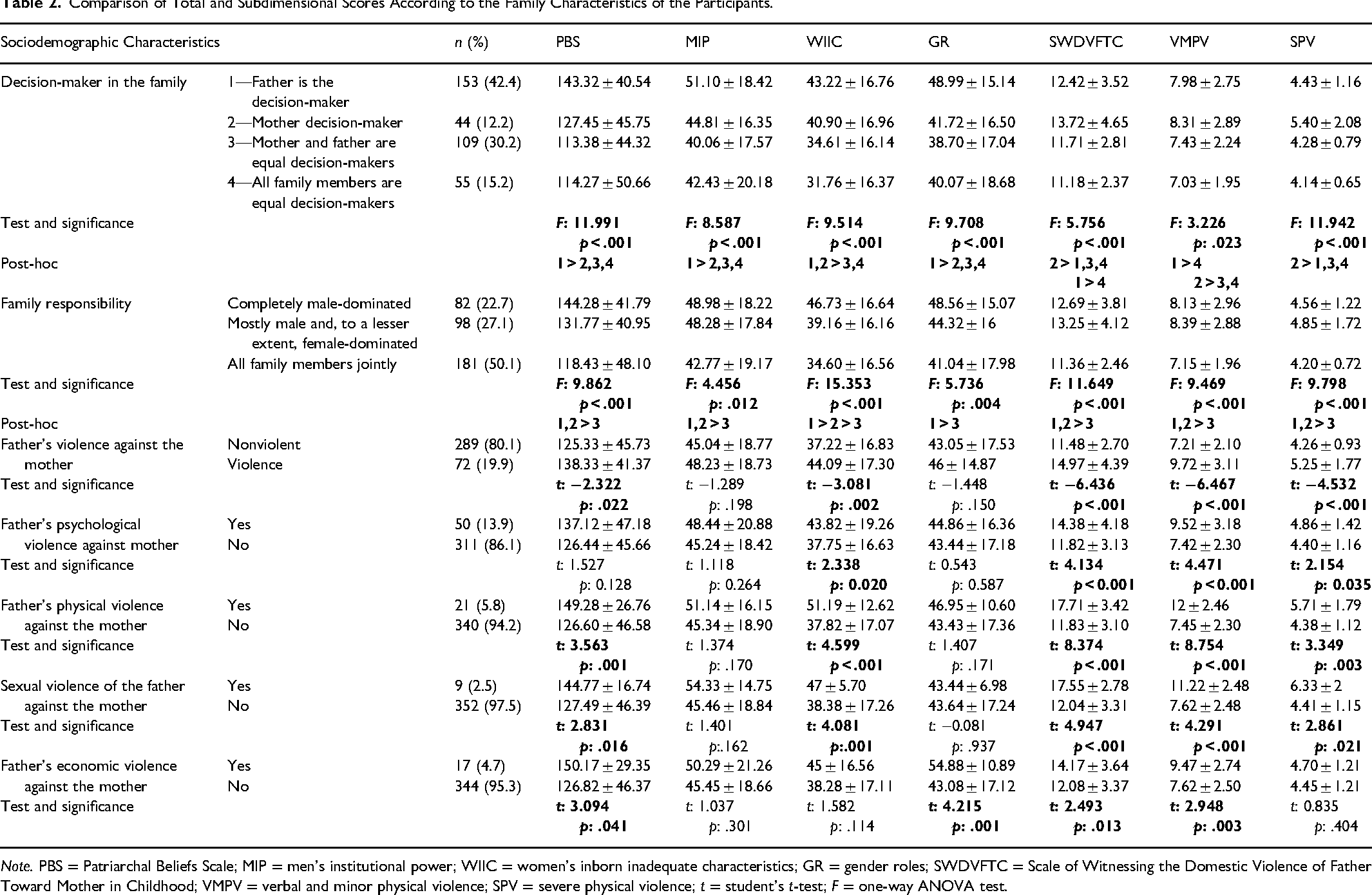
Note. PBS = Patriarchal Beliefs Scale; MIP = men's institutional power; WIIC = women's inborn inadequate characteristics; GR = gender roles; SWDVFTC = Scale of Witnessing the Domestic Violence of Father Toward Mother in Childhood; VMPV = verbal and minor physical violence; SPV = severe physical violence; t = student's t-test; F = one-way ANOVA test.
A positive, significant but weak correlation was found between the total score of the participants’ PBS and the scores of the participants on the SWDVFTC (r: 0.172, p: 0.001), verbal and minor physical violence (r: 0.159, p: 0.002), and severe physical violence (r: 0.150, p: 0.004). In addition, a positive, weakly significant correlation was found between the total score of the SWDVFTC and men's institutional power (r = 0.180, p < .001) and women's inborn inadequacy (r = 0.190, p < .001). These findings indicate that as attitudes toward witnessing domestic violence increase, perceptions of male-dominated institutional power and beliefs that women are inherently inferior also tend to increase (Table 3).
Relationships Between the Total and Subscale Scores of the PBS and SWDVFTC.
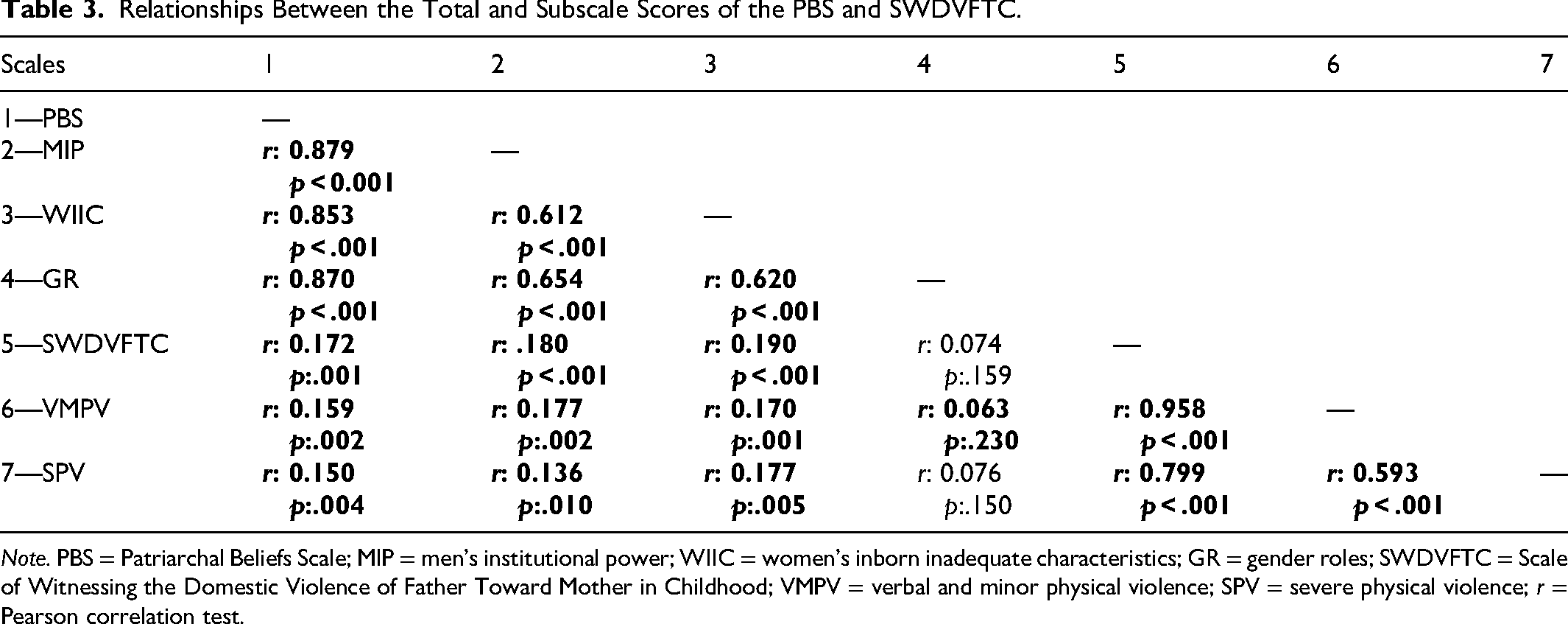
Note. PBS = Patriarchal Beliefs Scale; MIP = men's institutional power; WIIC = women's inborn inadequate characteristics; GR = gender roles; SWDVFTC = Scale of Witnessing the Domestic Violence of Father Toward Mother in Childhood; VMPV = verbal and minor physical violence; SPV = severe physical violence; r = Pearson correlation test.
Discussion
Witnessing violence against the mother in the family during childhood is a critical experience that can leave deep and lasting traces in the psychosocial development of the individual (Gourisankar et al., 2025). Especially for boys, such experiences may pave the way for the strengthening of a patriarchal mindset and the development of negative perspectives toward gender equality (Gul & Schuster, 2020; Mueller & Tronick, 2019). This study aims to examine the patriarchal belief levels and attitudes toward gender equality of Turkish men who have had such an experience. The topic is important for its potential to yield findings that can help prevent the intergenerational transmission of violence and support equality-based social norms. The results obtained in this direction were evaluated in the context of the literature, and both similar and distinct findings were noted.
In our study, a significant positive relationship was observed between age and the PBS-Gender Roles. This finding shows that individuals’ beliefs about gender roles become more evident and fixed as they grow older. This can be explained by the fact that individuals in the older age group have grown up with more traditional and stereotyped gender roles and have internalized these attitudes throughout their lives. The literature reports that younger generations exhibit more egalitarian, flexible, and sensitive attitudes toward gender roles, whereas older individuals are more resistant to change in these roles (Lalchandani & Pardasani, 2023). In line with these results, it may be advisable to design awareness programs with gender equality in mind, particularly for older individuals. In addition, more detailed qualitative studies should be conducted to examine the attitudes of young and older individuals toward gender roles, and the possible reasons for these differences should be discussed. The fact that the participants’ patriarchal belief levels are above average in general shows that patriarchal values are still effective in society. In particular, the fact that education level is significantly related to patriarchal beliefs reveals that education is an essential factor in breaking such beliefs. The fact that illiterate or only literate individuals have greater beliefs in both men's institutional power and women's inherently inadequate characteristics than other groups does show that a low level of education has a negative effect on gender equality. This result once again demonstrates the importance of education in promoting gender equality and creating a fair and egalitarian society (Karim et al., 2024). A study conducted in China revealed that increasing educational attainment is associated with more egalitarian gender attitudes (Du et al., 2020). However, according to a systematic review, initiatives to ensure gender equality and to raise awareness within curricula, education systems, and policies remain insufficient (Karim et al., 2024). In this respect, both increasing individuals’ educational attainment and integrating gender equality into existing education systems are essential.
When patriarchal beliefs are examined by profession, it is observed that public employees and retired individuals hold stronger beliefs in men's institutional power. The high scores observed among retired participants can be explained by generational differences, as individuals in the older age group may have been socialized within more traditional gender norms. Similarly, some occupations are still classified as socially “male” or “female,” contributing to the perpetuation of hierarchical gender structures and the shaping of perceptions of occupational prestige based on gender (Jaoul-Grammare, 2024). These findings suggest that age-related experiences and occupational socialization may play a role in the formation and perpetuation of patriarchal beliefs. Therefore, it is important to develop interventions to reduce gender-based stereotypes at the individual, organizational, and societal levels.
It was determined that men with chronic diseases had greater beliefs that women were born with inadequate characteristics. This finding suggests that individuals experiencing health-related disadvantages may be more inclined toward traditional and sexist perspectives regarding gender. Structural inequalities, including those related to health, can shape individuals’ gender beliefs and attitudes. In a multilevel study conducted by Gok et al. (2019) to determine the impact of higher education on the attitudes of unemployed Turkish people toward gender, it was determined that those living in cities with a high socioeconomic development level had more egalitarian attitudes toward gender (Gok et al., 2019). Based on this research and the literature, health-related and socioeconomic conditions shape individuals’ gender norms. In this context, efforts should focus on improving health outcomes and reducing structural inequalities to challenge traditional gender norms.
The participants’ scores for witnessing “verbal and minor physical violence” and “severe physical violence” by the father against the mother were found to be below average. This finding may be partially interpreted within the context of changing public awareness regarding domestic violence in Turkey. In recent years, domestic violence has become more visible in public discourse, and awareness campaigns and legal regulations have increased societal sensitivity toward the issue. However, considering the traditionally patriarchal structure of the Turkish family, where male authority and hierarchical gender roles have historically been normalized, such changes may not immediately translate into substantial decreases in violence rates. National data indicate that 41.3% of women reported experiencing domestic violence in 2015–2016 (Basar & Demirci, 2018), while more recent reports show that 37.5% of women have experienced spousal or partner violence at some point in their lives (TURKSTAT & UN WOMEN, 2024). Although these figures suggest a limited change over time, they also indicate that violence remains a persistent social problem. Therefore, rather than implying a direct causal reduction, these findings may reflect gradual shifts in awareness and reporting patterns within a complex sociocultural structure. Continued efforts to address gender-based norms and strengthen violence prevention policies remain essential.
Similarly, those who had children were more likely to have witnessed “father's violence against their mother during childhood” and “father's verbal and minor physical violence against her mother.” This may be attributed to the fact that individuals who have witnessed violence in their past lives are more protective, have developed the ability to manage family dynamics, and are open to improving their emotional systems. Participants who developed such skills may have transformed the negative experience they witnessed into a positive one and developed more positive attitudes toward having children. A review of the literature indicates that some studies support this assumption. According to a phenomenological study conducted with adult victims of domestic violence in Taiwan, individuals who were abused in childhood stated that parent‒child relationships expressed rebirth (Chang, 2024). However, it has also been reported in the literature that individuals who witnessed family violence in childhood have an increased risk of abusive and neglectful parenting (Greene et al., 2020). In other words, among the participants in this study, those who have children and a high level of witnessing violence by the father against the mother in the risky parent group should not be forgotten. For this reason, it may be recommended to support individuals who witnessed domestic violence in childhood in their parenting processes, to strengthen their protective parenting skills, to improve their ability to manage family dynamics and emotional systems, and to organize training programs and provide guidance services to break possible negative transmission cycles.
On the other hand, the levels of witnessing “verbal and minor physical violence of the father against the mother” and “severe physical violence” among the participants whose education level was illiterate/literate were significantly greater than those of the other groups. This may be associated with the fact that the participants with a lower education level have parents with a lower education level and that these parents have a greater potential to use violence. In fact, Smits and Gunduz-Hosgor (2006) reported that individuals with low parental education levels had significantly lower levels of participation in secondary education (Smits & Gunduz-Hosgor, 2006). Based on this relationship between parental education level, child participation in education, and the violence triad, to reduce domestic violence and its intergenerational transmission, initiatives should be taken to increase the education levels of all individuals, especially parents. In particular, examining the past life experiences of men who are the perpetrators of violence, raising their awareness of violence, and improving their empathic skills may be beneficial.
According to the findings of the present study, the total and subdimension scores of the level of patriarchal belief and the status of witnessing the father's violence against the mother in childhood were significantly higher in participants in whom the father was the determinant in the decision-making process and whose family responsibility was completely male-dominated than in the other groups. This situation reveals that the hierarchical structure within the family and authoritarian structures based on gender roles contribute to patriarchal values and beliefs and increase the risk of domestic violence. In fact, the literature also states that the fact that the man is a central figure in the family leads to a system that allows the exploitation of women and increases the risk of violence against women (Maan, 2025). The unequal distribution of decision-making power within the family also indicates that gender inequality and patriarchal order persist (Agarwal & Arshad, 2024). In light of these findings, to ensure a fairer future for women, it is essential to support women's active participation in decision-making processes at all levels, beginning with the family unit, the basic building block of society. In addition, it would be beneficial to secure women's rights and responsibilities through legal and constitutional arrangements that strengthen them within the family.
The fact that the level of patriarchal belief and the belief that “women have inborn inadequate characteristics” in individuals whose fathers inflicted violence on their mothers is above average shows that domestic violence is not only limited to the current victimization but also shapes the attitudes and behaviors of both the victim and the individuals in her immediate environment. This result is consistent with the literature on the intergenerational transmission of violence. Individuals who grow up in violent family environments are more likely to legitimize or reproduce this violence later in life (Bendezu-Quispe et al., 2024). It was also found that women who witnessed maternal violence in the family were more likely to be exposed to intimate partner violence later in life (Bendezu-Quispe et al., 2024). Another study revealed that couples with a history of violence reinforce stereotyped gender roles and affect their marital relationships through intergenerational transmission (De Sant'Anna & Penso, 2018). To break this transmission and cycle, it is essential to incorporate education and awareness-raising activities that prioritize gender equality. In addition, implementing early intervention and information programs to prevent intimate partner violence and strengthening women's education level and status are among the other essential steps that can contribute to this process.
In this study, positive and significant relationships were found between the total score and subdimensions of the participants’ patriarchal belief level and the total score and subdimensions of Witnessing Father's Violence Against Mothers in Childhood. This finding suggests that witnessing domestic violence in childhood affects individuals’ gender attitudes and increases their tendency toward violence later in life. The literature shows that childhood trauma and witnessing violence are associated with a propensity for violence and unhealthy romantic relationships in adulthood (Jewkes et al., 2025). In a study conducted in Bangladesh, it was determined that men who witnessed violence between parents during childhood were more likely to perpetrate violence against their wives later in life (Islam et al., 2017). A study conducted in Turkey revealed that women who witnessed domestic violence in childhood stayed away from violent environments in adulthood, but their ability to choose the right partner and cope with conflicts was negatively affected (Genc & Turhan, 2022). This study and the findings in the literature show that witnessing domestic violence can affect not only the moment but also the future attitudes and behaviors of individuals. Therefore, it is essential to identify individuals who witness violence in childhood and to support and inform them through appropriate education programs. In addition, protecting both children and victims of violence in families where violence is experienced will make a significant contribution to breaking this cycle.
Strengths and Limitations of the Study
Strengths
This research contributes to the literature by exploring the associations between patriarchal attitudes and selected sociodemographic factors from a multidimensional perspective.
The scales used in the study are instruments with high measurement power, validity, and reliability.
The sample size is sufficient for statistical analyses and increases the reliability of the results.
Limitations
Owing to its cross-sectional design, causal relationships cannot be inferred.
Although data were collected online from participants across Turkey, the use of convenience sampling may limit the generalizability of the findings to the broader population.
The collection of data through self-reports carries the risk of biased responses in terms of social favorability.
Conclusion
In this study, which was conducted to determine the patriarchal belief levels and attitudes toward gender equality of Turkish men who witnessed their father's violence against their mother in childhood, patriarchal family structure and domestic violence seen at an early age significantly affected the gender roles and attitudes of male individuals toward women. It was determined that patriarchal belief levels and attitudes that legitimize violence were greater, especially in individuals whose fathers inflicted violence on their mothers. These results indicate that violence can have permanent effects not only on the victims but also on the intellectual structures and behaviors of the individuals who witness it. In this direction:
It is essential to plan psychosocial support from an early age to prevent intergenerational transmission of violence. Specifically, structured parenting education programs should be developed for individuals who have witnessed domestic violence. These programs should focus on healthy communication, empathy, emotional awareness, and coping with trauma. Considering the long-term effects of domestic violence, child protection policies should be strengthened, and children exposed to trauma should be systematically followed. The discipline of nursing plays an essential role in defining experiences of violence by evaluating the life history of individuals in a holistic manner and establishing empathy-based communication with these individuals. Nurses are expected to develop approaches that support gender equality in individuals with a history of domestic violence, refer to preventive mental health services, and contribute to the restructuring of gender-based beliefs. In future studies, it would be helpful to examine the relationships of domestic violence experiences with individuals’ parenting styles, attitudes, and psychosocial adjustment in depth and to reveal these relationships in more detail through qualitative and longitudinal studies. In addition, conducting similar studies across different age and cultural groups may enhance the generalizability of the results.
Footnotes
Acknowledgments
The authors would like to thank the individuals who participated in the survey for their valuable contributions.

Informed Consent
Informed consent was obtained from the men participating in the study.
Author Contribution
Conceptualization was done by SK, BÇD, and AEG; data curation was done by SK, BÇD, and AEG; formal analysis was done by SK, BÇD, and AEG; funding acquisition was done by SK, BÇD, and AEG; investigation was done by SK, BÇD, and AEG; methodology was done by SK, BÇD, and AEG; project administration was done by SK, BÇD, and AEG; resources was done by SK, BÇD, and AEG; software was done by SK, BÇD, and AEG; supervision was done by SK, BÇD, and AEG; validation was done by SK, BÇD, and AEG; visualization was done by SK, BÇD, and AEG; writing—original draft was done by SK, BÇD, and AEG; writing—review and editing was done by SK, BÇD, and AEG.
Funding
The authors received no financial support for the research, authorship, and/or publication of this article.
Declaration of Conflicting Interests
The authors declared no potential conflicts of interest with respect to the research, authorship, and/or publication of this article.
Data Availability
Anonymous data supporting the findings of this study can be obtained from the relevant author upon reasonable request.