







Abstract
This study examines the relationship between women's gender role attitudes and their perceptions of economic abuse. The data were collected from 386 married and divorced women living in Yalova, Türkiye, using self-administered questionnaires and validated measurement scales. Regression analysis revealed a significant negative association between gender role attitudes and perceived economic abuse. Women with more egalitarian gender role attitudes reported lower levels of perceived economic abuse. The regression model explained approximately 27% of the variance in perceived economic abuse. These findings suggest that greater awareness of gender equality may strengthen women's capacity to recognize and challenge forms of financial control that are often embedded and internalized within patriarchal social structures.
Introduction
Gender roles refer to socially constructed beliefs about how individuals should behave as women or men (Eagly & Wood, 2012). These roles not only shape individual identity but also contribute to the reproduction of structural inequalities in institutional domains such as family, education, and the labor market (Ridgeway & Correll, 2004). Traditional gender roles typically portray women as obedient, emotional, and nurturing, while positioning men as dominant, authoritative, and financially responsible (Bem, 1981; Eagly & Wood, 2012). Such roles are widely recognized to legitimize various forms of violence, particularly intimate partner violence (Flood & Pease, 2009). In this context, economic abuse emerges as a less visible yet deeply impactful form of control, restricting women's access to financial resources and undermining their autonomy (Postmus et al., 2012; Stylianou, 2018).
In patriarchal contexts such as Türkiye, gender norms significantly influence women's roles in both the private and public spheres (Arat, 2010; Kandiyoti, 1988). These norms often reinforce traditional expectations that position men as primary breadwinners and women as caregivers, thereby limiting women's access to economic resources and opportunities. Within this broader sociocultural context, women's individual attitudes toward gender roles may shape how they perceive, tolerate, or resist economically controlling behaviors.
Economic abuse, defined as the control and restriction of women's access to economic resources (Postmus et al., 2020), represents a significant social problem in Türkiye. According to the Türkiye Violence Against Women Survey, 18.3% of women have experienced economic violence at some point in their lives (Turkish Statistical Institute, 2024). Despite the growing recognition of economic abuse as an important dimension of gender-based violence, existing research has primarily focused on physical and emotional forms of intimate partner violence. In contrast, economic abuse remains comparatively underexamined as a distinct form of abuse, although it is increasingly recognized as a specific type of intimate partner violence (Bruno et al., 2025). Furthermore, most of these studies have been conducted in Western contexts, with limited quantitative research in culturally specific settings such as Türkiye. Despite increasing academic attention to gender-based violence in Türkiye, the relationship between gender role attitudes and economic abuse remains insufficiently investigated, particularly through quantitative approaches. This study aims to address this gap.
Grounded in the theoretical framework outlined above, this study examines the relationship between women's gender role attitudes and perceptions of economic abuse while controlling for key demographic variables through multivariate analysis.
Accordingly, the central research question is as follows: To what extent do gender role attitudes and demographic variables predict women's perceptions of economic abuse?
Based on the theoretical framework and previous research, the following hypothesis is proposed:
Literature Review
Theoretical Perspectives on Gender and Economic Abuse
Gender roles are shaped by cultural codes and reproduced through social institutions such as family, religion, media, and education (Lorber, 1994; West & Zimmerman, 1987). In patriarchal societies, women are expected to be passive, obedient, and nurturing, while men are associated with power, authority, and control (Connell & Messerschmidt, 2005). These role expectations are not abstract; they are embedded in everyday life through language, tradition, and intergenerational transmission. This process begins in early childhood and influences not only individuals’ interactions with the external world but also their internal self-perception. As Bartky (1990) argues, patriarchal control operates not only through institutional structures but also through psychological mechanisms that shape the self. These structures limit women's participation in income generation, property ownership, and decision-making processes, thereby reinforcing structural gender inequalities. As a result, the likelihood of economic abuse increases, often remaining socially invisible.
Economic abuse refers to the systematic restriction of women's access to and control over financial resources (Postmus et al., 2020). It constitutes a multidimensional form of control that undermines women's economic autonomy. Unlike physical violence, economic abuse functions through structural exclusion from employment, income, and participation in financial decision-making (Adams et al., 2008). Common manifestations include preventing women from working, coercing them into undesired jobs, confiscating their income, prohibiting personal spending, and limiting access to healthcare services (Kılıç, 2019; Köse & Beşer, 2010; Yalçın, 2015). Economic violence against women cannot always be addressed within the narrow framework of crimes against property such as “theft.” Rather, it may manifest in various forms, including forcing a woman to take out a loan, using her bank card without her knowledge, or coercing her to renounce her inheritance rights through threats. Therefore, economic violence is a multidimensional phenomenon that may occur across different institutional contexts, including the family, the economy, and the legal system (Beşpınar & Beşpınar, 2024). This form of violence frequently co-occurs with psychological, physical, or sexual abuse, which makes it difficult for victims to recognize economic abuse as a distinct category of harm (Kocadaş & Kılıç, 2012). Research indicates that many women experience economic abuse without explicitly identifying it. This lack of recognition stems not only from women's economic dependence but also from the social acceptance of male control over financial resources within patriarchal family structures. In traditional household arrangements, men are often expected to control financial resources, while women are expected to prioritize family welfare over financial autonomy. As a result, behaviors such as restricting women's access to money or monitoring their spending are frequently interpreted as ordinary household management practices rather than forms of abuse. Institutionalized practices such as denial of alimony, unequal division of property after divorce, and exclusion from inheritance rights exemplify structural forms of economic violence (Metaj-Stojanova, 2023).
Although economic abuse frequently co-occurs with other forms of intimate partner violence, it is increasingly recognized as a distinct dimension of abuse that specifically targets women's access to financial resources, employment opportunities, and economic decision-making power (Adams et al., 2008; Bruno et al., 2025; Stylianou, 2018). Through mechanisms such as financial deprivation, employment restriction, and control over household expenditures, perpetrators create long-term economic dependency. These mechanisms demonstrate that economic abuse is not merely the financial consequence of other forms of violence but constitutes a distinct form of control and abuse in its own right.
Therefore, economic abuse should not be understood as a series of isolated incidents within interpersonal relationships. Rather, it must be recognized as a structural phenomenon deeply embedded in gender inequality, patriarchal value systems, and institutional shortcomings.
Empirical Findings in Türkiye and Global Comparisons
In Türkiye, economic abuse is closely linked to patriarchal power dynamics, particularly within the institution of marriage. According to the latest data published by the Turkish Statistical Institute (Turkish Statistical Institute, 2024), 18.3% of women have experienced economic violence at some point in their lives, while 3.2% reported experiencing economic violence within the last 12 months. These findings indicate that economic violence constitutes a significant yet often under-recognized dimension of gender-based violence in Türkiye. While women are generally more able to identify physical or emotional abuse, they often struggle to recognize the boundaries and consequences of economic abuse. Local studies indicate that restricting women's participation in the labor force and excluding them from household financial decisions are the most prevalent forms of economic abuse (Gökulu et al., 2014). Research in Malatya and Sivas shows that many women do not perceive economic abuse as a distinct form of violence and often endure it for the sake of their children (Güler et al., 2005; Kocadaş & Kılıç, 2012). This difficulty stems not only from financial dependence but also from internalized gender norms and emotional attachment. These findings are consistent with international literature emphasizing the invisibility and complexity of economic abuse (Postmus et al., 2020; Stylianou, 2018).
Cross-national studies reveal how economic violence is intertwined with gender norms and reinforced by structural inequalities. Cultural and religious traditions often restrict women's participation in the labor market, increasing financial dependency and facilitating abusive dynamics (European Institute for Gender Equality, 2023; Ohlan, 2021). Male perpetrators’ occupational roles, psychological states, and early-life trauma have also been identified as significant contributing factors (Ahmad et al., 2021). In certain contexts, women's economic empowerment is perceived as a threat to traditional male dominance, triggering violent responses (Macmillan & Gartner, 1999; Tjaden & Thoennes, 2000). Motherhood has also been found to intensify women's vulnerability to economic abuse by reinforcing financial dependency (Bruno et al., 2025). Moreover, in some countries, women are pressured to renounce inheritance rights, face unequal asset division during divorce, and lack access to legal protection (Metaj-Stojanova, 2023). Collectively, these findings demonstrate that economic violence is not merely a private matter but a structural issue perpetuated by patriarchal norms and institutional shortcomings.
Summary of Literature and Contribution of the Study
Existing research demonstrates that economic abuse is closely associated with gender roles and often goes unrecognized. However, most studies conducted in Türkiye rely on qualitative methods and small samples. There is a notable lack of quantitative research examining the relationship between women's gender role attitudes and their perceptions of economic abuse. This study addresses this gap by quantitatively analyzing the relationship using data from a Turkish sample. It also explores the influence of demographic variables such as age, marital status, education level, and partner's socioeconomic background. The findings aim to contribute to a deeper understanding of the structural causes of economic abuse in patriarchal, family-oriented societies where traditional gender norms remain prevalent.
Method
This study explored the relationship between gender role attitudes and perceived economic abuse among married and divorced women in Yalova, Türkiye, a culturally diverse province where traditional and modern gender norms coexist.
A relational screening model was used to examine associations between gender role attitudes, economic abuse perceptions, and demographic variables such as age, marital status, education level, and partner's socioeconomic background (Krosnick et al., 2014). The relational screening model is a quantitative research design used to examine statistical relationships between variables without manipulating them. In this approach, the aim is to identify the direction and strength of associations among variables based on observed data.
Data were analyzed using SPSS (Version 26.0) and Jamovi (Version 2.6.44). Descriptive statistics summarized demographic characteristics. Independent-samples t-tests and one-way ANOVA were employed to assess group differences. When normality assumptions were not met, Mann–Whitney U and Kruskal–Wallis H tests were used.
To identify predictors of perceived economic abuse, a multiple linear regression analysis was conducted. The model included gender role attitude scores and relevant demographic variables. Since the dependent variable did not meet the assumption of normality, HC3 robust standard errors were applied. Missing data were handled through listwise deletion by default in Jamovi. Variance inflation factor (VIF) values remained below 2.5, indicating no multicollinearity. A significance level of p < .05 was applied in all analyses.
The study addressed the following research questions:
Do gender role attitudes vary by demographic and spousal factors? Do perceptions of economic abuse differ across the same variables? To what extent do gender role attitudes and demographics predict perceived economic abuse?
Participants
The study targeted married and divorced women residing in Yalova, Türkiye, in 2023. Yalova was chosen for its demographic diversity and accessibility for fieldwork. According to the Turkish Statistical Institute (2023), this group comprised 82,420 women. Sample size was determined using Krejcie and Morgan's (1970) formula for finite populations, assuming a 95% confidence level and a 5% margin of error. At least 383 participants were required. Although 420 women completed the survey, 386 valid responses were included in the final dataset.
Purposive sampling was used to identify the relevant population, and convenience sampling was employed during data collection (Patton, 2002). While effective for reaching the target group, this non-probability method limits generalizability. Results should therefore be interpreted with caution and are most applicable to women with similar socio-demographic characteristics. This limitation is acknowledged in interpreting the findings.
Measures
Data were collected using a structured questionnaire with three sections. The first section included demographic variables: age group, marital status, marriage duration, education, income, number of children, employment status, and birthplace (urban/rural). Participants also reported their (former) spouse's education, income, employment, and birthplace. The second section assessed gender role attitudes using the Gender Role Attitude Scale, developed by García-Cueto et al. (2015) and adapted for Turkish samples by Bakioğlu and Türküm (2019). The 15-item, unidimensional scale uses a 5-point Likert format and showed high internal consistency (Cronbach's alpha = .88). The third section measured perceptions of economic abuse using the Economic Abuse Scale by Adams et al. (2020), adapted by Kalaycı et al. (2023). This 14-item scale uses a 5-point Likert format (0 = never, 4 = very often) and demonstrated high reliability (Cronbach's alpha = .90). The scale includes items describing economically controlling behaviors such as restricting women's access to money, controlling how money is spent, preventing employment, and using the woman's financial resources without her consent. Married participants answered the questions with reference to their current spouses, whereas divorced participants responded with reference to their former spouses. Participants were instructed to respond based on their experiences within their current or most recent marital relationship; the scale does not impose a fixed temporal reference.
Data were collected between March and November 2024 using a self-administered questionnaire administered to voluntary participants in person. Verbal consent was obtained, and ethical approval was secured from the relevant institutional board. Participants were informed about the voluntary nature of participation and their right to withdraw at any time. All responses were collected anonymously, and strict confidentiality was maintained throughout the research process. Given the sensitive nature of questions related to economic abuse and intimate partner violence, participants were also informed about available support services.
Procedure
Ethical approval was obtained from the Human Research Ethics Committee of Yalova University (Decision No. 2025/45). All procedures adhered to approved ethical guidelines.
Analytic Strategy
Data were analyzed using SPSS 26.0 and Jamovi 2.6.44. Descriptive statistics summarized demographic variables. Group comparisons were conducted using independent-samples t-tests and one-way ANOVA; where parametric assumptions were violated, Mann–Whitney U and Kruskal–Wallis H tests were applied.
To predict perceived economic abuse, a multiple linear regression model was estimated with gender role attitudes, education, marital status, number of children, and spousal characteristics (education, income, employment, birthplace) as predictors. Given the non-normal distribution of the dependent variable, heteroscedasticity-consistent standard errors (HC3) were used. Missing data were handled via listwise deletion. The Enter method was used for model estimation. Multicollinearity diagnostics showed acceptable VIF values (all < 2.5). Statistical significance was set at p < .05.
Findings
Sample Characteristics
Participants’ demographic characteristics are summarized in Table 1. The data provide a general overview of the sample's socioeconomic and cultural diversity. The largest age group was 37–47 years (33.2%), followed by 26–36 years (26.7%). Most participants were married (82.9%), while 17.1% were divorced. Those married for 21 years or more made up 34.3% of the sample.
Demographic Characteristics of Participants.
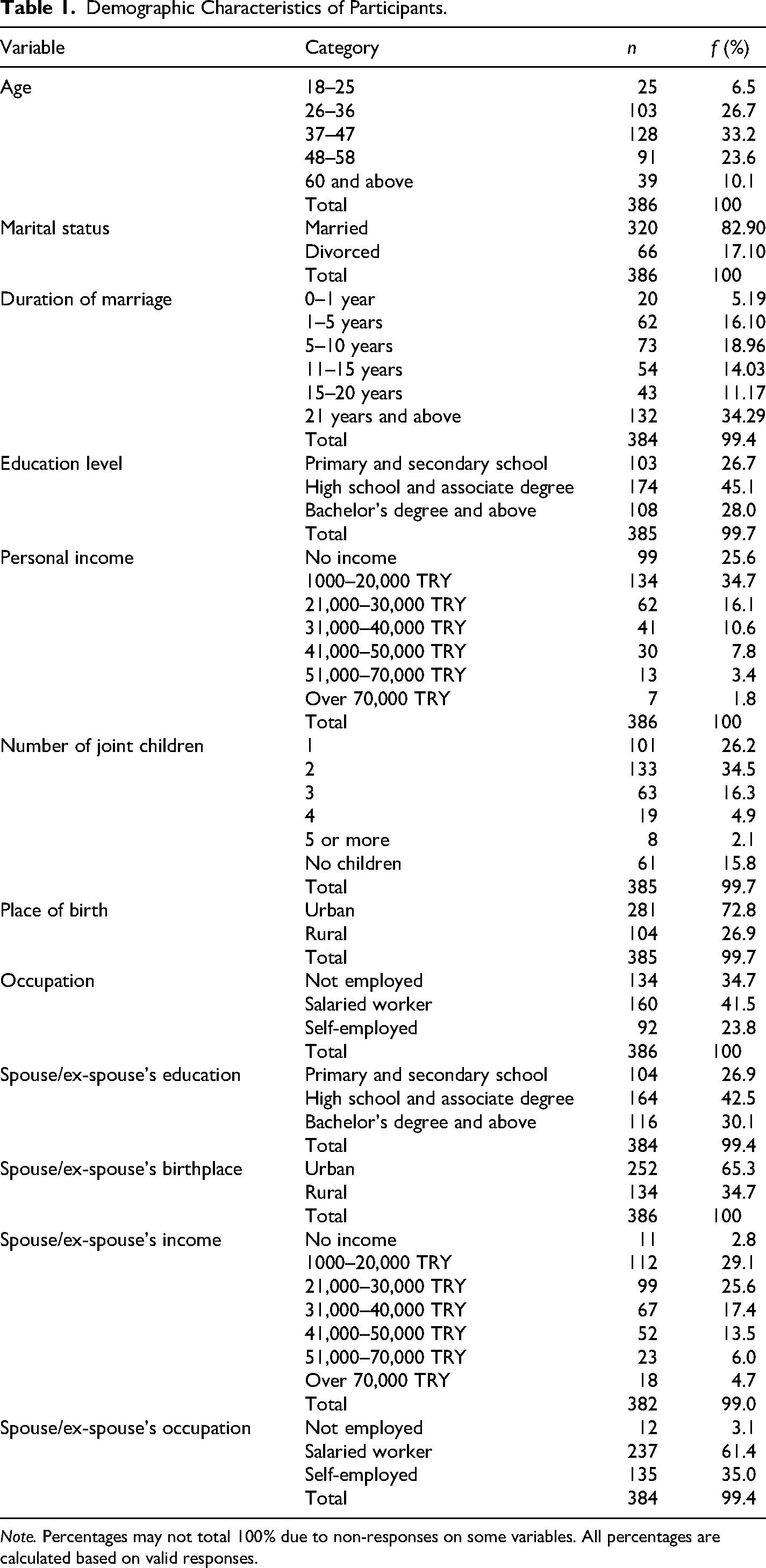
Note. Percentages may not total 100% due to non-responses on some variables. All percentages are calculated based on valid responses.
Regarding education, 45.1% had completed high school or an associate degree, and 28% held a bachelor's degree or higher. Approximately 25.6% reported having no personal income; the most common income range was 1,000–20,000 TRY (34.7%). In terms of employment, 34.7% were unemployed, and 41.5% were salaried employees. Urban-born participants accounted for 72.8%, and 34.5% had two children. As for spousal characteristics, 42.5% of spouses had a high school or associate degree, 61.4% were salaried employees, and 65.3% were born in urban areas. These distributions reflect the diversity of the sample and offer a sound foundation for further statistical analysis.
Descriptive Statistics and Reliability
The internal consistency of the scales was assessed using Cronbach's alpha coefficients. The Gender Role Attitudes Scale yielded a value of .827, and the Economic Abuse Scale yielded .932, both indicating high reliability (George & Mallery, 2019). Both scales had previously been adapted into Turkish, and their psychometric properties were validated in earlier studies (Bakioğlu & Türküm, 2019; Kalaycı et al., 2023). Therefore, no additional validity analysis was conducted in the present study. Normality was assessed based on skewness and kurtosis values. The Gender Role Attitudes Scale fell within the acceptable range, while the Economic Abuse Scale did not meet this criterion. As a result, parametric tests were applied when assumptions were met, and non-parametric alternatives were used otherwise. The mean score on the Gender Role Attitudes Scale was 49.83 (SD = 9.30), suggesting a moderately egalitarian orientation among participants. The mean score on the Economic Abuse Scale was 20.68 (SD = 10.15), indicating relatively low perceived economic abuse. However, the high standard deviation suggests substantial individual variation in responses.
Group Differences in Gender Role Attitudes
Gender role attitude scores varied significantly across several socio-demographic variables. Higher scores indicate more egalitarian views, while lower scores reflect more traditional perspectives.
A significant difference was found across age groups, with women aged 26–36 scoring higher than those aged 48–58 and 60+ (F = 5.78, p < .001). Similarly, women married for 1–15 years scored higher than those married for 21 years or more (F = 4.32, p = .003). Education level was strongly associated with attitudes: those holding a bachelor's degree or higher reported significantly higher scores (F = 35.89, p < .001). Salaried employees scored higher than both unemployed and self-employed participants (F = 8.45, p < .001). Participants earning 41,000 TRY and above reported more egalitarian views than those in lower income brackets (F = 6.66, p < .001). Fewer children were linked to more egalitarian attitudes, with childless women or those with one child scoring higher than those with multiple children (F = 9.15, p < .001). Urban-born participants scored higher than rural-born (t = 3.22, p < .001). Spousal characteristics were also influential: participants with highly educated spouses (F = 19.26, p < .001), urban-born spouses (t = 3.35, p < .001), and high-earning spouses (F = 5.45, p < .001) demonstrated more egalitarian attitudes (see Table 2).
Group Differences in Gender Perception by Socio-Demographic Factors.
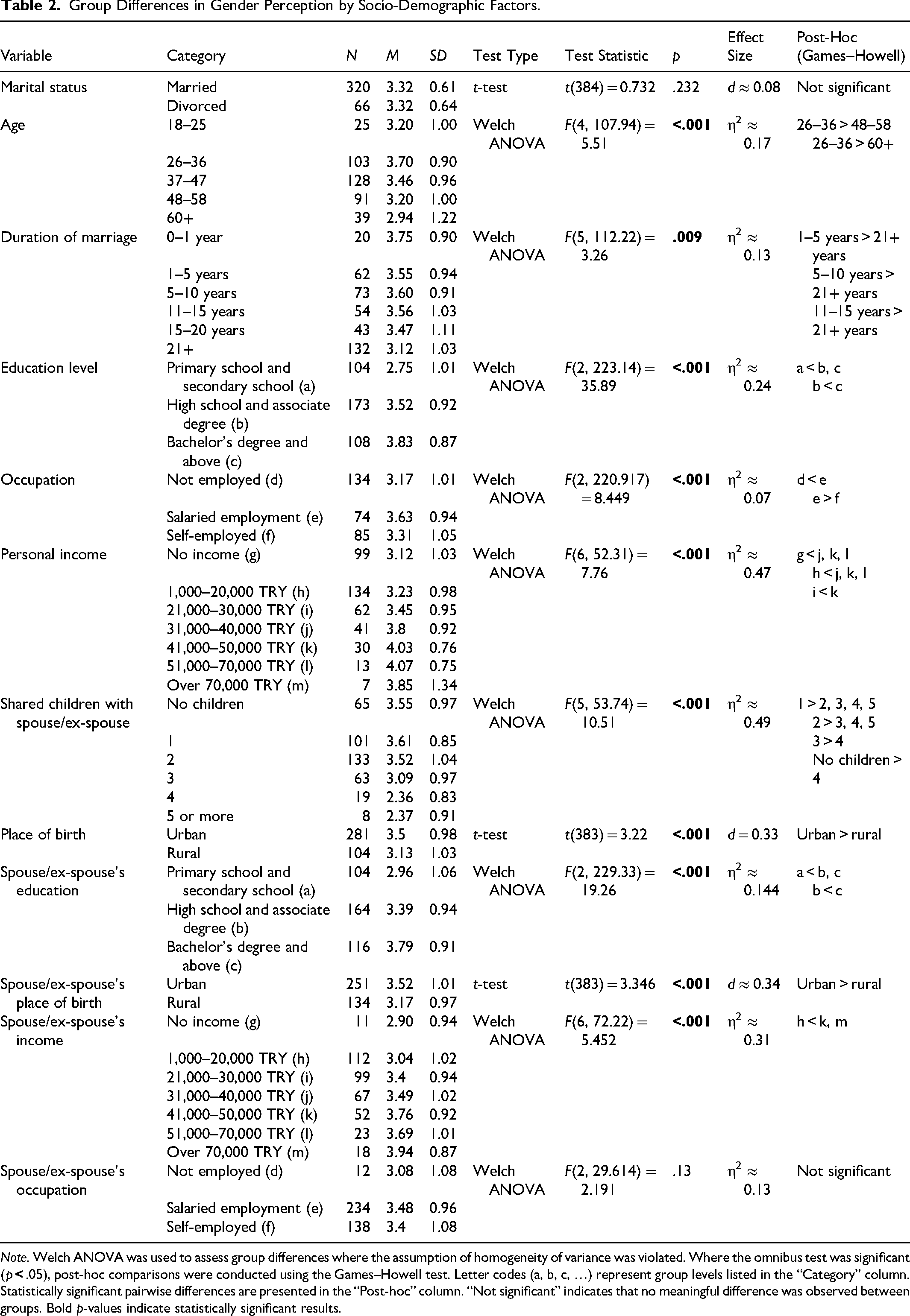
Note. Welch ANOVA was used to assess group differences where the assumption of homogeneity of variance was violated. Where the omnibus test was significant (p
Group Differences in Economic Abuse Perception
Perceptions of economic abuse varied significantly across several socio-demographic variables. Higher scores indicate greater perceived financial control, restriction, or dependency within intimate relationships. Divorced women reported significantly higher perceptions of economic abuse compared to married women (U = 7050, p < .001, r = .31). Similarly, women married for 15 years or more scored higher than those married for 11–15 years (H = 9.92, p = .042).
Participants with lower education levels reported higher perceptions of economic abuse than those with higher educational attainment (H = 17.66, p < .001). Those born in rural areas also had higher scores than their urban-born counterparts (U = 12,268, p < .001). Spousal characteristics showed similar patterns. Women with less-educated spouses (H = 11.31, p = .004) and spouses born in rural areas (U = 14,580, p = .002) reported significantly higher economic abuse perceptions. Lastly, participants whose spouses earned between 1,000 and 40,000 TRY scored higher than those whose spouses earned 51,000–70,000 TRY (H = 12.60, p = .050) (see Table 3).
Non-Parametric Group Differences in Perceived Economic Abuse by Socio-Demographic Variables.
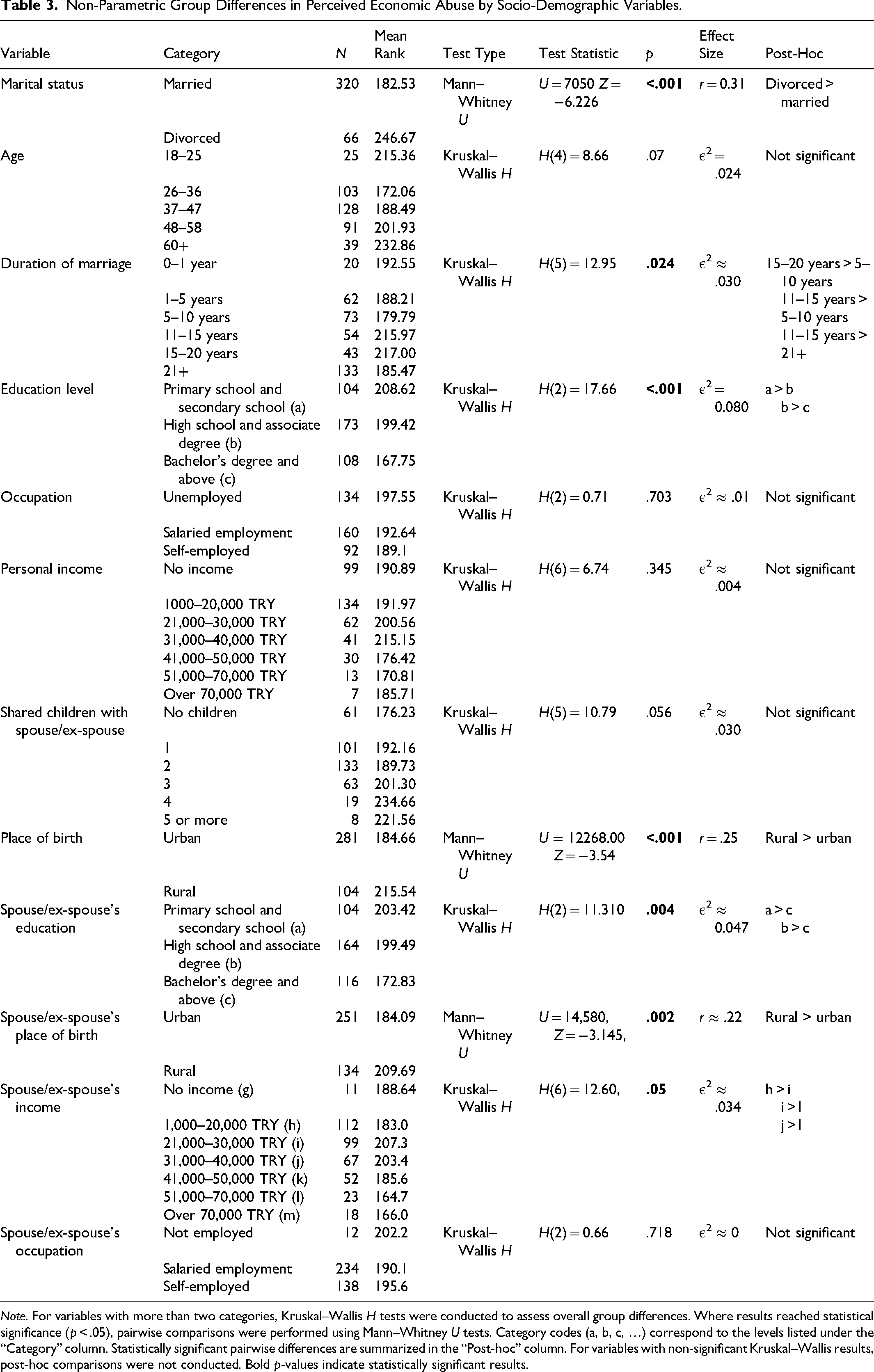
Note. For variables with more than two categories, Kruskal–Wallis H tests were conducted to assess overall group differences. Where results reached statistical significance (p < .05), pairwise comparisons were performed using Mann–Whitney U tests. Category codes (a, b, c, …) correspond to the levels listed under the “Category” column. Statistically significant pairwise differences are summarized in the “Post-hoc” column. For variables with non-significant Kruskal–Wallis results, post-hoc comparisons were not conducted. Bold p-values indicate statistically significant results.
Robust Regression Analysis
To identify the predictors of economic abuse perception, a robust multiple regression analysis was conducted using the GAMLj module in Jamovi with HC3 heteroscedasticity-consistent standard errors due to violations of the normality assumption. The model was statistically significant (F = 10.20, p < .001) and explained 26.9% of the variance in economic abuse perception (R2 = .269; adjusted R2 = .242) (see Table 4). Lower support for gender equality significantly predicted higher perceptions of economic abuse (B = −0.136, p = .021). Divorced women reported significantly higher levels of perceived abuse compared to married women (B = 0.792, p < .001). Higher education (B = −0.145, p = .048) and fewer shared children (B = −0.042, p = .041) were also associated with lower perceptions of abuse. Other predictors in the model were not statistically significant (p > .05). All VIF values were below 2.5, indicating no multicollinearity and supporting the robustness of the model coefficients (see Table 5).
Model Summary of the Robust Regression Predicting Perceived Economic Abuse.

Note. The analysis was conducted using robust standard errors.
Robust Regression Coefficients Predicting Perceived Economic Abuse.
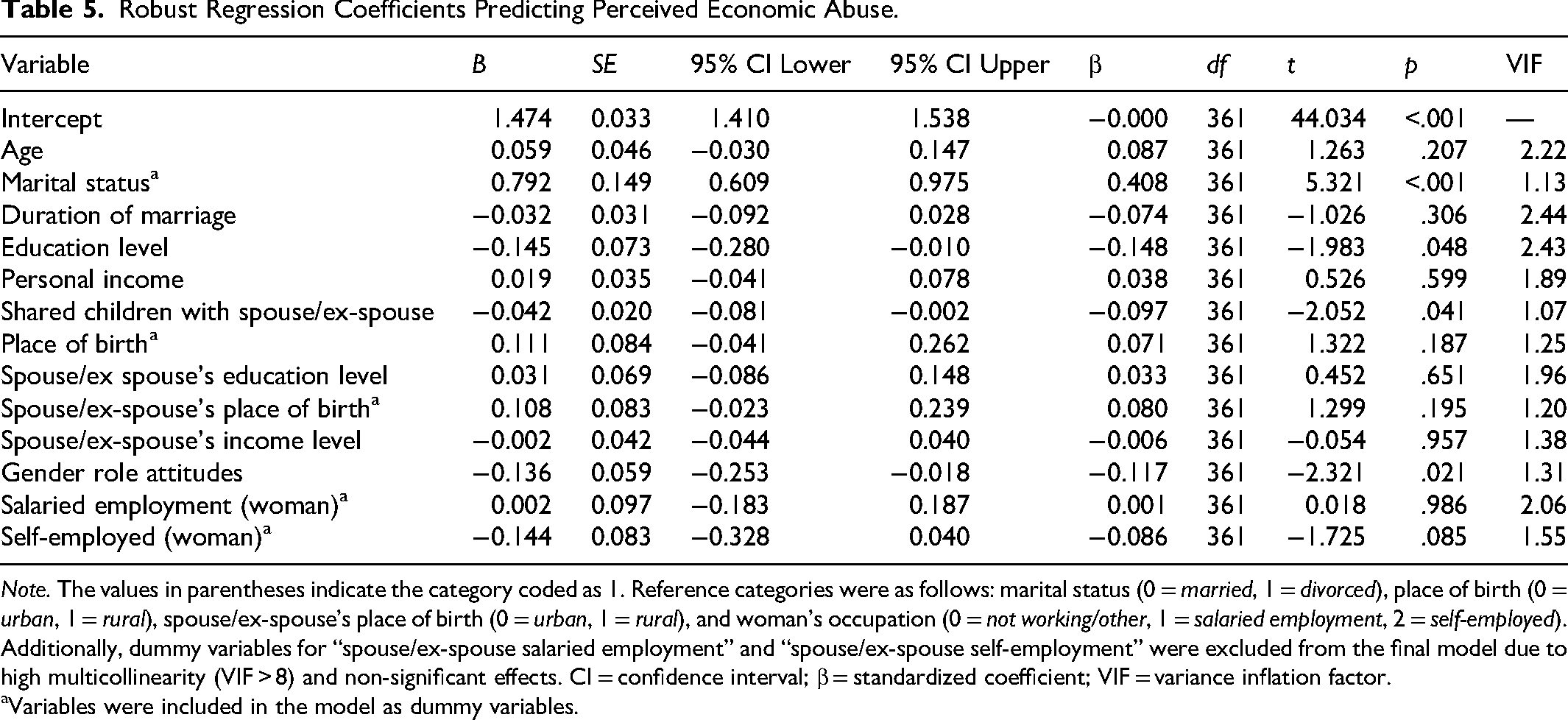
Note. The values in parentheses indicate the category coded as 1. Reference categories were as follows: marital status (0 = married, 1 = divorced), place of birth (0 = urban, 1 = rural), spouse/ex-spouse's place of birth (0 = urban, 1 = rural), and woman's occupation (0 = not working/other, 1 = salaried employment, 2 = self-employed). Additionally, dummy variables for “spouse/ex-spouse salaried employment” and “spouse/ex-spouse self-employment” were excluded from the final model due to high multicollinearity (VIF > 8) and non-significant effects. CI = confidence interval; β = standardized coefficient; VIF = variance inflation factor.
Variables were included in the model as dummy variables.
Discussion
This research focused on the connection between women's gender role attitudes and perceptions of economic abuse, aiming to fill a noted gap in current academic discussions. The findings revealed a statistically significant and negative association between the two variables. In this context, it is important to recognize that the dependent variable reflects women's perceptions of economic abuse, and that these perceptions constitute a multidimensional construct encompassing not only actual exposure to abuse but also individuals’ awareness, recognition, and interpretation of such behaviors. This distinction is critical for interpreting the findings. Accordingly, the observed association may reflect multiple underlying mechanisms: women with more egalitarian attitudes may be less exposed to economically controlling behaviors; they may demonstrate higher levels of awareness and recognition of such behaviors; or they may interpret these behaviors differently. These mechanisms are not mutually exclusive and may operate simultaneously. In this respect, gender norms appear to shape not only how women interpret economically controlling behaviors but also their ability to recognize such behaviors as abusive.
According to the economic abuse framework proposed by Postmus et al. (2020), economic abuse is a multidimensional and often invisible form of violence that systematically undermines women's autonomy and restricts their ability to leave abusive relationships. The present findings align with this framework, particularly by illustrating how economic control mechanisms may become normalized and invisible among individuals who have internalized traditional gender roles. Moreover, Corley et al. (2021) emphasize that individuals with stronger beliefs in gender equality tend to show heightened awareness of all forms of violence, including economic abuse, reinforcing the importance of gender ideology in recognizing abuse.
The study also found that women born in rural areas reported higher levels of perceived economic abuse. This may be due to the influence of traditional social structures where women's economic independence is more limited. In such contexts, economic control mechanisms may be more normalized and often co-occur with psychological or verbal violence. A qualitative study by Parsova and Eroğlu (2018) with rural women entrepreneurs similarly found that economic abuse frequently accompanied emotional abuse. Parallel findings have been reported by Fawole (2008) and Serpa Pimentel et al. (2021) in traditional societies.
The finding that divorced women reported higher perceptions of economic abuse than married women suggests that economic control may persist even after the formal end of a relationship. Studies by Joyce (2007) and Vatnar and Bjørkly (2011) have shown that women's economic security tends to deteriorate post-divorce, which may also influence women's perceptions and experiences of economic abuse. An alternative interpretation is that divorced women may retrospectively recognize abusive behaviors more clearly after leaving the relationship. Distance from the relationship may increase awareness of economic control practices that were previously normalized or overlooked. This interpretation suggests that perceptions of economic abuse may change over time as women reassess past relationship dynamics, highlighting the importance of awareness-raising interventions and support mechanisms during and after separation.
A further important observation was that a higher number of shared children aligned with more traditional perspectives on gender roles and reduced sensitivity to economic abuse.
This may be attributed to the central role of motherhood in shaping women's identities. As caregiving responsibilities increase, women may align more closely with traditional roles and normalize economic control mechanisms. The regression analysis also revealed that the number of children significantly and negatively predicted economic abuse perception, suggesting that abuse awareness is shaped not only by individual cognition but also by familiar responsibilities and socially constructed role expectations.
The results further showed that education and income levels significantly influenced women's gender role attitudes and perceptions of economic abuse. Women with higher levels of education and income were more likely to adopt egalitarian gender views and demonstrate greater sensitivity to economic abuse. These findings are consistent with both national (Gökbulut et al., 2023; Türk et al., 2023) and international research (Ahmed & Rabie, 2018; Ángel-Aguirre et al., 2024). Additionally, women whose spouses had higher education and income levels reported lower perceptions of economic abuse. However, Alsawalqa (2020) found that in certain cultural contexts, educated husbands may strategically increase economic control, highlighting the layered and complex nature of economic abuse as shaped by individual, cultural, and structural dimensions.
The lack of significant effects for variables such as age, duration of marriage, women's employment status, and spouses’ occupation suggests that economic abuse may be less influenced by individual demographic factors and more deeply rooted in broader social structures, cultural gender norms, and patriarchal ideologies. This finding underscores the need to conceptualize economic abuse as a multidimensional phenomenon situated within a wider sociocultural context. However, these relationships should be interpreted with caution, as some variables included in the analysis—such as employment status, income level, and number of children—may themselves be influenced by the dynamics of abusive relationships, indicating potential reverse causality. Indeed, economic abuse can restrict women's participation in the labor market and undermine their financial autonomy. This mechanism suggests that structural gender norms may play a more decisive role in shaping perceptions of economic abuse than individual demographic characteristics. In addition, the relatively low mean economic abuse score observed in this study may also reflect the normalization of economic control practices within traditional gender relations. In sociocultural contexts where such behaviors are widely accepted as part of household management, women may be less likely to interpret them as abusive. Consequently, some forms of economic abuse may remain underreported, even when standardized survey instruments are used. Furthermore, the lack of statistically significant effects for some variables may also reflect measurement limitations inherent in the perception-based nature of the data, the normalization of economic control, and restricted variability within the sample, suggesting that these factors may still be relevant but only partially captured within the scope of the present analysis.
Ultimately, the findings suggest that gender equality may function as an important factor associated with women's awareness of economic abuse and their ability to recognize economically controlling behaviors. In this regard, social policies that support women's economic independence, institutional mechanisms that encourage labor force participation, and legal reforms addressing economic abuse may play an important role. Furthermore, awareness-raising initiatives that help women identify economic abuse can yield significant benefits at both individual and societal levels. Training programs for social workers, legal professionals, and practitioners working with survivors of intimate partner violence may also play an important role in improving the identification and prevention of economic abuse.
Limitations and Directions for Future Research
This study offers valuable insights but also has several limitations. First, the cross-sectional design does not allow for causal inferences. In addition, some of the variables included as predictors in the regression analysis—such as women's employment status, income level, and number of children—may themselves be influenced by the dynamics of abusive relationships. Economic abuse can restrict women's labor market participation and financial autonomy. Therefore, the observed relationships should be interpreted as descriptive associations rather than causal predictors. Future research should employ longitudinal methods to better understand how gender role attitudes influence economic abuse perceptions over time.
Second, the sample was limited to married and divorced women residing in Yalova. The small number of divorced participants may affect representativeness. Therefore, findings should be interpreted with caution and supported by larger, more diverse samples in future studies. Third, data were collected through face-to-face surveys, which may have introduced social desirability bias—especially concerning sensitive topics like economic abuse. Future studies should consider more private or mixed-method data collection strategies. Fourth, the study focused exclusively on women's perspectives. However, perpetrators’ attitudes and value systems also shape economic abuse. Including men or couples in future research could provide a more comprehensive understanding.
Finally, the study used quantitative methods. Yet, economic abuse is a complex phenomenon that is also shaped by emotions and lived experiences. Qualitative methods such as in-depth interviews or focus groups may offer richer insights into the sociocultural dynamics involved.
Conclusion
This study revealed that women with more egalitarian gender role attitudes reported lower levels of perceived economic abuse. Increased awareness of gender equality may facilitate the recognition and questioning of economically controlling behaviors, while higher levels of education and income appear to further support this awareness. On the other hand, the finding that divorced women and those living in rural areas reported higher perceptions of economic abuse illustrates how cultural norms and social roles shape the interpretation of such behaviors. As the number of shared children increased, women's gender role attitudes tended to shift toward more traditional values, and their perceptions of economic abuse decreased. These findings highlight the potential importance of policies that promote gender equality and awareness in efforts to prevent and address economic abuse.
Footnotes
Acknowledgments
The author would like to thank all women who voluntarily participated in this study.

Funding
The author received no financial support for the research, authorship, and/or publication of this article.
Declaration of Conflicting Interests
The author declared no potential conflicts of interest with respect to the research, authorship, and/or publication of this article.