







Abstract
The black sheep effect (BSE) occurs when “deviant” ingroup members are judged more negatively compared to deviant outgroup members. We tested the BSE in the context of perceptions of rape victims. In a 4 (participant religion) × 3 (victim religion) × 2 (gender) between-subjects design (N = 760), Latter-Day Saints (LDS) (Mormon) participants blamed the LDS victim more than the Catholic victim. Utah LDS participants had higher negative affect toward the LDS victim compared to the Catholic victim. Catholic participants did not show this pattern, suggesting a need to examine additional contextual factors, including religious salience and cultural tightness. Implications are discussed.
In April 2016, a New York Times article reported that a female student at Brigham Young University (BYU) reported a sexual assault and was subsequently sanctioned for honor code violations, including substance use and extramarital intercourse (Healy, 2016). Similarly, Liberty University, a Christian University in Virginia, was the target of a lawsuit after telling women that their sexual assault allegations would have violated Liberty University's honor code (known as “The Liberty Way”; Insight Staff, 2021).
Such institutional patterns raise important questions about how religious culture may shape public perceptions of sexual assault victims, particularly in regions with strong or dominant religious identities. For example, in Utah, about 65% of the population identifies as Christian, with 50% identifying as members of the Church of Jesus Christ of Latter-Day Saints (LDS, or Mormon; Pew Research Center, 2025a). Many states in the southern United States, as well as countries in the Middle East, North Africa, and Latin America, are religiously homogeneous (Pew Research Center, 2025b; 2025c). In these contexts, it is likely that many victims of sexual assault are religious and that shared religious affiliation may influence how these victims are perceived.
Understanding how religious affiliation influences perceptions of rape victim blame is crucial in both national and international contexts, especially in regions where religion plays a central or unifying social role. The present study examined how the religious affiliations of both the victim and the perceiver influenced evaluations of a sexual assault victim.
Victim Blame
Victims of sexual assault are often blamed for their behaviors before, during, or after an assault. For instance, victims who were using alcohol or drugs at the time of the assault are often perceived as responsible for their victimization (e.g., Angelone et al., 2007). Individuals who dress in ways deemed provocative by societal standards elicit harsher judgments (e.g., Whatley, 2005). A lack of physical resistance during the assault is often misinterpreted as complicity (Ong & Ward, 1999). Additionally, when victims delay reporting an assault, which is not uncommon, they may be viewed with suspicion or held accountable for not acting “appropriately” (e.g., Lucarini et al., 2020). This tendency became particularly evident in the public's reaction to many survivors who came forward during the #MeToo movement, where delayed disclosures were frequently met with doubt or criticism (Fraser et al., 2022).
One theoretical framework that helps explain why victims are blamed for their own victimization is belief in a just world (BJW). BJW reflects the assumption that the world is fundamentally fair, that good things happen to good people and bad things happen to those who deserve them (Lerner, 1980). When confronted with instances of sexual violence, this belief can be psychologically threatened, as the existence of innocent victims challenges the perception of a fair and orderly social world. To resolve this tension, individuals often engage in cognitive strategies that restore their sense of justice, such as assuming that victims must have done something to cause their victimization. BJW is often conceptualized as a system justification ideology, a broader class of beliefs that motivate individuals to defend existing social arrangements, such as inequalities in power, status, and gender relations (Jost & Banaji, 1994). Victim-blaming often serves an important system-justifying function by preserving one's belief that social systems are fair and predictable, even in the face of evidence to the contrary. In the context of sexual assault, this worldview can lead to the endorsement of rape myths, which are false beliefs about rape, rape victims, and rapists, often shifting the responsibility from the perpetrator to the victim (Burt, 1980). Both rape myth acceptance (RMA) and BJW have been shown to influence rape blame attributions (e.g., Russell & Hand, 2017; Strömwall et al., 2012; Van der Bruggen & Grubb, 2014).
Religion and Victim Blame
Importantly for the present study, religiosity has also been identified as a significant predictor of rape victim blame. An increasing number of studies have found direct correlations between religiosity and endorsement of rape myths or rape victim blame (e.g., Ensz & Jankowski, 2020; Heath & Sperry, 2021). Several mechanisms have been proposed to explain this relationship. Religiosity often correlates with strict gender role beliefs, which emphasize female purity, passivity, and moral responsibility and are consistently linked with higher levels of victim blame (Davies et al., 2012; Grubb & Turner, 2012). Similarly, benevolent sexism is also tied to both RMA (e.g., Abrams et al., 2003) and religiosity (e.g., Burn & Busso, 2005; Mikolajczak & Pietrzak, 2014). Benevolent sexism refers to subjectively positive but restrictive beliefs about women, such as the idea that women should be protected, morally pure, and compliant with traditional gender roles (Glick & Fiske, 1996). These beliefs, while superficially positive, paradoxically reinforce gender inequality and can increase blame toward women perceived as violating gender or sexual norms (Abrams et al., 2003; Mikolajczak & Pietrzak, 2014).
Beyond general correlations between religiosity and rape-related attitudes, religious teachings themselves may reinforce victim-blaming attitudes. Some scholars argue that devaluing women is embedded in religious texts, which sometimes imply that women's actions contribute to sexual assault (e.g., Edwards et al., 2011; Franiuk & Shain, 2011). Differences by denomination further highlight this pattern: Protestant and Catholic individuals demonstrate higher RMA than atheist or agnostic individuals (Barnett et al., 2018). Many religious teachings, combined with strict gender roles, reinforce benevolent sexism and can increase blame toward victims who deviate from prescribed norms (Burn & Busso, 2005; Glick & Fiske, 1996; Viki & Abrams, 2002).
While prior research has established a relationship between religiosity and negative perceptions of rape victims, little is known about the combined influence of the victim's and the participant's religious identities on these judgments. In the present study, religious identity is conceptualized as a shared social group membership, rather than as the intensity of personal belief or religious practice. Accordingly, our focus is on how categorical religious affiliation shapes victim evaluations, above and beyond individual differences in religiosity or related belief systems.
Ingroup Favoritism versus the Black Sheep Effect
To better understand how religious identity may influence perceptions of rape victims, it is useful to consider social identity processes such as ingroup favoritism and the black sheep effect (BSE). According to social identity theory (Tajfel & Turner, 1986), one's self-concept stems from identifying with social groups. One of the strategies for enhancing self-esteem is to identify strongly with an ingroup, particularly a successful one. This creates ingroup favoritism, in which the ingroup is viewed more favorably compared to the outgroup (e.g., Crocker & Schwartz, 1985; Rivera et al., 2024).
In much of the sexual assault literature, similarity to the victim is associated with reduced victim blame and is frequently attributed to increased empathy or identification with the victim (e.g., Grubb & Harrower, 2009; see Grubb & Harrower, 2008, for a review). For example, Harrison et al. (2008) found that sexual assault victims who shared participants’ university affiliation were blamed less than victims from a rival university, particularly when the victim engaged in behaviors often perceived as gender norm violating, such as alcohol consumption or sexual promiscuity. The authors interpreted this pattern as reflecting greater empathy and protective responding toward ingroup members. This similarity-leniency effect has also been interpreted through the lens of defensive attribution theory (Shaver, 1970), in which identifying strongly with the victim leads to reduced victim blame. This protects them from such blame, if they were to find themselves in that situation (van der Bruggen & Grubb, 2014). While empathy-based explanations emphasize concern for and identification with the victim, defensive attribution theory emphasizes self-serving motivations, where observers minimize blame to reduce perceived vulnerability to similar harm. Importantly, many studies are unable to clearly distinguish whether this similarity-leniency effect arises from increased empathy and identification, or from defensive attribution processes aimed at self-protection.
Taken together, these accounts implicitly conceptualize similarity and ingroup membership as protective, such that identifying with the victim is expected to reduce blame. However, these perspectives offer limited insight into circumstances in which ingroup membership might paradoxically increase blame rather than reduce it. Neither empathy-based nor defensive attribution explanations directly address how group-based identity concerns might lead observers to judge ingroup members more harshly.
One theoretical perspective that may help account for this possibility is the BSE, derived from social identity theory. Although ingroup membership is typically a source of self-esteem, maintaining a positive social identity sometimes requires distancing from those who threaten the group's image. As a result, ingroup members who are disliked or who deviate from group norms are often judged more harshly than outgroup members. This pattern is known as the BSE and has received substantial empirical support in other domains (e.g., Lewis & Sherman, 2003; Marques et al., 1988; Marques & Yzerbyt, 1988) but has not yet been examined in the context of sexual assault. Prior work demonstrates that the BSE can emerge in moralized domains, particularly when violations implicate values that are central to the group's identity (e.g., Begue, 2001; Tang et al., 2023).
Applied to the context of sexual assault, the BSE suggests that ingroup victims may be judged harshly when their behavior is perceived as violating core moral norms of the group. Religious identity provides a particularly strong test of this process, as moral norms around sexuality and substance use are often explicit, highly salient, and closely tied to group membership.
The Present Study
The present study tested whether patterns consistent with the BSE emerge in perceptions of rape victims in the context of religious identity. This framework may be particularly relevant to examine in this context, as religious ingroup members are often held to strict moral standards, particularly around sexuality and gender roles. For example, official doctrine in many Christian traditions holds that engaging in premarital sex is morally wrong. The LDS religion explicitly prohibits the consumption of alcohol (The Church of Jesus Christ of Latter-Day Saints, n.d.). When victims are perceived as violating these norms, religious individuals may judge them especially harshly.
Hypotheses
Consistent with the BSE, we hypothesized that LDS participants would judge an LDS victim more negatively than a Catholic victim, and Catholic participants would judge a Catholic victim more negatively than an LDS victim (Hypothesis 1).
We expected the BSE to be stronger among the LDS participants than the Catholic participants (Hypothesis 2). Due to the explicit prohibition of alcohol in the LDS community (The Church of Jesus Christ of Latter-Day Saints, n.d.), the victim's alcohol consumption would be considered particularly “deviant,” and lead LDS participants to derogate the LDS victim as a result. This is consistent with prior findings by Su et al. (2023) demonstrating that “tighter” social norms are more prone to the BSE.
We also hypothesized that the BSE would occur more strongly among Utah LDS participants compared to non-Utah LDS participants (Hypothesis 3). Research shows that the extent to which an ingroup is perceived as a “unified social entity” (i.e., entitativity), the BSE is stronger (e.g., Lewis & Sherman, 2010). Given that about half of Utahans are LDS (Pew Research Center, 2025a), the LDS community was expected to be perceived as more of a unified social ingroup for Utah LDS compared to non-Utah LDS. Additionally, cultural “tightness” has been connected to ingroup homogeneity, as the group norms are easier to enforce among a more homogenous ingroup (Uz, 2015). The LDS cultural context in Utah has been described as particularly norm-dense, with strong behavioral expectations and clear moral prescriptions that are socially reinforced at both institutional and community levels. As such, Utah-based LDS communities may reflect a relatively tighter cultural context compared to LDS communities outside of Utah, where religious identity is embedded within more heterogeneous social environments.
Method
Materials and data can be found at: https://osf.io/cnxem.
Participants and Design
This was a 4 (participant religion: unaffiliated, Catholic, Utah LDS, non-Utah LDS) × 3 (victim religion: Catholic, LDS, control) × 2 (participant gender) between-subjects design. Unaffiliated participants served as a comparison group to establish a boundary condition for the BSE, which is predicated on ingroup identification and was not expected to emerge among individuals without a salient religious ingroup.
We conducted an a priori power analysis using G*Power. With 80% power, a small to medium effect size (f = .20), and 24 conditions, we estimated needing 571 participants. To account for failed manipulation checks, our target sample size was N = 750. However, due to an error in the initial quota setup, Qualtrics initially oversampled Catholic participants, resulting in more participants than requested.
The sample originally consisted of N = 919 Qualtrics panel members who were paid according to their agreement with Qualtrics. Participants were eligible to participate if they were at least 18 years old and identified as either Catholic, LDS, or “unaffiliated,” which was a response option on the survey. The unaffiliated participants were not agnostic or atheist, as those were separate (disqualifying) categories on the religion question. Participants were filtered out if they failed to correctly identify the victim's religion on a multiple-choice question or if they indicated the victim was not consuming alcohol (n = 159). The final sample size was N = 760.
The average age was 52.46 with a roughly even gender split. The sample was mostly White (n = 632; 83.2%), followed by Black or African American (n = 49; 6.4%), multi-racial (n = 33; 4.3%), and Latinx (n = 31; 4.1%). There were smaller numbers of Asian (n = 8), American Indian (n = 5), and Hawaiian or Pacific Islander (n = 1). One participant indicated “prefer not to say.” Participants were recruited from various regions across the United States (19.1% Northeast, 16.7% Midwest, 28.6% South, and 35.7% West). There were 277 Catholic participants, 174 LDS participants who live in Utah, 108 LDS participants who live outside of Utah, and 201 religiously unaffiliated participants.
Procedure
The Institutional Review Board at Weber State University approved this project (IRB-AY24-25-171). Participants were first asked about their religious identity. If they identified as either LDS, Catholic, or unaffiliated, they were allowed to advance to the survey. Participants who live in the western region of the United States were asked what state they live in, and a quota was in place to ensure we obtained LDS participants who live in Utah and LDS participants who live outside of Utah.
Participants were randomly assigned to read one of three vignettes about a sexual assault case in which the victim was portrayed as either LDS, Catholic, or no religion was mentioned (see Appendix). The victim in all three conditions had been drinking alcohol at the time of the assault. Participants were then assessed on the dependent measures described below.
Measures
Victim Blame
The victim blame scale used in this study was created by Sperry and Siegel (2013). The scale consisted of six items (α = .88) in which participants were asked the extent to which they agreed that the victim was responsible for the sexual assault, using a 7-point Likert scale from 1 (strongly disagree) to 7 (strongly agree).
Victim Credibility
On a scale from 1 (not at all) to 7 (extremely), participants rated the victim on the following traits: credible, honest, trustworthy, likeable, and believable (five items; α = .90).
Affect Toward the Victim
On a scale from 1 (not at all) to 7 (extremely), participants were asked to rate the emotions they felt toward the victim. The positive emotions included: sympathy, pity, compassion, kindness, and understanding (five items; α = .86). The negative emotions included: anger, annoyance, bothered, and irritation (four items; α = .89).
Religiosity
The religiosity scale was adapted from the Duke University Religious Index (DUREL; Koenig & Büssing, 2010). The scale used in the present study contained six items: “I attend a place of worship,” “I attend religious services,” “I experience situations in which I feel that God or something divine intervenes in my life,” “I make decisions based on my religious beliefs,” “I think about religious issues,” and “I participate in a religious community” (six items; α = .91).
Religious Fundamentalism Scale
The revised 12-item Religious Fundamentalism Scale (RFS; Altemeyer & Hunsberger, 2004) assesses people's conviction that there is one true religion, belief in the superiority of their religious teachings, and belief in a strict division between the righteous and evildoers. Sample items include: “God has given humanity a complete, unfailing guide to happiness and salvation, which must be totally followed,” and “To lead the best, most meaningful life, one must belong to the one, fundamentally true religion.” Responses were made on a scale from 1 (very strongly disagree) to 9 (very strongly agree). Half of the items were reverse-coded prior to creating the composite measure. The revised 12-item survey has been found to be as reliable as the original 20-item survey (Altemeyer & Hunsberger, 2004; α = .91). The reliability in the present study was also high (12 items; α = .86).
Religious Collective Self-Esteem Scale
Collective self-esteem is the extent to which self-worth is derived from one's social groups (Oulali et al., 2017). The Religious Collective Self-Esteem Scale (RCSES; Oulali et al., 2017) was originally created for children but adapted in the present study to be appropriate for any age. Participants were asked to keep their religious identity in mind as they answered the survey questions. The RCSES includes three subscales: Private (“Are you proud that you are…?”), Public (“Do other people feel good about you being…?”), and Importance (“Do you feel it matters to your sense of being that you are…?”). To adapt the scale for adults, we changed the public subscale items to read: “Do other people feel good about you being…” instead of the originally worded item: “Do other children feel good about you being…” Response options were: No, certainly not, On a few occasions, Most of the time, Yes, certainly. Four items were reverse-coded, and a composite score was created. The RCSES had high reliability in the present study (12 items; α = .80).
Illinois Rape Myth Acceptance Scale
The 22-item Illinois Rape Myth Acceptance Scale (IRMAS; McMahon & Farmer, 2011) assesses participants’ agreement with commonly held misconceptions about rape. Using a scale from 1 (strongly disagree) to 7 (strongly agree), participants rated their agreement with statements such as “When girls get raped, it's often because the way they said ‘no’ was unclear.” Payne et al. (1999) demonstrated the scale's predictive validity through correlations with rape proclivity. The IRMAS had high reliability in the present study (α = .94).
Belief in a Just World
BJW is a belief system in which people believe that good people get good outcomes and bad people get bad outcomes (Lerner, 1980). The present study used the Global Belief in a Just World Scale (Lipkus, 1991), which includes eight items (α = .89), with responses ranging from 1 (strongly disagree) to 7 (strongly agree).
Ambivalent Sexism Inventory
The 22-item Ambivalent Sexism Inventory (ASI) was created by Glick and Fiske (1996) to assess two forms of sexism: hostile sexism and benevolent sexism. Hostile sexism maintains that men are superior to women, dismisses continued discrimination, and believes that women are trying to gain power over men. Benevolent sexism views women as possessing qualities that are subjectively positive but restricts women to stereotypical roles. Benevolent sexism includes believing that women should be honored and put on a pedestal and that women need protecting. Responses were made on a 6-point scale, and three items on each subscale were reverse-coded. Previous research has demonstrated the convergent validity, as it correlates with the Old-Fashioned Sexism Scale and the Modern Sexism Scale (Glick & Fiske, 1996). In the present study, both benevolent sexism (11 items) and hostile sexism (11 items) had acceptable reliability (α = .75 and α = .84, respectively).
Victim Typicality
Participants were asked to indicate the extent to which the victim seemed typical of all members of her faith, using a scale from 1 (extremely atypical) to 7 (extremely typical).
Analytic Strategy
We used General Linear Model in SPSS to conduct a multivariate analysis of variance (MANOVA). The fixed factors were participant religion, victim religion, and participant gender, and the dependent measures included: victim blame, credibility, negative affect toward the victim, and positive affect toward the victim. We controlled for RFS and religiosity in all analyses.
In addition, other dispositional measures such as the ASI, BJW, and the IRMAS were assessed because these constructs are known to relate to rape-related attitudes. These variables were included to provide descriptive context and to account for established individual difference correlates of victim blame, rather than to test mediation or moderation pathways, which were beyond the scope of the present study. While these measures were not included as covariates in the MANOVA, Table 1 presents descriptive comparisons across religious groups to provide context on potential group differences in these relevant attitudes.
Mean (Standard Deviation) for Several Key Variables, Comparison for Gender (t-Test), and Participant Religion (One-Way MANOVA).
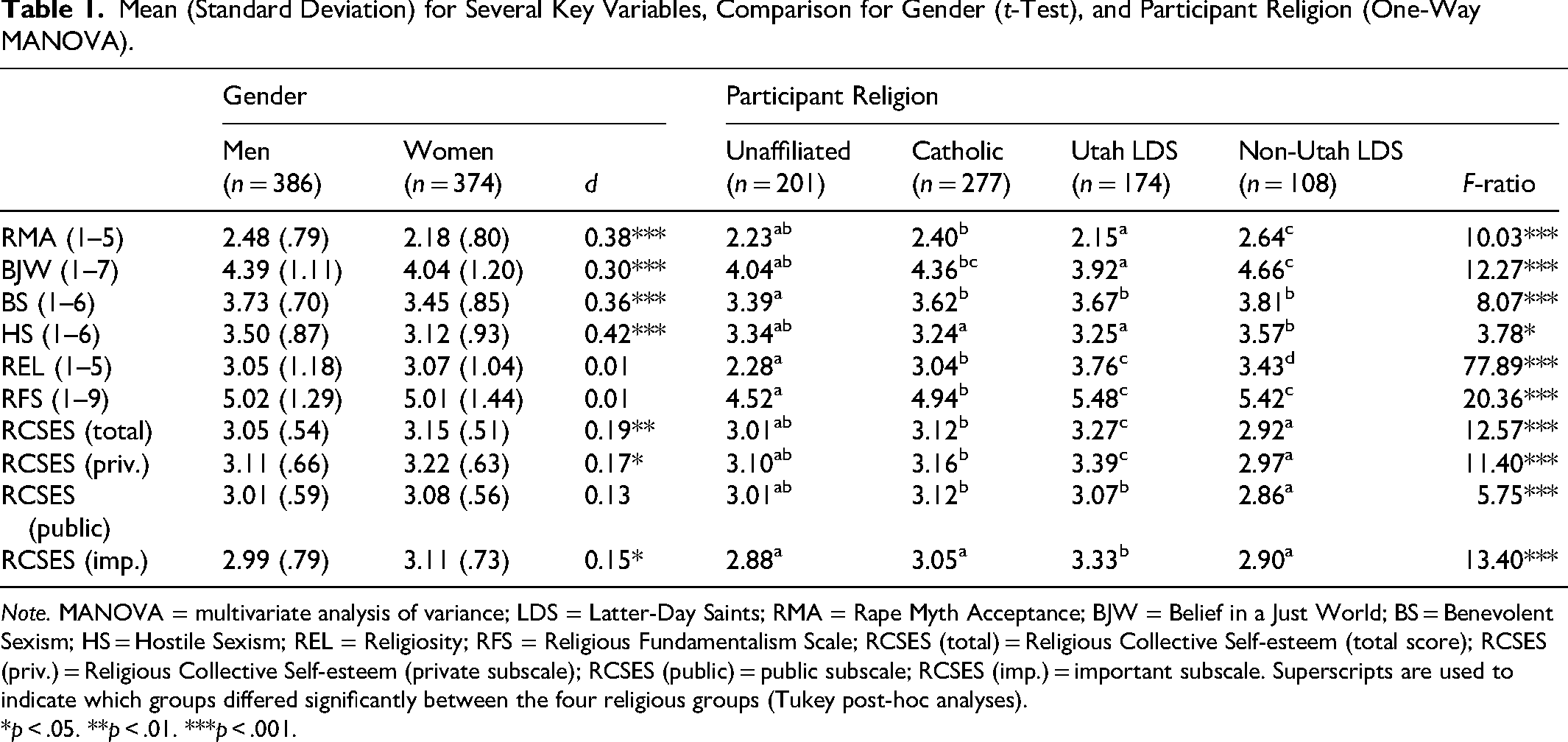
Note. MANOVA = multivariate analysis of variance; LDS = Latter-Day Saints; RMA = Rape Myth Acceptance; BJW = Belief in a Just World; BS = Benevolent Sexism; HS = Hostile Sexism; REL = Religiosity; RFS = Religious Fundamentalism Scale; RCSES (total) = Religious Collective Self-esteem (total score); RCSES (priv.) = Religious Collective Self-esteem (private subscale); RCSES (public) = public subscale; RCSES (imp.) = important subscale. Superscripts are used to indicate which groups differed significantly between the four religious groups (Tukey post-hoc analyses).
*p < .05. **p < .01. ***p < .001.
We first conducted the MANOVA with three participant religions and then conducted the MANOVA with four religions after splitting LDS into Utah LDS and non-Utah LDS. There were no interactions among variables for credibility or positive affect.
Results
Descriptive Data
Table 1 presents descriptive statistics and one-way ANOVA results for several measured variables across the four participant religious groups. Table 2 displays the main effects of participant gender and participant religion on the key dependent measures. There were no main effects of the victim's religion on any of the dependent variables.
Estimated Marginal Means for the Main Effects of Gender and Participant Religion on the Dependent Variables (4 × 3 × 2 MANOVA), Controlling for Religiosity and RFS.
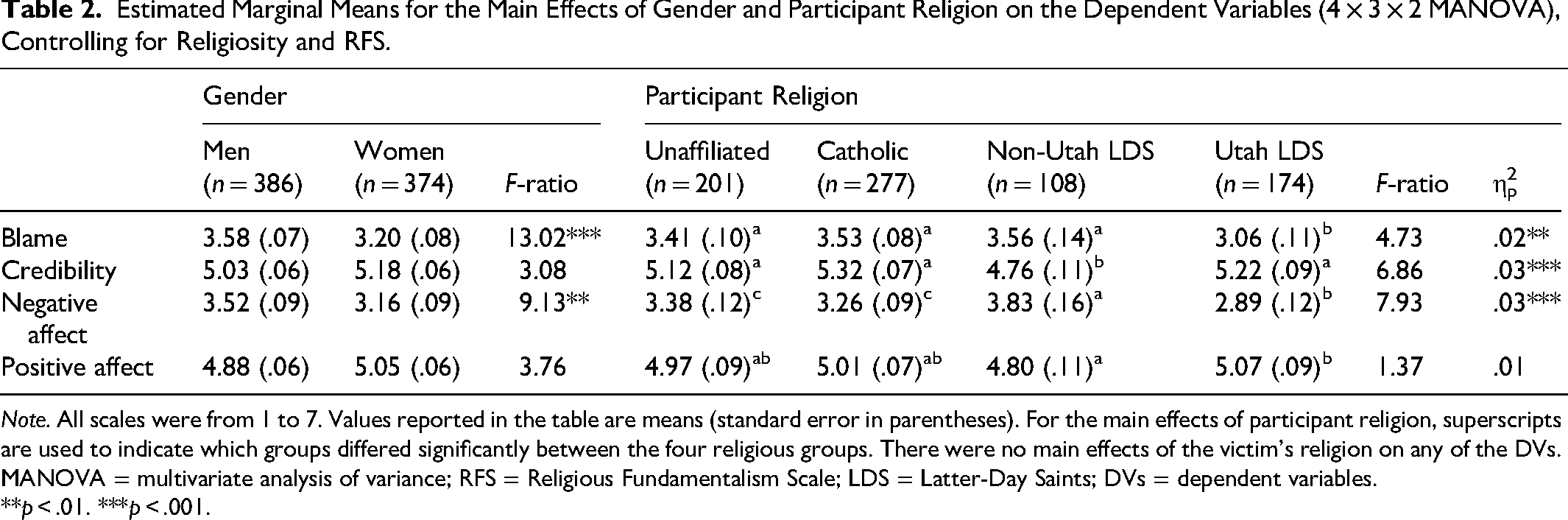
Note. All scales were from 1 to 7. Values reported in the table are means (standard error in parentheses). For the main effects of participant religion, superscripts are used to indicate which groups differed significantly between the four religious groups. There were no main effects of the victim's religion on any of the DVs. MANOVA = multivariate analysis of variance; RFS = Religious Fundamentalism Scale; LDS = Latter-Day Saints; DVs = dependent variables.
**p < .01. ***p < .001.
Victim Blame
We conducted a 3 (participant religion) × 3 (victim religion) × 2 (participant gender) MANOVA, controlling for religiosity and RFS. The three-way interaction was not significant. The interaction between the participant's religion and the victim's religion was significant, F(4, 740) = 2.60, p = .035, ηp2 = .01 (see Figure 1). The simple main effect for LDS participants was significant, F(2, 740) = 3.43, p = .033, ηp2 = .01. The LDS participants blamed the LDS victim significantly more than both the Catholic victim and the control condition. For Catholic participants, the simple main effect approached significance, F(2, 740) = 2.81, p = .061, ηp2 = .01. The Catholic participants blamed the Catholic victim significantly more than the control condition, but not significantly more than the LDS victim. The simple main effect for unaffiliated participants was not significant. These findings partially support our hypotheses, as the BSE was exhibited among LDS participants, but not among Catholic participants.
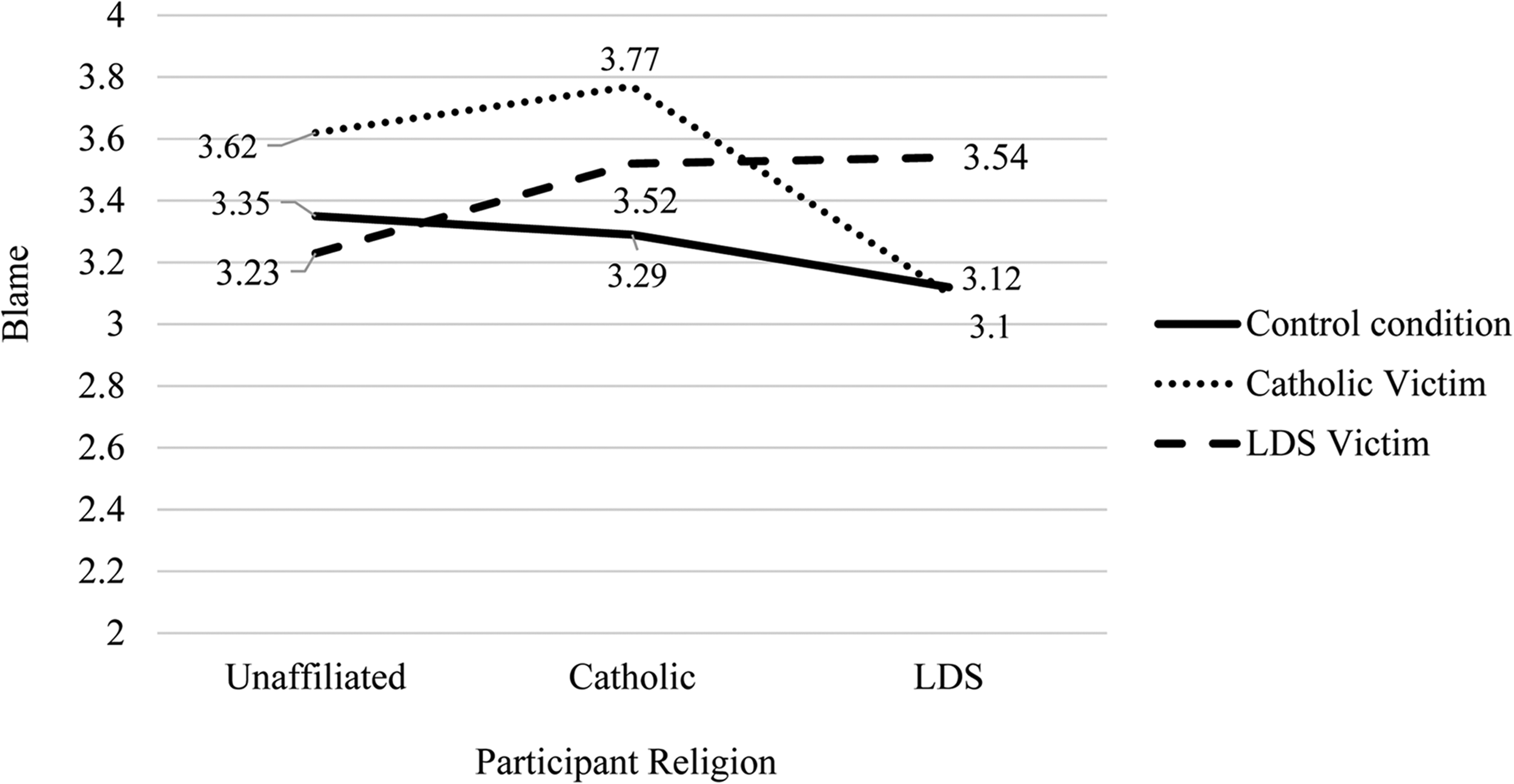
Significant interaction between participant religion and victim religion on perceptions of victim blame (N = 760), collapsed across gender.
We split the LDS participants into Utah LDS and non-Utah LDS, resulting in a 4 (participant religion) × 3 (victim religion) × 2 (participant gender) MANOVA. There were no significant interactions between the variables on victim blame. Contrary to our hypotheses, the BSE did not emerge more strongly for Utah LDS participants than non-Utah LDS participants on victim blame.
Negative Affect Toward Victim
In the 3 (participant religion) × 3 (victim religion) × 2 (gender) MANOVA, there was a marginally significant three-way interaction, F(4, 740) = 2.28, p = .060, ηp2 = .01. We split the file by gender to examine the participant religion × victim religion interaction for men and women separately. Among female participants, there was a significant interaction between participant religion and victim religion, F(4, 363) = 2.90, p = .022, ηp2 = .03 (see Figure 2a). The simple main effect was significant only for the LDS women, F(2, 363) = 3.04, p = .049, ηp2 = .02. LDS women had significantly higher negative affect toward the LDS victim compared to either the Catholic victim or the control condition. There were no main effects or interactions for male participants (see Figure 2b).
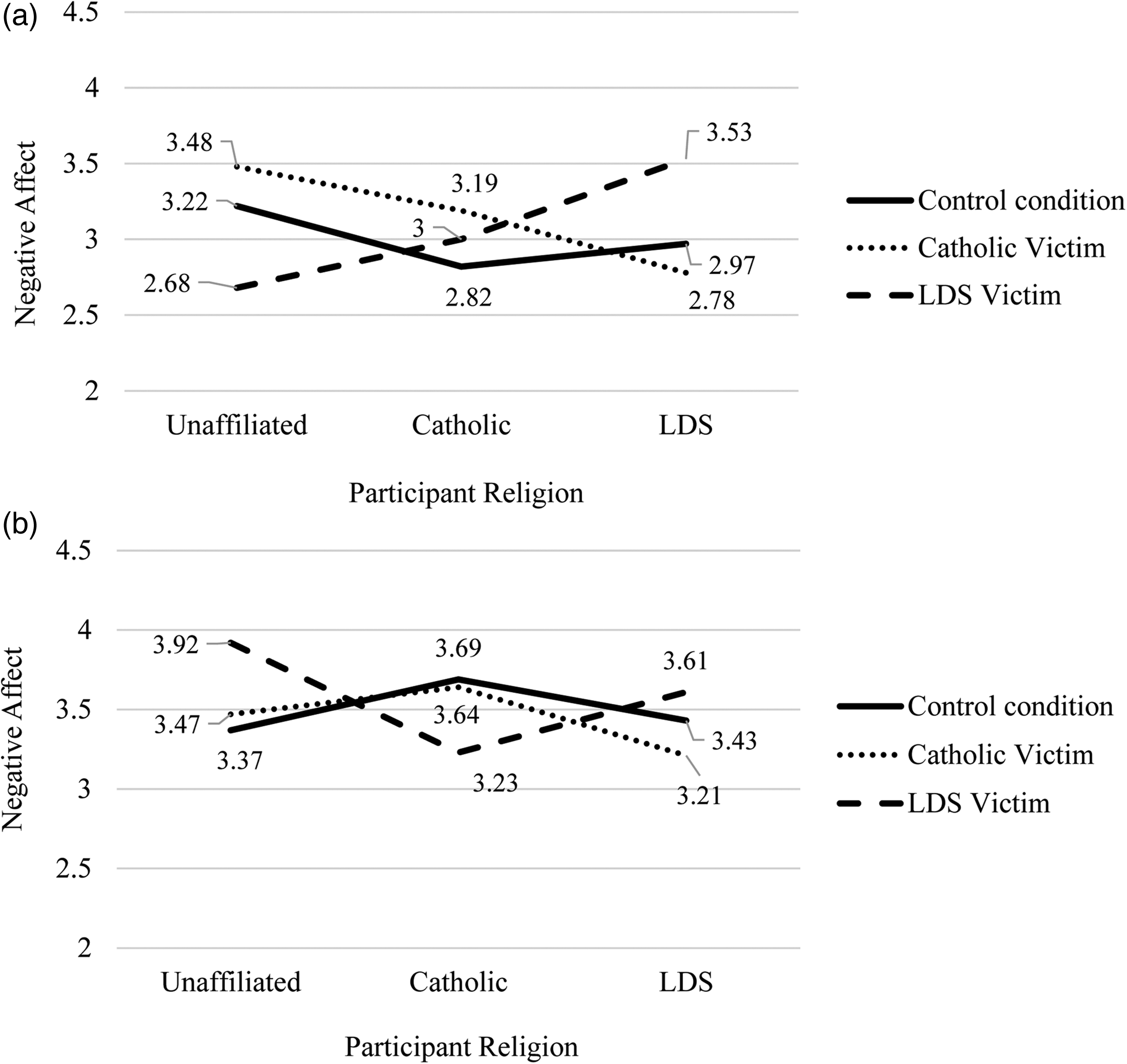
(a) Significant 3 (participant religion) × 3 (victim religion) MANOVA on negative affect toward the victim among female participants (N = 374). (b) Non-significant 3 (participant religion) × 3 (victim religion) MANOVA on negative affect toward the victim among male participants (N = 386).
In the 4 (participant religion) × 3 (victim religion) × 2 (gender) MANOVA, there was no three-way interaction on negative affect. There was a significant interaction between participant religion and victim religion, F(6, 734) = 2.30, p = .033, ηp2 = .02 (see Figure 3). The simple main effect was significant only for Utah LDS participants, F(2, 734) = 5.04, p = .007, ηp2 = .01. Utah LDS participants had significantly higher negative affect for the LDS victim compared to the Catholic victim.
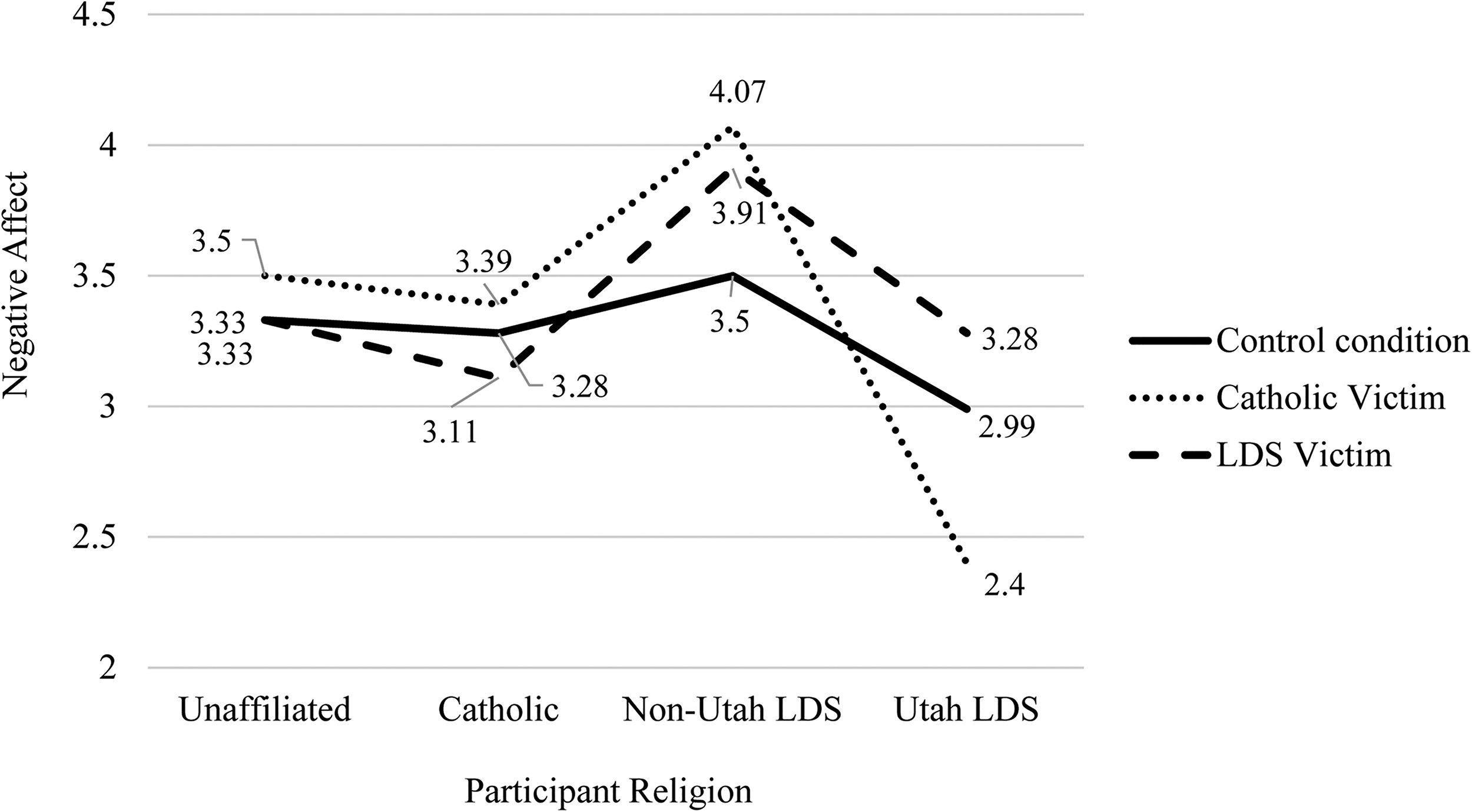
Interaction between participant religion and victim religion on negative affect (N = 740).
Exploratory Analyses
The following analyses were conducted on an exploratory basis to probe patterns that were not specified a priori. These analyses were not preregistered and should be interpreted as hypothesis-generating rather than confirmatory.
As exploratory analyses, we split the file by region of the United States to examine whether more religious regions (i.e., the south) would exhibit a stronger BSE. We conducted a 3 (participant religion) × 3 (victim religion) MANOVA, controlling for religiosity and RFS. The interaction between the participant's religion and the victim's religion on victim blame was significant among participants in the South, F(4, 206) = 2.45, p = .047, ηp2 = .05 (see Figure 4). The BSE emerged only for Catholic participants. The simple main effect was significant, F(2, 206) = 5.22, p = .006, ηp2 = .05; Catholic participants exhibited higher victim blame toward the Catholic victim compared to the LDS victim or the control condition. It is worth noting that we had fewer LDS participants in the South (n = 54), so these results should be viewed with some caution. There was also a significant interaction among participants in the Western United States, but the majority were LDS participants in Utah, with some cell sample sizes as small as n = 3.
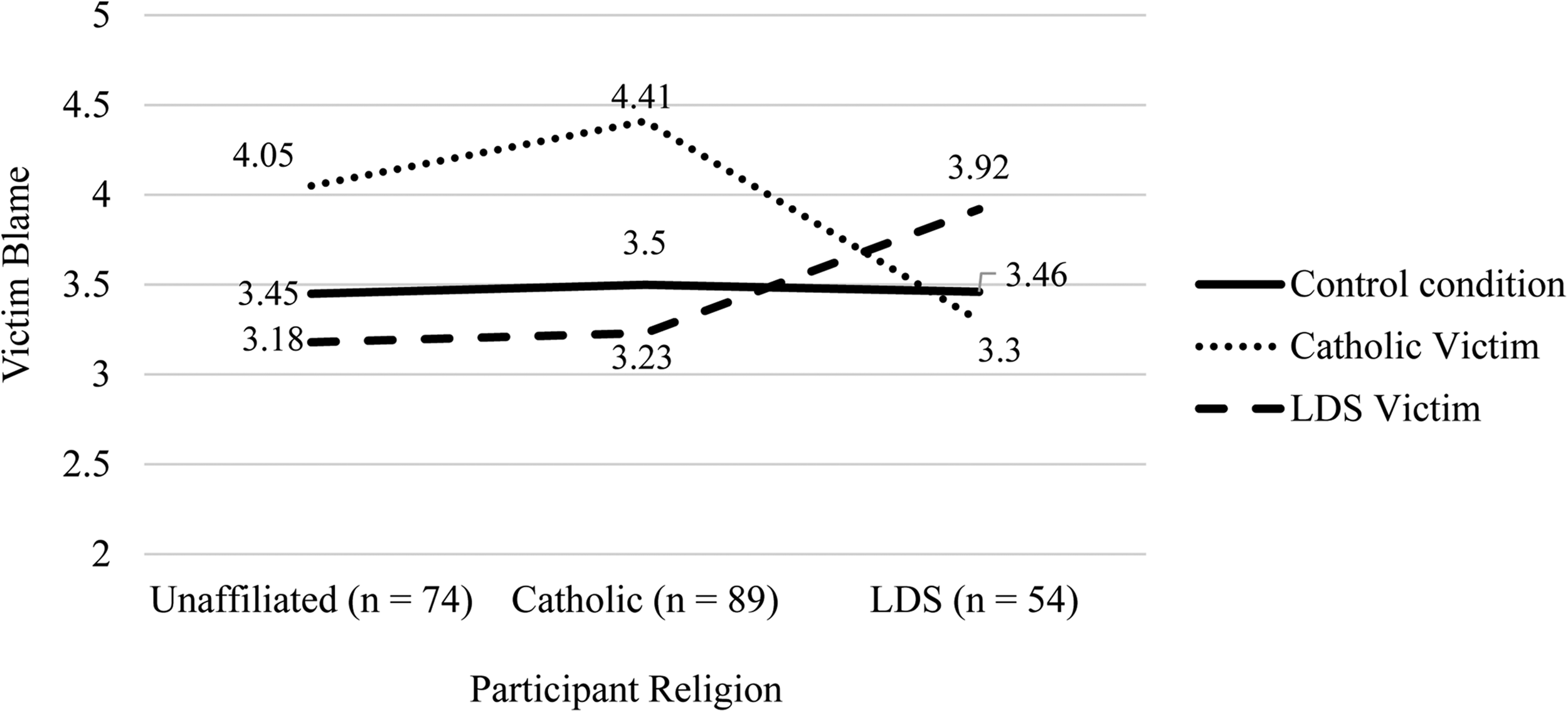
3 (participant religion) × 3 (victim religion) MANOVA on victim blame among participants in the Southern states (N = 217).
Another variable that we explored was the victim's typicality. The BSE would predict a stronger effect if the victim was seen as a “typical” member of the ingroup. We used PROCESS Version 4.2 (Hayes, 2018) to examine the three-way interaction between participant religion, victim religion, and perceived victim typicality, controlling for religiosity and RFS (see Figure 5a). This analysis lent itself to using PROCESS due to having a moderator variable on a Likert scale (perceived victim typicality). We dummy-coded participant religion and ran the model for LDS participants and Catholic participants separately. There was a significant three-way interaction between participant religion (LDS vs. not), the victim's religion, and perceived victim typicality on credibility, F(1, 750) = 7.96, p = .005. At high levels of typicality (84th percentile), there was a significant interaction between being LDS and the victim's religion, F(1, 750) = 6.11, p = .014 (see Figure 5b). Simple slopes analyses revealed that among participants in the LDS victim condition, being LDS predicted lower perceived credibility of the victim, b = −.51, p < .001, 95% CI [−0.7925, −0.2289]. These findings should be interpreted cautiously given the exploratory nature of the analyses.
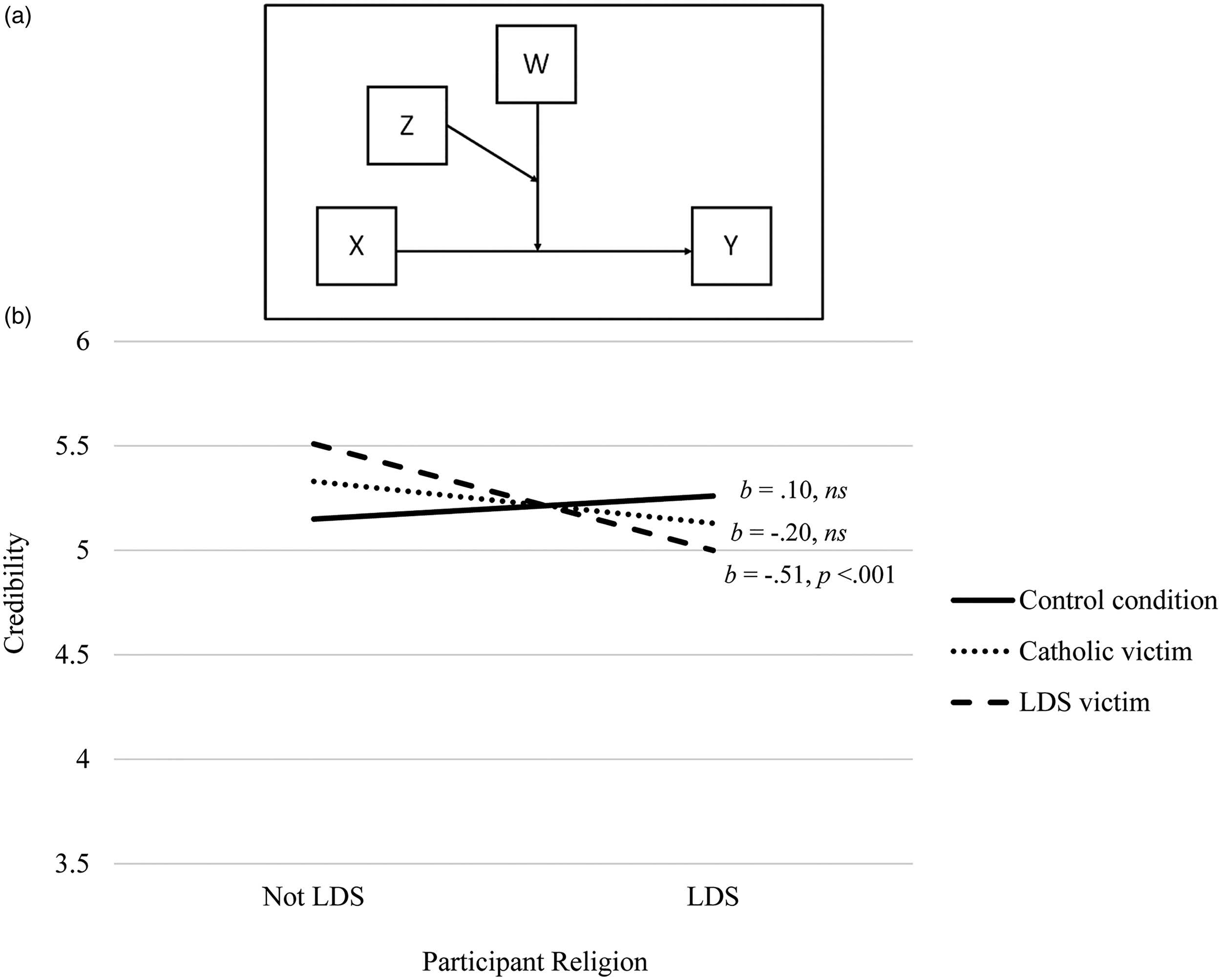
(a) Moderation model in which participant religion (LDS or not) is variable X, credibility is variable Y, victim religion is variable W, and perceived victim typicality is variable Z. (b) Significant interaction between LDS affiliation and victim religion on victim credibility, among participants high in perceived victim typicality (84th percentile).
We also used PROCESS to examine whether religious collective self-esteem interacted with both the participant's religion and victim's religion. This did not yield significant results.
Discussion
The present study examined whether patterns consistent with the BSE would emerge in perceptions of sexual assault victims across religious identities. We hypothesized that members of the LDS (Mormon) faith would judge an LDS victim more negatively than the Catholic victim, and members of the Catholic faith would judge a Catholic victim more negatively than the LDS victim. We also hypothesized that the BSE would emerge more strongly for LDS participants, particularly those LDS participants residing in Utah.
Our hypotheses were partially supported. Consistent with predictions derived from the BSE framework, LDS participants blamed the LDS victim more than either the Catholic victim or the control condition. Similarly, LDS women (but not men) exhibited higher negative affect toward the LDS victim compared to the Catholic victim or the control condition. As expected, on negative affect, only Utah LDS participants demonstrated a BSE, suggesting a stronger effect for LDS participants in Utah compared to outside of Utah.
Several exploratory analyses suggested patterns consistent with a BSE in this context. The effect emerged primarily among participants who perceived the victim as typical of members of her faith, such that derogation was more pronounced when the victim was perceived as highly typical of her religious ingroup. Additionally, Catholic participants in the southern United States demonstrated the BSE. Because perceived typicality was assessed rather than experimentally manipulated, these findings should be interpreted cautiously and are intended to be hypothesis-generating rather than confirmatory.
Contrary to our expectations, the BSE did not consistently emerge among Catholic participants, suggesting limited generalizability across religious groups. Although Catholics did blame the Catholic victim more than the control, they did not blame her significantly more than the LDS victim, failing to support the effect.
Rather than serving as post-hoc explanations, we conceptualize several theoretically informed conditions that may help account for variability in BSEs across religious contexts. Specifically, prior theory and empirical work suggest that the emergence of ingroup derogation may depend on: (1) religious salience, (2) cultural tightness, and (3) the subjective importance of religious identity. These factors are not tested directly in the present study, but they provide a framework for understanding why BSEs may emerge in some religious contexts (e.g., Utah LDS; Southern Catholics) but not others.
Future Directions
Religion Salience
The BSE might be stronger among participants for whom their religious identity is particularly salient. This possibility could be tested experimentally by employing a religion prime. Religion may also be chronically salient for individuals who belong to the majority religion or who live in a context where there is one culturally dominant faith. We did not have enough Catholic participants residing in Utah to thoroughly investigate this possibility. Interestingly, among participants from the Southern United States, the BSE emerged strongly within Catholic participants, who assigned the most blame to the Catholic victim. Catholicism is one of the most common religions in the South, second to Evangelical Protestant (Pew Research Center, 2025b). The South is also the most religious region of the United States (Norman, 2018). This exploratory finding does lend some credence to this possibility.
Cultural Tightness
Cultural tightness refers to a culture that has many enforced rules and little tolerance for deviance (Harrington & Gelfand, 2014). It has been suggested that tighter cultures are also more religious (Senay, 2025). However, the degree of tightness—in terms of norms and punishment of norm violations—may vary across religions. Our findings do not support a generalizable BSE in the context of all religions. Our a priori expectation that LDS participants would exhibit a stronger BSE compared to Catholics was partially informed by the concept of “norm tightness” (Su et al., 2023). Future research could explore whether similar patterns emerge in other religions that are theorized or perceived to have relatively strict social norms, such as Islam, Orthodox Judaism, or Evangelical Christianity (Bartkowski & Read, 2003; Rakimzhanova & Rakymzhanov, 2019). Importantly, cultural tightness was not directly measured in the present study and is therefore conceptualized as a contextual characteristic rather than a tested psychological mechanism. Future research would benefit from incorporating direct assessments of perceived cultural tightness to more precisely examine its role in shaping ingroup norm enforcement processes.
Cultural tightness has also been associated with social and cultural homogeneity, as shared norms are easier to enforce in more uniform communities (Uz, 2015). This suggests that regions with greater religious homogeneity may exhibit higher cultural tightness, and, in turn, stronger BSEs. This interpretation is consistent with the finding that Utah LDS participants showed stronger evidence of ingroup derogation compared to non-Utah LDS participants. However, because cultural tightness and religious salience were not directly measured, these findings should be interpreted cautiously and viewed as suggestive rather than explanatory. Similarly, the strong BSE observed among Catholics in the South may also reflect the influence of cultural tightness, although it is unclear whether these participants were from regions with high concentrations of Catholics.
Importance of Religious Identity
In the present study, we assessed religious collective self-esteem to measure the extent to which participants’ religious identity was an important part of their identity and their self-esteem. Utah LDS participants had higher religious collective self-esteem than the other three groups, particularly when it came to the overall score, the importance subscale, and the private subscale (Table 1). This may partially explain why we found stronger evidence of the BSE among Utah LDS participants, particularly on negative affect toward the victim. The more a person's identity and self-esteem depend on their group membership, the more likely they are to protect the group's image by derogating a deviant ingroup member. However, when we explored religious collective self-esteem as a moderator, it did not moderate the interaction between participant religion and victim religion.
Limitations
One of the limitations of the present study was the use of a written vignette to explore perceptions of sexual assault victims. While this method allowed for a high degree of experimental control (which was prioritized in the present study), it may limit ecological validity. Future research should consider using alternative media formats to enhance realism and generalizability. That said, the use of a written vignette can also be viewed as a strength in the present study; despite the subtle nature of the manipulation, significant interactions emerged in the theorized directions.
The inclusion of the unaffiliated participants as a comparison group increased the complexity of the study design. This approach allowed us to test theoretically meaningful boundary conditions, particularly by distinguishing ingroup-based derogation from more general patterns of victim evaluation. However, this inclusion may reduce interpretive clarity for some readers, as the BSE was not expected in this group. Future studies could focus more narrowly on specific religious ingroups, which may simplify the design while still building on the patterns observed in the present research.
Participant religion was a quasi-independent variable, and therefore, it cannot be disentangled from other demographic factors, such as geographic region. Certain religions are more prevalent in specific areas of the United States, which introduces a potential confound between religion and location. We only collected state-level data for participants in the Western United States to ensure adequate representation of LDS participants outside of Utah, limiting our ability to pinpoint participant locations more precisely.
Despite conducting an a priori power analysis and providing Qualtrics with the target sample size for each religion (93 men and 93 women in each of four religion categories), our study was slightly overpowered. An error in the Qualtrics quotas led to oversampling Catholic participants. While many of the effect sizes were small, the findings were theoretically consistent, and all effects were in the predicted direction. We acknowledge that small effects may raise questions about practical significance. However, we argue that these findings remain important; they align with a strong theoretical framework and consistently show that, in some religious contexts, ingroup victims may be judged more harshly than outgroup victims.
Although the observed pattern is consistent with the BSE, the present study cannot conclusively determine the psychological mechanisms underlying these responses. Alternative explanations merit consideration. For example, stereotype activation or system-justifying motives may contribute to harsher judgments of victims perceived as violating moral norms. However, these accounts alone would not necessarily predict the selective derogation of ingroup victims relative to outgroup victims. The ingroup-specific nature of the interaction aligns more closely with social identity-based explanations, including the BSE, while still leaving room for alternative interpretations. Future research should experimentally manipulate identity salience and directly assess competing mechanisms to more clearly disentangle these processes.
Implications
Earlier in this paper, we explored how gender role beliefs and benevolent sexism shape perceptions of rape victims, and how these same constructs intersect with religiosity and religious fundamentalism. However, the tendency to derogate religious sexual assault victims may involve more subtle dynamics than a straightforward BSE based solely on religious affiliation. That said, our findings suggest that in certain religious contexts, a BSE may indeed contribute to more negative perceptions of religious ingroup victims.
More broadly, the present findings may be situated within a larger literature on sexual violence, gendered norm expectations, and identity-based regulation of behavior. Prior work has shown that sexual assault victims are often judged more harshly when they are perceived as violating norms surrounding sexuality, alcohol use, modesty, or femininity (e.g., Abrams et al., 2003; Grubb & Turner, 2012; Viki & Abrams, 2002). Religious identities may intensify these dynamics because moral expectations surrounding sexuality and substance use are often closely tied to group identity and community belonging. From this perspective, negative reactions toward ingroup victims may reflect not only social identity processes, but also broader attempts to reinforce gendered and moral norms within communities. The BSE therefore represents one potentially useful framework for understanding these judgments, rather than the sole explanatory account.
Although the observed effects were small, this is not unexpected given the subtle nature of the manipulation and the complexity of attitudes toward sexual assault. Even modest shifts in blame or negative affect may have meaningful consequences when aggregated across repeated interactions with institutional actors (e.g., peers, administrators, investigators), particularly in religiously homogeneous contexts. Importantly, the present findings should not be interpreted as evidence that religious affiliation directly determines institutional outcomes or legal decisions. The study examined individual-level perceptions in a controlled experimental context and cannot speak to how formal policies are enacted or enforced.
At the same time, understanding individual-level perception processes is a necessary first step in identifying the conditions under which institutional responses may emerge or be reinforced. Religious institutions and universities around the world often share many of the key contextual features we have discussed here: high religious salience, cultural tightness, and large populations of individuals for whom religion is deeply intertwined with identity. Although the present findings do not allow conclusions about institutional responses to sexual assault, they highlight the relevance of examining victim perception processes within these environments. Given that college-age women are at an elevated risk for sexual assault, and that more than 25% of undergraduates experience a sexual assault (RAINN, 2025), these settings may be uniquely important contexts for examining how religiosity intersects with perceptions of victims and responses to sexual violence. Within religiously salient institutional contexts, religiosity may shape how victims are perceived, as those perceptions are formed within institutional and cultural norms that define expectations around sexuality, morality, and disclosure.
Footnotes
Acknowledgments
We would like to acknowledge Carly Barlow, BS, for her contributions to the development of the study materials, as well as her assistance with data collection and analysis during the early stages of this project.

Funding
This research was supported in part by faculty start-up funds provided through the Dean’s Office of the College of Social Sciences and Education at Weber State University.
Declaration of Conflicting Interests
The authors declared no potential conflicts of interest with respect to the research, authorship, and/or publication of this article.
Author Biographies
Appendix
Angela is an active member of the (Church of Jesus Christ of Latter-Day Saints [LDS or Mormon]/Catholic Church)*. She recently got back from (an LDS mission/a Catholic Mission trip)* and began attending college. During her second semester there, she was invited to a party at an off-campus apartment where she met Brian. A few days after the party, Angela reported that she had been sexually assaulted at that party.
Here is a short excerpt from Angela's testimony at the trial:
Attorney: Can you tell the court what happened on the night of the party? Angela: Well, Brian and I were getting along really well so we went upstairs because it was noisy and we wanted to keep talking. I really don’t drink but I was the only person not drinking, so when Brian poured me a cup of fruit punch mixed with vodka I decided to have a few drinks. I was pretty drunk by the end of the party, so Brian walked me to my room where we talked some more. I leaned in and kissed him goodnight and, after a few minutes he began to take things further. I pushed him off a few times, but he just kept insisting. Because of the alcohol, I don’t remember much, but I do know I didn’t want to have sex.
*In the control condition, these sections were removed, and the vignette began: “Angela recently began attending college. During her second semester…”