







Abstract
Rape myth acceptance has been connected to increased victim blaming and reduced perpetrator blame. However, variability exists in how scholars conceptualize relationships between rape myth stereotypes and assignment of victim and perpetrator blame. The current study sought to examine how social dominance orientation and personal and social power perceptions predict blame assignment in sexual assault scenarios among a community sample recruited from social media (N = 462). Social dominance orientation significantly predicted greater victim blame and lower perpetrator blame after controlling for sex assigned at birth, prior victimization, and knowledge of others’ victimization. Findings have applied implications for therapeutic interventions and system-level prevention.
Keywords
Introduction
Scholars suggest that one of the underlying elements implicated in both the occurrence of rape and its consequences is the proliferation and belief in rape myths (e.g., Trottier et al., 2021). Rape myths are prescriptive and descriptive beliefs or attitudes about rape victims, 1 perpetrators of rape, and rape itself (Burt, 1980; Lonsway & Fitzgerald, 1994). Myths about male-on-female sexual assault include beliefs that if a woman is raped it is her fault, men who commit rape just got “carried away” because they are unable to control their sexual impulses, and if a woman is drinking, she holds greater responsibility if assaulted whereas men who perpetrate rape while drinking only do so because of the presence of alcohol (Ayala et al., 2018; Burt, 1980; Lonsway & Fitzgerald, 1994).
Rape myths operate as a cognitive paradigm that can affect the interpretation of information, thus functioning as a stereotype (Chapleau & Oswald, 2013; St. George, 2022). These stereotypes influence how individuals evaluate sexual assault scenarios and assign responsibility, with higher rape myth acceptance consistently associated with greater victim blame and reduced perpetrator blame in experimental and vignette-based studies (Ayala et al., 2018; Gravelin et al., 2019; Klement et al., 2019; Murray et al., 2023; St. George, 2022). Mock-juror studies show that higher rape myth acceptance predicts lower complainant credibility, greater leniency toward defendants, and increased likelihood of acquittal in sexual assault cases (e.g., Headd and Willmott, 2025).
Rape myths function to justify, excuse, or normalize perpetrators’ behavior while scrutinizing survivors’ behavior, thereby diminishing the harm resulting from sexual violence (e.g., Burt, 1980; Lonsway & Fitzgerald, 1994; Walfield, 2021). As such, rape myths influence the network of people who interact with the survivor and contribute to an environment that is unsupportive or detrimental to rape victims (Burt, 1980; Holland et al., 2020; Lonsway & Fitzgerald, 1994; Suarez & Gadalla, 2010). For example, Holland et al. (2020) found that resident assistants (RAs) in college housing at a U.S. university who had greater endorsement of rape myths were less likely to offer emotional and material support to survivors upon sexual assault disclosure among RAs. Rape myth stereotypes may promote greater victim blaming among survivors, which in turn is linked to increased psychological distress and poorer recovery (Bernstein et al., 2024; Edwards et al., 2023; Ullman et al., 2020; Witherspoon et al., 2024).
Accordingly, examining the factors that shape the application of rape myth stereotypes is critical to understanding attributions of blame in sexual assault contexts, as the influence of rape myths on blame judgments may vary in response to situational cues and motivating drives (Chapleau & Oswald, 2013). Guided by this framework, the present study examined factors that influence victim and perpetrator blame, conceptualizing rape myths as context- and person-dependent stereotypes expressed through patterns of blame in sexual assault vignettes.
Power, Stereotype Use, and Assignment of Blame
With respect to contextual variables, endorsement of rape myth stereotypes has been attributed to a variety of factors (e.g., Suarez & Gadalla, 2010; Walfield, 2021), including perception of power. Power is theorized to shape the use of stereotypes by influencing individuals to either rely on automatic, schema-consistent judgments or engage in effortful, individuating processing when evaluating others (Fiske, 1993; Kossowska et al., 2016). Thus, it is crucial to consider how power may facilitate the application of rape myth stereotypes in the evaluation of sexual assault scenarios and levels of blame.
Some scholars have found that powerholders are more likely to use stereotypes to evaluate and engage in automatic judgments of others while ignoring situational context (Cho & Keltner, 2020; Fiske, 1993; Goodwin et al., 2000). Furthermore, research has shown that powerholders disregard information that is stereotype-inconsistent due to a lack of motivation to attend to individuating information or inability due to increased demand on cognitive and attentional resources (Cho & Keltner, 2020; Fiske, 1993; Goodwin et al., 2000). Conversely, other work has found that powerholders were better at remembering individuating information about their powerless target (Cho & Keltner, 2020; Overbeck & Park, 2001, 2006). In a U.S. college undergraduate sample, a condition of high power primed increased responsibility for the outcome (Overbeck & Park, 2001), which has been linked to greater motivation for accuracy and compassion among powerholders (e.g., Chen et al., 2001; Overbeck & Park, 2001).
These seemingly contradictory findings suggest that power does not inherently increase or decrease stereotyping; rather, its effects may depend on the type of power experienced and the motivational context in which judgments are made. To attempt to address this inconsistency, scholars have differentiated between social power and personal power (Lammers et al., 2009). Social power refers to the exertion of control over others whereby the powerholder is able to influence others to do something they might not otherwise do (Lammers et al., 2009; Leach et al., 2017). Social power comes with responsibility and increases motivation for thoughtful consideration of the powerless, thereby decreasing the use of stereotypes and increasing attention to individuating information (Lammers et al., 2009; Mayiwar & Lai, 2019). Given this potential focus on responsibility and consideration of the powerless, social power may thus be associated with lower victim blaming. Personal power refers to the ability to dictate the outcomes in one's own life, maintain autonomy, and disregard influence from others (Lammers et al., 2009; Leach et al., 2017), which does not engender motivation to engage in careful individuation of others, corresponding to increased reliance on stereotypes (Leach et al., 2017). Lammers et al. (2009) posit that this distinction explains the discrepant conclusions regarding stereotype use and power since past studies treated power as unidimensional. Therefore, the connection between power and stereotype use may vary because of differences in the type of power measured or primed. This distinction is particularly relevant, as perception of distinct types of power may influence the application of rape myth stereotypes differently when evaluating levels of blame in sexual assault scenarios.
Regarding rape myth stereotypes and assignment of blame in sexual assault scenarios, we could locate only one study that examined how perception of power affected victim blame in cases of rape among U.S.-based community and undergraduate samples (i.e., Gravelin et al., 2017); however, the study did not specify the type of power manipulated. Priming powerlessness increased victim blaming among women but decreased victim blaming among men. The authors hypothesized that powerlessness is incongruent with men's accustomed position of power in society, which led them to attend to the powerlessness experienced by sexual assault survivors, thereby diminishing victim blaming. Conversely, powerlessness is congruent with a woman's default standing and increased risk of victimization; women responded with increased victim blaming, reflecting the rape myth stereotypes that only certain women are raped and are responsible for their misfortune, allowing them to maintain a sense of safety and control (Gravelin et al., 2017). These findings underscore the importance of disentangling social and personal power to clarify how power-related motivations shape reliance on rape myth stereotypes when assigning victim and perpetrator blame. For the current study, we hypothesized that greater personal power would be associated with higher victim blame and lower perpetrator blame, while greater social power would be associated with lower victim blame and higher perpetrator blame.
Social Dominance Orientation and Attributions of Blame
Research has also demonstrated that perpetrator and victim blame can fluctuate due to motivation (Canto et al., 2021; Chapleau & Oswald, 2013), a person-dependent variable. For example, one study with U.S. college undergraduates manipulated perpetrator and victim traits and found that victim and perpetrator blame varied via motivation to uphold a hierarchical social structure or antiegalitarian worldview (Chapleau & Oswald, 2013). This antiegalitarian worldview is a component of the personality disposition known as social dominance orientation (SDO), or a preference for inequality and hierarchy among groups (Ho et al., 2012). High levels of SDO are associated with a range of belief systems such as sexism, just-world beliefs, nationalism, and rape myths (Ho et al., 2012; Pratto et al., 1994; Sidanius & Pratto, 1999).
More broadly, social dominance theory suggests that humans tend towards group-based hierarchies and examines how the interaction between processes at the individual and structural levels contribute to group-based oppression (Sidanius et al., 2004). Within this framework, individuals high in SDO are more likely to internalize cultural attitudes, beliefs, and stereotypes that serve to justify and support group-based hierarchy and inequality (Ho et al., 2012; Pratto et al., 1994; Sidanius et al., 2004), including beliefs that minimize violence against women and shift responsibility away from perpetrators of sexual assault and towards victims (Murray et al., 2023; Rollero et al., 2021). The significant correlation between female and male rape myth acceptance (e.g., Walfield, 2021) suggests that a general disposition or worldview may contribute to endorsement of rape myths (Murray et al., 2023), rather than solely hostile attitudes towards women as has been suggested in the past (e.g., Burt, 1980).
Indeed, research has demonstrated that SDO, along with hostile sexism towards women and prejudicial beliefs about homosexuality, predicted male-on-female rape myth acceptance in a U.S. university sample of undergraduates (Hockett et al., 2009). Similar work found associations linking SDO, ambivalent sexism, right-wing authoritarianism, and religious fundamentalism to male-on-female rape myth acceptance in a college sample in Scotland (Manoussaki & Hayne, 2019). The manifestation of these belief systems is evident in individual-level behaviors such as blaming rape survivors. For example, among students and faculty members at a university in Spain, scholars found that greater levels of social dominance and right-wing authoritarianism predicted increased victim blaming, with those who exhibited elevations of both characteristics displaying the highest levels of victim blame (Canto et al., 2021).
In this way, high levels of SDO may be associated with efforts to maintain and legitimize an unequal gender hierarchy by reallocating responsibility for sexual violence. For example, although gender was previously established as contributing to victim blaming (i.e., Suarez & Gadalla, 2010), Lambert and Raichle (2000) found that, regardless of respondent gender, greater conservatism and SDO predicted more female-victim blame and less male-perpetrator blame, whereas higher endorsement of liberal ideology predicted the opposite. The authors posited that results supported the legitimization hypothesis, suggesting that greater SDO motivates individuals to assign more blame to the female victim and less blame to the male perpetrator to justify the unequal male–female hierarchy (Lambert & Raichle, 2000). Thus, in the current study, we hypothesized that higher SDO levels would predict higher victim blame and lower perpetrator blame.
The Interaction of Power and SDO
In her seminal article about stereotyping and control, Fiske (1993) indicated that power, personality characteristics, and the interaction between the two should be included when examining stereotype use as type of power interacts with personality characteristics differently, leading to different outcomes. Research indicates that the effects and outcomes of power are moderated by traits such as exchange versus communal relational orientation (Chen et al., 2001) or prosocial orientation (Côté et al., 2011). As such, character traits may serve as the motivation to expend increased mental effort and intentionally attend to individuating information, which is required to overpower stereotype activation (Chen et al., 2001; Goodwin et al., 2000).
Similarly, other research suggests that perception of high power engenders individuals to behave in ways that are consistent with temperament, goals, or motivations (Côté et al., 2011; Goodwin et al., 2000) and manipulating perception of low or high power can serve to augment or diminish an individual's dispositional tendencies (Cho & Keltner, 2020; Côté et al., 2011). Scholars have demonstrated that those high in the need for dominance attended to stereotype-consistent information more than those who displayed a low-dominance orientation style in undergraduate samples from the U.S. and Belgium (Goodwin et al., 2000). Furthermore, in ambiguous power situations (i.e., no power manipulation), those who endorsed a high need for dominance attended more to stereotype-consistent information that confirmed stereotypes of those who would be considered “subordinate,” suggesting that individuals were engaging in stereotyping by design. The authors posited that those who exhibit high need for dominance may be more likely to intentionally attend to stereotype-confirming information which then may increase their perception of control in a power-ambiguous situation, whereas people with a low dominance orientation do not (Goodwin et al., 2000). Applied to sexual assault scenarios, this pattern suggests that personal and social power may differentially shape reliance on rape myth stereotypes among individuals high in SDO, thereby producing systematic differences in victim and perpetrator blame. Given the literature that suggests that personal power is associated with increased reliance on stereotypes, high SDO was expected to have a strong influence and reinforce reliance on stereotypes, resulting in higher victim blame and lower perpetrator blame. However, given that social power is associated with more thoughtful consideration of individuating information, we expected that the interaction with SDO (even those high in SDO) would have less of an effect on victim or perpetrator blame. Thus, we hypothesized that SDO would moderate the relationship between personal and social power and victim blame, such that victim blame would be highest among those high in SDO and personal power. Likewise, we hypothesized that perpetrator blame would be lowest among those high in SDO and personal power.
Gender and Sexual Assault History as Control Variables
Research suggests that at least two demographic variables, gender and sexual assault history, may also be relevant to victim and perpetrator blame and therefore warrant consideration as control variables. While a large body of research links respondent gender to variations in assignment of blame (e.g., Gravelin et al., 2019), some scholars note that it is not a one-to-one relationship wherein women demonstrate lower victim blame and higher perpetrator blame in comparison to men (e.g., Wilson & Newins, 2023). Studies among community and undergraduate samples within the United States show that rape myth acceptance and levels of blame vary due to the interaction of gender with other variables, such as power (Gravelin et al., 2017), or variables associated with SDO, such as sexist beliefs (Angelone et al., 2021; Wilson & Newins, 2023). Furthermore, some studies suggest that gender no longer results in significantly different levels of blame once factors such as SDO are included in analyses (Lambert & Raichle, 2000). Research indicates that both women and men with higher SDO tend to report higher victim blaming and lower perpetrator blame (e.g., Canto et al., 2021; Strickler et al., 2023) and within single-gender samples, differences in levels of blame can be attributed to greater rape myth adherence (Ayala et al., 2018). These findings indicate the importance of controlling for gender to determine how factors beyond demographic differences exert effects on assignment of blame.
Similarly, research has examined how rape myths and assignment of blame are influenced by knowledge of another's sexual assault, personal acquaintance with the victim or perpetrator, or personal experiences of sexual violence. Knowledge that a loved one experienced sexual assault predicted lower victim blame among community samples within the United States (Strickler et al., 2023; Walfield, 2021). In contrast, undergraduate students who were personally acquainted with the victim and had high rape myth acceptance levels, tended to blame their friend for the sexual assault (Rich et al., 2021). Having friends in common with the survivor or the perpetrator also increased friends’ victim blame attributions when controlling for rape myth acceptance and prior victimization history. Results regarding personal history of sexual assault are mixed across both single-gender and gender-diverse samples, with some indicating no relationship between prior victimization and attributions of blame or endorsement of rape myths (Strickler et al., 2023; Walfield, 2021), and others finding a negative relationship between variables (Miller et al., 2011; Vonderhaar & Carmody, 2015; Wilson & Newins, 2023). Notably, within single-gender samples, some studies show that while knowledge of another's victimization initially predicted lower victim blame, this variable lost significance with the addition of SDO (Strickler et al., 2023) and beliefs associated with SDO, such as heterosexism and endorsement of traditional gender stereotypes (e.g., Rosenthal et al., 2012; Walfield, 2021). These findings demonstrate the need to control for sexual assault history to isolate the unique influence of dispositional and contextual factors on victim and perpetrator blame.
Present Study
Given the ongoing importance of investigating rape myth stereotypes and their application, this study explored how social and personal power and SDO influence the use of rape myth stereotypes as measured by assignment of victim and perpetrator blame. Drawing on prior theory (e.g., Lammers et al., 2009; Leach et al., 2017), personal and social power were conceptualized as distinct motivational states with different implications for evaluating sexual assault scenarios. Personal power was expected to increase reliance on rape myth stereotypes that shift responsibility toward victims (i.e., higher victim blame and lower perpetrator blame), whereas social power was expected to reduce such reliance and promote greater perpetrator accountability (i.e., lower victim blame and higher perpetrator blame). Accordingly, both forms of power were assessed, as prior research has largely treated power as unidimensional when examining blame attributions (e.g., Gravelin et al., 2017). SDO was also included given evidence that it shapes blame judgments through the endorsement of rape myth stereotypes (Canto et al., 2021), yet has not been examined alongside distinct forms of power. Finally, because the effects of power on stereotyping appear to depend on dispositional tendencies (e.g., Chen et al., 2001; Cho & Keltner, 2020; Côté et al., 2011; Goodwin et al., 2000), the interaction between power and SDO was examined to clarify how motivational context and ideology jointly shape victim and perpetrator blame.
Thus, the hypotheses were as follows: victim blame was hypothesized to vary as a function of power and SDO, with greater personal power and SDO predicting higher victim blame and greater social power predicting lower victim blame. Further, SDO would moderate the relationship between personal and social power and victim blame, such that victim blame would be highest among those high in SDO and personal power (Hypothesis 1). Perpetrator blame was hypothesized to vary as a function of power and SDO with greater personal power and SDO predicting lower perpetrator blame and greater social power predicting higher perpetrator blame. In addition, perpetrator blame would be lowest among those high in SDO and personal power (Hypothesis 2). To understand the unique influence of SDO and power on levels of blame, participant gender and victimization history were controlled for in analyses.
Method
Participants
The target sample for this study was 250 individuals over the age of 18. No additional exclusion criteria were used. A total of 693 individuals agreed to participate via informed consent. Individuals were excluded from final analyses if they did not finish the survey (n = 198), left 18% or more questions unanswered on a single measure or across several measures (n = 13), or failed two or more attention check items (n = 12). Finally, since sex assigned at birth served as a control variable, participants who left the item blank (n = 1), selected “prefer not to say” (n = 3), or identified as intersex (n = 4) were removed from analyses. Thus, the final dataset comprised 462 participants. A power analysis using G*Power 3.1.9.6 (Faul et al., 2009) indicated a sample size of 166 was needed to detect a medium effect size (f2 = .15; Cohen, 1988) for multiple linear regression analyses with α = .05 and power = 0. 95. In addition, research suggests that a sample size of at least 240 participants was needed to detect interaction effects and achieve 80% power (Aberson, 2019).
A small amount of missing data (0.16%) was present among items in the final dataset (N = 462); analyses verified that missing data were random (Tabachnick & Fidell, 2013). When data is missing in less than 5% of cases and is randomly distributed, any method for managing missing values generates comparable results. Thus, mean substitution was employed, wherein the mean was calculated for each individual's items on a given measure and the rounded value then replaced the missing data (Tabachnick & Fidell, 2013).
The sample had a mean age of 32.48 years (standard deviation [SD] = 14.21, range = 18–89 years). Two outliers for age were deleted as the numbers provided were not possible; the remainder of their data was retained after checking for additional outliers or abnormalities. Racial/ethnic background of the sample included White or European American (57.1%); Black or African American (15.6%); Asian, Asian American, or Pacific Islander (7.6%); Hispanic or Latino/a/x (4.8%); Middle Eastern, Arab American, or North African (0.4%); and Biracial or Multiracial (13%). Regarding gender identity, participants were prompted to select all applicable categories, with most (49.7%) identifying as a cisgender woman, cisgender man (21.8%), or as nonbinary, (11.9%). In terms of sex assigned at birth, 73.8% of participants were assigned female at birth, while 26.2% were assigned male at birth. Regarding sexual orientation, participants could select multiple categories, with most identifying as heterosexual or straight (48.3%), bisexual (25.3%), or queer (19%). In terms of highest education level attained, most participants completed college (39.0%) or some college (24.0%), with 25.3% obtaining a graduate degree, 6.7% graduating high school or attending some high school (2.8%), and 1.5% completing a training/vocational program. Roughly 41% of the sample was employed full-time (n = 191; 41.3%), with 30.3% (n = 140) indicating part-time employment, 26.8% (n = 124) student status, and 17.7% (n = 82) unemployed. (Participants could select more than one category for the employment item.)
Measures
Social Power
The Sense of Power Scale (Anderson & Galinsky, 2006; Anderson et al., 2012) is an eight-item measure that examines perception of social power in relationships, groups, and in general. The present study examined generalized beliefs about social power in the respondents’ relationships as a whole. Participants were asked to rate their level of agreement on a seven-point Likert scale ranging from 1 (disagree strongly) to 7 (agree strongly). An example item is “I can get others to do what I want.” Previous research indicates good internal consistency, ranging from α = .82 to .93 (i.e., Anderson et al., 2012; Lammers & Burgmer, 2019). Convergent and construct validity have been supported (Anderson & Galinsky, 2006; Anderson et al., 2012). Internal consistency reliability in the present study was 0.86.
Personal Power
Personal power was assessed using the eight-item Sense of Control measure (Lammers & Burgmer, 2019), which is an adaptation of a four-item scale created by Cichocka et al. (2018). In the present study, respondents were asked to indicate the degree to which they agreed or disagreed with statements such as “I have great influence on my fate.” The seven-point Likert scale ranged from 1 (disagree strongly) to 7 (agree strongly), with higher total scores indicating a greater sense of personal power. Research demonstrates good internal consistency (α = .89; Lammers & Burgmer, 2019). Validity information for the scale was not published. Internal consistency reliability in the present study was 0.86.
Assignment of Blame
Assignment of perpetrator and victim blame was examined using Davies et al.'s (2006) scale that measures reactions to sexual assault. The measure includes two subscales: victim blame (11 items), which assesses a respondent's beliefs about the victim's responsibility for the assault and sympathy for the victim, and perpetrator blame (five items), which examines general perception of the perpetrator, extent to which the perpetrator should be punished, and responsibility for their behavior. Respondents were asked to answer questions in relation to the sexual assault scenario presented (see Procedures). Following procedures used by Wilson and colleagues (2021) and Diamond-Welch and colleagues (2021), names and pronouns were changed to align with the vignette used in our study. Sample items on the subscales include “Do you think (victim name) was to blame for what happened because she didn’t try hard enough to escape?” and “(Perpetrator name) did not mean to upset (victim name), he just got carried away. How much do you agree?” Similar to other research using the scale (e.g., Morrison & Pedersen, 2020; Wilson et al., 2021), neutral language was used for scale anchor points to decrease demand characteristics, ranging from 1 (not at all) to 7 (completely). Higher scores on the victim blame subscale reflect greater victim blame, while higher scores on the perpetrator blame subscale reflect more favorable reactions to the perpetrator, that is, less perpetrator blame. Previous research has demonstrated good internal reliability for the victim blame subscale, α = .88–.92 (Davies et al., 2006; Morrison & Pedersen, 2020), and adequate internal reliability for the reactions to the perpetrator subscale, α = .72–.75 (Davies et al., 2006; Morrison & Pedersen, 2020). In terms of validity, research has demonstrated associations in expected directions, with increased rape myth acceptance associated with higher victim blame and lower perpetrator blame (Ayala et al., 2018; Wilson et al., 2021). Internal consistency reliability in the present study was 0.91 for victim blame and 0.78 for perpetrator blame.
Social Dominance Orientation
The 16-item Social Dominance Orientation SDO7 scale (Ho et al., 2015) is the most recent iteration of the widely used original Social Dominance Orientation SDO6 scale (Pratto et al., 1994), which assesses preference for inequality and hierarchical relations among groups. The SDO7 scale uses both pro-trait and con-trait language, thereby addressing potential confounds present in the previous measure. Participants were directed to indicate the degree to which they favored or opposed an idea; responses were rated on a seven-point Likert scale ranging from 1 (strongly oppose) to 7 (strongly favor). An example item is “Some groups of people must be kept in their place.” The measure provides a total score that represents an individual's SDO. Research has reported high internal reliability of the SDO7 total score (α = .89−.95; and convergent validity has been established (Ho et al., 2015). Internal consistency reliability in the present study for the total scale was 0.93.
Procedures
Recruitment of participants occurred via announcements on personal (i.e., Facebook, Instagram) and public (i.e., Reddit, Instagram, Facebook) social media pages. Announcements invited individuals to participate in an online survey examining the evaluation of sexual encounters. Electronic consent was obtained before respondents could access the survey. Participants were informed that participation was voluntary, they could skip any question they did not wish to answer or discontinue the survey at any time; information collected would be anonymous; and responses would not be linked to their email address, computer, or any other identifiers. The informed consent document also detailed a possible risk of psychological distress and, in case of distress, encouraged participants to reach out to a mental health provider or call one of the mental health hotlines for which contact information was provided. The survey started with demographic information and was followed by the two power measures. The power scales were administered before the sexual assault vignette as the measures themselves can prime power and therefore influence behavior and cognition (e.g., Anderson & Galinsky, 2006; Sturm & Antonakis, 2015). As the current study sought to examine the extent to which assignment of blame in sexual assault scenarios might be associated with the perception of power, the aforementioned order was warranted. The vignette and all measures were in English.
Participants then read the sexual assault vignette (see Appendix) before responding to Davies et al.'s (2001, 2006) scale measuring reactions to sexual assault. The vignette is a modified version of the sexual assault scenario in Lambert and Raichle's study (2000), which was adapted from materials originally created by Lonsway and Fitzgerald (1994). In order to be relevant to community participants, information referring to college was altered. No mention of the word rape or sexual assault was used in the vignette or other materials, and vignette names were selected from the most common names for males and females in the 1990s (e.g., Diamond-Welch et al., 2021). The final measure of the survey was the SDO SDO7 scale (Ho et al., 2015).
After completing the final measure, participants were asked where they heard about the study, and whether they or someone close to them had experienced unwanted or forced sexual contact. Most participants (46.5%) accessed the survey via a personal social media page, while the rest encountered the survey through an advertisement posted on Facebook (37.8%), Reddit (4.7%), or “Other” (11.1%) means. Many participants indicated they experienced forced sexual contact personally and knew someone close to them (relative or close friend) had experienced unwanted or forced sexual contact (33.3%); this was termed the “both” variable for history of unwanted sexual contact. Remaining participants reported knowing someone close to them experienced forced sexual contact (26.2%; the “know” variable), experiencing it themselves (26%; the “assault” variable), or endorsed having neither experience (14.5%; the “neither” variable). Participants could enter a drawing for one of ten $20 gift cards to an online shopping platform. Participants who wanted to enter the drawing clicked a link that took them to a separate survey so that their responses were not associated with an email address. Odds of winning were roughly a 2% chance given the number of participants who entered the drawing. Winners were selected using a random number generator application. The university's Internal Review Board reviewed and approved all procedures.
Data Analysis
All data analysis was conducted with SPSS software version 28.0. Means, ranges, SDs, and internal consistency reliability for all continuous variables were calculated. Predictor and criterion variables were examined to determine appropriateness for multivariate analysis by analyzing skewness, kurtosis, and multicollinearity, and values were in acceptable ranges.
This study examined the following research questions: (1) do social and personal power and SDO influence the use of rape myth stereotypes as measured by assignment of victim and perpetrator blame and (2) do context and disposition combine to shape the use of rape myths (i.e., does an interaction between power and SDO affect blame). To test Hypotheses 1 and 2, we conducted two hierarchical linear regressions to test the effects of the predictor variables (i.e., social power, personal power, and SDO) on the outcome variables of victim blame and perpetrator blame. Sex assigned at birth (coded 0 = female, 1 = male) and history of unwanted or forced sexual contact were dummy coded and entered as control variables in the first step of the model. For the sexual contact variable, three dummy-coded variables were created to reflect (1) personally experiencing unwanted or forced sexual contact versus all other categories (i.e., “assault”), (2) knowing someone close who experienced unwanted or forced sexual contact versus all other categories (i.e., “know”), and (3) knowing someone close who experienced and personally experienced forced or unwanted sexual contact versus all other categories (i.e., “both”). For all sexual contact dummy codes, the category of interest was coded as 1 and all other categories were coded as 0. Social power, personal power, and SDO were then mean-centered and added as predictors in the second step of the model. The third step of both regressions included interaction terms to examine the potential moderating role of SDO on the relationships between social power and personal power on both outcomes. The mean-centered values for social power, personal power, and SDO were multiplied to form the interaction terms (social power × SDO and personal power × SDO; Aiken & West, 1991). If an interaction was significant, low, medium, and high values of the moderators were plotted to show their relationships with the outcome variables at 1 SD above the mean and 1 SD below the mean.
Results
Ranges, means, SDs, and correlations for all predictor and outcome variables were calculated (see Table 1). Average levels of victim blame (M = 24.53, SD = 13.05) and perpetrator blame (M = 10.82, SD = 5.50) were found to be equal or similar to respective means in other studies with college population samples (e.g., victim blame, M = 17.21–31.70, perpetrator blame, M = 10.13–19.60, Davies et al., 2006; victim blame, M = 19.85, Wilson et al., 2021). Regarding the predictor variables, the means for social power (M = 38.96, SD = 8.16) and personal power (M = 34.75, SD = 9.48) were similar to those found in other community and student samples (e.g., social power, M = 5.16–5.46, Anderson & Galinsky, 2006; personal power, M = 37.12–37.60, Lammers & Burgmer, 2019). Similarly, the average level of SDO (M = 34.08, SD = 18.78) was analogous with the means observed in other studies that recruited U.S. participants native from online research platforms such as Amazon MTurk and GFK Knowledge Panel (M = 39.36–47.20; Ho et al., 2015).
Range, Mean, SD, and Correlations Between Variables (N = 462).
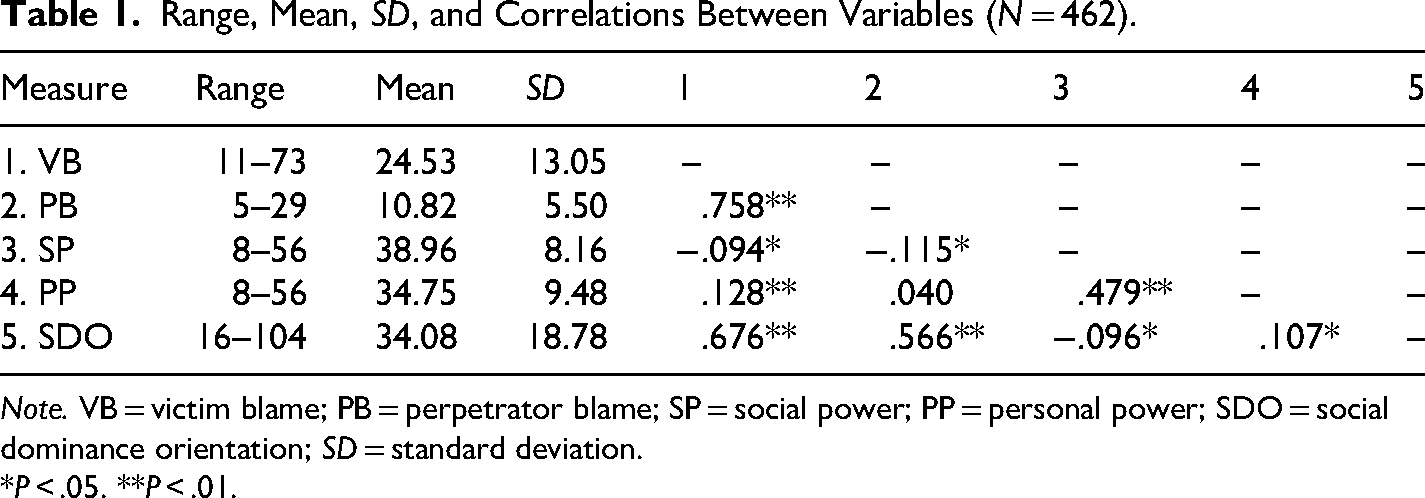
Note. VB = victim blame; PB = perpetrator blame; SP = social power; PP = personal power; SDO = social dominance orientation; SD = standard deviation.
*P < .05. **P < .01.
Correlational analyses showed a significant negative correlation between social power and both outcome variables of victim (r = −.094, P = .043) and perpetrator blame (r = −.115; P = .013). Victim blame was significantly positively correlated with personal power (r = .128, P = .006) and SDO (r = .676, P < .001), while perpetrator blame was significantly positively correlated with SDO (r = .566, P < .001). Additionally, a significant positive correlation was found between victim blame and perpetrator blame subscales (r = .758, P < .001), indicating that high levels of victim blame were associated with more favorable reactions towards the perpetrator.
To test Hypotheses 1 and 2, two hierarchical linear regressions were conducted. The overall regression model predicting victim blame was significant, explaining 52% of the variance in assignment of blame before adding the interaction terms, (F(9, 452) = 57.32, P < .001, Adj. R2 = .524; see Table 2). Sex assigned at birth significantly predicted victim blame in both steps of the model (β = 0.22, P < .001). Furthermore, the “both” category (i.e., knowing someone close who has experienced forced sexual contact and personally experiencing forced sexual contact) significantly predicted lower levels of victim blame in both steps (β = −0.13, P = .012). After controlling for sex assigned at birth and prior experiences of forced sexual contact, SDO significantly predicted victim blame (β = 0.58, P < .001), while social power (β = −0.06, P = .13) and personal power (β = 0.06, P = .12) were not significant predictors. The interaction terms (social power × SDO, personal power × SDO) were not significant.
Hierarchical Regression Analyses Predicting Victim Blame and Perpetrator Blame.
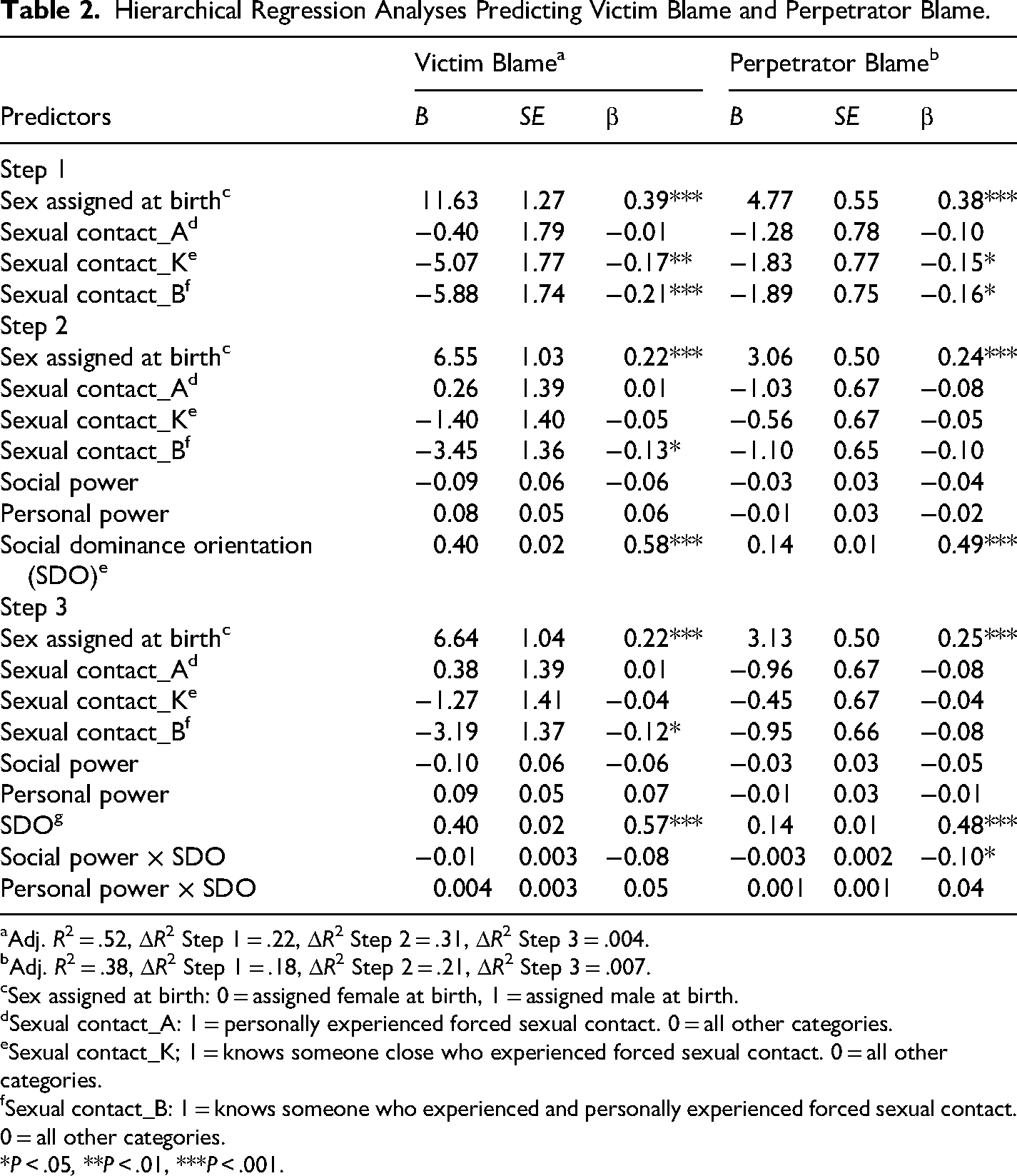
Adj. R2 = .52, ΔR2 Step 1 = .22, ΔR2 Step 2 = .31, ΔR2 Step 3 = .004.
Adj. R2 = .38, ΔR2 Step 1 = .18, ΔR2 Step 2 = .21, ΔR2 Step 3 = .007.
Sex assigned at birth: 0 = assigned female at birth, 1 = assigned male at birth.
Sexual contact_A: 1 = personally experienced forced sexual contact. 0 = all other categories.
Sexual contact_K; 1 = knows someone close who experienced forced sexual contact. 0 = all other categories.
Sexual contact_B: 1 = knows someone who experienced and personally experienced forced sexual contact. 0 = all other categories.
*P < .05, **P < .01, ***P < .001.
With regard to perpetrator blame, the overall regression model was significant, explaining 38% of the variance in assignment of blame before the interaction terms were added, (F(9, 452) = 32.97, P < .001, Adj. R2 = .384). In both steps of the model, sex assigned at birth was found to be a significant predictor of perpetrator blame (β = 0.24, P < .001); however, prior experiences of forced sexual contact were not significant in the second step. When controlling for sex assigned at birth and experiences of forced sexual contact, SDO significantly predicted perpetrator blame (β = 0.49, P < .001), but social power (β = −0.04, P = .30) and personal power (β = −0.02, P = .67) did not. The interaction terms (social power × SDO, personal power × SDO) did not significantly predict perpetrator blame.
Discussion
To better understand the influence of rape myths, this study sought to examine how power and SDO affect the manifestation of rape myths as measured by assignment of victim and perpetrator blame in sexual assault scenarios. Partially consistent with Hypothesis 1, higher levels of SDO predicted higher victim blame. However, contrary to predictions, personal power and social power were not significant predictors of victim blame, nor was the interaction between SDO and power. Hypothesis 2 regarding perpetrator blame was also partially confirmed, with lower levels of perpetrator blame predicted by higher levels of SDO. Contrary to predictions, personal and social power were not significant predictors of perpetrator blame, nor was the interaction between SDO and power.
Regarding the control variables, sex assigned at birth also significantly predicted victim blame and perpetrator blame, such that participants assigned male at birth were more likely to endorse higher levels of victim blame and lower levels of perpetrator blame. Lastly, regarding sexual contact variables, endorsement of prior unwanted sexual contact and knowing someone close had experienced unwanted sexual contact (i.e., the “both” category) significantly predicted lower levels of victim blame but not perpetrator blame.
Our results corroborate findings from other studies (e.g., Canto et al., 2021; Lambert & Raichle, 2000), demonstrating that SDO predicts greater blame towards a female victim and reduced blame towards a male perpetrator, which we interpret as indicative of the endorsement of rape myth stereotypes. Previous studies have found that victim blame and the application of rape myths can vary based on the motivations associated with the SDO personality disposition and its related traits (Canto et al., 2021; Chapleau & Oswald, 2013). Our study adds to the literature by examining perpetrator blame in addition to victim blame and utilizing the updated SDO7 scale (Ho et al., 2015). The changed wording on the SDO7 addresses confounds present in previous iterations of the measure, ensuring that the measure evaluates a preference for inequality amongst groups rather than a preference for domination of one's in-group (Ho et al., 2015).
Our results also show that differences in the outcome variables are significantly predicted by sex assigned at birth: males endorsed greater levels of female victim blame and lower levels of male perpetrator blame, demonstrating higher endorsement of rape myths in judging the scenario. These results align with some findings that male gender, which may differ from sex assigned at birth, is associated with assignment of greater victim blame and endorsement of both male and female rape myths (Angelone et al., 2021; Gravelin et al., 2019; Suarez & Gadalla, 2010). Our findings add to current literature by investigating perpetrator blame, which is understudied compared to victim blame, and utilizing a community sample, thus augmenting the existing literature as most samples are from student populations (e.g., Suarez & Gadalla, 2010).
Contrary to our predictions, personal and social power were not significant predictors of perpetrator or victim blame. Our results may have been influenced by our decision to measure power rather than prime power (e.g., Lammers et al., 2009). Although some research suggests that measuring power can serve as a power prime, and manipulation of power engenders the same results as measuring power (e.g., Anderson & Galinsky, 2006; Lammers et al., 2009; Sturm & Antonakis, 2015), our method did not allow for direct manipulation of participants into low, neutral, or high-power conditions. Indeed, the mean levels of social and personal power in our study fell within the middle of the range of possible values. Therefore, SDO may have been a significant predictor of assignment of blame in comparison to the power variables because the power measures may not have primed a feeling of power within participants. Furthermore, because all participants were given both power measures and the measures referred to a person's overall sense of power, this may not have allowed for a nuanced approach that represents how perception of power fluctuates and manifests in context-dependent ways, or how type of power produces different behaviors and cognitions. Rather, participants read a sexual assault scenario that activated rape myth stereotypes and, in the presence of an ambiguous power context, applied those stereotypes in alignment with their level of SDO.
Several complementary findings from previous research support this supposition. While manipulating participants to feel a sense of low power may moderate the influence of temperament (e.g., Cho & Keltner, 2020), ambiguous or neutral power situations engender the use of stereotypes in alignment with one's disposition and associated goals or motivations (Goodwin et al., 2000). Consistent with this view, research suggests that the effect of power on cognition depends in part on motivational orientation and whether the context elicits careful individuation versus automatic, schema-consistent processing (Chen et al., 2001). Furthermore, the one study we found that examined the impact of power manipulations on assignment of victim blame found no differences between the neutral and high power conditions in terms of blame levels (Gravelin et al., 2017), suggesting that neutral power contexts, such as that of the present study, may not sufficiently activate power-based cognitions. Relatedly, work on stereotyping indicates that stereotype-congruent interpretations are cognitively efficient and readily applied when situational information is ambiguous, thereby shaping meaning-making processes (Mari & Müller, 2023). Accordingly, in the absence of salient power cues, participants may have relied more heavily on dispositional cognitive frameworks to guide attributional judgments. Thus, our study adds to this literature by suggesting that higher SDO facilitated greater application of rape myth stereotypes in an ambiguous or neutral power context, rendering generalized perceptions of power less influential than default cognitive schemas in shaping interpretations of the vignette.
Lastly, the sexual contact “both” category significantly predicted lower victim blame in both steps of the model but was no longer a significant predictor of perpetrator blame with the addition of SDO. In terms of the “both” variable, our findings build upon other research as we were not able to identify any studies that combined these experiences into one variable. To our knowledge, only one study (e.g., Strickler et al., 2023), which solely sampled women, examined these sexual contact variables in conjunction with SDO to examine victim and perpetrator blame. Strickler et al. (2023) measured the sexual contact variables separately (i.e., only used the categories of experiencing or knowing someone, but not both), and, consistent with our results, did not find that either category on its own significantly predicted blame after inclusion of SDO. This further suggests that ideological dispositions play a central role in blame judgments, reflecting the use of rape myth stereotypes to legitimize and reinforce existing social hierarchies.
Moderation was not supported for either hypothesis as the interaction terms (social power × SDO, personal power × SDO) did not significantly predict victim or perpetrator blame. Results may not have been significant due to the previously noted limitations regarding the power variables and the associated non-significant findings. Additionally, the inclusion of four additional predictor variables (i.e., sex assigned at birth and the sexual contact variables) decreased the likelihood of detecting significance for each effect.
Collectively, this study advances theory on rape myth endorsement and blame attribution by highlighting the central role of SDO as an ideological mechanism through which rape myth stereotypes are expressed. While prior research has linked rape myth endorsement to gender and individual experiences of sexual violence, the present findings suggest that dispositional preferences for hierarchy and inequality may more consistently shape endorsement of rape myth stereotypes, as measured by victim and perpetrator blame, than either demographic characteristics or generalized perceptions of power, particularly in the absence of salient power cues (Chapleau & Oswald, 2013; Wilson & Newins, 2023). By demonstrating that SDO predicts both greater victim blame and reduced perpetrator blame, even when accounting for sex assigned at birth and knowledge of or personal experience with victimization, this study supports a framework in which rape myths function as system-legitimizing tools rather than solely as expressions of misinformation or individual prejudice. These results help explain why interventions that focus narrowly on bystander interventions, attitude change, or rape-specific knowledge may yield limited long-term effects and underscore the importance of targeting broader hierarchy-enhancing belief systems as captured by SDO (Anderson & Whiston, 2005; Kettrey et al., 2019). In doing so, this work reframes rape myth endorsement as an outcome of ideological commitment to social inequality, offering a more integrative account of how rape-supportive beliefs persist across contexts and populations.
Clinical Implications
The results of this study add to the ongoing conversation regarding efforts to better assist survivors of assault and reduce the prevalence of sexual violence. Scholars have begun to posit that a broad array of factors contributes to a culture supportive of rape, and these factors need to be targeted to obtain demonstrable, long-term results (Angelone et al., 2021). Examples of these factors include hostile and benevolent sexism; adherence to traditional gender roles and belief in inherent and “natural” differences among sexes (i.e., gender ideology); and other stereotypical beliefs such as heterosexism, racism, ageism, and classism (Angelone et al., 2021; Suarez & Gadalla, 2010; Walfield, 2021; Wilson & Newins, 2023). As stated, these types of beliefs can be seen as reflecting the goals and motivations associated with SDO. Therefore, our study's findings underscore the importance of ensuring that sexual assault response and prevention initiatives include interventions aimed at elucidating and addressing the function and underlying elements of rape myths.
In individual interventions with survivors, clinicians should assess the extent to which patients endorse rape myths and related stereotypes, such as sexism and heterosexism, as these beliefs may shape survivors’ self-appraisals and how they view the responses they receive from others (Chapleau & Oswald, 2013; St. George, 2022; Suarez & Gadalla, 2010; Wilson & Newins, 2023). When rape myths function as ideologically grounded cognitive schemas, survivors may internalize narratives that increase self-blame or minimize the harm experienced from sexual violence, particularly when experiences are interpreted through system-legitimizing frameworks that assign reduced blame to perpetrators and increased blame to victims (Suarez & Gadalla, 2010; Ullman et al., 2020; Wilson & Newins, 2023). Assessing these beliefs can inform treatment planning and support interventions that explicitly target cognitions related to rape myths and other stereotypes, such as cognitive restructuring, to help survivors challenge beliefs rooted in broader ideological assumptions rather than personal responsibility (Resick et al., 2017; Vonderhaar & Carmody, 2015).
Likewise, the present findings align with research demonstrating that rape myths and related biases can shape professional judgments in healthcare, forensic, and legal contexts, sometimes resulting in minimization of harm or inadvertent victim blaming (Holland et al., 2020; Suarez & Gadalla, 2010). Accordingly, these results underscore the importance of clinician awareness of their own ideological assumptions and implicit biases, both to better support survivor recovery by reducing internalized blame and to advocate for practices that resist hierarchy-enhancing interpretations of sexual violence. With respect to prevention efforts on college campuses, one such intervention that may be useful is intergroup dialogue, a practice shown to reduce prejudice through facilitated conversation among individuals from different social groups by fostering empathy, enhancing awareness of similarities and differences between members, and cultivating collaboration to address social inequality (Allport, 1954; Pettigrew et al., 2011). This type of intervention, which targets a wide range of sociocultural attitudes, may be more effective in creating systemic, long-lasting change in comparison to programs that solely focus on rape-specific attitudes and behaviors (Angelone et al., 2021; Suarez & Gadalla, 2010).
Limitations and Future Directions
A few limitations should be considered when interpreting these results. First, as stated previously, our results may have been impacted by measuring rather than priming power and administering both social and personal power measures to all participants. The use of both power measures in our study may have activated the general sense of power paradigm and therefore precluded our ability to assess each type of power directly and specifically. Thus, future studies should consider replicating this study and priming one type of power to allow researchers to capture the magnitude of felt power and facilitate individualized evaluation of power type. Additionally, inducing different levels of felt power would assist in determining whether the influence of SDO fluctuates across different situations, that is, when experiencing low, neutral, or high power, as posited by numerous authors (Cho & Keltner, 2020).
Second, although research suggests that rape myths about male and female victims and perpetrators include assumptions about sexuality and operate in the same manner to mitigate perpetrator blame and amplify victim culpability (Walfield, 2021), studies also show that levels of blame can vary based on the characteristics of the respondent, the individuals within the scenario, and the scenario itself (Ayala et al., 2018; Gravelin et al., 2019). Thus, these results may not be applicable to scenarios in which the victim and perpetrator gender or sexual orientation differ from the current study, or in cases that describe stranger rape. Furthermore, though not stated explicitly, the individuals in our scenario are likely assumed to be cisgender by the participants; thus, results may not be applicable to scenarios describing transgender individuals.
Relatedly, the present sample included a slightly higher proportion of participants identifying as gay, lesbian, bisexual, or queer (19%), which may influence the generalizability of findings to populations with different sexual-orientation distributions. Prior research indicates that sexual minority status is often associated with lower rape myth acceptance and reduced victim blaming (Worthen, 2021). In addition, research examining gender identity and trans status suggests that heightened perceived vulnerability and in-group identification among sexual and gender minority individuals may increase empathy for victims and reduce blame attribution (Diamond-Welch [et al.] et al. 2021). Accordingly, the greater representation of queer participants in the current study may have contributed to lower overall levels of blame. However, SDO remained a robust predictor of both victim and perpetrator blame within this sample, suggesting that hierarchy-enhancing ideological beliefs exert a strong influence on rape-related judgments beyond demographic or identity-based factors.
Future studies should therefore examine whether variations in the characteristics of the scenario and the respondent produce different outcomes. For example, recruitment primarily occurred through social media platforms such as Facebook, Instagram, and Reddit, thus excluding individuals who lacked internet access or did not engage in social media. Therefore, individuals who met study criteria may have been excluded due to these factors. We also did not indicate that participation was limited to individuals in the United States, and therefore it is possible that some participants were international and their rape-related attitudes and interpretation of the vignette may have differed depending on the national context.
Similarly, it is necessary to consider the extent to which social desirability contributed to responses on the outcome measures. Average level of victim blame appeared to be on the lower end of the scale (M = 24.53, range = 11–73), as did perpetrator blame (M = 10.82, range = 5–29). A previous study found that social desirability (i.e., the degree to which participants sought approval) significantly predicted rape myth acceptance and endorsement of sexist beliefs (Hockett et al., 2009). Indeed, other scholars acknowledge the challenge of assessing these paradigms due to the heightened awareness of the social undesirability of such attitudes and have worked to construct more subtle measures that enable accurate assessment of rape myth beliefs (e.g., Gerger et al., 2007). As such, it is necessary to consider how the face-valid nature of our outcome measures may have produced a similar phenomenon.
Conclusion
Scholars point to rape myth acceptance as a significant factor in the perpetuation of sexual assault by shaping a culture that assigns blame to victims, exonerates perpetrators, and minimizes the occurrence of rape. This study investigated the influence of perception of power, SDO, sex assigned at birth, and victimization history on assignment of blame to further explore aspects related to the application of rape myths. We identified a relationship between SDO, sex assigned at birth, victimization history, and levels of blame, with results indicating that SDO was the strongest predictor of greater victim blame and lower perpetrator blame. Hence, SDO is strongly implicated in upholding and perpetuating rape myths. These findings highlight the importance of exploring the mechanisms by which rape myths influence the assignment of blame in sexual assault scenarios. By doing so, we gain insight into how SDO influences the use of stereotypes to contribute to a rape-tolerant culture, thus better informing strategies that seek to combat sexual violence and support survivors.
Footnotes
Author Note
Lynsey A. Hinnenkamp is now at Bryant West Psychology.
This article is based on the dissertation completed by the first author (Hinnenkamp). The authors have no conflicts of interest to disclose.

Funding
The authors received no financial support for the research, authorship, and/or publication of this article.
Declaration of Conflicting Interests
The authors declared no potential conflicts of interest with respect to the research, authorship, and/or publication of this article.