






Abstract
This study examines intimate partner violence (IPV) victimization among second-generation immigrant women in Australia using a nationally representative dataset. It compares their experiences with those of nonimmigrant women and investigates whether IPV victimization is higher among women whose parents originate from countries with greater structural gender inequality, measured by the Gender Inequality Index. The findings reveal that second-generation immigrant women face a higher risk of IPV than nonimmigrant women. Women whose parents originate from countries with higher levels of structural gender inequality are more likely to experience IPV. These results underscore the importance of culturally responsive prevention and intervention strategies.
Keywords
Introduction
Decades of feminist research have shown gender inequality to be a significant factor in male-perpetrated intimate partner violence (IPV) and women's vulnerability to such violence (Dobash & Dobash, 1992; Heise & Kotsadam, 2015; Johnson et al., 2024). Scholarship further suggested that IPV is not simply an individual or relational problem but is also shaped by broader systems of gendered power operating across families, institutions, and social contexts (Webster et al., 2021). From this perspective, violence in intimate relationships is embedded within wider social structures that shape gender relations. At the same time, it is important to recognize that gender inequality is not exclusive to particular societies or cultural backgrounds; rather, it manifests in diverse forms across both immigrant and non-immigrant contexts. Although this body of research has advanced understanding of the IPV, less is known about how gender inequality intersects with immigration and generational position to shape the IPV victimization experiences of second-generation immigrant women. Second-generation immigrants—individuals born in the host country with at least one parent born overseas (Rumbaut, 2004)—occupy a distinct social position shaped by gender relations and immigration histories within broader social contexts.
Importantly, second-generation immigrants are not a homogeneous group, as they encompass diverse social backgrounds and immigration experiences. Research suggests that second-generation immigrants may experience elevated levels of interpersonal victimization compared with their first-generation counterparts (Curry et al., 2018; Johnson, 2005). Young people in immigrant families may be influenced by norms and expectations linked both to their parents’ country of origin and to the broader context in the host country, which may shape understandings of identity, autonomy, and gender roles (Giguère et al., 2010; Ragavan et al., 2021). From a cultural transmission perspective, these influences may be conveyed across generations through family socialization and reinforced, modified, or challenged through interactions with peers, communities, and broader institutional contexts (Bisin & Verdier, 2011). This is particularly relevant when considering gender inequality at the country level, as political, social, and institutional conditions may shape the development of gendered norms. Drawing on an intersectional perspective (Crenshaw, 1991), this study considers second-generation women's IPV experiences as shaped not only by interpersonal dynamics but also by the wider social contexts in which relationships are formed. From this perspective, second-generation women's experiences are understood in relation to structural conditions rather than as products of individual or cultural characteristics alone.
Given its multicultural population, Australia serves as the setting for the current study. Australia has one of the highest concentrations of immigrants globally (United Nations Department of Economic and Social Affairs, 2021). Nearly half of the population (48.2%) are second-generation immigrants. Despite this significant immigrant presence, research on IPV among second-generation immigrant women in Australia remains limited (Vaughan et al., 2016). More broadly, relatively little empirical work has examined how structural gender inequality intersects with immigration histories and generational status in shaping vulnerability to IPV.
This study aims to ascertain the prevalence of IPV victimization among second-generation immigrant female adolescents, compared to their nonimmigrant counterparts, in Australia. Moreover, it seeks to examine whether IPV victimization among second-generation immigrants is associated with the level of structural gender inequality in their parents’ countries of origin. The study draws on two unique data sources: a nationally representative dataset held by the Australian Institute of Family Studies and the Gender Inequality Index (GII) developed by the United Nations Development Programme (2010), which captures structural gender inequality at the societal level.
Review of Literature
IPV Victimization Among Immigrant Women
Research on IPV among immigrants is still emerging (Vaughan et al., 2016), underscoring the need for more comprehensive exploration. This area of study is particularly important given the wide range of IPV victimization estimates reported among immigrant women, with prevalence rates varying from 17% to 70.5%, according to studies conducted in Europe and North America (Gonçalves & Matos, 2016). Despite this variability, existing research consistently indicates that immigrant women may be more likely to experience IPV than their nonimmigrant counterparts (Park et al., 2021; Vives-Cases et al., 2010). For example, a cross-sectional study in Spain involving 10,048 women aged 18–70 receiving primary health care revealed that, even after controlling for sociodemographic and social support factors, immigrant women were more likely than their native counterparts to experience IPV (Vives-Cases et al., 2010). Similarly, a Canadian study that retrospectively reviewed immigrant women's interactions with social workers at a nonprofit organization over a 9-year period (2006–2014) found that immigrants with permanent residency had a 1.37 times higher risk of reporting IPV compared to nonimmigrants (Park et al., 2021). These findings suggest that immigrant women may face elevated IPV risks across diverse contexts, highlighting the importance of further research.
Within the Australian context, research examining IPV among immigrant women remains limited. Australian inquiries into domestic and family violence have noted that immigrant and refugee women may have distinct vulnerabilities and support needs (Special Taskforce on Domestic and Family Violence in Queensland, 2015; Royal Commission into Family Violence, 2016). Much of the Australian literature has focused on domestic and family violence more broadly, rather than IPV specifically, with attention to service access and help-seeking pathways (Ghafournia & Easteal, 2021; Jelinic, 2021; Satyen et al., 2018; Segrave, 2017).
Empirical studies that explicitly examine IPV prevalence among immigrant women in Australia are relatively few. A survey of 130 immigrant women originating from diverse countries and regions highlighted that more than half experienced some form of IPV; verbal and emotional abuse were the most common, followed by physical, psychological, and financial abuse (Satyen et al., 2018). Studies that directly compare IPV prevalence between immigrant and nonimmigrant women have produced mixed findings. For instance, a survey of 1,392 immigrant and refugee women with varying immigration statuses revealed that women holding permanent visas were 6% more likely to experience physical and sexual violence compared to Australian citizens (Segrave et al., 2021). In contrast, a study involving 677 women aged 19–65 identified no significant differences in IPV prevalence between immigrant and nonimmigrant women (Satyen et al., 2021). These inconsistent findings underscore the value of qualitative research for understanding the social and relational contexts in which IPV occurs. Semi-structured interviews with nine first-generation Chinese immigrant women indicated that patriarchal norms and gender roles may be mobilized as mechanisms of coercive control, and at the same time be reshaped through direct contact with the political and social context of the host country (Louie & Vasil, 2025). This emphasizes the importance of situating IPV within broader structural contexts, rather than attributing risk to cultural background.
One limitation of existing research is the lack of focus on second-generation immigrant women. Much of the literature has concentrated on first-generation immigrants or treated immigrants as a broad group. This distinction matters because first- and second-generation immigrants often differ in their immigration pathways, socialization contexts, and level of exposure to the host country's social and political environment; these factors may shape their experiences of intimate relationships. Growing evidence suggests second-generation immigrants may be even more vulnerable to interpersonal violence. Studies have shown that second-generation immigrants are more likely to experience various forms of violence compared to their first-generation counterparts. For example, a study using a large random sample of 979 adults living in Texas found that second-generation immigrants were at a higher risk of experiencing family violence than first-generation immigrants (Curry et al., 2018). In Australia, this pattern is similarly observed. A study specifically identifying interpersonal victimization among second-generation immigrants found that they had an elevated risk compared to first-generation immigrants (Johnson, 2005). Despite these findings, few studies have examined IPV victimization among second-generation female immigrants, particularly when compared to nonimmigrant females.
Gender Inequality and Female IPV Victimization
Understanding the vulnerabilities of second-generation immigrant women to IPV requires examining the broader social and structural context in which gendered power relations are formed and maintained. Central to this context is gender inequality, which feminist scholars have long identified as a fundamental driver of IPV victimization (Dobash & Dobash, 1992; Heise & Kotsadam, 2015; Johnson et al., 2024). Gender inequality is rooted in patriarchal systems that endorse male privilege and perpetuate male dominance (Dobash & Dobash, 1979). In this framework, interpersonal violence, particularly IPV, is viewed as a manifestation of the patriarchal societal system where male dominance and female subjugation foster conditions that lead to violence in intimate relationships (Dobash & Dobash, 1992). Patriarchy and gender inequality manifest in various forms, including women's limited involvement in decision-making, disproportionate burden of unpaid care work, unfair working conditions, and culturally defined gender stereotypes dictating roles for men and women (United Nations Educational, Scientific and Cultural Organization, 2014).
Recent research and prevention frameworks have specified how gender inequality operates across multiple levels of society. An Australian framework, Change the Story, conceptualizes violence against women as both a cause and a consequence of gender inequality and identifies key gendered drivers of this violence, which include the normalization of violence against women and gendered power imbalances that limit women's autonomy and decision-making (Our Watch, 2021). Importantly, the framework states that factors associated with higher levels of violence against women are evident across societal, institutional, community, and individual/relationship contexts rather than a single or isolated factor (Our Watch, 2021).
Empirical research provides robust support for the association between societal-level gender inequality and women's vulnerability to IPV victimization, reinforcing the importance of situating this issue within broader structural contexts. For instance, a cross-national analysis of gender-related factors contributing to IPV against women, which included responses from 40,457 women aged 18–74 across the European Union. The study found that women residing in countries with stronger societal endorsement of gender unequal beliefs were more likely to experience IPV, whereas residence in nations with greater societal endorsement of gender equality was associated with lower IPV prevalence (Zapata-Calvente et al., 2019). Similarly, cross-national research has demonstrated that higher levels of gender inequality at the country level, operating through societal norms and institutional arrangements, are associated with greater societal acceptance of IPV (Hayes & Boyd, 2017). Extending this evidence to sub-national context, research in Indian communities revealed that higher rates of spousal violence against women have been observed in areas where both men and women are more likely to endorse norms justifying wife beating (Ahmad et al., 2021).
An intersectional perspective further strengthens this structural framing by recognizing that gender does not operate in isolation but intersects with other forms of disadvantage across structural, political, and cultural levels to produce distinct patterns of vulnerabilities (Crenshaw, 1991). Applied to the present study, rather than viewing gender inequality or immigration background in isolation, intersectionality highlights how multiple social positions, such as gender, generational status, and political and economic context, intersect to shape women's experiences. While the analysis does not examine all intersecting factors explicitly, the intersectional framework informs the interpretation of findings by recognizing the complexity of women's social locations and the broader social context within which gender norms and relationship expectations may emerge.
While second-generation immigrants are embedded within the social context of the host country, existing research suggests that intergenerational influences may continue to shape their experiences (Friberg & Jahanlu, 2024; Kretschmer, 2018; Röder & Mühlau, 2014). Cultural transmission theory provides a framework for understanding how social norms and values, including those related to gender relations, are conveyed across generations through family socialization, community interactions, and exposure to peers and broader social environments (Bisin & Verdier, 2011). Research on cultural transmission emphasizes that intergenerational influence is shaped by social context rather than operating as a simple inheritance. Parental socialization efforts interact with broader environments such as schools, peer networks, and labor markets, influencing how gender norms may be selectively maintained, adapted, or transformed across social contexts (Bisin & Verdier, 2011; Röder & Mühlau, 2014).
At the level of family socialization, parents act as key socializing agents, shaping children's understandings of gender roles, expectations, and acceptable behaviors through everyday practices, role modelling, and explicit instruction (Bisin & Verdier, 2011). Parental socialization efforts may vary depending on the surrounding normative environment, with greater emphasis placed on transmitting particular norms when they differ from or are less prevalent in the broader social context (Bisin & Verdier, 2011). At the same time, the transmission of gender norms occurs alongside exposure to institutional environments of the host country. As a result, second-generation individuals often navigate multiple normative environments regarding gender relations (Portes et al., 2009; Röder & Mühlau, 2014).
Research provides support for these intergenerational socialization processes, indicating that parental gender ideologies may shape their children's gender-related beliefs (Apgar & McManus, 2019). For instance, an analysis of 1995–2015 U.S. population survey data found that stronger societal endorsement of male dominance and patriarchal institutional arrangements in parents’ countries of origin were associated with lower labor force participation among second-generation women (Apgar & McManus, 2019). Research suggested that gender attitudes among second-generation youth often reflect both continuity with norms of parents’ country of origin and adaptation to norms and expectations of the host society (Kretschmer, 2018; Röder & Mühlau, 2014). This literature also highlighted heterogeneity across families and social contexts, with variation in gender attitudes linked to differences in education and institutional exposure in the host country (Röder & Mühlau, 2014).
While gender inequality and intergenerational transmission help explain the persistence of unequal gender relations, exposure to gender-equal norms may coexist with resistance within families or communities. This highlights the need to consider backlash as a response to gender equality. Backlash has been conceptualized as reactionary responses that arise in opposition to advances in gender equality, seeking to reassert traditional gender norms and power relations (Faludi, 1991). Such responses may be expressed overtly through opposition to equality initiatives, or more subtly through denial of inequality or resistance to change. Backlash is often rooted in the defense of existing privilege, particularly when gender equality gains are perceived as a threat to established hierarchies (Flood et al., 2018). A survey using nationally representative data in Australia indicated that violations of the male breadwinner gender norm are associated with increased IPV against women. When women earn more than their male partners, they were approximately 35% more likely to experience IPV compared to women who earn less than their partners (Zhang & Breunig, 2021). This pattern was also evident in data from the European Union Agency for Fundamental Rights survey among 28 European Union member states. Countries such as Denmark, Finland, and Sweden, which have the highest level of gender equality as measured by the Gender Equality Index (European Institute for Gender Equality, 2012), reported higher than the European Union average IPV prevalence rate (European Union Agency for Fundamental Rights, 2014). These findings underscore that disruptions to traditional gender norms may trigger backlash dynamics that contribute to heightened IPV risk for women.
Taken together, this literature suggests that gender inequality associated with parents’ countries of origin operates as a broader contextual influence on second-generation immigrant women's experiences. This framing recognizes intergenerational influence while allowing for diversity and change and supports examination of how structural gender inequality may be associated with IPV victimization among second-generation women.
Knowledge Gaps and Study Focus
There remains a significant gap in the literature regarding the extent of IPV victimization among second-generation female immigrants, particularly in comparison with nonimmigrant women. Addressing this gap is important for developing targeted interventions and support systems that meet their needs. Furthermore, little is known about the extent to which structural gender inequality in the parents’ country of origin is associated with IPV victimization among second-generation immigrant women. A better understanding of this relationship may help inform interventions that are responsive to the broader social conditions affecting this population. Without such understanding, efforts to prevent and address IPV may be less effective and may overlook the social and structural dynamics that contribute to women's vulnerability. To bridge these knowledge gaps, this study addresses the following research questions: (1) Are second-generation female immigrants in Australia more likely to experience IPV than nonimmigrant? and (2) Are females whose parents come from countries with higher levels of structural gender inequality more likely to experience IPV victimization than those whose parents come from countries with lower levels of structural gender inequality?
Methodology
Sample
This study used secondary data from the Longitudinal Study of Australian Children (LSAC; Mohal et al., 2020). LSAC participants were recruited using probability sampling. A sample of children was selected randomly from the publicly funded universal health care insurance scheme database (“Medicare”), which is the most complete database of the Australian population. Approximately 300 postcodes were randomly selected nationwide, and the sample was stratified by state. The sample provides a nationally representative snapshot of Australian children (citizens and permanent residents). Parents could opt out of the study before the data collection. The first wave of data collection was conducted in 2003–2004; participants were subsequently followed at 2-year intervals. Study participants included children, their parents, childcare providers, and teachers. Data collection methods involved face-to-face interviews, questionnaires, observations, and direct assessment. Most of the data were collected by the Australian Bureau of Statistics. LSAC data are available to researchers through an application process. The data are provided in deidentified form.
The present study used data from children aged 4–5 at the first wave of data collection in 2003–2004. Data are drawn from wave eight of the LSAC study, collected in 2019; these participants were aged 18–19 at the time of the survey, which falls between adolescence and young adulthood; however, given the reporting period for the dependent variable, we classified them as adolescents. The study focused on female participants who responded to IPV-related questions and had ever had a romantic partner (n = 913). Considering the study's emphasis on second-generation immigrants, 18 first-generation immigrant participants (not born in Australia) were excluded from the final sample, resulting in a sample of 895. Of these, 82 had data missing for one or more variables. Independent samples t-tests and chi-square tests were conducted to examine variables associated with missingness. The analysis revealed that the only variable associated with missingness was neighborhood-level socioeconomic disadvantage. Participants missing any data were significantly more likely to live in socioeconomically disadvantaged areas, t(891) = −2.69, p = .007. Missing values were not imputed, and listwise deletion was used. As a result, the final dataset for analysis consisted of 813 female adolescents aged 18–19. The [Griffith University] Human Research Committee granted ethics approval.
Measures
IPV Victimization
IPV victimization was measured using a 15-item scale adapted from the Composite Abuse Scale Revised-Short Form (Ford-Gilboe et al., 2016). Participants were asked about their experiences of physical, sexual, and emotional violence by their current or former partner(s) in the 12 months preceding the survey. Frequency of victimization was measured on a 6-point scale ranging from 1 (not in the past 12 months) to 6 (daily and almost daily). The items were combined into a summative scale (α = .91). The median for the scale was 0, the mean was 0.12, and the 95th percentile was at .66, suggesting that most responses were concentrated between never and once. Notably, for 11 out of the 15 items, at least 95% of respondents answered experiencing IPV either once or never. Due to skewness, the scale was recoded into a dichotomous measure (1 = IPV victimization; 0 = no IPV victimization). Of the participants, 27.8% reported experiencing some form of IPV.
Second-Generation Immigrant Status
Second-generation immigration status was defined based on parents’ country of birth. Information on the mother's and father's country of birth was derived from wave one face-to-face interviews where household and family demographics were collected. This process resulted in a compilation of 35 countries and territories for mothers and 39 for fathers. The most common country of origin was Australia (83.83% of mothers and 80.63% of fathers), followed by the United Kingdom (5.10% of mothers and 7.55% of fathers), New Zealand (1.62% of mothers and 2.34% of fathers), and China (1.00% of mothers and 0.69% of fathers). Subsequently, a dichotomous variable was computed, where at least one parent was born overseas (1 = second-generation immigrants; 0 = nonimmigrants).
Gender Inequality in Parents’ Country of Origin
Gender inequality was assessed using GII, which was conceptualized in this study as an indicator of structural gender inequality. The GII is a comprehensive composite measure developed by the United Nations Development Programme (2010) that has previously been used in IPV research (Gressard et al., 2015). The GII encompasses three dimensions: reproductive health, empowerment, and the labor market. This index compares gender disparities at the country level, evaluating the differences between males and females as collective groups. GII rankings reflect the extent to which disadvantages across these dimensions overlap. It is one of the most widely used measures of gender inequality with data available for most countries, making it preferable to other indices, such as the Gender Social Norm Index, which covers only 75 countries (United Nations Development Programme, 2010). In 2021, Denmark was on top of the GII ranking, while Yemen had the highest disparity and ranked at 170th place (United Nations Development Programme, 2022). Among the countries where participants’ parents were born, Switzerland was ranked third on GII, representing the highest level of gender equality in the sample, while Papua New Guinea ranked 169th, reflecting the lowest level. Australia ranked 19th, highlighting its relatively high level of gender equality compared to most countries worldwide. Among participants, only 1% of mothers were from Switzerland, Singapore, Italy, and Canada combined, while 1.38% of fathers were from Singapore, the Netherlands, Italy, and Canada combined—countries that ranked higher than Australia individually (United Nations Development Programme, 2022). For this study, GII ranks were the average of the GII ranks of mothers’ and fathers’ country of origin when both were available. For countries lacking individual GII ranks, such as the former Yugoslavia (n = 4), Hong Kong (n = 3), and Taiwan (n = 1), alternative methods were employed. The GII rank for Yugoslavia was substituted with the mean ranks of its former republics: Bosnia, Croatia, Serbia, North Macedonia, Montenegro, and Slovenia. Regarding Hong Kong and Taiwan, Singapore's GII rank was used as a proxy. This decision was made after consulting an alternative index, namely the Women Peace and Security Index (WPS: Georgetown Institute for Women Peace and Security, 2024). The WPS Index scores are as follows: Hong Kong 0.81, Taiwan 0.82, and Singapore 0.88. Given the close similarity between the scores, the use of Singapore's GII rank as a proxy was considered appropriate.
Control Variables: Neighborhood Characteristics
Control Variables: Individual Characteristics
Data Analysis
Binary logistic regression analyses to examine predictors of IPV victimization were conducted using IBM SPSS v29. The first set of analyses examined immigrant status as a predictor variable, while the second set of analyses focused on gender inequality as a predictor variable. Each of these analyses involved three stages. The first stage included only the dependent variable and the outcome variable. In the second stage, neighborhood variables were added, including relative socioeconomic disadvantage decile of the participant's SA2, the percentage of Australian-born individuals in the participant's SA2, and the percentage of people who speak English only in their homes in the participant's SA2. The third stage added individual characteristics including psychological distress, social support, antisocial behavior, alcohol consumption, and mother's education. Model fit was assessed using several measures, including Nagelkerke's R2, Model χ2, and the Model Prediction Rate.
Results
Descriptive Statistics and Bivariate Correlations
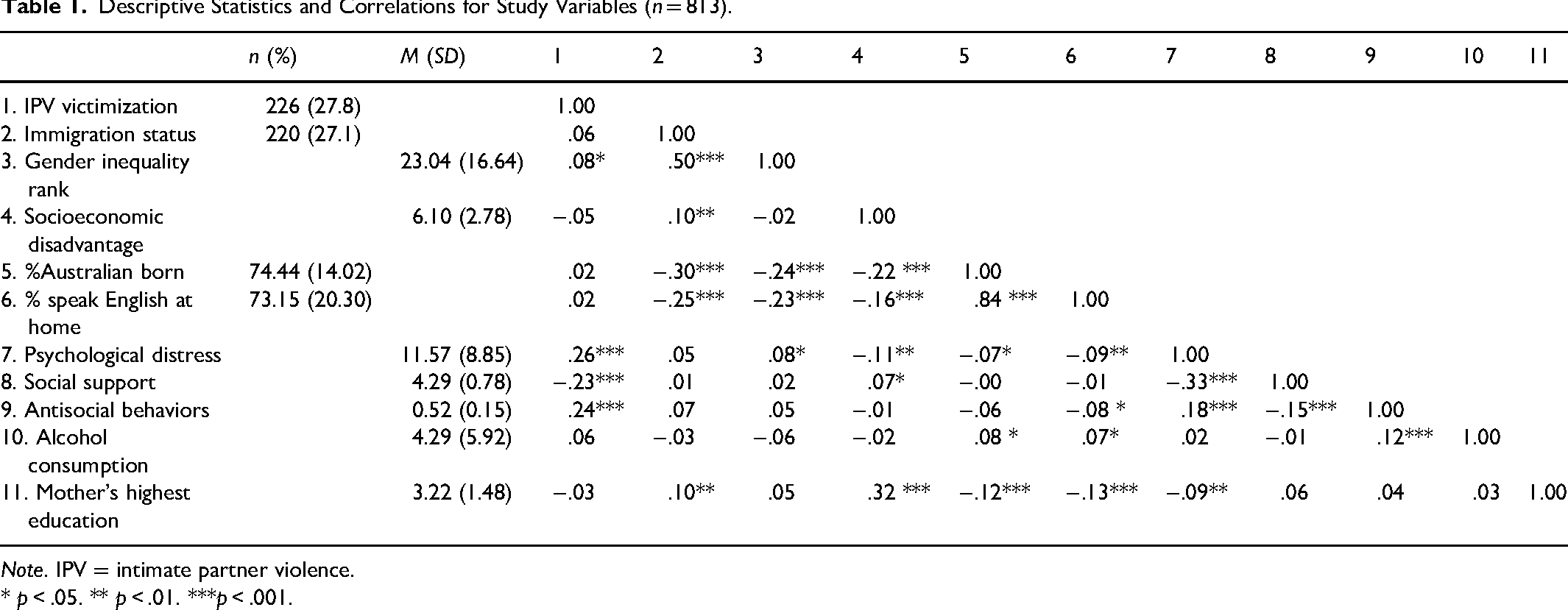
Of the sample, 27.8% had experienced IPV victimization, and 27.1% were second-generation immigrants who had at least one parent born overseas. The GII ranks ranged from 7 to 145. GII displayed a highly skewed distribution, primarily as a result of the majority of participants with parents born in countries characterized by low GII ranks (Table 1).
Descriptive Statistics and Correlations for Study Variables (n = 813).
Note. IPV = intimate partner violence.
* p < .05. ** p < .01. ***p < .001.
RQ1: IPV Victimization and Second-Generation Immigration Status
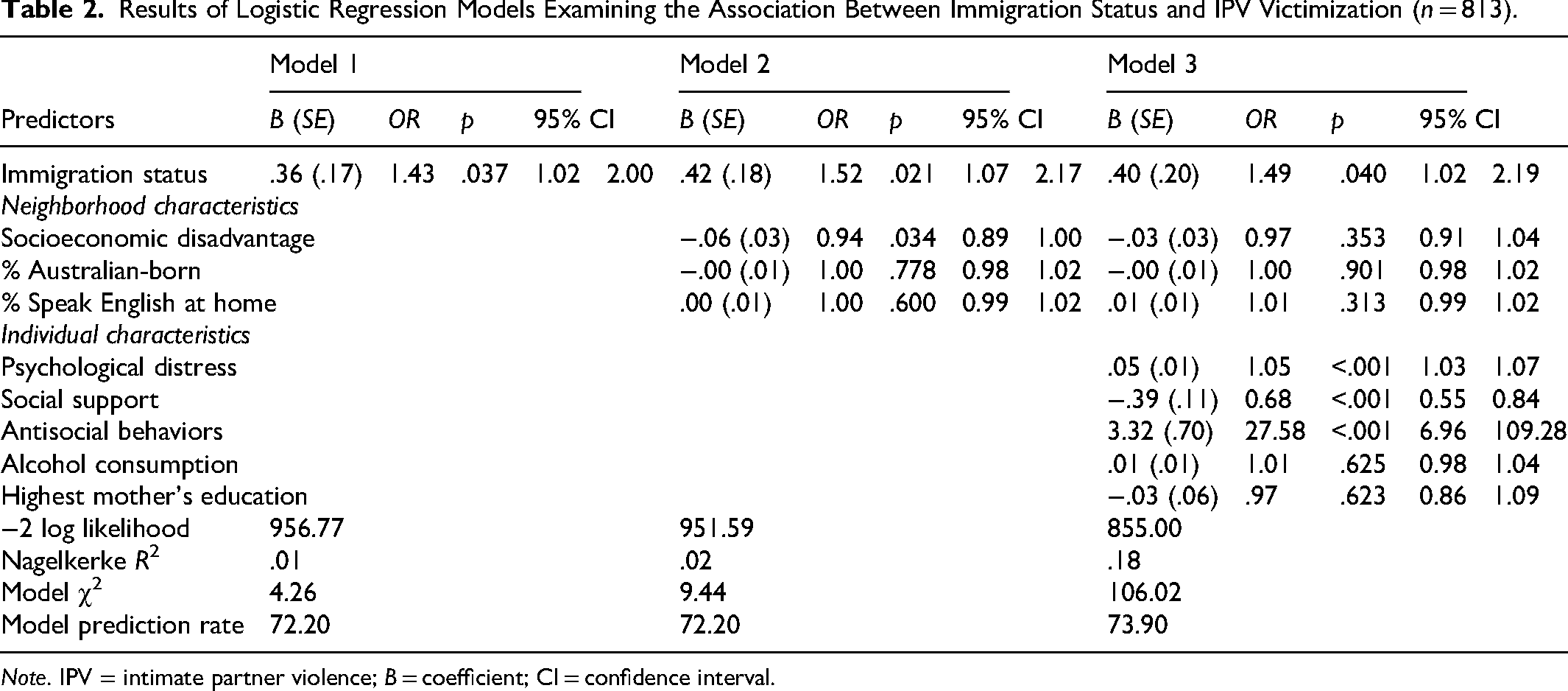
Three logistic regression models were estimated to answer Research Question 1. Model 1 included immigration status only, Model 2 introduced neighborhood characteristics, and Model 3 introduced individual characteristics variables (see Table 2). Across all three logistic regression models, second-generation immigration status was significantly associated with participants’ IPV victimization. Second-generation immigrant female adolescents exhibited a higher likelihood of experiencing IPV compared to their nonimmigrant counterparts in Australia. Although the coefficients for second-generation immigration status were slightly attenuated in Model 2 and Model 3 due to the addition of covariates, they remained statistically significant. After controlling for all the explanatory variables (Model 3), immigration status still significantly increased the odds of IPV victimization (OR = 1.49). Additionally, psychological distress (OR = 1.05), lower social support (OR = 0.68), and higher levels of antisocial behaviors (OR = 27.58) increased the odds of IPV victimization.
Results of Logistic Regression Models Examining the Association Between Immigration Status and IPV Victimization (n = 813).
Note. IPV = intimate partner violence; B = coefficient; CI = confidence interval.
RQ2: Gender Inequality in Parental Country of Origin and IPV Victimization
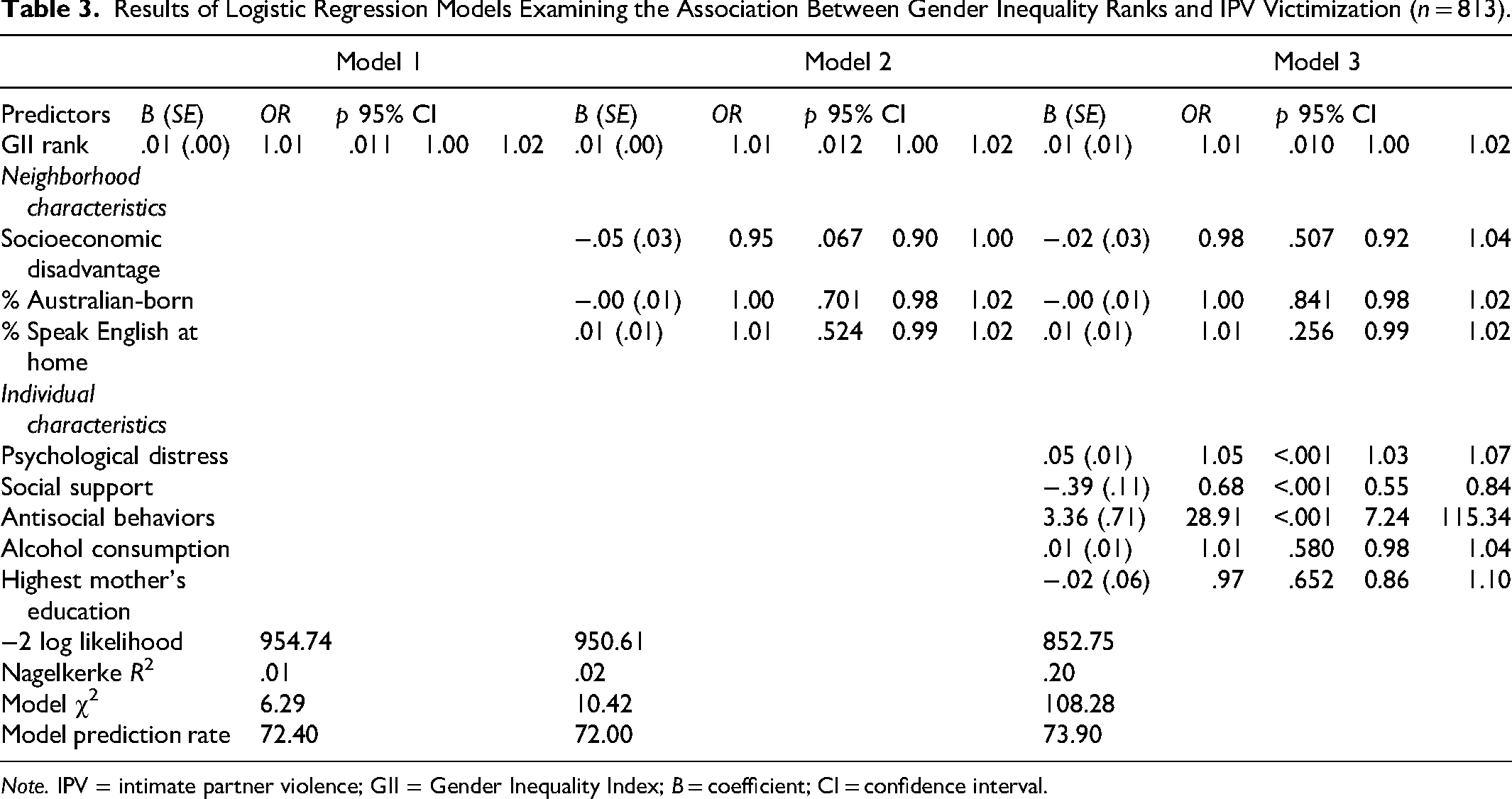
Similarly, three logistic regression models were estimated to answer Research Question 2. Model 1 included gender inequality in parental country of origin only, Model 2 introduced neighborhood characteristics, and Model 3 introduced individual characteristics variables. The findings revealed that females, whose parents come from countries with higher levels of gender inequality, were more likely to experience IPV than those whose parents come from countries with lower levels of gender inequality (see Table 3). In all three models, coefficients for GII rank remained statistically significant, although they were slightly attenuated after adding covariates. After controlling for all the explanatory variables (Model 3), the GII rank was still significantly associated with IPV victimization (OR = 1.01). Furthermore, psychological distress (OR = 1.05), social support (OR = 0.68), and antisocial behaviors (OR = 28.91) also significantly increased the odds of IPV victimization.
Results of Logistic Regression Models Examining the Association Between Gender Inequality Ranks and IPV Victimization (n = 813).
Note. IPV = intimate partner violence; GII = Gender Inequality Index; B = coefficient; CI = confidence interval.
In both logistic regression models, the antisocial behavior variable produced unusually wide confidence intervals for the odds ratio. This is likely due to the variable's sparse distribution, where extreme values may have predominantly aligned with one outcome category (Allison, 2012). However, the inclusion or exclusion of this variable did not substantially affect the coefficients of the key predictors.
Discussion
This research responds to the limited empirical attention given to factors that contribute to IPV experiences among second-generation immigrants. These individuals, born in the host country to at least one immigrant parent, are positioned within multiple social contexts shaped by both intergenerational influences linked to their parents’ country of origin and the broader social and institutional environment of the host country (Barros & Albert, 2020). Given the central role that male dominance and gendered power relations play in perpetuating and supporting IPV (Dobash & Dobash, 1992; Webster et al., 2021), it is crucial to examine how structural gender inequality across contexts may contribute to second-generation immigrant women's vulnerability to IPV.
Based on data from a nationally representative sample of Australian adolescents, the results indicated that second-generation immigrant female adolescents were at a heightened risk of experiencing IPV compared to their nonimmigrant peers in Australia. The logistic regression models consistently demonstrated that immigration status was associated with IPV victimization. Even after accounting for various neighborhood and individual characteristics, the odds of IPV victimization among second-generation immigrant females remained elevated.
The results align with certain aspects of previous literature on IPV victimization among immigrant populations, emphasizing the vulnerability of women with immigration backgrounds to IPV. Specifically, this vulnerability finds support in studies conducted in Spain and Israel, which revealed that women from immigrant backgrounds were at a greater risk of experiencing IPV in comparison to their nonimmigrant peers (Daoud et al., 2020; Vives-Cases et al., 2010). However, the results contradict a study conducted in Canada, which explored IPV victimization across first-, second-, and third-generation immigrants and found no association between IPV experience among adolescents and immigration statuses (Exner-Cortens et al., 2021). Similarly, the results differ from a study conducted in Australia, which discovered no notable differences in IPV prevalence between immigrant and nonimmigrant women (Satyen et al., 2021).
The findings of this study highlight the importance of understanding the factors associated with IPV victimization among second-generation immigrants in Australia. The heightened likelihood of IPV victimization among second-generation immigrant adolescents observed in this study may reflect the interaction of multiple structural and social influences. Previous research has identified lack of awareness of rights as one of the factors associated with IPV victimization among immigrants (Satyen et al., 2021). The present findings may indicate that this lack of awareness may continue to impact second-generation immigrants even when other factors, such as language barriers, diminish in influence. This study provides evidence that measuring generational status is important for understanding IPV among immigrant populations, yet it remains underexamined in existing research.
Another key result from the current study is the finding of an association between structural gender inequality in the parents’ country of origin and IPV victimization. The results revealed that even after controlling for covariates, higher ranks of gender inequality (as measured by the GII) remained significantly associated with IPV across all models. This finding aligns with previous research highlighting that societal-level gender inequality is associated with increased risk of IPV victimization (Ahmad et al., 2021; Hayes & Boyd, 2017; Zapata-Calvente et al., 2019).
One possible explanation for this finding lies in the role of intergenerational influences linked to societal-level gender inequality associated with parents’ country of origin, which may influence norms and expectations within intimate relationships. Gender inequality has been consistently recognized as a key driver of IPV, reflecting gendered power relations within social systems (Dobash & Dobash, 1992; Heise & Kotsadam, 2015; Johnson et al., 2024). Cultural transmission theory proposes that gender role behavior may emerge through the intergenerational transfer of gender-related norms and values within families, communities, and wider institutional environments (Bisin & Verdier, 2011). These intergenerational influences operate alongside exposure to the social, political, and economic conditions of the host country and may contribute to how gender roles, values, and acceptable behaviors are understood and enacted (Bisin & Verdier, 2011). Consequently, second-generation immigrants from different backgrounds, and with varying levels of engagement with multiple contexts of the host country, may perceive IPV victimization differently.
Besides the core focus of immigration status and gender inequality, the results from these logistic regression models also unveiled the influence of several other factors on participants’ likelihood of experiencing IPV. Psychological distress emerged as a noteworthy contributor to heightened vulnerability for IPV victimization. Individuals with higher levels of psychological distress were at an increased risk of experiencing IPV (Brooks-Russell et al., 2013). Additionally, the presence of a robust social support network was found to be significantly related to a decrease in IPV victimization. This finding is consistent with studies emphasizing the protective role of social support in buffering against IPV (Dias et al., 2019). It underscores the importance of nurturing strong social connections, including for vulnerable populations like second-generation immigrant female adolescents. Conversely, participants with a history of antisocial behavior were more likely to be victimized. This highlights the complex relationship between individual traits and victimization, with certain behavioral tendencies potentially increasing the risk of abusive relationships (Herbert et al., 2021).
The results of this study carry notable implications for IPV prevention among immigrants, particularly second-generation immigrant women. The findings highlight the role of gender inequality in shaping the IPV experiences among female adolescents, underscoring the need to address structural gender inequality and the wider social conditions that contribute to vulnerability to IPV. Given that immigrants constitute a substantial proportion of the Australian population (Australian Bureau of Statistics, 2022), implementing primary prevention initiatives to promote gender equality is essential.
In Australia, discussions of healthy relationships, consent, gender roles, and respectful communication have been incorporated into the Australian curriculum (Australian Human Rights Commission, 2014). By fostering these values early in life, children can develop a strong foundation for healthy relationships and are better equipped to recognize the signs of abuse. Evidence suggests that such programs can be effective in reducing IPV among youth in Australia (Our Watch, 2021). Importantly, these prevention programs should be implemented in ways that are inclusive and that recognize the diversity of people's social and family environments. To ensure cultural relevance, accessibility, and effectiveness, IPV intervention initiatives should be co-designed with end users, particularly those with lived experience. Co-design enables interventions to be informed by the perspectives of those most affected, helping to ensure that programs are contextually appropriate and more likely to be accepted and sustained within communities (Shoshana et al., 2022).
Moreover, the findings of this study also highlight the vulnerability of some second-generation immigrants, especially those whose parents are originally from countries with a higher level of structural gender inequality. This highlights the importance of effective secondary intervention strategies, including screening mechanisms that can help identify individuals or families who may be at greater risk of IPV. Efforts have been made to develop culturally sensitive screening tools that help service providers, such as healthcare professionals, recognize signs of IPV in these populations (Peters et al., 2022). If service providers could identify at-risk individuals and address their needs proactively, they may offer support before the violence escalates. A comprehensive approach to preventing IPV among immigrants should therefore combine primary prevention efforts that promote gender equality with culturally responsive secondary interventions in order to achieve sustained changes in social norms, practices, and structures to reduce IPV and its impacts (Adult Multicultural Education Services Australia and Department of Social Services, 2016).
Limitations and Recommendations for Future Research
This study is the first known study using a nationally representative sample to examine the IPV victimization experience of second-generation immigrant female adolescents in Australia. This is an important contribution, given the limited visibility of second-generation immigrants in quantitative research on IPV victimization, particularly in adolescent samples. The use of a nationally representative sample offers several advantages. Firstly, findings derived from such samples possess a unique generalizability, ensuring a more comprehensive understanding of the topic. Second, a nationally representative sample helps minimize biases associated with sampling. Third, large sample sizes provide greater statistical power and lead to more reliable conclusions. In addition, the present study extends existing research by examining IPV victimization in relation to both the Australian context in which second-generation immigrants are growing up and characteristics associated with parents’ countries of origin.
However, it is crucial to acknowledge the limitations inherent in this study. One notable limitation is the reliance on self-report data, particularly for sensitive topics like IPV. This approach may introduce reporting biases, as participants might underreport or omit experiences due to societal stigma associated with IPV (Laskey et al., 2019). Moreover, accurate recall of past incidents could present challenges, potentially leading to inaccuracies in their reporting (Laskey et al., 2019). Discrepancies in perspectives could result in varied accounts of the same event. Moreover, self-report surveys might lack the depth needed to capture the full context of the violence experienced by participants (Laskey et al., 2019).
Another limitation of this study is that, in Research Question 1, second-generation immigrants were treated as a homogeneous group. However, their experiences may vary due to differences in family background, socioeconomic status, and broader social environments. While second-generation immigrants are diverse in their individual experiences, they share a common structural position of being raised in a host country by parents who, in most cases, grew up in a different social context. This shared positioning may influence relationship expectations and behaviors, making it meaningful to examine this group at an aggregate level. Future research could further explore disparity in IPV victimization within this population. Examining within-group differences is important for informing more effective prevention strategies. Such research could benefit from supplementing quantitative findings with qualitative approaches. Qualitative data may capture nuances that quantitative methods might overlook (Rennison & Hart, 2018), providing insights into the contextual factors that shape IPV experiences and barriers to accessing support.
Conclusion
The current research is a pioneering endeavor, being the first to exclusively focus on the experiences of IPV victimization among second-generation immigrant female adolescents in Australia. This study fills a crucial gap in the literature by examining the relationship between immigration status, structural gender inequality, and IPV victimization. Specifically, this study investigated whether second-generation immigrant female adolescents face a higher risk of IPV compared to their nonimmigrant counterparts. Additionally, it explored whether female adolescents whose parents originate from countries with higher levels of structural gender inequality face an elevated risk of experiencing IPV compared with peers whose parents originate from more structurally gender-equal countries. The findings suggest that second-generation immigrant female adolescents are indeed at an increased risk of experiencing IPV compared with their nonimmigrant peers. Furthermore, female adolescents whose parents originate from countries with lower levels of structural gender equality face a greater risk of IPV than their counterparts whose parents are from more structurally gender-equal countries. The findings underscore the importance of ensuring universal IPV prevention programs are relevant and accessible to diverse populations, and that secondary intervention strategies are available to this vulnerable group. This research contributes to the understanding of IPV within the context of immigration and gender inequality. It highlights the importance of considering structural gender inequality and the broader social conditions that shape vulnerability to IPV in prevention and intervention efforts. By acknowledging these influences, policymakers, practitioners, and researchers can design initiatives that are responsive to the needs of second-generation immigrant female adolescents and more effective in addressing IPV within this demographic.
Footnotes
Acknowledgments
This paper uses unit record data from Growing Up in Australia: The Longitudinal Study of Australian Children (LSAC) conducted by the Australian Government Department of Social Services (DSS). The findings and views reported in this paper, however, are those of the authors and should not be attributed to the Australian Government, DSS, or any of DSS’ contractors or partners. DOI:  .
.
Funding
The authors received no financial support for the research, authorship, and/or publication of this article.
Declaration of Conflicting Interests
The authors declared no potential conflicts of interest with respect to the research, authorship, and/or publication of this article.