






Abstract
Employment and income are critical in aiding intimate partner violence (IPV) survivors. The Earned Income Tax Credit (EITC) is a strategic anti-poverty initiative, promoting workforce participation. This study investigates the effect of state-level EITC policies on physical IPV incidence. Utilizing data from the National Incident-Based Reporting System (NIBRS) spanning 2011 to 2019, we performed a generalized linear model with fixed-effects individual slopes to estimate the relationship between the level of state EITC benefits and state-level IPV rates by quarter. We found that increased state EITC levels were correlated with reduced physical IPV reports to law enforcement.
Introduction
Economic policies have the potential to reduce social problems impacting families above and beyond poverty alone. The Earned Income Tax Credit (EITC) is considered to be a promising anti-poverty strategy in the United States and has been studied for its relationship to a variety of outcomes in families. EITC has been found to be related to lower rates of child maltreatment (Berger et al., 2017; Biehl & Hill, 2018; Klevens et al., 2017; Rostad et al., 2020). It has also been found to be related to a decrease in an individual's likelihood of experiencing intimate partner violence (IPV) (Spencer et al., 2020). EITC has also been found to be related to decreased levels of depression (Boyd-Swan et al., 2016; Evans & Garthwaite, 2014). The current study seeks to estimate the policy impact of state-level EITC levels on state rates of IPV reports to police.
Background
IPV Incidence and Consequences
IPV is a severe and widespread public health issue in the United States, profoundly impacting the safety and well-being of millions of individuals annually. Approximately one-third of adults have experienced physical or sexual IPV or stalking, while nearly half have reported psychological aggression by an intimate partner (Leemis et al., 2022). IPV's devastating consequences extend across physical, psychological, financial, and social domains.
Victims of IPV often sustain immediate physical injuries, including bruises, fractures, and traumatic brain injuries. These immediate impacts of IPV can evolve into chronic health conditions, such as persistent pain, migraines, gastrointestinal disorders, sexually transmitted infections, and reproductive health complications like preterm births and low birth weight (Gilbert et al., 2023; Kozhimannil et al., 2023). The psychological effects of IPV are equally severe, frequently leading to mental health conditions such as depression, anxiety, and post-traumatic stress disorder (PTSD). IPV-related trauma can induce feelings of helplessness, diminished self-esteem, and persistent stress. Specifically, survivors of intimate partner sexual violence often experience profound emotional impacts, such as intense feelings of betrayal and diminished self-worth, which severely affect their identity and capacity for healthy relationships (Gilbert et al., 2023; Tarzia et al., 2020). IPV can also result in fatal outcomes, contributing to over 10% of violent deaths in the United States. These fatalities include intimate partner homicides (IPHs), homicide-suicide events, and suicides linked directly to IPV experiences (Kafka et al., 2021).
Employment and Income Provide a Pathway for Survivors Out of IPV
Employment and income play a critical role in helping survivors of IPV escape abusive situations and rebuild their lives. For this reason, abusive partners utilize tactics of economic abuse, including control of financial resources, manipulation of current financial situations, and sabotage of current or prospective employment (Postmus et al., 2016). Economic abuse significantly undermines survivors’ financial independence by restricting access to resources, limiting employment opportunities, and impairing financial decision-making capabilities (Tarshis, 2020).
Employment offers one avenue of psychological and physical relief from IPV and economic autonomy for IPV survivors (MacGregor et al., 2021; Rothman et al., 2007; Showalter et al., 2025). In a review of the literature, researchers found that 44% of studies had themes of work as a safe place away from abusers, and 25% found that work provided psychological respite from IPV (MacGregor et al., 2021). It is also possible that workplace supports, formally and informally (Branicki et al., 2023; Yragui, 2008), can significantly contribute to the employment stability of IPV survivors. Conversely, survivors lacking economic self-sufficiency often experience prolonged financial instability and intensified psychological distress (Willie et al., 2023).
The Stress Process Theory provides a valuable theoretical framework for understanding the connection between economic abuse, employment, financial independence, and psychological health among IPV survivors. According to this theory, stressors such as economic hardships and limited access to resources increase psychological distress and negatively affect survivors’ health outcomes (Fox et al., 2002). Economic IPV serves as a chronic stressor, impairing survivors’ ability to achieve financial autonomy and thus exacerbating vulnerability to mental health issues like PTSD and depression (Sippel & Marshall, 2011; Willie et al., 2023). Resource Theory further explains how power dynamics related to economic resources contribute to IPV risk. According to this theory, disparities in financial resources or employment stability within couples increase the risk of IPV, as the economically advantaged partner may exert control, or the disadvantaged partner may resort to violence as a means of compensating for perceived power imbalances (Fox et al., 2002). Stable employment and adequate income thus serve as protective factors against IPV and critical components of empowerment, enabling survivors to regain autonomy and agency (Fox et al., 2002; Tarshis et al., 2022).
Empowerment Theory complements these perspectives by highlighting the importance of survivors’ economic self-sufficiency in restoring autonomy and self-worth, essential for effective recovery and long-term psychological health (Tarshis et al., 2022). Employment provides financial stability and reinforces survivors’ confidence, improving coping skills and resilience. Stable employment significantly reduces psychological distress and enhances overall well-being by decreasing economic dependence on abusive partners and weakening perpetrators’ control (Tarshis, 2020; Willie et al., 2023).
Overview of EITC—Federal and State Credits
The EITC is recognized as an effective anti-poverty initiative within the United States. This refundable tax credit aims to enhance the economic value of labor for individuals with low to moderate incomes by reducing their tax obligations. Upon fulfilling their tax liabilities, qualifying taxpayers receive the remaining balance of the credit as a refund due to its refundable nature. Individuals can qualify for EITC if they have earned income, savings and investments below the annual limit, a valid social security number, and legal citizenship status for the entire year of filing. There are certain exceptions to EITC qualifications for military members, clergy members, and individuals with disabilities.
Compared to other public assistance programs in the United States, the EITC is perceived as a relatively generous provision, available to a broader population with substantial benefits. For instance, in 2024, a single parent with three or more children and an income up to $59,899 could receive the maximum credit of $7,830. Additionally, some states offer a supplementary state-level EITC, thereby increasing the total benefit received. These benefits are often refundable, similar to the federal benefit, and are typically set at a percentage of the federal credit (How Do State Earned Income Tax Credits Work?, 2024). In 2023, 31 states had a state-level EITC to supplement the federal EITC, and in all but four states (Missouri, Ohio, South Carolina, and Utah), this credit was refundable. In that same tax year, all but three states (California, Minnesota, and Wisconsin) use a percentage of the federal credit to determine the amount that an individual receives from the state credit.
The EITC has been demonstrated to encourage workforce participation among single parents and primary earners in married couples with children, lifting a substantial segment of families above the federal poverty threshold (Hoynes & Patel, 2018). A recent policy simulation assessing the impacts of four state policies—the Supplemental Nutrition Assistance Program, Temporary Assistance for Needy Families, EITC, and Child Tax Credit—identified the EITC as the most influential in reducing child poverty (Pac et al., 2020). Specifically, if all states matched the generosity of Wisconsin's state EITC (43% of the federal credit and fully refundable), an estimated 2.7 million fewer children would be in poverty (Pac et al., 2020).
Prior Research on EITC and IPV
Prior research exploring the relationship between the EITC and IPV presents diverse findings, reflecting the complexity involved in leveraging economic policies as preventive strategies. Economic empowerment through the EITC appears to hold promise for reducing IPV. One study found that a $1,000 increase in annual income through EITC expansions led to approximately a 9.73% reduction in IPV incidents and a 21% decrease in the intensity of IPV, particularly among unmarried and Black women (Cesur et al., 2022). These findings align closely with theoretical arguments suggesting that enhanced financial independence can improve survivors’ bargaining power, thereby reducing vulnerability to IPV.
Consistent with these findings, another study utilized data from the Future of Families and Child Well-being Study (FFCWS) to examine the impact of refundable EITC (Spencer et al., 2020). They identified significant protective effects, noting that refundable EITC effectively reduced IPV victimization, especially among economically disadvantaged groups. This suggests that direct financial transfers offered through refundable credits could significantly bolster survivors’ economic autonomy, enabling them to leave or resist abusive relationships more effectively.
Additional literature provides complementary indirect evidence on how economic stability can influence IPV through broader economic support systems. Rostad and colleagues reported reductions in overall violent crime rates associated with refundable state-level EITC, suggesting indirect protective effects against IPV resulting from greater economic stability (Rostad et al., 2024). Researchers have offered further support, showing how the Michigan EITC Access Project significantly reduced child maltreatment through targeted financial empowerment strategies, indirectly reducing factors linked to IPV risks through improved household economic conditions (Maguire-Jack et al., 2025).
In contrast, several other studies reported null effects, highlighting complexities in policy implementation and barriers that may limit EITC's effectiveness. Edmonds and colleagues, analyzing data from the National Crime Victimization Survey (NCVS) and the FFCWS, found no statistically significant associations between state-level EITC generosity and IPV (Edmonds et al., 2021). The researchers speculated that structural barriers, such as loss of eligibility for economic support upon separation from an abusive partner, could severely limit the potential protective benefits of EITC policies.
Similar findings emerged from Moe and colleagues, who investigated state-level EITC impacts on IPH rates across the United States from 1990 to 2016 (Moe et al., 2020). They found no statistically significant relationship between state EITC policies and IPH rates, highlighting the possibility that abusive partners’ control over household financial resources might negate the economic advantages survivors could otherwise gain from EITC expansions. Recent county-level analyses of IPV and domestic violence (DV) homicides similarly found no significant causal relationship between state EITC generosity and lethal IPV or DV homicide rates, indicating that positive effects at the individual level might be offset by complex relationship dynamics and financial control within abusive relationships (Sims et al., 2024). Lastly, it is possible that EITC eligibility limits IPV survivors’ access to additional income. For instance, research has established that immigrants, asylum seekers, and non-citizens are at greater risk for IPV (Morrison et al., 2024) but are currently prohibited from accessing EITC.
Current Study
The current study sought to examine the following research question: Do state earned income tax credits reduce physical IPV? Given prior research demonstrating employment and income as protective factors against IPV, we hypothesized that states with a more generous level of tax credit provided would have lower rates of physical IPV over time. Previous research indicates that EITC generosity (maximum federal and state EITC benefit) can reduce financial hardship for IPV survivors, but the relationship is not statistically significant (Edmonds et al., 2021). Researchers attribute this null finding to EITC guidelines not accounting for married individuals who leave abusive relationships, and the program generally has a low take-up rate among individuals experiencing trauma (Edmonds et al., 2021). Prior research has predominantly utilized data from sources such as the NCVS, FFCWS, and homicide-specific datasets like the Supplementary Homicide Reports (SHRs) and Uniform Crime Reporting Supplemental Homicide Reports (UCR-SHR). However, no existing study has leveraged the National Incident-Based Reporting System (NIBRS), which provides comprehensive, incident-level data capturing both fatal and non-fatal IPV offenses. Given previous studies indicating limited impacts of EITC generosity on lethal IPV, examining non-lethal IPV incidents becomes especially important, as these constitute the majority of IPV events.
To address this critical gap, the present study utilizes NIBRS data to examine whether state-level variations in EITC generosity are associated with reductions in physical IPV incidents. By expanding analysis beyond lethal violence to encompass lower-level offenses, this study provides a more nuanced understanding of how economic policies might empower survivors and disrupt the cycle of IPV. This contribution aims to guide targeted policy interventions designed to effectively address IPV through economic support mechanisms.
Methods
Data
To investigate the effects of state-level EITC on IPV, we utilized data on physical IPV incidents reported to the police from 2011 to 2019. A large percentage of IPV incidents are never reported to police and therefore are not represented in the current study. Physical IPV was measured using the NIBRS, which, as of May 2023, encompassed 77% of the United States population. Although all states have at least one NIBRS-certified law enforcement agency, not all agencies within a state are certified and therefore do not report their data to NIBRS. Areas that may be systematically underrepresented within the data are likely to be rural or under-resourced agencies. For this analysis, the dataset was structured into a state-by-quarter-year panel format (e.g., 2011Q1, 2011Q2, etc.).
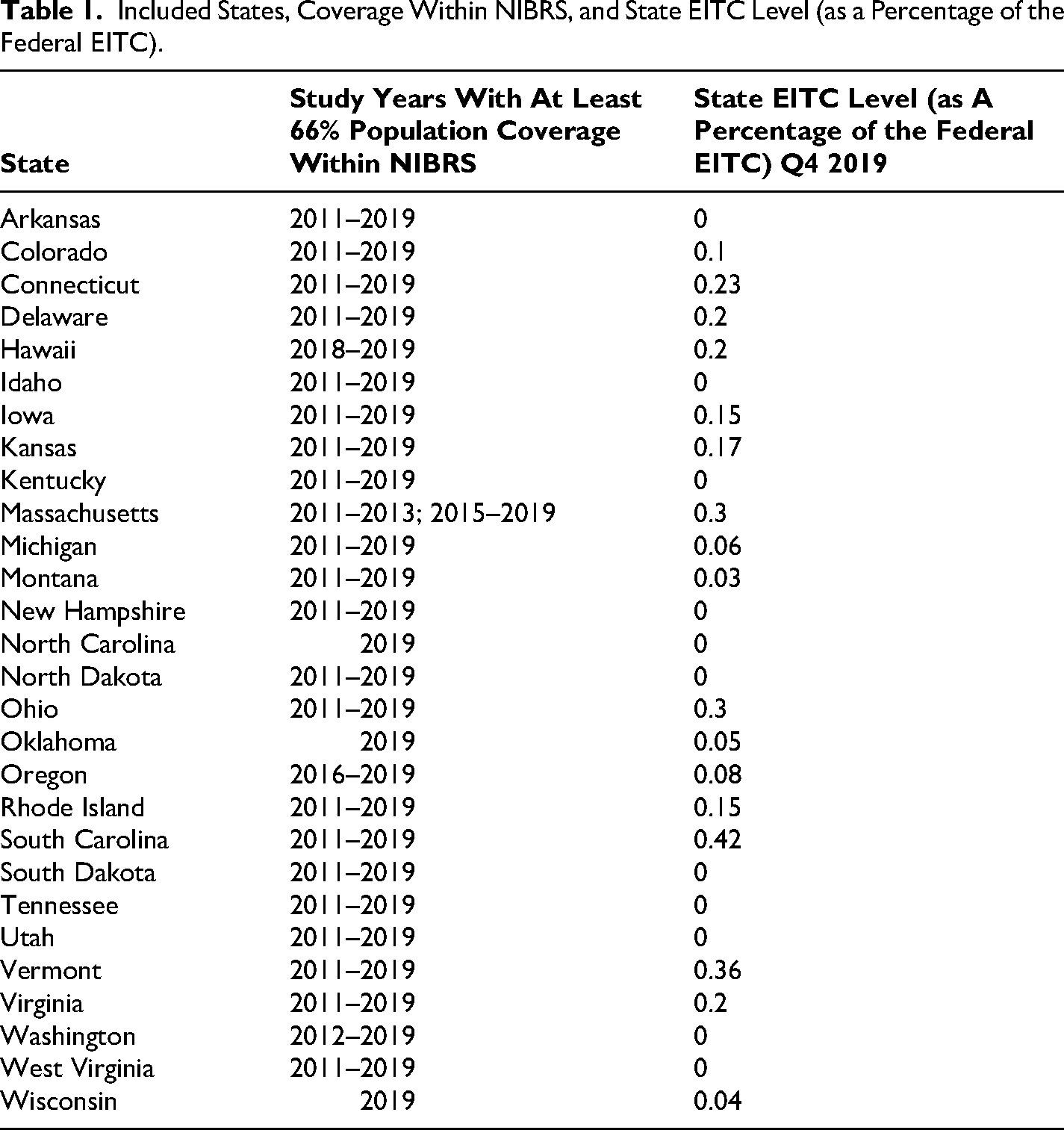
We selected 28 states in which NIBRS data were reported by precincts, covering at least 66% of the state's population. Table 1 details the specific states and years included in the dataset. NIBRS data were subsequently linked to policy variables sourced from the University of Kentucky Center for Poverty Research (University of Kentucky Center for Poverty Research, 2025). Control variables, such as race, urbanicity, poverty rate, and unemployment rate, were obtained from the U.S. Census Bureau's American Community Survey (ACS), while additional policy context variables were referenced from the Kaiser Family Foundation. All datasets were merged by state and quarter/year.
Included States, Coverage Within NIBRS, and State EITC Level (as a Percentage of the Federal EITC).
Measures
Dependent Variables
Our analysis concentrated on the incidence rate of physical IPV incidents, specifically aggravated assault and simple assault, reported to law enforcement per 1,000 individuals within the covered population. The term “covered population” denotes the number of individuals residing in areas served by police agencies that submit data to the NIBRS. The study encompassed cases where the victim–offender relationship was classified as spouse, common-law spouse, boyfriend/girlfriend, same-sex relationship, or ex-spouse. Notably, in 2017, the category of ex-relationship (ex-boyfriend/ex-girlfriend) was incorporated into the dataset.
Key Independent Variables
The policy of interest for this investigation was the state EITC level. In addition to the federal EITC available to US citizens, states have the option of providing additional tax credits. The University of Kentucky Center for Poverty Research maintains a database of important policy variables over time and across states. One of the variables included is the state EITC level, which is measured as the state EITC amount as a percentage of the federal credit. Table 1 includes the state EITC levels for quarter 4 of 2019.
Control Variables
State-level demographic data were obtained from the ACS annual estimates, which included variables such as the racial composition (percentage of the population identifying as Black, American Indian/Alaska Native, Asian, Native Hawaiian/Pacific Islander, other race, or multiracial), the proportion of the population residing in urban areas, the unemployment rate, and the poverty rate (i.e., the percentage of residents living below the federal poverty level). Racial and socioeconomic demographic information are incorporated as control variables due to the varying degrees of police contact across different racial and socioeconomic groups (Holliday et al., 2020). Additionally, several measures related to the policy context were sourced from the University of Kentucky Center for Poverty Research National Welfare dataset, including the value of the state social welfare safety net, quantified as the combined maximum monthly benefits of TANF and SNAP for a two-person family, the percentage of low-income children without health insurance, and the participation rate in the Women, Infants, and Children program. Furthermore, a policy variable concerning the implementation of Medicaid Expansion was included, obtained from the Kaiser Family Foundation.
Analysis
Before conducting the inferential analyses, we assessed the distribution of the dependent variable. The Shapiro–Wilk test indicated a deviation from normality. Given that the distribution was skewed and bounded at or above zero, a gamma distribution was deemed appropriate for modeling the data. To investigate the relationship between state EITC levels and IPV, we employed a fixed-effects individual slopes generalized linear model using Stata version 18 (StataCorp, 2023). The model included state-fixed effects, quarter-year fixed effects, and state*year fixed effects to account for average differences across states and over time in both observed and unobserved predictors, as well as state-specific linear time trends (Rüttenauer et al., 2023). We utilized the cluster option in Stata to account for state-level clustering and to generate robust standard errors.
Results
Descriptive Statistics
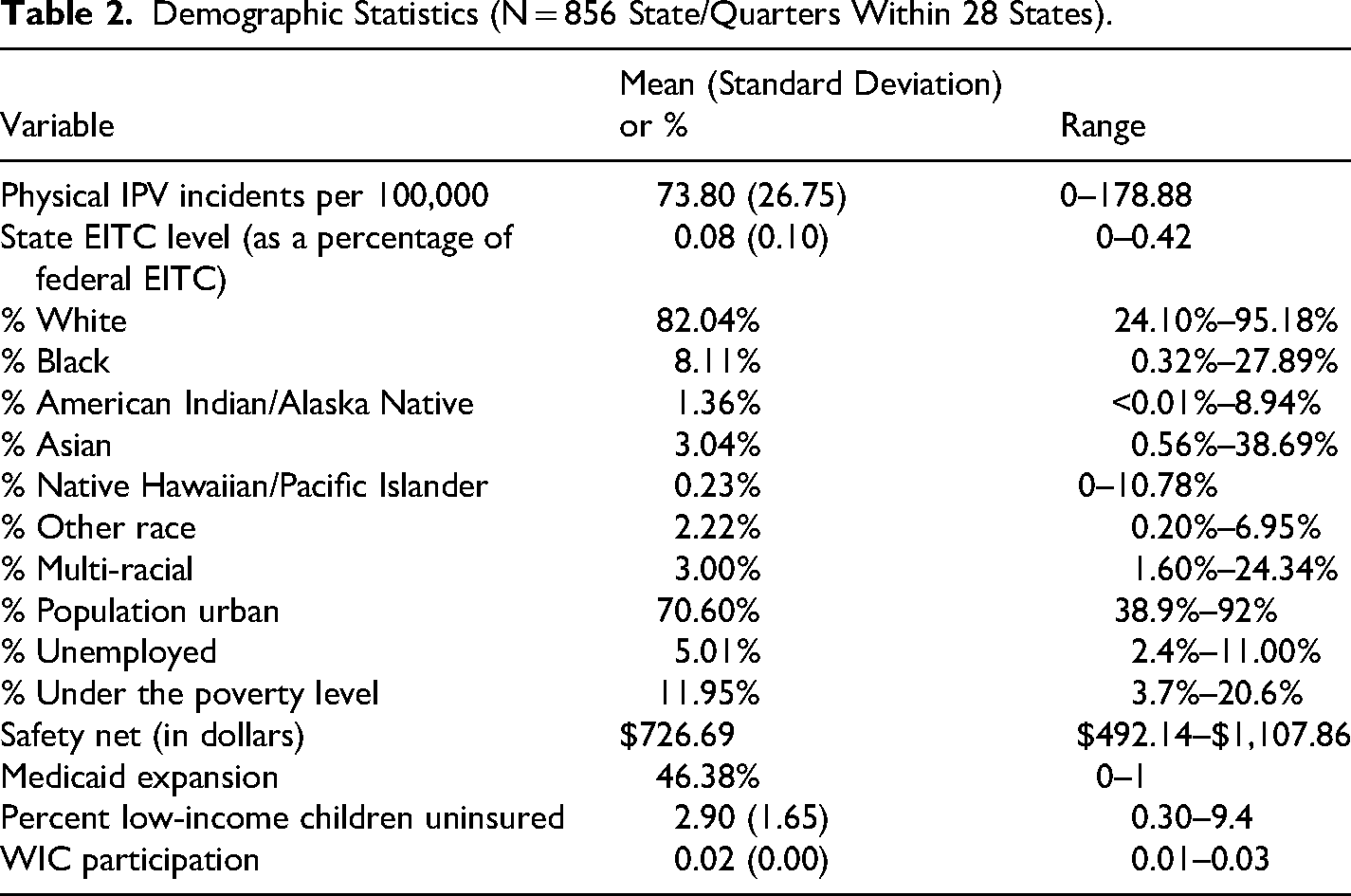
Table 2 presents the descriptive statistics for our analytical sample. On average, there were approximately 70 incidents of IPV per 100,000 individuals across the states studied. In quarter 4 of 2019, the average level of state EITC, as a percentage of federal EITC, was about 8% of the federal level and ranged from no credit (0%) to 42% of the federal level in the state of South Carolina. The maximum amount of EITC was $6,557 in 2019 (El-Sibaie, 2018), meaning that the maximum amount one could receive in South Carolina in 2019 from the state EITC was approximately $2,754. Racial composition percentages were, on average, 82.04% White, 8.11% Black, 3.04% Asian, 3.00% multi-racial, 2.22% other races, 1.36% American Indian/Alaska Native, and 0.23% Native Hawaiian/Pacific Islander. Urban areas encompassed roughly 71% of the population across the states. The average unemployment and poverty rates were 5.01% and 11.95%, respectively. Lastly, the mean value of the safety net was approximately $727 per month.
Demographic Statistics (N = 856 State/Quarters Within 28 States).
EITC and IPV
The results of the generalized linear fixed effects individual slopes model are available in Table 3. State level of EITC was associated with lower levels of physical IPV reported to police. Specifically, each percentage point increase in state EITC was associated with a reduction of 0.17 in the number of physical IPV events per 100,000 population reported to police. In terms of other policy variables, the size of the social safety net was associated with lower levels of IPV, while the size of the uninsured low-income child population was associated with higher levels, though both of these effects were small in magnitude. The WIC participation rate was associated with a reduction of 0.87 in the number of physical IPV events per 100,000 population reported to police. In terms of other control variables, areas with a greater percentage of the population that was Black or Asian had lower rates of physical IPV, while areas with a greater percentage of the population that was American Indian/Alaska Native, Native Hawaiian/Pacific Islander, other race, or multi-racial were related to higher rates. Percent of the population that was urban was related to lower rates of physical IPV, while the unemployment rate and poverty rate were related to higher rates of physical IPV.
Generalized Linear Fixed Effects Individual Slopes Model Findings Estimating the Relationship Between State EITC Level and Physical IPV Incidents (per 100,000).
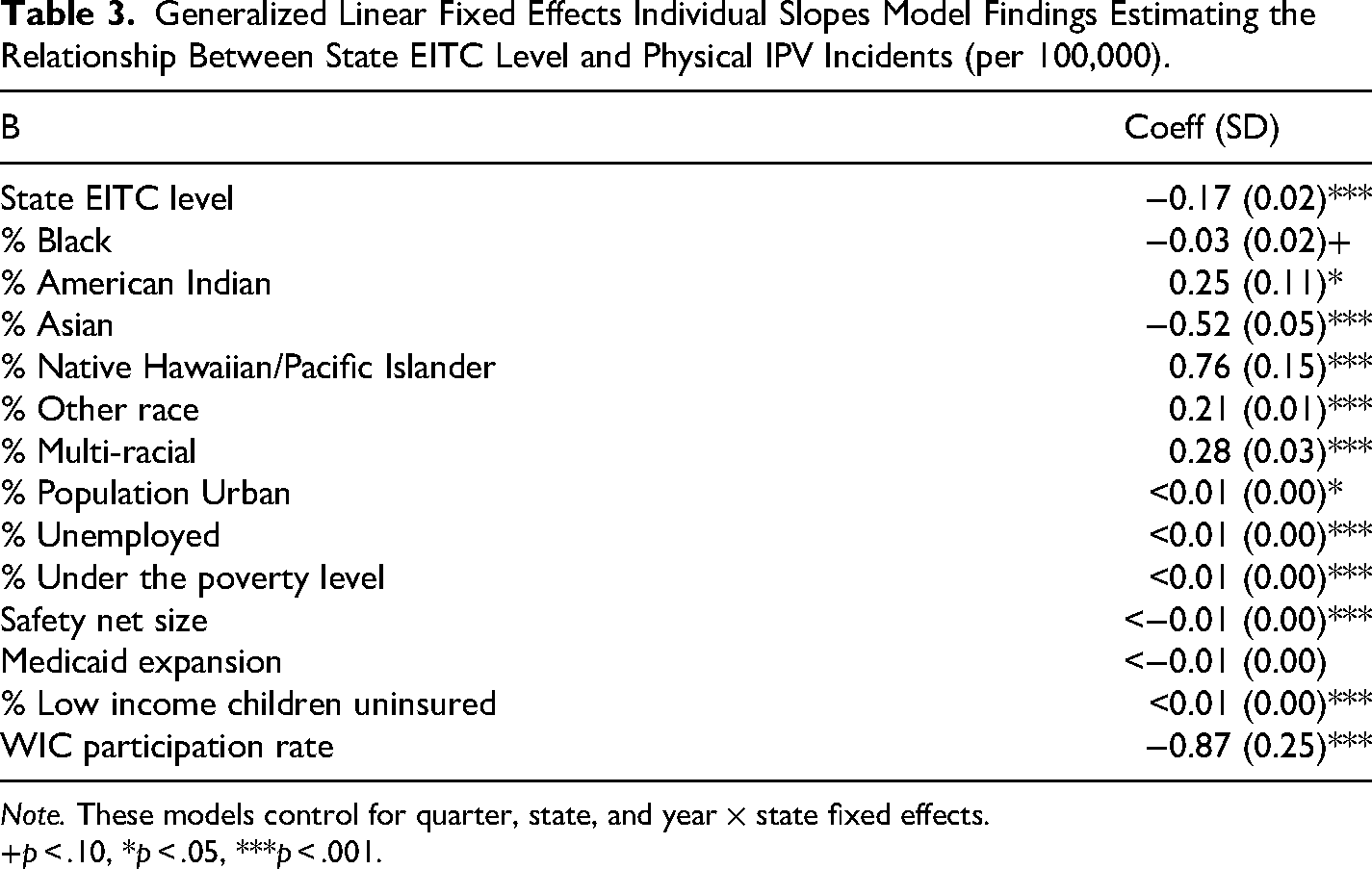
Note. These models control for quarter, state, and year × state fixed effects.
+p < .10, *p < .05, ***p < .001.
Discussion
The present study finds that more generous state EITC policies are associated with lower levels of reported IPV. States in which low- and moderate-income families received a greater tax break saw fewer incidents of physical IPV per 100,000 people reported to police, controlling for other state-level demographic and economic factors. Results suggest potential promise for reducing family violence through economic supports.
Families who get to keep more of their income may experience lower economic stress and hardship compared to those in states with lower EITC benefits (Edmonds et al., 2022). The extra income can be used to cover basic needs or reduce financial hardships that can make daily life taxing and increase violence. Income benefits can also increase women's financial independence, offering a pathway out of a violent relationship. Economic hardship has been linked to increased risk for IPV (Bonomi et al., 2014; Cochran et al., 2023; Zharima et al., 2024); stress over unpaid bills can increase household conflict and lead to violence (Frye & Karney, 2006). Limited research investigates the impact of economic supports on IPV, but some studies show promise. A randomized study conducted in Ecuador found that direct cash transfers, vouchers, or food transfers were associated with a 6- to 7-percentage point reduction in physical violence, sexual violence, and controlling behaviors (Hidrobo et al., 2016). When interventions reduced economic pressure on households, women experienced less violence at the hands of their intimate partners. Despite these findings, little research has examined direct economic benefits as a means for reducing IPV in the United States. The present study demonstrated a clear state-level link between more generous EITC policies, which let families keep more of their income, and reduced reports of IPV.
In the present study, the proportion of the state's population that was Black was negatively associated (with marginal statistical significance) with reported IPV. Given elevated rates of poverty among Black women compared to Whites and residential segregation that leads to concentrated poverty in majority-Black communities, it may be expected that a higher proportion of Black residents would be associated with greater IPV; however, mistrust between police and Black communities may leave Black IPV survivors less likely to report incidents of violence. Prior studies examining prevalence of IPV victimization and reporting by race have somewhat mixed findings. Two studies showed that police-reported rates of IPV were roughly twice the rates found among White women (Holliday et al., 2020; Lipsky et al., 2009). Two studies estimating prevalence by self-report, however, were mixed. A national sample of married or cohabitating women, in contrast, showed no differences in self-reported IPV between Black and White women (Cho, 2012). A more recent national survey found that Black women self-reported double the rate of physical violence, sexual violence, or stalking by an intimate partner in the past year compared to White women (Leemis et al., 2022). Our study found that the proportion of state residents who were Black was negatively associated with police-reported IPV, suggesting that Black communities were either less likely to experience or less likely to report IPV. It is further possible that states with larger Black populations are necessarily less segregated by race; more diverse communities with more diverse police forces show greater trust and lower crime (Peyton et al., 2022), although some research suggests this is further linked to higher crime reporting rates (Miller & Segal, 2019). Finally, it is possible that Black communities, which are more surveilled than others, come into contact more often with police officers or other officials and thus appear more often in crime statistics. Future research should examine more closely, perhaps qualitatively, the relationship between race, residential segregation, violence, and police interactions.
A number of important implications emerge from the present study. First, the study shows that more generous tax breaks for low-income families are associated with reduced police-reported physical IPV. Putting more money in families’ pockets is a promising strategy for reducing population-level violence. Expanding EITC generosity across all U.S. states, as well as implementing additional tax benefits for low-income working families, are opportunities to leverage the growing body of research suggesting that reducing economic hardship can reduce violence. Second, the study finds lower levels of police-reported IPV in states in which a higher proportion of the population is Black. This may reflect a true lower risk of violence among Black families, reluctance of Black families to involve police in family violence, or more complex dynamics not captured in official records. Future research should engage Black families, law enforcement, and policymakers to better understand the dynamics underlying IPV reporting.
Limitations
This research utilizes data on incidents of physical IPV reported to entities involved in the NIBRS. Consequently, IPV incidents not reported to these agencies were excluded from our analysis. Within the NIBRS dataset, occurrences of non-physical IPV were infrequent compared to physical violence, prompting a specific focus on physical IPV alone. As a result, we were unable to evaluate the relationship between our variables of interest and other forms of IPV, such as emotional, economic, or sexual abuse. IPV is often underreported due to associated stigma and concerns regarding the consequences of disclosure (Heron & Eisma, 2021). NIBRS underreporting concerns could be due to the late addition of IPV by an “ex-partner” and should therefore be seen as conservative estimates prior to 2017. Certain demographic groups are statistically less likely to report IPV to law enforcement; factors such as race/ethnicity, educational attainment, and age significantly influence the propensity to self-report IPV (Holliday et al., 2020). Furthermore, NIBRS data encompasses only information from law enforcement agencies that submit their details to the Federal Bureau of Investigation, potentially introducing bias if systematic differences exist between reporting and non-reporting agencies. This necessitates cautious interpretation of the findings. Our analysis concentrated on states where at least two-thirds of the population is covered by NIBRS, restricting our study to 28 states and limiting the generalizability of our results to the entire U.S. population. It is important to acknowledge that fixed effects individual slopes models have limitations, including a tendency to underestimate effect sizes (Callaway et al., 2024). Additionally, although we are unable to establish causality in the models, the use of fixed effects individual slopes models and controlling for unobserved heterogeneity provides models that are more robust than a simple ordinary least squares regression.
Conclusion
The present study finds an important link between an economic benefit to low-income families and reduced reports of physical IPV. Tax benefits for working families, which have the effect of directly increasing available income, offer an opportunity to reduce both economic and relationship hardship for vulnerable families. Future research should consider examining time variation within states to examine changes in EITC implementation to further explore the impacts of EITC on IPV using dynamic panel difference-in-difference models. Additionally, interventions should explore additional opportunities to empower families financially and reduce risk for violence. Likewise, future research should consider how IPV policies across states protect the employment, housing, and financial stability of survivors.
Footnotes
Funding
The authors received no financial support for the research, authorship, and/or publication of this article.
Declaration of Conflicting Interests
The authors declared no potential conflicts of interest with respect to the research, authorship, and/or publication of this article.
Author Biographies
 ), and Associate Editor for the journal, Child Maltreatment.