







Abstract
Urban redevelopment governances are commonly treated as singular, monolithic entities that are interactively homogeneous, deploying uniform ensembles of policies and practices across their respective cities. This study, alternatively, reveals these formations as adroitly proactive and interactively heterogeneous across their respective cities. Through a racial economy lens, we empirically examine the racial contours of this “governance heterogeneity” in one urban setting: Chicago, Illinois. In this frame, a comparative analysis of Chicago’s Bronzeville and Pilsen neighborhoods is presented. Both neighborhoods are constituted by different racial profiles: Bronzeville is home to a predominantly African-American population, whereas Pilsen is mostly Mexican and Mexican-American. The study reveals that redevelopment governances are differentially responsive to established, deeply rooted racialized conceptions of “Blackness” and “Latinoness.” As a result, the form and trajectory of redevelopment in both settings has unfolded in markedly different ways.
Introduction
The social and economic upgrade of formerly disinvested urban spaces continues to propel urban economies across North America (Hackworth 2007; D. Wilson 2007). Gentrification—the displacement of lower-income residents by more affluent populations—remains a central policy agenda by city governments to resuscitate revenue streams and aesthetically enhance city landscapes, especially at a time of perceived hypercompetitiveness and place-punishing globalization (Brenner and Theodore 2002; Leitner, Peck, and Sheppard 2007). Driving this process of gentrification are ensembles of public and private actors and institutions (i.e., city officials, developers, builders, and financial institutions), what we refer to as urban redevelopment governances. 1
These governances are now increasingly recognized as hybrid institutional formations that are constantly evolving and contingently manifest in different cities (Brenner, Peck, and Theodore 2010; Leitner, Peck, and Sheppard 2007; D. Wilson 2004b, 2007; D. Wilson and Sternberg 2012). They are deceptively complex entities whose subtle diversities render them anything but staid, predictable, and easily generalizable. Yet, to date, scholars commonly treat these governances as monolithic and interactively homogeneous formations that deploy uniform ensembles of policies and practices across their respective cities. Governance contingency is typically treated as an interurban, rather than an intraurban, phenomenon. 2 Following Phelps and Wood (2011, p. 2593), we suggest this singular conception of urban governance too often assumes a generalized simplicity that renders the “city ‘proper’ or the ‘urban’ as an undifferentiated or unchanging unit of analysis.”
In this context, we chronicle the reality that contemporary urban governances are less monolithically driven than is commonly portrayed and should be theorized as adroitly proactive and interactively heterogeneous across their respective cities. These governances, constituted by more or less coherently formed ensembles of “redevelopment agents,” are here understood as pragmatically flexible and differentially responsive to the variegated local conditions and challenges they invariably confront. 3 Our objective is to widen the study of urban governance that recognizes its complexity and adaptive capacities to read and respond to evolving city conditions and redevelopment specificities.
In this frame, this study empirically examines the racial contours of this governance heterogeneity in one urban setting: Chicago, Illinois. We draw on D. Wilson’s (2009) “racial economy” perspective that explicitly analyzes the constitutive role of race in the unfolding of urban economies and urban transformation. Here, established and deeply rooted conceptions of race function as vital semiotic resources for those who seek to build normalcy, legitimacy, and justification for redevelopment agendas. Urban redevelopment in racial economy is identified as critically shaped by how race and processes of racialization are conceptualized, deployed as semiotic resources, and humanly mediated. Yet, we know relatively little about the ways in which established stereotypical conceptions—of “Blackness” and “Latinoness”—differentially shape the unfolding of redevelopment trajectories across “socioracial” contexts.
To address this question, we present a comparative analysis of Chicago’s Bronzeville and Pilsen neighborhoods (Figure 1). Both neighborhoods possess similar sociospatial attributes and are now targeted by the city as principal sites for redevelopment. Each neighborhood, however, is constituted by different racial profiles. Pilsen is predominantly Mexican and Mexican-American, and Bronzeville is African-American. 4 As such, we suggest that a comparative analysis between Bronzeville and Pilsen is valuable in terms of controlling for race and deepening our understanding of Blackness and Latinoness as differentially constitutive aspects of racialized urban economies and within processes of urban redevelopment.
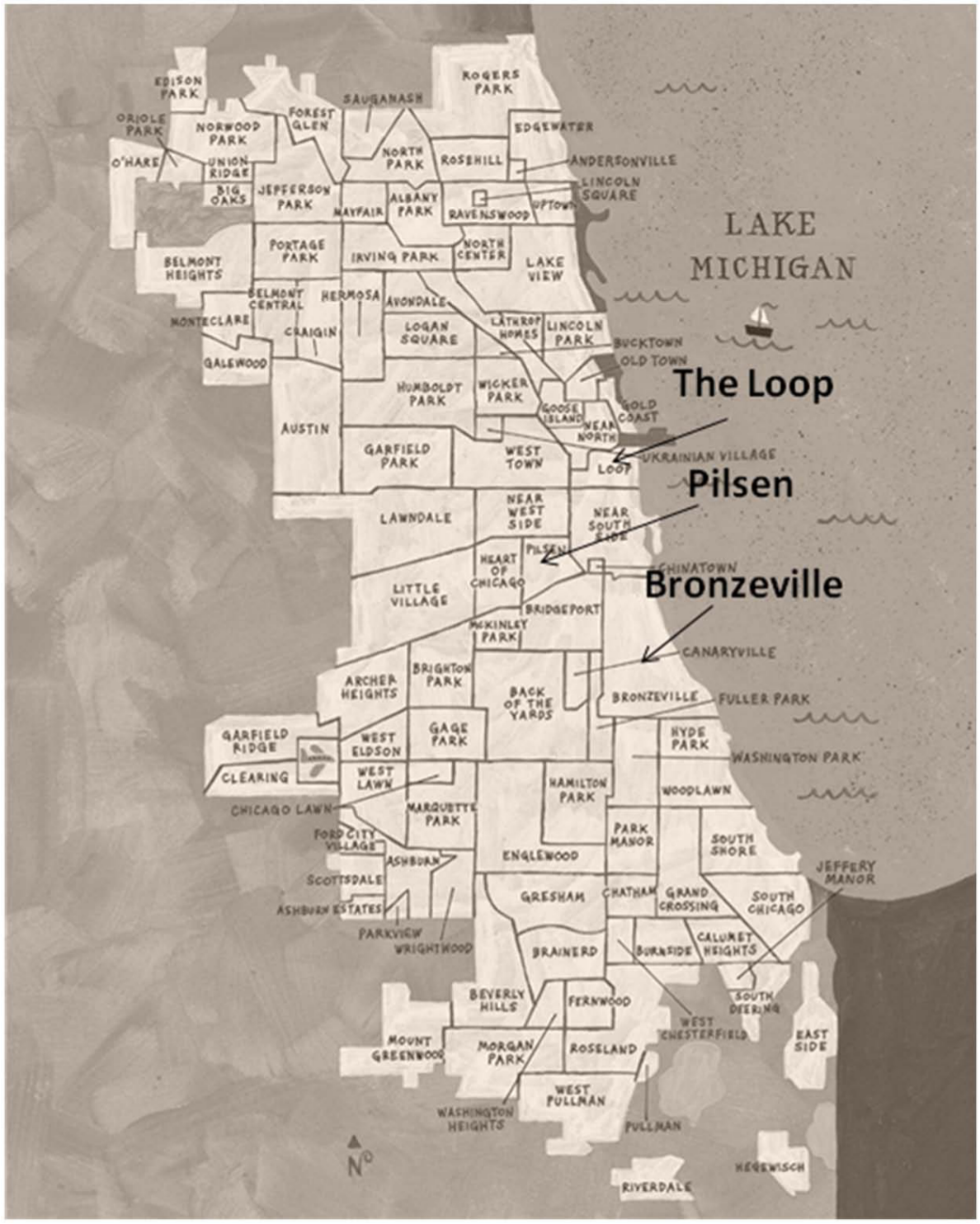
Map of Chicago neighborhoods, including Bronzeville and Pilsen.
In what follows, we first engage with relevant literature on racial economy and the relationship between race and gentrification. Then, following a brief section on neighborhood profiles and methods, we empirically chronicle the experience of Bronzeville and Pilsen. After decades of neglect, both neighborhoods are now experiencing a new and emergent form of “non-White” gentrification: the displacement of a low-income non-White population by one of non-White affluence. A driving feature of this has been an evolved process of racial recodification and sanitization. Yet, as we reveal, established but different conceptions of Blackness and Latinoness are differentially mediating factors: Redevelopment agents, despite their recodification campaigns, are continually forced to negotiate what are deeply entrenched mainstream sentiments and imaginaries of both racial types. Redevelopment, in the process, has proceeded differently in both neighborhoods due to these distinctly different racial conceptions.
Racial Economy and Gentrification
Racial economy is a perspective that seeks to explain processes of capitalist uneven development by examining the “interconnections” between “political institutions, economic markets, and conceptions of race” (D. Wilson 2009, p. 140). It represents an emergent body of research that spans multiple disciplines. Of course, the issue of race has been a central concern within urban sociology and critical race studies for decades. However, following D. Wilson (2009), the specific connections between race and political economy are minimally understood and need a more thorough explication, particularly in a time (the neoliberal era) when race and racialization are crucial forces through which urban change, redevelopment, and policy making unfolds.
Although research in this conceptual orientation can be traced back several decades (Peet 1975; Tabb 1970, 1971), it has only recently emerged as an important epistemological project in geography and urban studies (see Gilmore 2002). This includes, for instance, the role of race in the construction of post–World War II “narratives of decline” (Cope and Latcham 2009; also see Beauregard 1993), the development of U.S. industrial capitalism (B. Wilson 2000), processes of urban neoliberalization (Barraclough 2009; K. Mitchell 2004; Pulido 2000, 2006; Roberts and Mahtani 2010; D. Wilson 2007), the neoliberal prison-industrial complex (Gilmore 2006; Peck and Theodore 2008; Wacquant 2009), and discriminatory patterns of subprime mortgage lending (Wyly et al. 2006; Wyly et al. 2009; Wyly and Hammel 2004).
Racial economy, as an emergent perspective, can be characterized by three central points. First, conceptions of race, humanly produced, are inseparably connected to the unfolding of urban economies (Gilmore 2002, 2006; Pulido 2006; B. Wilson 2000). These economies, constituted by assemblages of actors and institutions that produce and redistribute wealth, are deeply shaped by race: It operates as an “expedient opportunity structure” through which political and economic actors—city officials, realtors, developers, lenders—advance their capitalist interests (D. Wilson 2009, p. 141). These actors, however, do not just draw upon existing racial conceptions. They also, in the process, work through, remake, and often transform these conceptions (Roberts and Mahtani 2010).
Second, “racial economies” are interpreted as complex, evolving cultural projects (D. Wilson 2007). Rather than blunt, static formations crafted through strictly economic imperatives, their functioning also necessitates the careful mobilizing of elaborately choreographed identities—the Black and Latino poor—to legitimize these imperatives. In the process, political and economic actors must continuously navigate evolving public perceptions on race. To D. Wilson (2009), these actors help constitute a cast of characters whose function is to justify capitalist agendas, such as restoring city competitiveness, up-scale redevelopment, and banishing the racialized poor— historically narrated as crime-ridden and prone to gang violence—to spaces of disinvested neglect.
Third, the role of space is also understood as an important constitutive aspect to the functioning of these economies (Swyngedouw 2000). Space is conceptualized here as a social product, as “institutionally produced but humanly mediated” (D. Wilson 2009, p. 143). Produced social spaces—public housing towers, low-income residential spaces, glossy gentrified townhomes, and sites of historical preservation—operate as deeply symbolic and visual “carriers” of a multiplicity of meanings: They are active mediums through which people constitute their identities and shape the “socioracial” stocks of knowledge that these economies constantly work through and (re)produce (D. Wilson 2009).
Research in this perspective, however, has typically focused on the study of urban poverty and marginalization. It also tends to be biased toward the Black experience in urban America, although the Latino experience is now growing (see Davila 2004; Hague, Hague, and Breitbach 2011; D. Wilson, Beck, and Bailey 2009). Latinos, contrary to Blacks, are more likely to be depicted as submissive, hardworking, and dependable sources of labor (see Gomberg-Munoz 2011). In Chicago, as a result, neighborhoods inhabited by low-income Latinos tend to function as zones of low-wage “manual” labor for businesses (i.e., construction and landscaping firms): The majority of day-labor sites are located in these neighborhoods (Peck and Theodore 2001). This has fostered a specific kind of racial economy in these settings: the “neoliberal-parasitic economy” of day-labor hirers, payday lenders, check cashers, temp agencies, and pawnshops (D. Wilson 2011; D. Wilson, Beck, and Bailey 2009).
Despite portrayals of Latinos as culturally stunted (Grammenos 2006; D. Wilson and Grammenos 2005; D. Wilson, Grammenos, and Wouters 2004), similar to Blacks, neighborhoods inhabited by mostly low-income Latinos represent distinctly formed racial economies constituted by (and replete with spatial signifiers of) specific conceptions of Latinoness. Neighborhoods inhabited by low-income Black populations, however, although marked by similar “parasitic” installations, lack the same degree of day-labor sites and tend to function more as zones of low-wage fast food and/or janitorial labor. The question of how conceptions of Blackness and Latinoness differentially affect racialized spaces undergoing redevelopment, however, remains to be examined through this lens. In this context, we suggest that racial economy can be fruitfully applied and extended through this study’s focus on urban redevelopment and intraurban contingency.
Race and Gentrification
Although the literature on gentrification is now voluminous (Lees, Slater, and Wyly 2008), the role of race in this process remains to be systematically explored. Until recently, gentrification in Chicago and other large U.S. cities has predominantly meant the displacement of the non-Black poor (i.e., Latino or mixed populations) by affluent White populations (Smith 1996; D. Wilson and Grammenos 2005). Gentrification has only recently (until the 2000s) affected neighborhoods inhabited by low-income Black populations. This is in large part due to the urban renewal of the 1950s and 1960s where many of these neighborhoods, such as Bronzeville, were cleared for either concentrated public housing or redevelopment at a later date (Hirsch [1983] 1998). These disinvested spaces have remained poor and primarily Black due to the ominous image and presence of public housing and their media-reinforced perception as the worst crime-infested spaces imaginable (Dreier 2005; D. Wilson 2007).
However, following Smith’s (1979, 1996) widely acclaimed rent-gap thesis, we should expect gentrification to begin in the most disinvested inner-city neighborhoods where the rent gradient is steepest. This has not been the case as neighborhood-specific conditions, such as stigmatized structures like public housing, often mediate the operation of the rent gap (Lees, Slater, and Wyly 2008). These mediating forces are now well chronicled, particularly how “cultural” considerations—such as agency and consumption (Ley 1986, 1996), local business climates (D. Wilson 1991, 2004b), and the (re)packaging of ethnic histories (Mele 1996, 2000; Sorkin 1992) and historic infrastructure (Zukin 1982, 1995)—often complicate explanations of gentrification that are reduced to structured economic imperatives.
The role of race as a mediating factor was, in fact, acknowledged as early as Schaeffer and Smith’s (1986) speculative forecast of gentrification in New York’s Harlem (also see Taylor 2002). Although Harlem represented the gutter of the land-rent valley in New York, it remained poor and Black through the 1980s while other non-Black neighborhoods (i.e., SoHo and East Village) were gentrified instead. In short, gentrification in many large U.S. cities has tended to initially affect smaller pockets of less disinvested spaces perceived to be less risky: neighborhoods inhabited by mostly non-Black populations. The “pioneering” White middle class has been reluctant to consider low-income Black neighborhoods primarily due to particularly demonizing conceptions of Black poverty and public housing (Smith 1996).
The experience of Harlem similarly marks that of Bronzeville (Hyra 2008)—historically (until recently) the site of the vast majority of Chicago’s public housing stock (Bennett, Smith, and Wright 2006; Hirsch [1983] 1998). We stress, however, that public housing should not be treated as a distinct “spatial” variable separate from race: It is a deeply racialized spatial structure linked to Chicago’s particularly contentious history of Black–White race relations. In short, the image of public housing and Black poverty in this setting are inextricably linked (Rast 1999). 5 Pilsen and Latino residents, in comparison, are less affected by this form of spatial stigmatization, a factor attributed to the different “socioracial” historical legacies that mark these two landscapes.
A new form of gentrification, however, now affects neighborhoods formerly inhabited by low-income Black populations. In these emergent cases, low-income Blacks are displaced by a primarily affluent Black population; a form of “Black gentrification” that, to Moore (2009), represents a distinct departure from established White-led patterns (also see Boyd 2008). Marking this form of Black gentrification are positively charged conceptions of early twentieth century African-American culture, as chronicled in Bronzeville (Boyd 2008; Hyra 2008; Pattillo 2007), New York’s Harlem (Hyra 2008; Taylor 2002), Atlanta’s Auburn Avenue (Inwood 2010), and Philadelphia’s Brickton (Moore 2005, 2009). While comparatively less studied than the African-American experience (Brown-Saracino and Rumpf 2011), many spaces inhabited by predominantly low-income Latinos, like Pilsen, are also experiencing a form of “Latino gentrification.” These cases are marked more by mixed gentrifying populations that include Whites in addition to Latinos (see Davila 2004; Perez 2004). These studies (on both Black and Latino gentrification), however, tend to focus more on the race/class dynamics of this gentrification than the role of race within the process itself.
Both forms of gentrification also reflect an emergent trend unfolding across urban America: non-White gentrification. This is due, in large part, to the significant growth in both Black and Latino middle-class populations over the past three decades (Grammenos 2006; Hyra 2008). 6 A central characteristic of this gentrification, as these studies illustrate, has been a necessary recodifying of established, negative conceptions of race. These established conceptions, once politically and economically functional, are now deemed incompatible with a non-White middle class that seeks to carve out its own space for identity constitution. 7 As a pragmatic adjustment, Black and Latino residents are now portrayed by redevelopment agents in ways that contradict the established “ghetto-invoking” imagery: They are now morally sound and hardworking citizens as opposed to the classic renderings of being uniformly socially pathologic and mired in conditions of self-imposed poverty (Wacquant 2008; D. Wilson 2007). We examine the differential impacts of this in Bronzeville and Pilsen after the following brief discussion on methods.
Demographic Profiles and Research Methods
The Chicago neighborhoods of Bronzeville and Pilsen were selected for investigation as they exhibit many similarities. 8 Both sites enjoy good access and proximity to downtown, have an affordable and “historic” housing stock (more than 50% in both neighborhoods were built before 1939), similar class composition, nearly identical rates of racialized minority populations, and have experienced similar degrees of contestation to redevelopment. Both also share similar histories as spaces of racialized poverty and marginalization (Wacquant 2008; D. Wilson, Grammenos, and Wouters 2004) that, since the early-1990s, have been targeted for substantial redevelopment. Yet, their racial compositions differ: Bronzeville is predominantly African-American, and Pilsen is Mexican and Mexican-American. We suggest these attributes render these two neighborhoods appropriate for comparative analysis.
Bronzeville, although not officially recognized as a “community area” in Chicago, 9 is typically referred to as the combination of the Douglas and Grand Boulevard community areas (Boyd 2008). 10 Pilsen, also not an officially recognized community area and popularly noted as “La 18,” is the primary neighborhood within the Lower West Side community area. For purposes of simplification, the figures in Table 1 are representatives of these common territorial markers. Both neighborhoods have experienced similar population declines yet maintain their African-American and Latino majorities. Douglas, north of Grand Boulevard, has experienced an increase in White residents since 2000 (6.7%-9.9%), concentrated to the most northern sections. The greater Bronzeville area, however, remains mostly African-American, with Grand Boulevard holding at 94%.
Population, Demographic, and Income Figures for Bronzeville (Douglas and Grand Boulevard) and Pilsen (Lower West Side).
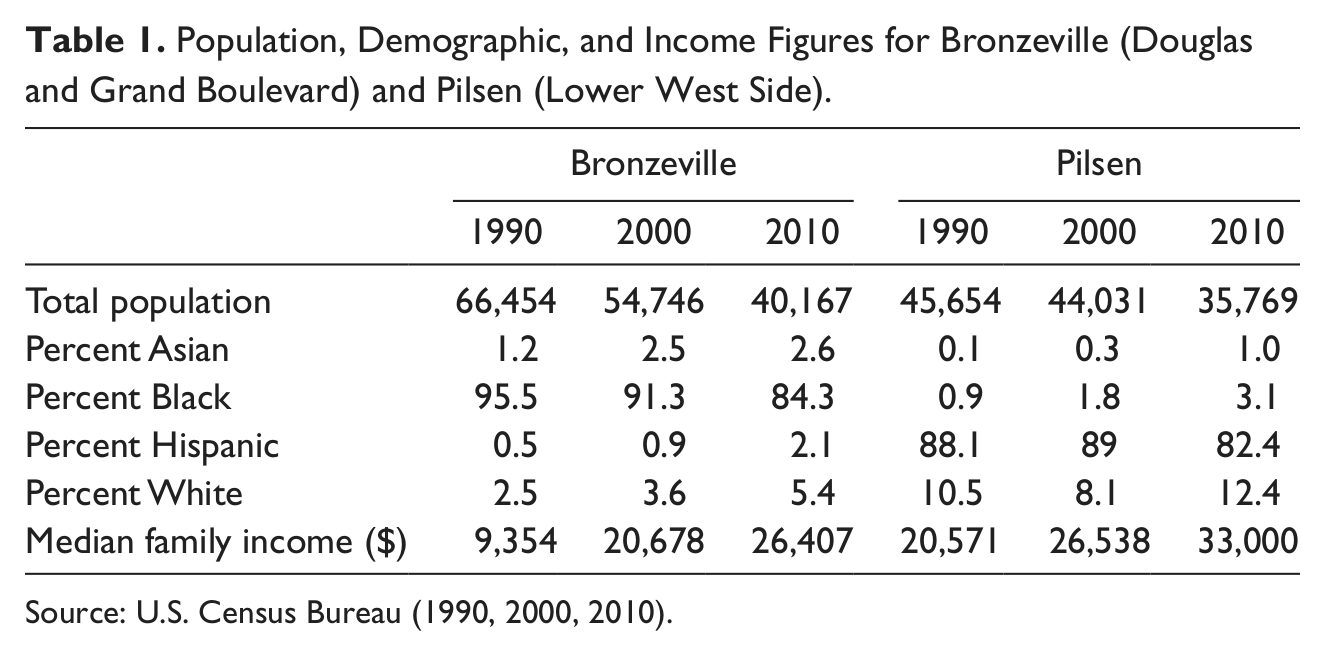
Source: U.S. Census Bureau (1990, 2000, 2010).
Pilsen’s Latino population has fallen from 89% in 2000 to 82.4% in 2010. Pilsen’s White population, however, has increased by 28.2% and is concentrated mostly in affluent pockets along 18th Street between Halsted and Damen Avenues and adjacent to the University Village retail complex. Both of these neighborhoods are also marked by notable increases in median family income. For example, between 1990 and 2000, the average household income in Grand Boulevard increased by 111.5%.
The evidence presented in this article is drawn from wider case studies on Bronzeville and Pilsen. Our analysis involved examining 500 newspaper articles and policy documents dating from 1989 to the present, primarily from the Chicago Tribune and Chicago Sun-Times. In the process, the dominant actors and rhetorical themes in each neighborhood were identified. In total, 40 semistructured interviews were also conducted with community organizers, city officials, planners, business owners, developers, and residents in both neighborhoods. To supplement this, 10 White middle-class residents were interviewed beyond Bronzeville and Pilsen: 5 in Hyde Park, south of Bronzeville and relatively close to Pilsen and 5 in Albany Park, on the far north side of the city. 11 These interviews were conducted to gain a sense of the perceptions of African-American and Latino culture among this racial group in Chicago, from neighborhoods in both close proximity to and well removed from both study sites.
Chicago’s Bronzeville
Bronzeville’s history as an African-American neighborhood on Chicago’s south side dates to the late-nineteenth century when African-Americans migrated from the south in search for employment (see Boyd 2008; Drake and Cayton [1945] 1993). Despite vicious discrimination, ruthlessly enforced segregation, and horrific living conditions, this early period is remembered today by city officials, developers, and local organizers as a “vibrant” African-American neighborhood of cultural vitality and racial solidarity. Commonly referenced as the “Black Metropolis” (Boyd 2008), Bronzeville was home to many successful Black businesses, night clubs, blues bars, and notable figures such as Richard Wright, Gwendolyn Brooks, Duke Ellington, Louis Armstrong, Langston Hughes, and Muddy Waters (Boyd 2008; Hyra 2008; Pattillo 2007). During the mid- to late-twentieth century, however, Bronzeville was socially and economically decimated by deindustrialization, mass suburbanization, and urban renewal (Hirsch [1983] 1998; Hyra 2008; Venkatesh 2000; Wacquant 2008; W. Wilson 1996).
After decades of disinvestment and neglect, the fortunes of this community began to change circa 1980. At this point, an array of local institutions in the area mobilized to inaugurate a community renewal. The centerpiece of this was a “rediscovery” of the area’s history and culture, promoted by the rise of a well-organized coalition of Black middle-income homeowners and activists. This was principally a means to attract investment and resources that were primarily flowing to other parts of the city (Boyd 2008; Pattillo 2007).
These activists, however, faced a steep uphill battle as Bronzeville had come to represent the most disinvested and demonized landscape in the city. For city officials and developers, Bronzeville’s reputation as riddled with crime and poverty stifled any consideration for redevelopment (Hoffman 2003). But in the 1990s, this local movement, led by the Mid-South Planning and Development Commission (MSPDC), had garnered the attention of a growing base of Black middle-class consumers through its persistent efforts to revitalize the long-lost Black Metropolis (Boyd 2008).
At the same time, another redevelopment force was emerging: the drive to demolish and revitalize the area’s public housing. Its roots were in a deeply racialized and national discourse to retrench public housing across urban America. By this time, the image of public housing, long one of drugs, crime, and gang violence, had developed deep roots in Chicago (see Wacquant 2008). This discourse promptly led to the targeting and eventual demolition—through the federal Housing Opportunities for People Everywhere (HOPE VI) program—of the vast majority of Bronzeville’s public housing by the early-2000s (Hackworth 2007; Hyra 2008). Perceived as a major impediment to redevelopment on the south side (Hoffman 2003), efforts to revive the Black Metropolis were now catalyzed (Anderson 2012; D. Wilson and Sternberg 2012). It was at this point, in the mid-1990s, that the city pragmatically endorsed the MSPDC-led vision. As Mayor Daley declared in 2000,
That’s exactly how Bronzeville became the center of African-American business and culture during the period between the two world wars . . . The members of the community built their own homes, churches, clubs and businesses. Families were strong, and people looked out for each other. (in Blair Kamins, Chicago Tribune, July 28, 2000)
As this “nostalgic revival” gathered steam through the 2000s, Bronzeville was collectively promoted by city officials, developers, and local organizers as a site of historical and cultural preservation, tourist destination, and historic “Blues District” (Boyd 2008). This once demonized, ghetto-stricken “urban jungle” became a landscape increasingly portrayed through the media as an attractive neighborhood with good, decent, and caring citizens who embody the kind of entrepreneurial spirit that once marked the neighborhood’s heralded “golden years.” Media stories on Bronzeville’s redevelopment have typically played to this purported rich history:
Bronzeville always has been a portrait framed by African-American culture—and that culture is now reviving the historic community . . . is once again brimming with a renewed fellowship. African-American entrepreneurs are lifting up the community with their own hands. (Dan Hoekstra, Chicago Sun-Times, p. D1, March 26, 2005) Bronzeville was once a thriving “black metropolis” with hundreds of black-owned businesses and a booming night life. (Cromidas 2010, p. A33A)
In the process, this narrative became widely accepted and understood as core truth. As one local business owner recounted, “It’s [Bronzeville’s rich history] so embedded in the community, even to the extent that that’s what cab drivers talk about . . . the good old days of the blues when you’re riding through the neighborhood” (interview, August 17, 2010).
The propagation of this narrative by redevelopment agents reflects a governance that is adeptly responsive to changing local and racialized conditions. With redevelopment led exclusively by the Black middle class, endorsing this vision was deemed a necessity. As one local planner verified and exhibiting a sense of pragmatics rather than genuine adoption, “for many [city officials and planners], if it means having to put up some statue of some local historical figure to get things rolling, then so be it” (interview, February 8, 2011).
Despite this increasingly sanitized portrayal, established perceptions among non-Black outsiders remain just as prevalent. The following images were given by White, middle-class Chicago residents when asked to comment on their thoughts of Bronzeville and African-Americans in Chicago:
When you think of Blacks in Chicago the first thing that comes to mind is poverty . . . kids getting killed by other kids. (interview, April 5, 2011) Well, when you think of the south side, the reputation is Black male violence, that’s the first thing that comes to mind . . . the absence of family structure . . . and, of course, the history of racial discrimination. (interview, April 5, 2011) I don’t even really know where this place [Bronzeville] is, I mean, I know it’s between downtown and Hyde Park, but it’s just like empty space in my mind, I never even think about it. (interview, May 29, 2011)
12
For many, lingering negatively charged conceptions of Black poverty remain silent obstacles to redevelopment, as the following remarks reflect:
Hurdles to development included concerns about crime that are rooted in racial stereotypes. (local organizer, Cromidas 2010, p. A33A) I still have guests arrive from the airport where the cab driver warned them not to come down here, that they’ll get mugged, shot . . . it scares them . . . and it’s bad for business. (interview with local resident and business owner, August 17, 2010)
Although redevelopment agents now propagate a revised and positive portrayal of Bronzeville (and African-Americans) they must also negotiate the persistence of these deeply entrenched negatively charged imaginaries. As a result, on one hand, this redevelopment has struggled to attract even a hint of non-Black investment or consumer interest. Following Krysan (2000, 2002), this is, to a large degree, because the relative proportion of Black people in a given area tends to anticipate the common perceptions of crime among Whites—perceptions that remain colored by preexisting stereotypes (also see Krysan and Lewis 2006). On the other hand, it has attracted a sizable Black middle-income base of newcomers. Responding to this dilemma, redevelopment agents often explicitly target only this population group (see Figure 2). 13
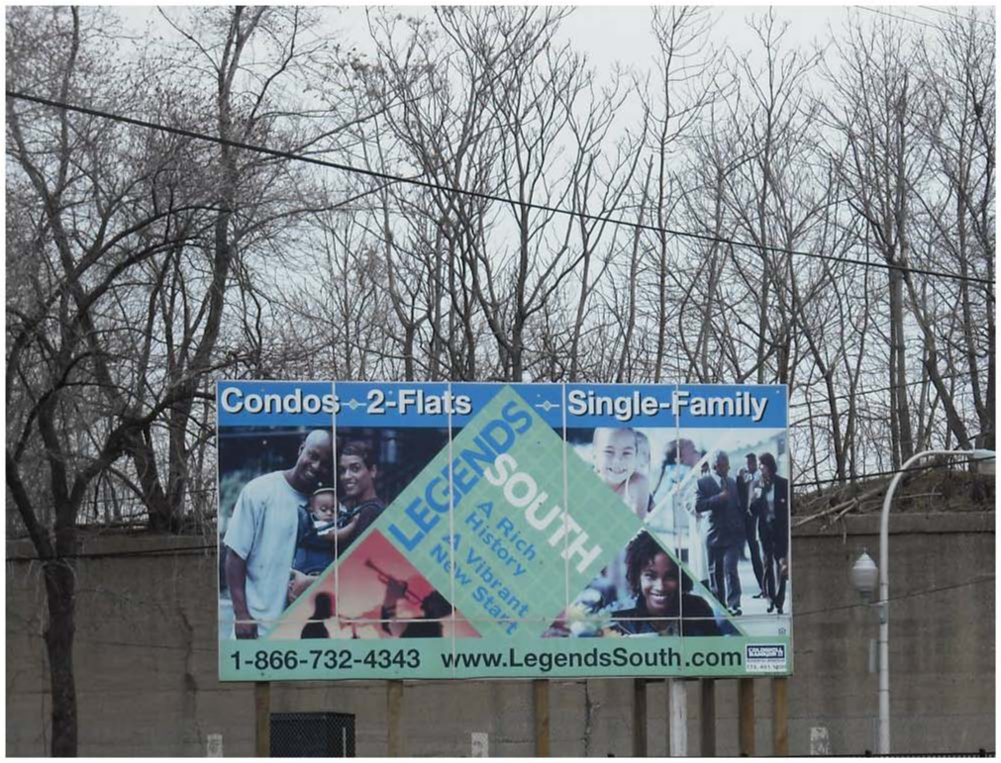
The “rich history” at Legends South replaces the now demolished Robert Taylor Homes.
Redevelopment in Bronzeville has also struggled to attract the degree of entertainment-oriented businesses and visitors/consumers that other tourist-branded neighborhoods have experienced. A local organizer bemoans this persistence:
Why can’t we improve like Andersonville? . . . Or be like Lincoln Park? . . . What’s wrong with our neighborhood? . . . There shouldn’t be anything standing in our way that isn’t for all these other neighborhoods. (interview, June 18, 2009)
As reported in the Chicago Sun-Times, “Although property values have skyrocketed in the former ghetto, tourists are not pouring into Bronzeville, and there is only limited recognition of the area’s importance to African-American history [outside of Bronzeville]” (Anderson 2007, p. B7). A former Bronzeville resident laments the now failed Blues District, once celebrated as the foundation of the neighborhood’s revival:
You only have local Black folks that are really going to go and spend money in those spaces . . . ya know, the folks that are invested in this history and tradition, but its only the wealthier people, poor folks can’t justify spending the kind of money that keeps these places in business . . . and Whites simply aren’t gonna come down here, I never saw one White person down here, they’re just not gonna come flocking down from the north side to experience the blues. (interview, May 29, 2011)
For many local residents and redevelopment agents alike, the push to remake Bronzeville into a tourist destination, despite its residential gentrification, has failed precisely because of lingering conceptions of Black poverty:
The only “blues” I see around here are the blue police cameras they’ve got up to stop the drug dealers . . . You see any customers in here? (local business owner, Olivo 2009, p. 1)
To 3rd ward Alderman Pat Dowell,
To me, the idea of this blues district is not grounded in reality . . . nothing against blues, but I don’t think that concept is viable in the community today. (Olivo 2009, p. 1)
The “reality” that Dowell references is rooted in mainstream conceptions of Blackness that continue to hinder the development of Bronzeville into a tourist destination and site for “ethnic consumption” on par with other Chicago neighborhoods such as Greek Town, Chinatown, and Pilsen.
Although Bronzeville is still advertised as a tourist destination (e.g., the Bronzeville Visitor Information Center), featuring tours and events that do attract visitors, the city and outside investors are no longer chief promoters of this vision. In fact, the now defunct Blues District is seen by many as having directly affected Dorothy Tillman’s failed reelection as longtime 3rd ward Alderman in 2007 (Olivo 2009). 14 Her replacement, Pat Dowell, has now pulled the plug on the Blues District as a tourist-attracting venture, one of the hallmarks of Tillman’s aldermanic tenure.
In addition, large-scale retailers have yet to match the degree of purchasing power that the neighborhood’s ongoing residential gentrification has produced. Indeed, Bronzeville’s median income has skyrocketed while thousands of low-income residents have been displaced from public housing demolition and spiraling costs (Hyra 2008). Yet, as one local planner informed us, retail capital remains guided by “misconceptions that poor neighborhoods provide too little purchasing power” to justify investment (interview, February 8, 2011). But Bronzeville is not the poor neighborhood it once was. Rather, it is the image of Black people (and associated stereotypical understandings) rather than poverty that is likely driving this persistent reluctance, a seeming imperceptibility of class variation within Black communities among non-Black outsiders (see Moore 2009).
Bronzeville, it should be noted, is not void of retail establishments. But it is specifically lacking the kind of mainstream outlets that attract middle-income consumers. For former Alderman Toni Preckwinkle, the neighborhood is not in need of just any commercial development: “She’s [Preckwinkle] just as clear about what she doesn’t want—no more nail salons, barber shops, hair salons or beauty stores” (Chandler 2007, p. 1).
15
To Pam Dempsey, local real estate broker, there’s no need for “the fast-food stuff we already have around here . . . but nicer retail, like the stuff that came to the South Loop and Hyde Park” (Cromidas 2010, p. A33A). In fact, many homeowners are often reported to “leave the neighborhood to enjoy a nice dinner out” due to the lack of such establishments nearby (Reed 2005).
16
Alderman Dowell laments this seemingly insurmountable dilemma:
People feel they have to drive out of the community to sit down and enjoy a meal and that should not be. Last Friday night, I went to a restaurant on the North Side . . . We had a choice of many. [In Bronzeville] we don’t have the same kind of options. (in Don Liebenson, Chicago Tribune, November 27, 2009)
Bronzeville also lacks a decent number and diversity of local grocery stores, according to a study conducted by the Mari Gallagher Research and Consulting Group: “About 70 percent of the food desert population [in Chicago] is African-American, and the remainder is equally split between Whites and Latinos” (in Lolly Bowean, Chicago Tribune, June 24, 2011).
To date, stereotypical conceptions of Blackness have marked this redevelopment in distinct ways: It is primarily residential and targeted almost exclusively to the Black middle class. It is also partial, hyperbalkanized, and limited mostly to the neighborhood’s eastern sections (Anderson 2012). In fact, despite the neighborhood’s increasingly sanitized portrayal, many news stories temper this with a reminder that Bronzeville is still plagued by “lingering crime and drug activity” (William Wilen, in Susan Diesenhouse, Chicago Tribune, October 28, 2007). In this context, Bronzeville’s revival is marked by a tension-ridden ambiguity: Alongside its sanitized rendering, the neighborhood remains haunted by a demonizing imaginary that continues to influence this evolving racial economy.
Chicago’s Pilsen
Until the 1950s, Pilsen—situated on the near southwest side of Chicago—was a neighborhood of predominantly Eastern European immigrants. This changed through the 1960s and 1970s when a steady wave of Mexican migrant workers settled in Pilsen to take advantage of its close proximity to downtown industrial jobs and inexpensive housing (Baker 1995). By the 1980s, Pilsen had become a predominantly Latino (Mexican and Mexican-American) neighborhood and remains a sizable port of entry for Latino immigrants in Chicago. This demographic transition, however, was also accompanied by a pummeling deindustrialization that left many Pilsen residents jobless shortly after arrival (Peck and Theodore 2001; D. Wilson, Grammenos, and Wouters 2004).
Unlike Chicago’s African-American population, its Latino population has historically experienced displacement from White-led gentrification. Wicker Park, Bucktown, Lincoln Park, and University Village have all experienced the displacement of low-income Latinos by affluent Whites since as early as the 1970s (Betancur 2005; Perez 2004; D. Wilson and Grammenos 2005; D. Wilson, Grammenos, and Wouters 2004). Well before Bronzeville, in the mid-1980s, Pilsen’s proximity to downtown and depressed property/land values has drawn the attention of developers (Curran and Hague 2008; D. Wilson, Grammenos, and Wouters 2004).
At this time, redevelopment agents initially deployed similarly demonizing portrayals of Pilsen as a decrepit ghetto in need of refurbishment and colonization by affluent White “pioneers,” and inhabited by untamed residents with limited work ethics, entrepreneurial values, and plagued by the supposed “culture of poverty” (Delgado 1999). For example, to a local developer,
Pilsen has become, quite simply, a crime-ridden slum . . . a Mexican ghetto. It is now less a place for decent people and decent families. The streets have become dangerous, the kids outside [on the streets] are destructive . . . it is a neighborhood that needs to be changed. Hell, I wouldn’t let my kids or any decent person I know walk these streets. (D. Wilson, Grammenos, and Wouters 2004)
Redevelopment slowly permeated Pilsen’s borders through the 1990s and the early 2000s in the form of affluent new construction, condo conversions (Figure 3), trendy cafes and businesses, and the arrival of more affluent residents (Betancur 2005). However, due to a strong legacy of activism in Pilsen and history of Latino displacement in Chicago, an ensemble of local activists formed a coalition, led by Pilsen Alliance, against what was only ever feared in Bronzeville: White-led gentrification (Puente 1998; D. Wilson, Grammenos, and Wouters 2004). This resistance, in fact, proved effective in forcing the retreat of many developers to other gentrifying neighborhoods where resistance was less formidable and organized such as Wicker Park, Bucktown, and Uptown.
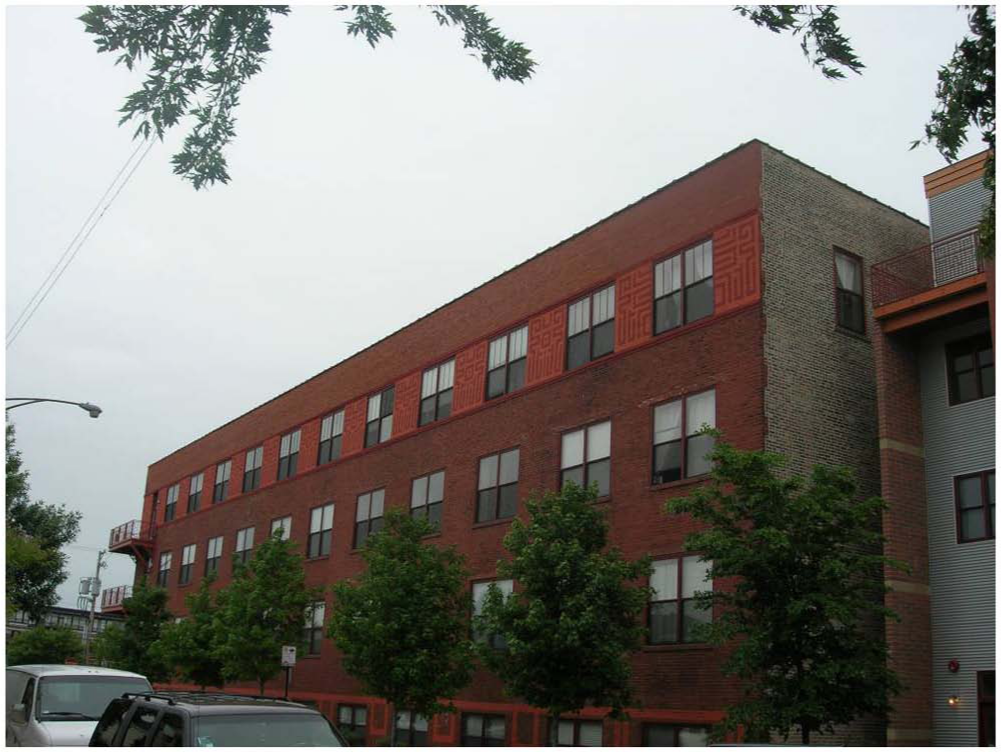
“Chantico Loft” condominium complex located on 16th street and Carpenter is a recycled four-story, 44,000-square-foot brick warehouse built by Lipe Properties.
But since the early-2000s, a compromise between some activist groups and a new ensemble of redevelopment agents formed around a revised and positively charged portrayal of Pilsen and its inhabitants (D. Wilson, Grammenos, and Wouters 2004). Led by 25th ward Alderman Danny Solis, the Chicago Office of Tourism, and the Pilsen Together Chamber of Commerce—and later through the Pilsen Planning Committee (a coalition led by Solis and four local community organizations)—this once maligned (discursively and materially) landscape is now recodified as an authentic and vibrant Mexican “ethnoscape” inhabited by a new racialized subject: the hardworking, professional, and civically reliable Mexican citizen. To Solis,
My vision is to make Pilsen the preeminent Mexican-American community as Chinatown is to Chinese-Americans—not only for the families who live here but for people who visit . . . we have a good mix of working-class and professional people who are fixing up the older buildings, getting involved in the community and putting down roots. We’ve always been a port of entry, but now we are more than that. (in Leslie Mann, Chicago Tribune, March 6, 2009)
This vision of Pilsen is deployed to facilitate a form of tourist-oriented redevelopment not too dissimilar from the one advanced in Bronzeville:
We have a great deal of orgullo, or pride, in what we have built in Pilsen, and we believe that the best future for this community is one that incorporates and celebrates our Mexican culture. (Pilsen Planning Committee 2006, p. 2)
In a similar act of pragmatics, Pilsen is now portrayed through an idealized, manufactured, and commodified vision of Mexican culture and community (Sternberg 2012) such as the “Mexican Mecca of the Midwest” (Betancur 2005):
A true Mexican neighborhood like Pilsen is one part of the total ethnic puzzle that makes Chicago a diverse ethnic city . . . preserving this ethnicity is the key. It is our job to identify [this], capture [this], and sell [this]. (Chicago Office of Tourism representative, D. Wilson, Grammenos, and Wouters 2004)
Despite persistent resistance from Pilsen Alliance (Avila 2005), this revised portrayal has worked to politically defuse much of Pilsen’s established base of opposition (i.e., The Resurrection Project and Pilsen Neighbors Community Council) by appealing to the identity-based sensibilities of both existing residents and the neighborhood’s growing Latino middle class. This now dominant vision effectively recodifies a formerly stigmatized landscape as sanitized and exotic, as reflected in the following media reports:
A walk down 18th Street, in the heart of Pilsen, makes all the senses come alive as smells of Mexican baked goods permeate the air and sounds of Latin music spills out of the record shops. (Lucio Guerrero, Chicago Sun-Times, July 1, 2005) You’ll still find old-school Mexican spots in this neighborhood . . . But stirred into the mix are funky second-hand shops, Chicana boutiques, upscale bakeries and artist cafes that make the area an exciting place to stroll after a Pilsen lunch or a visit to the Mexican Fine Arts Center Museum. (Monica Eng, Chicago Tribune, November 12, 2004)
As opposed to Bronzeville, this revised vision of Pilsen, we suggest, resonates more deeply in the public imaginary and increasingly shapes people’s conceptions of Latino culture and residents in Chicago and beyond.
17
This is reflected in the numerous media reports on Pilsen’s redevelopment:
Their pride can be seen in the ornate stone facades of buildings along 18th Street and in the brick and frame two-flats that give the community its sturdy feel . . . The lively culture of the Mexican-American people is now evident in restaurants, shops and the Mexican Fine Arts Museum. (Chicago Tribune 2005) The bleachers were filled with moms, dads and siblings cheering them on. And, this being Pilsen, lots of grandmas and other relatives in the extended family were right there with them. Latinos like to keep their family members close and involved. (Suzanne Ontiveros, Chicago Sun-Times, May 14, 2004)
Redevelopment agents have responded accordingly. As a result, established conceptions of Latinos as family oriented, hardworking, and community minded, despite purported cultural pathologies, embed in this redevelopment process in distinctly different ways. A local planner explains,
Well, Bronzeville is also redeveloping, much like Pilsen . . . both are considered up and coming neighborhoods . . . I don’t know much about Bronzeville, but there does seems to be a perception, at least, that Pilsen is attractive to a broader consumer base . . . for Bronzeville, while it’s understood that this is a Black neighborhood, Pilsen seems to be attractive to a more diverse range of people, as tourists, for the restaurants, as residents . . . but both are moving forward. (interview, February 9, 2011)
The sense is given here that Pilsen is treated as a more viable site of “ethnic consumption” than Bronzeville. This is also reflected in the following remarks from a former Bronzeville resident and planning assistant:
Mexicans, I feel, to folks I know, seem more festive . . . the culture I would say is perceived as more fun and mainstream . . . you think of good food before anything else, it’s just more exotic and non-American, which I think makes it more successful as a marketing thing . . . you still think of poverty and deviance, and what not, but not nearly as much [for Blacks], and it’s not as closely attached to their [Latino] culture, definitely not as much anymore, I would say . . . If anything, they get flak for stealing our jobs . . . but people are still gonna love drinking margaritas and eating burritos. (interview, May 29, 2011)
Most notably, systematic reference to Mexican food marks media portrayals of Pilsen: “Pilsen is Mexican-American culture. Pilsen is food. Pilsen is murals, a riot of color splashed onto the side of a building” (Garvey 2011, p. 6). This aspect of Mexican cuisine, that is, its greater salience within the American mainstream, is often played up by redevelopment agents. For instance, to Solis, “My vision for Pilsen is to become the best Mexican-American community in the Midwest, where you can come taste the food and experience the culture” (Webber 2003, p. 49). The same White, middle-class Chicago residents, now commenting on Pilsen, responded similarly when asked about their thoughts of Pilsen and Latinos in Chicago:
Well, they’re [Latinos] not American, Blacks are still Americans, but they’re way more cohesive, and support one another, they stick together . . . stronger families . . . they also don’t have a vendetta, they’ve come here to improve their lives and really work hard . . . and just seem more well-mannered, almost more professional, you know. (interview, April 5, 2011) I think of family, pride, and festivals, family tradition seems strong, there’s a generational continuity . . . and artwork, mural paintings, that kind of thing, they have a distinct cultural identity, which seems lacking for Blacks in the city, and there’s an absence of family structure . . . both [Blacks and Latinos] are discriminated against, but for Blacks it’s a race issue, for Latinos, its cultural, not race, I’d say it’s more class than race. (interview, April 5, 2011)
A distinct conception of Latinoness emerges from all of these comments.
18
Although Pilsen remains predominantly Latino, these sanitized portrayals of Mexican people and culture have proved more effective and attractive among a wider base of non-Latino tourists, consumers, and investors (Sternberg 2012). As Solis notes, “It’s an area that serves not only the people that live there but people who come from all over the world” (in Antonio Olivo, Chicago Tribune, November 15, 2005). As reported in the Chicago Tribune,
Some already know this Near Southwest Side area as a great place to buy authentic Mexican fare . . . for years it has hosted a thriving art community, with performance spaces, artist cafes and vibrant public murals. (Monica Eng, January 24, 2003)
Even other non-Latino ethnic establishments are investing in Pilsen such as the following Italian restaurant owner and developer: “It’s so close in proximity to downtown, the University of Illinois—and there’s a whole lot of development just north of here . . . there are 4,500 new households that have moved into the area” (Jenkins 2009, p. 1). This contrasts with Bronzeville where there is a lack of similar kinds of non-Black establishments.
Pilsen’s gentrifying population is also mixed, consisting of not only the Latino middle class but also White professionals and artists (interview with local official, March 10, 2010). Both outsiders and non-Latino consumers are also increasingly drawn to Pilsen where, as early as 2003, a “handful of newer retail establishments” have “injected an upscale flavor” (Webber 2003, p. 49). In a Chicago Sun-Times editorial, Pilsen’s 18th Street is described as a “really vibrant—and profitable—shopping area . . . The bodegas were full and restaurants such as Nuevo Leon were doing brisk business, as always” (Suzanne Ontiveros, May 14, 2004). More recently, a total of 20 “ethnic” restaurants were reported to have participated in the third annual “Buen Provecho! Pilsen” in 2010 (Chicago Sun-Times 2010)—a restaurant tour that attracts many non-Pilsen consumers. This distinctly contrasts with Bronzeville where gentrifiers take their consumer dollars elsewhere due to a persistent dearth of middle-income establishments and restaurants.
The media depiction of Pilsen, unlike Bronzeville, is also more focused on its transformation: as a reviving “ethnic” neighborhood that now attracts people from all other cities (Sternberg 2012). Although lingering gang activity is still reported (e.g., Konkol 2010), reminders of the neighborhood’s poverty-stricken past are not as frequent as in Bronzeville where redevelopment is depicted as struggling to move forward. Furthermore, renditions of Pilsen’s history also commonly reference its “100 years of ‘immigrant legacy’” (Patterson 2005), a notion that likens Latinos more closely to Whites (than Blacks) by curiously unifying the neighborhood’s Latino and European immigrant histories:
It [Pilsen] quickly became a center of culture in a working-class neighborhood that has historically been a port of entry for immigrants. (Escalona 2010, p. 27)
Despite increased foreclosures and joblessness, affluent colonization continues in Pilsen, featuring new surges in loft condominiums, bookstores, coffeehouses, and trolleys that bring tourists to new shops and high-end restaurants (Curran and Hague 2008). Between 2001 and 2006, the median housing price in Pilsen increased from $145,000 to $295,000 (Garvey 2011), with the steepest changes registered along Halsted and 18th Street. As a consequence, as noted by a local official, low-income Latino residents—despite their positively charged portrayals—continue to be displaced westward to disinvested Little Village and as far as suburban Cicero and Berwyn (interview, March 10, 2010).
Concluding Remarks
This study has engaged and extended racial economy by examining the semiotic functioning of race as a central constitutive dimension and driving force within processes of capitalist urban redevelopment. In the process, we have chronicled two historically racialized neighborhoods that now experience an emergent form of non-White gentrification. Propelling this, redevelopment agents in both settings now exude a kind of race-based sensitivity rooted in place-based “traditions” that draw on idealized visions of Mexican and African-American heritage and identity.
Two critical points are revealed. First, urban redevelopment governances are acutely perceptive to evolving and varying local conditions, and exhibit an adept flexibility in their responsive capacities to new opportunities for growth. Second, race is revealed as an important element in how these two forms of redevelopment have been mediated and constituted. Redevelopment agents, as we have chronicled, are well attuned to mainstream conceptions of race. But they are also differentially responsive to both conceptions of Blackness and Latinoness. The subtle variations of these two racial conceptions open up different sets of redevelopment possibilities in Latino and African-American neighborhoods.
Although Bronzeville and Pilsen represent gentrifying landscapes that reflect new and positively charged portrayals of race, Bronzeville remains marked by a public imaginary rooted in a kind of “racial apathy” (Forman and Lewis 2006). In Chicago, a lack of sensitivity to African-American history maintains a perception of Black neighborhoods, despite their class composition, as uniformly poor and crime-ridden (see Moore 2009). Here, despite new racial constructions, redevelopment agents must continue to negotiate negative racialized meanings that persist in the public imaginary. This has markedly shaped the logic and structuring of Bronzeville’s redevelopment in both its social and spatial contours.
Certainly, the extent to which these case studies reflect broader-scale trends is a matter for further inquiry. However, we suggest that gentrifying Black neighborhoods are more likely to operate as sites of identity constitution that appeal to a Black middle class intimately connected to an emergent kind of nostalgia for the era of forced segregation, a period now remembered as a time of racial solidarity, class integration, and African-American cultural and economic vitality. Gentrifying Latino neighborhoods, however, are more likely to function as sites of ethnic consumption—Sorkin’s (1992) “ethnic theme parks” (also see Appadurai 1991; Krase 2012)—as they are capable of attracting a wider diversity of consumers. The same kind of positive Latino discourse, despite continued tension surrounding poverty, crime, and immigration policy, melds more cohesively with a common imaginary of a “Latino culture” that is choreographed as more exotic, safe, and palatable within mainstream America.
But race is also seen to operate in more complex and tension-ridden ways. Specifically, the ways in which both forms of redevelopment are mediated by race, via redevelopment governances, are not only contingent upon racial type and local context but also upon the ways in which these racial meanings operate discursively, imaginatively, and as a form of identity. Although the economic function of newer and more sanitized racial constructions is to facilitate gentrification, redevelopment governances must also negotiate long-standing, and particularly in the context of Blackness, contradictory mainstream imaginaries. In this context, spaces of Black and Latino gentrification can be understood as hybrid landscapes that reflect a different melding of new discursive articulations, evolving race- and class-based identities, and established mainstream imaginaries of race.
Footnotes
Acknowledgements
We are especially thankful to David Wilson for his critical comments on previous versions of this article. We also thank the editors and anonymous reviewers for their comments and suggestions. The usual disclaimers apply.
Declaration of Conflicting Interests
The author(s) declared no potential conflicts of interest with respect to the research, authorship, and/or publication of this article.
Funding
The author(s) received no financial support for the research, authorship, and/or publication of this article.