






Abstract
Black and Latino voters support coethnic candidates at high rates in local elections. What is less clear is how Black and Latino voters respond to out-group candidates when they do not have the option to support a coethnic candidate. I posit that when race and ethnicity become salient in a campaign, endorsements from Black and Latino leaders and organizations increase support of out-group candidates among Blacks and Latinos. I find that this hypothesis is strongly supported among Blacks. However, the same is not true for Latinos, most likely because of the political heterogeneity of the group. Using data from a survey experiment, I show that Black endorsements of minority out-group candidates are persuasive for Blacks, while comparable endorsements from Latinos are not as influential among Latinos.
Introduction
Politics inevitably involves a struggle over the distribution of resources. Groups may form based on race, ethnicity, or partisanship, or in support of or opposition to a particular policy, to compete for access to the power to decide how resources should be distributed. Ideally, groups will have one of their own group members at the table when resources are allocated. We see evidence of this, as partisanship remains a strong predictor of candidate preferences in elections. Race and ethnicity have also been proven to be strong predictors of vote choice in the political arena. Scholars estimate that, regardless of city government type, more than 61% of local elections lack partisan cues (DeSantis and Renner 2002). This means that in most local elections, partisan cues are absent. Furthermore, voters do not always have the opportunity to vote for a candidate from their own racial and ethnic group. This leads to an important question: What happens when Blacks and Latinos do not have the option to support an in-group candidate? I develop a theory of coethnic endorsement to help us better understand Black and Latino voting behavior in local elections when they do not have the option to support a coethnic candidate, particularly when a member of another minority group is on the ballot. Coethnic endorsements, although common, have only been studied sporadically (Barreto et al. 2008; Campbell et al. 1960). They send coethnics a signal that a particular candidate will represent the group well when a coethnic candidate is not on the ballot. I argue, that when race or ethnicity is salient—by highlighting a racial or ethnic issue, Black and Latino voters are more likely to rely on coethnic endorsements.
There is plenty of evidence showing that Black and Latino voters support their in-group candidates when they have the opportunity. The theory of Racial Voting suggests that Blacks and Latinos will vote for in-group candidates, barring a serious reason to do otherwise (C. S. Bullock and Campbell 1984; Hero 1992). Recent scholarship has confirmed this for Blacks (Philpot and Walton 2007) and Latinos (Barreto 2007). Barreto’s (2007) study of coethnic voting in local elections in Denver, Houston, Los Angeles, New York, and San Francisco provides some of the strongest evidence that Latinos act as a group and vote for coethnic candidates in local elections. He finds this is true regardless of party (a Green Party candidate in San Francisco) and ideology (a conservative candidate in Houston). These data also show that districts with large Black populations voted for the Black candidate when given the option (Barreto 2007). Yet, in many elections, Blacks and Latinos may not have the option to vote for a candidate from their in-group. 1 How do Black and Latino voters decide which candidate to vote for when they cannot select a coethnic candidate?
To answer this question, I present data from a survey experiment where I create a fictional campaign situation (to remove the effects of incumbency, campaign spending, and explicitly omit partisan cues) and manipulate three factors that help explain candidate preference: the race of the candidate, the racial/ethnic salience of the campaign, and the presence or absence of coethnic endorsements to determine the causal mechanisms at work. I show that under certain conditions, coethnic cues matter for Blacks and Latinos and help explain when Blacks and Latinos are willing to support out-group candidates. In the next section, I provide evidence that local elections provide a unique opportunity to test my claims.
Local Elections: Moving Beyond Partisanship
Research on local elections finds that the following factors matter: political resources available to the candidate, endorsements from local organizations and newspapers, candidate achievements, ideology, candidate issue positions, incumbency, campaign spending, and yes, partisanship (Abrajano, Nagler, and Alvarez 2005; Kaufmann 2004; Krebs 1998; Lieske 1989; Oliver and Ha 2007). In addition to these factors, race and ethnicity may also matter. To test this claim, Hajnal and Trounstine (2014) created “a data set that includes the vote choice for 56,000 respondents across 63 elections for different local offices in five cities (New York, Los Angeles, Chicago, Houston, and Detroit) between 1985 and 2005” (p. 69). The authors conclude that the race and ethnicity of voters are important factors in these elections, even when they control for partisanship, ideology, class, and other demographic factors. This relationship is strong for all groups (Hajnal and Trounstine 2014). This does not mean that partisanship does not matter, but it does suggest that race and ethnicity may be more important in these elections than previously thought. I build on Hajnal and Trounstine’s (2014) finding and seek to identify some of the factors that lead racial and ethnic minorities to vote for one candidate over another. I argue that by considering the race of the candidate and the racial and ethnic context of the campaign, coethnic endorsement can help us understand why racial and ethnic voters vote as a bloc in local elections. The first factor to consider is the race and ethnicity of the candidates themselves.
Candidate Characteristics
Local elections serve as the initial venue for racial and ethnic minorities to gain access to political representation and incorporation (Browning, Marshall, and Tabb 1984; Dahl 1961; Wolfinger 1965). More recently, there is evidence to suggest that the racial or ethnic group identity of the candidates matter to Blacks and Latino voters, with a decided preference for coethnic representatives (Barreto 2007; Philpot and Walton 2007). What is less clear is how Black and Latino voters respond to out-group candidates. There are reasons to expect Blacks and Latinos respond to out-group candidates differently. Some scholars show that Latinos indicate that they feel closer to Whites than Blacks; Blacks often state that they feel close to Latinos (Kaufmann 2003; McClain et al. 2006). In more recent studies, both Blacks and Latinos rate the respective minority out-group members higher on feeling thermometers than do Whites in the 2012 American National Election Study (ANES), although the difference is larger for Blacks than Latinos. 2 It is possible that a coethnic endorsement will help both groups believe that a particular candidate can represent the group. The second factor to consider is the potential for coethnic endorsements to signal to Blacks and Latinos that a candidate is good for the group and why these particular cues may be important to Black and Latino voters in the absence of a coethnic candidate.
Endorsements and Preferences
Coethnic endorsements may serve as a proxy that a particular candidate will represent the group interests well. This article contributes to the literature on cues and explicitly tests the relationship between coethnic endorsements and candidate preferences and perceptions among Blacks and Latinos. With only a few exceptions, researchers have failed to consider the role of a potentially powerful source cue: the coethnic endorsement. Coethnic endorsements have the potential to send a clear message to voters: Although this candidate is not a coethnic, this candidate will represent us well in the political arena. Campbell et al. (1960) hypothesized about the relationship between Black endorsements and the Black vote in the 1952 Presidential Elections. The data show that when a majority of Black leaders supported Stevenson, Black voters did as well. Four years later, when the Black leadership was not unified behind a single candidate, the Black vote was split (Campbell et al. 1960). Beyond voting, Kuklinski and Hurley (1994) find that irrespective of the ideology of the Black leader, when he endorses the notion that Blacks should stop making excuses, Blacks agree with this statement. When the statement is attributed to no one, Black support for the statement is extremely low. Implicit in this study is that Blacks trust Black leaders because of their shared identity.
The case that coethnic endorsements serve as a useful cue among Latinos may prove to be more difficult to make, given the political heterogeneity of the group (Beltran 2010; Kaufmann 2003). Research on Latino endorsements and candidate preferences is also limited. Barreto et al. (2008) note that endorsements were one factor that helped explain Latino support for Clinton in the 2008 Democratic primary. In data collected in Texas and California, Latino Decisions 3 found that respondents indicated that endorsements from select individuals would make them more likely to vote for a candidate. 4 In both states, an endorsement from the Cesar Chavez Foundation was cited as a useful endorsement.
Despite research on a variety of groups and various cues and cue sources, coethnic cues have not been explored in depth. Rapoport, Stone, and Abramowitz (1991) find that while union endorsements influence union members’ candidate preferences, endorsements from a women’s organization did not influence candidate preferences among women. This suggests that not all social group members use endorsements the same way and that cues alone may not be enough. Coethnic endorsements and candidate characteristics may explain Black and Latino vote choice, which leads me to my first two hypotheses:
Although previous literature suggests that endorsements and the race of the candidate alone can explain vote choice among Blacks and Latinos, I argue that when Blacks and Latinos are thinking about their racial and ethnic identities, coethnic endorsements will work better. The third and final factor to explore is the context of the election and how issues that highlight race and ethnicity help create that context for Black and Latino voters.
Racial and Ethnic Salience in the Campaign Context
The previous sections examined two factors (candidate characteristics and endorsements) that might explain Black and Latino vote choice in local elections. Missing from these explanations are contextual factors that distinguish one election from another. I posit that heightened racial/ethnic saliency in a campaign may increase the importance of racial and ethnic identities for Blacks and Latinos. Of course, issue positions matter in most elections (Downs 1957; Oliver and Ha 2007), but here, the focus is specifically on racial and ethnic issues. These issues are unique because voters often know how they feel about racial issues (Converse 1964). Previous research shows that race or ethnicity may become salient in a campaign through issues that relate to race and ethnicity and that when campaigns focus on racial and ethnic issues, voters behave differently than when campaigns focus on nonracial issues (Barreto 2007; Kaufmann 2004; Mendelberg 2001; Pantoja, Ramirez, and Segura 2001; Reeves 1997; White 2007). Racial and ethnic salience is perhaps the most important factor to understand Black and Latino support for out-group candidates in local elections. Simply put, the endorsements and the race of the candidates alone are not as likely to influence vote choice because Blacks and Latinos may not be thinking about their racial and ethnic identities until racial and ethnic issues are mentioned in the campaign. The presence of racial and ethnic issues should enhance the effects of endorsements. This is because racial and ethnic salience makes minorities’ racial and ethnic identity salient in their vote considerations. Given this, I make the following two hypotheses:
Method and Procedures
To the test my hypotheses, I developed a 2 × 2 × 2 experimental design. The benefit of the experimental design is precisely to isolate the causal mechanisms, which is not possible using the real-world election data (Kinder and Palfrey 1993). The drawback of the experiment is that it lacks external validity. Real-world elections are messier than the experimental conditions used here. Campaigns often focus on more than one issue, and voters may have prior opinions about the endorsers and the candidates in the election. This makes the experiment a cleaner and less ambiguous test of the relationship between endorsements and preferences among Blacks and Latinos. This particular experimental design is relatively conservative in that the more liberal candidate never embraces a racially liberal policy platform, so it is merely the presence of racial and ethnic issues that cue the respondents. This design may limit some of the complexity involved in a real-world election, but it nevertheless provides invaluable information regarding the specific causal mechanisms that may be at work.
To deliver the treatment, I designed eight mostly identical newspaper articles, complete with photographs of the candidates, which differed only along the three factors identified above (the race of the candidate, the presence of a coethnic endorsement, and racial/ethnic salience). All of the articles focus on an environmental company seeking to renew its trash-burning contract. 5 The conservative candidate always supports the contract renewal because the city needs more time to develop a recycling program. The liberal candidates always oppose the contract renewal and support an immediate recycling program. The story ends with a fact about the percentage of voters who felt the environment was important in the election. In every article, the conservative candidate is depicted in the accompanying photograph as a middle-aged White American. To determine if the race of the candidate influences candidate preferences among Black subjects, the more liberal candidate is depicted as White in half of the experimental cells and as Latino in the other half. For Latino subjects, the liberal candidates are White in half of the experimental cells and Black in the other half. To test my claims about endorsements in the Black sample, half of the treatments provide no endorsement, while in the other half, the “Local Association of Black Leaders” endorses the more liberal candidate. For the Latino sample, half of the treatments provide no endorsement, while in the other half of the treatments, the “Local Association of Latino Leaders” endorses the liberal candidate. These generic organizations are meant to signal coethnic leader support for the endorsed candidate.
The articles where race/ethnicity is not salient only focus on the environmental company. To determine the role of racial/ethnic saliency, in the articles where race/ethnicity is salient, the articles still focus on the environmental company and the contract renewal except in these versions, the story also says that the company “received the contract, despite several bids from minority companies and a promise from the city to use the newly enacted Affirmative Action laws” or “received the contract, despite several concerns about the company’s English Only policy and a promise from the city to end business with such companies.” In these treatments, the liberal candidates still oppose the contract for the same (nonracial) reasons listed in the environment only articles. The versions of the story that highlight the racial/ethnic issues also end with a fact about the percentage of voters who felt Affirmative Action/English Only was important in the election.
These data come from a community sample of Black and Latino adults collected in the summer of 2009 and spring of 2010 (see, for example, Hutchings et al. 2004; Valentino, Hutchings, and White 2002; White, Laird, and Allen 2014). I relied on a convenience sample to administer the experiment. Given my interest in Black and Latino respondents, I selected locations where those populations were easily accessible. The Detroit Metro Area was selected for its large Black population (82%), and the greater Los Angeles area was selected for its Latino population (47%). For the Black sample, the author and Black research assistants attended community events in the greater Detroit metro area. These events were not political in nature. 6 Respondents were approached and asked to complete a short political survey in exchange for $5 cash. The surveys were completed in a paper and pencil format. Respondents read the fictional news article (see Appendices A and B) and then answered a short questionnaire assessing their support for the candidates for mayor. For the Latino sample, the author employed a similar strategy with Latino research assistants in the greater Detroit metro area and Southern California, where about half of the surveys were collected using the paper and pencil format. However, to complete the data collection, the author also contacted Latino organizations to recruit respondents to the online version. The organizations were not told they were being contacted because they were Latino organizations. 7 These respondents were e-mailed a $5 gift card. Comparisons between the online and paper surveys indicate there are no differences between the two samples (see Appendices C and D). Respondents in both samples are much more educated, younger, and slightly less democratic than the ANES 2008 for Blacks and slightly more democratic than the Latino National Survey (Table 1). Despite these minor differences from larger national surveys, the data come from a nonstudent sample and are not dramatically different from nationally representative samples. Finally, while this sample is generally more educated, previous research suggests these respondents are more likely to be voters (Leighley and Vedlitz 1999; Verba, Schlozman, and Brady 1996).
Sample Demographics.

Note. CA = California; NA = Not applicable.
Overall, 85% of American National Election Studies’ (ANES) Blacks said Democrat, 47% said strong. The sample here is slightly less democratic.
In the Latino National Survey (LNS), the ages ranged from 18 to 97. Only 36% identified as Democrats, while 12% said Republicans, and 17% said Independents. In the LNS, 21% said they considered themselves as Conservatives compared with only 13% that said Liberal. Almost half of the respondents said they did not think of themselves in these terms or do not know. Only 29% of the sample was born in the United States, and 66% said they were born in some other country. Of the 66% born outside of the United States, 70% were born in Mexico. In addition, 35% preferred to use the term Hispanic to identify themselves, 33% said either Latino or Hispanic was fine, and 13% preferred the term Latino. Finally, 62% asked that the survey be administered in Spanish. This sample is younger, more educated, more liberal, and born in the United States. This makes them more likely to understand the ideological scale in our country (Hajnal and Lee 2011). Ideology and partisanship match here (Alvarez and Bedolla 2003).
All of these surveys were completed using the paper format.
Nine surveys were completed using the paper format.
These 14 surveys were collected online and included responses from Florida (1), Illinois (6), New Jersey (2), Vermont (4), and Washington (1).
Out-Group Candidates, Endorsements, and Racial Saliency Among Blacks and Latinos
Candidate preference was measured with the following question: “If the election were held today, which candidate would you vote for?” Response options for the treatments that featured two White candidates were “Jeremy Broadman,” “Henry Brewer,” or “Undecided.” In the treatments that featured a White and a Latino candidate, response options were “Jeremy Broadman,” “Anthony Gonzalez,” or “Undecided.” Responses were recoded into a dichotomous variable where “1” indicates the respondent selected the more liberal candidate, and a “0” indicates the respondent selected the more conservative candidate or “Undecided.” Roughly 40% of the participants said they would vote for the more liberal candidate. 8 To test my hypotheses among Blacks, I used logistic regression analysis to estimate support for Candidate 2 by treatment group as compared with the baseline. Recall, in the baseline treatment, participants read an article where there was no endorsement, two White candidates, and race was not salient.
Candidate preference among Latinos was measured using the same question: “If the election were held today, which candidate would you vote for?” I recoded this in the exact same manner as in the previous analyses, where a 0 indicates a preference for “Broadman” or “Undecided,” and a 1 indicates a preference for “Brewer” or “Jackson.” Roughly 52% of the participants said they would vote for either Brewer or Jackson. 9 In the baseline article, participants read an article where there was no endorsement, two White candidates, and ethnicity was not salient. I then used logistic regression analysis to assess the levels of support for Candidate 2 compared with the baseline treatment.
Recall that my hypotheses for Blacks focus on the direction and magnitude of the following coefficients on treatments c, d, g, and h. The results in Table 2, Column 1 show that there are some differences in levels of support for Candidate 2 by the treatment groups among Blacks. First, coethnic endorsements alone do not move Black voters to prefer the endorsed candidate (treatment c). This provides no support for H1, that coethnic endorsements will be effective in raising support for the targeted candidate among Blacks. When the liberal Latino candidate receives a Black endorsement (treatment d), Blacks are more likely to indicate support for the candidate (1.72, p < .01). This provides support for H2 that coethnic endorsements will be persuasive to Blacks when the candidate receiving the endorsement is a minority. When a White liberal candidate receives a Black endorsement and the article mentions the city’s new affirmative action law (treatment g), Blacks also prefer him to the baseline liberal White candidate (1.12, p < .05). This provides some support for H3, that coethnic endorsements will be more persuasive among Blacks when race/ethnicity is salient. Finally, the endorsed Latino candidate (treatment h) receives more support than the baseline liberal White candidate when race is salient (3.11, p < .001), which provides support for H4, that coethnic endorsements will be more persuasive among Blacks when the endorsed candidate is a minority and race/ethnicity is salient. 10 These results are not quite consistent with Campbell et al. (1960) who found a relationship between endorsements and preferences in the 1952 presidential election. Campbell et al. had the benefit of more than one factor in their study (endorsements and partisanship), which may explain their findings. In this experiment, endorsements alone are not enough, but when the candidate is a minority or race is made salient, the endorsements work well among Blacks.
Coethnic Endorsements Are Useful Cues to Blacks Under Some Conditions.
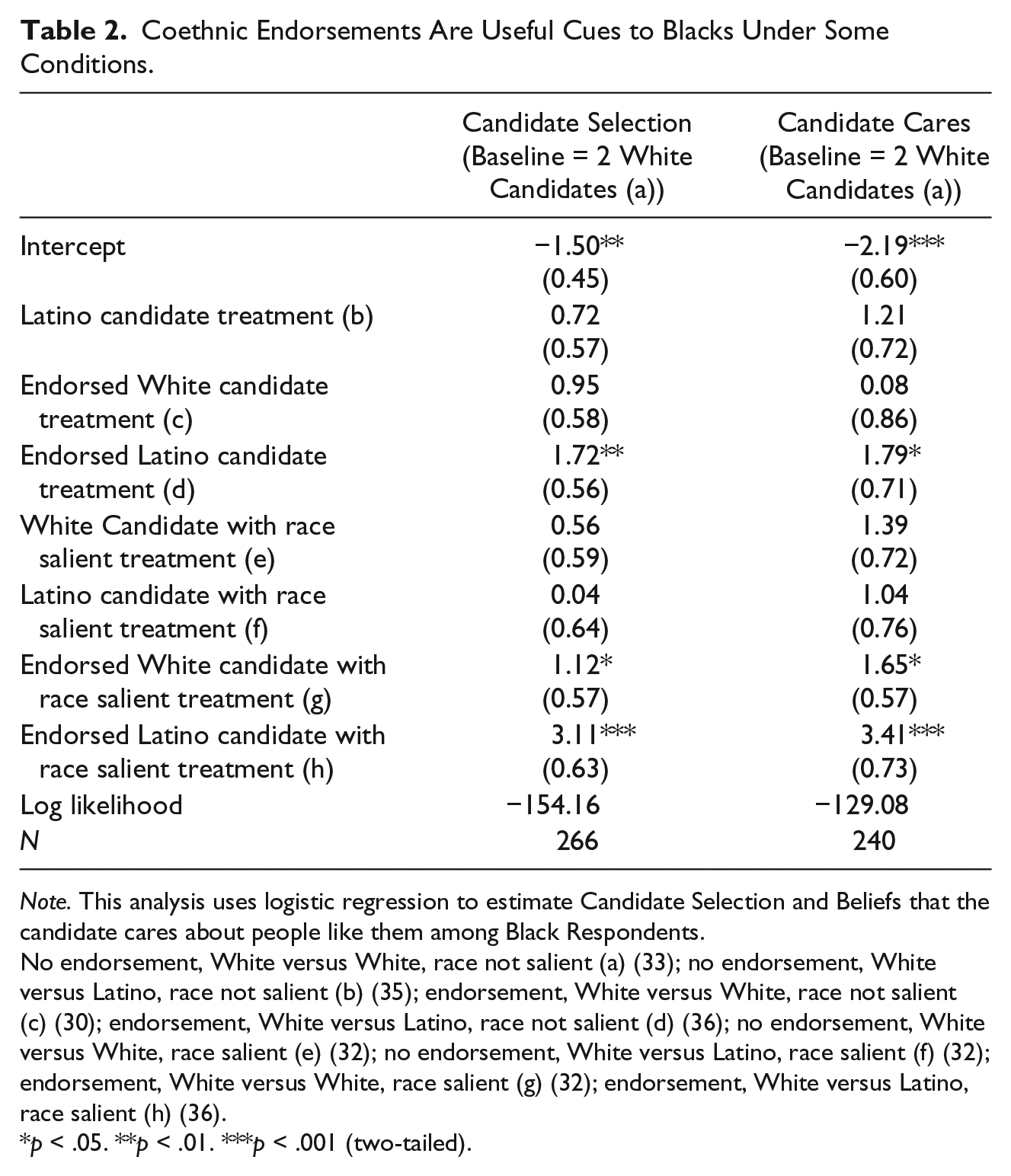
Note. This analysis uses logistic regression to estimate Candidate Selection and Beliefs that the candidate cares about people like them among Black Respondents.
No endorsement, White versus White, race not salient (a) (33); no endorsement, White versus Latino, race not salient (b) (35); endorsement, White versus White, race not salient (c) (30); endorsement, White versus Latino, race not salient (d) (36); no endorsement, White versus White, race salient (e) (32); no endorsement, White versus Latino, race salient (f) (32); endorsement, White versus White, race salient (g) (32); endorsement, White versus Latino, race salient (h) (36).
p < .05. **p < .01. ***p < .001 (two-tailed).
These results above provide support for the coethnic endorsement theory. When race is salient, by highlighting a racial issue, Black voters are more likely to rely on coethnic endorsements when faced with out-group candidates. This is especially true when the endorsed candidate is a minority. The other goal of this article is to explore these relationships among Latinos. Recall that Latinos indicate strong levels of coethnic voting (Barreto 2007), vote as a bloc in local elections (Hajnal and Trounstine 2014), indicate that they often do not feel close to Blacks (Kaufmann 2003; McClain et al. 2006), and may rely on coethnic endorsements under certain conditions (Barreto et al. 2008). The experiment allows me to test these claims about coethnic endorsements and out-group candidate preferences and perceptions directly.
The results in Table 3, Column 1, indicate that coethnic endorsements, the race of the candidate, and highlighting ethnic issues are not persuasive to Latinos. Even when more than one factor was present in the treatment, Latinos did not express different levels of support for Candidate 2. The estimates are small, and they are not different from the baseline treatment. While Barreto et al. (2008) found that endorsements help explain candidate preference among Latinos in the 2008 Democratic primary; the endorsements in this study did not move Latinos to prefer a particular out-group candidate. The election Barreto et al. studied also featured more than one factor (endorsements and partisanship) and a nationally recognized candidate (Clinton).
Coethnic Endorsements May Provide Useful Cues for Latino Respondents.

Note. This analysis uses logistic regression to estimate Candidate Selection and the Belief that the candidate cares about people like them among Latino respondents.
No endorsement, White versus White, race not salient (a) (26); no endorsement, White versus Black, race not salient (i) (21); endorsement, White versus White, race not salient (j) (24); endorsement, White versus Black, race not salient (k) (26); no endorsement, White versus White, race salient (l) (22); no endorsement, White versus Black, race salient (m) (24); endorsement, White versus White, race salient (n) (25); endorsement, White versus Black, race salient (o) (25).
p < .05. **p < .01. ***p < .001 (two-tailed).
The Potential for Coalitions: Perceived Candidate Sympathy Among Blacks and Latinos
The results above show that together, the race of the candidate, endorsements, and racial issues influence candidate preference among Blacks, but this is not the case among Latinos. However, candidate preference is only one way to evaluate the validity of my theory. It is also important to know how these three factors shape the way Black and Latino voters perceive out-group candidates and their sympathy toward Blacks and Latinos as a group. This may help us better understand how the racial context of a campaign, candidate race, and coethnic endorsements can foster the development of cross-racial electoral coalitions. The interaction of these factors is important in part because they signal to Black and Latinos voters that a candidate will address group-specific concerns, even if they are not members of their racial/ethnic group.
Perceived candidate sympathy was measured with the following question: “Which candidate cares about people like you?” Response options for the treatments that featured two White candidates were “Jeremy Broadman,” “Henry Brewer,” or “Undecided.” In the treatments that featured a White and a Latino Candidate, response options were “Jeremy Broadman,” “Anthony Gonzalez,” or “Undecided.” Responses were recoded into a dichotomous variable where “1” indicates the respondent selected “Henry Brewer” or “Anthony Gonzalez,” and a “0” indicates the respondent selected “Jeremy Broadman” or “Undecided.” Roughly 30% of the participants said either Brewer or Gonzalez cared about people like them. To explore this relationship among Latinos, I used the same question: “Which candidate cares about people like you?” to create dichotomous dependent variable such that a 0 means the participants indicated “Broadman” or “Undecided” and a 1 means the participants indicated “Brewer” or “Jackson.” Roughly 37% of the participants said either Brewer or Jackson cared about people like them.
In Table 2, Column 2, I examine the relationship between the treatment effects and perceived candidate sympathy. The combination of elite endorsements and racial salience prompts Blacks to view the liberal candidate as concerned about their needs, even when he is depicted as White. These results provide further support for the coethnic endorsement theory among African-Americans.
Turning to Table 3, Column 2, I remind the reader that my hypotheses among Latinos focus on the direction and magnitude of coefficients on treatments j, k, n, and o. An examination of Table 3, Column 2, allows me to directly test my hypotheses among Latinos. Latinos who read about the endorsed White candidate (treatment j) were not more likely to prefer that candidate. This provides no support for H1 that coethnic endorsements will be effective in raising support for the targeted candidate among Latinos. This is not consistent with the previous literature, which suggests that endorsements will move Latinos (Barreto et al. 2008). When participants read about the endorsed Black candidate (treatment k) but ethnicity was not salient, they are also more likely to perceive the candidate as sympathetic (2.14, p < .01). This provides some support for H2, that coethnic endorsements will be persuasive for Latinos when the candidate receiving the endorsement is a minority. However, the coethnic endorsement theory predicts that coethnic endorsements will be persuasive when Latinos are thinking about their Latino identity. The greatest difference in positive perceptions of Candidate 2 comes when Latinos read about the endorsed White candidate and ethnicity is salient (treatment n) (2.39, p < .01), which provides support for H3, that coethnic endorsements will be more persuasive among Latinos when race/ethnicity is salient. Finally, when participants read about the endorsed Black candidate and ethnicity was salient (treatment o), they were more likely to perceive him as sympathetic compared with the baseline White candidate (2.17, p < .01). This provides support for H4, that coethnic endorsements will be more persuasive among Blacks and Latinos when the endorsed candidate is a minority and race/ethnicity is salient. 11 Despite Latinos indicating that they do not feel close to Blacks, they are more likely to support Black candidates when they receive an endorsement, regardless of whether or not ethnicity is salient. These results provide support for the coethnic endorsement theory: When ethnicity is salient, by highlighting a racial or ethnic issue, Latino voters are more likely to rely on coethnic endorsements, when the candidate is Black or White. That Latinos perceive the endorsed White candidate when ethnicity is salient as sympathetic is consistent with previous literature that shows that Latinos feel closer to Whites (Kaufmann 2003; McClain et al. 2006). That Latinos perceive an endorsed Black candidate as sympathetic to Latinos when ethnic issues are mentioned provides useful insight into the potential for Black–Latino electoral alliances.
Potential for Black–Latino Coalitions
To understand the magnitude of the treatment effects, I present the marginal effects (the likelihood of preferring Candidate 2, given the treatment) for those who read a particular treatment compared with those who read the baseline treatment, which is set to 0 (see Figures 1 to 4). Figure 1 shows that Black participants were more likely to prefer the endorsed Latino candidate (0.34, p < .01). The endorsed Latino candidate when race was made salient also did quite well among Blacks (0.61, p < .000). The results in Figure 1 also show that the endorsed White candidate when race is made salient also does well among Blacks (0.22, p < .05). These results are mirrored with respect to perceived candidate sympathy (Figure 2). Endorsements are persuasive to Blacks in this sample when the endorsed candidate is a minority and/or when racial issues are mentioned.

Support for out-group candidates among Blacks.

Perceived out-group candidate sympathy among Blacks.

Support for out-group candidates among Latinos.

Perceived out-group candidate sympathy among Latinos.
Shifting the focus to the Latino sample, again, there are no treatment effects for candidate preference (see Figure 3). The likelihood of preferring Candidate 2, compared with the baseline, is essentially 0. Turning to Figure 4, we see that Latinos in the sample were more likely to perceive the endorsed Black candidate (regardless of ethnic issues) as sympathetic to Latinos (0.45, p < .01). They also perceived the endorsed White candidate when ethnic issues are mentioned (0.50, p < .01) as sympathetic. While coethnic endorsements did not move Latinos when it came to candidate preferences, Latinos did respond to coethnic endorsements with respect to perceived candidate sympathy. Taken together, both Latinos and Blacks respond to coethnic source cues, racial and ethnic issues in a campaign, and the race of the candidate under certain conditions.
These results provide some insights into the potential for a Black–Latino coalition. Overall, Blacks rely on coethnic endorsements when the candidate is Latino (regardless of issues) and when the candidate is White and in the context of issues. For Latinos, when it comes to candidate preferences, the coethnic endorsements do not work at all. However, when asked to indicate which candidate is sympathetic to Latinos, the coethnic endorsements do work for the White candidate when issues are present and for the Black candidate, regardless of issues. These results suggest that the most viable Black–Latino coalition would come in the form of a Latino candidate led coalition. That candidate’s strategy should include outreach to the Latino community (to ensure coethnic support) and endorsements from Black leaders, organizations, and politicians to garner Black support.
Conclusion
In this article, I presented experimental data designed to rigorously test the relationship between coethnic endorsements, the race of the candidate, and racial/ethnic saliency in the campaign and out-group candidate preferences and perceptions in local elections. These data are the first of their kind and are a first step to better understanding the causal mechanisms at work when Blacks and Latinos are exposed to coethnic cues and their response to out-group candidates. For Blacks, when racial issues are mentioned in the presence of coethnic endorsements, Blacks express greater support for out-group candidates. Among Latinos, there is a weaker relationship between coethnic endorsements, candidate characteristics, ethnic issues, and candidate preference. However, they were moved by coethnic endorsements, candidate characteristics, and ethnic issues in response to perceived out-group candidate sympathy. These results are also more than simple social desirability, as endorsements alone are not enough (Suhay 2015). This is different from previous research on coethnic endorsements most likely because previous research also considered partisanship (Barreto et al. 2008; Campbell et al. 1960).
The findings presented here are consistent with previous research on African-Americans, which shows that there is a strong commitment to the sense of the group in the political arena (Dawson 1994; White 2007). This has not always been the case among Latinos, and the findings presented here are consistent with previous research among Latinos (Masuoka 2006; Sanchez and Masuoka 2010). While Blacks demonstrate high levels of linked fate, lasting feelings of linked fate among Latinos have not been observed (Sanchez and Masuoka 2010).
Several factors might explain low levels of linked fate among Latinos: First, Latinos may still prefer their national origin group identity to a pan-ethnic identity (Beltran 2010; Masuoka 2008). Second, the group is quite heterogeneous, and researchers cite the ways in which experiences with immigration, assimilation, and discrimination help shape these identity choices (Beltran 2010; Masuoka 2008; Sanchez and Masuoka 2010; Segura and Rodrigues 2006). Future research should focus on identity choices and potential source cues that might be persuasive (Beltran 2010; Kaufmann 2003; Masuoka 2008). While Sanchez (2006) finds that Latinos apply a Latino group consciousness to support for bilingual education policies, Pantoja, Ramirez, and Segura (2001) find that Latinos will mobilize around immigration issues. Given this finding, it is possible that highlighting immigration instead of bilingual education might have mobilized Latinos in this study to select a candidate. Future research should consider immigration as an issue to try to make ethnicity salient among Latinos. In addition, this article uses a generic endorsement, but not all endorsements are created equally. Endorsements from other politicians, trusted community leaders, and ethnic news sources might be viewed as more credible than endorsements from newcomers or clergy. Further research using a variety of endorsement sources is needed to better understand which endorsements work well and which ones do not. Finally, future research should consider the role of endorsements for candidates that do not share the ideology of the group or are on the wrong side of the issues. Yet, recent research on Blacks and social pressures show that even when other Blacks offer support for Republican candidates (Romney), Blacks are still hesitant to express support for the Republican candidate (White, Laird, and Allen 2014). Local nonpartisan elections are an interesting place to test these claims.
The treatments in this study are designed to mimic a low information electoral situation (McDermott 1997, 1998). In low information contests, voters may rely on information shortcuts or stereotypes or imply ideology or partisanship, but it is still possible to make decisions that are beneficial for their self-interest (Arceneaux and Kolodny 2009; Lupia 1994). Despite the benefits of the experiment (controlling the three factors of interest), there may be some reasons to be cautious of these results as scholars find there are often differences between the lab and the real world (Chong and Druckman 2010; Druckman and Nelson 2003). Future research should consider coethnic endorsements and candidate preferences in a real election to provide external validity to this study.
Footnotes
Appendix A
Appendix B
Appendix C
Candidate Preferences Among Latinos (Controlling for Mode of Survey).

| Candidate Selection |
|
|---|---|
| Intercept | −0.09 (0.42) |
| Black candidate treatment (i) | 0.65 (0.60) |
| Endorsed White candidate treatment (j) | 0.65 (0.58) |
| Endorsed Black candidate treatment (k) | 0.07 (0.56) |
| White candidate with ethnicity salient treatment (l) | −0.23 (0.58) |
| Black candidate with ethnicity salient treatment (m) | −0.19 (0.57) |
| Endorsed White candidate with ethnicity salient treatment (n) | 0.55 (0.57) |
| Endorsed Black candidate with ethnicity salient treatment (o) | 0.27 (0.57) |
| Paper | −0.14 (0.30) |
| Log likelihood | −130.57 |
| N | 192 |
Note. This analysis uses logistic regression to estimate Candidate Selection among Latino respondents who took the survey using the paper and pencil format.
No endorsement, White versus White, race not salient (a) (26); no endorsement, White versus Black, race not salient (i) (21); endorsement, White versus White, race not salient (j) (24); endorsement, White versus Black, race not salient (k) (26); no endorsement, White versus White, race salient (l) (22); no endorsement, White versus Black, race salient (m) (24); endorsement, White versus White, race salient (n) (25); endorsement, White versus Black, race salient (o) (25).
p < .05. **p < .01. ***p < .001 (two-tailed).
Appendix D
Perceived Candidate Sympathy Among Latinos (Controlling for Mode of Survey).

| Perceived Candidate Sympathy |
|
|---|---|
| Intercept | −1.92**
(0.64) |
| Black candidate treatment (i) | 1.10 (0.78) |
| Endorsed White candidate treatment (j) | 1.00 (0.78) |
| Endorsed Black candidate treatment (k) | 2.14**
(0.73) |
| White candidate with ethnicity salient treatment (l) | 1.24 (0.77) |
| Black candidate with ethnicity salient treatment (m) | 1.35 (0.76) |
| Endorsed White candidate with ethnicity salient treatment (n) | 2.40**
(0.74) |
| Endorsed Black candidate with ethnicity salient treatment (o) | 2.21**
(0.76) |
| Paper | −0.16 (0.32) |
| Log likelihood | −113.05 |
Note. This analysis uses logistic regression to estimate Candidate Selection among Latino respondents who took the survey on the Internet.
No endorsement, White versus White, race not salient (a) (26); no endorsement, White versus Black, race not salient (i) (21); endorsement, White versus White, race not salient (j) (24); endorsement, White versus Black, race not salient (k) (26); no endorsement, White versus White, race salient (l) (22); no endorsement, White versus Black, race salient (m) (24); endorsement, White versus White, race salient (n) (25); endorsement, White versus Black, race salient (o) (25).
p < .05. **p < .01. ***p < .001 (two-tailed).
Declaration of Conflicting Interests
The author(s) declared no potential conflicts of interest with respect to the research, authorship, and/or publication of this article.
Funding
The author(s) received no financial support for the research, authorship, and/or publication of this article.