







Abstract
Over the past four decades, cities have experienced greater oversight from state government. Why have states become increasingly involved in local affairs? How has the increasing presence of state government altered how we understand urban politics? Relying on a case study of Newark, New Jersey, this article argues that the increasing presence of state government in local affairs was a response to the growth of Black political empowerment. Furthermore, the Newark case reveals that the changing role of state actors, particularly governors, in urban regimes requires an expansion of urban regime theory as a conceptual framework. Building on the argument that urban regimes should be viewed as intergovernmental regimes, the findings from the case study suggest that local communities are best represented under cohesive state–local regimes, while localities are exposed to less desirable, even hostile, state-led policies, under disjointed state–local regimes.
Keywords
Urban regime theory has been criticized for its failure to incorporate the roles of race (Horan 2002; Kraus 2004; Nelson 2000) and state government (Peter Burns 2002; Imbroscio 1998; Kantor, Savitch, and Haddock 1997) in its analysis of urban regimes. Despite the criticism, urban regime theory has been the dominant urban political theory of the last 30 years because it still provides a relevant framework to analyze urban governance. However, two significant changes in American politics over the past 40 years—the increasing role of state government in local affairs and the emergence of Black-led urban political regimes—have spurred questions about how the intersection of these two factors has altered urban politics and the extent to which it challenges existing theories of urban politics?
This article analyzes the state take-over of the Newark, New Jersey, public schools to examine why states increased their presence in urban localities. In addition, it seeks to explore how the convergence of increasing state involvement in local affairs and the rise of a Black-led urban political regime have altered urban governance. Although local public schools have always been under the purview of the states, historically, states have had minimal involvement in the local public schools (Tyack 1974). However, in the 1970s and 1980s, state governments began to provide greater oversight of the local schools, and a focus on accountability led to the rise of governance policy options that included take-overs as the most severe of policy options (Wong and Shen 2003).
The case of Newark, New Jersey, suggests that the increasing presence of state government was a response to the growth of Black political empowerment in the state’s most populous city. Following the Civil Rights Movement and civil unrest in the 1960s, Blacks gained political empowerment of the city and pursued redistributive policies—particularly in the area of public education—that would provoke a response from political opponents at the state level, including governors and nonurban state legislators. In New Jersey, as in other states, urban communities sought to bring additional resources to their cities to improve public education by suing state governments for more equitable school funding. As plaintiffs succeeded in the courts, and urban, predominantly Black and Latino communities were poised to receive additional resources from state governments for their schools, governors and nonurban state legislators responded by utilizing the powers of the state legislature to delay, curtail, and then control the court-mandated increases in funding for low-resourced communities.
The increasing presence of state actors, particularly governors, in local affairs, has altered urban governance. The Newark case reveals that as governors assume greater leadership roles in urban regimes, local constituencies have to contend with the presence of an influential regime actor whose electoral success may or may not be dependent on the communities that they lead. The changing role of state actors in urban regimes requires an expansion of urban regime theory as a conceptual framework. Building on the argument that urban regimes should be viewed as intergovernmental regimes (Peter Burns 2002), the findings from the case study suggest that local communities are best represented under cohesive state–local regimes, while localities are exposed to less desirable, even hostile, state-led policies under disjointed state–local regimes.
Urban Regime Theory, State Centralization, and Race Politics
Understanding how political relationships affect governance has been a major focus of urban politics for several decades (Stone 1989). Urban regime theory emerged as a response to the urban politics debates of the 1960s and 1970s, which were dominated by the pluralist versus elite perspectives of political power in cities. For urban regime theorists, the elite and pluralist perspectives contained several limitations, particularly concerning relationships between public officials, business, community groups, and other local political actors, which regime theorists considered the foundation of urban governance (Elkin 1987; Orr 1992; Stone 1989). Urban regimes, wrote Clarence Stone (1989, p. 6), are “informal arrangements by which public bodies and private interests function together in order to be able to make and carry out governing decisions.” In the urban regime, the “public” is represented by their government leaders, which presumably are given the consent to govern and represent the citizenry through democratic processes.
The growing presence of state actors in local affairs complicates our understanding of the public official in the urban regime. As state actors, particularly governors, assume a greater role in local governance, the “public,” in the public–private partnership that is at the foundation of the regime, is still intact. Indeed, private interests may work well with state officials to carry out governing decisions at the local level. Moreover, the local citizenry may consider governors legitimate representatives of their interests on local matters. Therefore, the presence of state actors in local governance does not disqualify urban regime theory as a conceptual framework.
Conversely, there is also the possibility that governors and private interests may form alliances to make governing decisions that local citizens reject. Furthermore, local citizens may not consider the governor a legitimate representative of their local interests. In this scenario, the public–private partnership is still in effect; however, the “public” may not be representative of the local citizenry. Thus, while the increasing presence of state actors in local affairs does not disqualify urban regime theory as a conceptual framework, the presence of governors as leaders in urban regimes does require an expansion of urban regime theory to account for the degree to which the local citizenry is represented in the regime.
States in the Urban Regime
Although urban regime theory has been able to stay relevant as a conceptual framework, scholars have challenged urban regime theory for its failure to account for how factors outside of city boundaries affect urban governance (Peter Burns 2002; Imbroscio 1998; Kantor, Savitch, and Haddock 1997). Indeed, scholars of state politics have shown how state institutions establish the contours by which local officials could exercise political authority. Frug and Barron (2008) point out that cities are not autonomous entities and that its powers are derived by state laws. Therefore, the arena in which local political actors can exercise power is structured and constrained by the laws that state legislatures have passed.
The institutional constraints on cities demand that local political actors create alliances outside of their urban spheres. Bridges (1984) points out that cities are dependent on state and national government, and the permeability of its boundaries force local officials to work with political actors outside of the city to achieve their political objectives. Similarly, Nancy Burns et al. (2009) argue that state legislatures are central to the understanding of local policy outcomes and find that state legislature treatment of cities is influenced by the extent to which urban legislators are unified as a delegation. That is, when urban delegations are unified on an issue, they are able to ward off unwanted state involvement.
In his work on political machines, Steven Erie (1988) proposed an intergovernmental theory to explain why political machines were able to have long-lasting, powerful presence in some cities and not others. Erie (1988, p. 9) argued that powerful political machines emerged because of the intergovernmental alliances that local party leaders were able to forge with party leaders at the state and federal level. State patronage and federal funding for job programs helped support local political machines during their “fragile incubation period.”
Erie’s work shows that relationships between party leaders at the local, state, and federal level were critical in helping sustain local political machines. The existing state scholarship has also demonstrated that state politics is integral to the understanding of urban politics. However, these works do not account for the changing role of state government over the past four decades, when there has been a shift to greater state centralization, and local governance transitioned from White-led political machines to Black-led urban regimes. Furthermore, while the scholarship has emphasized the importance of state legislatures in understanding urban politics, we know less about the role of governors as local regime actors.
As the state’s executive officer, governors are influential state actors. Over the past four decades, gubernatorial power has grown, leading governors to exercise greater authority over state policy (Barrilleaux and Berkman 2003). Governors can be “chief legislators” and initiate and promote the passage of state laws (Bernick and Wiggins 1991). In addition, governors can exercise authority over the implementation of policy and have had influence over many policy areas, including economic and environmental policies (Lester and Lombard 1998). In the area of public education, governors have had a particularly influential role. In the late 1970s and 1980s, governors increased their presence in public education (McDermott 2011), and some scholars have argued that governors have more of an influence on education than state legislatures (Goertz and Fuhrman 1991).
To bridge the gap between the local focus of urban regime theory and the increasing presence of state actors in local affairs, Peter Burns (2002) argued that governors should be considered part of urban regimes, and therefore, urban regimes should be considered “intergovernmental regimes.” In a study of Hartford, Burns finds that the governor in Connecticut has the authority to implement policy and allocate resources at the local level. Peter Burns (2002) concludes that leadership vacuums at the local level provide opportunities for governors to become bigger actors in local governing regimes.
This article builds on the Burns argument that urban regimes should increasingly be seen as intergovernmental regimes because of the increasing role of state governments, particularly governors, in local affairs. However, where Burns sees the growing presence of state actors in local affairs as a result of an absence of leadership at the local level, I argue that the growing presence of state actors in urban affairs is a result of political changes in the 1970s that altered local governance.
State Politics
In the middle of the twentieth century, a number of factors began to emerge that ultimately changed intergovernmental relations in the United States. Although local governments have always been “creatures of the states,” the new emerging factors led to a greater interconnectedness between state and local governments. Scholars have attributed the increase in state–local interconnectedness to three major factors.
The first is the increasing capacity of state governments. In the 1960s, grants from the federal government sent to the states to address specific issues of education, poverty, and infrastructure, among other issues, helped states build capacity and expand their governmental reach in ways that were previously unfeasible (Hanson 1998; Hedge 1998; Manna 2006). The second reason is greater state powers. By the early 1970s, the Nixon administration’s “New Federalism” devolved decision-making powers to the states (Conlan 1998; Nice 1998; Reagan 1972). Under this new policy, programs that previously fell within the purview of federal government were now under the authority of the states.
Changes at the local level also had an effect on state–local relations. At the same time that states gained greater authority, local governments began to become increasingly dependent on state governments (Agranoff and McGuire 1998). Deindustrialization and population declines contributed to eroding tax bases for localities. For instance, in the early 1900s, 95% of local government revenue was generated locally. By the late twentieth century, local governments had received one-third of their revenue from the state and national governments (Nice 1998).
The combination of greater state capacity, the devolution of authority from the federal government to the states under the Nixon and Reagan administrations, and the decline in local resources contributed to the increasing involvement of state government in local affairs. As a result, the political ties between state and local actors gained greater significance, particularly for urban regimes and their leaders, whose ability to govern would become increasingly dependent on relationships with state actors.
Race Politics
The state scholarship has said little about how race politics has influenced the increasing presence of state government in local affairs. Soss, Fording, and Schram (2008) have studied how the combination of race and second-order devolution—decentralization from state to local—affects welfare provisions. They find that as the size of the Black population increases, states are more likely to devolve authority for the Temporary Assistance to Needy Families (TANF) program to local governments, which has led to racial disparities in the implementation of social policies. However, we know less about the emergence of state-level centralization and its effect on urban, predominantly communities of color. Although scholars have dedicated less attention to examining the role of race in explaining the growth of state involvement in local affairs, there are several race-related factors that have had a significant role in shaping state–local relations.
First, the declines in local tax bases were partly driven by segregation and “White flight” from cities (Sugrue 1996). Second, the Nixon and Reagan administrations’ efforts to disrupt the funding streams from the federal government directly to cities were motivated by a concern over Black political mobilization in cities. Both Nixon and Reagan considered community development programs, particularly the Community Action Programs, as a political threat because they served to mobilize communities of color (Conlan 1998; Kantor 1988). From 1955 to 1975, federal aid that went directly to cities, bypassing states, increased by more than 4,000% (Kantor 1988). However, by the mid-1980s, funds for community development were cut by nearly 40%, representing the largest cuts in funding by the Reagan administration (Conlan 1998).
By disrupting the pipeline between the federal government and cities, Nixon and Reagan strengthened the role of states. Thus, the era of “New Federalism,” which has been typically considered an era of devolution, also ushered an era of centralization—where states would gain greater say over local governance. As governance and policy powers shifted from the national government to state governments, new political factors would shape intergovernmental relations.
Finally, the emergence of Black-led urban political regimes introduced new dynamics that altered city governance and intergovernmental relations. By the 1970s and early 1980s, Blacks had gained majorities on school boards and city councils, as well as mayoralties, in many U.S. cities (Colburn 2001; Nelson and Meranto 1977). Adolph Reed (1999, p. 80) argued that Black-led regimes—“black-led and black dominated administrations backed by solid council majorities”—are a “distinctive phenomenon” because of the demographic and socioeconomic factors that propelled Blacks to regime leadership. Increases in residents of color combined with White outmigration from cities changed urban demographics. Decreasing tax bases, deindustrialization, and the growth of suburbs contributed to socioeconomic challenges for cities as Blacks assumed regime leadership. Reed argues that the demographic and socioeconomic factors that allowed Black-led regimes to emerge also provided structural limitations that constrained Black leadership. These limitations, particularly the socioeconomic pressures, led Black-led regimes to become increasingly dependent on state and federal resources.
In sum, race has had a central role in shaping the dynamics that have led to greater state involvement in urban localities. The Nixon and Reagan administrations’ policies of strengthening state governments in the 1970s and 1980s was influenced by a concern over the growth of Black political power in cities. In addition, a decline in local resources demanded that urban leaders rely on resources outside of the city. This was acutely felt by Black-led urban regimes. As state governments became stronger, and cities grew more dependent on state resources, cities grew more susceptible to oversight and intervention from state governments. Therefore, the more successful urban regimes were in securing resources from state government, the more they became the subject of scrutiny from state officials. The changing role of state governments in local affairs introduced new dynamics to the challenges of urban governance.
Perhaps more so than any other policy domain, control over public education became a central point of contention between state and urban localities. In the United States, public school governance has historically been considered a responsibility of local governments (Tyack 1974). However, by the 1980s, state governments became increasingly involved in the local public schools. Governors and state legislatures cited concerns with the quality of education as a reason for greater involvement (Peter Burns 2003; Manna 2006; Wong and Shen 2003).
In addition to academic concerns, finances were also a major reason for increased attention from state actors. By the 1980s, public education had become the largest item in state budgets (DiLeo 1998, p. 112). At the local level, public education is responsible for the highest number of public-sector jobs in the United States (U.S. Census Bureau 2013). As public education budgets grew, the schools increasingly became the subject of contestation between state and local governments. It is within this political context of contestation that state take-overs of local districts emerged as a policy option for state governments.
Take-Overs of Local School Districts
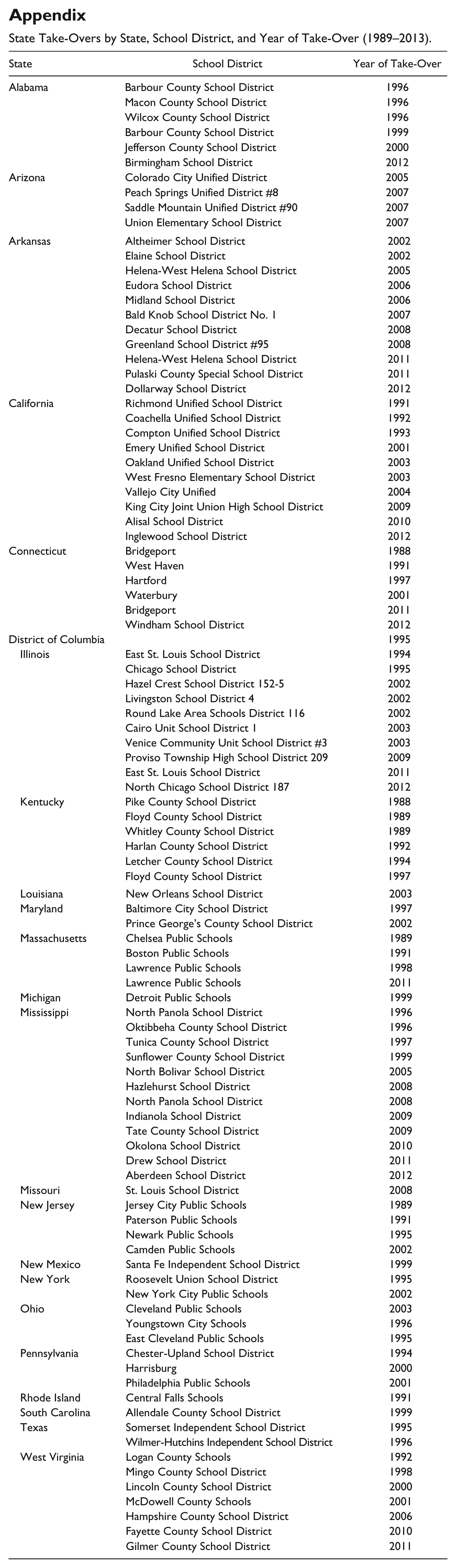
State take-overs of local school districts emerged out of the accountability efforts in the 1980s (Wong and Shen 2003). Governors, who became increasingly involved with education, pushed state legislatures to pass laws that allowed state governments to take over underperforming school districts. Republican governors, in particular, led efforts to allow states to take over school districts. Nearly 80% of all take-over laws in the United States were passed under Republican gubernatorial administrations. 1 As of 2015, 31 states in the United States had laws that allow state governments to take over their local school districts, and 22 states and the District of Columbia have taken over at least one school district (see Appendix). 2
State take-overs of school districts also disproportionately affect Black and Latino communities. More than 80% of take-overs occur in districts where Blacks and Latinos make up the majority of the student population. 3 Furthermore, in three-quarters of all take-overs, the local school board is replaced by a state-appointed board or completely abolished. 4 In many cities, the state take-over of the local school district has been seen by local communities and their leaders as an assault by outside forces on their local autonomy (Green and Carl 2000; Oluwole and Green 2009; Orr 1999; Reid 2001). Cities such as Baltimore, Cleveland, Detroit, Philadelphia, and Oakland experienced state take-overs of their local school districts.
State take-overs also emerged at a time when urban, predominately communities of color demanded greater resources from state governments for education. In the 1970s, communities began challenging education funding in the courts. Plaintiffs argued that a reliance on local taxes created inequitable educational opportunities for students from low-resource communities. The first successful school funding challenge came in 1973, in Robinson v. Cahill, when a New Jersey state court decided in favor of plaintiffs seeking to increase school funding for low-resource communities in the state (Yaffe 2007).
In New Jersey and other states where plaintiffs won school funding litigation, wealthy communities and their state legislators opposed raising state taxes to increase funding for low-resourced communities. Race also factored into the resentment. In many cases, opposition to raising taxes was largely led by White suburbanites and those seeking additional resources were urban communities of color. The increasing demands for state resources from local communities and the successful court decisions in favor of increasing state funding for local schools, led governors and state legislatures to increase their involvement in local school governance. State take-over of local school districts was one of the tools that states utilized to increase their presence in local school governance.
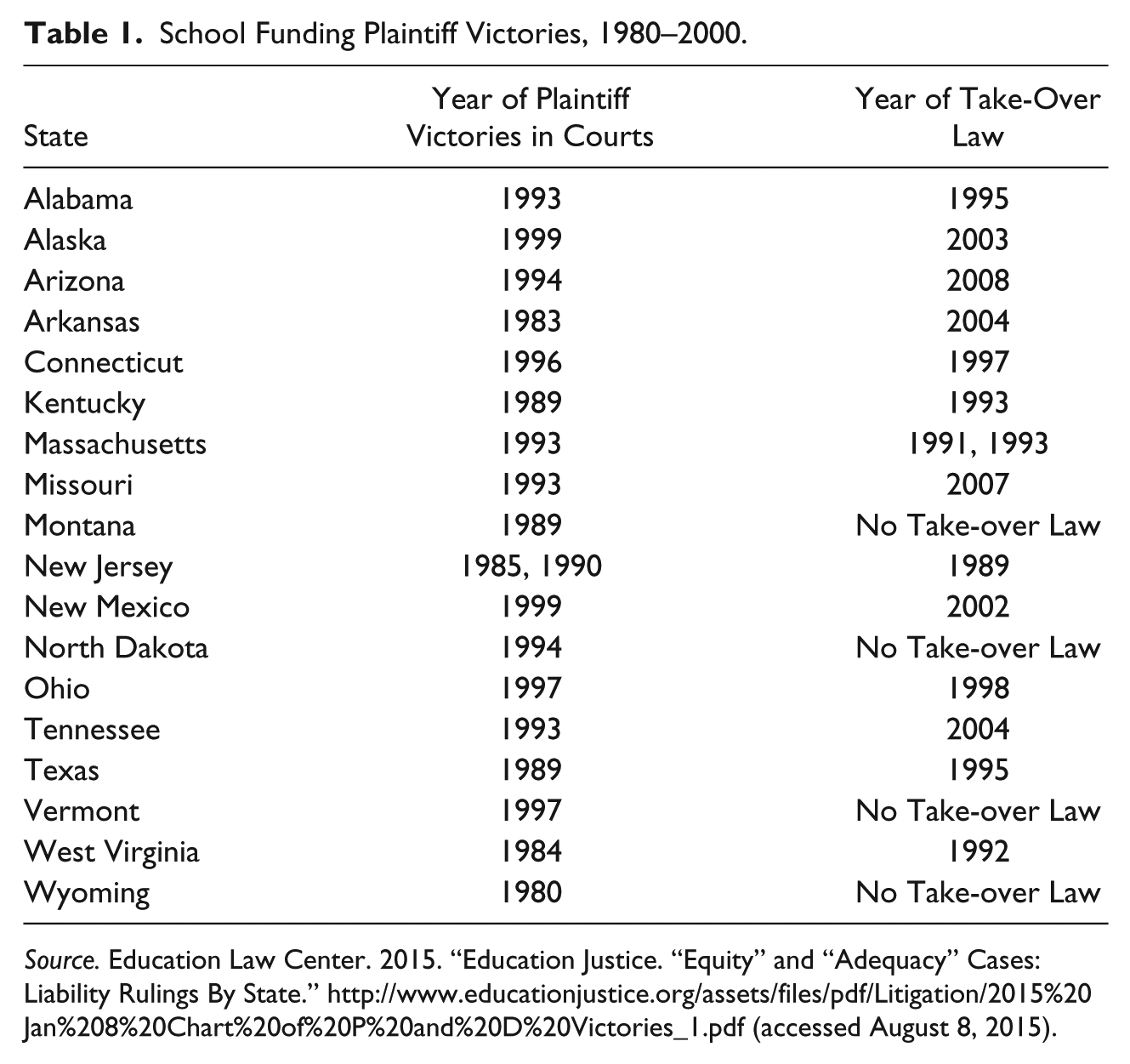
Between 1980 and 2000, plaintiffs won school funding cases in 18 states (see Table 1). In 14 out of the 18 states where plaintiffs were successful, states passed laws that allowed them to take over local school districts. The average timespan between the court decision and the passing of a state take-over law was less than seven years. Interestingly, the states that did not pass state take-over laws following court decisions were Montana, South Dakota, Vermont, and Wyoming. In these states, the average Black population is less than 1%.
School Funding Plaintiff Victories, 1980–2000.
Source. Education Law Center. 2015. “Education Justice. “Equity” and “Adequacy” Cases: Liability Rulings By State.” http://www.educationjustice.org/assets/files/pdf/Litigation/2015%20Jan%208%20Chart%20of%20P%20and%20D%20Victories_1.pdf (accessed August 8, 2015).
State take-overs of local school districts have expanded the role of governors in local governance. As governors assume greater roles in urban regimes, our understanding of urban regimes should be expanded to account for the political leaders within regimes that may or may not be politically accountable to the urban communities that they lead. Based on the urban regime theory literature, which posits that political relationships influence governance, as well as the state politics and race politics scholarship, I argue that governors, as regime leaders, will be less likely to pursue policies that are perceived as hostile by local communities, like a take-over of local government, when there is a political alignment between local citizens, local elected officials, and the governor. However, when state–local regimes are disjointed, and there is a misalignment of interests between the local community, local officials, and the governor, local communities have less political leverage and become increasingly susceptible to state policies that are perceived as hostile, like a take-over of local government.
New Jersey
To examine how increasing state involvement in local affairs and the rise of Black-led political regimes affect urban governance, I will examine the state take-over of the Newark public schools. There are several reasons why studying Newark, New Jersey, can help us understand how the growth in state–local interconnectedness affects urban communities of color. First, New Jersey, like most states, began to increase their presence in local affairs in the 1970s, as a result of a national movement to devolve powers from the federal level to state governments as well as a growing dependence on state government by local governments. As was already mentioned, New Jersey courts were the first in the country to decide in favor of plaintiffs seeking more equitable school funding formulas. In the 1980s, New Jersey became the first state to pass a law that allowed the state to take over local school districts. In 1989, the state was the first in the country to utilize a take-over law when it took over the Jersey City school system. The take-over of the Jersey City schools was followed by take-overs of the Paterson and Newark school districts in 1991 and 1995, respectively. Like most state take-overs in the United States, African-Americans and Latinos represented the majority of the population in each of the New Jersey take-over districts.
Also, Newark, like many cities with majority African-American populations, transitioned from a White-led urban regime to a Black-led urban regime in the 1970s. Finally, the Newark case provides the opportunity to conduct a comparative analysis within the single case study. As New Jersey has had Democratic and Republican governors in the period leading up to the take-over of the Newark schools, the state provides the ideal setting to examine political variation in the state–local relationships leading up to the take-over. Moreover, because the Newark school district has been under state control for 20 years, and the state has had Democratic and Republican governors during this time, we can also examine the state–local relationship during a period of state control.
Data
To analyze the Newark case study, several data sources will be employed. I rely primarily on the Census for demographic data. I use several newspaper sources, most notably the Star Ledger and the New York Times for historical and contemporary data. I rely on documents from the Essex County Clerk’s Office, New Jersey Department of Education, New Jersey Department of State, and the Newark Public Schools for voting records, teaching and staff data, and school board meeting minutes to conduct content analysis. I also conducted 38 interviews of state officials, district administrators, teachers, parents, and local leaders. Finally, I attended Newark School Board meetings during the 2012–2013 school year.
Newark
Newark, New Jersey’s most populous city, has a population of 277,140 (U.S. Census Bureau 2010). African-Americans and Latinos represent 86% of the city’s population. As of 2014, African-Americans had majorities on the school board and city council. Since 1970, the city has also had an African-American mayor. The rise of Black political leadership in Newark followed a tumultuous late 1960s, when tensions between a frustrated African-American community, which had very little political power, and Whites, whose population had significantly decreased but still held on to political power, led to civil unrest in 1967 (Mumford 2007; Tuttle 2009). A commission that studied the causes of the unrest cited lack of Black representation on the school board and lack of influence on school-related matters as factors that contributed to the environment that led to the unrest (Lilley et al. 1968).
However, by the early 1970s, the transition to a Black-led local political regime had begun in Newark. In the 1970 municipal election, Newark elected three Black city council members as well as the city’s first Black mayor, Kenneth Gibson (Rich 1996). In addition, during the 1970–1971 school year, non-Whites represented the majority on the school board for the first time in the city’s history (Tuttle 2009). As Blacks gained political power in Newark, so did their clout in New Jersey’s state politics. As the state’s largest city, in one of the most vote-rich counties in New Jersey, Newark’s Black political leadership gained influence beyond its city limits, which local leaders utilized to bring resources to the city.
In addition to gaining political control of the local institutions, Black citizens in the largest urban communities in New Jersey challenged schooling disparities in the courts. Although the state of New Jersey did not begin to conduct statewide education assessments until the 1970s, officials at the state and local level were aware that schools were failing to provide equitable educational opportunities to students in the urban, predominantly Black schools. The report on urban unrest in Newark showed that by the mid-1960s, the Newark public schools did not have the physical space to educate every Newark student. The report also showed that by third grade, Newark students were reading at two grade levels below the “national norm,” and the dropout rate was at 32% (Lilley et al. 1968, p. 77). Local political officials, community leaders, and their allies in Newark and other cities in New Jersey mobilized to address the lack of resources and educational opportunities that were contributing to poor educational outcomes in the urban and predominantly Black schools.
In 1970, a suit was filed on behalf of Kenneth Robinson, a student in the Jersey City’s public schools, which argued that New Jersey’s system of funding public schools was unconstitutional. The plaintiffs argued that the system’s heavy reliance on local property taxes created a disadvantage to students from poorer communities (Tractenberg 1974). In 1973, the state’s Supreme Court ruled in Robinson v. Cahill that the state’s funding system was unconstitutional because it failed to provide students from poorer districts a “thorough and efficient” education as mandated by the state’s constitution. Despite the court’s decision to change the funding formula, state legislators refused to act on the order. However, urban legislators eventually led the push to approve a new funding formula that increased state funding for urban school districts (Salmore and Salmore 2008). Between 1975 and 1977, the state’s contribution to support public education increased by nearly $450 million (Yaffe 2007).
The new funding formula provided increased funding for Newark and other urban districts in the state. At the same time, opposition to the increased funding grew within the state’s wealthier districts who resented increased taxes on the state’s wealthier communities. The resentment was also noticeable along racial lines as the demands for increased funding were led by Black political officials on behalf of mostly Black and Latino students in cities such as Newark. As Salmore and Salmore (2008, p. 314) pointed out, in the 1970s, New Jersey’s “tribal politics” led to rivalry “between largely white suburbs, mostly middle class or wealthy, and largely minority urban areas, mostly poorer.”
In response, the legislators from the wealthier districts demanded the implementation of accountability measures. Therefore, the “thorough and efficient” law provided increased funding for school districts, but it also created a monitoring regime as well. Legislators incorporated mechanisms that would not only monitor student academic achievement, but district governance and fiscal management as well. It was the first time in the state’s history that student academic achievement and district governance would come under such scrutiny.
The added scrutiny set expectations that urban leaders in cities across the state were bound to fail to meet. Newark, for instance, had a long history of fiscal mismanagement. Decades before Blacks gained leadership of the city and the schools, the Newark school district had been cited for its fiscal issues. A 1942 report by the Teachers College “found that the business administration of the Newark district was of questionable accuracy and thoroughness” (Anyon 1997, p. 66). Furthermore, the state had not monitored student progress, particularly Black and Latino student progress, until the 1970s (Yaffe 2007). As a result, the absence of a reliable baseline from which to measure academic progress made it difficult to prove that local efforts at improving student achievement were, indeed, successful.
Finally, in Newark, the school district had been part of a system of patronage for decades. Generations of local leaders saw the local school system as an engine for local economic development (Anyon 1997). However, when Blacks gained political leadership, the practice of patronage would also come under added scrutiny. In short, the promise of improved economic and social conditions that Blacks had expected following the rise of Black political power in the city, and the increased state funding for its local schools that came as a result, was also accompanied by a monitoring regime that challenged local governing autonomy.
However, as long as the city’s leadership could count on partnerships with state leaders, particularly the governor, local leaders attempted to leverage their power to influence the state’s role in the city’s affairs. In 1975, Democratic Governor Brendan Byrne, who began his professional and political career in Newark, as a lawyer and then deputy attorney general in charge of the Essex County Prosecutor’s Office, ordered a state investigation into Newark’s school finances, following a report from Newark’s Star Ledger about fiscal mismanagement in the district (Pratt 1992). The task force charged with investigating the district’s finances recommended greater monitoring of the district, but Newark avoided more severe action from state authorities.
However, by the early 1980s, the political landscape began to change and Newark and other urban districts would experience greater oversight from state authorities. In 1981, Republican Thomas Kean was elected governor of New Jersey. Kean had promised to push for greater accountability from the urban districts, and his education commissioner, Saul Cooperman, implemented a more robust system of monitoring school district performance (Quinn 1988).
At this same time, there was an additional school funding challenge in the courts. In 1981, the Education Law Center, which is based out of Newark, filed a lawsuit claiming that Robinson v. Cahill did not fundamentally address the funding gap between urban and suburban schools. In 1985, the state Supreme Court issued the first ruling in the Abbott v. Burke case, deciding in favor of the plaintiffs and ordered the Office of Administrative Law to remedy the state’s unequal funding of school districts. The decision and the subsequent Abbott cases had significant educational, economic, and political implications. The New Jersey legal community considered the decision “the most important state court decision of the Twentieth Century” and the New York Times described it as “the most significant education case” since the 1954 Brown v. Board decision (Tractenberg, Liss, and Sadovnik 2005).
As urban districts challenged the state’s funding of schools in the courts, in 1985, the composition of the state’s leadership also changed, and with it came significant consequences for Newark and other urban districts in the state. Along with a Kean landslide reelection, Republicans gained control of the New Jersey General Assembly for the first time in 12 years (Stonecash 2002) and used their newly gained political power to demand greater accountability from the urban districts. In 1986, Kean proposed a law to the state legislature that would allow the state to take over underperforming school districts (Verdon 1986). The take-over law was passed by the state legislature in 1988. In 1989, the state became the first in the country to take over a school district when it took over the Jersey City public schools (Newman 1999). During the same time, state officials also notified Newark that their school district was being targeted for a take-over (McCoy 1988).
Cohesive State–Local Regime
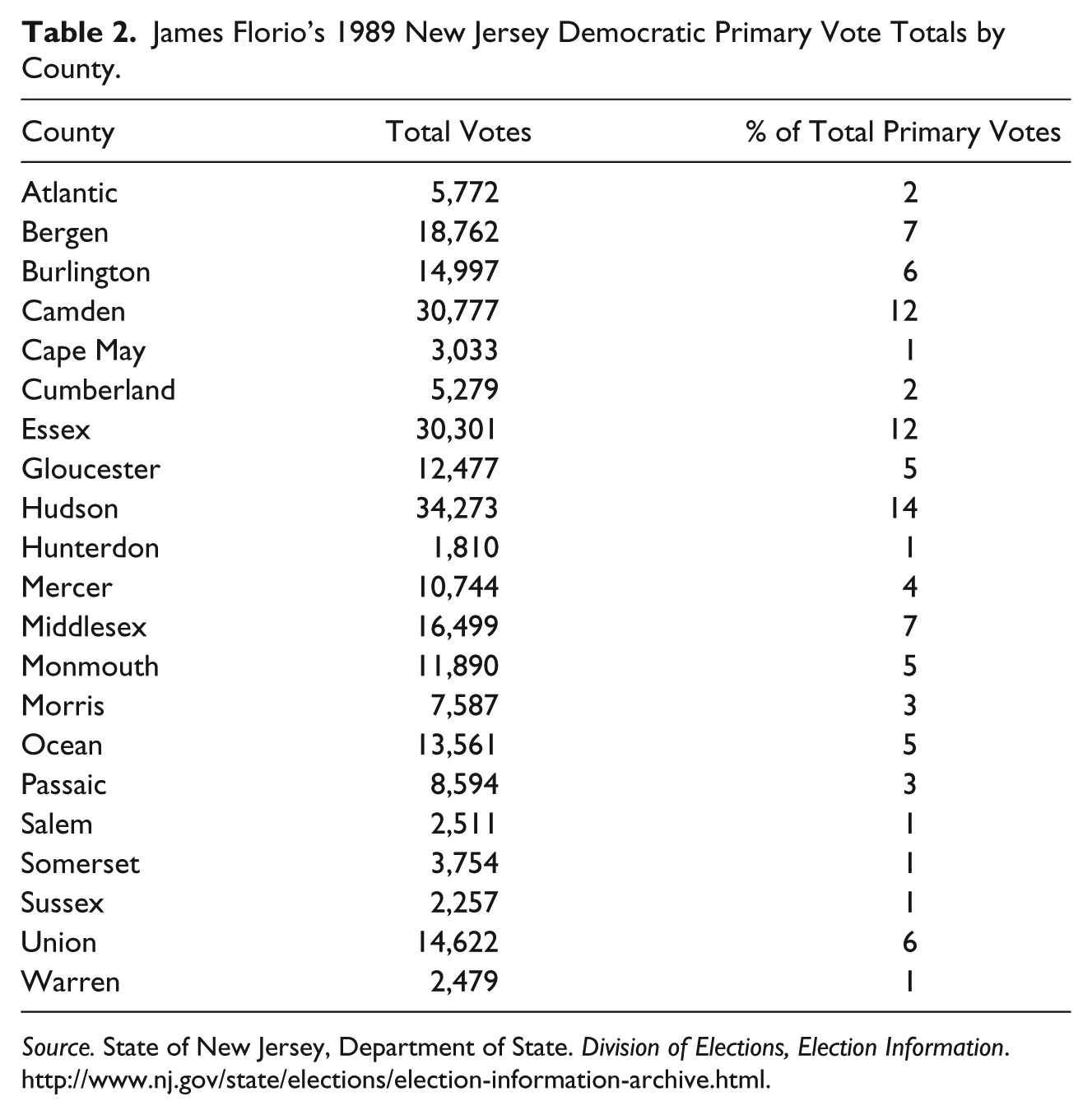
As the state was moving toward a take-over of the Newark schools, the political landscape changed once again in New Jersey. In 1989, New Jersey elected Democratic Governor James Florio, largely as a result of votes Florio received from the New Jersey’s urban centers. In the 1989 Democratic Primary, Newark’s Essex County, Jersey City’s Hudson County, and Camden County accounted for nearly 40% of Florio’s primary votes (see Table 2). Newark’s Essex County not only played an important role in Florio’s election but has represented an important electoral county for all Democratic gubernatorial candidates. Between 1965 and 2013, Essex County had the highest percentage of Democratic votes of any county in New Jersey (see Figure 1). As a Democratic stronghold, and the largest city in the state, Newark citizens represented a vital constituency to Democratic state officials, particularly governors.
James Florio’s 1989 New Jersey Democratic Primary Vote Totals by County.
Source. State of New Jersey, Department of State. Division of Elections, Election Information. http://www.nj.gov/state/elections/election-information-archive.html.
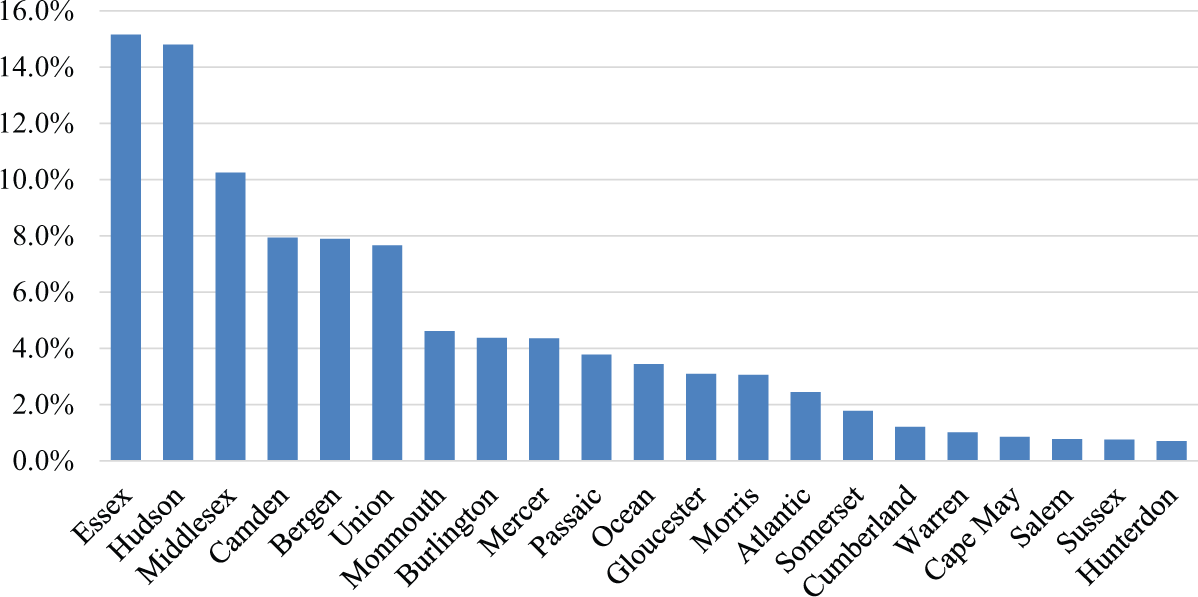
Average % of votes for Democratic primary gubernatorial winner by county, 1965–2013.
Rather than move forward with plans to take over the Newark schools, Florio put a halt on the monitoring regime that the Kean administration had established. In 1991, Florio suspended all state monitoring of the school districts (Braun 1991). The suspension of the state monitoring of school districts meant that for the time being, Newark was no longer on the take-over clock.
During the Florio years, the Newark school district saw an increase in school funding and a decrease in monitoring. Interestingly, while the state’s commitment to school funding increased, school budgets had to be approved by local voters as required by New Jersey’s constitution (Salmore and Salmore 2008). This meant that Newark’s school budget had to be approved by Newark voters. In 1992, Newark voters overwhelmingly passed a $523 million school budget, an increase of a $100 million from the 1990 budget, a record for the state (DePalma 1990; Roberts et al. 1992). Although the city had to contribute $80 million of the share, the state was responsible for nearly 75% of the total amount.
Newark leaders hailed the voters’ decision to pass the record budget because it demonstrated the city’s commitment to addressing the school district’s significant challenges. In 1993, the district’s graduation rate was only at 54%, and roughly 25% of all 11th grade students had passed every section of the state’s high school proficiency tests (McLarin 1994). However, education advocates and Newark school administrators viewed the increase in resources for the city schools as the first significant effort in the state and city’s history to address racial educational inequities in Newark. Superintendent Eugene Campbell said, “the citizens of Newark spoke out in support of what we are attempting to do: Improve education for the children” (Roberts et al. 1992).
Disjointed State–Local Regime
Governor Christine Todd Whitman (1994–2001)
Although the record budget symbolized a promise of opportunity for many in Newark, the state’s wealthier districts mobilized to put a halt on tax increases, and therefore, a halt on increased school budget increases in Newark. In 1993, suburban voters succeeded in electing Republican Christine Todd Whitman as governor. The mutually beneficial political alignment that existed between Newark’s political leadership and Trenton during the Florio years did not exist with Whitman’s administration. The misalignment in interests was nowhere more visible than in the politics of education.
One of Governor Whitman’s promises was to “improve the financial accountability of public schools” (Mondics 1993). Whitman’s commitment to this promise was evident when she named Leo Klagholz, her first cabinet-level appointee, to head the state’s Department of Education. Klagholz was an advocate of the state’s monitoring of the schools and was a vocal critic of Florio’s decision to suspend school monitoring. Soon after Klagholz was confirmed as commissioner, the state’s efforts to monitor the Newark schools increased and talk of a state take-over gained increasing attention.
Although the commissioner’s office maintained that student academic achievement was a focus of their monitoring efforts, fiscal concerns were also a significant factor (Mondics 1993). In 1994, Klagholz ordered a “comprehensive compliance investigation” (CCI) of the Newark school district. The CCI focused on three key areas: educational programs, fiscal practices, and governance and management (McLarin 1994). The report cited nearly 100 complaints that included issues related to education as well as concerns with fiscal mismanagement and political patronage. Leaders at the state Department of Education mentioned the buildup to the take-over and added, “Given the pattern of the last 10 years, it is unlikely that the district’s same leadership, however well-intentioned, can demonstrate the ability . . . to produce major change” (Turcol and John-Hall 1994). In July of 1995, the state moved to take over the Newark public schools.
For decades, the city’s Black community had fought for greater political empowerment, particularly to address concerns with the education system. By the mid-1970s, Newark finally had a Black-led regime. The Black community and its local officials recognized that the schools needed improvement. Despite the challenges, the Black community viewed the increasing resources for the district as a step in the right direction and an opportunity to work collaboratively with the state to improve education in Newark. However, only one decade after Blacks gained control of the city and the school district, state officials began to challenge their control and by 1995 had taken over the school district. Following the take-over, Eugene Campbell, the outgoing superintendent, said,
I don’t feel good—having started in the district as a teacher and being born in Newark and graduating from the school system . . . as an educator, father, and grandfather, there are changes in Newark and other school districts that need to be made for African-Americans, Hispanics, and poor whites . . . In the school system, there are pockets of success. You find schools in our district that work very well, but you find schools in our district with students in great need . . . I think if the state had come in as a partner with us, I think [we] would be talking about changes in urban education instead of a takeover.
5
Beyond the proposed academic reforms that the state would implement in Newark, the take-over undermined the city’s political leadership and local economy. Following the take-over, state authorities removed the superintendent of schools and abolished the locally elected school board (Peterson 1995). The office of the mayor, which had always had a major presence in school politics, was replaced by the governor’s office, as the most influential political office overseeing the schools. In addition, the state administration fired more than 600 district staff members, most of whom were Newark residents. Among the laid-off employees, 160 were school bus attendants, 117 cafeteria workers, 72 teacher aides, and 50 clerks (Chiles 1996). Furthermore, in the five years following the take-over, student academic performance worsened in a number of key areas, including high school proficiency test scores, graduation rates, and suspension rates (Newark Kids Count 2000).
Governor Jim McGreevy (2002–2004)
Between 1995 and 2001, there was a disjointed state–local regime, between Newark and the state administration. Politically, the governor and Newark’s political leaders were responsive to different constituencies. Despite the governor’s influential role in Newark, Newark political leaders and the city’s residents did not represent an important political constituency to the Republican governor. As a result, Newark’s political standing vis-à-vis the state was negatively affected. However, in 2001, New Jersey elected Jim McGreevy, a Democrat, as governor. The McGreevy election was instrumental in forging a period of cohesive state–local regime, where Newark’s internal politics were stabilized, and the city—the community and its political leaders—experienced a different relationship with the political leadership in Trenton.
The 2001 McGreevy election solidified a new phase in the state–local relationship. In this new phase, there would be an increase in community involvement in Newark’s school politics. First, the state-appointed advisory board would fully transition into an elected board by 2003. The 15-member advisory board, which had been appointed at the time of the take-over, transitioned into an elected nine-member board. Although it remained an advisory board, Newark voters were able to elect their representatives on the board. The elected board would eventually become a significant player in the political struggle for local control in Newark.
The second factor was that Sharpe James, who had been Newark’s mayor since 1986, was a key ally of Governor McGreevy. From the early stages of the gubernatorial race, James had supported McGreevy. In fact, state Democratic leaders credit James for helping McGreevy secure the Democratic nomination, when other statewide political leaders were discouraging McGreevy from running for office (Haddon 2013). As a result, McGreevy’s election meant that James, and Newark, were going to occupy a different status under his administration than they had during the Whitman years.
The third factor was McGreevy’s appointment of William Librera as the state’s commissioner of education. Librera did not believe that an extended state take-over of schools was productive and, therefore, began a process to attempt to transition governance of the Newark schools back to local control. Unlike Whitman’s administration, McGreevy and Librera wanted to transition authority back to Newarkers. When the state had to decide whether to reappoint the superintendent, Marion Bolden, a native Newarker, or appoint a new superintendent, Librera left the choice to the community and the elected school board. Regarding the superintendent search, Librera said,
Although the decision was mine to make, I decided that so long as the board was conscientious, thorough, and responsible in the interview process, even though I was part of it, I said that I would support what they decide. Now that was purely something that I could do and I didn’t need legislation.
6
These factors contributed to a restoration of local politics in the Newark schools. In addition, the advisory board worked collaboratively with the state authorities. Although the board was an “advisory” board, and the superintendent did not have to adhere to their wishes or demands, Bolden said, “I understood that the board represented the community, and that the community voice had to be included in the district’s governance.” 7 Bolden and Librera’s approach to the community created an environment where the board did not feel like the state had an imposing presence. Richard Cammarieri, who served on the board from 2002 to 2008, recalls his early years on the board as a time “when we had very little interference from the state.” 8
In addition, Newark residents who attended the school board meetings were largely silent on the issue of state control in the early 2000s. Since the 1960s, the board meetings had become a place where Newarkers, particularly members of Newark’s Black community, would come to voice their grievances. Therefore, it was telling that the community members that attended the school board meetings voiced very few complaints about the state intervention in the early 2000s. Between 2002 and 2008, there were only 11 mentions of state or local control at the board meetings, compared with 29 mentions of state or local control between 1995 and 1998. 9
The political climate in Newark was stabilized during the cohesive state–local regime. In addition, there is also evidence that educational outcomes improved during this period. Between 2002 and 2008, the district’s graduation rate increased from 49% to 72% (Newark Kids Count 2008). During the same period, the gap between Black male graduation rates in Newark compared with the national White male graduation rate, nearly closed (Holzman 2010). In addition, math scores in the state’s High School Proficiency Assessment (HSPE) also improved (New Jersey State Department of Education 2008).
The End of the Black-Led Regime in Newark
Governor Jon Corzine (2006–2009) and the emergence of Mayor Cory Booker
During the Democratic administration of Jim McGreevy, Newark’s local elected officials and the state administration had a cohesive state–local regime. By 2007, however, there were signs that this period of cohesive state–local regime was starting to collapse. The business community, led by Prudential Financial in Newark but which also included Wall Street backers, was interested in advancing a school reform agenda that in their view required new leadership in the city for its success (Russakoff 2015). In their effort to unseat Mayor Sharpe James and replace the school leadership, business leaders supported Cory Booker, a city councilman from the city’s Central Ward in the 2002 mayoral election, a race that Booker lost to James.
Although Booker was supported by the business community in and outside of Newark, the city’s Black community was ambivalent about the young, African-American Democrat, who grew up in Harrington Park, a wealthy suburb 20 miles north of Newark. In the 2002 election, Booker earned 47% of the vote, but his weakest performance came in Newark’s predominately African-American wards (Gillespie 2012). In 2006, Booker ran against longtime Newark city councilman and state senator, Ron Rice, for mayor, after Sharpe James decided not to seek a sixth term. Booker soundly defeated Rice, but like the 2002 campaign, Booker’s weakest performance was among the city’s Black voters (Gillespie 2012).
Unlike the two previous Black mayors before him, who gained the mayoralty on the basis of strong Black support, and were considered “unknown” variables among the city’s business community, Booker’s rise to political power in Newark was the opposite. He was supported by the city’s business class and a lesser known figure in the city’s Black community. It was the first time in the city’s history that a Black mayor was elected without winning the majority of Black votes. At the same time, Booker was the first mayor since the establishment of the public school system in Newark, who was elected at a time when the mayor did not have direct influence over the city’s schools. 10 Unlike other big city mayors and mayoral candidates, who place public education on the top of their agenda, Booker’s campaigns were largely silent on education (Gillespie 2012).
Although education policy was not a prominent campaign theme for Booker, he had a vision for Newark’s schools that consisted of reforms that were considered controversial by many in Newark; including the expansion of charter schools, school vouchers, and merit pay for teachers (Mooney 2013; Russakoff 2015). However, as the state controlled the Newark school district, Booker did not have to subject these reform policies to public scrutiny during his campaign for mayor. Yet, once elected, Booker exercised influence over school policies despite not having formal authority of the public schools. In 2007, Booker began orchestrating the ouster of Superintendent Marion Bolden, which led to her resignation in 2008 (Curvin 2014). Booker wanted new leadership for the school district, and Jon Corzine, who was elected governor in 2006, and had authority of the school district, supported Booker. 11
Education policy in Newark seemed to be supported by a cohesive state–local regime. The Democratic governor, the city’s Black mayor, and the business community were working together to advance an education agenda in Newark. However, despite the appearance of the public sector working together with the private sector, the public and its elected officials, including the majority Black school board and city council, were increasingly excluded from school governance decisions. At school board meetings, citizens expressed dissatisfaction with Booker’s growing influence over school affairs without community input. 12 Eventually, the city council would also join the school board and a frustrated community, in voicing frustration with the lack of community input on school matters, which included hiring personnel, awarding contracts, and the use of public buildings. 13 Booker’s rise to Newark’s mayoralty combined with the return of a Republican governor in 2009 represented the emergence of a disjointed state–local regime that had significant political implications for Newark. Equally as concerning for the Black community, the Black-led regime, which was established by Black mobilization at the school level, was no longer part of decision-making at the schools.
Governor Chris Christie (2010–)
In 2009, Chris Christie, a Republican, was elected governor of New Jersey. From the beginning of his administration, Christie made several decisions concerning the Newark schools that removed authority from local actors in Newark. During the press conference to announce the appointment of Cami Anderson, a Cory Booker ally, as his choice to run the Newark school district, Governor Christie was asked if he would consider returning the Newark schools to local control, and he responded, “Absolutely not” (Calefati 2011). Christie’s response to the question of local control angered many in Newark and set a tone that led to a hostile climate between the state government and the community.
Governor Christie, and his superintendent of Newark schools, Cami Anderson, began implementing a set of reforms that were considered unpopular by many in the community, and this led to a dramatic increase in community engagement at the board meetings. In addition, the teachers union, which has had a history of conflict and collaboration with the community (Golin 2002), saw the reforms as an effort to undermine the teachers union. Anderson’s reforms included the expansion of charter schools, school closures, and teacher merit pay. The teachers unions, parents, community leaders, and elected officials coalesced against the Christie and Anderson reforms.
In response, Newarkers demonstrated their concerns for the proposed reforms by increasing their presence at the board meetings. On average, more than 200 people attended the monthly board meetings during the 2012 to 2013 school year. 14 On several occasions, the meetings had well over 300 people in attendance. The amount of speakers also increased. Between 2005 and 2009, an average of 10 people spoke at each monthly board meeting. Between 2010 and 2013, during the Christie administration, the number of speakers doubled. 15 The increase in community participation was in response to the administration’s unwillingness to take into account the voices of the community. Nearly 63% of all the comments referenced state control of the schools and the administration’s efforts to implement school reform, including school closings, without the input from the community. 16
As the disjointed state–local regime increasingly excluded the public from school governance, it created opportunities for nonpublic entities to influence school policies. In Newark, foundations have played a particularly influential role in education policy (Reckhow 2013; Russakoff 2015). In many instances, the role of the foundations is shielded from public scrutiny. The most prominent example of the foundation role in Newark is the Foundation for Newark’s Future, which was created with a $100 million donation from Facebook founder and CEO Mark Zuckerberg. The first time Newarkers heard about the donation and the partnership between Governor Christie, Mayor Booker, and Zuckerberg was on the Oprah Winfrey Show (Russakoff 2015).
By 2013, the hostility between the state and Newark residents reached an unprecedented level. At the April board meeting, Board Chair Baskerville-Richardson read a resolution from the board that stated, “Let it be resolved, the Newark Board of Education has no confidence in the vision, leadership and direction of the state-appointed superintendent, Cami Anderson.” Despite the growing tension and demands for greater input, Governor Christie remained steadfast on his plan to push through his agenda without the consent of the community. At a September 2013 press conference, when asked about growing community concerns with Anderson and the schools, Christie said, “I don’t care about the community criticism” of Anderson, “we run the school district in Newark, not them” (Rundquist 2013).
Christie’s rhetoric served to provoke further anger among Newarkers. In addition to demanding a greater say on school policy, the demand for local control increased at the advisory board meetings as well. Content analysis of Newark school board minutes from 1995 to 2013 show that since the state take-over of the district in 1995, the issue of “state control” and “local control” has received most attention during the periods of a disjointed state–local regime, when Republicans have held the governor’s seat (see Figure 2). However, the mentions of state and local control have increased significantly during the Christie administration. During the Whitman years (1995–2001), there were 29 mentions of state or local control. Between 2001 and 2009, during the Democratic administrations of DiFrancesco, McGreevy, Cody, and Corzine, there were a total of 12 mentions of state or local control. Under the Christie administration (2010–2013), there were 92 mentions of state or local control.
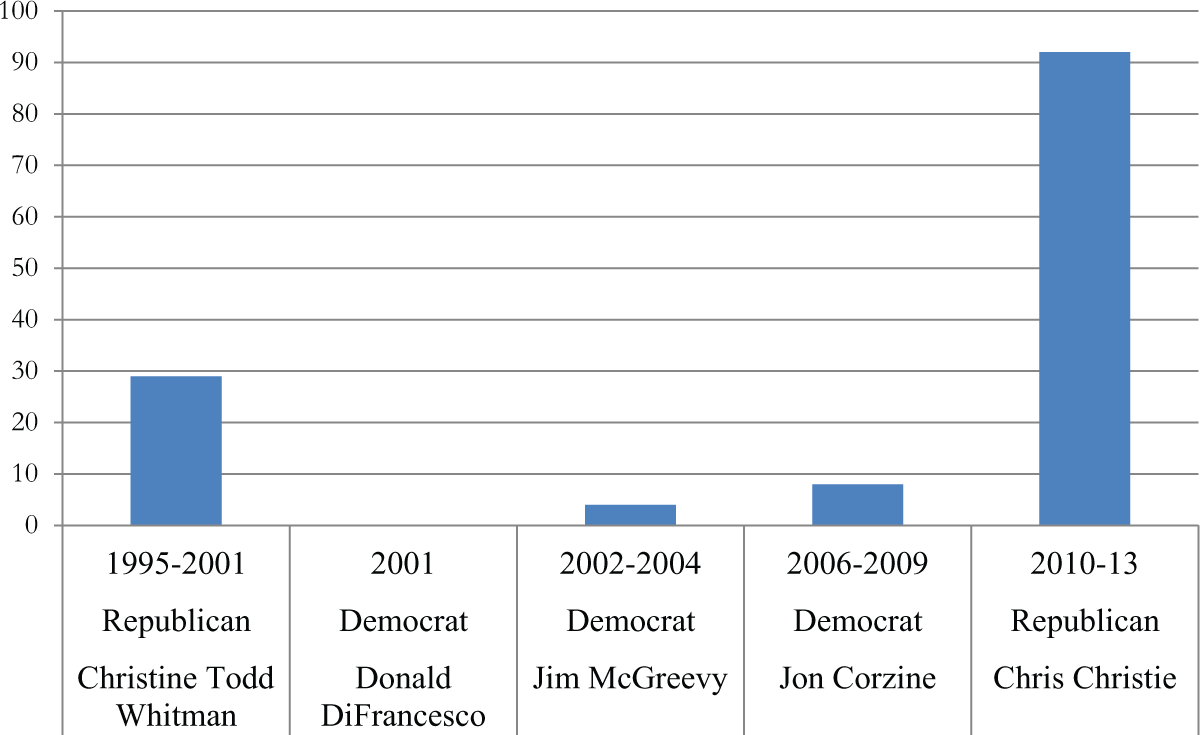
Number of “local control” mentions at Newark advisory board meetings since state take-over in 1995.
The lack of response from Christie and Anderson also prompted a response from the city council, although they do not have any authority over school governance. In May of 2013, the city council voted unanimously to approve a resolution introduced by then-South Ward City Councilman Ras Baraka, calling for a “moratorium on all school initiatives.” Newark voters also supported efforts to gain local control by electing Baraka mayor of Newark in 2014. Baraka, a former high school principal, made the Newark public schools and the fight to regain local control a central focus of his campaign (Cody 2014). Despite the actions of the Newark voters, the elected school board, city council, and the newly elected mayor, Newark residents and their elected officials do not have authority of their school district. As a state-controlled school district, school governance authority rests with the governor. In the 2013 gubernatorial election, Republican Chris Christie was reelected and won every county in the state except Newark’s Essex County (New Jersey Department of State 2013).
Conclusion
As the Newark case demonstrates, the growing presence of state government in local affairs has significant implications for our understanding of state politics, race politics, and urban governance. Although the era of “New Federalism” has been associated with devolution of governance authority, this article shows that the growing strength of states has led to centralization of state authority. In Newark, as Blacks gained political power in the city and were successful in increasing state resources for education, the city became increasingly vulnerable to intervention from state officials. However, a cohesive state–local regime decreased the likelihood that the state would take over the school district, despite state monitoring of the district since the 1970s. In contrast, the election of a Republican governor, who did not depend on Newark voters or their elected officials for their political success, led to a disjointed state–local regime, which increased the likelihood of a take-over in Newark. In 1995, after years of threats to take over the school district, the state’s Republican administration moved to take over the Newark schools.
Over the next 20 years, Newark would experience the role of the state differently in the city, depending on which political party controlled the governorship. Although partisan identification was a major factor in helping produce cohesive or disjointed state–local regimes, the Newark case shows that co-partisanship does not have to equate to cohesive intergovernmental regimes. Cory Booker, a Democrat, played an influential role in the transition from a cohesive to a disjointed state–local regime in Newark, primarily because of the support he received from Newark’s business community.
In Newark, the business community contributed to the disjointed state–local regime by supporting Booker and promoting an education reform agenda that was not supported by many of the city’s residents and their elected officials. Booker and the business community shared a vision for the Newark public schools that Booker did not subject to public scrutiny during his campaign for mayor but promoted once in office. The state presence in Newark allowed Booker to pursue an agenda for the public schools that was out of the public eye. Moreover, by receiving strong support from influential private-sector actors in Newark, Booker was able to circumvent traditional state–local partisan alliances that had served as the foundation for creating cohesive state–local regimes.
As the role of the public decreased during the disjointed state–local regime, foundations were able to increase their presence in the regime. Although the Zuckerberg donation brought attention to the role of philanthropic dollars in Newark, the presence of foundations is not unique to Newark. In her work on the role of foundations in the public schools, Reckhow (2013) finds that state take-overs of local school districts are likely to increase the presence of foundations in the district. The presence of foundations adds another layer of influence in the public schools that often operates away from public scrutiny.
Finally, Booker’s reliance on the business community allowed him to become the first African-American mayor in Newark who did not receive strong support from the city’s Black community. Thus, Booker’s support from the business community and his alliance with the Republican governor, Chris Christie, on education policy, contributed to and strengthened a disjointed regime that included the school board, city council, and Newark voters on one hand, and the mayor, governor, and the business community on the other. In other words, Booker’s mayoralty presented the appearance of a Black-led urban regime, however, the majority Black city council and school board were not supportive of the agenda. More important, these important aspects of the Black regime in Newark were removed from the decision-making process. Booker’s mayoralty in Newark complicates our understanding of the Black-led urban regime and merits further discussion.
The Newark experience illustrates how relationships between local regimes and state administrations can have an effect on state policy. The findings from this study suggest that collaboration, a key aspect of successful school improvement efforts, is most likely to occur under cohesive state–local regimes. At the same time, further work needs to be done to examine how relationships between state actors and local regimes affect urban governance. As of 2016, Republicans control state legislatures in two-thirds of the states. Furthermore, following the 2014 elections, 31 states have Republican governors; the most by any party in more than 15 years. The emergence of Republican-dominated state politics will continue to have significant political implications on urban governance and communities of color.
Footnotes
Appendix
State Take-Overs by State, School District, and Year of Take-Over (1989–2013).
| State | School District | Year of Take-Over |
|---|---|---|
| Alabama | Barbour County School District | 1996 |
| Macon County School District | 1996 | |
| Wilcox County School District | 1996 | |
| Barbour County School District | 1999 | |
| Jefferson County School District | 2000 | |
| Birmingham School District | 2012 | |
| Arizona | Colorado City Unified District | 2005 |
| Peach Springs Unified District #8 | 2007 | |
| Saddle Mountain Unified District #90 | 2007 | |
| Union Elementary School District | 2007 | |
| Arkansas | Altheimer School District | 2002 |
| Elaine School District | 2002 | |
| Helena-West Helena School District | 2005 | |
| Eudora School District | 2006 | |
| Midland School District | 2006 | |
| Bald Knob School District No. 1 | 2007 | |
| Decatur School District | 2008 | |
| Greenland School District #95 | 2008 | |
| Helena-West Helena School District | 2011 | |
| Pulaski County Special School District | 2011 | |
| Dollarway School District | 2012 | |
| California | Richmond Unified School District | 1991 |
| Coachella Unified School District | 1992 | |
| Compton Unified School District | 1993 | |
| Emery Unified School District | 2001 | |
| Oakland Unified School District | 2003 | |
| West Fresno Elementary School District | 2003 | |
| Vallejo City Unified | 2004 | |
| King City Joint Union High School District | 2009 | |
| Alisal School District | 2010 | |
| Inglewood School District | 2012 | |
| Connecticut | Bridgeport | 1988 |
| West Haven | 1991 | |
| Hartford | 1997 | |
| Waterbury | 2001 | |
| Bridgeport | 2011 | |
| Windham School District | 2012 | |
| District of Columbia | 1995 | |
| Illinois | East St. Louis School District | 1994 |
| Chicago School District | 1995 | |
| Hazel Crest School District 152-5 | 2002 | |
| Livingston School District 4 | 2002 | |
| Round Lake Area Schools District 116 | 2002 | |
| Cairo Unit School District 1 | 2003 | |
| Venice Community Unit School District #3 | 2003 | |
| Proviso Township High School District 209 | 2009 | |
| East St. Louis School District | 2011 | |
| North Chicago School District 187 | 2012 | |
| Kentucky | Pike County School District | 1988 |
| Floyd County School District | 1989 | |
| Whitley County School District | 1989 | |
| Harlan County School District | 1992 | |
| Letcher County School District | 1994 | |
| Floyd County School District | 1997 | |
| Louisiana | New Orleans School District | 2003 |
| Maryland | Baltimore City School District | 1997 |
| Prince George’s County School District | 2002 | |
| Massachusetts | Chelsea Public Schools | 1989 |
| Boston Public Schools | 1991 | |
| Lawrence Public Schools | 1998 | |
| Lawrence Public Schools | 2011 | |
| Michigan | Detroit Public Schools | 1999 |
| Mississippi | North Panola School District | 1996 |
| Oktibbeha County School District | 1996 | |
| Tunica County School District | 1997 | |
| Sunflower County School District | 1999 | |
| North Bolivar School District | 2005 | |
| Hazlehurst School District | 2008 | |
| North Panola School District | 2008 | |
| Indianola School District | 2009 | |
| Tate County School District | 2009 | |
| Okolona School District | 2010 | |
| Drew School District | 2011 | |
| Aberdeen School District | 2012 | |
| Missouri | St. Louis School District | 2008 |
| New Jersey | Jersey City Public Schools | 1989 |
| Paterson Public Schools | 1991 | |
| Newark Public Schools | 1995 | |
| Camden Public Schools | 2002 | |
| New Mexico | Santa Fe Independent School District | 1999 |
| New York | Roosevelt Union School District | 1995 |
| New York City Public Schools | 2002 | |
| Ohio | Cleveland Public Schools | 2003 |
| Youngstown City Schools | 1996 | |
| East Cleveland Public Schools | 1995 | |
| Pennsylvania | Chester-Upland School District | 1994 |
| Harrisburg | 2000 | |
| Philadelphia Public Schools | 2001 | |
| Rhode Island | Central Falls Schools | 1991 |
| South Carolina | Allendale County School District | 1999 |
| Texas | Somerset Independent School District | 1995 |
| Wilmer-Hutchins Independent School District | 1996 | |
| West Virginia | Logan County Schools | 1992 |
| Mingo County School District | 1998 | |
| Lincoln County School District | 2000 | |
| McDowell County Schools | 2001 | |
| Hampshire County School District | 2006 | |
| Fayette County School District | 2010 | |
| Gilmer County School District | 2011 |
Declaration of Conflicting Interests
The author(s) declared no potential conflicts of interest with respect to the research, authorship, and/or publication of this article.
Funding
The author(s) received no financial support for the research, authorship, and/or publication of this article.