







Abstract
Electoral and campaign finance reforms are believed to improve the competitiveness of elections and the accessibility of the electoral process; however, the interaction between electoral institutions and competitiveness and accessibility in nonpartisan municipal elections remains understudied. This article examines the City of Toronto, which exemplifies many of the reforms proposed in the American context, including a strict campaign finance regime and low barriers to candidate entry. Analysis of campaign finance disclosure data and candidate characteristics for Toronto’s 2014 ward elections reveals that electoral and campaign finance rules increase electoral accessibility while doing little to limit incumbency advantage. We argue that crowded nonpartisan races are low-information environments in which candidates, donors, and voters cannot assess challenger quality, which reinforces incumbent name recognition and access to campaign resources. The Toronto case highlights the limits of institutional and regulatory change as a means of increasing local electoral competitiveness and accessibility.
Keywords
Local government is often characterized as more open and accessible than national and subnational governments. Indeed, Alexis de Tocqueville portrayed local government as democracy’s schoolhouse—a vital training ground for civic participation and a launch pad for higher office. Yet prior findings have challenged this image of democratic accessibility, highlighting in particular the electoral advantage possessed by incumbents in terms of prestige, name recognition, and access to campaign funding and other resources (Holbrook and Weinschenk 2014b; Krebs 1998; Krebs and Turner 2014). Adams (2010) suggested that the need to raise large sums of money to be competitive in large city elections undermines both the capacity of nonelites to run for local office and the potential for democratic participation and civic learning. As the accessibility and competitiveness of local elections are structured by institutional arrangements governing candidate selection, fund-raising, and expenditure, there have been numerous proposals to level the playing field by reforming the electoral process and campaign finance rules. These include limiting the size of individual donations, prohibiting corporate and union donations, capping spending by candidates and third parties, and public subsidy of campaigns (Adams 2011).
In what is perhaps the most detailed examination of campaign finance in local elections, however, Adams (2010) argued that these reforms are likely to be ineffective or counterproductive. Spending limits may inhibit the ability of all candidates to reach voters, shift political money toward independent groups, and penalize challengers. Donation limits may restrict the resources available to candidates and increase time spent on fund-raising as opposed to other campaigning activities. Optional public funding is one response, but Adams finds that it is often insufficient to finance competitive campaigns and may, as with spending limits, drive private money to third parties. He concludes that the best means of increasing the competitiveness of local elections is, first, to lower barriers to candidate entry and reduce election costs by eliminating primary and runoff contests, and second, to promote public interest and focused engagement by consolidating small local governments, lengthening council terms, and encouraging citizen mobilization by community organizations.
This article investigates Adams’s conclusions in a local government context where many of these institutional arrangements are in effect: the City of Toronto, Canada. At 2.8 million residents, Toronto is larger than City of Chicago, to which it is often compared. Its council imposes substantial tax burdens on residents and businesses and administers an annual operating budget of over $11 billion, along with billions more in capital spending. 1 During and between elections, which occur at four-year intervals, the media routinely portrays the actions of local government as consequential to social welfare, economic growth, and quality of life. Neighborhood associations, single-interest organizations, and good government groups host citywide and ward-level all-candidates debates and engage in public information campaigns. Civic interest and engagement is reflected in high turnout: At 54.7%, turnout in the most recent election exceeded that of the previous three Ontario provincial elections. 2 By virtue of its weak-mayor and nonpartisan system of government, councillors possess considerable autonomy and influence over policy and the allocation of public resources—a prize that makes council office attractive to prospective candidates.
While Toronto is similar in many respects to many large American “reform” cities in that political representation is officially nonpartisan and ward-based, its elections are subject to more stringent campaign finance rules, including the prohibition of corporate and union donations, caps on individual donation size and candidate spending, mandatory financial reporting requirements, and prohibitions on building “war chests” by carrying forward unspent funds to future campaigns. Toronto’s electoral regime also features few barriers to candidate entry. Unlike many American cities, there are no primaries or runoff votes. To appear on the ballot, citizens need only make a small refundable deposit. In short, Toronto exemplifies the objectives of many American reformers and, as such, represents something of a “tough test” of whether institutional and regulatory reforms increase electoral accessibility and competitiveness (Eckstein 1975).
To this end, we present an analysis of an original dataset that combines campaign finance disclosure data, information on candidate characteristics, and election results for the most recent general election to Toronto’s 44 council seats held on October 27, 2014. Multiple regression models are used to test the influence on candidates’ electoral performance of the amount of funds raised, their personal characteristics, and the terms of the electoral contest, including whether the candidate is an incumbent or challenger, how many opponents they face, whether an incumbent is present, and whether the candidate has received media endorsement. Candidate performance is operationalized as vote share received rather than victory (see Krebs 1998). To further explore the relationship between incumbency and campaign finance, we also examined the correlates of the amount of external funds raised.
We conclude that Toronto’s electoral regime holds useful lessons for American reformers. The findings suggest that, despite embodying many of the elements desired by American reformers, Toronto’s electoral and campaign finance regime increases electoral accessibility while doing little to limit incumbency advantage. Negligible barriers to becoming a candidate enable crowded, multicandidate races, yet incumbency is by far the strongest determinant of vote share received, with spending a distant second. Incumbents generally outspend opponents by a large margin. Even while relying more heavily on self-financing, challenger spending rarely approaches the statutory expenditure limit. In short, limits on donation and expenditure do little to promote competitiveness in Toronto’s crowded nonpartisan elections. Maximal electoral accessibility may be too much of a good thing. We hypothesize that in a “noisy,” low-information environment, donors cannot accurately assess challenger quality and, on this basis, choose to “invest” in incumbents. With easy access to funds, a legal requirement to spend them, and limited knowledge of the threat posed by challengers, incumbents spend freely. This complicates Jacobson’s (1978) depiction of incumbents as misers who spend only if they perceive a genuine threat to reelection.
Determinants of Candidate Performance
Institutions and Rules
Institutions and rules determine the costs to prospective candidates and regulate the sources and uses of campaign resources. In so doing, they may confer differential advantage on candidates in relation to their personal characteristics, public profile, and incorporation into networks of community and business influence.
Of particular significance are official nonpartisanism and the relatively low barriers prospective candidates face to appearing on the ballot. Both reinforce incumbent advantage. The absence of party names on the ballot increases the cost to the voter of acquiring political information, increasing reliance on the name recognition heuristic (Milner 1997; Schaffner, Streb, and Wright 2001). At the same time, nonpartisan candidates cannot coattail on party reputation or machinery as they solicit funds. The absence of primaries or partisan nomination processes, as well as minimal deposit or signature requirements, is expected to generate more crowded races. These fragment the donor pool and require candidates to expend greater resources to compete for voter attention and donations. Indeed, Krebs (1998) and Kushner, Siegel, and Stanwick (1997) both found that candidates’ vote share declined as the number of opponents increased.
Incumbency advantage and challenger competitiveness are also potentially influenced by campaign finance rules; however, there is little consensus on the impact of specific institutional reforms. Advocates of limits on total campaign donations and expenditure, bans on corporate and union donations, and public subsidy of campaigns believe that they will increase campaign resources available to challengers relative to incumbents, encourage the assembly of broader fundraising coalitions, and shift candidate attention from soliciting funds to engaging electors (Mandle 2010; Miller 2014). Others have found that contribution and spending limits harm challengers more than incumbents (Johnson 2013), pointing to the widening gap between incumbent and challenger spending in congressional elections since the introduction of individual contribution caps in the 1970s (Smith 2010). Adams (2010) found that the impact of expenditure limits on the competitiveness of municipal council races is minimal. An additional concern is that limits on candidate fund-raising and spending will drive political money to outside actors that are more difficult to monitor and regulate, including issue advocacy groups and political action committees (Adams 2010; Green 2015; Lee, Ferguson, and Earley 2014). Finally, scholars of American self-financed campaigns by wealthy congressional and gubernatorial candidates have demonstrated that money does not buy victory. In fact, the principal impact of deep-pocketed candidates is to deter experienced potential candidates from entering races in the first place (Steen 2006). It is unclear whether this dynamic operates in the smaller realm of local elections.
Spending and donation limits are the core components of Toronto’s campaign finance regime, which are set out in the provincial Municipal Elections Act. The amount of money a candidate may spend is capped at $5,000 plus $0.85 per elector. As ward populations vary considerably, candidate spending limits in 2014 ranged from $25,938.05 to $49,142.20. Those who exceed the cap must pay a fine equal to the surplus. Candidates may not carry surpluses forward to future campaigns but may use them to repay money they personally loaned to the campaign. Deficits may be carried forward, however, and so it is not uncommon for candidates to use current surpluses to pay down debts incurred in previous campaigns.
The Act also caps individual donations to any one council candidate at $750 and $5,000 in total. Until recently, provincial law permitted campaign contributions only from Ontario residents, corporations that do business in Ontario, and trade unions that bargain for Ontario employees. Donations from collective entities, including advocacy groups and political parties, are prohibited. The City of Toronto banned corporate and union donations to candidates in 2006, a measure instituted across the province in 2016. There is no limit on donations from candidates and their spouses. The City of Toronto encourages campaign donation with a publicly funded rebate system whereby the municipality reimburses a portion of the contribution after the election. Donors must file an application to receive the rebate.
Ontario law mandates postelection disclosure of fund-raising and expenditure. Of the 358 registered candidates in Toronto’s 2014 election, 304 (85%) filed financial disclosure statements; the remaining 54 defaulted and are prohibited from running in future elections. The candidates who filed disclosures collectively raised over $5.36 million, including self- and spousal donations, and spent over $5.26 million. (These amounts include end-of-campaign deficits and loans. As these are assumed by the candidate, they are considered self-donations in this analysis. They also only include expenditures not subject to the spending limit. By law, the spending limit does not apply to certain administrative costs, including those associated with recounts, audits, and fundraising events and activities.)
Adams’s (2010) summary of campaign finance rules in 11 American cities suggests that they are less stringent than those operating in Ontario and Toronto. While state law and municipal ordinances cap contributions in some cities, progressively broader legal interpretation of campaign contributions and spending by candidates and third parties as constitutionally protected forms of speech has eroded the ability of governments to put boundaries around campaign spending. Jurisdictions such as New York City and Los Angeles impose limits on candidates who opt into partial public funding programs; however, these rules do not bind those who forego them. In the wake of the 2010 Citizens United ruling, it is virtually impossible to limit third-party intervention in local elections.
Toronto’s barriers to nomination are also relatively low. No nomination petition is required. Prospective candidates are neither vetted nor endorsed by party organizations. Candidates need not incur expenses associated with multistage electoral processes that include primaries and runoffs. To run, a citizen need make only a $100 deposit that is refunded if he or she receives more than 2% of the vote. Perhaps because of this low threshold, races are crowded. In 2014, candidates faced an average of 14.4 opponents in open races and 8.8 in races with incumbents. A large number of candidates did not appear to seriously campaign. A total of 102 candidates raised no money at all (and received an average of 2.5% of the vote). The fact that 60% of candidates in Toronto received less than 5% of the vote, 44% either raised no money or failed to file mandatory campaign finance disclosures, and that low fund-raising and low vote shares are highly correlated indicates that many candidates are either incompetent or motivated by reasons other than electoral success.
In a city where wards have small populations and are territorially compact, it is possible for candidates to directly interact with a large proportion of the electorate. Face-to-face interaction may be especially important in nonpartisan elections due to the absence of party labels as cues (Raymond 1992). In municipalities with large wards or where the council is elected at-large, candidates may substitute capital-intensive activities such as advertising and the distribution of campaign literature for direct human contact (Adams 2010). The degree to which the campaign finance regime facilitates or limits donation and expenditure is therefore likely to have a greater impact on competitiveness and accessibility in large districts like Toronto’s, where the average ward contains 63,600 residents, 25,000 households, and 36,420 eligible electors.
Candidate Characteristics
Within a given set of rules, we may expect candidates’ fundraising and electoral performance to vary in relation to their personal characteristics. Candidate characteristics are expected to be especially relevant in low-information, nonpartisan elections because voters cannot rely on party labels as “shortcuts” as they make their decision (Matson and Fine 2006; Moore, McGregor, and Stephenson 2017). Presenting what may be the most encompassing model of the relationship between individual characteristics and support, Lieske (1989) usefully argued that a candidate’s primary objective is to accrue legitimacy, and therefore public support, through the accumulation and communication of what he called “credentials”: ascribed characteristics (e.g., age, gender, religion, and ethnoracial background), personal achievements (e.g., education, income, and occupation), and political resources (e.g., incumbency, political record, campaign funds, and endorsement by political parties, media, or influential civic actors). Lieske hypothesized that candidates’ personal characteristics and achievements influence voters directly by activating social and cultural voting cues and indirectly by attracting symbolic and material resources such as endorsements, donations, and volunteer labor.
The most successful candidates benefit from a self-reinforcing circle. With the accumulation of resources comes greater legitimacy, which in turn expands access to resources. As candidates cannot be all things to all people, they pursue legitimation strategies that deploy their credentials and resources to selectively mobilize a winning electoral coalition. Credentials are substitutable. An explicit appeal on the basis of ethnic identity or professional expertise may, for example, substitute for incumbency or superior funds. Lieske’s factors, and the interactions between them, have been well examined in the literature. For example, women tend to be as successful as men when controlling for occupational background and financial resources, but fewer choose to run for office in the first place (Adams and Schreiber 2010; Ingalls and Arrington 1991). Others have found that candidates with private-sector occupational backgrounds requiring advanced education perform better, potentially because their professions afford superior access to donor networks and higher-income earners possess a greater capacity to self-finance their campaigns (Krebs 2001; Kushner, Siegel, and Stanwick 2001; Lieske 1989).
Incumbents ran for reelection in 37 of Toronto’s 44 wards in 2014; seven ward races were open. Only one incumbent, ward 26 councillor John Parker, was defeated. About 22% of registered candidates were female, a proportion consistent with Tolley’s (2011) national findings. The vast majority of candidates were between the ages of 30 and 65. About 46% of candidates had private-sector occupational backgrounds in business, management, retail services, law, finance, insurance, and real estate. Another 25% reported employment in government, health and social services, education, and higher education. Approximately 60% of both winning and losing candidates identified as nonpartisan.
Data and Method
In some American jurisdictions, governments and nonprofit organizations produce voter’s guides containing candidate biographies and platform summaries (Canary 2003). This has enabled retrospective analysis that incorporates information about candidates’ personal characteristics. As comprehensive voter’s guides are neither mandated nor produced in Toronto or other Canadian jurisdictions, information on candidate characteristics had to be collected in real time. An online survey was sent to the 358 candidates for ward councillor following the September 12, 2014, registration deadline. 3 A review of candidate websites was used to verify the currency of email addresses. Candidates were surveyed regarding five personal characteristics analyzed in prior studies of candidate performance in local elections (Krebs 1998, 2001; Kushner, Siegel, and Stanwick 2001; Lieske 1989): gender, age, occupational background, provincial party affiliation, and ethnocultural background. Three reminders were sent to remaining nonrepliers over a period of 10 days. Despite these efforts, the survey response rate was less than ideal: 127, or 35%. Following Siemiatycki (2008), information regarding the age, gender, occupational background, and the provincial party affiliation of nonresponders was then collected through examination of candidate websites and social media profiles. Variables were coded as “unknown” if the information was unclear or no website or profile existed.
Candidates were also coded on incumbency status, the number of opponents faced, the share of the vote received, and how many City of Toronto elections they had contested. Endorsements and prior political experience have been shown to influence support (Krebs 2001; Lieske 1989; Stein and Fleischman 1987). However, endorsement by the Toronto Star newspaper and whether the candidate had previously run for or held office in the amalgamated City of Toronto were dropped from the analysis because they correlated strongly with incumbency. The ethnocultural background variable was also dropped for two reasons. First, for the survey nonresponders, assignment to ethnocultural categories proved impossible in numerous cases of apparent mixed ethnicity and when female candidates had assumed their husband’s name, both evidenced by hyphenated names and appearance in photographs. Second, analysis of the survey responder group on its own revealed no statistically significant relationship between ethnicity and performance.
These data were merged with fundraising and expenditure information contained in mandatory campaign finance disclosure filings when they became available. Summary tables published by the City proved unreliable because many candidates filled out the forms incorrectly. The data used in this analysis were transcribed from the original filing documents and cross-checked against the City’s candidate summary tables. Common errors were rectified, including failing to report self-donations as campaign income and not including the filing fee as an expenditure. Some candidates reported self-donations equal to final campaign deficit, bringing the balance to zero, while others did not. For consistency, unresolved campaign deficits were recorded as self-donations.
We first tested multivariate ordinary least squares (OLS) regression models to assess the relative impact on candidate vote share of being an incumbent; being in an open race; having run in a prior election; personal characteristics, including gender, age, occupation, and partisanship; the amounts spent by the candidate and all opponents; and the number of opponents. To understand the correlates of fund-raising, we reran the analysis with funds raised from third parties as the dependent variable.
As a substantial proportion of candidates received very low vote shares and spent very little money, we assessed whether low-performing and low-effort candidates skewed the analysis by distinguishing between “serious” and “nonserious” candidates. Adams (2010) argued,
[s]pending at least some money on a race indicates that a candidate is making an effort to mount a competitive campaign, which is why a fundraising minimum (even a very low one) serves well to discriminate between major and minor candidates. (p. 40)
We defined serious candidates as those who raised more than $1,000 from people other than themselves or their spouse. Only candidates for whom data are complete are included in the analysis. A candidate’s record is considered complete if his or her gender, age, occupation, and provincial party affiliation are known and he or she submitted a campaign finance disclosure statement. Complete data are available for 259 (72%) of the 358 candidates. There are 190 serious candidates, for whom complete data are available for 182 (96%).
Determinants of Candidate Performance
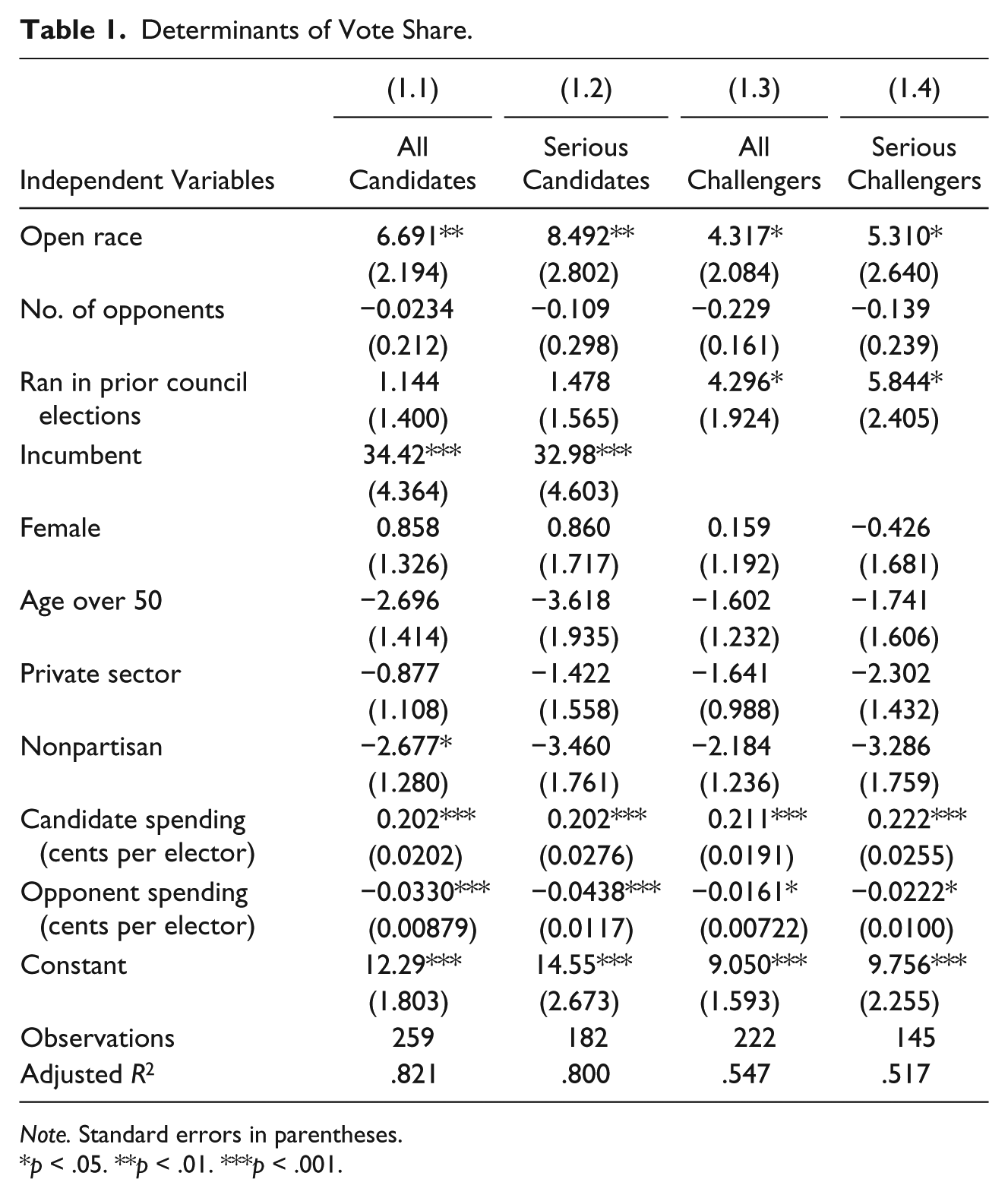
Table 1 presents the results of regression models with vote share as the dependent variable for candidates for which complete information is available. The first two models report results for all and serious candidates, while the third and fourth models exclude incumbents to focus on challengers. The fact that the coefficients are identical in direction and similar in magnitude for both all and nonserious candidates indicates that the latter do not skew the results despite their large number. The R2 values are high—over .80 in the models that include incumbents and over .50 in those that exclude them.
Determinants of Vote Share.
Note. Standard errors in parentheses.
p < .05. **p < .01. ***p < .001.
Incumbency
The first two models indicate that incumbency is the dominant predictor of vote share. Indeed, being an incumbent increases a candidate’s vote share by over 30 percentage points. Candidates do better in open races. Interestingly, the crowdedness of races (operationalized as the total number of opponents) was not found to be significant in any of the models. This runs counter to expectations as the number of candidates is expected to fragment the attention of voters. The personal characteristics of candidates—age, gender, occupational background—are not statistically significant in any of the models. While the finding that women perform as well as men is consistent with prior research, we expected partisanship to provide an advantage by acting as a cue for informed voters and affording superior access to fundraising opportunities. We also expected age and private-sector occupation to provide a reputational and fundraising advantage. Neither is borne out here. Having run in prior council elections is positively associated with vote share in the challenger-only models. This is intuitive, as prior political experience translates into additional name recognition and greater experience with the administrative tasks of campaigning.
Spending
In all four models, the next most important, albeit much weaker, determinant is incumbent expenditure. The spending limit would be $35,965.50 in an average ward of 36,430 electors or a bit less than a dollar per elector. As wards vary significantly in population, we followed Jacobson (1978) by standardizing expenditure in relation to population: as cents spent per registered elector. Each additional penny spent per elector
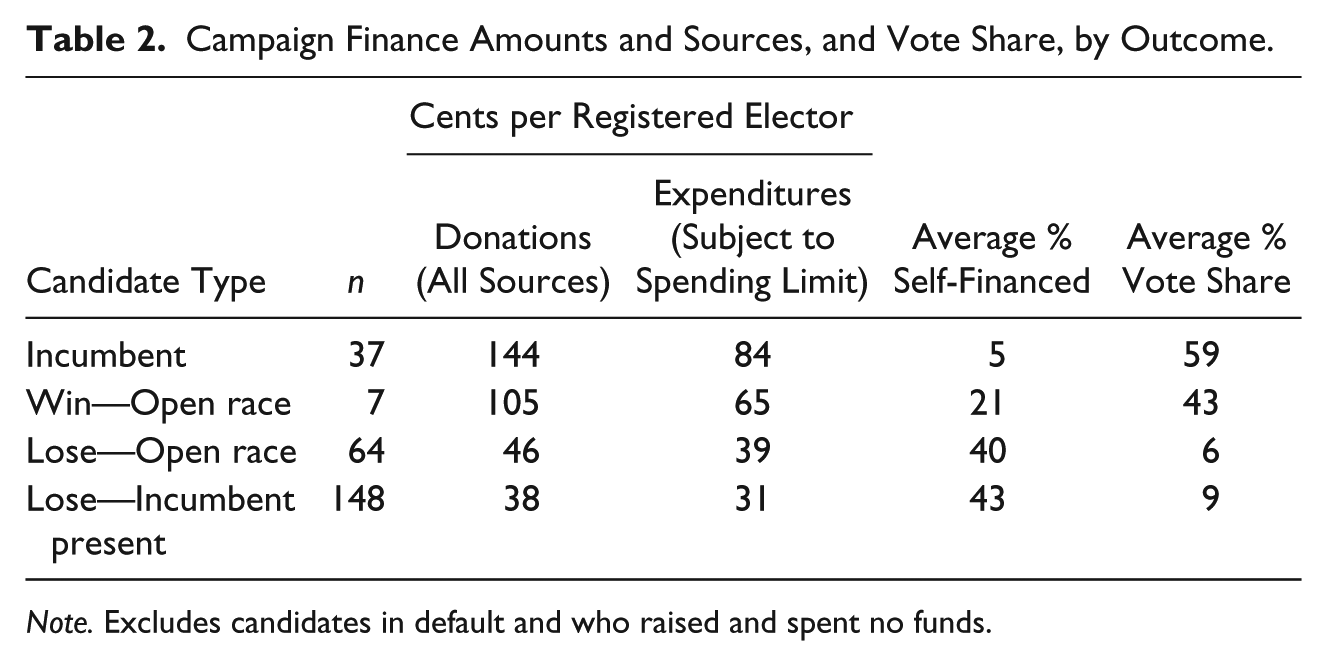
increases vote share by 0.2 points. Each additional $10,000 spent by a challenger in an average ward (the equivalent of 27 cents per elector) would be associated with an expected 5.7% increment in vote share. The small size of the vote share increment relative to expenditure suggests the uphill battle this hypothetical challenger faces—even if she spent her entire spending limit, it would not be enough to offset the incumbents’ vote share advantage. Each penny increase in total opponent spending was found to decrease candidate vote share by a much smaller increment—between 0.01 and 0.04 points. This does not conform to expectations. Considering congressional elections, Jacobson (1978, 2006) demonstrated that incumbents spend in proportion to the perceived magnitude of the electoral threat posed by challengers. The more incumbents spend, the less well they do; the more challengers spend, the better their performance (see also Bonneau 2007; Gierzynski and Breaux 1991). We do not observe this relationship in Toronto. Incumbents outraised and outspent open-race winners, who in turn outraised and outspent unsuccessful candidates by wide margins (see Table 2). Incumbents raised approximately 40 cents more per elector than winners in open races. On average, losing candidates raised and spent less than half as much as open-race winners. Losing candidates in open races raised and spent more funds than those facing incumbents, a finding consistent with Krebs’s (2001) analysis of Chicago and Los Angeles, but their level of spending did not, on average, rival the winners. Excluding candidates who raised and spent no funds, winners spent on average 82% of their spending limit, compared with 46% for unsuccessful serious candidates and 8% for nonserious candidates.
Campaign Finance Amounts and Sources, and Vote Share, by Outcome.
Note. Excludes candidates in default and who raised and spent no funds.
Plotting campaign expenditures against vote share received suggests that spending is a necessary but insufficient condition of high performance. Winners spend, although not all spenders win. In Figure 1, we graphically distinguish between winners in open races, winning and losing incumbents, and “serious” and “nonserious” losing challengers. To reiterate, serious candidates are those who raised more than $1,000 from third parties—people other than themselves or their spouse. As wards vary significantly in population, we again standardize expenditure as cents spent per registered elector. The nonserious candidates are clustered at the bottom left, indicating that low levels of spending correlate with low vote shares. No challenger who spent less than 60 cents per elector received more than 25% of the vote. Almost all winning candidates, and especially winning incumbents, spent considerably more than this. Still, the low performance of many of the challengers who matched winners’ spending levels indicates that money is not enough.
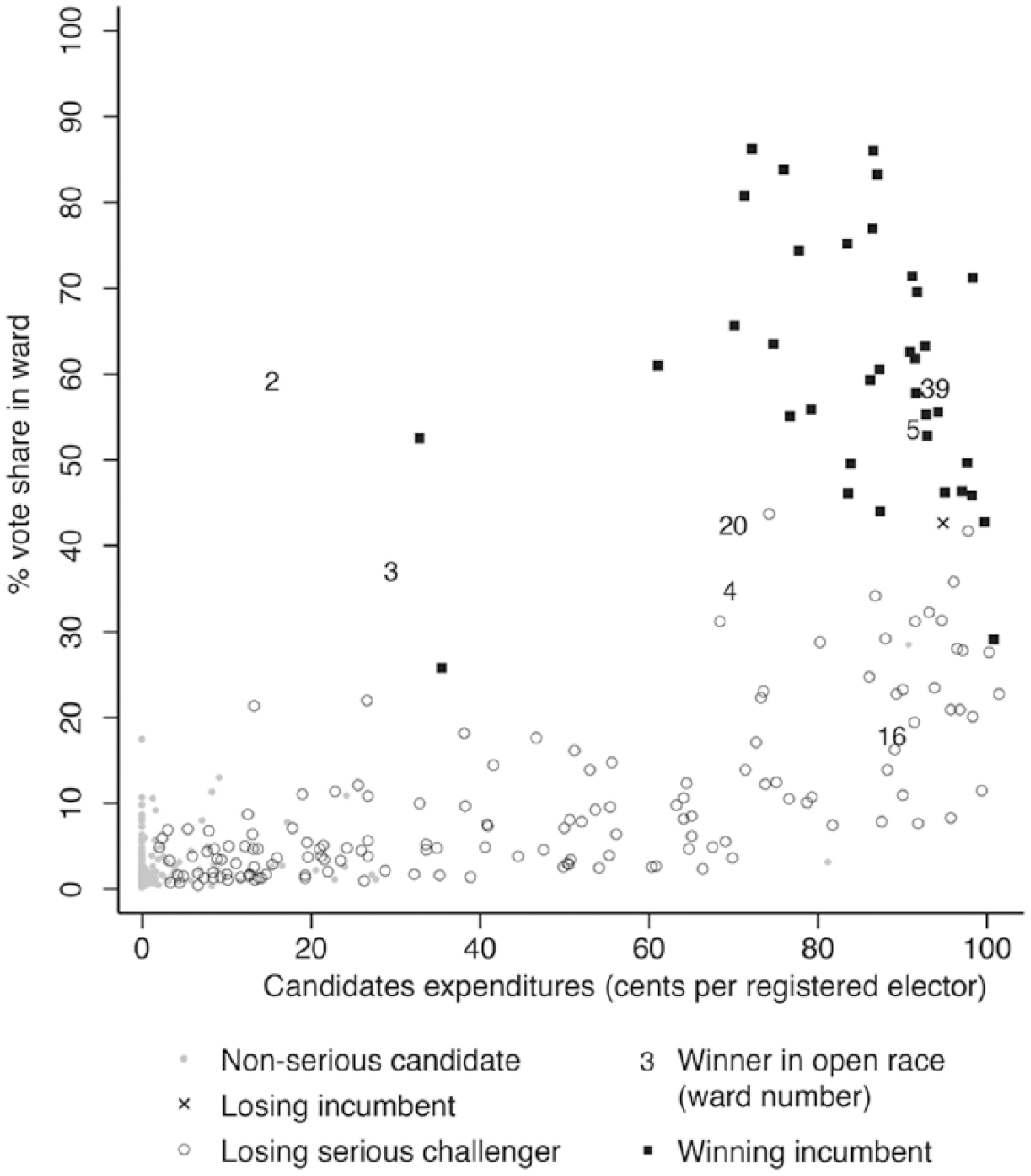
Vote share by campaign expenditures, all races.
Figure 2 plots expenditures against vote share for the seven open races. Open races were crowded, featuring between eight and 22 candidates, most of them “serious.” Here we see an inconsistent relationship between expenditure and vote share, one that we hypothesize is mediated by candidate name recognition and campaigning experience. The winning candidates in wards 2 and 39 are quasi-incumbents, having previously represented the same ward or the corresponding federal district. Similarly, the winning candidates in wards 3, 16, and 20 are the children of municipal and provincial politicians. The ward 20 winner had also run unsuccessfully in a federal by-election only weeks before. In wards 4 and 5, the winners had narrowly lost to the retiring incumbent in the previous election. Each of these candidates therefore benefited from a distinct combination of name recognition, prior political experience, and partisan connections that either facilitated fund-raising or substituted for spending.
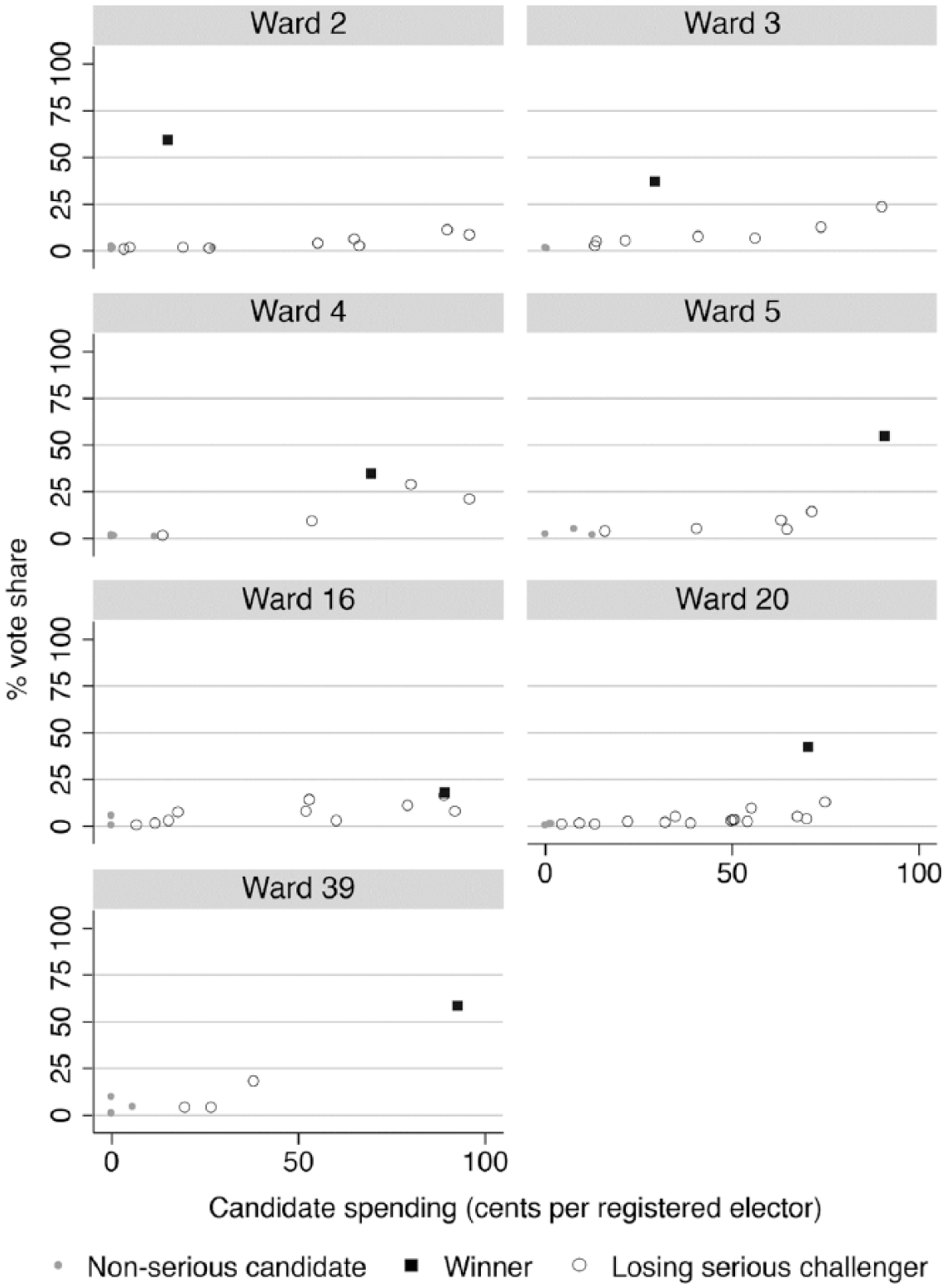
Vote share by campaign expenditures in open races.
Fundraising Effort
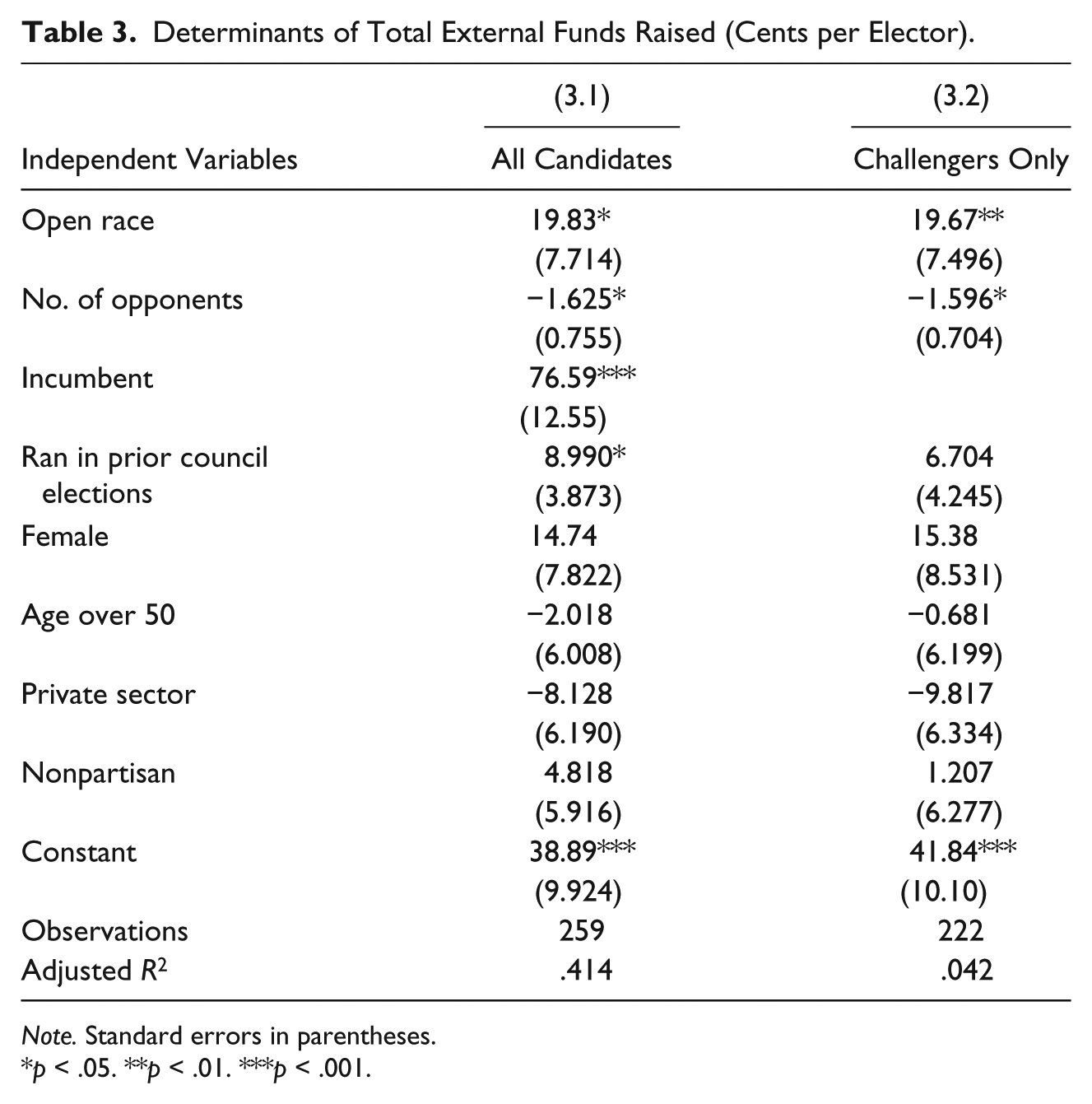
The foregoing analysis indicates that incumbency and campaign spending are the dominant predictors of candidate vote share. As a group, winners (mostly incumbents) spent more than most challengers. Few of the challengers who rivaled incumbents’ spending came close to matching their vote shares. Incumbency appears to confer a powerful spending advantage. Although spending is function of available funds, a separate focus on fund-raising may reveal whether candidates with particular characteristics are favored (see Krebs 2001). Table 3 presents two regression models, the first including all candidates, the second including only challengers. Funds contributed by the candidate and his or her spouse are removed to focus on candidates’ capacity to solicit funds from external donors who have other options.
Determinants of Total External Funds Raised (Cents per Elector).
Note. Standard errors in parentheses.
p < .05. **p < .01. ***p < .001.
The first model has more predictive power than the second—an R2 value of .41 versus .04. Consistent with Krebs’s (2001) analyses of Chicago and Los Angeles, gender, age, occupational background, and partisan affiliation are statistically insignificant. There appears to be little systematic relationship between challenger characteristics and external funds raised. What is clear, however, is that incumbents attract considerable donations—an additional 77 cents per elector. Unsurprisingly, candidates in open races have a substantial fundraising advantage compared with those in races featuring incumbents. The analysis also indicates that individual candidates raise less money as races become more crowded. These results confirm the earlier findings: Incumbents possess an extraordinary advantage when it comes to external fund-raising, one that is unmediated by personal characteristics.
This analysis only includes funds raised from outsiders. A significant proportion of campaign funds, however, are donated by the candidate or the candidate’s spouse. Excluding candidates who raised no money at all (and who received an average of 2.5% of the vote), self- and spousal donations accounted for 17% of funds in all races. Table 2 indicates that, on average, winners in open races relied on self-financing more than incumbents (21% vs. 5%). Losing candidates self-financed almost half their campaign budgets. These percentages do not translate into substantial differences in absolute terms, however. Win or lose, candidates and their spouses donated an average of $3,000 to their own campaigns in races featuring an incumbent and $4,500 in open races. While incumbents contribute funds to their own campaigns, they also tap much greater funding from external sources.
Discussion
The Toronto case is relevant because its campaign finance regime incorporates many prescriptions advocated by American reformers: strict limits on the size of individual donations and total expenditures, prohibition of corporate and union donations, donation incentives, and mandatory campaign finance disclosure. There are few financial or procedural barriers to becoming a candidate. Parties play no role in candidate selection, endorsement, or fund-raising; candidates run as individuals and only their names appear on the ballot. More broadly, Toronto embodies many institutional characteristics that Adams portrays as desirable for robust local democracy: a large, multifunctional, general-purpose local government with four-year council terms, relatively high media and community interest in local elections, and no primaries or runoffs.
The question is, do these institutions and rules improve electoral accessibility and competitiveness? The answer, it seems, is no. Incumbents possess an almost insurmountable advantage despite limits and rules that are very strict by American standards. The fact that candidates’ gender, occupation, age, and party affiliation have no significant effect on vote share or fundraising ability is a good news story. All else being equal, candidates with a diverse array of characteristics have an apparently equal chance of achieving similar outcomes. But all else is not equal. Challengers face almost insurmountable odds regardless of their personal characteristics. Their vote share increases in proportion to spending and political experience (having previously run for office); however, victory remains rare. Turnover is most likely to occur when incumbents voluntarily retire from the field. Even while relying more heavily on self-financing, challenger spending rarely approaches the statutory expenditure limit. In Toronto, restrictions on individual donation amounts and sources, expenditure limits, and donation incentives do little to increase the competitiveness of challengers.
The findings suggest a curious relationship between electoral accessibility and competitiveness. Low barriers to candidate registration enable and encourage crowded, multicandidate races. Each candidate faces an average of nine opponents. Moreover, a large proportion of candidates raise and spend little or no funds and receive a correspondingly small share of the vote. The motivations of these minor candidates are unclear and are worthy of further study. As a result of these phenomena, Toronto’s ward elections are “noisy,” low-information contests. Many names appear on the ballot, yet few are “serious” contenders. In such an environment, it may be that prospective donors cannot accurately assess the quality of challengers and so opt to invest in the devil they know: the incumbent.
Why do so many incumbents engage in high spending if challengers pose only a minimal threat? One possibility is that they cannot accurately perceive the magnitude of threats posed by challengers. Commissioned polling remains rare at the ward level in Toronto, and so candidates assess their electoral strength through such imprecise measures as door-to-door canvasing and yard sign market share. Even if it is ineffective, incumbents may view high spending as an insurance policy to protect their advantage in the fog of the campaign. Another explanation lies in the regulatory framework. As noted, candidates are prohibited from building war chests by carrying surpluses forward to future campaigns. Able to attract the most money with relatively little effort, incumbents are legally obliged to spend it, often approaching the statutory spending limit.
The Toronto case therefore exemplifies unresolved dilemmas of electoral and campaign finance reform. Should rules be crafted to reduce incumbents’ fundraising advantage or to increase challengers’ relative access to capital? Jacobson’s analysis suggests, however, that challenger fundraising and electoral performance are a product of candidate quality and visibility. The solution may lie not in lower spending limits but in striking a different balance between electoral accessibility and the encouragement of experienced candidates. Indeed, restricting electoral accessibility may increase the competitiveness of races. One avenue would be to increase the size of the nomination deposit. This would discourage frivolous candidates but risk excluding the less well-off. Another avenue would be to create stronger incentives to seriously campaign. For example, the threshold for refunding the nomination deposit could be increased or public subsidy of campaign costs made conditional on meeting a high level of support. (In Québec, municipalities reimburse 50% of campaign expenses if the candidate receives more than 15% of the vote.) The latter approach, however, effectively subsidizes incumbents as much as it discourages frivolous candidacies. Another way of discouraging minor candidates without imposing a financial barrier would be to require the demonstration of community support by collecting a minimum number of signatures. While something of a blunt instrument—and without precedent in Canadian elections at all levels—term limits may be the most effective way of leveling the playing field for serious challengers, simply by periodically removing incumbents.
There are no easy answers. Every solution—for example, Ontario’s ban on carrying forward surpluses to future campaigns—may generate a new problem. This study contributes to the study of local elections by probing the limits of institutional and regulatory reforms, finding that conventional dynamics persist even though Toronto has a relatively accessible electoral process and stringent campaign finance regime. This should not be taken as a call to deregulate local elections. We agree that institutions and rules are needed to ensure democratic accountability and responsiveness in the face of deep-pocketed interests. The Toronto case raises interesting questions that can be assessed through comparative research on the relationship between competitiveness and the regulatory regimes that govern electoral accessibility, fund-raising, and spending, and also through more intensive survey research on the motivations and perceptions of candidates.
Footnotes
Acknowledgements
The authors are grateful for the comments of the journal’s editors and the three anonymous reviewers and also acknowledge the work of research assistants Jeff Allen and Remy Caruso who inputted and verified the campaign finance disclosure data.
Declaration of Conflicting Interests
The author(s) declared no potential conflicts of interest with respect to the research, authorship, and/or publication of this article.
Funding
The author(s) received no financial support for the research, authorship, and/or publication of this article.