







Abstract
Many U.S. elections provide voters with precious little information about candidates on the ballot. In local contests, party labels are often absent. In primary elections, party labels are not useful. Indeed, much of the time, voters have only the name of the candidate to go by. In these contexts, how do voters make decisions? Using several experiments, we find that voters use candidates’ race, ethnicity, and gender as cues for whom to support—penalizing candidates of color and benefiting women. But we also demonstrate that providing even a small amount of information to voters—such as candidate occupation—virtually erases the effects of candidate demographics on voter behavior, even among voters with high levels of racial and gender prejudice.
Keywords
When Los Angeles County voters entered their polling booths in November 2016, they might have known who they supported for president but had little information to guide many of their other choices. How did voters decide between two U.S. Senate candidates who were both Democrats? Perhaps even more challenging, how did they determine which nonpartisan candidates for Board of Supervisors, Superior Court, City Council, and Rent Control Board would pursue their preferences if elected? Filling out this ballot asked a lot of citizens, yet the information available to voters about most of these candidates was minimal. How do voters make decisions in this kind of environment? 1 How does the information available shape the kinds of candidates voters elect to public office?
As in many other parts of life, voters are motivated to make easy decisions—minimizing the time and cognitive resources they must use to cast their ballots (Lau and Redlawsk 1997). So voters use a variety of shortcuts to help them make their choices (e.g., Fiske and Taylor 2013; Lupia 1994; Popkin 1995). Shortcuts vary widely in how well they enable voters to select a candidate who is most likely to represent their interests when in office. Party identification may serve as the best cue for this purpose, but it is often absent or does not vary between candidates in primary elections; elections for city, county, and special district offices; and state and federal offices in states with runoff elections. Other shortcuts—like using individual candidates’ demographic traits to infer their ideology and partisanship—offer voters much noisier estimates of who will best represent them (Koch 2000; Sen 2017). 2 Yet voters regularly choose candidates to support even in conditions of very low information and when the shortcuts available to them are imperfect.
In this paper, we examine how voters make decisions under varying levels of information to study how voters use candidate characteristics as a shortcut when casting their ballots in the kinds of low-information conditions that are increasingly common in American politics. We argue that voters use race and gender, signaled by candidates’ names, to infer their quality and ideological position and to decide whom to support. Evidence from two different conjoint design experiments supports this argument. In low information elections, minority candidates are penalized while female candidates are preferred, though these effects differ by voter ideology and partisanship. Voters’ use of cues to select candidates may compromise their ability to achieve representation of their policy preferences and has normative implications for the descriptive and substantive representation of Americans from many (e.g., racial, ethnic, gender) identity groups.
Importantly, we also show that voters’ use of candidate demographic traits when casting ballots can be changed. Providing limited amounts of additional information about candidates—a circumstance already enabled by some states’ ballot designs—fundamentally reshapes how voters react to candidate demographics. Disadvantages for candidates from all racial and ethnic minority groups are eliminated by providing voters with enough information—and the threshold is lower for Asian and Latino/a candidates relative to Black candidates. Furthermore, the preference for women simply due to their gender is weakened significantly in our highest information condition. Thus, increasing the information easily accessible to voters—particularly in the kinds of low-information contexts endemic in American local politics as well as in primaries—can diminish the use of racial, ethnic, and gender heuristics in elections.
Our findings hold among different types of voters—across party and ideology. Very small amounts of information enable voters to significantly diminish their reliance on candidates’ race and gender when casting ballots, with beneficial effects for candidates of color. Given clear evidence that descriptive representation affects the substantive care and policy representation local officials provide to constituents (e.g., Boles 2001; Karnig and Welch 1980; Marschall and Shah 2007; Schumaker and Burns 1988), determining how to increase—even slightly—the information provided to voters in American elections is essential to drawing closer to a democratic ideal in both voter decision-making and the provision of high-quality representation to all Americans.
Voters (Often Have To) Use Heuristics
We propose that voters aim to select candidates who will do a good job in office (those who are qualified for the position) and candidates who match voters’ values (those who share the voters’ ideology and partisanship). However, in many election contexts, voters must use shortcuts to determine which candidates meet these criteria. Decreases in the number of local media outlets and limited coverage of politics at the congressional level and below have left many voters with few resources for learning about most of the candidates who appear on their ballots (Hayes and Lawless 2015; Shaker 2014). Many voters fail to seek out even the political media that does exist (Prior 2007), leaving low-cost—and low-information—tools like campaign signs as primary methods of voter outreach for many candidates (D. P. Green et al. 2016). Although some elections feature well-funded candidates who are able to reach hundreds or thousands of voters with policy information, many do not, and even the information provided to voters by candidates is often targeted at a small set of frequent voters (Panagopoulos 2016). Some states seek to inform voters by mailing out ballot guides with endorsement information, issue positions, and candidate biographies, but most states do not provide this information (Wolfinger, Highton, and Mullin 2005). The ballot itself may offer information about the candidates (see examples in Online Appendix Figures A1–A5), but in many contests, this is not the case. Thus, in a variety of elections from the local through federal level, voters know little about the candidates and have few incentives to devote much time or effort to their candidate selections (Downs 1957; Hayes and Lawless 2015; Schaffner, Streb, and Wright 2001; though see Oliver, Ha, and Callen 2012 on local elections).
In an effort to support candidates who have experience, share their ideology, and identify with groups they support, voters draw on whatever cues are available to make their decisions. Existing research demonstrates voters rely on cues such as the partisanship or ideological position of the candidate, the candidate’s stance on particular issues, personal knowledge of the candidate, endorsements, and the candidate’s personal characteristics like race, gender, age, appearance, occupation, and socioeconomic status (Benjamin 2016; Downs 1957; Fiske and Taylor 2013; Key 1949; Kirkland and Coppock 2017; Lupia 1994; McDermott 1998, 2005; Popkin 1995; Sen 2017; Todorov et al. 2005).
We argue that candidate race, ethnicity, and gender—candidate characteristics that can often be identified even in the lowest information elections—are particularly powerful shortcuts for voters when they lack information about the candidates. Given pervasive racial and gender stereotypes among Americans, candidates’ demographic traits may be used to stand in for candidate quality and ideology under conditions of low information—leaving a gap in voter support for candidates of color versus White candidates and potentially for female candidates versus male candidates. However, as more information is provided, we expect these gaps to diminish.
Our experiments examine how the provision of moderate levels of information (candidate occupation) and high levels of information (occupation, incumbency, age, education) about candidates affect the extent to which respondents use candidate gender, race, and ethnicity as cues to guide their vote. Like gender, race, and ethnicity, these additional cues (e.g., occupation, education, incumbency) may also be used by respondents as heuristics for candidate quality and ideology. However, unlike demographic cues, these additional cues are arguably preferable for respondents to use because they are not immutable traits; rather, they are characteristics that are under candidates’ control. Furthermore, inferences based on traits like occupation are less likely to derive from historical patterns of prejudice and discrimination than those based on gender and race.
For reasons explained in the following, we expect that racial and gender heuristics will have the largest effect on choices between candidates in the lowest information condition. But, when provided with other substantive information about candidates, we expect that respondents will rely less on gender and race heuristics, diminishing or eliminating demographic differences in which candidates respondents support. Importantly, we expect that the provision of information will influence the use of race and gender cues among many types of respondents: Republicans and Democrats, liberals and conservatives, and individuals with various racial and gender attitudes. This makes the level of information provided to voters in American elections particularly powerful.
Quality Cues
When aiming to select candidates who are qualified to hold office and will reflect their preferences, respondents in low-information contexts may prefer male and White candidates over women and racial and ethnic minorities. Because women and racial minorities continue to be dramatically underrepresented in elected office in the United States, respondents likely assume that female and minority candidates are less likely to have political experience—potentially signaling their lower quality. In a pre-test, we asked 1000 MTurk respondents to indicate the likelihood that a candidate had held a city council position, and randomly varied the name of the candidate to signal race, ethnicity, and gender. 3 We find that men are significantly more likely to be viewed as having council experience compared with women, and that Whites are significantly more likely to be viewed as experienced relative to candidates of color. 4 Experience is one way to measure candidate quality, so these perceptions should lead respondents seeking high-quality candidates to disproportionately support male and White candidates.
Both members of the public and political elites prioritize qualities like intelligence and being hardworking when evaluating political candidates (Broockman et al. 2018), and racial stereotypes influence evaluations of these qualities. Prejudices against Blacks are particularly large and commonly held, as revealed in tests of implicit attitudes and surveys measuring explicit opinions about Blacks (Knowles, Lowery, and Schaumberg 2010). For example, more than a quarter of Whites rank members of their race as more hardworking and more intelligent than Blacks, and more than half of White Americans attribute poorer jobs, income, and housing among Blacks to a lack of motivation and willpower (Bobo et al. 2012). Given these views, it is not surprising that stereotypes and prejudices negatively affect support for Black candidates (Huddy and Feldman 2009; Piston 2010).
Prejudices against other racial and ethnic groups are more mixed in tone than those about Blacks. For example, Asian Americans are perceived as “model minorities,” both academically gifted and hardworking (Kao 1995; Kinder and Kam 2009), and in some contexts, Latino/as are also rated more favorably than Blacks (Maldonado 2006). 5 But there are negative stereotypes associated with Asian-Americans and Latino/as as well. Both groups are frequently considered “perpetual foreigners” and “civicly ostracized” relative to other racial and ethnic groups in the United States—potentially relevant when voters are considering who to place in American government positions (Kim 1999; McConnaughy et al. 2010; Xu and Lee 2013). Consequently, in low information elections, we expect that respondents using race and ethnicity as cues for a candidate’s level of political experience or quality will be less likely to support racial minority candidates than White candidates and that this effect should be strongest for Black candidates.
Scholarship identifying prejudices against women in politics is also mixed. Sen (2017) and Kirkland and Coppock (2017) find that in the absence of partisan cues, female candidates are preferred to male candidates (particularly among Democrats). A long line of scholarship demonstrates that women are stereotyped as better at handling particular types of issues (e.g., poverty and education) and as more honest, compassionate, and open to compromise than men (e.g., Eagly and Karau 2002; Huddy and Terkildsen 1993). Female candidates and elected officials have been shown to be of higher quality than their male counterparts, and popular media trumpets their successes (Anzia and Berry 2011; Fulton 2012; Stolberg 2015). On the other hand, men are stereotyped as better at military and crime issues (Provins 2018), and as better leaders than women. Recent research indicates that the effect of gender stereotypes is conditional on the campaign environment, and that gender stereotypes are often not related to vote decisions (Bauer 2015; Dolan 2014). In sum, stereotypes of female politicians in recent years “are nebulous and lack clarity” (Schneider and Bos 2014, p. 261). Thus, in low information elections, we expect that respondents using gender as a cue for candidate experience or quality may be less likely to support female candidates than male candidates.
As respondents are provided with more information—information that more directly signals candidate quality—respondents should prioritize this over heuristics like race and gender (Devine and Monteith 1993; Kirkland and Coppock 2017; Mo 2015; Terkildsen 1993). 6 In short, in low-information elections, if White and male are quality cues, then racial minorities and women should pay a price in terms of votes. That price should be lessened by additional information that they do, in fact, possess indicators that they are high-quality candidates (i.e. that they serve in a job that would give them relevant skills or have previously held office).
Ideology Cues
In addition to seeking high-quality candidates, voters also value candidates who will act in their stead when making policy—who share their ideology and partisanship. Yet many elections leave voters with inadequate information on this dimension. Some voters will use candidates’ gender and race to infer candidate ideology. Studies indicate that female and Black lawmakers are more liberal than their male and White counterparts (Tate 2003; Thomsen 2015). In addition, voters rate female, Black, and Latino/a candidates as more liberal than they are due to their gender and race (Huddy and Terkildsen 1993; Jacobsmeier 2014; Jones 2014; Koch 2000; McConnaughy et al. 2010; McDermott 1998). Our own research confirms this behavior. In Experiment 2 (discussed later), following the experimental manipulation, we asked participants to rank the ideology of two randomly generated candidate profiles. We found statistically significant distinctions in ideology ratings: Black and Latino/a candidates are viewed as more liberal than Whites, and female candidates are viewed as more liberal than men. 7 Thus, in low-information elections, we expect that Democratic/liberal respondents will be more likely to support women and racial minority candidates compared with Republican/conservative respondents. We expect that adding information will decrease the effects of candidate race, ethnicity, and gender on votes across all types of respondents.
Racial Resentment and Modern Sexism
It is not just assumptions about experience or ideology that voters use when deciding between candidates. Voters’ “feelings toward groups” are also likely to matter (Brady and Sniderman 1985, p. 1073). Indeed, studies of implicit attitudes make clear that most Americans view individuals through racial and gender lenses, and evidence indicates that voter prejudices can influence support for candidates with particular traits (Banaji and Greenwald 2013; Piston 2010; Stout and Le 2017; Visalvanich 2017).
There are reasons to expect that the effects of candidate gender and race will vary by voter, based on individual levels of explicit racial and gender prejudice and on political party identification (Banaji and Greenwald 2013). Research reveals the continued prevalence of negative affect toward racial and ethnic minorities among many Americans, and the effects of racial resentment on vote choice (Hutchings and Valentino 2004; Kinder and Sanders 1996; Tesler 2016; Tesler and Sears 2010). Sexism too persists among Americans and influences voter decision-making (McThomas and Tesler 2016; Sharrow et al. 2016; Swim et al. 1995).
In our main experiment (Experiment 1), we too find evidence of continued racial resentment and modern sexism among our sample of 961 MTurk respondents. In total, 62% of our White respondents agree that Blacks should have to work their way up without special favors, 46% disagree that discrimination has made it difficult for Blacks to work their way out of the lower class, and 47% think that if Blacks just tried harder, they would be just as well off as Whites. Nearly half (48%) of our respondents see discrimination against women as a minor problem, and 10% agree that women should focus on running their homes, leaving running the country to men. 8 Thus, we expect that under conditions of low information, racial and gender conservatives will prefer White and male candidates while racial and gender liberals will be more likely to support non-White and female candidates. However, as existing research shows that prejudice and stereotypes are more likely to play a role in decision making when candidates’ qualifications are ambiguous (Citrin, Green, and Sears 1990; Fiske 1998; Mo 2015), we expect that the addition of further information about the candidates will lessen these gaps.
Hypotheses
To summarize, then, we argue that voters use candidate characteristics—their race, gender, and ethnicity—as shortcuts when making decisions in low information conditions. Our Race Hypothesis predicts that in conditions of low information, respondents will prefer White candidates over racial minority candidates, as race is used as a cue for candidate quality and captures negative stereotypes about minority candidates. Our Gender Hypothesis predicts that in conditions of low information, voters may prefer male candidates over female candidates, given inconsistent findings regarding stereotypes and prejudices toward female candidates. Because race and gender may be used to infer ideology, in conditions of low information our Ideology Hypothesis predicts that Republicans and conservatives will prefer male and White candidates while Democrats and liberals will prefer female and non-White candidates. Finally, due to the continued power of racial resentment and sexism to shape voter behavior, our Prejudice Hypothesis predicts that voters with higher levels of racial resentment and sexism will prefer White and male candidates to a greater extent than those who score low on these measures.
A key contribution of this study is our examination of the way in which the level of information available to respondents conditions each of these relationships. We test how providing moderate and high levels of information about the candidates affects whether respondents use candidate traits (gender, race, and ethnicity) to guide their votes. Our Information Hypothesis predicts that racial and gender heuristics and prejudices will have the largest effect on choices between candidates in the lowest information condition. When provided with other substantive information about the candidates, we expect that respondents— from both parties and with various ideologies—will rely less heavily on gender and race heuristics, diminishing or eliminating demographic differences in which candidates respondents support.
Real Elections Are Complicated (or, the Need for Experiments)
Although voters frequently cast ballots in low and moderate information elections, it is difficult to test how candidate characteristics or other heuristics are influencing their vote choices because there are many moving pieces in real-world elections. Most importantly, correlations exist between election environments and opportunities for underrepresented candidates. Women and candidates of color are less likely than similarly situated men or Whites to be recruited to run or to seek political office; they are more strategic when determining whether or not to enter a race and seek different types of offices; and those who do run are more qualified than their male and White counterparts (Crowder-Meyer, Gadarian, and Trounstine 2015; Fulton 2012; Fulton et al. 2006; Lawless 2011).
In addition, elections that feature different amounts of information on their ballots or media coverage may vary along a variety of dimensions (such as size of the electorate, demographic characteristics of voters, and the presence or absence of a local newspaper) that are correlated with factors that facilitate the election of women and candidates of color. The election of diverse candidates may be a function of these antecedent factors rather than the information environment itself. Actual election outcomes are not clear measures of whether voters use heuristics when making decisions between candidates, how those heuristics affect support for female or racial minority candidates, or how levels of information affect these processes. We designed experiments to test how voters respond to candidates by race, ethnicity, and gender when other confounding factors (e.g., self-selection into candidacy, party recruitment practices, stereotypes about particular offices) are not present.
Method
We use two conjoint-design voting experiments to evaluate the way in which varying amounts of candidate information affect minority and female representation. Our experiments ask respondents to choose between randomly assigned candidates of varying races and gender, and under several different levels of information (P. E. Green, Krieger, and Wind 2001; Hainmueller, Hopkins, and Yamamoto 2014). This allows us to test the interaction of candidate gender, candidate race, and information within the same study rather than relying on separate survey experiments that test a limited set of hypotheses (i.e., varying only the race of candidates but not information).
In both experiments, respondents were asked to act like voters in an election. They were assigned to vote under one information environment for all elections, and within each election, the race and gender of the candidates was randomized. Each respondent “voted” in three types of elections: city council, county board of supervisors, and a parks and recreation board. After voting in these elections, respondents answered a series of demographic (e.g., ideology, gender, education) and attitudinal (e.g., racial attitudes, interest in politics) questions.
We varied the amount of information that respondents had about the candidates by changing the look of the “ballot” that respondents saw when making their choices. Nonpartisan ballots across the United States vary widely in the amount of information they provide to voters—from names only, to occupation, incumbency, and even home address (see examples in the online appendix). We mimic this real-life ballot variation in our experimental designs, which are summarized in Table 1.
Experimental Design.
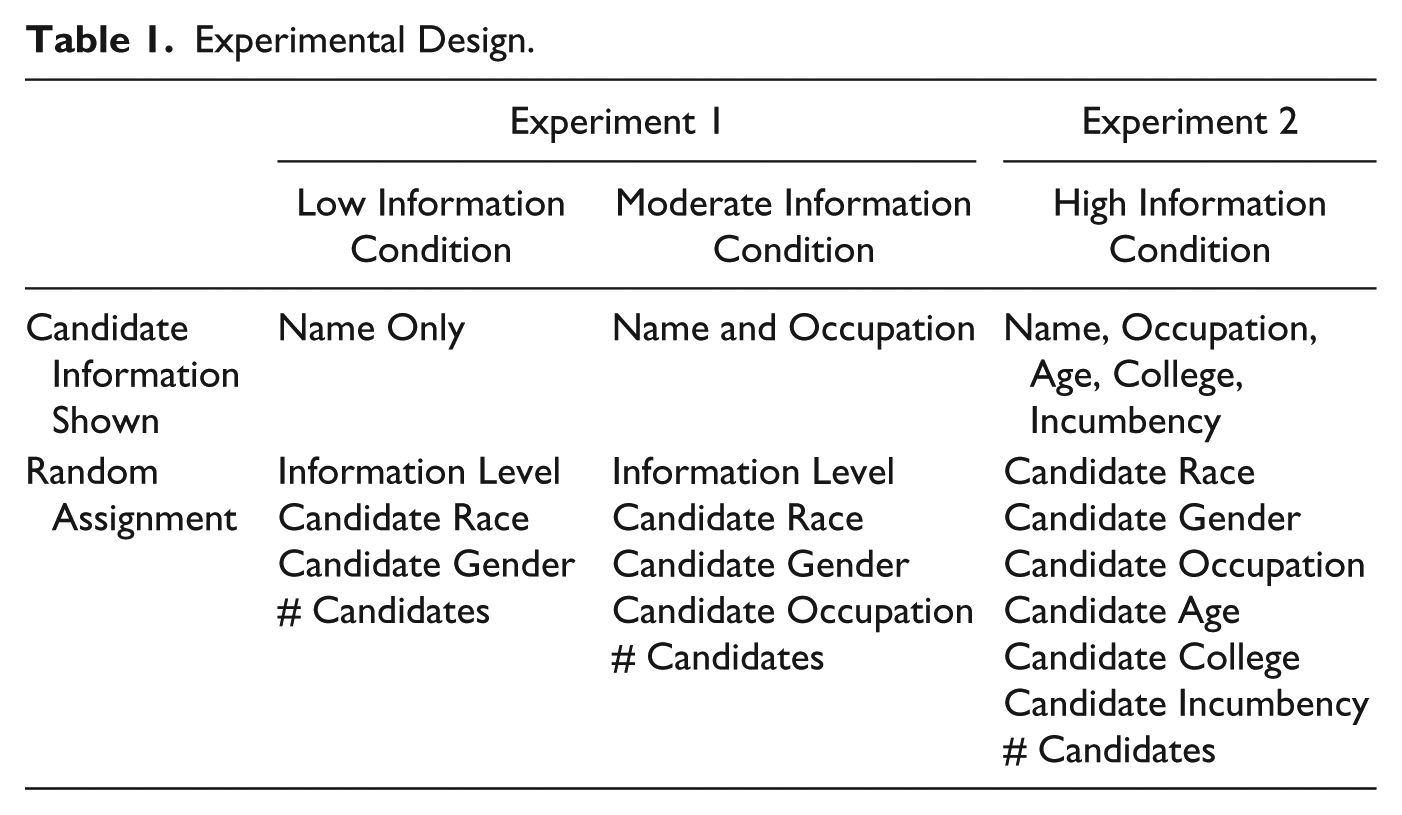
In Experiment 1, we presented respondents with candidates in a table and asked them to choose which one they preferred for the office. We randomly assigned half of our respondents to see only candidates’ names (low-information condition) and the other half to see candidates’ names along with their occupations (moderate-information condition). Each election was presented on a separate screen. We cued candidate race and gender using names, relying on surnames to signal that a candidate was White, Asian, or Latino/a and on first names to signal that a candidate was African-American and/or female. 9 For those in the moderate information condition, occupation was also randomly assigned. Adding a candidate’s occupation to the ballot replicates conditions in local elections in places like California, where candidates are permitted to include, beside their name on the ballot, a “ballot designation” noting their principal profession, vocation, or occupation. We selected occupations based on information gathered from California ballot reports and the International City/County Management Association survey of city councils. We used the most commonly appearing occupations in these two sources (business employee, business manager, small business owner, educator, and lawyer) and added journalist to increase the number of occupation possibilities. Because local governments have a wide variety of electoral rules, we also randomized the types of choices respondents made to ensure that our results would be generalizable to different settings. Respondents saw either two or six candidates per election and were asked to vote for one or three candidates respectively—paralleling typical conditions in district and at-large elections across the United States. 10 The set of names from which candidates were selected for each election included equal numbers of candidates from the four racial groups and two gender groups. The probability that a respondent was presented a candidate of color or a female candidate was random, enabling us to directly test the effects of information on respondent choices unaffected by other factors. The tables were randomly populated so the ballot position of each candidate and the characteristics of each candidate’s opponent(s) were randomly assigned. Figure 1 displays an example of the type of decision that respondents were asked to make in the six-candidate, moderate-information condition. 11
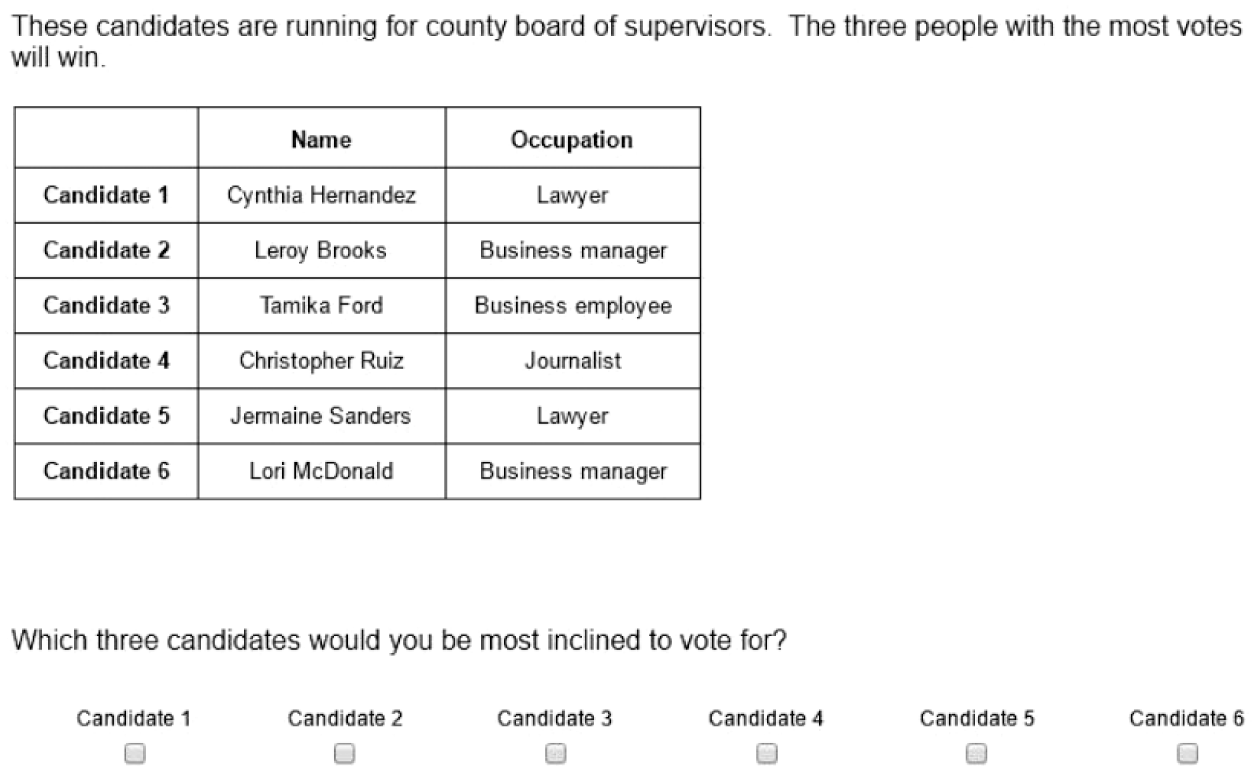
Experimental screen shot of at-large, moderate information election.
Experiment 2 enables us to determine how respondents make choices when they have more information about candidate qualifications. Specifically, Experiment 2 uses the same set-up as the first but includes much more detail in the candidate profiles. In this high information condition, all respondents received information about all of the candidates. In addition to occupation, we provided information about candidates’ ages (35–60), educational backgrounds (16 large public universities), and political experience (previously held elective office or not)—the kind of information often included in campaign materials and candidate speeches. Each of these attributes was varied randomly for each candidate. 12
Our two experiments were administered between November 2014 and November 2015 on Amazon’s Mechanical Turk (MTurk) workplace. We recruited separate samples for each experiment. 13 MTurk respondents have been found to be more representative of the American population than other types of convenience samples, and experiments conducted with national probability samples that have been replicated on MTurk yielded similar results (Berinsky, Huber, and Lenz 2012; Horton, Rand, and Zeckhauser 2011; Huff and Tingley 2015; Mullinix et al. 2015). However, MTurk samples are younger and more likely to contain Latino/a and Asian respondents (though not African Americans) than nationally representative samples like the Cooperative Congressional Election Study (Huff and Tingley 2015). MTurk respondents are also more likely to be liberal and to identify with the Democratic Party than nationally representative surveys (Huff and Tingley 2015). In Experiment 1, we used a prescreening survey to generate a more representative sample by partisanship. This resulted in a survey population that approximated the party identification of Americans according to the 2012 American National Election Study (ANES) (46% Democrats, 14% Independents, and 39% Republicans). There were 962 respondents in Experiment 1 and 966 respondents in Experiment 2. 14 Summary statistics for our samples are provided in the online appendix in Table A4.
Information and Voter Choices
How do racial and ethnic minorities and women candidates fare among respondents with low, moderate, and high levels of information to make their decisions? Our results reveal that information—even just a small amount—helps respondents choose candidates based on more substantive measures of their quality, and helps respondents avoid drawing on racial and gender stereotypes and prejudices when casting ballots. But, in low information contexts, respondents do use race and gender to determine for whom to vote. These patterns—which confirm our Race Hypothesis and Information Hypothesis, but not our Gender Hypothesis—can be seen in Figure 2. Our dependent variable in these analyses is whether or not a candidate was selected by the respondent. Our independent variables are dummy indicators for candidate race and gender with White and male as the excluded categories. We cluster standard errors by respondent. We run separate linear regressions for each information condition in Experiment 1—low (names only) and moderate (names and occupation). 15 Figure 2 plots the coefficients from these regressions. Because our candidate demographics are randomly assigned, these coefficients estimate the Average Marginal Component Effects (AMCE), defined by Hainmueller, Hopkins, and Yamamoto as “the increase in the population probability that a profile would be chosen if the value of its lth component were changed from t0 to t1, averaged over all the possible values of the other components given the joint distribution of the profile attributes” (Hainmueller, Hopkins, and Yamamoto 2014, p. 10). Figure 2 can be interpreted as the difference in the probability of choosing a Black (Asian, Latino/a, female) candidate compared with a White or male candidate under conditions of low and moderate information.
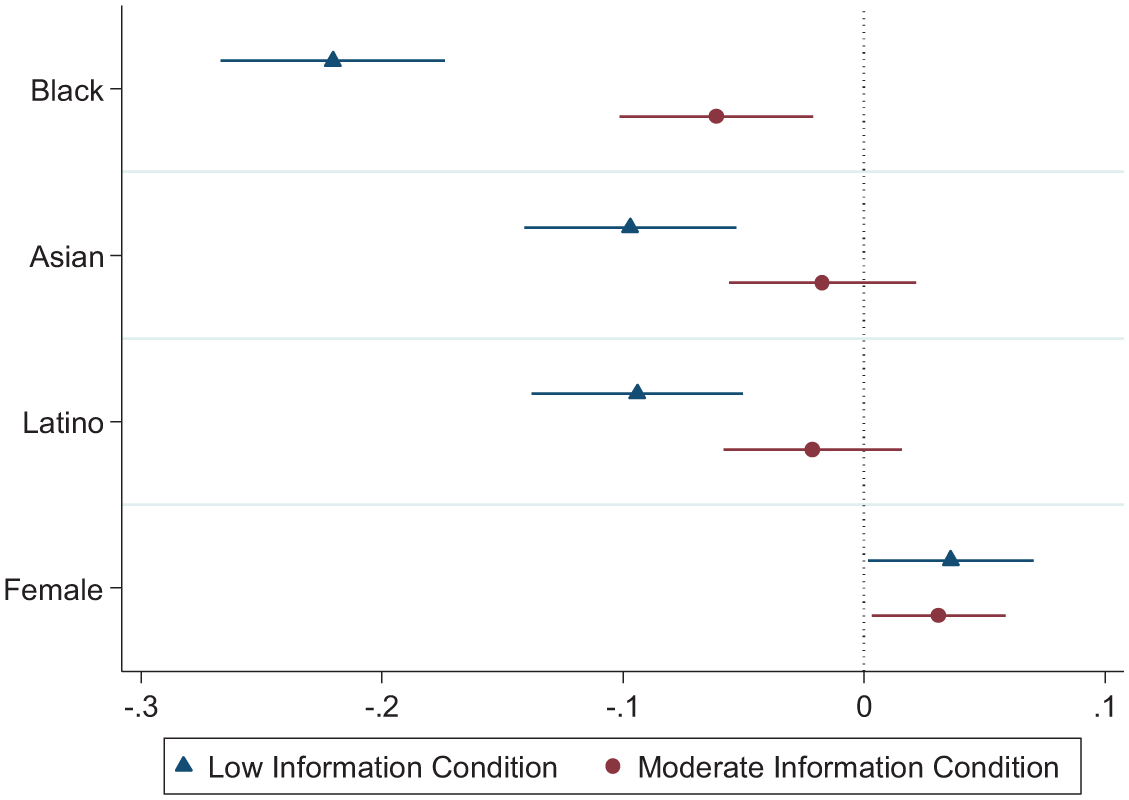
Effect of candidate characteristics on vote choice in low and moderate information elections.
The significant negative coefficients in the low information condition shown in Figure 2 reveal that Black, Latino, and Asian candidates are penalized relative to White candidates, but this penalty is significantly reduced when respondents are given more information. For example, when respondents have only a candidate’s name to use as a cue (low information condition), Black candidates are less likely to be chosen than White candidates by 22 percentage points, and Asian and Latino candidates are less likely to be chosen compared with a White candidate by 10 percentage points. In this low information condition, female candidates are slightly preferred to male candidates overall. However, information reduces these effects. In the moderate information condition, there is no effect of candidate race for Asian and Latino candidates, a small effect of race for Black candidates, and very little effect of gender on vote choice. By adding one additional piece of information, candidate occupation, the difference between the probability of choosing a White candidate over a Black candidate shrinks to 6 percentage points, and respondents become equally likely to choose Asian, Latino, or White candidates. In the moderate information condition, candidates’ occupations—which may cue both candidate quality and ideology—largely drive respondents’ choices. Respondents’ assumptions about candidates due to their race and gender shape respondent behavior in circumstances of low information, but as respondents have access to more information, their reliance on race and gender heuristics in making voting decisions diminishes and is largely replaced by information arguably more appropriate to the voting task.
This effect can be further seen in Figure 3, which demonstrates that when respondents in Experiment 2 are provided with high levels of information about candidates (names, occupation, incumbency, age, and education), candidate race, ethnicity, and gender have very limited effects on respondent choices, particularly when compared with the effects of candidate experience and occupation. 16 Figure 3 displays the ACME point estimates and 95% confidence intervals for each factor on the probability that a respondent chooses that candidate. 17 The dots with no intervals are the reference categories. The figure shows that when respondents are provided more information about candidates’ backgrounds, they are no more likely to choose a White candidate over a Black, Latino, or Asian candidate. In this high information condition, female candidates have a slight edge of 1.5 percentage points over male candidates, although the result is only marginally significant. 18
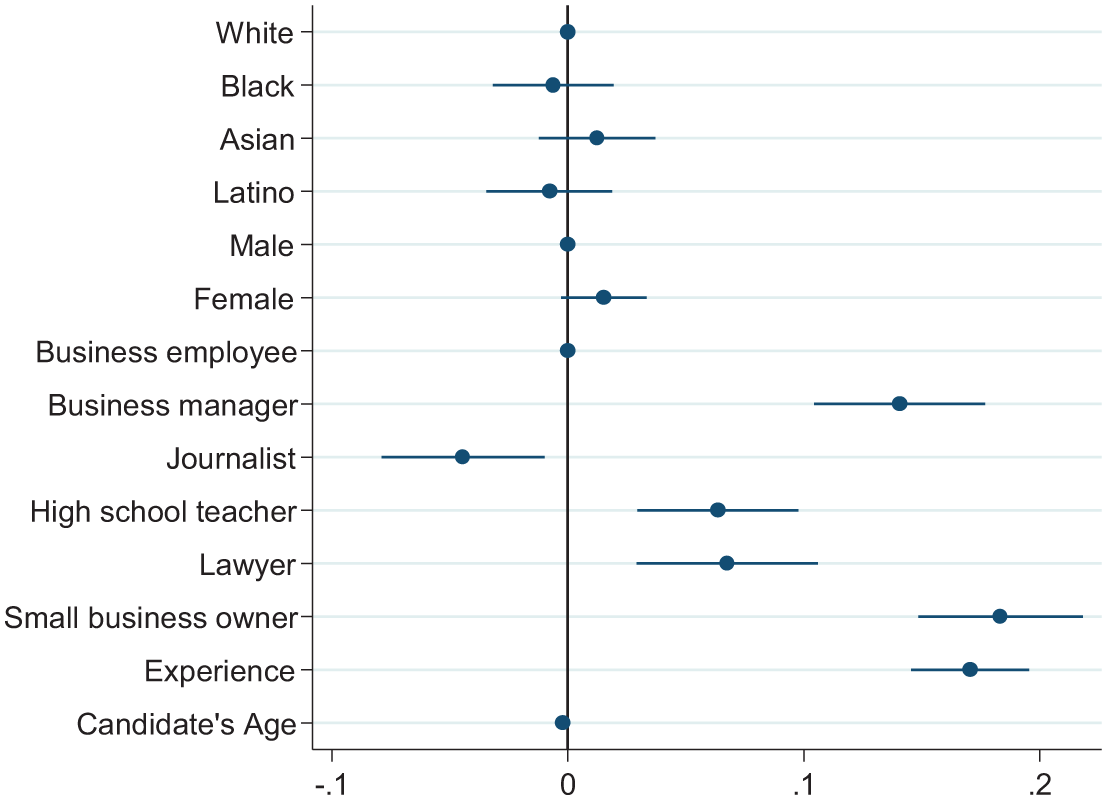
Effect of candidate characteristics on vote choice in high information elections.
Thus far, our results reveal that racial minority candidates are penalized when respondents have less information, and female candidates may get a slight boost in this condition. One explanation for this pattern is that respondents are drawing on racial and gender stereotypes and prejudices when using these traits as heuristics in their voting decisions. They may be using race and gender to infer candidate quality when they have few other cues to draw on. However, respondents may also use race and gender to stand in for ideology, leading to greater support for women and racial minority candidates (who are stereotyped as liberal) among Democrats and liberal respondents relative to Republicans and conservative respondents. 19 Next, we evaluate how respondents with different party identifications, ideologies, and prejudices choose candidates. Our findings in these tests follow a similar pattern: Under conditions of low information, stereotypes affect vote choice in the ways we predicted, but as information increases, these effects decrease.
Ideology Stereotypes and Voter Choices
Our Ideology Hypothesis predicts that in low information contexts, Republican and conservative respondents will be less likely to support non-White and female candidates than their White and male counterparts due to stereotypes about their ideology. To test this hypothesis, we evaluate respondent choices in our low-information condition in Experiment 1, splitting the sample based on respondents’ political characteristics. 20
Figure 4 reveals support for our Ideology hypothesis. The figure displays the coefficients from regressing vote choice on candidate demographics, separated by respondents’ partisanship or ideology in the low information condition. The coefficients can be interpreted as the probability that a conservative/liberal respondent will choose a Black/Latino/Asian-American candidate compared with a White candidate or will choose a female candidate compared with a male candidate in our low-information condition. 21 The preference for female candidates in low information elections is exclusive to Democratic and liberal respondents. In contrast, Republican and conservative respondents prefer male candidates in the low information condition. Democratic respondents are more likely to choose female candidates over male candidates by about 13 percentage points (SE = .02), while Republican respondents are less likely to choose female candidates by approximately 6 percentage points (SE = .03). We also find that the penalty for Black, Asian, and Latino/a candidates is smaller for Democratic/liberal respondents than Republicans/conservatives. Democrats in the lowest information condition are less likely to choose a Black candidate by 16 percentage points (SE = .04) compared with 28 percentage points for Republicans (SE = .03). This suggests that respondents are ascribing ideology to candidates based on demographic traits and using these race- and gender-based stereotypes to cast ballots when they have little information about the candidates. Yet the fact that Black candidates are still less likely to be chosen than White candidates among Democrats and liberals suggests that negative stereotypes about candidate quality and racial stereotypes about Black candidates still play a role in vote choice across party lines at the lowest level of information.
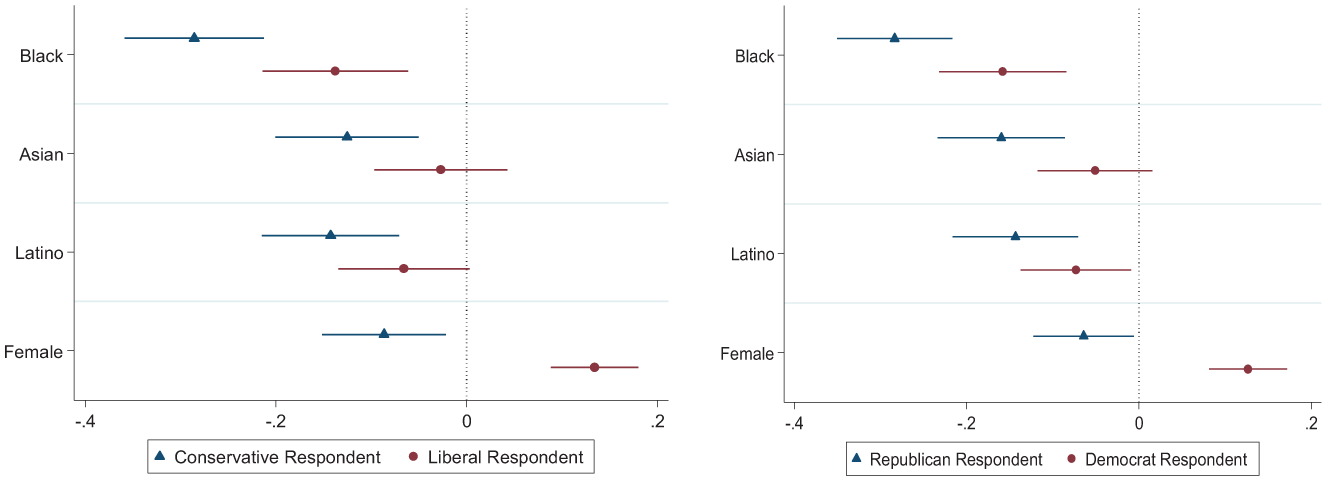
Average Marginal Component Effect (ACME)of candidate race and gender, by voter ideology and partisanship in low information elections—Experiment 1.
In Figures 2 and 3, we showed that providing respondents with additional information about candidates, including their occupation, incumbency, and education lessened respondents’ reliance on race and gender as heuristics. But, does information reduce this tendency among liberals and conservatives, Democrats and Republicans alike? In Figure 5, we show that it does.
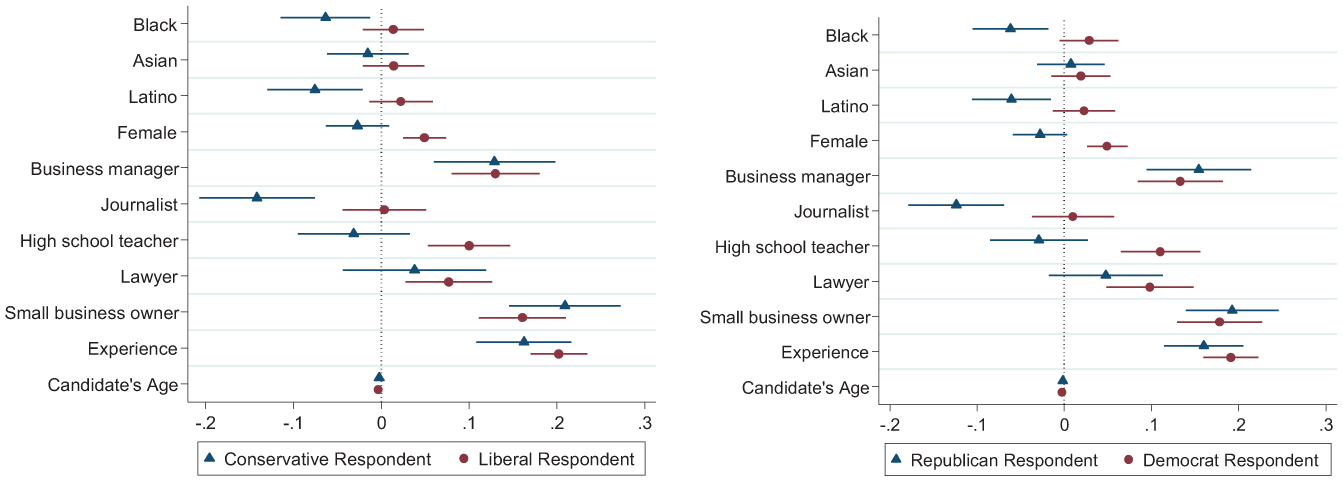
Average Marginal Component Effect (ACME) of candidate race and gender, by voter ideology and partisanship in high information elections—Experiment 2.
Figure 5 displays the same ACME point estimates and 95% confidence intervals as in Figure 3, but splitting our high information sample by respondent ideology and party identification (base categories are excluded from this figure for readability). Figure 5 demonstrates that in this highest information condition, race and gender are less powerful predictors of vote choice than occupation or incumbency across all types of voters. 22 However, some interesting differences appear. With additional information, liberals and Democrats become equally likely to choose a Black, Latino, Asian, or White candidate, while Republican and conservative respondents continue to offer Black and Latino candidates a vote penalty. On the other hand, liberals and Democrats continue to give female candidates a boost of 6 percentage points over male candidates, even with additional information, while Republican and conservative respondents do not. These results are consistent with our assertion that racial identity signals candidate ideology in addition to quality. Furthermore, it appears that occupation may also signal ideology as conservative/Republican respondents are significantly less likely to choose journalists compared with business employees, while liberals and Democrats prefer teachers. Models interacting ideology/partisanship with candidate characteristics reveal that these differential preferences for Black, Latino, female, journalist, and high school teacher candidates are statistically significant at the .01 level or better.
Given conventional wisdom that female candidates are generally not preferred at the polls, we sought additional evidence to verify the external validity of our finding that female candidates receive more support than male candidates from liberal and Democratic respondents in low information contexts. The online appendix (Figure A6) contains evidence from our analyses of voter behavior in the 2016 Democratic primary election in New York State. We demonstrate that Democratic primary voters favored female delegate candidates over male delegate candidates generally, and that voters in districts with low information ballots (where the candidate a given delegate candidate was pledged to was not clear) supported female delegates at higher rates than voters in districts with higher information ballots (on which the connection between a delegate and their pledged presidential candidate was clear). These results from a real-life election offer the same pattern of Democratic voter support for female versus male candidates, particularly in a lower versus higher information condition, that we reveal in our experimental data.
The results presented thus far reveal that Democrats and Republicans, liberals and conservatives can all be encouraged to make vote choices based on nonessentialist characteristics. But the toughest test of the power of information is among respondents who hold racially resentful or sexist views. To evaluate our Prejudice Hypothesis, we separate our sample based on respondents’ levels of racial resentment and sexism. 23 To identify racial and gender conservatives, using factor analysis, we combined respondents’ answers to survey questions asking their race and gender attitudes. 24 We split our sample at the median and coded respondents above the median as racial or gender conservatives and respondents below the median as racial or gender liberals. We hypothesized that information could ameliorate the negative effects of race and gender prejudices on female and minority candidates. In Figure 2, we showed that information does diminish gender- and race-based gaps in voter support, and Figure 5 showed that these results hold even for voters from different parties and with different ideologies. Figure 6 demonstrates that information even shapes voter preferences for White candidates versus Black, Asian, and Latino/a candidates and male candidates versus female candidates among respondents with high and low levels of racial and gender prejudice. In Figure 6, we present coefficients from eight separate regressions. Results from models analyzing the responses of racial conservatives and gender conservatives are in the left panel, while the right panel includes results from models analyzing the responses from racial liberals and gender liberals in our sample. Specifically, the left panel shows candidate preferences in our low and moderate information conditions among racial and gender conservatives respectively. The right panel shows preferences for candidates from each racial and gender group under the two information conditions among racial and gender liberals, respectively.
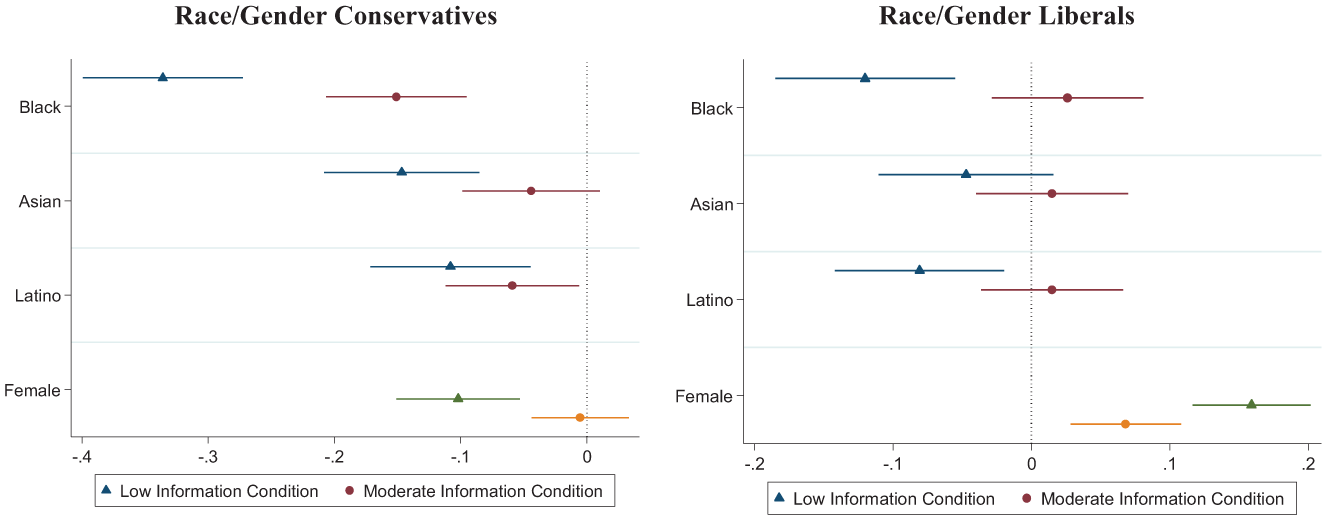
Average Component Interaction Effect (ACME) of candidate race and gender, by voter racial conservatism and gender conservatism in low and moderate information elections—Experiment 1.
Our results indicate that the provision of even a moderate amount of information (occupation of the candidate) makes race and gender less important to the vote decision across our sample. Ballot information diminishes the negative effects of prejudice among racial and gender conservatives and enables racial and gender liberals to vote in a way that more accurately matches their explicit, expressed attitudes about members of various racial and gender groups.
Figure 6 shows that in low information elections, gender conservatives support male candidates over female candidates, while gender liberals support women over men. Respondents with higher levels of racial resentment are much less likely to select Black candidates under conditions of low information, compared with those with low racial resentment. Support for Asian and Latino/a candidates is not meaningfully different between racial conservatives and racial liberals. Thus, our Prejudice Hypothesis is supported, particularly for Black and female candidates—in low information elections, candidates from underrepresented groups are hurt by the persistence of racial and gender prejudice among many respondents. Furthermore, even racial liberals continue to show a slight preference for White candidates over Black candidates in low information contexts, which suggests that implicit biases against racial and ethnic minorities shape even the behavior of explicit racial liberals in low information elections.
However, Figure 6 also reveals that these gaps decrease significantly as respondents are offered information. Racially resentful respondents still slightly prefer White candidates to Black candidates when provided an additional cue (candidate occupations), but the gap is much smaller. For Asian and Latino/a candidates, racially resentful respondents become no more likely to support White than Asian or Latino/a candidates under moderate levels of information. Among racial liberals, the effect of candidate race becomes insignificant (and positively signed) in the moderate information condition. Information in elections can enable those who explicitly wish to behave in nonprejudiced ways to overcome their (implicit) biases and do so.
Similarly, while those with high levels of gender conservatism prefer male to female candidates in low-information conditions, increasing information makes this effect disappear. And while gender liberals strongly prefer female to male candidates in low information contexts, this effect decreases as information increases. Providing fairly small amounts of information about candidates decreases the probability that a candidate’s race and gender affect the likelihood of their election.
These results demonstrate strong and substantively consequential support for our Information Hypothesis. When respondents have even a small amount of information about candidates—occupation, which some states already easily provide on ballots—this sharply diminishes respondent use of racial and gender stereotypes. While racial minority candidates, and to some extent female candidates, suffer at the ballot box due to continued stereotypes about candidate quality and ideology, and especially due to persistent racial and gender prejudices among many respondents, these effects can be alleviated. Even respondents with high levels of prejudice draw less on those prejudices to cast ballots when given more information. Our findings have significant implications for voter decision-making in the frequent low-information contexts of local elections and party primaries—and offer a potential reform that could substantially shift the processes through which voters cast ballots in those contexts.
Discussion and Conclusion
When respondents are asked to make decisions without any information about candidates other than their names, they use the race, ethnicity, and gender cued by candidate names to figure out who to pick. When respondents have the least information, candidates of color—particularly Black candidates—are disadvantaged, among respondents across party, ideological, and racial attitude lines. Adding information to respondents’ ballots largely eliminates these penalties, or, in the case of Black candidates, greatly diminishes them. Our findings build on other scholars’ findings that a significant share of voters “act upon racially-discriminatory tastes” (Soltas and Broockman 2017, p. 18). However, we also reveal that the provision of only a small amount of additional information (e.g., a candidate’s occupation or incumbency status) can overcome respondents’ racial- and gender-based preferences between candidates. We show that even in nonpartisan elections, when voter shortcuts are scarce, respondents’ use of racial and gender cues can be substantially reduced. This is consistent with other research demonstrating that adding additional cues, like partisan labels, can also increase the election of candidates of color (Karnig and Welch 1980).
Our results also point to several mechanisms through which candidate demographics influence vote choice: stereotypes about candidate quality and ideology and racial and gender prejudices. We found that Black candidates suffered the largest penalties in low information settings, and that adding moderate amounts of information lessened but did not eliminate this outcome. On the contrary, moderate amounts of information did eliminate penalties for Latino/a and Asian candidates, consistent with differences in the negativity and pervasiveness of racial and ethnic stereotypes across groups. We also found that respondents assume that Black and Latino/a candidates are more liberal than White candidates, and that female candidates are viewed as more liberal than male candidates. This explains our finding (bolstered by our analyses from a real-life delegate election in New York) that respondents’ preference for women over men in the lowest information setting is wholly driven by liberal and Democratic respondents. Ideology stereotypes may, thus, particularly harm the chances of female and racial and ethnic minority candidates seeking local offices in predominately Republican areas or seeking to win Republican Party primaries. Furthermore, our findings indicate candidates of color likely face challenges in many Democratic-leaning localities and Democratic primaries as well—because we reveal that respondents from both parties prefer White candidates over non-White candidates.
We also confirm that racial resentment and modern sexism continue to affect respondent choices—particularly when respondents are given little information to use to make a more socially desirable (less prejudiced) choice. Because of the distribution of racial and gender prejudices across parties (Simas and Bumgardner 2017; Tesler 2016), these results may also particularly hinder the success of women and racial minority candidates in Republican party primaries or in elections with predominately conservative voters. Thus, our findings about how ideological stereotypes and racial and gender prejudices influence respondents provide another explanation for women’s and racial and ethnic minorities’ disproportionately higher representation among Democratic than Republican elected officials.
We add a caveat to these results though. Women may only be preferred by respondents in our study because of the lower stakes involved in our elections. Other research demonstrates that women are penalized in elections for executive offices (Crowder-Meyer, Gadarian, and Trounstine 2015), and it is possible that greater amounts of information may be necessary to overcome negative effects of gender on female candidates at higher levels of office (see, for example, Dolan 2014 who finds partisanship can outweigh gender stereotypes in congressional races). On the contrary, our findings help explain research suggesting that when women run, they win (Burrell 2014); we find evidence that at least some respondents prefer female to male candidates in low-information elections.
In all, our research reveals that small amounts of virtually costless information substantially decrease respondents’ use of demographic traits to make decisions. Thus, changes in the media or campaign environment that increase voter information could substantially affect how heuristics and prejudice shape election outcomes. Although more research is needed to investigate how specific pieces of information interact with candidate traits in the real world to shape voter behavior and affect representation, our research suggests that the negative effects of stereotypes can be diminished, even among voters with high levels of race and gender conservatism. In low information elections that form the basis of the electoral pipeline—the local contests and party primaries in which many candidates get their start—offering just a bit more information to voters could open the pipeline to a broader set of candidates.
Supplemental Material
Voting_can_be_Hard_Info_Helps_-_UAR_-_Online_Appendix_FINAL – Supplemental material for Voting Can Be Hard, Information Helps
Supplemental material, Voting_can_be_Hard_Info_Helps_-_UAR_-_Online_Appendix_FINAL for Voting Can Be Hard, Information Helps by Melody Crowder-Meyer, Shana Kushner Gadarian and Jessica Trounstine in Urban Affairs Review
Footnotes
Declaration of Conflicting Interests
The author(s) declared no potential conflicts of interest with respect to the research, authorship, and/or publication of this article.
Funding
The author(s) received no financial support for the research, authorship, and/or publication of this article.
Notes
Supplemental Material
Supplemental material for this article is available online.

Author Biographies
References
Supplementary Material
Please find the following supplemental material available below.
For Open Access articles published under a Creative Commons License, all supplemental material carries the same license as the article it is associated with.
For non-Open Access articles published, all supplemental material carries a non-exclusive license, and permission requests for re-use of supplemental material or any part of supplemental material shall be sent directly to the copyright owner as specified in the copyright notice associated with the article.
