






Abstract
Inter-municipal cooperation in public service delivery has attracted the interest of local authorities seeking to reform public service provision. Cost saving, together with better quality and coordination, has been among the most important drivers of such cooperation. However, the empirical results on inter-municipal cooperation and its associated costs offer divergent outcomes. By conducting a meta-regression analysis, we seek to explain this discrepancy. We formulate several hypotheses regarding scale economies, transaction costs, and governance of cooperation. While we find no clear indications of the role played by transaction costs in the relationship between cooperation and service delivery costs, we find strong evidence that population size and governance are significant in explaining the relationship. Specifically, small populations and delegation to a higher tier of government seem to offer cost advantages to cooperating municipalities. As an extension of our model, we seek to disentangle service-related transaction costs based on asset specificity and ease of measurability of the service.
Introduction
The growing skepticism expressed by local governments toward private-sector participation in public service provision, and different fiscal and economic constraints these governments face in terms of efficiency and effectiveness, have led many local authorities to devise new forms of public service delivery. In recent decades, one of the alternatives most frequently adopted has been inter-municipal cooperation (IMC), within a context of increasing cooperation between governments, local councils, agencies, and political parties (Bouckaert, Peters, and Verhoest 2010). IMC is seen as a tool that can lower costs by exploiting economies of scale, while maintaining greater control over production, something that is not readily achievable with privatization (Hefetz and Warner 2012; Levin and Tadelis 2010).
Long-term IMC agreements can be justified on the grounds of benefits of enhanced cross-jurisdictional coordination, service quality, and inter-municipal reciprocity, which usually applies to IMC agreements based on positive past experiences regarding interpersonal trust, reputation, and sanctioning power (Aldag and Warner 2018). Concerns over stability, equity, and universality also stimulate cooperation. This said, and as it happens with other public services, obtaining cost savings is a key rationale for cooperation.
However, the empirical evidence obtained so far does not systematically confirm the cost-saving potential of IMC agreements (as can be seen in our review of results). While context may be important in explaining the divergent results, this is not in itself an adequate explanation (Feiock 2007). Thus, the main motivation for our research is to account for the divergence in outcomes reported for IMC agreements, and to explore the factors that explain this variation. In this way, policy makers should have more realistic expectations about cooperation. We benefit from the booming literature over the last decade and seek to reconcile results by means of meta-regression analysis (see for other types of service delivery, Bel and Fageda 2009; Bel, Fageda, and Warner 2010; Bel and Warner 2016).
Our article makes three main contributions to the literature. First, to create the database for our meta-regression analysis, we review all available (to the best of our knowledge) multivariate empirical studies that analyze the cost-saving effects of IMC. This includes both published and unpublished articles. Second, based on a prior analysis of the theoretical background underpinning IMC, we study the causes of this variation in results. To do this, we design a multivariate model to check the theoretical outcomes empirically. Specifically, we focus on the effects of economies of scale, transaction costs, and governance arrangements for IMC. Third, and by way of extension, we further analyze the role of transaction costs based on asset specificity and ease of measurability/contract management difficulty, to better understand the nature and the effects of transaction costs based on their components.
We organize the article as follows. First, we review the theoretical background and analyze theory-based outcomes or propositions. Based on this review, we then formulate our hypotheses regarding economies of scale, transaction costs, and governance arrangements. Second, we review the multivariate empirical evidence about the effects of IMC on costs. 1 We then explain how the database was built and the choices we made to ensure homogeneity. Next, we formulate a multivariate model and present the results from our estimations, which we discuss generally, and also with special attention to the relationship with our theoretical hypotheses. Then, we offer an extension of our model to trace the effects of transaction costs, based on the nature of the specific public services under analysis. Finally, we present the results of robustness tests, and draw the main conclusions and policy implications.
Theoretical Background
Efficient service provision based on IMC has been discussed essentially in terms of the theory of local public economics, within the framework of institutional collective action, and related to the principal-agent problem in collaborative governance. Bel and Warner (2016) reviewed the evidence on IMC and costs, and classified the relevant factors into three groups: scale-related costs, organizational characteristics and service-related transaction costs, and governance arrangements. We adopt this same classification and analyze these factors. Before doing so, we should stress that it is not our objective to provide a full analysis of the theoretical factors underlying IMC. In fact, studies so far have mostly focused on studying motives and outcomes of IMC, without paying much attention to its multiple dimensions or to differences in the working of IMC (Teles and Swianiewicz 2018a). Here, we choose to focus on the studies that are most relevant to the empirical analysis we conduct herein.
Economies of Scale
One of the key motives for adopting IMC is to improve the scale at which a service is delivered, given that municipalities may be of suboptimal size, reflecting the fact that they are usually the outcome of historical/cultural events and do not adhere to any obvious economic/geographic rationale. This means jurisdictional boundaries can be redefined to improve scale and internalize spillover effects. However, certain trade-off relations need to be borne in mind. Mirrlees (1972) explained optimum town size in relation to such conditions as individual preferences regarding consumption, distance from work, area occupied by the individual’s residence, and population density in the immediate neighborhood. Similarly, Dixit (1973) argued that it is simply unrealistic not to include the benefits of scale economies in economic models, and proposed a model for determining the optimum size and arrangement of a monocentric city. In this model, he also considered the trade-off between economies of scale and diseconomies of congestion, for instance, in commuter transport.
Taking a different perspective, Ladd (1992) examined the effect of population growth and density on the cost and quality of public services. She found that a higher population density lowers provision costs and described a U-shaped relationship between output and population density. Her study served to confirm that there are certain optimal boundary conditions, and that while economies of scale can be achieved initially, as size increases, scale benefits become exhausted. For this reason, scale economies can be potentially advantageous—above all for smaller municipalities—since with increasing capacity, average production costs should fall and greater efficiency should be achieved (Hulst and van Montfort 2012).
One way to modify boundaries for the purpose of service delivery is by means of IMC (Ostrom, Tiebout, and Warren 1961). As has been emphasized by many scholars (i.e., Bel and Costas 2006; Da Cruz and Marques 2012; Hefetz, Warner, and Vigoda-Gadot 2012; Warner and Bel 2008), IMC provides a market alternative, which allows a service to continue under public delivery while enjoying the advantages of scale economies. However, it should be borne in mind that the optimal scale differs for each local public service. Hence, IMC can provide a better alternative than that of amalgamation (which can be considered as generalized—and usually compulsory—cooperation) to profit from scale economies.
Most empirical papers report a negative effect of population on the frequency of cooperation (Bel, Fageda, and Mur 2014; Hefetz, Warner, and Vigoda-Gadot 2012; Levin and Tadelis 2010), that is, as the size of the municipalities grows, IMC tends to be less cost-advantageous for the participating municipalities. This belief that IMC is especially beneficial for smaller municipalities has been addressed from other perspectives as well. For instance, Warner and Hefetz (2002, 2003) and Mohr, Deller, and Halstead (2010) emphasize that small municipalities are less likely than larger municipalities to use competitive bidding. However, it is worth noting that the relationship between population size and cooperation can be ambiguous when multiservice cooperation is considered (Bel and Warner 2016).
Theoretically, therefore, we expect the scale of cooperation to be a significant variable. In the empirical literature, the usual proxy employed for scale is the municipality’s average population or output. As such, our first hypothesis states,
Organizational Characteristics and Service-Related Transaction Costs
The importance of transaction costs is stressed by Williamson (1999) in accounting for inefficiencies in public bureaucracy. Moreover, he argues that the choice of service delivery method varies according to service type. Building on Williamson’s insights, researchers have analyzed the characteristics and nature of transaction costs by looking at a wide range of public services. Brown and Potoski (2003, 2005) revamped the analysis of service-related transaction costs in delivery choices, by focusing on asset specificity and the ease/difficulty of measurement. Levin and Tadelis (2010) not only adopted a similar approach to that of Brown and Potoski (2003) but also included in their theoretical proposal service characteristics, which they defined as contracting difficulty and resident sensitivity, especially as related to quality. Later, Hefetz and Warner (2012) analyzed service characteristics in terms of asset specificity, contract management difficulty, citizen interest, and market competition. The indexes of asset specificity proposed by Brown and Potoski (2005) and Hefetz and Warner (2012), and of the ease/difficulty of measurement (Brown and Potoski 2005) and contract management (Hefetz and Warner 2012) are of key relevance to the empirical analysis we conduct herein.
According to transaction cost theory, if delivering a service requires specialized investments, and if performance measurement is difficult, that service will incur high transaction costs (Brown and Potoski 2003, 2005). In such a scenario, privatization is less likely. This insight is based on the idea that agents act in their own self-interest and do not cooperate (Jensen and Meckling 1976). In partnerships, however, which are likely to be based on trust and mutual commitment between participants, these theoretical outcomes may change (Brown and Potoski 2005). As such, IMC appears better suited to the latter scenario. Furthermore, cooperation can lead to interactive learning (Hefetz and Warner 2012), and transaction costs can be lowered over time due to that learning process (Máñez et al. 2016).
Alternatively, it can be argued that transaction costs in the case of IMC are likely to be high, since participants will incur information and coordination costs, negotiation and division costs, enforcement and monitoring costs, and bargaining costs, as defined by Feiock (2007). We return to these potential costs in the following subsection. However, as Brown (2008) pointed out, cooperation costs do not have to be high. Municipalities tend to place greater trust in other public partners in the case of services exposed to a high risk of opportunism. By way of example, in the case of health and human services, the author concludes that this might occur because governments have similar structures and goals; hence, they are inherently perceived by each other as being more trustworthy. Moreover, although some service-related investments might be high (which usually coincides with high transaction costs), if we consider that IMC is likely to include cost sharing, the results of cooperation can be positive. However, ease of measurement might not necessarily improve with cooperation, which in a broader sense also refers to the difficulties encountered in contract specification and monitoring (Hefetz and Warner 2012). Likewise, inter-municipal contracting is more likely to be beneficial for those services for which competition is very low. This can also be explained in terms of transaction costs, since if a market is not competitive enough, it will require a much greater effort by the government to secure and monitor the service at an efficient and effective level (Girth et al. 2012).
Based on theoretical insights of the aforementioned studies, our next hypothesis states,
Governance Arrangements
Engaging in IMC implies that decision-making is externalized, either partially or totally (Argento et al. 2010, pp. 45, 50), and because of this, multiple problems related to collective action are likely to arise (Feiock 2007; Silvestre, Marques, and Gomes 2018; Voorn, van Genugten, and van Thiel 2017). Indeed, the transaction costs related to governance arrangements can be high in the case of cooperation, because participants must face the costs—of information and coordination, negotiation and division, enforcement and monitoring, and bargaining—identified in the previous subsection (Feiock 2007). Moreover, as Ostrom (1990) pointed out, trust and norms of reciprocity are also of importance in IMC (see, in this regard, Thurmaier and Wood 2002), and these can develop through networks (Carr, LeRoux, and Shrestha 2009; Shrestha and Feiock 2011). It would seem that trust and commitment are, effectively, critical for IMC to work, making IMC a viable form of public service delivery (Silvestre, Marques, and Gomes 2018).
IMC governance can take the form of informal agreements, formal contracts between the parties, joint-bodies for governance, or the delegation of power and resources to supra-municipal bodies—government or agency (Bel and Warner 2015, 2016; Hulst et al. 2009). A common characteristic of all these IMC arrangements is the option available to a municipality to withdraw from the collaboration as and when it wishes. Cooperation is voluntary (unlike the situation in an amalgamation), so opting-out is a viable reaction to undesired outcomes, or to exploitation by more powerful partners.
IMC is subject to potential risks. Marvel and Marvel (2007) found that monitoring can be a central issue, if services are provided internally or by another nonprofit or governmental provider. In such cases, monitoring is either externalized along with the service or the level of monitoring falls. Also, significant problems of coordination (Feiock 2007, 2013; Lowery 2000; Tavares and Feiock 2018) and political transaction costs (Bergholz and Bischoff 2018; Rodrigues, Tavares, and Araújo 2012; Tavares and Camöes 2007; Tavares and Feiock 2018) can also arise.
By looking at IMC through the more structural lens provided by principal–agent theory, the main problem to emerge is that of multiple principals relating with one agent. As Gailmard (2009) shows theoretically, the existence of multiple principals raises a collective action problem in relation to monitoring, which can result in the level of oversight being inferior than that required to guarantee the principals’ joint interests. For this reason, even if the principals have interests in common, the institutional structure of the overseeing body plays a key role in relation to accountability. Because of this Voorn, van Genugten, and van Thiel (2019) have suggested the hypothesis that delegation can entail lower transaction costs than other alternative forms of governance arrangements. The problem of multiple principals is further stressed by Da Cruz and Marques (2012) and van Thiel (2016), among others, and has been found to be damaging for ICM outcomes by Sørensen (2007); Garrone, Grilli, and Rousseau (2013); and Blåka (2017a).
Given the multiple principal problem, the option of delegating to a supramunicipal government or agency has gained increasing attention. This course of action is frequent in Spain (comarcas and mancomunidades; see Bel, Fageda, and Mur 2014; Warner and Bel 2008), France (communautés; see Frère, Leprince, and Paty 2014), and more recently, in Italy (Unione dei Comuni; see Ferraresi, Migali, and Rizzo 2018). With governance arrangements of this type, the relation is limited to one principal and one agent. The principal has incentives to consider the interests of all the municipalities involved in the IMC agreement, as each municipality can opt out and leave. Furthermore, these supramunicipal governments typically manage cooperation in different services and, because of this, economies of scale and scope in monitoring and coordination can be exploited (Bel and Costas 2006; Bovaird 2014). Hence, the delegation of power and resources to a supramunicipal government or agency can help minimize monitoring and coordination costs, while enabling participants to reap benefits of cost-related economies of scale. In line with this reasoning, we formulate our next hypothesis.
IMC and COSTS: Empirical Evidence
The multivariate empirical literature on the effects of IMC on costs is recent, the first papers published on the topic being Bel and Costas (2006) and Sørensen (2007). Thereafter, this literature has grown rapidly, as documented in Bel and Warner (2015). In the last few years it has undergone a veritable boom, with an expansion in the coverage of countries and services considered. While the early studies typically focused on solid waste management, subsequent studies have examined many other services.
Multivariate studies on IMC and costs have been conducted (in chronological order) for Spain, Norway, the Netherlands, Italy, France, Czech Republic, Sweden, Germany and the United States. As explained in Bel and Warner (2015, 2016), empirical literature on IMC in the United States has focused much more heavily on drivers of cooperation, because analysis of IMC in the United States is embedded in the wider debate on regionalization. In Europe, where regionalization of services is more frequent than in the United States, drivers of IMC have a singular relationship with costs; hence, empirical studies on effects of IMC on costs have been much more frequent. As usual, studies from countries outside North-America and Europe are not frequent (nonexistent in our case), mainly because of lack of data. In all, our analysis provides a complete vision of the existing empirical literature on IMC and costs, particularly comprehensive for European countries. In the following, we briefly review this literature.
Spain
The earliest study analyzed solid waste management in the region of Catalonia (Bel and Costas 2006) and examined the relationship between costs and production mode. While the mode of production (public or private) did not show significant effects on the costs of refuse collection, IMC was found to reduce the costs for small municipalities. The Stevens (1978)-type cost function used in this empirical study has been followed in many subsequent studies, facilitating robust comparisons. Later articles by Bel and Mur (2009) and Bel, Fageda, and Mur (2014) focused their attention on the Spanish region of Aragon and drew on data from a number of different years. In these articles, the authors reported that cooperation reduced costs for smaller municipalities. As both these regions (Catalonia and Aragon) share the trait of having higher tiers of government to which functions and resources are transferred for IMC, the authors suggest that delegation can be an advantageous way to organize IMC governance.
Zafra-Gómez et al. (2013) analyzed waste management according to the forms of delivery adopted by Spain’s small and medium-sized municipalities. The authors considered various forms of IMC (mancomunidad, consortium, mancomunidad under contract, and supramunicipal management via province, county, or public firms). They found that IMC reduces costs with respect to single municipal delivery. Pérez-López, Prior, and Zafra-Gómez (2015) confirmed these findings in a study that expanded the number of services considered. Further studies by Pérez-López et al. (2016); Pérez-López, Prior, and Zafra-Gómez (2018); and Zafra-Gómez and Chica-Olmo (2019) analyze the effect of cooperation on efficiency using different techniques (order-m frontiers and data envelopment analysis (-DEA)- panel data), and find that smaller municipalities show higher efficiency in waste collection with IMC.
Scandinavian Countries
One of the first articles to examine this question was Sørensen (2007), who studied solid waste collection in Norwegian municipalities. The author compared two theoretical approaches to IMC in the Scandinavian context: on one hand, corporate governance theory, which holds that indirect and dispersed ownership incur high agency costs, and, on the other, standard political economy, which suggests that introducing distance between politicians and decisions might increase service delivery efficiency. Sørensen’s results show that, in Norway, IMC is responsible for efficiency losses that are higher than the benefits obtained from scale economies. Remaining in Norway, Blåka (2017a) studied fire and rescue services in a comparison of hypotheses developed under institutional collective action and corporate governance theories, respectively. Her findings indicate that the cost-saving feature of cooperation depends heavily on its organizational form. Costs are lower for IMC under contractual agreements, but cost-saving significantly decreases with the number of partners. 2
Holmgren and Weinholt (2016) analyzed the cost of fire and rescue services in Swedish municipalities by means of stochastic frontier analysis. Because Swedish fire and rescue services are increasingly formalizing cooperation between municipalities, and also collaborating with other actors, cooperation was introduced with these two variables, that is, formalized IMC and cooperation with other actors. Both were expected to reduce inefficiency, but the outcomes were mixed: While cooperation with other actors increased efficiency, the effect of cooperation between municipalities was not significant.
The Netherlands
Dijkgraaf and Gradus (2013) analyzed waste collection in Dutch municipalities based on data for the period 1998–2010, using a standard cost function for a long panel dataset. They found cost savings with IMC. The same authors conducted a follow-up study with very similar characteristics, in which they controlled for provincial and municipal fixed effects and found a decreasing significance of cost savings with IMC (Dijkgraaf and Gradus 2014). The same decreasing significance of cost savings was recorded when they controlled for the impact of various unit-based pricing systems on the quantity of waste produced by different streams.
Other articles have been published recently for the Netherlands. Niaounakis and Blank (2017) analyzed efficiency in relation to cooperation between tax departments, and found that municipalities with a threshold population of 60,000 inhabitants had already exhausted their scale economies, and that IMC stopped being advantageous above that threshold. In the case of municipalities engaged in cooperation, they conclude that, whereas costs may increase initially, IMC does reduce costs over time. Allers and de Greef (2018) have confirmed the costs savings to be gained from IMC in the case of tax collection in Dutch municipalities. However, they found no evidence of cost-saving when considering total public spending. Geertsema (2017) has looked at the interest rate levels of municipalities engaged in IMC and of those working in amalgamation as a proxy for efficiency, and finds that IMC organizations pay a higher interest rate. In contrast, the difference is not significant in the case of amalgamations. Finally, Klok et al. (2018) have recently investigated perceived transaction costs, benefits, and trust attributable to IMC, and find that smaller municipalities are more positive about the perceived benefits of cooperation and that perceived results depend on the form of cooperation.
Italy
Garrone, Grilli, and Rousseau (2013) studied joint, inter-municipal ventures in Italy, with a sample made up of multi-utility firms (providing water, electricity, gas, and waste management services). They found that coordination costs increased significantly for such firms, an expenditure that outweighed the potential cost savings from cooperation. A quite different type of IMC, that undertaken by the Unione dei Comune (municipal unions, with clear similarities with Spain’s mancomunidades), is analyzed by Ferraresi, Migali, and Rizzo (2018). Their empirical analysis focuses on Emilia Romagna and Toscana and employs difference-in-differences and propensity score matching methods. Their results suggest that being a member of a municipal union reduces a municipality’s total per capita expenditure, and that this effect is increasing in a period of up to six years after joining the union. Finally, Giacomini, Sancino, and Simonetto (2018) have recently used survey-based data to examine perceptions in small municipalities and found significant expectations that cooperation can contribute to cost reduction, better quality, and institutional legitimacy.
France
French experiences with IMC and its effects on local expenditure were analyzed by Frère, Leprince, and Paty (2014). They examined the effect of fiscal cooperation over the period 1994–2003 and drew two main conclusions: (1) Cooperation has no significant effect on public spending levels, and (2) no spending interactions within the cooperating organization exist.
Czech Republic
Soukopová and Klimovský (2016a, 2016b) analyzed solid waste management in the region of South Moravia for 2013 and 2015, respectively, again using a standard cost function, and found that IMC has cost-saving effects. Soukopová et al. (2016) then extended this study of solid waste management to the whole of the Czech Republic and found that IMC increased costs, contrary to the findings of the previous study. This contradiction triggered a series of follow-up studies in the country. Soukopová, Vaceková, and Klimovský (2017); Soukopová and Vaceková (2018); and Soukopová and Sládeček (2018) undertook analyses in which they introduced variations in terms of municipality size, the time period of their databases, and the regions specifically included. Overall, these studies have found that IMC reduces costs, the most significant values being recorded for small municipalities, but they show that these savings disappear with increasing municipal population size.
Germany
Blaeschke and Haug (2018) examine the effects of IMC on the efficiency of the wastewater sector in Hessen. Using a two-stage data envelopment analysis, they find that IMC is related to lower levels of technical efficiency. However, smaller municipalities can benefit from scale economies through cooperation. Using a metafrontier analysis of efficiency, the authors show that cooperation gains from scale economies are probably off-set by technical inefficiencies. Furthermore, scale effects apply primarily to small municipalities.
The United States
The effects of cooperation in the United States have been studied by Bel, Qian, and Warner (2016) by drawing on survey-based data from a large sample of municipalities in New York State in 2013. The analysis examines a wide range of services and finds conflicting results. This indicates that the cost-saving potential of IMC depends on the characteristics of each service. The authors found that cooperation in police, library, road, and highway services reduced costs at the 1% level of significance, while it was effective in garbage and landfill management at the 10% level. For the remaining services, no significant effects were found.
Data
To create a comprehensive database that includes all studies of the effects of IMC on costs and to obtain a representative and unbiased dataset, we conducted a search of the following academic literature database services between April and July 2018: EconLit, Social Science Research Network, AgEcon, and Repec-Ideas. So as to include unpublished studies and “gray literature” too, we searched the following websites: OpenSIGLE, NBER, National Technical Information Service in the United States, U.S. GAO, E-Thesis Online Services, and European Science Research Council. We used the following keywords: “inter-municipal cooperation,” “interlocal cooperation,” “interlocal contracting,” “joint contracting,” and “shared delivery.” In addition, we conducted a search using the same keywords on Google Scholar. Finally, we reviewed citations in all the articles we had identified that way. In all, we identified 29 multivariate empirical studies of the effects of IMC on costs, broadly considered.
After completing a brief literature review (see previous section), we next defined the rules for the inclusion of studies in the metaregression. Our main selection criterion was to ensure the homogeneity of the definition of variables included in our database. After applying this criterion for inclusion, we then extracted the required data from the individual studies. First, the list was confined to those studies in which the costs associated with cooperation were considered as the dependent variable when compared with the costs of individual municipalities. 3 We then checked whether IMC was defined homogenously in the articles. 4
After confirming the homogeneity of the studies included in the meta-regression analysis, we next sought to ensure the homogeneity of the data for our moderators and our theory-related variables. To do this, we contacted several authors to obtain data on the average population of the municipalities included in the estimations. 5 After all these refinements, we ended up with a database comprising 18 published and unpublished studies, with a total of 111 estimations. Throughout this process, we carefully adhered to the Meta-Analysis of Economics Research Reporting Guidelines set out in Stanley et al. (2013).
Table 1 shows the studies included in our database for the meta-regression, with their main characteristics. We have useful information on studies conducted for Spain, Norway, the Netherlands, Czech Republic, France, Italy, and the United States. As for the specific services, they include a wide range of fields in which municipalities cooperate. Of the 111 estimations, 23 are drawn from either book chapters, conference papers, or other unpublished studies. In total, 20% of the estimates come from unpublished work. Moreover, two thirds of the estimates are drawn from panel data.
Multivariate Studies Included in the Meta-Regression Analysis.
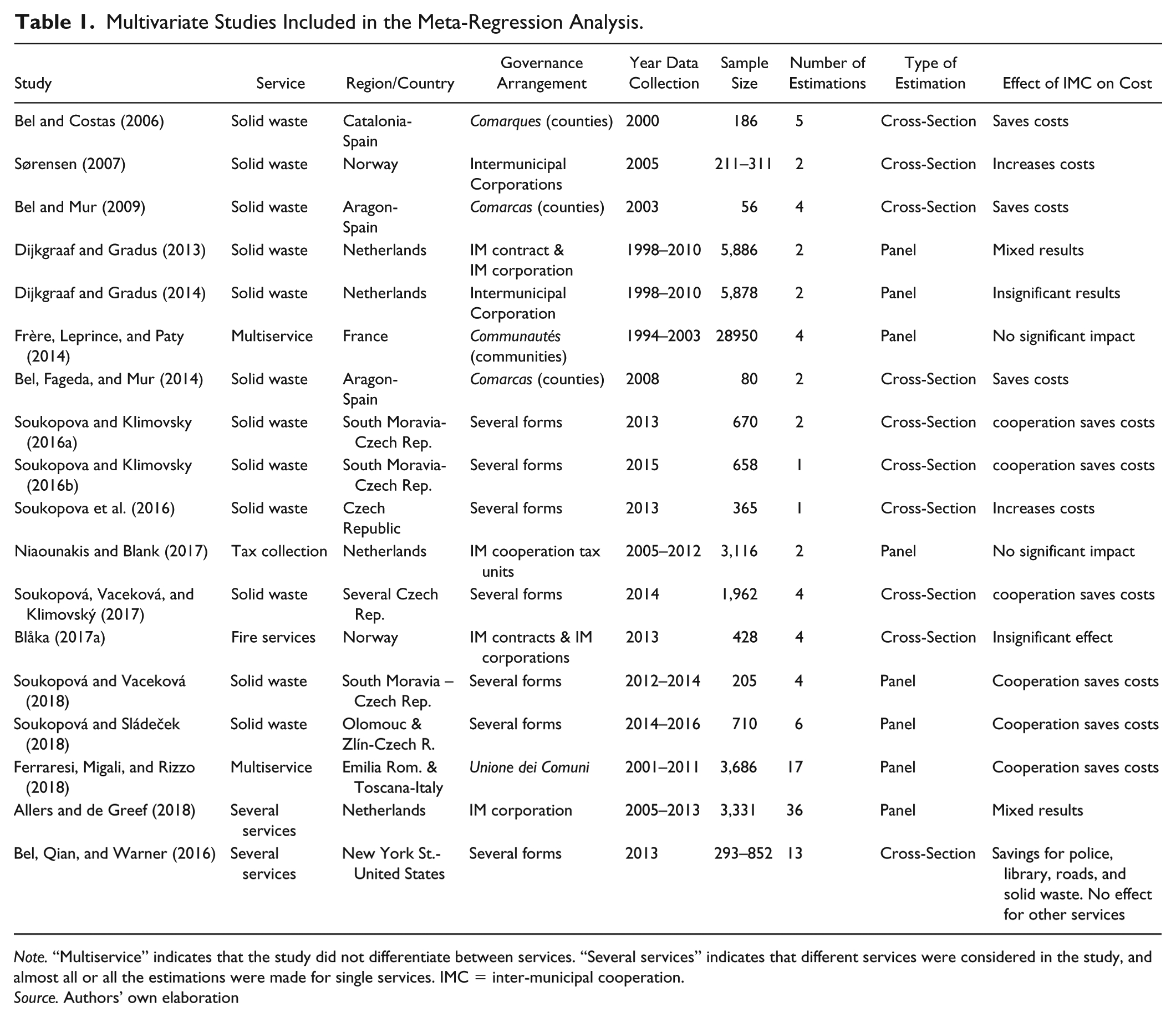
Note. “Multiservice” indicates that the study did not differentiate between services. “Several services” indicates that different services were considered in the study, and almost all or all the estimations were made for single services. IMC = inter-municipal cooperation.
Source. Authors’ own elaboration
Our database includes information on the service(s) considered, the region and/or country for which the study was conducted, the type of collaborative governance arrangement, the year(s) for which the data were obtained (we take the average year in case that data were obtained for several years), the sample size, the type of estimation, and the overall results for the variable of interest. All these are shown in Table 1, in which we can see that among the 18 studies included in our study, nine obtain costs savings, seven obtain mixed or insignificant results, and two obtain cost increases.
Furthermore, the database includes other statistical information, namely, coefficients, t-statistics, and standard errors for the variable of interest, the regression method, and the transformation to transaction costs, as we explain in the following. In addition, we constructed dummy variables for delegation, to consider whether the study looked at the United States or at European countries, and whether panel data were used. In the following, we discuss this in more detail.
Empirical Strategy
The Model
Because the aim of this article is to analyze the divergence in the outcomes of studies examining the effect of IMC on service costs, we opted to employ a meta-regression methodology to explain the variation in results. This methodology has been widely used, for example, in psychotherapy and in studies of expectations and different types of elasticity, and so on (Jarrell and Stanley 1989), as well as to analyze the effects of privatization on the costs of local public service delivery (Bel, Fageda, and Warner 2010), the effects of private/public ownership on the productivity of local water services (Carvalho, Marques, and Berg 2012), the factors explaining the choice of the privatization of local public services (Bel and Fageda 2009), and the factors that account for the choice of IMC (Bel and Warner 2016). The standard econometric model has the following structure:
In this way, we can explain both the determinants of an event or phenomena and their importance and magnitude. If, however, we want to explain reported differences, we require a model that can synthesize the various findings. The structure proposed by Jarrell and Stanley (1989) is as follows:
where bj, the observed dependent variable, is the reported coefficient of the true effect—β from the jth study out of the set of L studies. The other part of the equation includes the “meta-part,” in which αk represents the meta-regression coefficients, Zjk the meta-independent variables that capture the systematic variations between studies, and ej is the meta-regression disturbance term. Thus, the studies’ different results cause differences in Zjk, and αk is the average biases introduced by the misspecification of the studies. From a practical point of view, instead of using the reported coefficients for bj, it is customary to use the ratio between the reported coefficient and the standard error, that is, the t-value. The reason is that in studies using different data sets, sample sizes, and model specifications, the variances of the coefficients are likely to be different, and so the meta-regression errors will be heteroscedastic. Here, we use the t-values for the estimations (either as reported in the studies or as calculated from the standard errors). 6
To conduct our estimations, we formulate the following equation:
Hence, our model includes eight variables. The first five are the usual moderators related to the environmental or technical characteristics of each study. The last three are variables that reflect theoretical expectations concerning the results: Population, TransactionCosts, and Delegation.
As argued earlier, one of the most important drivers of IMC is the achievement of optimal boundary levels with the lowest average costs for the provision of a given service. By extending these boundaries, municipalities’ scale economies can be a good way to reduce costs. In the studies included in our dataset, the variable representing output is the number of inhabitants. This figure is determined here by data availability, and the results are also readily double-checked. Thus, we examine Hypothesis 1 based on the average population of the municipalities included in the estimations. We expect this variable to be significant and to present a positive sign, reflecting the fact that the cost advantages of IMC tend to be more frequent in studies of small municipalities.
Hypothesis 2 was formulated to reflect the expected decreasing effect on costs (negative relationship) of service-related transaction costs with IMC. We have constructed TransactionCosts as a categorical variable, taking stock of the ratings and indicators provided by Brown and Potoski (2005) (B&P Index) and by Hefetz and Warner (2012) (H&F Index). The variable takes a value of zero if the transaction costs index of the specific service in the estimation is low (below average) according to the combined (B&P) and (H&F) indexes. A value of one corresponds to estimations that include many services (we assume this to be an intermediate position regarding transaction costs), and a value of two indicates relatively high transaction costs of a specific service, with respect to average values on the (B&P) and (H&F) indexes. 7 In keeping with Hypothesis 2, we assume this variable to be negatively related to costs. Later, we extend our analysis and consider in greater detail the nature of transaction costs.
The dummy representing Delegation captures the effect of the transfer of power and resources to a supramunicipal level of government, where decisions are made about the service delivery. This variable is relevant because it can be used to test Hypothesis 3 as defined earlier. We expect this variable to be significant and to present a negative sign. Table 2 summarizes information on our main variables; Table 3 shows their descriptive statistics.
Variables Used in the Meta-Regression Analysis.
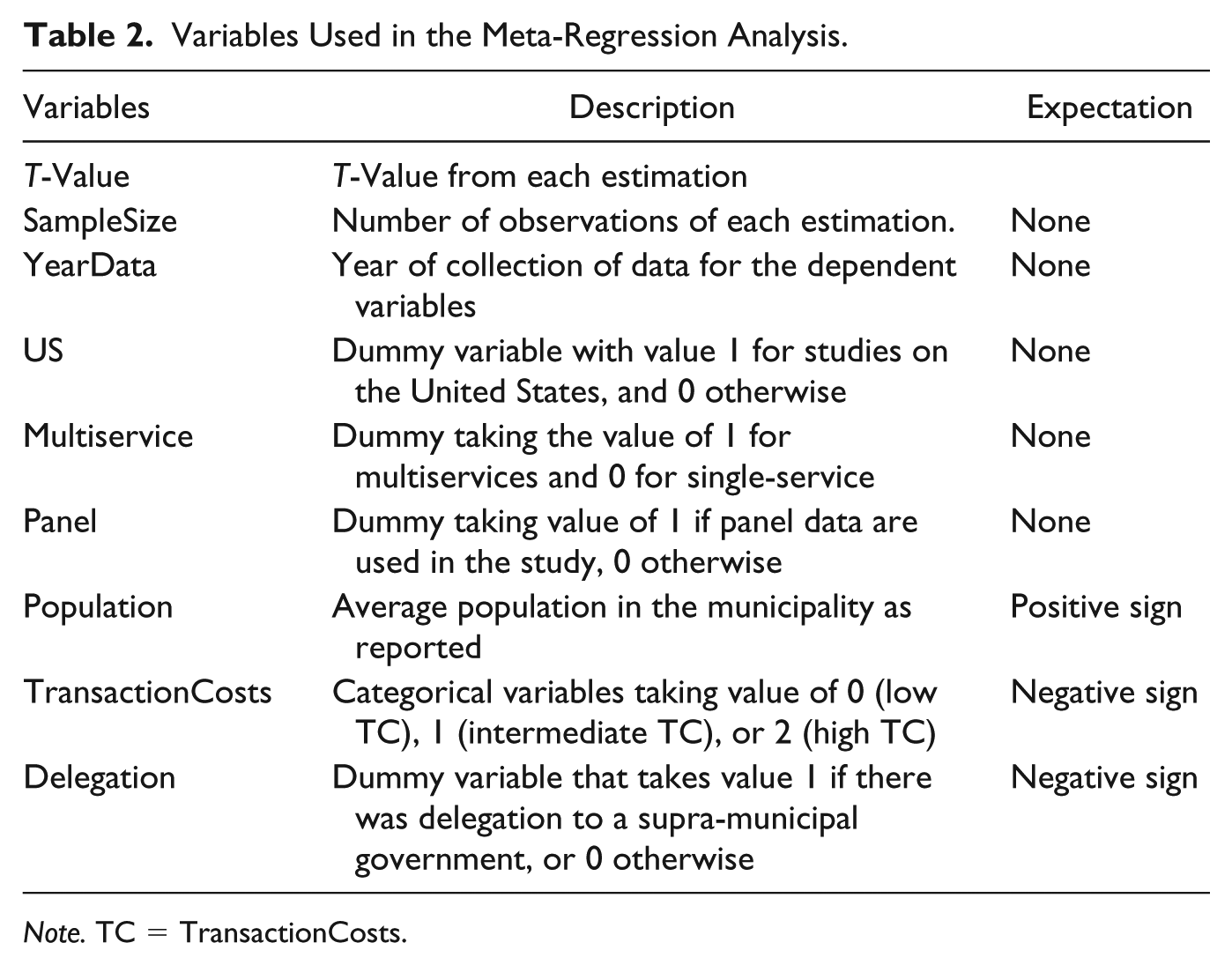
Note. TC = TransactionCosts.
Descriptive Statistics of the Variables Used in the Meta-Regression Analysis.
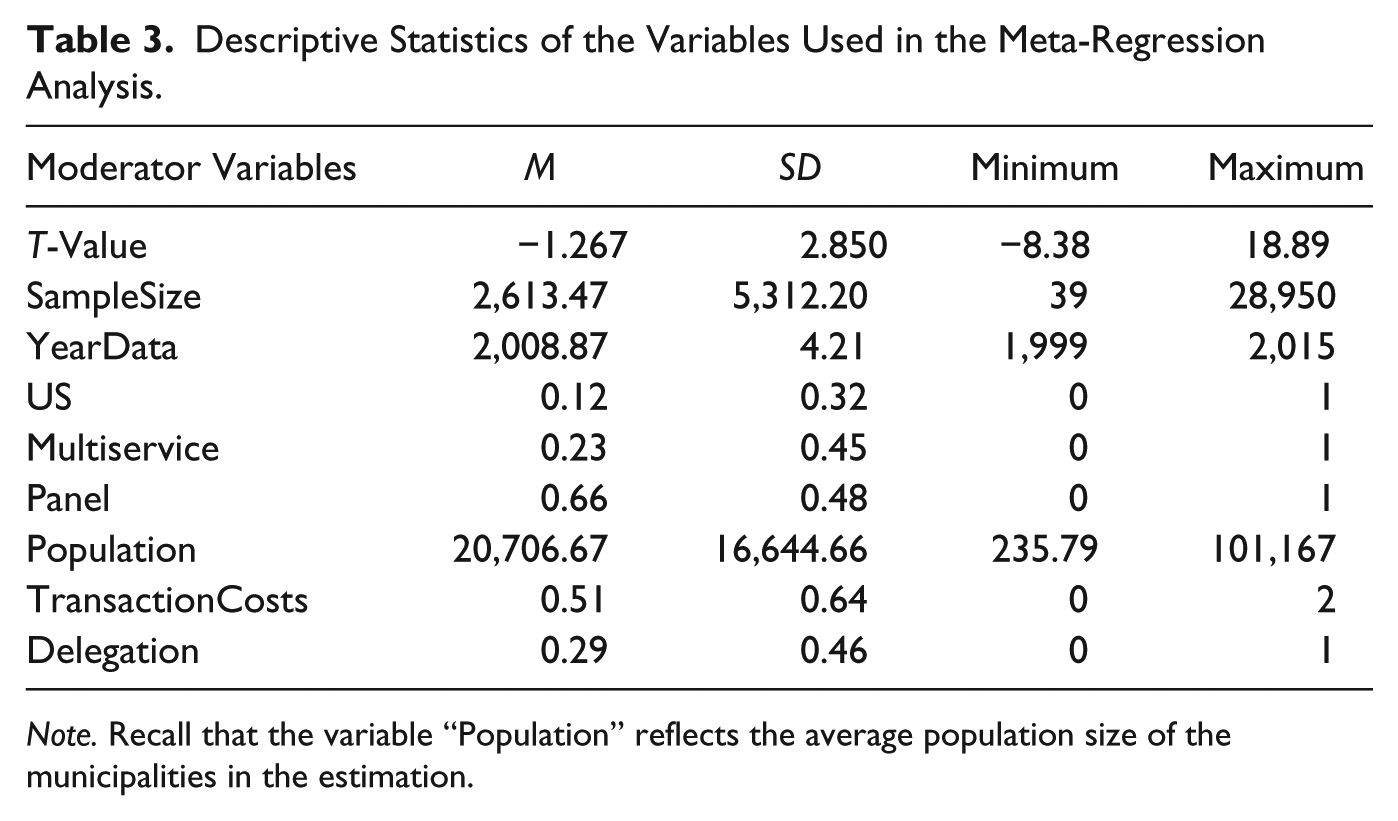
Note. Recall that the variable “Population” reflects the average population size of the municipalities in the estimation.
Funnel Plots
One of the potential threats to meta-analyses (and other methods based on literature reviews, in general) is that published studies have a greater tendency to report positive effects. This so-called “publication bias” (Card, Kluve, and Weber 2010) can greatly affect results, so in this subsection, we seek to evaluate whether it is present in our estimations. Funnel plots are a way of graphically evaluating potential “publication bias” and are similar to scatter plots of studies; however, here one axis represents study precision (the inverse of standard error) and the square root of the sample size, and the other represents effect sizes (Card 2012; Stanley 2008). If there is no “publication bias,” the funnel plot should give us symmetrically varying estimates around the “true effect.” At the bottom, studies with high standard errors (and, therefore, less precise) will be shown. Here, Figure 1 shows that there are more estimates on the negative side of the true effect; hence, it is probable that “publication bias” is present.
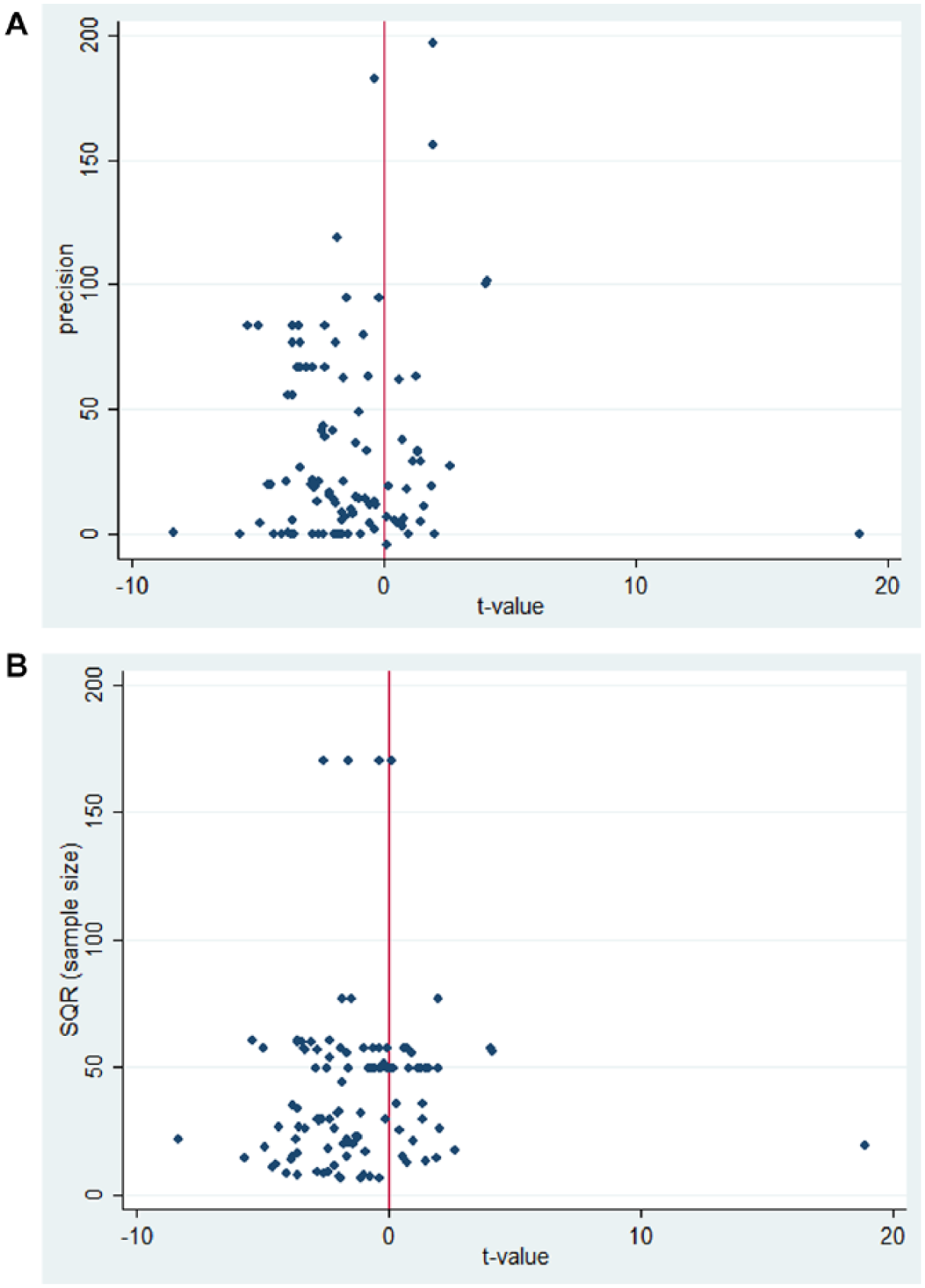
Funnel plots for (a) precision and (b) size (SQR = Square Root).
Results
Our results are shown in Table 4. We first estimated the model with ordinary least squares (OLS). After testing for heteroscedasticity (Breusch–Pagan/Cook–Weisberg test: prob > chi2 = .000), we had to reject the null hypothesis of constant variance. Hence, we corrected the standard errors by conducting the estimation with robust OLS. The variance inflation factor (VIF) was 3.35. Hence, multicollinearity is not a relevant problem in our estimation. To avoid confusion when interpreting our results, it is important to recall that a negative coefficient means that the explanatory variable is related to lower costs with IMC and, therefore, with a substantive positive effect (cost reduction is preferred) of IMC on costs.
Results from Meta-Regression.
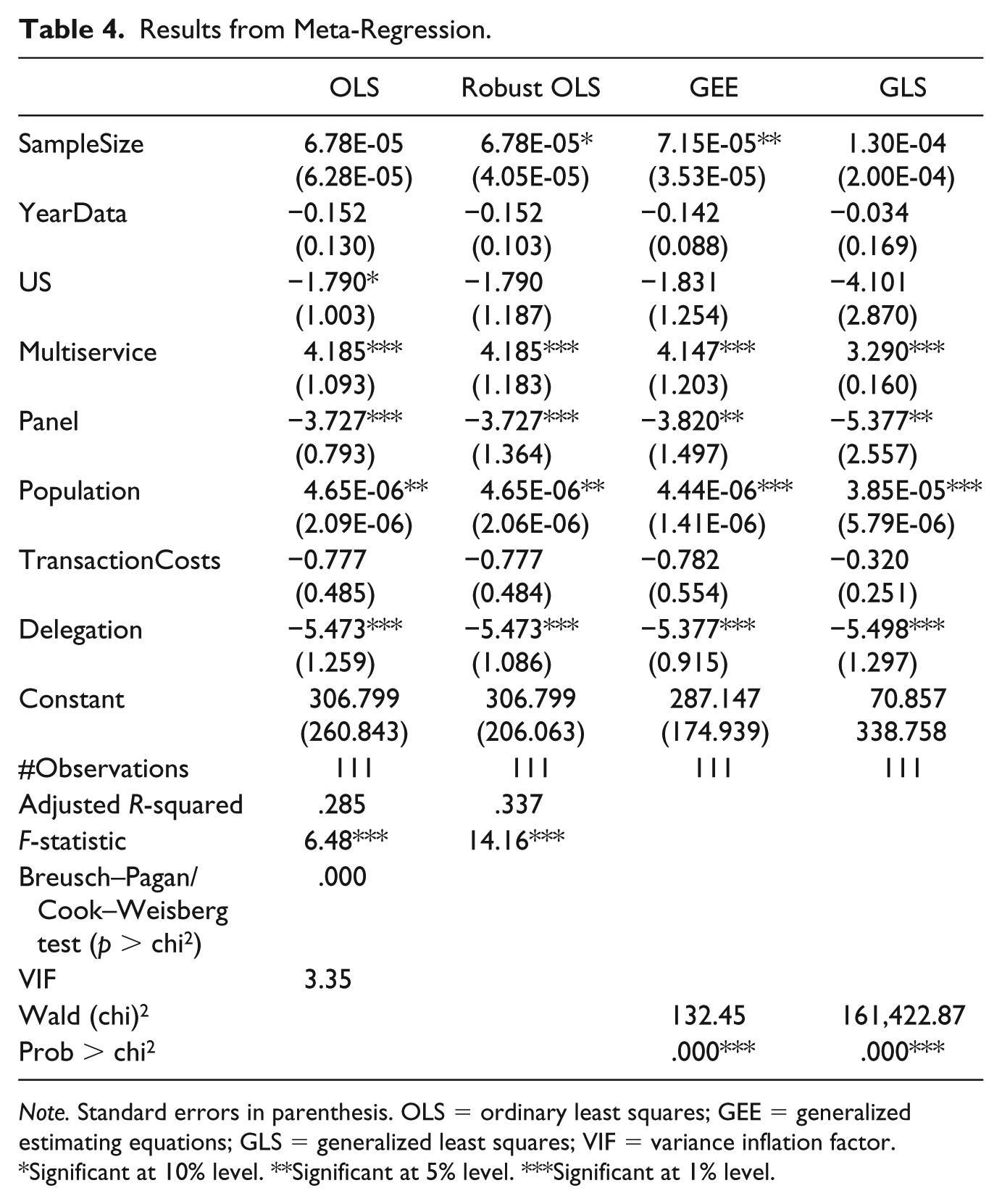
Note. Standard errors in parenthesis. OLS = ordinary least squares; GEE = generalized estimating equations; GLS = generalized least squares; VIF = variance inflation factor.
Significant at 10% level. **Significant at 5% level. ***Significant at 1% level.
The results show that two moderators, YearData and US, have no significant impact on the differences in results in the relationship between IMC and costs. 8 In contrast, SampleSize shows some weak statistical significance (10% level) and presents a positive sign. Looking at the technical variables, Multiservice is significant at the 1% level, and its coefficient presents a positive sign, which implies that studies that consider an aggregate set of services, in the delivery of which municipalities cooperate, tend to find IMC less advantageous in terms of costs. A likely explanation for this finding is that most studies with one single service are done for solid waste collection, service for which economies of scale have been usually found in the literature. Multiservice estimations likely include services for which economies of scale might be not so relevant, and because of this, IMC might be not as beneficial as it is for solid waste.
Of the other technical variables, Panel is significant at the 1% level and presents a negative sign, which indicates that studies based on panel data, as opposed to those that rely on cross-sectional analysis, tend to find IMC more advantageous. As studies with panel data tend to provide more robust results (note also that estimations in all studies with panel data in our sample are with fixed effects), we can conclude that analytical robustness analysis is positively related with the cost advantages derived from cooperation. 9
In the case of the theoretically based variables, Population was expected to be significant with a positive sign. Our results present the expected sign, and the variable is significant at the 5% level. This confirms Hypothesis 1, according to which IMC is more advantageous for small municipalities, but as their population grows they are less likely to reap the benefits of scale economies as they may have been able to exploit them more fully without cooperation. However, these municipalities still incur coordination costs when engaging in cooperation.
Hypothesis 2 states that these service-related TransactionCosts are positively related with the cost advantages of cooperation, and as such, we expected a negative sign for this variable. However, we fail to find a significant relationship between service-related transaction costs and the results obtained in the studies, which would suggest a weak relationship between these costs and those of IMC. Finally, we sought to capture the effect of governance arrangements by means of our variable Delegation. Consistent with Hypothesis 3, we found Delegation to be statistically significant at the 1% level and to present a negative sign, which implies that delegating power and resources to a supramunicipal government when cooperating is associated with cost advantages for the cooperating municipalities.
Next, because our sample is formed with observations from 18 studies, each of them containing a different number of estimations, we might be exposed to problems of dependence across observations (Nelson and Kennedy 2009; Ringquist 2013). To deal with within-study autocorrelation, we follow Ringquist’s (2013) suggestion and employ generalized estimating equations (GEE) to estimate a random effects meta-regression model. 10 In this way, we obtain both consistently estimated coefficients and standard errors. The GEE results, shown in the right-hand column of Table 4, are very similar to those from the robust OLS estimation. The only difference was presented by SampleSize, which was significant at the 10% level and now is significant at the 5% level, and in the same direction, significance of Panel decreases from 1% to 5%. On the contrary, Population now increases significance, at 1% level. As a check, we estimated a random effects generalized least squares model to determine the robustness of our results. Right-hand column in Table 4 shows the results. All the conclusions reported earlier continue to apply with the exception that the significance of SampleSize disappears, which makes us to be cautious about the results for this variable.
An Extension of the Analysis of Service-Related Transaction Costs
The transaction costs associated with IMC are related to the characteristics of the collaboration activities in which the municipalities engage (Hawkins 2017). By classifying the service-related transaction costs, we can take into account the nature of the service provided, which should help disentangle the relationship between service-related transaction costs and IMC costs. The two characteristics we can focus on are, on one hand, asset specificity, and on the other, ease of measurement. Asset specificity can be defined as the level of specific physical infrastructure or technical knowledge needed, while ease of measurement can be defined as quantifiability in contractual terms (Brown, Potoski, and van Slyke 2015). Based on these theoretical outcomes, we formulate the following hypotheses:
To analyze these two hypotheses, we checked the studies that assessed services based on more than one of their dimensions. We took the indicators for asset specificity from Brown and Potoski (2005) and Hefetz and Warner (2012): AS_B&P and AS_H&W, respectively. The ease of measurement indicator is taken from Brown and Potoski (2005), that is, EM_B&P, while the indicator of contract management difficulty (which embeds ease/difficulty of measurement) is taken from Hefetz and Warner (2012), that is, CMD_H&W. We run GEE estimations by introducing each of these factors sequentially. 11 Table 5 shows the results.
Asset Specificity and Ease of Measurement/Contract Management Difficulty.
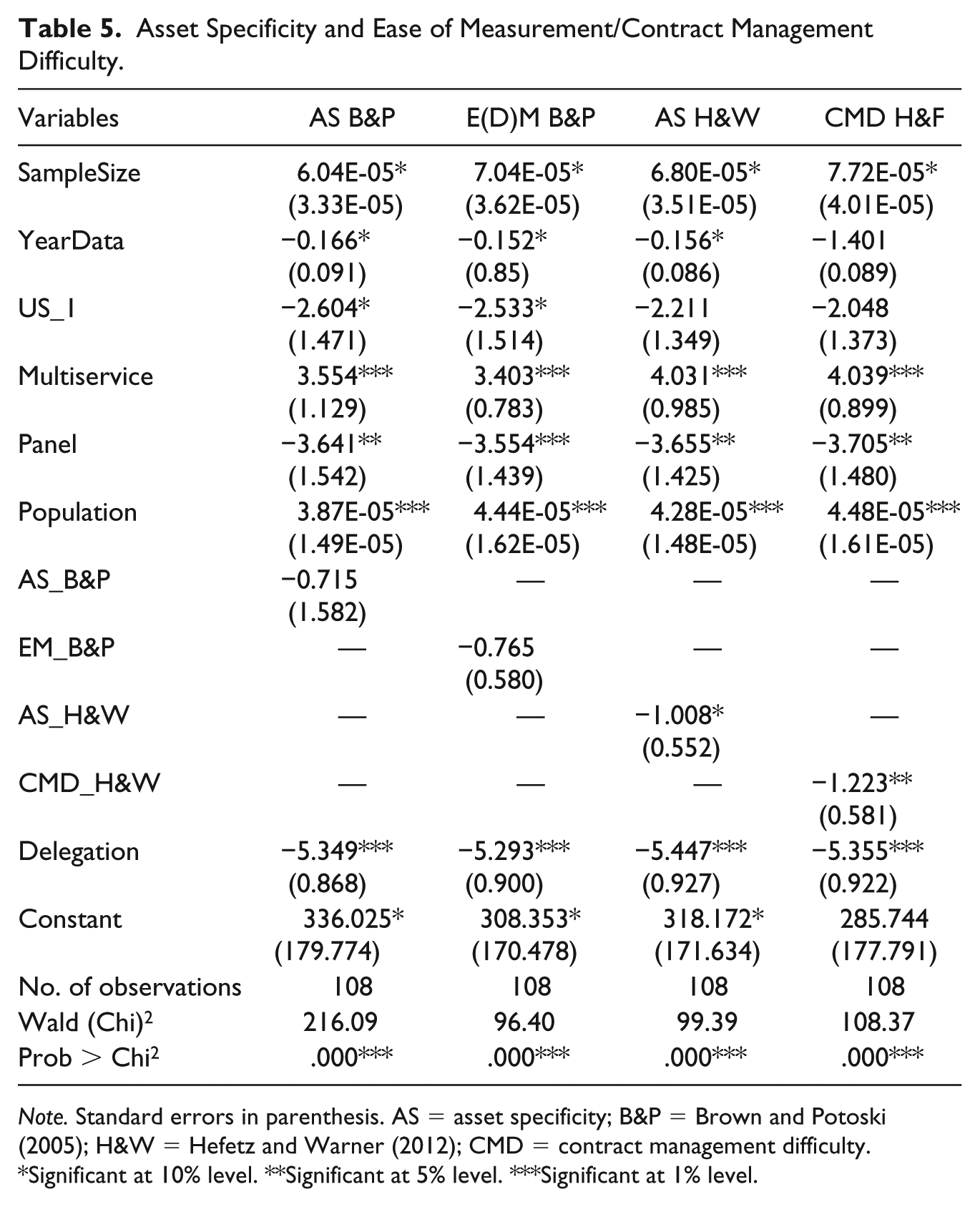
Note. Standard errors in parenthesis. AS = asset specificity; B&P = Brown and Potoski (2005); H&W = Hefetz and Warner (2012); CMD = contract management difficulty.
Significant at 10% level. **Significant at 5% level. ***Significant at 1% level.
It is worth noting that all significant variables, and particularly those theoretically grounded, mentioned previously keep the same sign and level of significance across all estimations. Looking at transaction costs, when we consider AS_B&P and EM_B&P measures, we find that neither helps account for differences in the IMC cost results. However, when we include in the estimation the AS_H&W and the CMD_H&W measures, a somewhat different picture emerges: Both asset specificity and contract management difficulty are significant (the first one at the 10% level and the second at the 5% level) and are associated with IMC cost advantages. Note, however, that we need to be very cautious in our interpretation of these results. Indeed, they point to the need for further research to disentangle more fully the relationship between service-related transaction costs and service costs under IMC.
Robustness Tests
As the funnel plot (Figure 1) shows, our sample might suffer from problems of “publication bias.” In this section, we test for its presence and evaluate its relevance. First, we conducted the funnel asymmetry test (FAT) to check for the presence of “publication bias” both in terms of study precision (FAT 1) and sample size (FAT 2), as recommended by Stanley (2008) and Stanley and Doucouliagos (2012). In the absence of any bias, the estimations should be randomly spread around the “true effect.” However, if the effect observed correlates with the standard error, then we need to test whether the publication selection has a genuine effect (Stanley 2008). In addition, Begg and Berlin (1988) argued that “publication bias” can also be caused by overlooking the variability in sample sizes. If the sample size is small, it is likely that the estimates’ variability will be greater. Similarly, if there is no “publication bias,” the graph depicting sample size and effect size should be symmetrical.
Table 6 shows the results from the FAT tests. The key issue is the significance of the intercept and its sign, which in turn reflects the sign of the bias (Stanley 2008). Here, both in FAT (1) and FAT (2), the constant is negative and significant at the 1% level, which means “publication bias” is a relevant concern in our database. Furthermore, we can analyze the presence of a genuine empirical effect—regardless of the “publication bias.” The meta-significance test (MTS) is based on the ability of the statistical power to provide evidence of a genuine empirical effect based on the relation between the t-value and the degree of freedom. According to the MTS result shown in Table 6, we can see that this genuine effect is negative, that is, we find a genuine negative effect of IMC on costs. This, in turn, helps explain the results of FAT(1) and FAT(2).
FAT and MTS Tests.
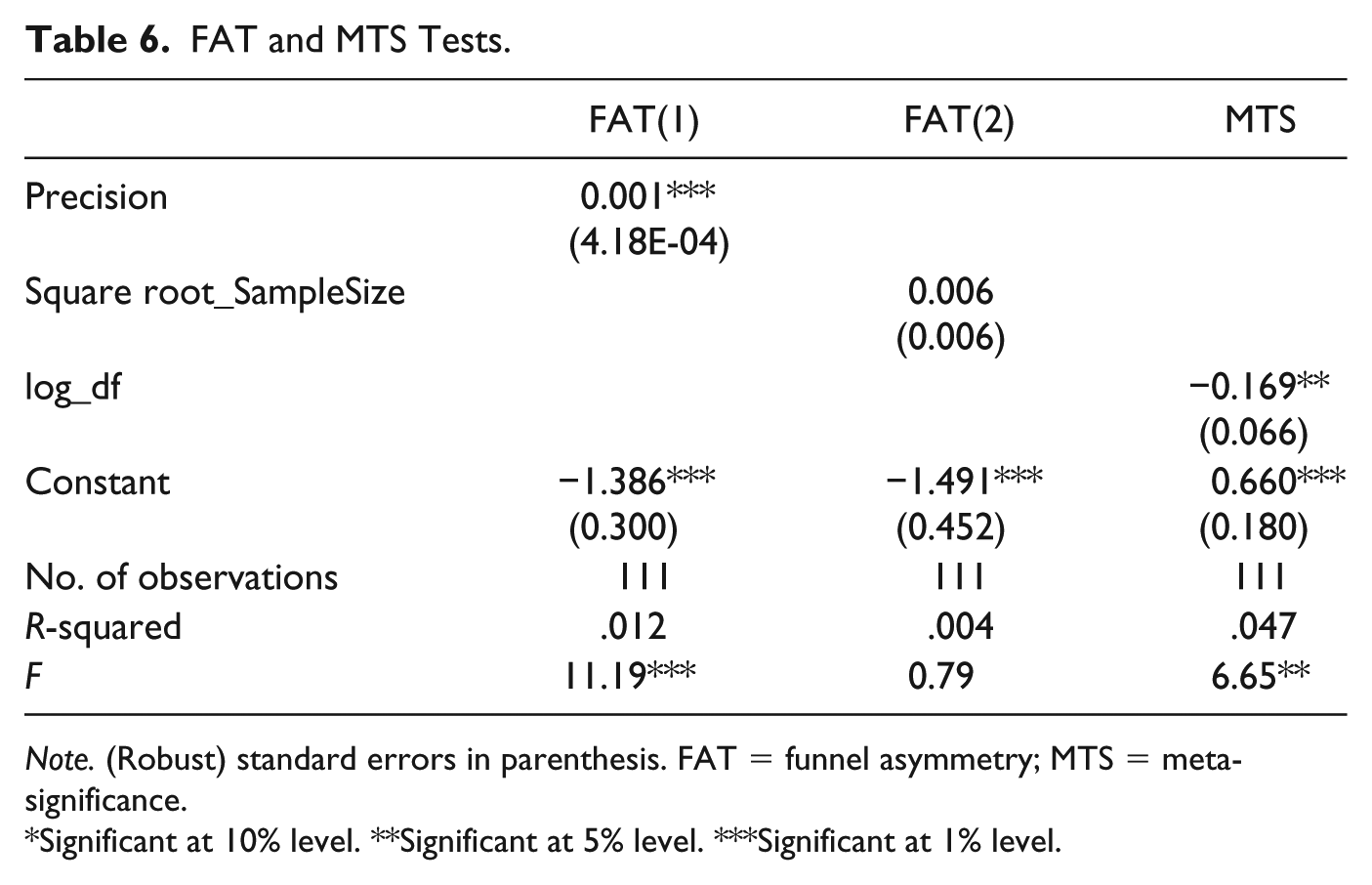
Note. (Robust) standard errors in parenthesis. FAT = funnel asymmetry; MTS = meta-significance.
Significant at 10% level. **Significant at 5% level. ***Significant at 1% level.
To assess the potential effect of publication bias on our results, we have estimated two FAT meta-regressions (Stanley 2005), replacing sample size first with study precision (the inverse of standard error) and then with the square root of sample size. Both FAT meta-regressions, employing the two different estimation techniques, give identical results to those found in our original meta-regressions, above all in the case of the theory-related variables. Table 7 shows the results of the FAT meta-regressions. For the sake of simplicity, we include only the GEE estimation (OLS, Robust OLS, and generalized least squares [GLS] results are available on request). Thus, we can conclude that “publication bias” does not undermine our results.
FAT Meta-Regressions.
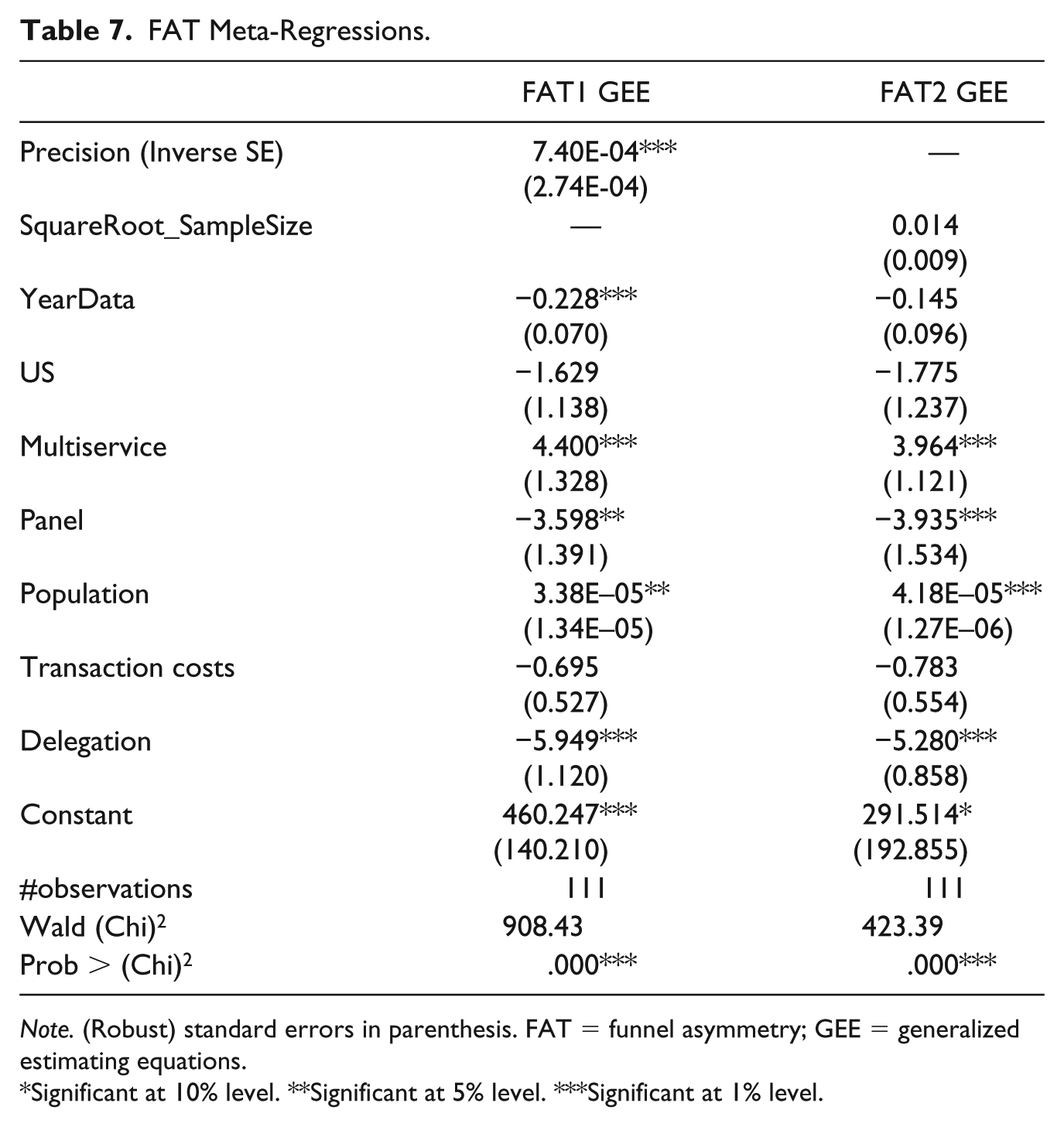
Note. (Robust) standard errors in parenthesis. FAT = funnel asymmetry; GEE = generalized estimating equations.
Significant at 10% level. **Significant at 5% level. ***Significant at 1% level.
Discussion and Conclusion
This study has sought to provide an explanation for the diverging empirical results of the effects of IMC on service delivery costs, and within this framework, to determine whether theoretical expectations about IMC play a relevant role in explaining these results. We have paid particular attention to hypotheses concerning economies of scale, service-related transaction costs, and governance arrangements.
After carefully building a database of all homogeneous multivariate studies that have addressed the issue, we employed a meta-regression methodology. Our data base is comprehensive—to our knowledge—of all available multivariate empirical studies on IMC and costs. Among the 18 studies included in our meta-regression, nine obtain costs savings, seven obtain mixed or insignificant results, and two obtain cost increases. While inter-local contracting has little presence in our study because of scarcity of studies on the United States, where it is most frequent, our analysis is extremely representative of other types of IMC, and of European practices of IMC.
We obtained interesting insights into the role played by the environmental and technical variables; thus, studies that focus on single services and those that employ panel data tend to find greater cost advantages of IMC. More importantly, we found that studies conducted in municipalities with small population sizes tend to find IMC more cost advantageous, which is consistent with the hypothesis we formulate in relation to scale economies. We also found that the studies in which the governance of cooperation is delegated to supramunicipal governments tend to find IMC more cost advantageous.
We did not find any significant overall relationship between service-related transaction costs and the cost advantages of IMC. When decomposing transaction costs into asset specificity and contract management difficulty, we found a slightly significant positive effect of transaction costs on the cost advantages of IMC. These results, though, should be treated as preliminary findings because they are neither systematic across estimations, nor statistically strong. Indeed, more empirical research on transaction costs and IMC is needed.
We have not been able to consider here questions of service quality, given that the empirical evidence is extremely scarce. Also, scarcity of studies on the United States and lack of studies on developing countries prevent us from claiming full generalization of our results. These are limitations of our analysis, and also issues that deserve further research.
In all, our research provides interesting results with considerable implications for the effects of IMC on costs. We believe the main implication that can be drawn by policy makers from our results is that “one size does not fit all”: IMC can be cost advantageous for some services, but not for others. The possibility of exploiting scale economies, particularly in the case of small municipalities, seems to be robustly associated with cost savings. Moreover, just how the governance of the cooperation is arranged matters, highlighting the need to carefully consider the coordination and supervision costs involved.
Footnotes
Declaration of Conflicting Interests
The author(s) declared no potential conflicts of interest with respect to the research, authorship, and/or publication of this article.
Funding
The author(s) disclosed receipt of the following financial support for the research, authorship, and/or publication of this article: The authors received financial support for the research from the Spanish Government - project ECO2016-76866-R -, and the Government of Catalonia - project 2017 SGR644-. No sponsor has been involved in the design and implementation of the research. Support was provided as well by the Public Governance Institute-Katholieke Universiteit Leuven, where part of the research was conducted during a research stay.
Notes
Author Biographies
