







Abstract
Continued critiques, evidence and newer reform trends have increasingly contested the use of market-centered models–the competition prescription–for urban public space maintenance as well as other local services. This article adopts a contextualized contingency perspective on the competition prescription and questions the contested status of market-centered models in a survey-based study of the current use of and satisfaction with private providers for maintenance of parks/greenspaces and road/streets in Scandinavian local governments. The study finds widespread use of and satisfaction with private providers. However, satisfaction depends on national context and multiple contingencies. The study challenges the contested status of market-centered models, highlights that different models serve different strategic objectives, and directs attention to discussions of context and key contingencies that define how well market-centered models perform.
Introduction
Most local governments hold responsibilities for the provision of urban public space such as parks, greenspaces, squares and roads/streets to serve a diverse range of local needs and uses distributed across a number of stakeholders and interests (Carmona 2010). Undertaking of maintenance operations is critical for upholding attractive and functional public spaces within the urban fabric–or at least for upholding standards and meeting expectations outlined or agreed upon by the involved stakeholders (Dempsey and Burton 2012; Lindholst et al. 2015). Under the influx of wider reform pushes, neoliberal politics and national policies many local governments have since the 1980s challenged and increasingly shifted away from traditional state-centered models for organizing maintenance responsibilities through the introduction of market-centered management models (Carmona, De Magalhães and Hammond 2008; De Magalhães and Carmona 2006; Lindholst 2020; Randrup, Lindholst and Dempsey 2020). A key assumption for the shift has been the general idea inherent in the new public management (NPM) reform agenda that governments can improve performance of service delivery by capitalizing on competitive markets (e.g., Dehoog 1990; Hood 1991; Walsh 1995)–an idea that Kettl (1993) labelled the “competition prescription.”
However, discussions in the literature and evidence have increasingly contested the use of traditional market-centered models and the underlying rationale of the competition prescription. On the one hand, multiple studies find that the introduction of market-centered models for organizing maintenance of public space in several national contexts has resulted in substantial cost savings (Lindholst 2017). On the other hand, the literature delivers a substantial critique by highlighting that market-centered models have led to substantial losses of social and recreational qualities (e.g., Dempsey and Burton 2012; Jones 2000) and are likely to produce ‘vicious cycles’ with multiple negative outcomes (Randrup, Lindholst and Dempsey 2020). Furthermore, some research indicates that salient outcomes across local governments present a diverse and multi-dimensional mix of negative and positive outcomes, the balance of which is only poorly understood (Lindholst et al. 2017). Critiques of traditional market-centered models have also called attention to and raised hopes for newer ideas of partnerships and collaboration as alternative approaches for organizing market-centered models within public space management (e.g., Lindholst 2009; Randrup, Lindholst and Dempsey 2020) and beyond (e.g., Donahue and Zeckhauser 2012; Vincent-Jones 2007). More broadly, critiques of market-centered models and developments within some local services have raised discussions about whether a new shift toward re-municipalization is emerging and replacing the movement toward market-centered models seen in the 1980s and 1990s (Clifton et al. 2019; Wollmann and Marcou 2010; Wollmann, Koprić and Marcou 2016). Finally, these discussions are connected to critiques and dismissal of the NPM and a shift in reform orientation toward other and newer models (e.g., Christensen and Lægreid 2017; Dunleavy et al. 2006). Some research, however, finds that local governments’ choice of service provider are balanced over time and based on a pragmatism mainly driven by (dis)satisfaction with cost and quality levels of incumbent service providers (Kim and Warner 2016; Warner and Aldag 2019). In light of such discussions and developments, research has been called for that tries to understand better the contexts and contingencies under which different market-centered models lead to more favorable outcomes (Lindholst 2017). Such calls bring attention to a multitude of arguments beyond economic reasoning that contribute to our understanding of variations in outcomes. Notably, the literature has harnessed multiple arguments rooted in a mix of economic, contractual, sociological and administrative-organizational reasoning to highlight contingencies with a likely bearing on variations in the performance of market-centered models (Brown, Potoski and Van Slyke 2006; Donahue 1989; Fernandez 2009; Kettl 1993; Kuhlmann and Wollmann 2019; Lamothe and Lamothe 2010; Lamothe, Lamothe and Feiock 2008; Lindholst, Petersen and Houlberg 2020; Warner 2006).
This article contributes to discussions in the literature on the contested status of market-centered models for public space management by developing a contextualized contingency perspective and providing an empirical test of implications in a study of Scandinavian local managers’ satisfaction with the performance of private providers engaged for maintaining local parks/green spaces and streets/roads. The study relies upon comparable survey-data collected in 2014–16 from managers with responsibilities for local parks/green spaces and streets/roads in Scandinavian local governments. The design enables a study that across three country contexts tests (1) whether local managers are more satisfied than dissatisfied with private provider performance, and (2) the national, managerial and urban contingencies upon which local managers’ satisfaction are likely to depend. Altogether eight hypotheses guide the study.
The first part of the article outlines the background and theoretical arguments on the performance of market-centered models for organizing maintenance services, and provides a set of arguments on why local managers’ satisfaction with private provider performance varies. The second part describes the study's methods and data. The third part presents results, discusses implications and draws up conclusions.
Background: A Contested status of Market-Centered Models?
The study's service context–public space–has, from an urban planning perspective, long been viewed as vital for the attractiveness of cities and the quality of human life in self-reinforcing urban environments where “liveliness and variety attract more liveliness; deadness and monotony repel life” (Jacobs 1961, p. 129). In the classical terminology for different types of goods based on the two dimensions of rivalry in consumption and exclusiveness of use (Samuelson 1954), public spaces can be argued to resemble a “public” or “collective” good. For example, in practice it would be difficult (or very radical) to exclude local residents or visitors from using or benefiting from these services, and the use by one user is to a certain extent non-rival for the use by other users. Given the (need for) non-exclusiveness, economic reasoning suggests that the use of market-centered models for delivering public space should ideally take place on the supply (production) side rather than the demand (consumer) side. From a welfare perspective, the risk for under-supply of public goods under a complete market-model also suggests that responsibilities for finance and availability should be in the hands of local government. In theory, decentralization of responsibilities to local governments should warrant a better match between local preferences, allocation of financing and availability of services (Warner 2006).
Research finds that services associated with maintenance of the physical infrastructures that constitute urban public spaces, such as parks and streets, represent a set of comparatively well-suited characteristics for implementation of market-centered models. Survey-based research from the US, for example, indicates that local managers find that the provision of services related to maintenance of public spaces, on average, is characterized by a relative ease of specifying and monitoring services, and represents a context where competition is relatively high (Hefetz and Warner 2012). The literature often contrasts these characteristics with social services, where competition is scarcer and services are argued to be harder to specify and monitor (Hansen 2010; Lamothe and Lamothe 2010; Van Slyke 2003). However, such assessments are qualified by the fact that the requirements of commonly used market-centered models for maintenance services often rely on technical ‘conformance-to-specification’ definitions of quality that are not necessarily linked to the requirements for aligning public space qualities with expectations of excellence, shifting circumstances, or the needs and demands of multiple stakeholders (Lindholst et al. 2015). A review of studies addressing the outcomes from the use of market-centered models for park and green space maintenance finds that most studies report various positive economic outcomes such as cost savings and improved cost-effectiveness, while other reported outcomes related to services, the organization or staff tend to be negative (Lindholst 2017). The range of negative outcomes is in particular voiced in critiques of the use of market-centered models in the context of UK experiences in the 1980s and 1990s (Dempsey, Burton and Selin 2016b; Hebbert 2008; Jones 2000). Hebbert (2008), for example, notes that the very radical UK policy regimen of compulsory competitive tendering (CCT) enacted in the 1980s and 1990s reduced “the ancient art of urban horticulture” to “mechanical crudity” and let genuine urban green spaces deteriorate into “ghost zones” and “green deserts” empty of social and recreational functions. Thus, these critiques suggest that public spaces to some degree stop being fit for purpose when (too) radical market-centered models are applied. Others associate such critiques more broadly with the combination of market-centered models with overly competitive and cost-focused approaches. The combination is argued to lead to ‘vicious circles’ where self-reinforcing dynamics return a pool of diminished organizational resources, poor working conditions, faulty performance of maintenance operations, loss of quality, increased monitoring activities, and a lack of development and innovation (Randrup, Lindholst and Dempsey 2020). Similar dynamics and negative outcomes are observed in other service contexts where, for example, the use of private providers–while superficially technically efficient–is less apt to promote outcomes related to local equity and democracy than the alternatives (Hebdon 1995; Warner and Hefetz 2002). Such dynamics can be interpreted as broad manifestations of the “quality shading” hypothesis (Hart, Shleifer and Vishny 1997) and/or as different kinds of “negative externalities” (Boyne 1998). Some research simply suggests that private provision is “cheap and dirty” (Elkomy, Cookson and Jones 2019). Congruently, research in the context of local public spaces finds that the overall balance of managers’ views on the outcomes from the use of market-centered models corresponds to a diverse and multi-dimensional mix of positive and negative outcomes (Lindholst et al. 2017). Thus, the comparatively well-suited characteristics of maintenance services do not appear to be sufficient conditions for an uncontested use of market-centered models in the context of public space management.
The findings echo insights from reviews of the general research on the outcomes from the use of market-centered models and involvement of private providers in the public sector–in particular by contracting out (Boyne 1998; Bel, Fageda and Warner 2010; Hodge 2000; Petersen, Hjelmar, and Vrangbæk, 2017; Vrangbæk, Petersen and Hjelmar 2015). The reviews highlight that evidence is far more abundant for financial and partly service performance criteria than for other criteria, and that performance appears to depend on various contingencies such as reform history, and service and country context. One key finding is that the reported returns, i.e., cost savings, from recurrent competition are diminishing over time (e.g., Hodge 2000) or even that private production is not cheaper than public production (Bel, Fageda and Warner 2010). On the one hand, this is apparently challenging key reform objectives for using market-centered models. On the other hand, this finding is congruent with theoretical reasoning that suggests that differences in cost levels are likely to diminish over time as competitive contexts spur both learning and searches for innovation equally within the private and public sectors (Vining and Boardman 1992). Consequently–and after several decades with market-inspired public sector reforms–it makes sense to apply multiple and more context-sensitive performance criteria rather than impose a global evaluation criteria for cost levels alone (e.g., Amirkhanyan, Kim and Lambright 2007, 2014; Brown, Potoski and Van Slyke 2006; Lindholst et al. 2017). Empirical findings also warrant such complementary shifts in criteria. A study from the 2010s (Lindholst et al. 2017) suggests that economic accountability–such as the ability to deliver services at the ‘market price’ or demonstrate transparency for cost levels and unit prices–rather than costs reduction is the most salient economic outcome from contracting out maintenance of local public spaces for managers in a Scandinavian context. Similarly, Warner and Aldag (2019) highlight the importance of focusing on local performance criteria by concluding that managerial satisfaction with price and quality is driving shifts between in-house and private provisions.
This study addresses these concurrent discussions in the literature by shifting attention to local managers’ satisfaction with private providers against multiple performance criteria and highlighting key conditions and contexts, i.e., contingencies, under which market-centered models are likely to become more or less contested.
Theory: A Contingency Approach
The following section develops a contingency approach to account for variations in the satisfaction with private provider performance–the performance of the competition prescription–with attention to the characteristics of the national and service context(s) of the study. The account expands and combines earlier literature (e.g., Donahue 1989; Brown, Potoski and Van Slyke 2006; Kettl 1993; Kuhlmann and Wollmann 2019; Lamothe and Lamothe 2008; Walsh 1995; Warner 2006) and links variations to differences in country characteristics, competitive environments, characteristics of contract-based exchange relations, organizational capacities and the urban context. The account offers eight testable hypotheses.
Country Context
Comparative research points out that the implementation and outcomes from various reforms and management models depend on a variety of contextual characteristics at the country level (Christensen and Lægreid 2011; Kuhlmann and Wollmann 2019). Christensen and Lægreid (2011), for example, highlight that contextual differences across groups of countries (and services) in structures (e.g., legal constitutions and politico-administrative systems), cultures (e.g., history and traditions), and environments (e.g., institutional and technical) are likely to produce divergence. The study integrates a comparative perspective in the context of the three Scandinavian countries of Denmark, Norway and Sweden–three OECD countries renowned for their highly developed economies, well-functioning politico-administrative structures and large tax-financed public sectors (Greve, Lægreid and Rykkja 2016). With a point of departure in a Scandinavian context, the study is able to examine the importance of contextual differences at the country level given that the three countries represent a mix of similarities and differences with a bearing on the performance of market-centered models. Table 1 summarizes key similarities and differences.
Country Characteristics (mid 2010s).
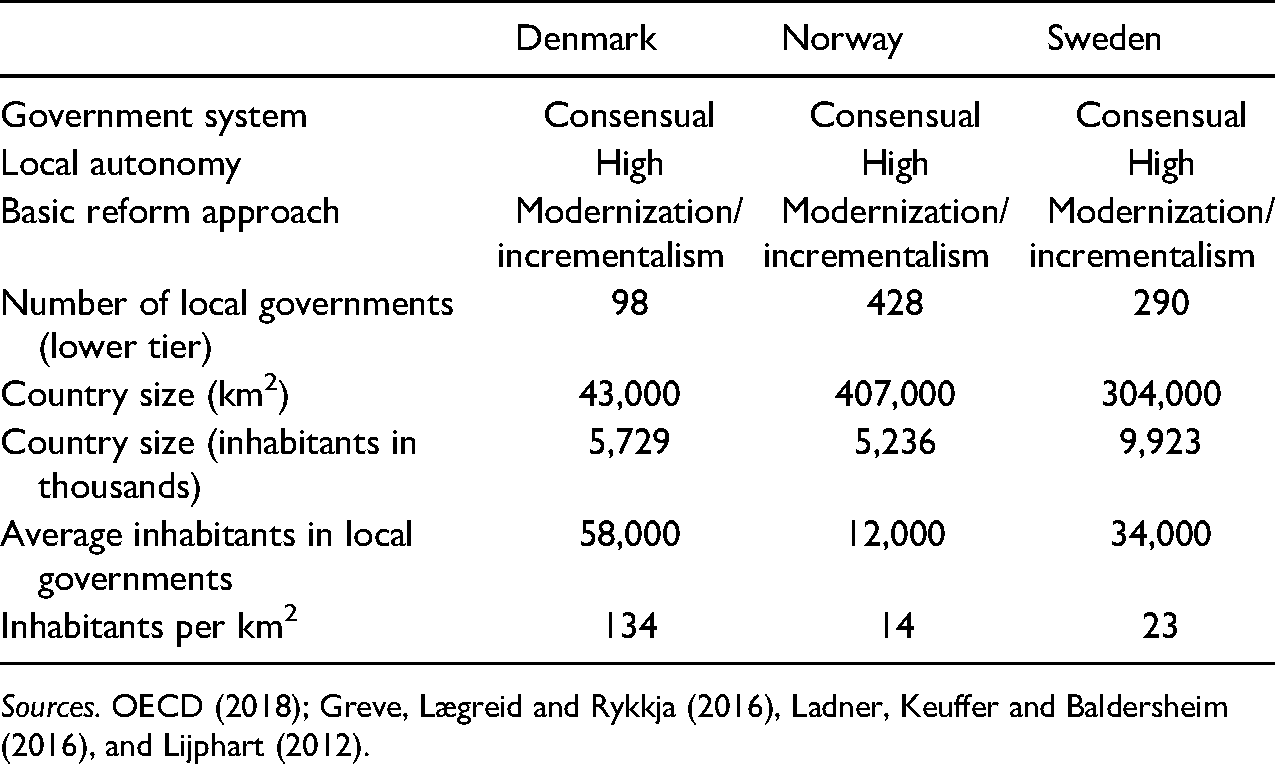
In a comparative perspective, Kuhlmann and Wollmann (2019) highlight that the Scandinavian countries belong to the same administrative tradition. In the consensus and decentralized democracies of Scandinavia, most national governments have been coalitions or minority-based and highly dependent on securing a wider parliamentary consensus across several, and sometimes opposing, political parties and interests for producing new legislation, policies, and reforms (Lijphart 2012). Local governments in Scandinavia also have a comparatively high degree of autonomy and competencies vis-à-vis the central government in terms of, for example, the level and organization of services (Ladner, Keuffer and Baldersheim 2016). Thus, in comparison with majoritarian democracies, central governments in Scandinavia are limited in their powers to implement (if desired) radical and comprehensive reforms. More generally, public sector reforms in Scandinavia since the 1980s have emphasized modernization more than marketization, and retained a dominant role of the state by integration of newer reform features into the classical Weberian bureaucracy–an integration often viewed as an expression of a “neo-Weberian state” (NWS) model (Greve, Lægreid and Rykkja 2016). Thus, markets and private providers are delegated a more limited role in reforms than in the more wholesale neoliberal state models and radical NPM reforms tried out in Anglo-Saxon countries (Christensen and Lægreid 2017). In addition, the legal-regulatory frameworks for the use of market-centered models are relatively similar and well-established in the three countries due to requirements for compliance with EU-law. However, EU-law only regulates procedures for involving private providers, i.e., how to use the market, and does not regulate whether local governments should use the market or not. Overall, these features imply that Scandinavian local governments are delegated substantial degrees of freedom for a pragmatic adaptation of market-centered models to local circumstances and for combining the use with (modernized forms for) state-centered models or other alternatives. Thus, time and space have allowed for decentralized sectorial dynamics to take hold within and across local governments and private providers where gradual and mutual learning and development of required capacities can occur. Congruent with these characteristics, research finds that reform trajectories within local park and road services since the 1980s and onward have been of an incremental and pragmatic character (Lindholst 2020). Combining the arguments on the relatively well-suited service characteristics and the decade-long pragmatic reform approach in Scandinavia suggests that local managers primarily use market-centered models where the overall balance between pros and cons are favorable. The following hypothesis tests the argument:
H1 – Local managers in Scandinavia are–on average–more satisfied than dissatisfied with private provider performance.
However, the territorial and administrative preconditions for the use of market-centered models differ remarkably across Scandinavia (Table 1). Denmark is a relatively small and densely populated country with a politico-administrative structure based on relatively few and large lower-tier local governments. In contrast, Norway is a sparsely populated country with many small local governments scattered across a vast geography and with a greater role for higher-level government bodies. In correspondence with earlier research (Bel and Fageda 2011; Foged 2016; Lamothe, Lamothe and Feiock 2008; Warner 2006), these characteristics suggest that Denmark represents comparatively better preconditions in which stronger, more attractive and competitive markets can evolve alongside with the development of internal capacities for the use of market-centered models. Likewise, a comparison of the general characteristics suggests that Norway represents preconditions that are the most challenging, characterized by a highly fragmented and geographically scattered market structure with relatively unattractive small contracts, while Sweden takes up a middle position in Scandinavia. In sum, the arguments suggest that the differences in country context are likely to have an impact on how well market-centered models perform. A key difference in Scandinavia is the degree to which territorial and administrative structures support market-centered models. Thus, the use of market-centered models are expected to be more contested in Norway (in particular) and Sweden than in Denmark. The following hypothesis tests the arguments in the context of Scandinavia:
H2 – In comparison to Norway and Sweden, the country context of Denmark is associated with higher satisfaction with private provider performance.
Competitive Environments
Market theory and economic reasoning routinely highlight a combination of price-based competition, user choice (consumer sovereignty), profit-based incentive structures, and gains from economies of scale as key mechanisms for explanation of why market-based models and involvement of private providers should (in theory) result in superior performance in terms of technical and allocative efficiencies (Boyne 1998; Vining and Weimer 2007). A core proposition in the traditional argument is the idea that establishment of competitive markets for contracts, where governments can freely choose between alternative providers based on evaluation of price and/or quality, gives providers a strong incentive to ensure cost-efficient service provision, and public authorities an option to replace incompetent or failing providers (Dehoog 1990; Donahue 1989; Walsh 1995). Similarly, common performance expectations of market-centered models in public policies include a mix of key criteria related to service quality, costs levels and responsiveness (Boyne 2002; Le Grand 2007; Warner and Aldag 2019).
Some arguments also suggest that competition can be detrimental to performance and its benefits can be outweighed if a change of provider(s) disrupts stability of relations, damages coordination, implies loss of knowledge and requires new learning (O'Flynn and Alford 2008; Lamothe and Lamothe 2010). Managing processes of competitive tendering may also incur increased transaction cost for local governments (Kettl 1993). Economic reasoning also points out that the presence of increasingly higher switching costs, i.e., the costs of replacing an incumbent provider, limits competition and transforms exchange relations (contracts) into bilateral monopolies with adverse consequences for performance (Williamson 1979). Thus, the positive association between competition and performance is likely to be rooted in the realistic possibility for replacement–as reflected in Baumol's argument on contestability (1982), and classical economic reasoning on competition (Abbott 1955)–rather than recurrent disruptions of service delivery through use of competitive tendering and change of service providers. The arguments suggest that the contested status of market-oriented models is partly explained by the strength of the competitive environment. The following hypothesis tests the arguments.
H3 – A stronger (weaker) competitive environment is associated with greater (lesser) satisfaction with private provider performance.
Contract-Based Exchange Relations
Market-centered management models rely heavily on formal contract-based exchange relations (Donahue 1989; Vincent-Jones 2007; Walsh 1995). According to traditional contract theory, the logic in the standard approach to contracting out–also designated the ‘competition model’–seeks to align formal contract features with the purpose of driving costs down by maximizing price competition, i.e., ensuring technical efficiency, as well as ensuring accountability by specifying and safeguarding the exchange (Dehoog 1990; Macneil 1980; Schepker et al. 2014). In a risk perspective (Marques and Berg 2011), the standard contract should ideally be able to minimize production costs by providing planning foresight and allocating a minimum of risk to the private provider. However, the overall welfare benefit and outcomes from this approach hinge on whether maintenance operations contribute to keeping public spaces fit for purpose within the urban fabric (e.g., Dempsey and Burton 2012; Lindholst et al. 2015). Key contract features in the standard model for maintenance services related to green spaces/parks and roads/streets usually include juridical parts, formal specification of services with reference to a set of performance- and instruction-based measures, a work schedule, a payment scheme, and provision for subsequent monitoring and sanctions (Lindholst 2009). The standard contract also commonly links ex post payments calculated on a regular (e.g., monthly) basis for work carried out in fixed work schedules and ad hoc work.
The standard model presumes that public authorities can, to a large extent, determine the “what,” “where” and “when,” and can foresee the key requirements and conditions of an exchange (i.e., maintenance operations) in advance (by ex ante planning) and specify them in a formal contract for a given duration of time. Subsequently, the contract forms the basis for holding providers accountable for provision of maintenance operations as agreed upon through the specification and monitoring of services and provisions for penalties and sanctions. Thus the reliance on standard contract features within an exchange relation reflects typical recommendations in economic reasoning and should in principle minimize the quality-shading problem (Hart, Shleifer and Vishny 1997). Overall, the level of contract completeness, i.e., the level of formal specification in the contract and the inclusion of relevant information for addressing contingencies and allocating risks between the contract parties, becomes important for accurate contract pricing and effective use of competition, reduction of uncertainties and minimizing the risks for later conflicts between the contracting parties (Walker and Davis 1999). These arguments suggest that the contested status of market-centered models partly depends on the degree to which local governments rely on standard contract features in their exchange relations with private providers. The following hypothesis tests the arguments:
H4 – Stronger (weaker) reliance on standard contract features is associated with higher (lower) satisfaction with private provider performance.
More broadly, the ideologically-informed reform push toward market-centered models in the 1980s and 1990s appears increasingly contested and replaced in the 2000s and 2010s with pragmatism among local governments where dissatisfaction with private (or other) providers in terms of cost and quality brings attention to alternatives and drives shifts between these (Bel, Hebdon and Warner 2018; Clifton et al. 2019). One alternative discussed in the literature is the shift back to state-centered models where responsibilities across multiple services are reorganized anew within local governments (Clifton et al. 2019; Wollmann, Koprić and Marcou 2016). However, newer alternatives within public space management also include social enterprises (Muñoz 2010), community-centered models (Mathers, Dempsey and Molin 2015), long-term public-private partnerships (Dempsey, Martínez Velarde and Burton 2020), and cross-sectoral partnerships (Dempsey, Burton and Duncan 2016a ). Interestingly, critiques of cost-focused and standard market-centered models also prompt hopes for partnership-based and collaborative contracting models as better alternatives for engaging private providers within public space management (Carmona, De Magalhães and Hammond 2008; Dempsey and Burton 2012; Jones 2000), as well as more broadly in the public sector (Bovaird 2004; Donahue and Zeckhauser 2012; Entwistle and Martin 2005; Vincent-Jones 2007). This development corresponds with contemporary contract theory, which also emphasizes the formal contract as an important supportive mechanism for the adaptation and coordination of activities within an ongoing exchange relation (Schepker et al. 2014; Vincent-Jones 2007). Commonly, market-centered models for partnership and collaborative models within public space management include a strategic focus on service development, flexibility, and multiple objectives, and rely on additional contract features such as formalized structures for joint planning and collaboration combined with supportive economic incentives, inclusion of a broader range of stakeholders, and requirements for partners to bring in a broader knowledge-base and set of professional skills (Lindholst 2009). These models should therefore be better able to keep public spaces fit for purpose in the urban fabric, i.e., ensure allocative efficiency, when circumstances and requirements are more uncertain and demand ongoing adjustment and development of services (e.g., Dempsey and Burton 2012; Lindholst et al. 2015). Thus, from a risk perspective (Marques and Berg 2011), these models should reduce the risk for service provisions that are unaligned with the preferences on the demand side (i.e., users) and for the pursuit of short-term interests at the expense of long-term concerns. On the downside, partnership and collaborative models may allocate a greater amount of risk (e.g., by increasing future uncertainty of what, when and where for maintenance operations) to the private partner and thereby run the risk of incurring additional costs/increasing prices. However, pragmatic managers (Kim and Warner 2016) should be able to balance the overall pros and cons and design their maintenance contracts to fit their purpose.
Sociological reasoning on exchange relations highlights the limitations of formal contracts more generally and brings attention to the importance of supportive collaborative norms and behaviors for effective coordination within contract-based relationships (Amirkhanyan, Kim and Lambright 2010; Macneil 1980; Vincent-Jones 2000; 2007). A collaborative orientation in attitudes and behaviors within a relationship is argued to enhance key requirements for effective contracting such as communication and sharing of information, minimization of misunderstanding and provision of a helpful environment for fixing unforeseen problems ‘ad hoc’ as they arise. Thus, a collaborative quality in exchange relations assists in filling in the gaps in the formal contact setup and helps partners to achieve mutually satisfying outcomes. A collaborative relationship may also reduce transaction costs associated with monitoring, dispute settlements and sanctioning of the contract (Brown, Potoski and Van Slyke 2006). The literature also argues that there is a ‘darker side’ of partnerships and collaborative relations. For example, long-standing exchange relations might succumb to inertia or ‘corruption’ and undermine sound competition and the consideration of alternative providers (Bovaird 2004; Walker and Davis 1999). However, these darker sides appear to be marginal or ‘conditional limits’ to a general positive link between partnerships and collaboration and performance (Poppo, Zhou and Zenger 2008). In light of these arguments, parts of the contested status can be argued to depend on the degree to which local governments develop respectively formal partnership features and a collaborative quality within their exchange relations. The two following hypotheses test the arguments:
H5 – Stronger (weaker) reliance on formal partnership contract features is associated with higher (lower) satisfaction with private provider performance. H6 – A stronger (weaker) collaborative quality of exchange relationships is associated with higher (lower) satisfaction with private provider performance.
Administrative-Organizational Capacity
Discussions in the literature suggest that use of market-centered models tends to fragment local governance structures and reduces the administrative-organizational capacity to govern public space in accordance with long-term interests and community needs (De Magalhães and Carmona 2006; Dempsey and Burton 2012). More broadly, the use of market-centered models is argued to ‘hollow out’ the capacity to govern due to internal loss of knowledge and resources and the transfer of these to the private sector (Milward and Provan 2000)–a loss that risks undermining the organizational requirements of market-centered models themselves (O’Flynn and Alford 2008). Also, politicians and high-level managers eager to reduce overall expenditures may overlook the importance of internal capacity and thus allocate insufficient resources for internal management (Van Slyke 2003). However, the implementation and use of market-centered models involves learning and development of internal contract management capacity, including the ability to address questions of “what to buy,” “whom to buy from” and “what is bought” (Kettl 1993; 2010). The general levers for these abilities relate to multiple administrative-organizational characteristics of public bureaucracies, including the administrative infrastructure and technology, leadership and the elaboration of priorities, the coordination and alignment of activities into coherent wholes, and supportive management systems (Andrews and Entwistle 2015; Ingraham, Joyce and Donahue 2003). Combined, these arguments suggest that the contested status depends on the degree to which local governments’ develop their internal capacity for managing services through market-centered models. The following hypothesis tests the arguments:
H7 – Stronger (weaker) internal contract management capacity is associated with higher (lower) satisfaction with private provider performance.
Urban Complexity
Parts of the privatization literature (e.g., Warner 2006) suggest that urbanized environments with larger and more diverse populations provide a more challenging environment for market-centered models. Similarly, the planning literature suggests that more populated and diverse urban settings represent more complicated, dynamic and unpredictable environments for maintenance operations in public spaces (e.g., De Magalhães and Carmona 2006). For example, a greater number of residents and visitors, and a more diverse and varied use of public space make it harder (and more expensive) to schedule and provide maintenance in accordance with performance- and instruction-based specifications. A provider must be capable of adapting or postponing operations on a day-to-day basis and rely less on standard routines with a fixed number of monthly and weekly maintenance operations. For example, it might be impossible to carry out planned routine maintenance operations if a public space is used for informal social events. Grass maintenance might also be impossible or require rescheduling due to a high number of visitors on sunnier days or if a park unexpectedly needs litter collection. Within a given economy, a provider's operational capacity is usually limited, and maintenance operations under more dynamic and complex circumstances are more likely to be delayed or temporarily insufficient. Consequently, satisfaction with quality and responsiveness suffers. The following hypothesis tests the argument:
H8 – A more (less) complex urban environment is associated with lower (higher) satisfaction with private provider performance.
Methods and Data
Survey
The study's empirical parts rely on items and quantitative data from a web-based survey administered to midlevel managers in all local governments in Scandinavia in 2014–2016. The survey took place as part of a comparative research project assessing experiences with local governments’ use of private and public delivery of park and road services. In the study's context, the survey delivers unique comparable data for variables across three countries where no other comparable data sources exist. Given that the survey data are cross-sectional, the study cannot infer empirically whether any statistically significant associations or differences between variables also are causal. Thus, causal reasoning in the study relies on theory.
The development of the survey included pre-tests of a common template with pilot respondents and expert evaluations, with the overall aim of ensuring that items were clearly understandable by respondents (i.e., ensure face validity) and comparable in their meaning across translations. Targeted respondents were midlevel managers in local government organizations with responsibilities for roads and/or park services expected to have insights into operational as well as strategic dimensions of park and/or road services. By targeting responsible managers, the survey reflects a major stakeholder perspective in local government contracting and a group of professionals with key insights into how contracting processes are organized and managed. Local research partners compiled contact lists for respondents in each country through a combination of contacts with professional associations, use of phone books for professionals, inspection of websites and direct phone contacts. Due to variations in internal organization, it was in some cases necessary to identify more than one respondent or use a general contact point for a local government or a department. Initial invitations were followed up by multiple reminders for partly and non-responding local governments. In a few instances where multiple respondents replied for the same local government, a primary respondent was selected ex post based on an assessment of years of employment, job title, responsibilities, and organizational position. Data on age and employment history indicate that respondents in the final dataset are on average relatively experienced. Respondents’ average age ranged from 50 (Sweden) to 52 years (Denmark and Norway). The average employment history ranged from respectively 17 (Sweden) to 20 (Norway) years within the public sector and 10 (Sweden) to 13 (Norway) years for employment within the current local governments. Thus, due to the selection strategy and the respondents’ characteristics it is reasonable to assume that the respondents were able to provide qualified responses to survey items.
The dataset includes data from 115 out of 290 local governments in Sweden (40 percent), 75 out of 98 in Denmark (77 percent), and 95 out of 490 in Norway (22 percent). T-tests (not shown) find that the data are representative according to local government size (population) and regional distribution for Denmark and Sweden, but tend to represent larger local governments located in more central and urbanized areas in Norway. Findings from other Scandinavian research (e.g., Fongar et al. 2019) suggest that non-response in Norway and Sweden are likely to be due to high numbers of small local governments (e.g., fewer than 5,000 inhabitants) with relatively few or no responsibilities for local parks and roads. The data reported in Table 2 furthermore show that private providers are more frequently used in Denmark compared to Norway and Sweden and less frequently used within local green space/park compared to street/road services.
Country Differences in Local use of Private Providers.
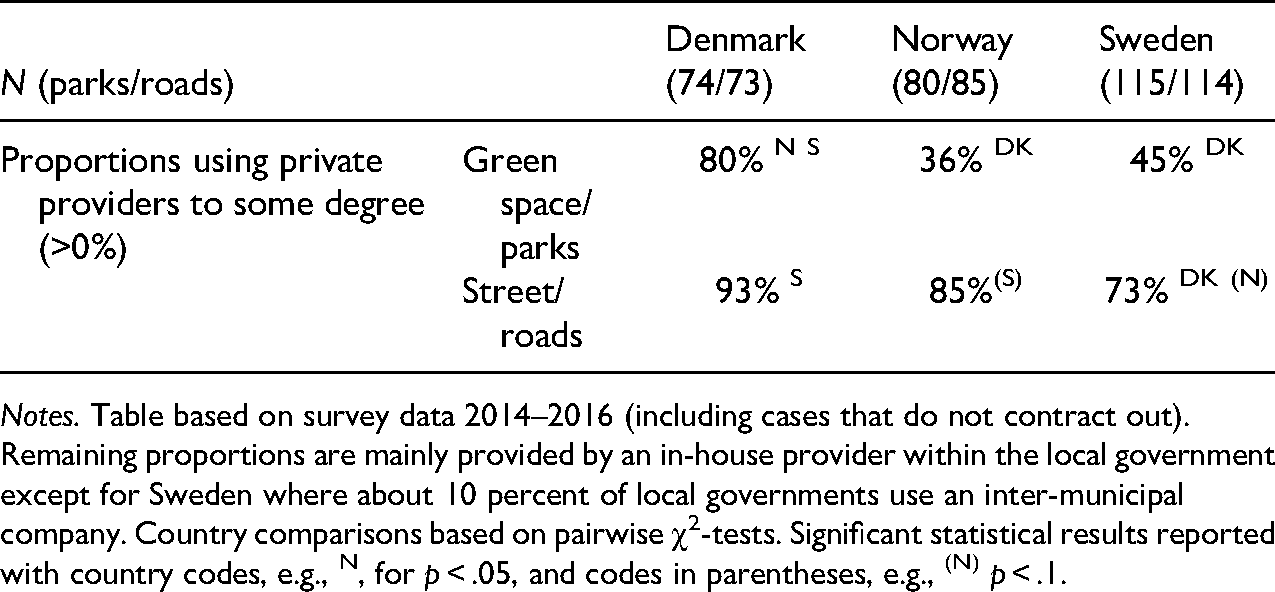
Notes. Table based on survey data 2014–2016 (including cases that do not contract out). Remaining proportions are mainly provided by an in-house provider within the local government except for Sweden where about 10 percent of local governments use an inter-municipal company. Country comparisons based on pairwise χ2-tests. Significant statistical results reported with country codes, e.g., N, for p < .05, and codes in parentheses, e.g., (N) p < .1.
Measurement Model
The study's measurement model includes 21 survey items. The items are used to construct and measure the study's main dependent (performance) and independent variables. Values for five variables based on multiple items are calculated with simple weighted averages to retain their interpretability in terms of the original response scales. In addition to survey-based items, the analysis includes three country dummy variables, a sector dummy, and a variable for local government size.
The study's dependent variables draw on four survey items that measure the respondent's satisfaction with private provider performance in terms of criteria for service quality, price/cost levels, responsiveness toward addressing issues and deficiencies, and development and innovation of services. The study uses the items separately and in combination as an index. Items measure a respondent's level of satisfaction on an 11-point bipolar numeric scale with the end anchors 0 = ‘very unsatisfied’ and 10 = ‘very satisfied.’ Scores above (below) the scale mid-point (5) indicate greater (dis-)satisfaction with private provider performance.
The study's independent variables draw on survey items measuring competitive environment (single item), formal contract features (eight items), the overall quality of relationships with private providers (four items), and the internal contract management capacity (four items). The items are measured with an 11-point unipolar numeric scale with the end anchors 0 = ‘not at all’ and 10 = ‘in a very high degree.’
The variable for competitive environment is based on a single item. The item reflects classical economic reasoning on competition (Abbott 1955) and contestability (Baumol 1982), and measures the strength of the competitive environment in which ongoing contract-based exchanges take place in terms of the relative ease of switching to an alternative. Higher scores indicate the presence of a more competitive environment. Four items for ‘standard’ and four items for ‘partnership’ features measure two key dimensions of commonly used maintenance contracts within park and road services (Lindholst 2009). Higher scores indicate a greater reliance on formal contract features for organizing and coordinating behaviors within the relationship. The variable for the (collaborative) quality of relationship is based on four items. Item formulations reflect core content of relational governance and are adapted from earlier research (Cannon, Achrol and Gundlach 2000). Lower scores indicate more adversarial relationships while higher scores indicate the presence of more supportive collaborative relationships. The variable for contract management capacity is based on four survey items. The items reflect a generic understanding of management capacity (Ingraham, Joyce and Donahue 2003) and refer to internal organizational features such as ‘systems,’ ‘methods,’ ‘procedures,’ ‘expertise’ and ‘time’ for managing contracts. Higher scores indicate the presence of greater internal contract management capacity.
The study uses a variable for local government size (number of inhabitants) as a proxy variable for urban complexity. The variable is based on register-based data (inhabitants) collected from national statistical bureaus.
Finally, the study includes a control variable for service context (park or road services). Two-hundred and twenty-five cases in the sample provide data for all items. Table 3 shows descriptive statistics for all included variables. Appendix A provides additional details on item formulations.
Descriptive Statistics.
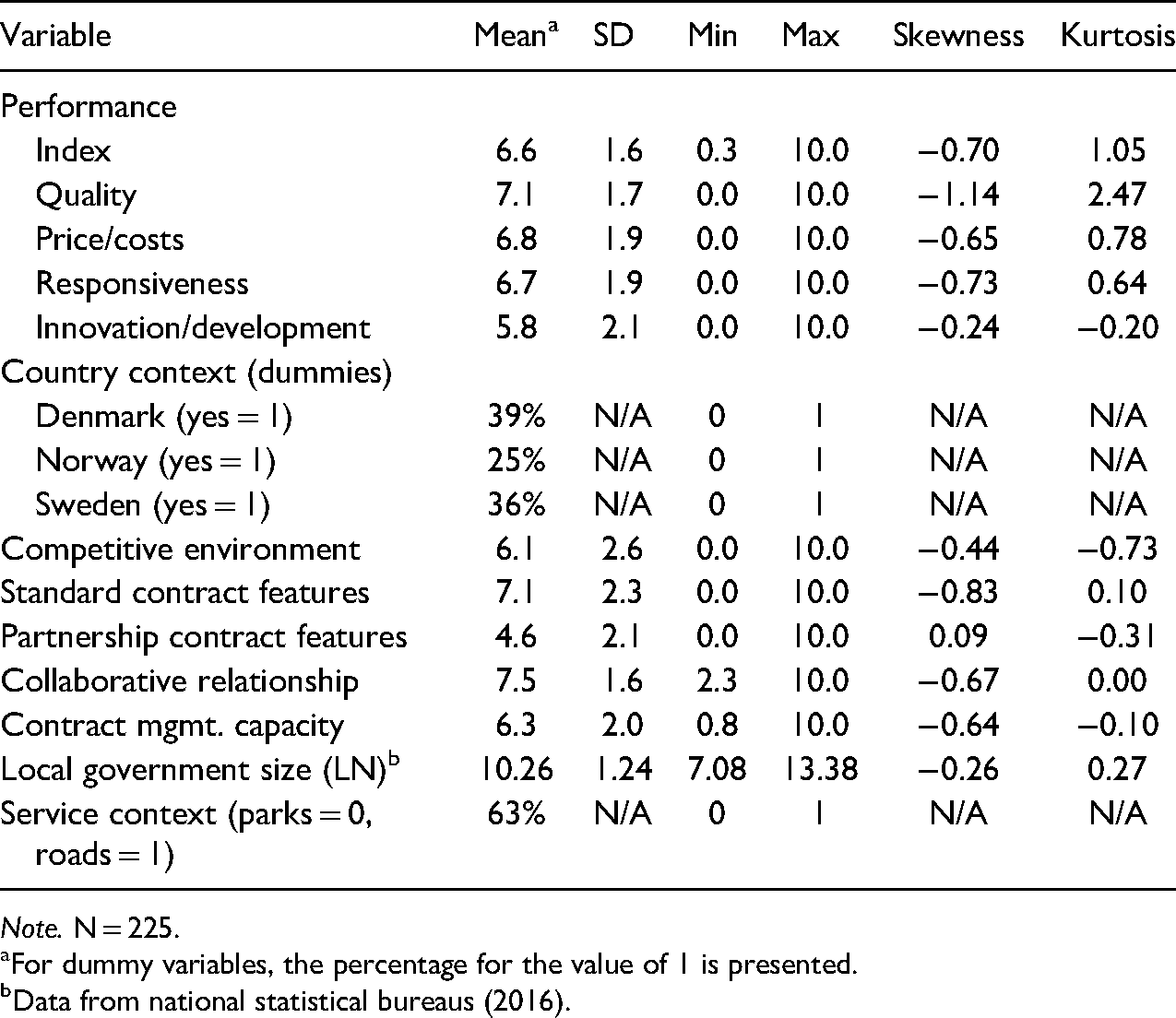
Note. N = 225.
For dummy variables, the percentage for the value of 1 is presented.
Data from national statistical bureaus (2016).
Validity Checks
A number of statistical ex post analyses were conducted to certify that the study relies on sound survey data and a valid measurement model. First, the data were checked for potential non-response bias based on guidelines offered by Armstrong and Overton (1977). The check tested differences in data from the groups of the early third and the late third respondents for each country with independent samples t-tests. Across 63 comparisons, the tests found no statistical significant differences at the .05 p-level and less than a handful of significant but unsystematically distributed (i.e., for different items) differences at the .10 p-level. Based on Armstrong and Overton's idea that late respondents resemble non-respondents, the check suggests that any substantial and systematic differences between respondents and non-respondents are unlikely to be present.
Second, construct validity of the survey-based part of the measurement model was assessed with principal component analysis (PCA). PCA allows for ex post assessment of content validity, uni-dimensionality, and convergent and discriminant validity of variables, i.e., the PCA checks whether items are associated with the variables that they are intended to (Hair et al. 2018). The PCA was carried out in a ‘confirmatory’ mode with the number of extracted components fixed to equal the number of survey-based variables in the measurement model (i.e., six) and with direct oblimin rotation to reflect the realistic assumption of substantial associations (i.e., correlations) between variables. The PCA shows that the six extracted components account for a satisfactory amount–72 percent–of the total variance among the 21 survey items with the first component (performance) accounting for 32 percent. The PCA returns a rotated solution with high primary loadings (>.7) for all but three items (still with acceptable loadings >.4) on their expected components and no troublesome or relatively large secondary loadings (>.3) on other components. Overall, the results from the PCA are indicative of good construct validity. Reliability scores (Cronbach's Alpha) for index-based variables ranging from .74 to .87 are indicative of good internal consistency and support the results from the PCA. Appendix A provides additional details for the PCA and reliabilities.
Third, social desirability bias is likely to influence the study if local managers provided answers in accordance with personal and/or organizational interests and/or socially accepted norms. The design and administration of the survey with full anonymity should ideally reduce the risk for social desirability bias. The risk was checked ex ante in a test where a dummy variable for whether the local manager relies on in-house provision (coded ‘1’) or not (coded ‘0’)–a variable indicative of the presence of any organizational interests–is added to the study's regression model. The test found the estimate to be statistically insignificant (−.27, p = .221) and the inclusion did not result in any substantial change for other estimates. Thus, social desirability bias should be–if present–limited in the study.
Finally, the risk for bias due to the presence of any common method variance (e.g., inflated or deflated estimates) was assessed against simulation-based guidelines offered by Fuller et al. (2016). Together, the size of reliabilities, the number of validated variables, the amount of variance explained by the first component in the PCA, and the correlations among components (ranging from .06 to .51 equal to shared variances ranging from .004 to .26) suggest that any substantial bias due to common method variance is unlikely.
Results
The descriptive statistics reported in Table 3 indicate that local managers generally appear satisfied with private provider performance in terms of quality, price/costs and responsiveness of maintenance services related to local parks and roads. The average scores range from 5.8 to 7.1 on the scale, where zero equals very high dissatisfaction and ten equals very high satisfaction, and they are well above the scale midpoint of five, where scores above (below) are indicative of more (dis-)satisfactory performance evaluations. One-sample t-tests (details not shown) for Scandinavia (n = 225) and for each country find that all differences between the average performance scores and the scale midpoint are statistically significant (p < .01). Thus, the study finds empirical support for the hypothesis (H1) that local managers in Scandinavia on the average are more satisfied than dissatisfied with private provider performance. However, standard deviations for each performance criteria, ranging from 1.6 to 2.1, are indicative of substantial variations.
Boxplots in Figure 1 illustrate these variations for each country based on the index variable for private provider performance. The main variations are rather similar in the three countries, with the majority of scores in the upper range of the scale from around 6 to 8. In Sweden and Norway, however, there are also a few deviating cases with very low scores, indicative of a more extreme dissatisfaction. In addition, the boxplots illustrate (by the lower whiskers) that a notable minority of local managers are more dissatisfied than satisfied. Clearly, market-centered models for maintenance do not work equally well for all. An additional comparison of country differences between local managers’ satisfaction with the individual performance criteria finds that differences between all scorings are insignificant except for price/costs (at p-level .01, ANOVA with post hoc test). Danish managers’ score for price/cost levels are respectively 0.90 and 0.88 higher than their Norwegian and Swedish colleagues’ scores. Overall, the substantial variations emphasize the importance of addressing the contingencies under which market-centered models work relatively well.
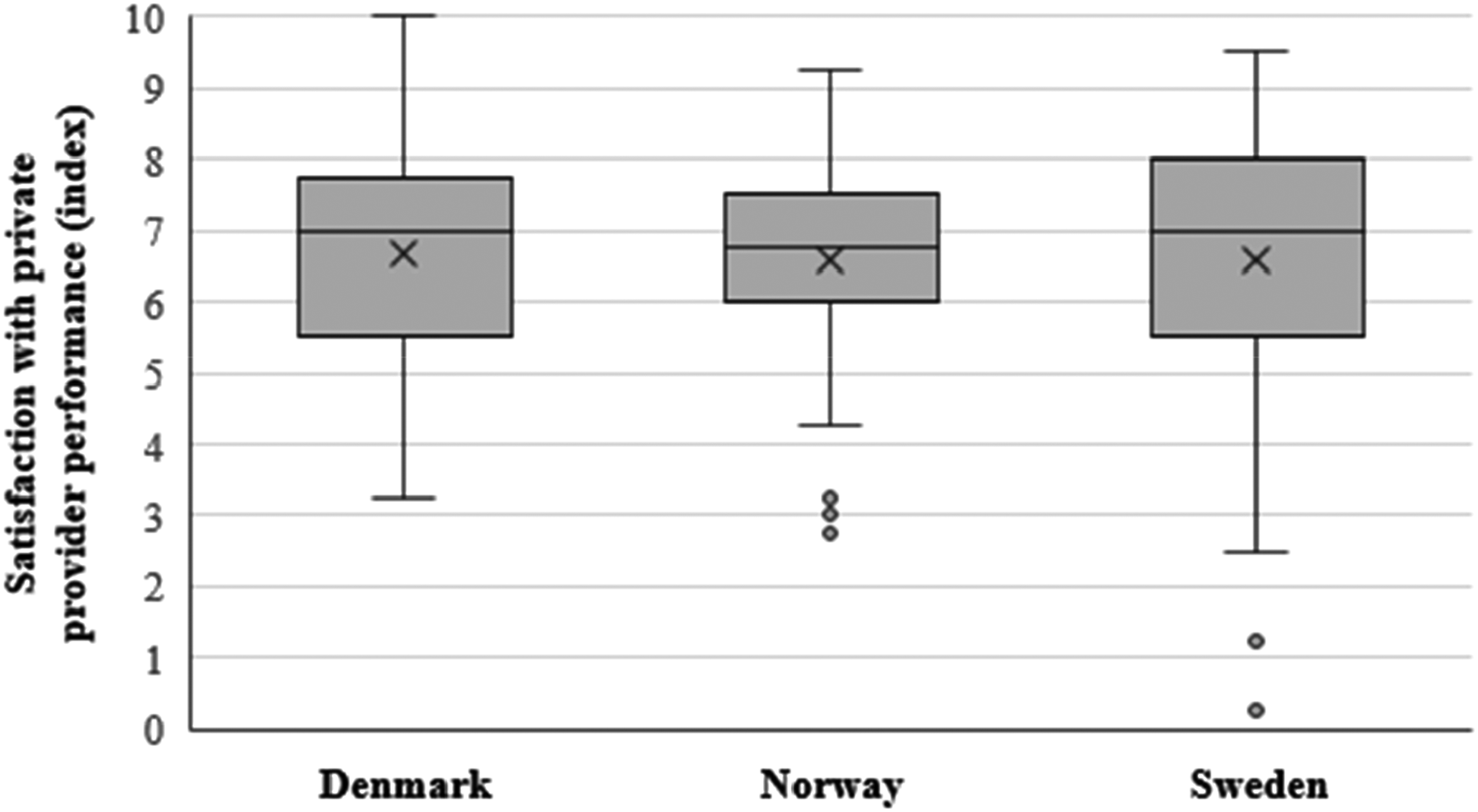
Boxplots of managers’ satisfaction with private providers’ performance of public space maintenance in three Scandinavian countries. Notes. N = 225. Satisfaction with performance measured on an eleven-point numeric response scale where ‘0’ = very dissatisfied and ‘10’ = very satisfied. Average scores marked by a cross.
Next, country differences and possible explanations for variations in satisfaction with private provider performance are tested through a multiple regression analysis. Table 4 shows the results from five ordinary lest square (OLS) regression models (1–5) that evaluate the importance of key contingencies for local governments’ satisfaction with private provider performance against criteria for quality, price/costs, responsiveness, innovation/development, and the aggregated performance index. All models are significant (F-tests, p < .01) and explain a substantial share of the variance in satisfaction with private provider performance with values for adjusted R2 ranging from 30 percent to 48 percent. Values for variance inflation factors (VIF) are low (i.e., <2) and indicate that multi-collinearity is not a concern. A check of the main results’ robustness against a regression model with stratified (by country) bootstrapping of standard errors, p-values, and 90 percent confidence intervals finds similar results (see supplementary materials).
OLS Regression Analysis of Private Provider Performance (Unstandardized beta-Coefficients, Standard Errors and p-Levels).
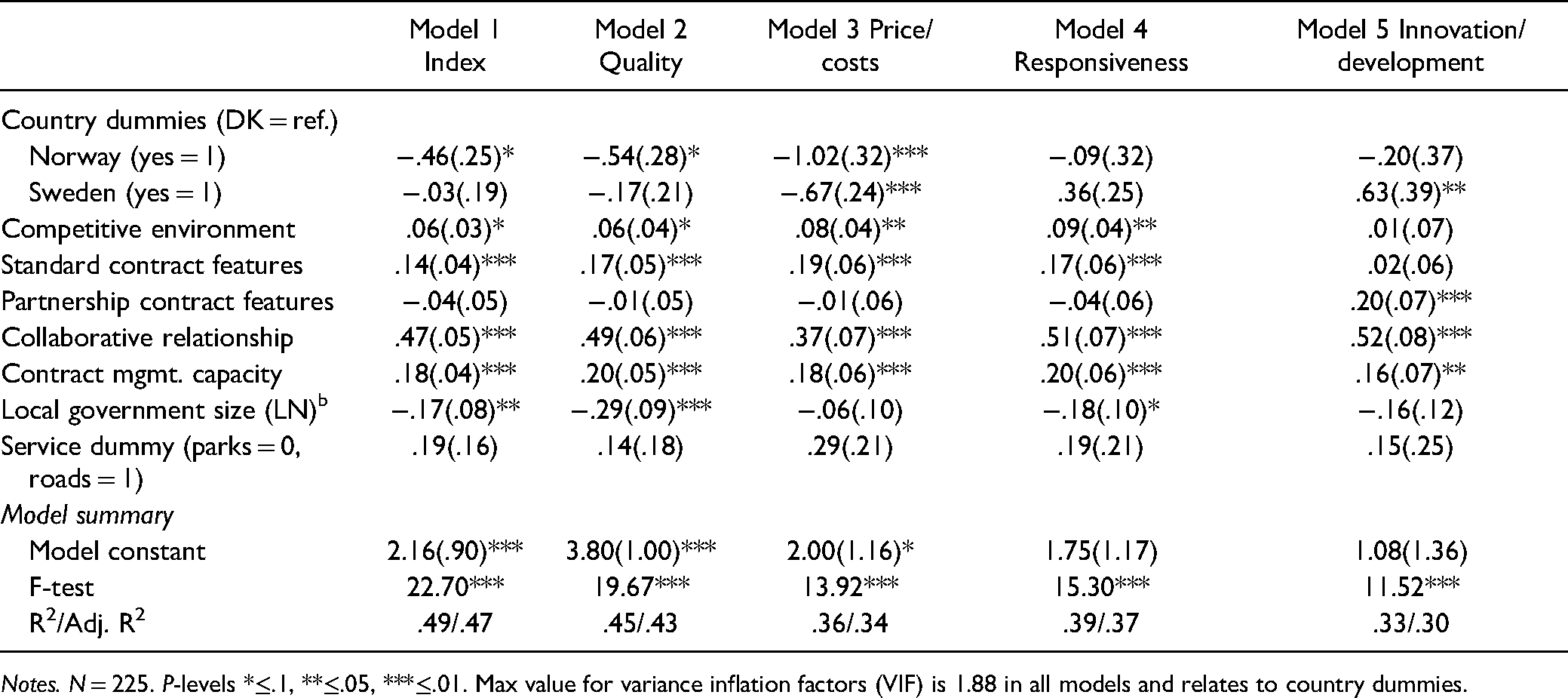
Notes. N = 225. P-levels *≤.1, **≤.05, ***≤.01. Max value for variance inflation factors (VIF) is 1.88 in all models and relates to country dummies.
Overall, the main results from the regression analysis shown in Table 4 corroborate most of the study's theoretical arguments and hypotheses (H2–H8) on the importance of country context, competition, standard and partnership contract features, relationship quality, contract management capacities and urban complexities for (explaining) variations in local managers’ satisfaction with private provider's performance of maintenance services against key criteria. Interestingly, the results differ slightly across the models for individual performance criteria (Model 2–5) and for the three countries, which provides for some nuances and unexpected results.
First, there are important differences related to country context. The differences in the satisfaction with price due to the Norwegian and Swedish country context compared to the Danish are respectively −1.03 and −.67 (p < .01). The difference between the Danish and Norwegian country context is also statistically significant for quality (−.54, p < .1). In contrast to the main argument, however, the country context of Sweden is found to be positively associated with higher satisfaction with development and innovation in comparison with the Danish country context (.63, p < .01). These findings point forward to a more complex association between country context and private provider performance across different country contexts. Second, emphasis on partnership contract features is not important (p > .1) for differences in satisfaction for three out of four specific performance criteria. Still, partnership features are found to be positively associated (.20, p < .01) with their most relevant performance criterion–innovation and development of services–a criterion for which standard contract features is found to be unimportant (p > .1). Standard contract features are positively associated with the three first performance criteria (p < .01). Third, larger local governments, compared to smaller, is associated with lower overall satisfaction (−.17, p < .05) and with regard to quality (−.29, p < .01) and responsiveness (−.18, p < .10). The logarithmic scale indicates that the association is more pronounced for differences between relatively smaller local governments.
Finally, the study checks for whether the main results for the importance of contingencies are similar at the country level. For this purpose, the regression analysis in Model 1 was fitted with interaction terms between country dummies and each of the variables that test the hypothesized associations with performance (see supplemental materials). The test found that all interaction terms were statistically insignificant at p-level .10 except for standard contract features (p = .09). Subsequent analysis found that the difference between the coefficients for Sweden and Norway is statistically significant at p-level .05 and the difference between the coefficients for Denmark and Norway is close to significant at p-level .10 (p = .107) in the main analysis and statistically significant (p = .088) in the robustness check. Figure 2 illustrates further the differences and reports significance test for the country specific coefficients (simple slope tests).
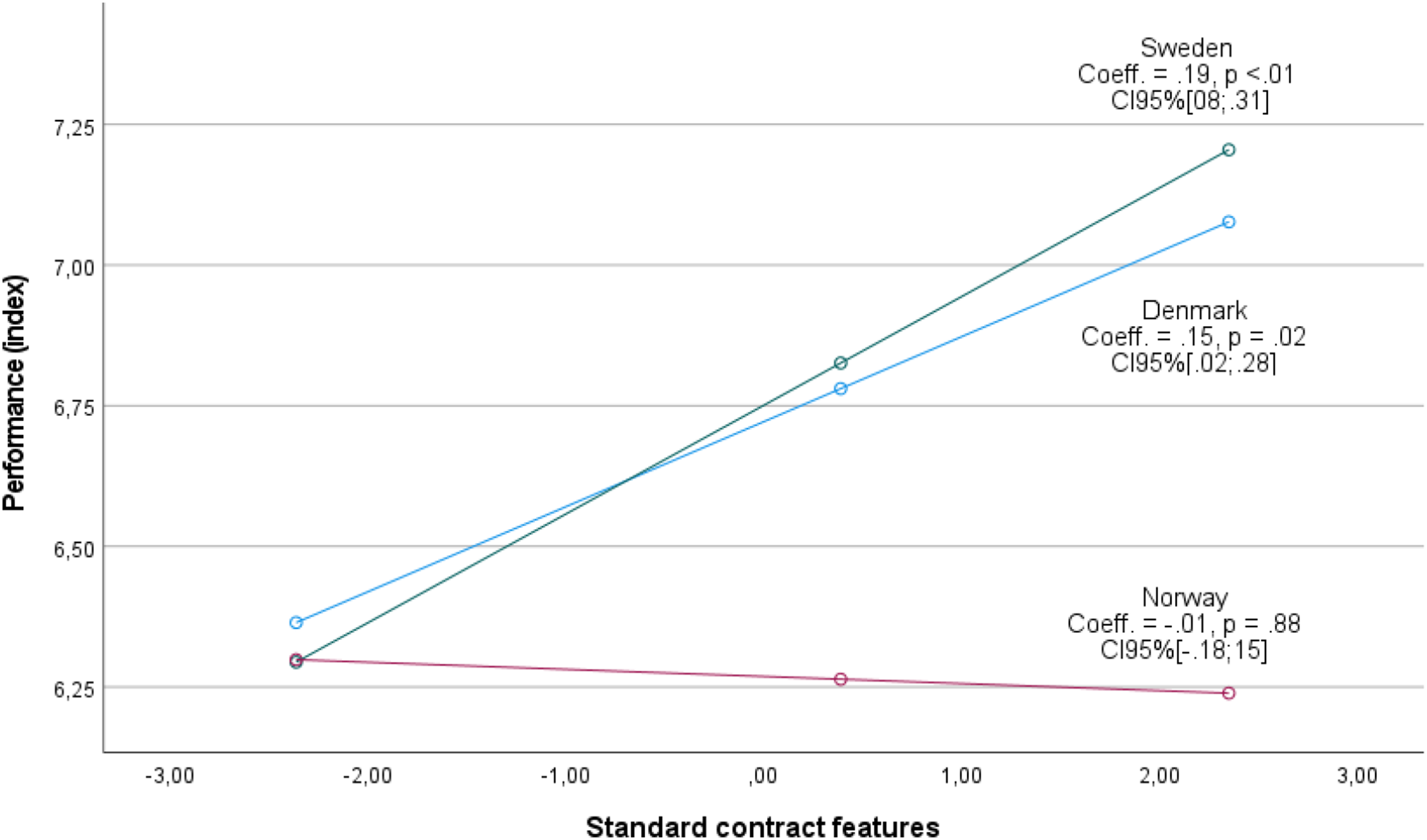
Estimated country moderation of the association between standard contract features and performance. Notes. N = 225. P-levels * ≤.1, ** ≤.05, *** ≤.01. Model summary R2 = .50, F(11, 213) = 19.25***. Significance test of interaction term for country and standard contract features (mean centered): F(2, 213) = 2.39, p = .09. ΔR2 = .011. Differences at increasing levels of standard contract features probed at the 16th (low), 50th (median) and 84th (high) percentile: Statistically significant differences found for DK-Norway at the median (−.51**) and high level (−.84**) and for Sweden-Norway at the median (−.56**) and high level (−.97***).
Overall, the results suggest that the hypothesized contingencies are not necessarily of equal importance for different performance criteria, nor do they work in accordance with general theory across different country contexts. Table 5 summarizes the empirical support for the hypothesized contingencies (H2–H8).
Summary of Empirical Support From Regression Analysis (Hypotheses H2 – H8).
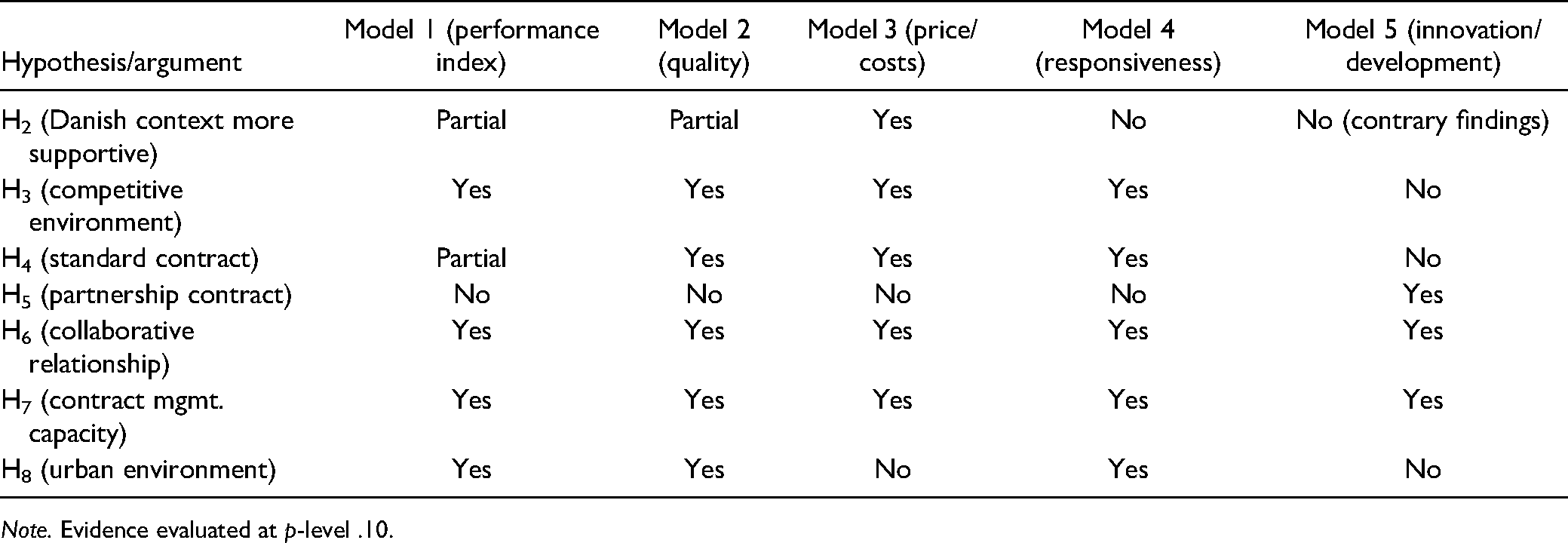
Note. Evidence evaluated at p-level .10.
Principal component analysis (PCA): Survey items and loadings
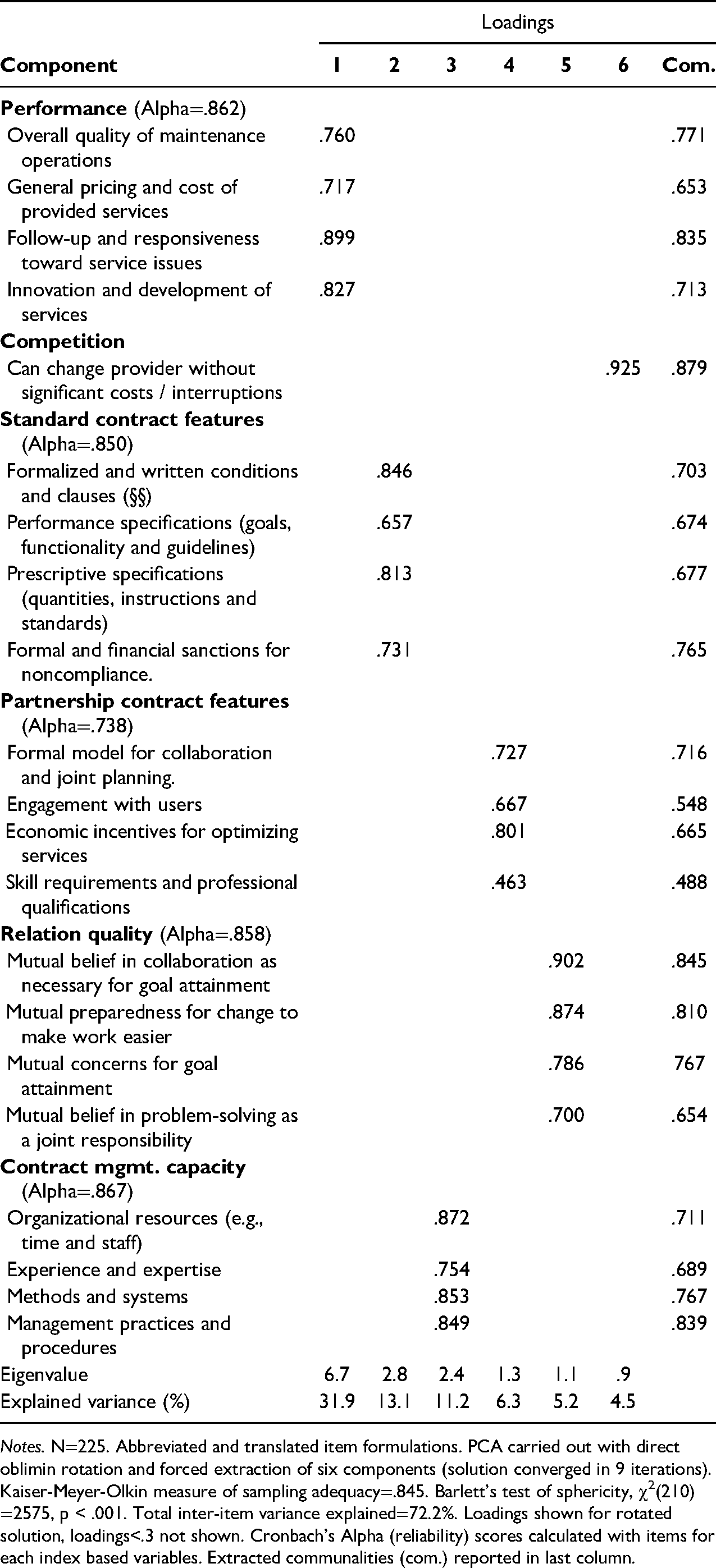
Notes. N=225. Abbreviated and translated item formulations. PCA carried out with direct oblimin rotation and forced extraction of six components (solution converged in 9 iterations). Kaiser-Meyer-Olkin measure of sampling adequacy=.845. Barlett's test of sphericity, χ2(210)=2575, p < .001. Total inter-item variance explained=72.2%. Loadings shown for rotated solution, loadings<.3 not shown. Cronbach's Alpha (reliability) scores calculated with items for each index based variables. Extracted communalities (com.) reported in last column.
Conclusions and Discussions
Market-centered management models represent one alternative for organizing responsibilities for the maintenance of public spaces in urban environments (Carmona, De Magalhães and Hammond 2008; Randrup, Lindholst and Dempsey 2020; Lindholst 2009). However, past evidence, discussions in the literature and wider developments in the public sector have increasingly contested the status of market-centered models within public space management and beyond. Overall, this study finds a widespread use of private providers across local governments in Scandinavia and a majority of local managers appears satisfied–rather than dissatisfied–with private provider performance of public space maintenance. Consequently, the study's results run counter to arguments and findings purporting a more contested status of market-centered models and return some leeway to earlier pro-market arguments and policies. However, the results come with some important amendments and reservations, and raise new discussions.
The study's main results suggest that the Scandinavian countries–on the balance–have adopted a relatively successful reform approach to the use of market-centered models for public space maintenance. The approach is characterized by incrementalism and pragmatism combined with a substantial delegation of autonomy to the local government level and retention of a strong, but reformed, government bureaucracy. This contrasts more radical approaches tried out earlier in Anglo-Saxon countries (e.g., Christensen and Lægreid 2011; Jones 2000) and also reflects the idea of a widespread pragmatism (rather than ideology) among local governments in their choice of service delivery arrangements (e.g., Clifton et al. 2019; Kim and Warner 2016). The results also contribute to discussions of whether local services are witnessing a historical movement toward state-centered models after years with reforms promoting market-centered models (e.g., Wollmann, Koprić and Marcou 2016). Although the study does not rely on longitudinal data, the findings are indicative of a strong entrenchment of market-centered models within public space management rather than a possible movement back to state-centered models. In perspective, these findings contribute to discussions about the merits of different reform types (e.g., Christensen and Lægreid 2017) by suggesting that some segments exist in the public sector where the core ideas from the NPM work out well, and more wholesale dismissals of the NPM are thus unwarranted.
The study adopts a contextualized contingency approach to the contested status of market-centered models and expands on the specific contingencies for the competition prescription in the context of public space management in Scandinavia. Findings suggest that differences in competition, different types of contract features, collaborative relations, internal capacities, and urban and national contexts help explain the relative success of local governments’ use of market-centered models. Thus, the study integrates and corroborates various arguments and findings from the existing literature. In particular, the study demonstrates the benefits of integrating several arguments related to national, urban and managerial contingencies. These arguments include–among other–economic reasoning (e.g., Baumol 1982; Vining and Weimer 2007), contract design (e.g. Lindholst 2009; Schepker et al. 2014), sociological reasoning (e.g., Macneil 1980), administrative-organizational reasoning (e.g., Kettl 1993, 2010), arguments on the role of urban environments (De Magalhães and Carmona 2006; Warner 2006), and comparative perspectives (e.g., Kuhlmann and Wollmann 2019). These arguments are furthermore expanding on the contingencies defining the circumstances under which the competition prescription performs relatively better (or worse).
In a comparative perspective (e.g., Kuhlmann and Wollmann 2019), the study corroborates the idea that the territorial and administrative structure in a country is important for the performance of market-centered models. The study also highlights that the importance of contingencies are likely to differ to some degree across country contexts. First, the study provides substance to the proposition that a more scattered, fragmented and unattractive market structure (represented by Norway) moderates the effectiveness of standard contract features for managing exchange relations. This insight warrants new comparative research that evaluates whether the contingencies, such as the use of contracts, for effective use of the competition prescription work in similar or dissimilar ways across different country contexts. However, the partly unexpected and diverging results for the Swedish country context are surprising and bring attention to needs for developing contextual arguments further. One speculation is that the Swedish context is more similar to the Danish than initially argued. The findings also present a puzzle of why the Swedish context is associated with a comparatively higher satisfaction with private providers’ development and innovation of public spaces. Second, the study questions the prospect of generalizing core propositions without careful consideration of contingencies and their possible interplay within different country contexts.
The study corroborates classical ideas of the importance of competition and contestability for performance of market-based exchange (e.g., Abbott 1955; Baumol 1982). This result diverges in part from other studies that suggest a limited or even negative role of competition (e.g., Fernandez 2009; Lamothe and Lamothe 2010). The divergence brings attention to the different ways local governments can harness competition for improving performance. This study suggests that a competitive environment that allows for less burdensome provider shifts in case of failure–in contrast to a routine use of competitive tendering that may upset existing well-performing exchange relations–is important for better performance.
The literature highlights that formal contracts can be designed differently, allocate risks in different ways and serve multiple functions and purposes within an exchange-relation (e.g., Lindholst 2009; Marques and Berg 2011; Schepker et al. 2014; Vincent-Jones 2007). This study contributes with empirical insights on the importance of formal contracts for performance and how different contract dimensions work within exchange relations. One interpretation of the results for the relative importance of respectively standard and partnership features for different performance criteria is that they are able to serve different purposes depending on local governments’ wider strategic objectives. Reliance on standard features appears to serve objectives related to technical efficiency (quality and price/costs), while partnership features serve objectives related to allocative efficiency (development and innovation). Thus the study provides some empirical support for hopes raised for partnership-based approaches in the literature (e.g., Dempsey and Burton 2012; Jones 2000; Vincent-Jones 2007). However, one limitation of this study for the judgment of partnership-based approaches is that these often encompass broader strategic and social objectives beyond the four performance criteria adopted in this study (e.g., Dempsey, Martínez Velarde and Burton 2020). In addition, the support for the importance of formal partnership features can be discussed in conjunction with the support for the importance of the collaborative quality of relations, as partnership-based models are commonly defined as a collaborative endeavor (e.g., Donahue and Zeckhauser 2012). In this respect, the study shows that the informal side of partnerships–a working relationship based on a collaborative spirit–is a key contingency. Relevant to this discussion, the descriptive statistics (see Table 2) show that reliance on partnership contract features appears relatively low compared to the level of collaborative quality of relations and the reliance on standard contract features. This is indicative of an overall complementary approach in Scandinavia, where a strong reliance on standard contract features is embedded within exchange relations characterized by a collaborative spirit. Thus the reliance on standard contract features in Scandinavia appears to be embedded in exchange relations where there is less need for the contract's function as a safeguard, and where the contract's primary function can be expected to be related to planning and coordination of activities. The study's findings for the importance of a collaborative quality of relationships for performance are furthermore congruent with sociological theories of contracts (e.g., Macneil 1980; Vincent-Jones 2000) and findings in earlier research (e.g., Amirkhanyan, Kim and Lambright 2010; Fernandez 2009). The findings for Norway–where reliance on standard contract features appears unimportant for satisfaction with private provider performance–is a more extreme illustration of the relevance of sociological arguments.
The study corroborates arguments in the literature that emphasize the importance of contract management capacity (e.g., Amirkhanyan, Kim and Lambright 2014; Kettl 1993; 2010; Van Slyke 2003). Thus the study further validates the importance of administrative-organizational contingencies. The study, however, draws on a generic concept of management competency and it would be of interest to explore further which particular managerial instruments (i.e., contingencies) competent managers rely upon for ensuring the performance of private providers.
Finally, the study finds empirical support for a negative association between local government size–as a measure for urban complexity–and satisfaction with private providers’ performance. Thus, the study supports the literature (e.g., Warner 2006) suggesting that urban complexities are detrimental to the performance of market-centered models. It would be of interest to explore further whether some models, such as partnerships (e.g., Dempsey and Burton 2012; Donahue and Zeckhauser 2012), are better suited to mitigating the challenges of more complex urban environments.
The study's findings offer guidance on how local governments can improve their returns from adopting market-centered models for organizing maintenance of public spaces. From a managerial perspective, the empirical support for the focal contingencies indicates prospective areas for development of managerial skills and the importance of investing in internal capacities. Rather than shifting to other alternatives, local governments could assess local circumstances and address key contingencies that determine the relative outcomes of using different types of market-centered management models, and seek to develop their expertise accordingly.
Limitations and Future Research
The number of available cases for analysis limits the study's statistical power in some parts. In particular, the lower n for Norway (56 cases) increases the risk of missing smaller but still substantial effects (i.e., type II errors). Thus, studies with higher n for subgroups are required to detect whether smaller effects are present and provide more certainty for empirical support.
The study relies on perceptual data from a single stakeholder to measure otherwise hard to measure variables and enable country comparison. One critique is that perceptual data are likely to be prone to several biases, and their validity relies critically on sound application of methods in particular in a study's design phase and the alignment of a study's purpose with respondents’ interest and competencies (Podsakoff, MacKenzie and Podsakoff 2012). However, it is important to note that perceptions–such as managers’ satisfaction with price and quality–inform local government decisions about who provides local services (e.g., Warner and Aldag 2019). Thus, gauging the perceptions of local managers is key for understanding dynamics in how service provision is organized. The perceptions of other key stakeholders, e.g., citizens, politicians and experts, are equally relevant in complementary accounts. Similarly, other sources, e.g., register-based accounts, might return different or complementary results (e.g., Amirkhanyan, Kim and Lambright 2014), and these are likely to be more valid for some research (e.g., comparisons of in-house and private providers) where social desirability bias can be expected to be more influential or the respondents’ yardstick for assessment differs (e.g., Andrews et al. 2010).
The study takes place in the specific context of public space maintenance and findings may–with some caution–be extended to other services with similar characteristics, e.g., relative ease of specification and monitoring. Whether the study's findings are generalizable to services with more dissimilar characteristics is speculative. However, the study relies and expands on theoretical arguments that are more parsimonious and finds empirical support for these within the context of public space maintenance services in Scandinavia. Thus the study provides a contextualized empirical validation of and extension to existing arguments on the contingencies for the competition prescription (e.g., Amirkhanyan, Kim and Lambright 2007; Brown, Potoski and Van Slyke 2006; Dehoog 1990).
In perspective, the study highlights several avenues for future research. Notably, the study warrants a contingency perspective on the performance of market-centered models corresponding to multiple national, managerial, and urban conditions and contextual characteristics. This also supports general calls for understanding organizational choices in regional governance by directing attention to context (Feiock 2007). The study highlights the prospects for advancing research by exploring the importance of country context further. One option would be to undertake replications to validate performance and contingencies within similar or dissimilar service and/or country contexts. The choice of dissimilar legal-institutional contexts with similar territorial and administrative structures could test the importance of neo-institutional arguments (e.g., Williamson 2000) on the importance of “higher-order” institutions (e.g., legal frameworks) or different “administrative traditions” (e.g., Kuhlmann and Wollmann 2019) for the effectiveness of lower-order institutions (e.g., contract-based exchange) and the performance of different market-centered models. Overall, the study highlights the relevance of context-sensitive scrutiny of the performance of different types of market-centered models and careful generalization and application of theory and arguments across country contexts.
Supplemental Material
sj-docx-1-uar-10.1177_10780874211042544 - Supplemental material for Long Live Marketization for Local Public Spaces: A Study of Scandinavian Managers’ Satisfaction with Private Provider Performance
Supplemental material, sj-docx-1-uar-10.1177_10780874211042544 for Long Live Marketization for Local Public Spaces: A Study of Scandinavian Managers’ Satisfaction with Private Provider Performance by Andrej Christian Lindholst in Urban Affairs Review
Footnotes
Acknowledgments
The author is thankful for comments and support from Thomas Barfoed Randrup, Morten Balle Hansen, Ylva Noren Bretzer, Merethe Dotterud Leiren, and Nicola Dempsey, and from colleagues at the Center for Organization, Management and Administration, Aalborg University.
Declaration of Conflicting Interests
The author declared no potential conflicts of interest with respect to the research, authorship, and/or publication of this article.
Funding
The author disclosed receipt of the following financial support for the research, authorship, and/or publication of this article: This work was supported by the Aalborg University (AAU) and Det danske Hedeselskab.

Supplemental Material
Supplemental material for this article is available online.
Author Biography
References
Supplementary Material
Please find the following supplemental material available below.
For Open Access articles published under a Creative Commons License, all supplemental material carries the same license as the article it is associated with.
For non-Open Access articles published, all supplemental material carries a non-exclusive license, and permission requests for re-use of supplemental material or any part of supplemental material shall be sent directly to the copyright owner as specified in the copyright notice associated with the article.
