







Abstract
Based on representative bureaucracy theory, the current study investigates whether increasing Black representation in police forces is negatively associated with racial discrimination in law enforcement. This study additionally investigates how associations may differ according to the organizational or environmental contexts of the forces. Results show that an increased share of Black officers is associated with decreased police-involved deaths of Black residents, but is not significantly associated with a change in order maintenance arrests of Black suspects. In addition, the negative association between Black representation and police-involved deaths of Black residents disappears when the percent of Black officers surpasses about 15 percent, especially in organizations where White officers comprise a larger share. These findings support the potential negative role of organizational socialization on the effectiveness of increasing the share of Black officers in policing, implying that additional long-term efforts to change organizational culture are needed to realize the benefits of enhancing Black representation.
Keywords
Introduction
The police force's discriminatory treatment toward Black residents has long been a significant social issue in the U.S. (Gaston 2019; Holmes, Painter II and Smith 2019). There is substantial empirical evidence showing that Black people are more likely than White people to be stopped-and-frisked and to be arrested for minor offenses (Cooley et al. 2020; Gelman, Fagan and Kiss 2007). The issue of discriminatory policing has become more publicly salient over the last few years following several high-profile police-involved deaths of Black residents.
Several policy proposals have been put forward to address the issue of racial discrimination by the police force. In addition to traditional accountability policies that have been adopted by many police agencies, such as civilian oversight of police misconduct and community policing strategies (Walker and Archbold 2019; Worden and McLean 2017), various new police reform policies have been proposed. This has been especially the case following the death of Michael Brown in 2014 and the resulting Black Lives Matter (BLM) movement. These new police reform movements include the adoption of police Body-Worn Cameras (BWCs), implementation of police training programs aiming at reducing conflictual police-citizen encounters (e.g. de-escalation trainings), revisions to use of force departmental policies, and repeals of qualified immunity (i.e. revising legislation that limits the liability of police officers sued for civil rights violations).
Among these diverse policy proposals, a policy that has received significant scholarly and political attention as a way to eliminate institutionalized racial bias within police organizations is to increase the share of Black officers in police forces. This reform reflects the critique that police forces have historically been dominated by White males (Ba et al. 2021). In particular, the benefits of enhancing racial representation have been discussed in terms of representative bureaucracy theory. Representative bureaucracy theory suggests that enhanced minority composition of a public bureaucracy would be linked to more equitable policy outcomes for minority residents (Sowa and Selden 2003; Meier, Wrinkle and Polinard 1999). This theory, therefore, predicts that police agencies with a higher minority representation would commit fewer discriminatory policing activities (Hong 2017; Nicholson-Crotty, Nicholson-Crotty and Fernandez 2017; Sharp 2014).
Despite the predictions of representative bureaucracy theory, empirical evidence concerning the link between increased racial representation in the police force and discriminatory policing activities is inconclusive. While several studies have demonstrated a positive association between increased shares of Black officers and decreased use of force by police (Ba et al. 2021; Headley 2021; Willits and Nowacki 2014), some studies found no significant association (Donahue III and Levitt 2001; Sharp 2014). In addition, some studies have found that increased racial representation is in fact positively associated with harsher law enforcement toward Black residents (Ochs 2011; Wilkins and Williams 2008). Given these mixed previous findings, more empirical evidence is necessary to understand the circumstances in which increased racial representation in the police force promotes fair law enforcement outcomes toward racial minority residents.
In this regard, the current study aims to examine how changes in the proportion of Black officers in local U.S. police agencies from 2007 to 2016 impacted police-involved deaths and order maintenance arrests of Black residents. This study makes contributions to the literature of representative bureaucracy in two ways. First, this study examines two different law enforcement outcomes (police use of deadly force and order maintenance arrests) simultaneously, which allows for exploration of whether the passive-active link of racial representation is revealed differently according to the type of police behavior. Since police-involved death is a rare outcome and occurs in unusual circumstances (Headley and Wright II 2020), the examination of an additional law enforcement outcome such as arrest may help elucidate the role of racial representation in the broader context of police-public encounters.
More importantly, this study contributes to the literature by examining whether and how the association between Black representation and policing outcomes differs according to the organizational and environmental contexts of the police agencies. Recently, representative bureaucracy scholars suggested the importance of examining interactive effects of racial representation with contextual variables in order to understand the conditions in which enhancing racial representation is effective (Meier 2019; Headley 2021). In this regard, the current study explores whether agencies that are more likely to have a strong traditional police culture (i.e. those having a bigger size or a larger share of White officers) show a weaker influence of Black representation. This study also explores whether police agencies that are more likely to have tenuous relationships with the communities (i.e. those serving communities with higher crime rates or more racially heterogeneous populations) benefit more from increased Black representation.
The next section describes the theory of representative bureaucracy and summarizes empirical evidence on the link between race-based passive and active representation in policing. The recent status of racial diversity in police forces and relevant governmental actions aiming to enhance racial diversity will be discussed, followed by explanations of the data, research methods, and results of the analysis used in this study.
Police Reform and Increasing Black Representation in the Police Force
Police accountability policies have received substantial scholarly and political attention, because of a long history of discriminatory policing in the U.S. (Beck and Blumstein 2018; Cooper 2015; Gaston 2019; Gelman, Fagan and Kiss 2007; Goel, Rao and Shroff 2016; Grogger and Ridgeway 2006; Epp, Maynard-Moody and Haider-Markel 2014). Traditional policies proposed to increase police force accountability include establishing citizen oversight (e.g. creation of civilian review board), allowing intervention of the federal government in local police agency operations (e.g. authority of the Department of Justice to investigate civil rights violations), and setting internal departmental rules for the use of force (Worden and McLean 2017). Although empirical evidence has generally shown mixed results about the effectiveness of these traditional policies for enhancing police accountability, recent studies have demonstrated that their effectiveness can manifest differently according to the contexts of the policies or the organizations. For example, studies examining civilian review boards found that boards have different levels of authority in different police agencies, and such differences matter for their effectiveness on controlling police misconduct (Headley 2021; Ali and Pirog 2019; Ali and Nicholson-Crotty 2021). Scholars have also shown that the effectiveness of departmental use of force policies in reducing officers’ use of force is evident when such policies strictly regulate those conditions in which officers can use force (Terrill and Paoline III 2017; Worden and McLean 2017).
The recent occurrences of publicly salient high-profile police-involved deaths of Black residents and resulting BLM movements have led to a “new conversation about policing and police reform” (Engel, McManus and Herold 2020a; Engel, McManus and Isaza 2020b, 722; Walker 2018). A diverse set of policies have been proposed and implemented that aim to more directly control police officers’ decisions to use deadly force. In this regard, examining the effectiveness of these policies has become a major subject of recent literature on policing. The effectiveness of these policies has not yet been clearly determined, in part because of conflicting results and the need for more evidence. For example, a frequently examined police reform policy in recent years is the adoption of police BWCs. By recording police-public encounters, BWCs are expected to improve transparency and accountability of police decision-making on the street (Pyo 2022; Police Executive Research Forum 2018). Several empirical studies supported the effectiveness of BWCs for decreasing both police use of force and citizen complaints against the police (Ariel, Farrar and Sutherland 2015; Braga et al. 2017; Jennings, Lynch and Fridell 2015; Hedberg, Katz and Choate 2017). However, there is also evidence suggesting an insignificant effect of BWCs on police use of force (Ariel 2016; Headley, Guerette and Shariati 2017; Peterson et al. 2018; Yokum, Ravishankar and Coppock 2019).
Another recent reform proposal considered by many police agencies is the implementation of de-escalation training (Robinson 2020). De-escalation training generally aims to develop police tactics that require officers to use verbal or non-verbal communication skills during encounters with the potential for escalation, in order to reduce conflictual or aggressive behavior (Engel, McManus and Herold 2020a; Engel, McManus and Isaza 2020b; Goh 2021). A handful of studies have examined the effectiveness of de-escalation training on reducing police use of force, but results have been inconclusive (Engel, McManus and Herold 2020a; Engel, McManus and Isaza 2020b; Goh 2021; McLean et al. 2020).
Among the policy proposals under scholarly scrutiny, one of the most frequently recommended policy alternatives for reducing discriminatory policing is to increase the share of racial minority officers within police forces (Ba et al. 2021; Smith 2003; Stokes 1997). Police forces have been criticized for being dominated by White males, and this has been suggested to be a major cause of the troubled relationship between the police and racial minority communities (Ashkenas and Park 2015). Increasing racial diversity within police forces is particularly meaningful not only because it may help to change a cultural tolerance for discriminatory activities formed by the dominant organizational members, but also because of potential broader implications of enhancing equity in police force responses toward racial minorities (Headley 2021).
The benefits of increasing racial diversity in bureaucracies have been actively examined through the lens of representative bureaucracy theory. Representative bureaucracy theory suggests that public bureaucracies representing the demographic characteristics of the populations they serve produce equitable policy outcomes for minority groups of people (Hong 2016, 13). Many existing representative bureaucracy studies have focused on exploring the link between passive and active representation by examining whether bureaucracies with increased minority representation implement policies in favor of minority residents in diverse policy areas. In the area of policing, therefore, an increased share of minority officers in police forces would be expected to reduce discriminatory policing activities against minority residents, and consequently would be expected to help improve relationships between the police and minority communities (Frank et al. 1996; Dulaney 1996; Barlow and Barlow 2018).
Scholars have suggested several mechanisms to explain why the positive link between passive representation (i.e. increased share of minority officers) and active representation (i.e. reduced discriminatory policing activities) occurs in policing. First, minority officers are likely to have empathy for minority residents based on their shared experiences and perspectives as members of a minority group, leading them to advocate for fair law enforcement (Bradbury and Kellough 2008; Nicholson-Crotty, Nicholson-Crotty and Fernandez 2017). Second, minority residents are more likely to trust and demonstrate respectful attitudes toward minority police officers, thus reducing the likelihood that their encounters with the officers become confrontational (Riccucci, Van Ryzin and Jackson 2018). Third, some scholars have suggested that an increased number of minority officers would lead to their increased collective voice within the organization, resulting in an organizational atmospheric shift toward condemning discriminatory operations against minority residents (Hong 2016).
Despite the expected positive influence of increased shares of minority officers, however, empirical evidence on its influence has been inconclusive (Smith and Holmes 2014; Nicholson-Crotty, Nicholson-Crotty and Fernandez 2017; Donahue III and Levitt 2001; Ochs 2011; Sharp 2014; Wilkins and Williams 2008). Contrary to what the theory would predict, some studies even found that increased racial representation may increase the disparity in law enforcement outcomes toward minority residents. For example, Ochs (2011) showed that, as the percentage of Black officers increases within the police force, the incidence of police-involved deaths of Black residents increases. Similarly, Wilkins and Williams (2008) showed that an increased proportion of Black officers is positively associated with a racial disparity in vehicle stops.
One potential reason explaining why increased racial representation in police forces can be linked to harsher law enforcement practices toward minority residents is the influence of organizational socialization. Organizational socialization exerts a substantial influence on the behaviors of an organization's members (Carroll, Wright and Meier 2019). Police forces are considered to have organizational cultures shaped by the characteristics of police work such as “uncertainty, danger, and coercive authority” (Paoline III, Myers and Worden 2000; Roscigno and Preito-Hodge 2021). As police officers must cope with uncertain and dangerous environments in their everyday work, they tend to endorse aggressive and strict law enforcement as a protective mechanism for their own safety (Paoline III, Myers and Worden 2000). In addition, the coercive authority police officers can have over citizens leads to isolation from the citizens, and as a result, police may emphasize the value of solidarity and loyalty to other officers (Peterson and Uhnoo 2012). As solidarity and loyalty are highly valued within police organizations, police officers are under strong pressure to behave in accordance with their colleagues (Wilkins and Williams 2008, 656). Minority police officers who are socialized within this organizational context, therefore, tend to place their loyalty to the dominant organizational goal, which encourages behaviors such as strict law enforcement, over potential individual interests of advocating for minority residents.
Considering the effect of organizational socialization, it is possible that minority officers enforce laws against minority residents even more harshly than non-minority officers do, in order to avoid suspicion from their peers that they are more lenient toward minority residents (Alex 1969). Scholars have further suggested that the influence of organizational socialization may lead officers to commit wrongdoings (Stinson, Todak and Dodge 2015; Stinson et al. 2018; Kane and White 2013; Wood, Roithmayr and Papachristos 2019), which can also partly explain potential discriminatory treatment by minority police officers against minority residents.
Because of the substantial influence of organizational socialization on minority bureaucrats, representative bureaucracy scholars have suggested the importance of critical mass for linking passive and active representation (Nicholson-Crotty, Nicholson-Crotty and Fernandez 2017). Critical mass refers to a certain percentage of minority composition within the organization that is sufficient for the minority bureaucrats to become active advocates for the preferences of minority clients (Nicholson-Crotty, Nicholson-Crotty and Fernandez 2017). A sufficiently large number of minority bureaucrats within the organization empowers those bureaucrats to resist the pressure of organizational socialization, and in turn can allow them to behave as representative agents of minority clients. Nicholson-Crotty, Nicholson-Crotty and Fernandez (2017) provided empirical evidence showing that an increased share of Black officers is positively associated with the number of police-involved deaths of Black residents when the proportion of Black officers within the force is relatively small; however, once the percentage of Black officers reaches a certain point (about 35–40 percent), the number of police-involved deaths of Black residents decreases as the percentage of Black officers increases.
Another reason explaining why minority officers may treat minority residents in a harsh way is because minority officers may have substantially different perspectives about the nature of police work than minority residents. It is possible that Black officers who wanted to become police officers in the first place have different views than other Black residents about appropriate responses of police officers toward Black suspects (Pew Research Center 2017; Braddock II et al. 2020). In other words, Black individuals applying to police forces may be more likely to accept strict policing practices against minority residents; meanwhile, individuals who are likely to challenge or deviate from those practices may not apply to join police forces.
Previous studies, as discussed above, provide valuable evidence regarding the link of passive and active racial representation in policing. However, despite the important role of institutional factors such as organizational socialization and critical mass, their impact on the passive-active link of racial representation has not been sufficiently examined in policing. More importantly, while scholars of representative bureaucracy have argued that organizational socialization mitigates the positive effect of enhancing Black representation (e.g. Wilkins and Williams 2008), they have not examined how the influence of organizational socialization manifests differently across agencies with different organizational characteristics. This subject is particularly important given that policing literature suggests that police culture can differ across agencies (Paoline III, Myers and Worden 2000; Paoline III 2003). More empirical studies are needed to improve our knowledge regarding the implications of increasing racial representation in policing.
Policy Movements for Enhancing Racial Representation in U.S. Police Forces
Despite significant political attention on the value of increasing racial diversity in police forces, many police agencies have not been successful in diversifying their forces to better reflect the racial compositions of the communities they serve. Studies have suggested several limitations in diversifying police forces (Ho 2005; Kringen and Kringen 2015). First, barriers exist in officer hiring processes that may effectively screen out some minority applicants. For example, police agencies perform several tests on applicants who have met the entry requirements, including personal interviews, psychological evaluations, and written tests. Several studies have found that Black applicants are disproportionally screened out during the processes of criminal record checks or background investigations (Kringen and Kringen 2015; Matthies, Keller and Lim 2012; but see Ho 2005).
A second reason for the lack of minority officers is the relatively small number of minority applicants, which has become more relevant in recent years. A great number of racial/ethnic minority people harbor feelings of hostility toward the police, discouraging them from pursuing a career in law enforcement (Gabbidon, Penn and Richards 2003; Waters et al. 2007). Recent high-profile police-involved deaths of Black residents further demotivate young Black people from pursuing police careers (Gibbs 2019). As a response, some police agencies changed hiring standards which had previously disproportionately screened out minority applicants. For example, several large police agencies (e.g. Philadelphia PD, Louisville Metro PD, Memphis PD) that originally required college degrees for applying for jobs changed their standard and now require applicants to have a high school diploma or equivalent (Allyn 2016; Collins and Pane 2016; Detling 2018).
Federal efforts have been made to address the issue of low racial diversity within police forces. Most recently, the Task Force on 21st Century Policing established by President Obama recommended that police organizations increase the number of minority police officers in order to improve police-minority relationships. In this regard, in 2016 the U.S. Department of Justice (DOJ) and the Equal Employment Opportunity Commission (EEOC) jointly launched a research initiative called “Advancing Diversity in Law Enforcement” (DOJ and EEOC 2016). In their report, several useful practices were suggested to improve racial diversity in law enforcement in three areas: recruitment, hiring, and retention (DOJ and EEOC 2016).
The report suggested that in the recruitment process, proactive outreach efforts should be made to target minority candidates (see also Matthies, Keller and Lim 2012). Examples of such efforts might include holding hiring workshops in cooperation with community-based organizations and creating internship programs to partner with local educational institutions. For the hiring process, the report recommended eradicating selection practices considered discriminatory against minority candidates, such as the exclusion of applicants with criminal conviction records or without U.S. citizenship. Finally, the report recommended practices to help minority officers feel accepted by the organization in order to improve retention of minority officers. Such practices might include assigning mentors to minority police recruits and preparing financial or welfare benefits that target the needs of minority officers. Considering these efforts to emphasize the importance of enhancing racial diversity in the police force, it is important to explore whether there have been actual changes in the share of minority officers in U.S. police agencies, and if so, how such changes have affected racial disparities in law enforcement.
Hypotheses
In order to explore the passive-active link of racial representation in police forces, this study examines two law enforcement outcomes: police-involved deaths and order maintenance arrests of Black residents. Scholars have suggested that the link between passive and active representation occurs when the bureaucrats in question have discretion in implementing policies for which results are salient to minority groups. The aforementioned two outcomes satisfy these conditions (Lim 2006; Nicholson-Crotty, Nicholson-Crotty and Fernandez 2017; Sharp 2014). First, there is no doubt that racial disparities in police-involved deaths are a major concern in Black communities, given that these disparities have triggered active BLM movements (Dunham and Petersen 2017). In addition, police officers’ decisions to use deadly force are made without direct supervision; those decisions are thus based on officers’ own interpretations about the situations and offenders, making such decisions highly discretionary (Nicholson-Crotty, Nicholson-Crotty and Fernandez 2017).
Second, order maintenance policing of Black residents has also been cited as a major source of police-related racial discrimination. Order maintenance policing refers to a police strategy to reduce crime which specifically targets minor street offenses (Bass 2001); this strategy often manifests as an active use of stop-and-frisk and zero tolerance policing against minor offenses (Schulhofer, Tyler and Huq 2011). Stop-and-frisks and arrests have been often used as outcomes to measure the degree to which a given police agency conducts order maintenance policing. However, the data for stop-and-frisk practices are not readily available for most U.S. local police departments (Sharp 2014). For this reason, the current study uses only the frequency of arrests as the main outcome for order maintenance offenses.
Representative bureaucracy theory predicts that police forces with a higher share of racial minority officers will commit fewer discriminatory policing practices against minority residents. Given these predictions, the current study examines the below hypotheses for two law enforcement outcomes:
Organizational Context: Organizational Socialization and Critical Mass
Research has shown that organizational factors matter for the translation of passive representation into active representation (Andrews et al. 2016; Lim 2006). Two organizational factors have been most often considered in the context of representative bureaucracy in policing: organizational socialization and critical mass (Wilkins and Williams 2008; Nicholson-Crotty, Nicholson-Crotty and Fernandez 2017).
As explained above, police forces have a unique organizational culture that emphasizes “cohesion and solidarity” among members (Wilkins and Williams 2008, 656). Despite these well-known characteristics of police cultures, literature on policing has suggested that police culture is not “monolithic,” but rather, varies across agencies (Paoline III, Myers and Worden 2000, 585). Several studies have also suggested that the strength of the influence of police culture on officers may vary according to organizational characteristics of police forces (Cordner 2017; Silver et al. 2017). In this regard, the current study considers two organizational characteristics that are relevant to the strength of the influence of organizational culture. First, Silver et al. (2017) found that departmental size plays a significant role in influencing officers’ agreement with traditional police culture (e.g. agreement that strict law enforcement is a more important police duty than order-maintenance or service, and that loyalty to their fellow officers is critical). Larger departments have more “complex, bureaucratic, and hierarchical” characteristics and emphasize more formal and strict aspects of police work compared to smaller departments (Silver et al. 2017, 1277; Brooks 2010; Maguire 2003). Therefore, police officers in bigger police departments are more likely to endorse traditional police culture than officers in smaller departments. This suggests that minority police officers working in larger agencies can be under stronger pressure to behave in accordance with traditional organizational missions, preventing them from pursuing advocacy on behalf of minority residents. Therefore, it is expected that the positive link of passive and active representation may be weaker in larger agencies.
Second, it is anticipated that the pressure to stick to organizational missions is stronger in agencies with a larger share of White officers, who have traditionally been the dominant group within police agencies. Historical evidence suggests that White police officers reacted negatively to Black police officers entering departments after the civil rights era (Dulaney 1996; Leinen 1984). Therefore, Black officers surrounded by a larger group of White colleagues may be reluctant to draw attention to their identity as a racial minority, which prevents them from defending and advocating for Black residents (Bolton Jr. and Feagin 2004). Thus, the association between an increased share of Black officers and decreased discriminatory policing outcomes is not likely to be seen clearly in agencies with a larger share of White officers.
The strong influence of organizational socialization is one reason to consider the role of critical mass in the link between passive and active representation (Nicholson-Crotty, Nicholson-Crotty and Fernandez 2017). This suggests the importance of considering the interplay of critical mass and organizational socialization when examining the association between passive and active representation. The phenomenon of critical mass is expected to have a stronger effect in organizations characterized as having relatively weak organizational socialization. While representative bureaucracy literature has suggested the importance of critical mass and organizational socialization individually, few studies have considered how the effect of critical mass manifests differently among the agencies with different degrees of organizational socialization. To address this gap, the current study hypothesizes that agencies expected to have relatively weak organizational socialization (i.e. those having a smaller departmental size or a smaller share of White officers) will demonstrate the positive effect of critical mass of the percent of Black officers more eminently.
Environmental Context: Communities with Social Disadvantages
The current study additionally examines how the link of passive and active racial representation in policing may occur differently depending on environmental characteristics. Scholars have demonstrated that police departments serving communities with higher crime rates or higher racial diversity have frailer relationships with minority residents compared to their counterparts (La Vigne, Fontaine and Dwivedi 2017; Weitzer and Tuch 2004; Weitzer, Tuch and Skogan 2008). Therefore, it is expected that the benefits of enhanced racial representation as a means to reduce discriminatory policing may be demonstrated more clearly in communities with higher levels of distrust between the police and minority residents. Given this, the current study considers the moderating effect of two community characteristics: proportion of racial minorities and crime rates. It is hypothesized that the positive association between passive and active representation will be more clearly revealed in communities with a larger share of minority residents or those with higher crime rates.
Data and Methods
The current study examines the hypotheses suggested in the previous section using panel data for 2007, 2013, and 2016 collected from 326 U.S. local police agencies. The unit of analysis is agency-year. This study uses several sources of administrative data, including 2007, 2013, and 2016 Law Enforcement Management and Administration Survey (LEMAS), 2016 LEMAS Body-Worn Camera Supplement (LEMAS-BWCS), and arrest data provided by the Uniform Crime Reporting (UCR) system. Local police agencies that had records in all of these datasets were selected as the final sample.
Dependent Variables
Two dependent variables are used for the current study. The first variable is the number of police-involved deaths of Black residents that occurred in a given year in a given police agency. As explained in the analytic method section below, the count of police-involved deaths is standardized by municipal Black population in the count regression model. Given that no reliable administrative data exist on police-involved deaths, I collected the data for this variable from the website of Fatal Encounters. 1 Fatal Encounters is a non-profit organization that advocates to enhance the quality of data on police-involved deaths. Fatal Encounters relies on diverse methods to collect data on police-involved deaths, including using paid researchers, public record requests, and crowd-sourced data (Fatal Encounters 2019). In addition, Fatal Encounters data include records of police-involved deaths since 2000. Because of these advantageous features of Fatal Encounters data, an increasing number of studies have used this data in recent years (e.g. Edwards, Esposito and Lee 2018; Jennings and Rubado 2017).
The second dependent variable is the number of Black arrests for low-level offenses categorized as order maintenance offenses in a given year in a given police agency. The current study refers to the study by Sharp (2014) to identify order maintenance offenses including drunkenness, liquor law violations, disorderly conduct, vagrancy, suspicion, curfew or loitering law violations, and runaways. The data on the number of arrests by race of offenders and by type of offenses were collected from the UCR data managed by the Federal Bureau of Investigations.
Independent Variable
The sole independent variable is racial representation of Black officers in a given year and in a given police agency. Kennedy (2014) argued that representative bureaucracy scholars used several different techniques to measure racial representation of public bureaucrats, including raw percentages (Meier 1993) and representation ratios (Selden 1997). Nicholson-Crotty, Nicholson-Crotty and Fernandez (2017, 210) suggested that the raw percentage is theoretically the best measurement for examining active representation because “active representation is stimulated by shared experiences between the bureaucrat and the client and not by the make up of the bureaucracy relative to society as a whole.” Because of this, many studies have used the raw percentage of racial minority officers to measure racial representation (e.g. Hong 2020; Nicholson-Crotty, Nicholson-Crotty and Fernandez 2017; Sharp 2014; Wilkins and Williams 2008). Given these, the current study used the percentage of Black officers to measure Black representation in the police force, and also included its square term to analyze the effect of critical mass. However, as a sensitivity analysis, the ratio of Black representation was also examined to assess whether the main result substantially differed from that which used the raw percentage. The data on the number of police officers by race was collected from 2007, 2013, and 2016 LEMAS data.
Moderating Variables
As described in the hypotheses section, the current study explores how the relationship between the share of Black officers and two policing outcomes changes according to two organizational characteristics (departmental size and the percent of White officers) and two environmental characteristics (the percent of racial minorities and crime rate). The departmental size is measured by the number of full-time sworn officers in each agency in each year, and the percent of White officers is the absolute share of White officers in each agency in each year. For indicating aforementioned environmental characteristics, I used the percent of the population that was non-White in each jurisdiction of the agency in each year, and the violent crime rates. These moderating variables are used as controls when they are not used as moderators, except for the percent of White officers which is excluded because of collinearity. 2
Control Variables
Referring to previous studies on the determinants of policing outcomes, I included two groups of time-varying control variables, which represent organizational and environmental characteristics of the police agencies (Nowacki 2015; Willits and Nowacki 2014; Chappell, MacDonald and Manz 2006; Eitle, Stolzenberg and D'Alessio 2005; Smith 1984; Hickman and Piquero 2009). With regard to the organizational characteristics, I first considered agency-level police reform practices aimed at controlling police discretionary decision-making and enhancing police accountability. Three reform practices are included in the analyses: BWC implementation, reform agreements between the DOJ and a given agency, and the adoption of community-oriented policing (COP) strategies. The data for most variables representing organizational characteristics were collected from LEMAS.
Police BWCs represent an important type of reform policy, which aims at controlling police behavior during police-public encounters. Although empirical evidence about the effect of BWCs on officer behavior is inconclusive, several empirical studies have shown the potential significant influence of BWC implementation on police officers’ use of deadly force or arrest behaviors (Braga et al. 2017; Katz et al. 2014; Pyo 2021). The variable of BWC implementation is coded as 1 if the police agency implemented BWCs in a given year.
A variable indicating whether a given police agency entered into a reform agreement with the DOJ as a result of an investigation for civil rights violations is also included as a control variable. The Civil Rights Division of the DOJ investigates cases in which law enforcement officers potentially violate “constitutional or federal rights” (DOJ 2017, 3). Once the DOJ determines that a pattern of police misconduct exists, they seek a solution with the agency under investigation and enforce a reform agreement in either a court-enforced consent degree or a memorandum of agreement. The reform agreement often requires that changes be made in departmental policies or police practices, which in turn can influence officers’ law enforcement behaviors in the agencies subject to reform. The presence of a reform agreement is indicated with a dummy variable taking the value of 1 if a given police agency entered into a reform agreement with the DOJ between 2007 and 2016. The list of agencies entered into the reform agreement was collected from The Civil Rights Division's Pattern and Practice Police Reform Work: 1994-Present report, written by the DOJ. There are only five sample police agencies that had entered into reform agreements during the observation period: Seattle Police Department in Washington, Albuquerque Police Department in New Mexico, Suffolk County Police Department in New York, Cleveland Police Department in Ohio, and Newark Police Department in New Jersey.
The degree to which each agency implemented COP strategy is also considered. COP strategy was widely adopted by many police agencies as an effort to solve community safety problems in collaboration with community members, particularly during the 1980s and 1990s (Cordner 2014). Although it is a relatively old policy, recent increased attention on police killing incidents led scholars and politicians to seek fundamental changes to traditional police culture and practices, and consequently a focus on COP philosophy has re-emerged (Koslicki et al. 2021; Office of Community Oriented Policing Services 2015). COP aims to change the focus of police work from strict law enforcement to the provision of police services, and allows officers to have more intimate relationships with residents (Paoline III, Myers and Worden 2000; Jennings and Rubado 2017). In order to indicate the implementation of COP strategy, the current study used an additive index score based on the number of activities regarding community policing that agencies adopted, among the following four activities: 1) including community policing components in written mission statements, 2) encouraging officers to engage in SARA-type problem-solving projects, 3 3) assigning the same patrol officers to be responsible for a particular area or beat, 4) utilizing information from surveys of local residents. 4 Therefore, the variable indicating the adoption of COP strategy ranges from 0 to 4.
The other organizational factor considered in this study is police unionization. Police unions are important interest groups regarding the adoption of police reform policies (DeLord et al. 2008; Scheiber, Stockman and Goodman 2020). As police union groups often raise collective voices against departmental changes that influence police practices, their existence can have a substantial impact on the behavior of individual officers (Chappell, MacDonald and Manz 2006). In addition, the existence of police unions may influence officers to feel more confident using coercive force toward the public, as they may believe that the union will protect them from being punished after use of deadly force (Alpert and Dunham 1997; Alpert and MacDonald 2001). Police unionization is coded as 1 if the police agency authorizes collective bargaining for its officers.
Third, research shows that officer characteristics, such as race, gender, and education level, also have an influence on policing outcomes. For example, it has been suggested that police organizations with a relatively larger share of non-White officers, female officers, or officers with a high level of education are less likely to be involved in discriminatory policing activities (Spillar, Harrington and Wood 2000; McElvain and Kposowa 2008). Therefore, the current study includes the percent of racial minority officers (excluding Black officers), the percent of female officers, and a dummy variable indicating whether a given agency requires some college education for police applicants as control variables.
Fourth, I controlled for the number of police-involved deaths of White residents and the number of order maintenance arrests of White residents. These variables were included to control for possible variation among police agencies regarding their reliance on strong law enforcement tools regardless of the race of the people they encounter. To make sure that these two variables were pre-determined before changes in the independent variable (i.e. to avoid a post-treatment bias), one-year lagged values of these two variables are used.
Several environmental characteristics of police agencies are also included in the analyses. Past research has demonstrated that police agencies tend to use stricter law enforcement against Black residents if they serve disadvantaged communities (Jennings and Rubado 2017). For example, studies have shown that police officers serving communities that have a lower socioeconomic status (Terrill and Mastrofski 2002), a higher crime rate (Lawton 2007; Lee, Vaughn and Lim 2014; Terrill and Reisig 2003), and a larger racial minority population (Alpert and Dunham 2004) are more likely to use coercive force, compared to their counterparts. Therefore, the percentage of the population below the poverty level, the violent crime rate, and the percent of non-White residents are included as control variables (the latter two variables are included as control variables in the analyses when they are not used as moderators). The data for the variables indicating environmental characteristics were collected from Census.gov and UCR.
Analytic Method
The current study estimated the association between the share of Black police officers and law enforcement outcomes based on following equation:

There are two ways to analyze panel data: fixed-effects models and random-effects models. Both of these techniques are considered to control for the influence of unobserved characteristics of the study subjects (e.g. police agencies) on the outcome, but they are different in terms of how to address such influence. Random-effects models assume that variations in unobserved characteristics across subjects are normally distributed and are not correlated with the independent variables, and generate more efficient estimations than fixed-effects models (Torres-Reyna 2007). Fixed-effects models, on the other hand, allow for production of an unbiased estimate by focusing on examining time-variant variations within each subject (Torres-Reyna 2007). However, fixed-effects models remove all time-constant variations across subjects and do not work well when there is not enough variation in the outcome across time within each subject (Gormley n.d.). To select better estimation between random-effects and fixed-effects models for each outcome variable, Hausman tests were conducted. The results of Hausman tests showed that random-effects models were preferred for the outcome of police-involved deaths of Black residents (possibly because many sample agencies had zero outcomes during the observation period), while fixed-effects models were preferred for the outcome of order maintenance arrests of Black residents. δi in the above equation indicates unit-fixed effects and is only included in the fixed-effects analysis.
Given that the outcomes of this study are measured with the count of the event, all models were estimated with Poisson regression. Some may argue that a negative binomial regression would be more appropriate than a Poisson regression model when the outcome variable shows a pattern of overdispersion (see the descriptive statistics of the outcome variables presented in Table 1). However, studies have suggested that estimating negative binomial regression with unit-fixed effects can cause an incidental parameter problem, and thus are not recommended (Allison and Waterman 2002). Studies have also suggested that Poisson regression with robust standard error can efficiently address the issue of overdispersion (Cameron and Trivedi 2010). In the Poisson regression analysis, the number of Black population in a given year in a given municipality was included as an exposure variable, which allows interpretation of the result in terms of the occurrence rate of the outcome in reference to the total Black population.
Descriptive Statistics.
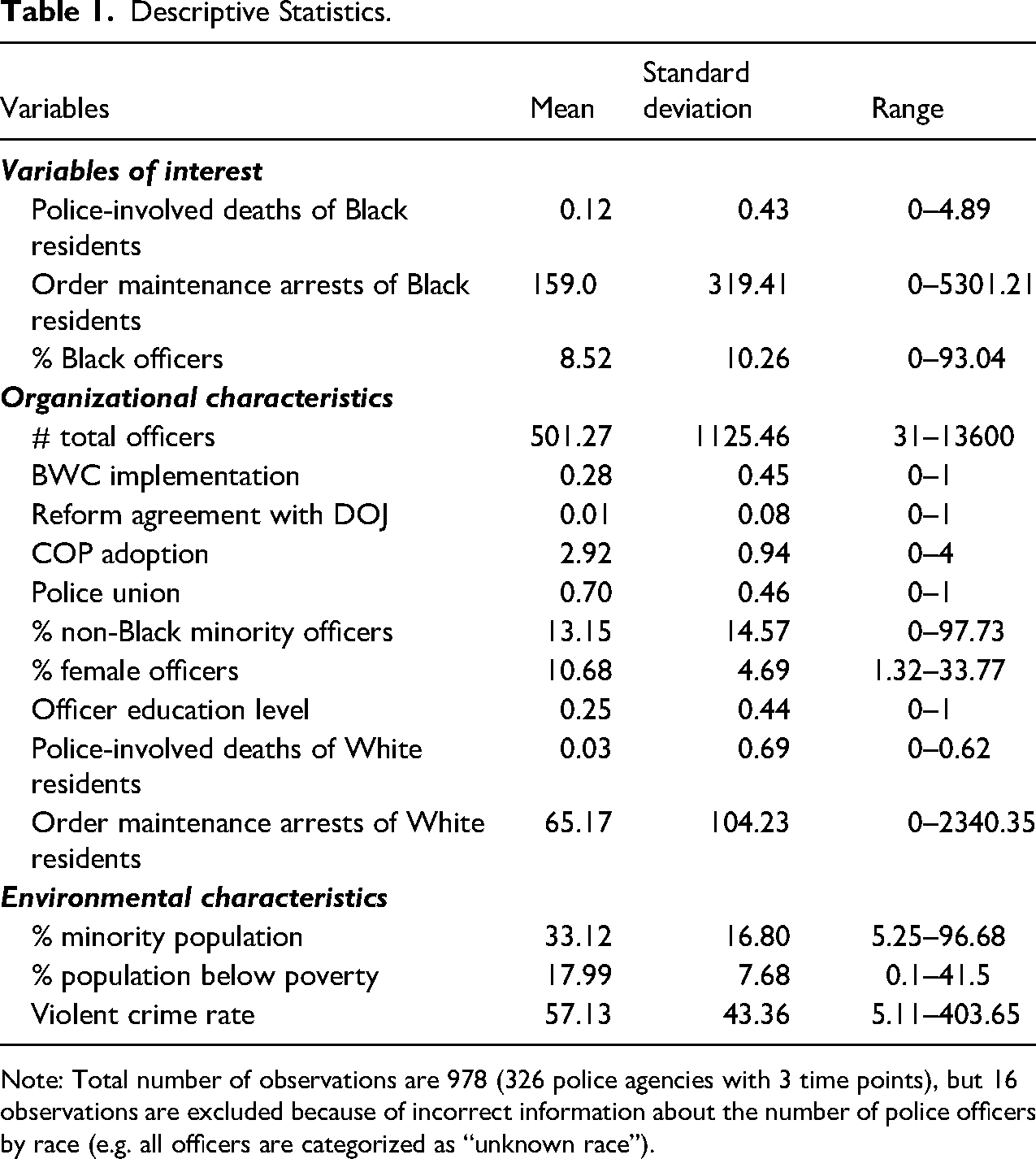
Note: Total number of observations are 978 (326 police agencies with 3 time points), but 16 observations are excluded because of incorrect information about the number of police officers by race (e.g. all officers are categorized as “unknown race”).
Result
Descriptive Statistics
The descriptive statistics of all variables used in the current study are presented in Table 1. It shows that the average number of police-involved deaths of Black people per 10,000 Black residents during the observation period (about 0.12) is much higher than that of White people per 10,000 White residents (about 0.03). Similarly, the average number of Black order maintenance arrests per 10,000 Black residents is more than 2 times larger than that of White order maintenance arrests per 10,000 White residents (e.g. 159 vs. 65.17).
The average percentage of Black officers was 8.52, which indicates underrepresentation of Black people in the police force among sample police agencies given that the average percentage of Black population is about 16 percent. In order to specifically evaluate changes in the percent of Black officers over time, I created a histogram that shows the distribution of the change in percent of Black officers across the sample police agencies. Figure 1 shows that the percent of Black officers changed only minorly in most sample agencies (mostly 0 percent to 5 percent), and almost half of the sample agencies (about 45 percent) even experienced a decrease in Black officers from 2007 to 2016. Further, the number of police agencies with a decrease in the percent of Black officers was larger during the period from 2013 to 2016 (170 agencies), compared to the period from 2007 to 2013 (147 agencies). This result may imply that the Michael Brown shooting in 2014 and resulting social movements to protest police use of force may have made it difficult for police agencies to hire or retain Black police officers.
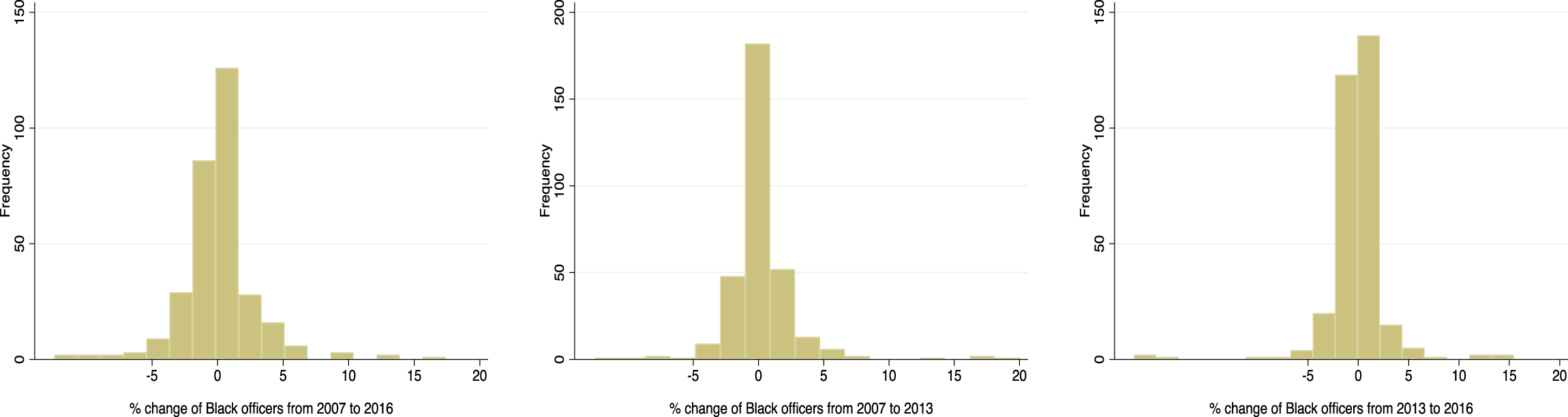
Distribution of the changes in the percent of Black officers from 2007 to 2016.
Main Result
I first analyzed the association between the percent of Black officers and police-involved deaths of Black residents, and the results are presented in Models 1 and 2 of Table 2. Model 1 is the result of the basic analysis without considering the quadratic term of the percent of Black officers; it shows that the estimated rate ratio of the percent of Black officers is 0.979 and is statistically significant at 95 percent significance level. In the result of Poisson regressions, an estimated rate ratio that is smaller than 1 suggests a negative association. Therefore, using the estimate of 0.979, it can be inferred that one unit increase in the percentage of Black officers is associated with decreases in the incident rate ratio (IRR) of police-involved deaths of Black residents by about 2.1 percent. This finding supports Hypothesis 1. Model 2 of Table 2 is the result of the analysis with the quadratic term of the percentage of Black officers and it shows that the estimated rate ratio of the quadratic term is not statistically significant. This result suggests that no detectable influence of critical mass of the percent of Black officers is observed for the outcome of police-involved deaths, which does not support Hypothesis 3-1.
The Association Between the Percent of Black Officers and Two Outcomes.
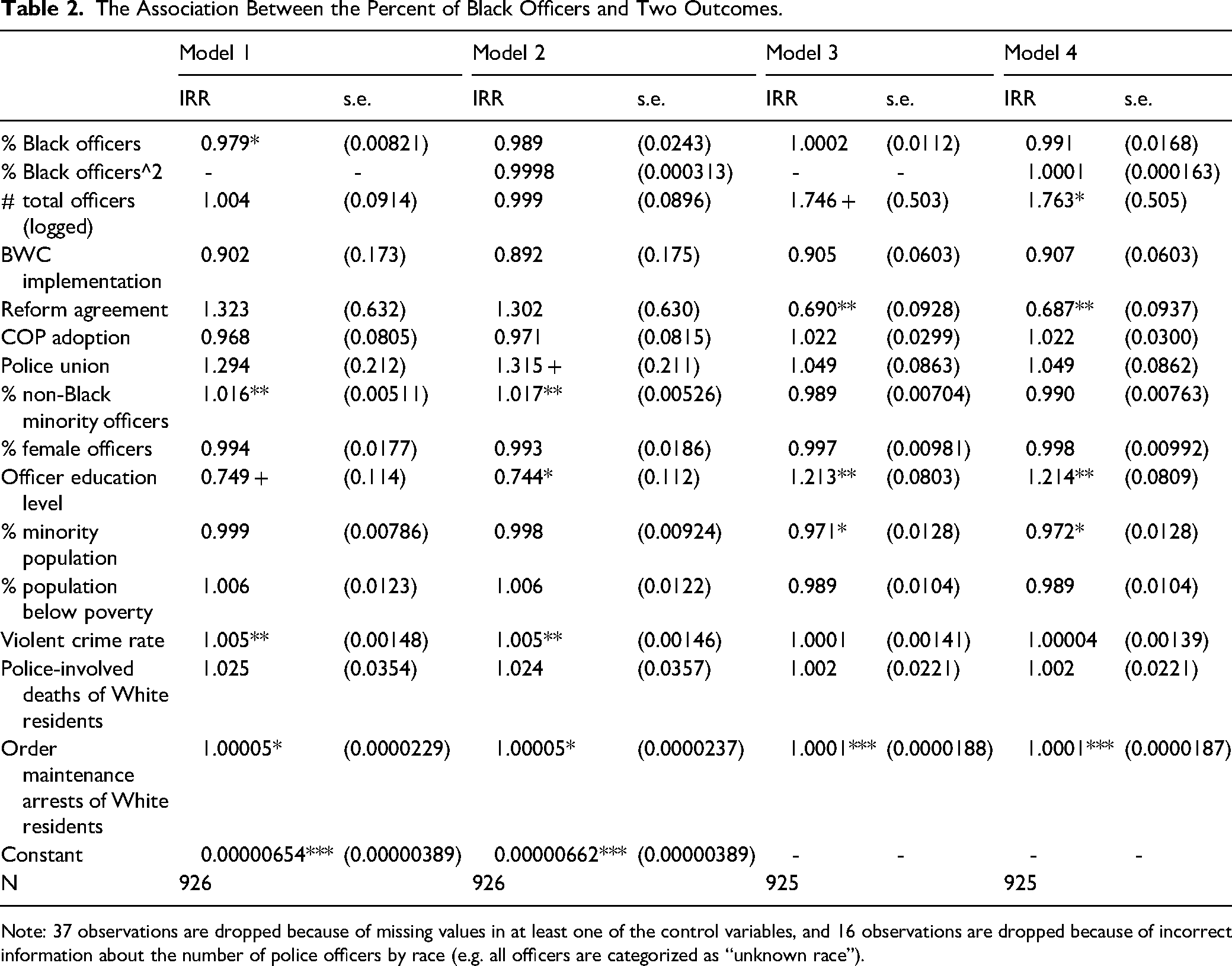
Note: 37 observations are dropped because of missing values in at least one of the control variables, and 16 observations are dropped because of incorrect information about the number of police officers by race (e.g. all officers are categorized as “unknown race”).
Models 3 and 4 of Table 2 present the results for the outcome of Black arrests for order maintenance offenses. Model 3 shows that the percent of Black officers is not significantly linked to the number of Black order maintenance arrests; this finding does not support Hypothesis 2. In addition, results of the quadratic model (Model 4) reveal that the percentage of Black officers and its square term do not have significant impacts on the number of Black order maintenance arrests, suggesting no effect of critical mass is observed, which does not support Hypothesis 4-1.
Moderating Effects of Organizational Characteristics
I first examined how the influence of critical mass is shown differently according to departmental size, as suggested by Hypotheses 3-2 and 4-2. For this analysis, I divided the sample into large versus small agencies, and ran the models including the square term of percent of Black officers for these two subsamples. I used the average value of total officers among the sample agencies as the threshold to divide the sample into large versus small agencies. The results for the outcome of police-involved deaths are presented in Model 1 (large agencies) and Model 2 (small agencies) of Table 3. Those for the outcome of order maintenance arrests are presented in Model 3 (large agencies) and Model 4 (small agencies) of Table 3. In all four models of Table 3, the IRRs of the percent of Black officers and its square term are not statistically significant. Therefore, I conclude that I found no evidence that the influence of critical mass of the percent of Black officers is more prominently revealed in smaller agencies, which does not support Hypotheses 3-2 and 4-2.
The Moderating Effect of Departmental Size on the Effect of Critical Mass of the Percent of Black Officers.
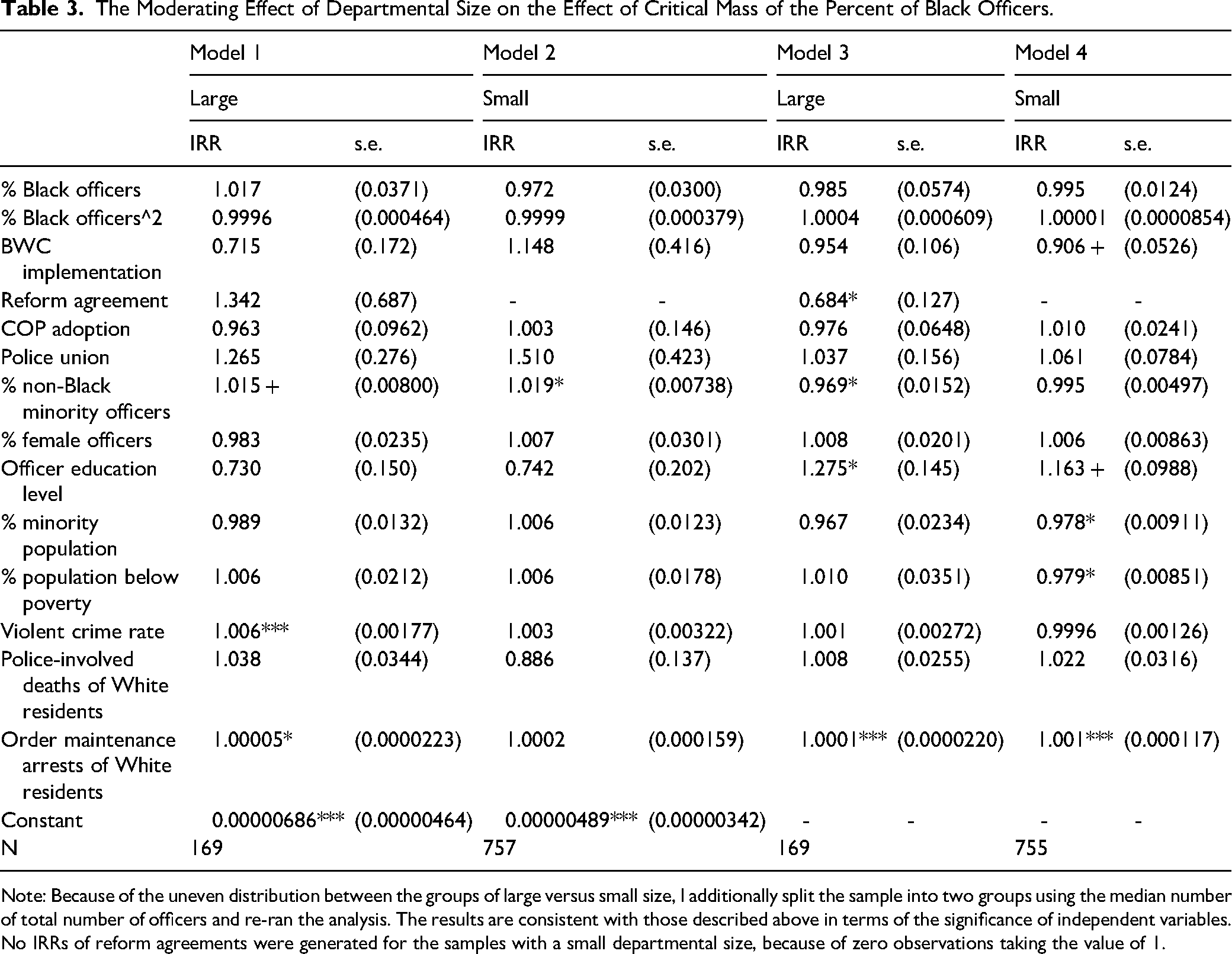
Note: Because of the uneven distribution between the groups of large versus small size, I additionally split the sample into two groups using the median number of total number of officers and re-ran the analysis. The results are consistent with those described above in terms of the significance of independent variables. No IRRs of reform agreements were generated for the samples with a small departmental size, because of zero observations taking the value of 1.
Second, I examined how the influence of critical mass is shown differently according to the share of White officers, and the result is presented in Table 4. Models 1 and 2 of Table 4 are results for the outcome of police-involved deaths of Black residents, and they show that the IRRs of the percent of Black officers and its square term are only statistically significant among agencies with a large share of White officers (Model 1); specifically, the percent of Black officers has a negative association (IRR = 0.79) while its square term has a positive association (IRR = 1.008). This result suggests that the significant non-linear relationship between the percent of Black officers and police-involved deaths of Black residents was found only in the model with a large share of White officers. In contrast, Models 3 and 4 of Table 4 reveal that the IRRs of the percent of Black officers and its square term are not statistically significant for the outcome of Black order maintenance arrests in both the models for large and small shares of White officers, which does not support Hypothesis 4-3.
The Moderating Effect of the Percent of White Officers on the Effect of Critical Mass of the Percent of Black Officers.
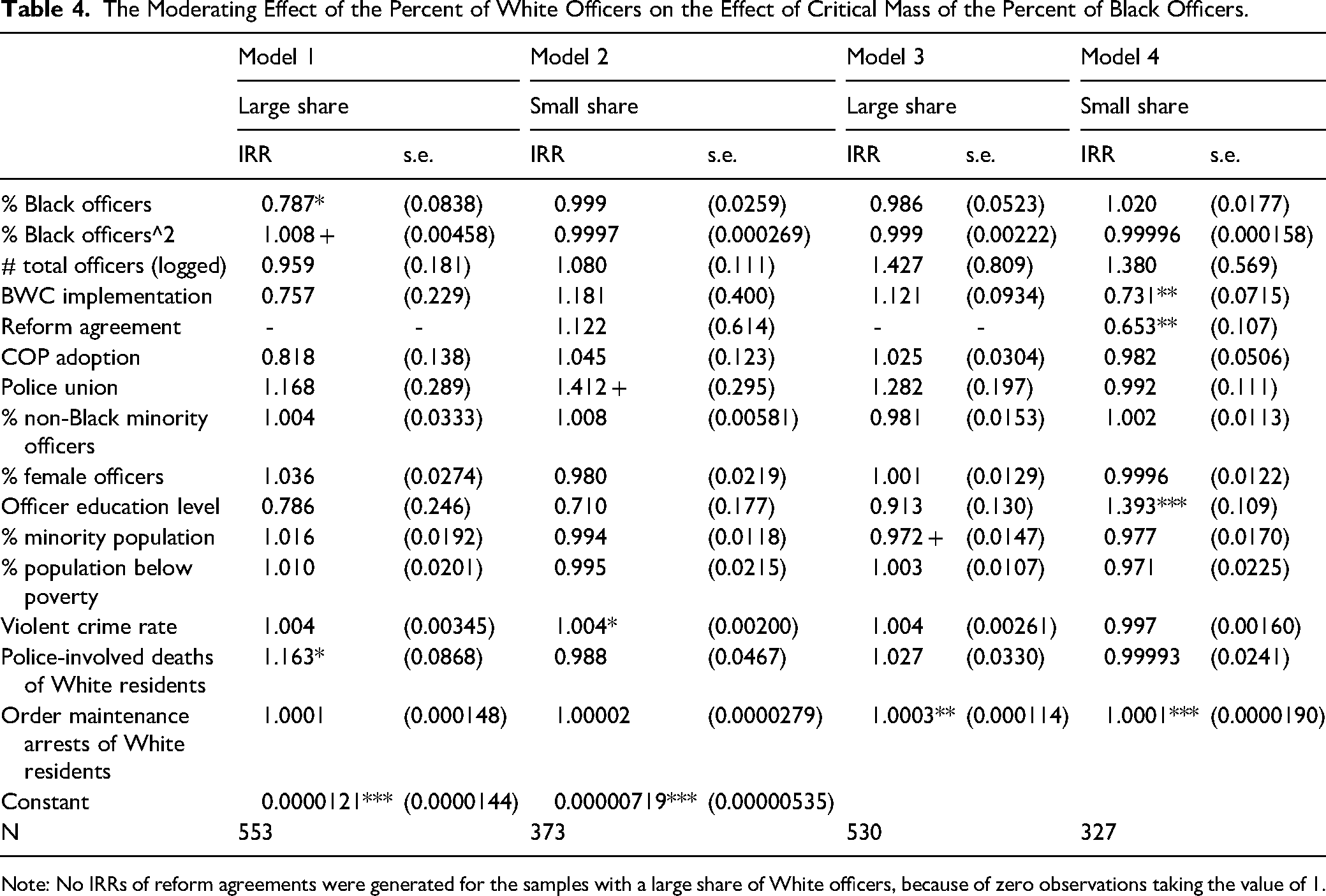
Note: No IRRs of reform agreements were generated for the samples with a large share of White officers, because of zero observations taking the value of 1.
To explore the actual shape of the relationship between the percentage of Black officers and the police-involved deaths of Black residents for the subsample with a large share of White officers (Model 1 of Table 4), I plotted the predicted counts of the police-involved deaths of Black residents across different percentages of Black officers. The plot is presented in Figure 2. It shows that the percentage of Black officers has a negative association with the police-involved deaths of Black residents until the percentage of Black officers reaches about 15 percent, after which the police-involved deaths of Black residents increase as the percentage of Black officers increases. The direction of the relationship between the percentage of Black officers and the police-involved deaths of Black residents, as shown in Figure 2, is opposite to their expected relationship; these results thus do not support Hypothesis 3-3.
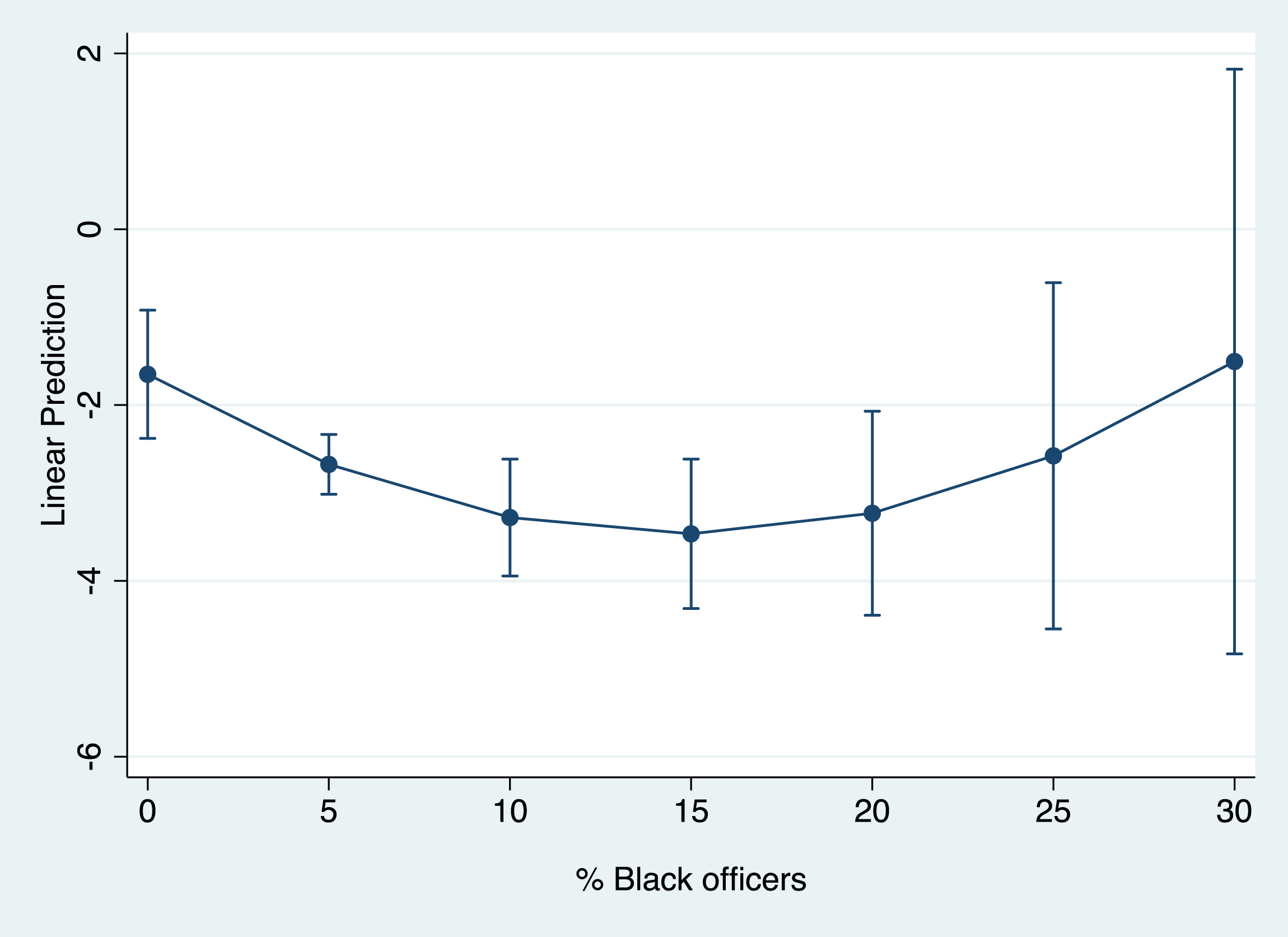
Predicted count of police-involved deaths of Black residents across percent of Black officers.
Moderating Effects of Community Characteristics
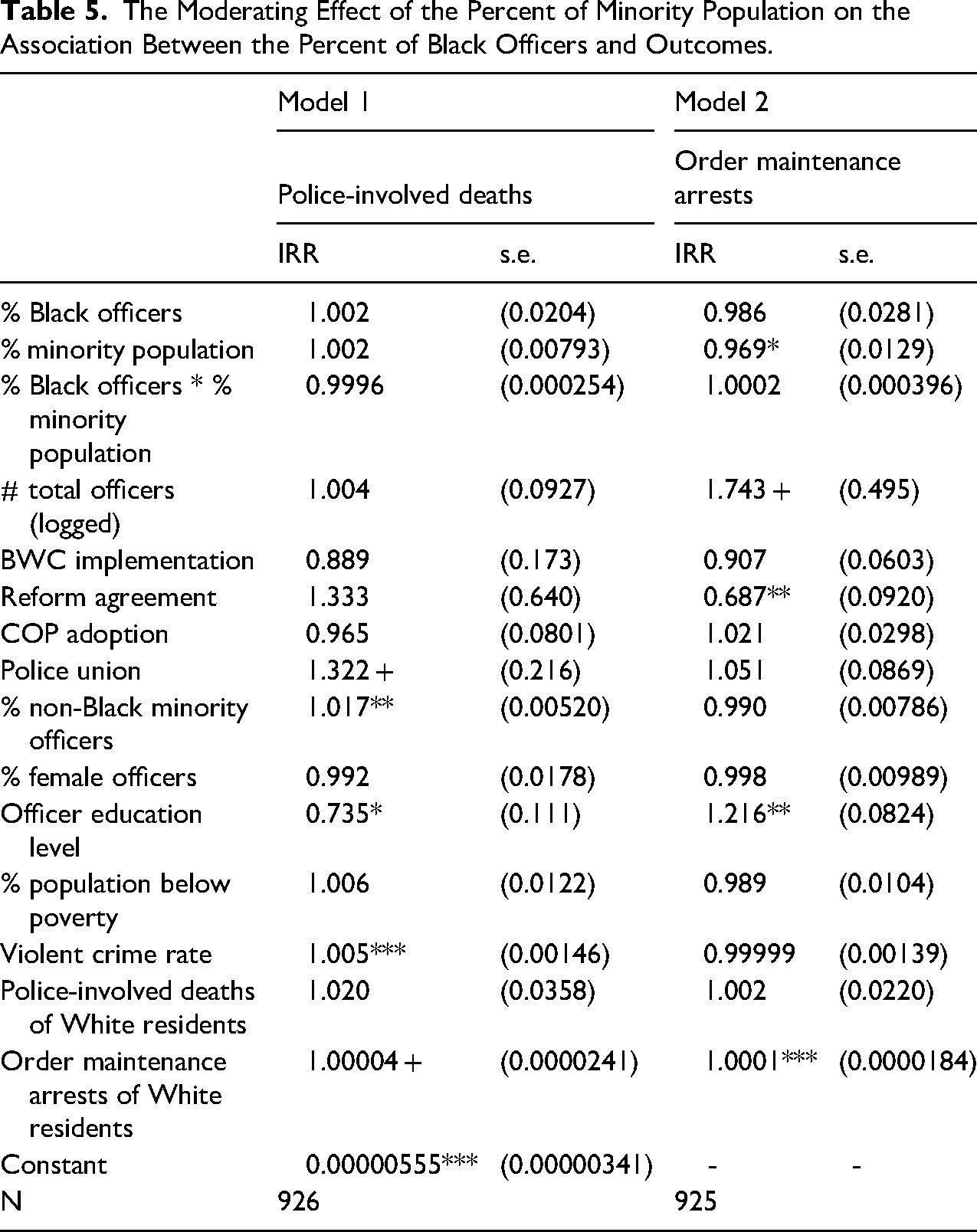
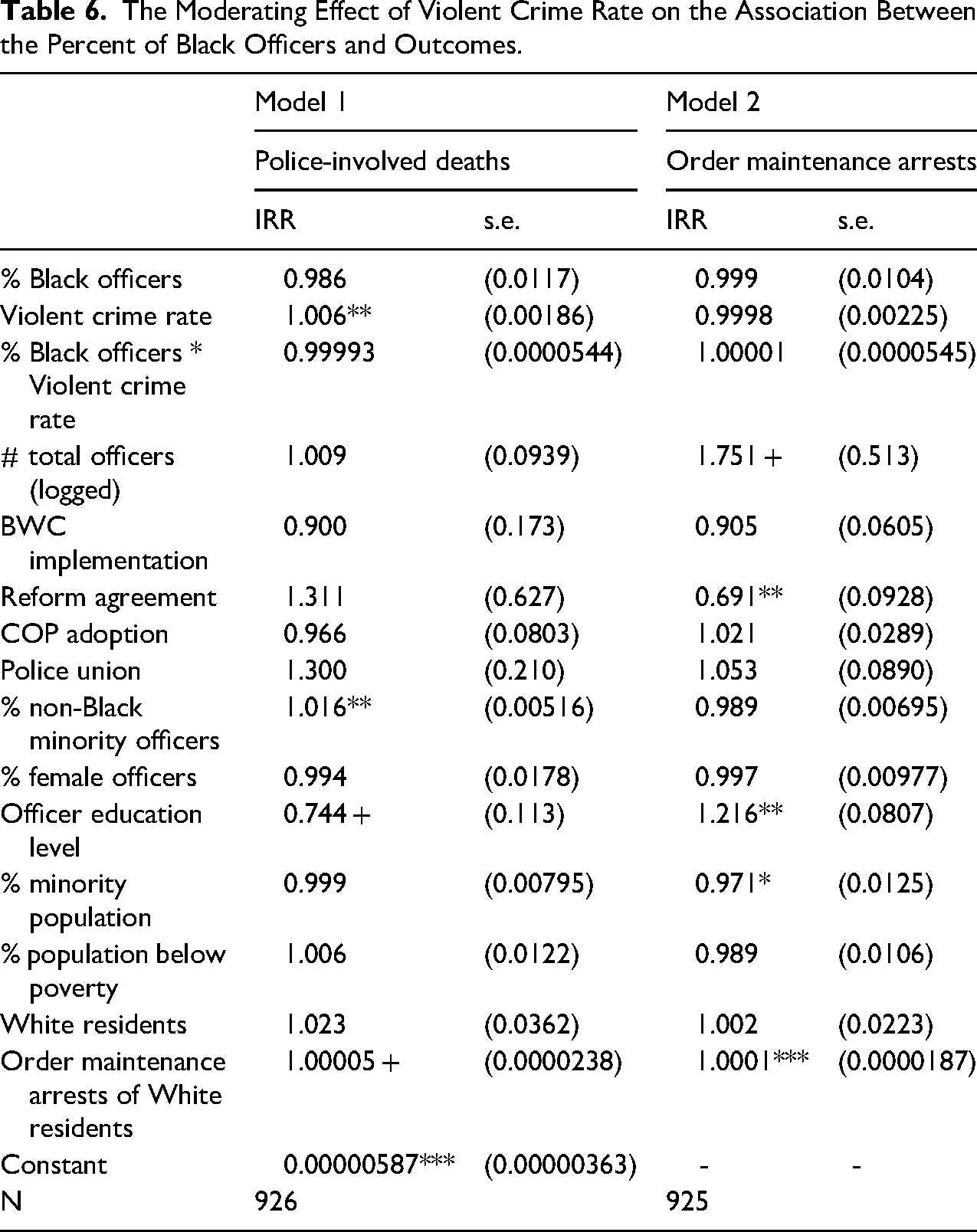
Tables 5 and 6 show the results of the interactive effect between community characteristics and the percent of Black officers for two outcomes. Table 5 reveals that the interaction term between the percent of the population that is non-White and the percent of Black officers is not significantly associated with either outcome of police-involved deaths of Black residents or order maintenance arrests of Black residents. Table 6 also shows the null effect of the interaction term between violent crime rates and the percent of Black officers on police-involved deaths of Black residents and order maintenance arrests of Black residents. In sum, the results of Tables 5 and 6 suggest that there is no significant difference in the relationship between the percent of Black officers and the two outcomes according to community characteristics, which does not support Hypotheses 5-1, 5-2, 6-1, or 6-2.
The Moderating Effect of the Percent of Minority Population on the Association Between the Percent of Black Officers and Outcomes.
The Moderating Effect of Violent Crime Rate on the Association Between the Percent of Black Officers and Outcomes.
Robustness Check
I conducted two robustness checks. First, I ran the analyses using a different specification of the variable representing Black representation in the police force, which is the Black representation ratio. The Black representation ratio is measured by the ratio of the percent of Black officers to the percent of the Black population. The results of analyses using the Black representation ratio as an independent variable are presented in Table A1 in the appendix. These analyses revealed that the Black representation ratio is not significantly associated with police-involved deaths of Black residents, which differs from the main result using the percent of Black officers as an independent variable. The Black representation ratio also does not have a significant impact on order maintenance arrests of Black residents, which is consistent with the main result that uses the percent of Black officers.
Second, I ran the analyses using the percent of White officers as an independent variable instead of the percent of Black officers. This was to assess whether the reduced police-involved deaths of Black residents shown in Table 2 was actually associated with the decrease of White officers, rather than with the increase of Black officers. It is possible that, when the share of White officers decreases while total number of officers is not changed, the percent of Black officers increases even though their absolute number within the agency is not increased. The result of using the percent of White officers as an independent variable is presented in Table A2 in the appendix, and it shows no significant IRR of the percent of White officers. This suggests that the current findings showing a negative association between the percent of Black officers and police-involved deaths of Black residents is not a collateral consequence of the decrease in the share of White officers.
Conclusion and Discussion
The current study explored whether an increased share of Black officers in the police force is linked to a decrease in police-involved deaths of Black residents and Black order maintenance arrests, as representative bureaucracy theory would predict. The findings provided supporting evidence of the theory for the outcome of police-involved deaths of Black residents, while providing null evidence for the outcome of Black order maintenance arrests.
More specifically, the current findings revealed that the percent of Black officers is negatively associated with the police-involved deaths of Black residents. However, the findings did not reveal the role of critical mass in the relationship between the percent of Black officers and the number of police-involved deaths of Black residents. This is inconsistent with the findings of Nicholson-Crotty, Nicholson-Crotty and Fernandez (2017) that showed an inverted u-shaped relationship between the percentage of Black officers and the number of police-involved deaths of Black residents. Such inconsistent findings may be due to different data sources and analytic methods (e.g. panel data analysis using 2007, 2013, and 2016 data vs. cross-sectional analysis using 2013 data). Regardless of the shape of the relationship between the percentage of Black officers and police-involved deaths of Black residents, the combination of the findings of Nicholson-Crotty, Nicholson-Crotty and Fernandez (2017) and those of the current study implies that increasing the share of Black officers can be an effective strategy to reduce police use of deadly force against Black residents.
On the other hand, the findings showed that the order maintenance arrests of Black residents were not significantly changed as the percentage of Black officers changed. This finding is consistent with the study by Sharp (2014) that revealed an insignificant relationship between the percentage of Black officers and Black order maintenance arrests.
Additionally, I examined the moderating effects of two organizational characteristics (departmental size and the percent of White officers) and two community characteristics (the percent of racial minority population and the violent crime rate). The current findings suggest that these variables did not have a significant moderating effect, except for the percent of White officers. More specifically, in the agencies with a large share of White officers, the percentage of Black officers is negatively associated with the police-involved deaths of Black residents only when the percentage of Black officers is relatively small; once the percentage became larger than about 15 percent, their relationship became positive. This finding suggests that the positive passive-active link of Black representation is not revealed when the percentage of Black officers is relatively large, especially in agencies consisting of a large group of White officers. This finding is contrary to what would be predicted by representative bureaucracy theory.
The first conclusion that can be drawn from the above results is that the benefits of increasing the share of Black officers may manifest differently according to the natures of officers’ decision-making. This conclusion is based on the finding that the percent of Black officers has different associations with the different outcomes of police-involved deaths and order maintenance arrests. Headley and Wright II (2020) argued that the circumstances when police officers use deadly force are mostly unexpected and sudden; therefore, officers often rely on automatic or intuitive decisions when using deadly force, which make their decision extremely discretionary. On the other hand, officers’ arrest decisions rely to a smaller degree on an “instinctive or fast thought process” (Headley and Wright II 2020, 1054). Rather, officers have to consider “legal and policy restrictions when making an arrest that prompt officers to be deliberate, logical, conscious, and rational in decision-making” (Headley and Wright II 2020, 1054). Officers still must use discretionary judgment when making an arrest, because they have to decide whether there is a “probable cause” to arrest a given suspect. However, when making the decision of whether to arrest, officers usually have sufficient time to consider the situational and organizational circumstances. In the process of making an arrest, they are therefore more likely to take organizational goals or peer expectations into account in their decisions.
Given this difference between the two outcomes, the current findings can be interpreted as follows: in cases of decision-making that rely heavily on the immediate discretionary judgment of individual officers (e.g. when using deadly force), enhancing Black representation may be effective in reducing discriminatory practices against Black residents. In cases of less automated decision-making (e.g. arrests), on the other hand, increasing Black representation may not be directly linked to increased advocacy for Black residents in the police force.
Second, the findings from the examination of the moderating role of the percent of White officers suggests that organizational socialization plays an important role in explaining the relationship between passive and active representation in policing. The findings showed that the negative association between Black representation and the police-involved deaths of Black residents disappears when the percentage of Black officers surpasses a certain point, especially in organizations consisting of a large group of White officers. This finding suggests that Black officers may become reluctant to advocate for minority clients in organizations with increased pressure to act in accordance with the dominant White police culture. Additionally, Black officers may become even more reluctant to advocate for minority clients when they are more visible within the organization (i.e. when they comprise a larger percentage of the organization). This interpretation is supported by previous arguments that minority officers are more likely to be viewed as “intruders” by a majority group as their share within the force increases, which may lead them to restrict expression of their minority identity more strictly (Puwar 2004; Stevens 2007).
This influence of organizational socialization on the decision-making behaviors of minority officers is consistent with prior knowledge (Wilkins and Williams 2008). Studies have demonstrated that the influence of the dominant organizational culture makes minority officers desire insulation from their social identity (Jung, Bozeman and Gaughan 2020; Alex 1969). Studies have reported that minority officers perceive that they are often viewed by their colleagues as “potential client(s)” of the police force, and that their loyalty is being consistently tested by their fellow officers (Peterson and Uhnoo 2012, 363; Cashmore 2002). For example, minority officers were tested about whether they tolerated their fellow officers’ abusive or discriminatory language regarding racial/ethnic minorities (Bolton Jr. and Feagin 2004; Cashmore 2002; Peterson and Uhnoo 2012). Minority officers could expect full support from their fellow officers only after they have proven their loyalty. Therefore, Black officers pursuing a successful career in the police force are likely to feel substantial pressure to behave as their fellow officers expect them to, forcing them to hide their individual preferences (Wilkins and Williams 2008).
In sum, the current finding implies that there are benefits of enhancing Black representation in police forces for reducing racial disparities in policing, at least for certain policing outcomes such as police-involved deaths. Although such benefits may not be prominent for types of decision-making that are strongly influenced by organizational pressure, this does not negate the necessity of enhancing Black representation in the police force. Given the recent increased political and social pressure to change a long-standing White-dominant police culture, it is possible that increasing the number of Black officers may have a positive influence across diverse policing outcomes in the long term.
In addition, enhancing Black representation can challenge majority officers’ existing expectations that they will not be held accountable for the incidents caused by their usage of deadly force in the line of duty. It has been noted that there are systemic difficulties in indicting police officers who have killed civilians in the line of duty (Samudzi 2017). For example, the prosecutors responsible for dealing with cases of police-involved deaths may not be able to maintain an objective perspective toward the officers, as they are close partners with the police. In addition, juries and the courts often sympathize with the difficult situations that police officers encounter every day and thus tend to determine that officers’ decisions to use deadly force are “objectively reasonable” (Jackman and Barrett 2020). Police officers' confidence that they will not be indicted for the use of deadly force is possibly stronger among White officers because they have long observed that White officers tend not to be charged in the deaths of civilians. However, Black or other minority officers are less likely to have such confidence, because they cannot be sure whether such a “fortunate consequence” that White colleagues have experienced after using deadly force would also occur for them. In this sense, White officers’ beliefs that they are legally safe from the use of deadly force can be weakened as they work with more Black or other minority colleagues. This change in officers’ beliefs may also develop further with recent increased social attention to the movements to repeal qualified immunity for police officers.
Before concluding, it is important to point out the implications of the current study for representative bureaucracy literature; that is, the choice of measurement of racial representation matters for determining the passive-active link of racial representation. This is because the current findings show that the positive link between passive and active racial representation for the outcome of police-involved deaths is not consistently revealed when using different measurements of Black representation (i.e. Black representation ratio). This implies two important points. First, as suggested by Nicholson-Crotty, Nicholson-Crotty and Fernandez (2017), the absolute size of the proportion of Black officers within an organization may be more important for facilitating the positive link of passive and active racial representation, compared to the measured share of Black officers in the police force relative to the Black population they serve. Second, it implies that representative bureaucracy scholars should be cautious in their measurement choices for passive representation. This is contrary to some previous arguments that the choice of measurement may not be critical (Kennedy 2014; Selden 1997). The studies that used representation ratios for indicating passive representation may reach different conclusions than if they used the raw percentage of minority bureaucrats.
Despite the above implications, the current findings should be interpreted with caution due to several limitations, which can pose avenues for future research. First, the results of this study should not be interpreted to suggest there is a causal influence of the percent of Black officers on the police-involved deaths of Black residents, because of potential endogeneity issues. Omitted variable bias might exist in random-effects models that were applied to the outcome of police-involved deaths of Black residents. In this regard, the current study was careful to interpret the results as associations, not as causal. Second, the current study used three time points of 2007, 2013, and 2016, which does not allow for addressing the specific influence of the death of Michael Brown in 2014 and the resulting BLM social movements on policing outcomes. These focusing events facilitated intensive political and media interest in police practices and policies, and thus may have exerted short- and long-term influences on the racial compositions of police forces and on police behaviors. Given the “de-policing” effects of these focusing events reported by several studies (Morgan and Pally 2016; Nix, Wolfe and Campbell 2018; Shjarback et al. 2017), 5 failure to address these effects may cause downward bias in the current estimated rate ratios of the percent of Black officers.
Third, the current study used aggregated data at the agency level, and thus did not specifically identify the mechanisms by which individual officers actually make decisions in situations where there is conflict between the pressures to advocate for minority clients and to follow organizational expectations. Additional future research using individual-level data to examine how individual officers cope with these conflicting pressures will help to supplement the implications of the current findings. Fourth, the current study employed frequency of arrests for order maintenance offenses as a proxy for order maintenance policing. However, more direct indicators for order maintenance policing exist, such as the frequency of stops-and-frisks, which was not adopted by the current study because of unavailability of relevant data. Fifth, the sample police departments used for the current study were not randomly selected. Additionally, the size of the sample is not large. Therefore, the results of the current study should be understood as exploratory in nature, and the pattern found in this study cannot be generalized to the entire population of U.S. police agencies.
Footnotes
Declaration of Conflicting Interests
The authors declared no potential conflicts of interest with respect to the research, authorship, and/or publication of this article.
Funding
This work was supported by the Catholic University of Korea under Grant M-2021-B0002-00046.
