







Abstract
New Municipalism governments in Madrid and Barcelona (2015 − 2019) promoted a new agenda which included participatory budgeting, e-initiatives, and randomly selected forums. Both cities implemented deep modifications in their Advisory Councils’ (AC) systems while the ‘New Municipalism movement’ (radical-left candidacies) was in government for first time. In this article we reflect on how these municipal administrations faced the different strategies for reform across their ecosystem of ACs. For this purpose, our analysis relies on six dimensions (drivers, inclusiveness, deliberation, communication, policy-making capacity and connectedness) which are identified in the literature and are empirically applied through a comparative case study (thirty-one interviews). Despite the common agenda, the cases show dissimilarities which are connected to alternative reform strategies: one case was characterized by experimentation (Madrid), the other by slight improvement (Barcelona). Path dependency contributes to understanding these alternative logics, even when a common agenda was at play.
Keywords
Introduction
Advisory councils (ACs) are permanent institutions which bring together association representatives, public officials, and politicians to discuss public issues. They may only include associations, or a mix of experts and stakeholders; some are related to specific policies or sectors of population (for example, gender or environmental issues) whereas others are territorial (district or neighborhood); some set their own agenda while others make proposals at the request of local governments. ACs belong to the first generation of participatory institutions. For instance, Arnstein (1969, p. 218) ranked them in the “manipulation” category, at the bottom of the participation ladder, because both the nomination process and their links with decision-making circles were usually ill-defined. These concerns have been also pointed out by more recent studies (Ansell and Gash 2008; Emerson, Nabatchi and Balogh 2012; Fung and Wright 2003).
The typical governmental reaction to this criticism has been to maintain ACs intact, while launching parallel democratic innovations such as participatory budgeting or mini publics (Anonymized; Ganuza, Nez and Morales 2014; Hendriks 2016). Though many academic works also urge a renovation of these institutions and a bolstering of their democratic qualities (Sintomer and Maillard 2007), few recent studies had examined their reform strategies, especially after important changes in the municipal context (e.g., new political actors and power relations after an election). There now exists a growing literature on this experience of radical left governments between 2015 and 2019 (Blanco, Salazar and Bianchi 2020; Bua and Bussu 2021; Janoschka and Mota 2021; Medina-García, de la Fuente and Van den Broeck 2021; Nez and Ganuza 2020). In this article, we assess a set of ACs’ reform strategies which were developed after significant shifts in municipal governments, and we interrogate why the reform of ACs was promoted, and what strategies and limitations local governments found.
To reflect on these issues, we rely on two Spanish urban cases which underwent reform strategies during the period of 2015 − 2019: Madrid and Barcelona. Both cities implemented deep modifications in their ACs’ systems while the ‘New Municipalism movement’ (radical-left candidacies) was in government for first time (Blanco, Gomà and Subirats 2018; Janoschka and Mota 2021), designing and implementing a plan to boost these institutions. This new political scenario represents a unique opportunity to observe how ACs were transformed in a context of political change. As stated by Emerson, Nabatchi and Balogh (2012, p. 9), changes in the context open the door to new possibilities but also to internal challenges. In this article we reflect on how these municipal administrations faced the different strategies for reform across their ecosystem of ACs. For this purpose, our analysis relies on six dimensions (drivers, inclusiveness, deliberation, communication, policy-making capacity and connectedness) which are identified in the literature and are empirically applied through a comparative case study. Beforehand, and in general terms, more similarities than differences between both cases are expected, since both local governments share a similar participatory agenda. But there is also room for differences, given the specificities of each city (mainly the trajectory of their AC system).
Our findings show two different municipal strategies: in Barcelona, partial changes were introduced in its vast AC system, while in Madrid some new spaces with reinforced functions were created. Both cases point to a common agenda, though they also illustrate how local reformers faced different constraints when renovating these institutions. The contribution of this article is, therefore, twofold. First, we detail the reform strategies in these two cities, which are clear examples of what has been known as New Municipalism (Ayuntamientos del Cambio). Second, using a qualitative approach, we conduct a comparison of cases considering the dimensions that the literature has commonly emphasized, which drives us to identify the factors which led to alternative strategies in each case. The overall objective is not to offer a new analytical framework but, on the basis of a unique scenario of political change, to reflect on the patterns of reform which followed, and the key factors leading to them.
The piece is divided as follows. First, the theoretical section begins by briefly exposing the appearance and development of urban ACs in Spain. It continues by presenting the dimensions of analysis which guide our specific research questions. Afterward, the cases are portrayed together with an overview of the Madrid and Barcelona contexts. Then the methods and data are described. Next, the results are presented, outlining the extent of the changes, how they were implemented in both cities, and the constraints encountered by those promoting them. Finally, we discuss the significance of alternative strategies of AC restructuring.
Urban ACs in Spain
Any political system needs ‘mediation institutions’ to organize and channel (a selection of) social interests (Forewaker 1990; Zaremberg, Guarneros-Meza and Lavalle 2017). This is the case of urban ACs in Spain, which began developing in 1979 when, in the aftermath of Franco's regime, the first local elections were held (Navarro 1999; Villasante 1995). ACs proliferated because parties and party leaders needed social support from civil society (Navarro 2001). 1 Neighborhood associations, trade unions, parents’ associations and women's groups were crucial as the basis for legitimizing the new regime (Funes 1995), so it was necessary to accommodate them, especially under the local governments led by Socialists and Communists. During the 80s and 90s, ACs mushroomed under all Spanish administrations (Hanson and Ulrich 1994; Jiménez Sánchez 2005) and decentralization also facilitated their expansion in the 90s and early 2000s.
The Spanish Local Regulation Act (Ley de Bases de Régimen Local (1985)) included ACs in its catalogue of institutions. Whereas during the early 80s urban councils were mainly at neighborhood level and centered on basic services (housing, public works, facilities maintenance, etc.), in the 90s ACs spread throughout the sectors to inform the policy-making process (education, youth and other welfare policies) (Navarro 1997). From then on, there was a clear diversification of topics (Navarro, Cuesta and Font 2009; Anonymized). By the 90s, more than 70 percent of Spanish cities had either sectorial or district councils (Brugué and Vallés 2005; Navarro 1997) and a recent study shows the heterogeneity of numbers (Anonymized): Barcelona has the highest volume in the country, while Madrid is in an intermediate position, with 36 councils. ACs, whether sectorial or territorial, had become traditional instruments in Spain. However, recent evaluations are critical of their performance because their membership is limited to a selection of associational leaders (Navarro 1999), their connection with decision-making circles is frequently weak and obscure (Blanco 2009; Sarasa and Guiu 2001), and their agenda and deliberative dynamics tend to be vertically set by governments (Anonymized). Since ACs are a central part of city-level institutions in Spain and other countries (Cooper and Musso 1999; Fobé et al. 2013; Navarro 1999; Schattan Coelho 2006; Sintomer and Del Pino 2014), the cases of Madrid and Barcelona have become referential for other cities that intend to initiate a reform process (Medina-García et al. 2021). The following section articulates the main dimensions addressed in the literature as well as the indicators that guide our analysis of reform strategies.
Reform Strategies to Redesign ACs
Many studies propose comprehensive frameworks to evaluate -and subsequently redesign- participatory institutions (Ansell and Gash 2008; Emerson et al. 2012; Fung and Wright 2003; Smith, 2009). Although these works respond to different theoretical traditions, in practice all of them end up indicating resembling research agendas and recommendations to restructure ACs. While some of these studies dialogue more directly with the literature on participatory and deliberative democracy (Fung and Wright 2003; Smith 2009), others do it with the literature on governance (Ansell and Gash 2008; Emerson et al. 2012). However, they share virtually the same analytical dimensions, despite the fact they emphasize one over the other or their terminology may vary. Drawing on these analytical frameworks, six dimensions and a set of indicators can be identified, mostly related to organizational characteristics which are also conceived as prerequisites for ACs to be successful.
Drivers
The literature on ACs has emphasized the idea that certain prior conditions may facilitate or impede their proper functioning and success (e.g., power imbalances between groups and actors, a prehistory of conflict/cooperation, etc.) More concretely, Emerson et al. (2012) have distinguished between contextual factors and drivers. Without a driver, any attempt to initiate or reform a participatory institution would be unsuccessful in its development. In turn, leadership has been singled out as potentially one of the most important drivers (2012, p. 22), meaning a leader who promotes the process and shows a high level of commitment and willingness to assume certain costs. Fung and Wright (2003), in their well-known study of Chicago neighborhood councils on policing and public education, highlighted the importance of this type of leadership as one of the drivers in initiating and reforming these participatory institutions. Specifically, the political thrust for the reform in Chicago came from a progressive politician who wanted to be seen as a reformer. In the specific case of Madrid, Nez and Ganuza (2020) remarked the importance of the trajectories and biographies of the promoters to understand the conditions of emergence and development of the participatory offer. Specifically, for our analytical purpose, we use the trajectories of the promoters of ACs reform as an indicator. This is relevant for the cases of Madrid and Barcelona since although these institutions had existed for decades, they had not previously undergone any profound reform.
Inclusiveness
Most of the analytical frameworks respond to three basic questions: who participates, how and for what? The first question (who) refers to the principles of inclusion which is operationalized through concepts such as ‘bottom-up participation’ (Fung and Wright, 2003) or ‘participatory inclusiveness’ (Ansell and Gash, 2008). Inclusion is usually identified with grassroot participation and experiential knowledge, which are useful to provide a practical orientation, redefine interests and discover new solutions on issues that are closely related to contextual conditions or affected by targeted problems (Emerson et al. 2012).
For its part, the empirical research on ACs has deepened on two specific inclusion measures which are feasible to test: the mobilization strategies and the participants selection procedures. These two measures have a direct effect on the level of representativeness as well as on the mobilization of sectors traditionally excluded from decision-making (Blanco et al. 2020; Bua and Bussu 2021; Fung 2001; Schattan Coelho 2006). The inclusion strategies imply the open election of members through electoral processes or by random selection; targeted mobilization to incorporate new participants and lay people with relevant experiential knowledge; and incentives for low-income groups. These actions are inspired by a concern for the exclusion of disenfranchised sectors. For example, Matthews (2001), in his study on youth councils in UK, proposes original solutions to reach excluded young people: the incorporation of trained personnel (who know how to engage with them), targeting fringe publics (beyond the traditional associations), or convening meetings in spaces where people spend their time. Regarding the Spanish case, most AC members are appointed by associations (80 percent), while other selection procedures, such as random selection, are residual (Font et al. 2021, p. 231). Most participants belong to associations, and they are typically male, around 50 years old, college graduated, and highly qualified personnel, which denotes certain limitations in terms of inclusiveness (Navarro and Font 2013). Following this discussion on the different ways to improve inclusiveness in ACs, we aim to offer an in-depth description of the measures carried out in Madrid and Barcelona for this purpose. For this we use two indicators: the mobilization strategies and the participants’ selection procedures.
Deliberation
Deliberation is a central element in the literature. The analytical frameworks addressed in this article emphasize the idea that real world deliberations are not synonymous with consensus, using alternative expressions such as ‘persuasion and reasoning-giving’ (Fung and Wright 2003, 9. 18), ‘consensus oriented/building’ (Ansell and Gash 2008, p. 559), ‘reasoned communication’ (Emerson et al. 2012: 12), or ‘considered judgement’ (Smith 2009). In sum, it is about prioritizing deliberation over other decision modes such as vote aggregation, expert opinion or strategic negotiation (Fung and Wright 2003). Though deliberation can be complemented with other modes of decision, the point here is not to be subordinated to any of them.
Drawing on these proposals, the measures to promote deliberation can be understood as a crucial dimension in AC reform, which aim to improve debates and enable the construction of proposals. Deliberation in these spaces is frequently affected by fixed-party positions because of vertical dynamics in which governments set the agenda. The empirical research literature on ACs has been paradigmatic in the study of the quality of deliberation. Hiring trained facilitators, coordination led by associations (instead of government staff or officials), and the creation of all-inclusive commissions for people who are under-represented are some examples of potential solutions to expand the deliberative dynamics (Cornwall 2008; Fung 2003; Hendriks 2016). More recently, in this same direction, Pawlowska and Kolomycew (2021) have studied to what extent local Polish ACs meet the conditions to be considered deliberative institutions, a question which has been also raised in the Spanish scenario. Having working groups or specialized commissions appears to be a clear indicator for the quality of deliberation (Anonymized; Font and Galais 2011). Considering these aspects, we aim to analyze possible readjustments in deliberative mechanisms as part of the reform strategies of Madrid and Barcelona. For this we use the creation of functional and operational deliberative spaces as an indicator.
Communication
Our fourth analytical dimension is related to the development of new communication channels to improve aspects such as deliberation, formal and informal interaction, publicity and transparency. The empirical research literature offers several feasible elements to analyze, for example, the development of ‘digital devices’ such as its own website, its own diffusion tools or internal communication platforms. All this enables the participants to distribute information without a complete authority's mediation. Another important aspect is the possibility of argumentation and voting on proposals through digital platforms (Barros and Sampaio 2016). In sum, opening new communication channels and direct access to mass media can be also an instrument to achieve social recognition and visibility (Spada and Allegretti 2017) acknowledging the value of the work undertaken by members of associations (Cooper and Musso 1999; Hendriks and Kay 2019; Nabatchi et al. 2012). If we look at the Spanish case, ACs show poor transparency and low presence on social networks (Anonymized). 2 The development, implementation and functionality of new digital tools is used as an analytical indicator of the reform processes carried out in Madrid and Barcelona.
Policy-Making Capacity
Another common dimension in the analytical frameworks is the policy-making capacity or authority of nonstate participants. Fung and Wright (2003) refer, for example, to the process of the ‘devolution of power’ to local action units such as the neighborhood councils. Similarly, Ansell and Gash (2008) highlight the importance of the ‘commitment to the process,’ for which it is necessary to ‘shift ownership’ of decision making from the state to the non-state participants acting collectively. Emerson et al. (2012) refer to it as the ‘capacity for joint action’ which is linked to providing the necessary resources, norms of reciprocity and organizational structure. Smith (2009) uses the term ‘popular control’ in which it is crucial to share or delegate the power in order to establish the agenda-setting in the hands of the participants. Basically, it consists in an acknowledgment – albeit only formal – by the authorities that these participatory institutions involve sharing power with other agents.
Part of the empirical research literature has gone one step further when analyzing policy-making capacity because even though ACs have limited final decision-making powers, they can, nonetheless, develop their own activities such as promote awareness-raising campaigns, training sessions and service evaluations (Bherer et al. 2016, p. 351) as well as submitting high quality proposals which are valued by political and social agents (Galais et al. 2021, p. 15). The presence of intermediate outcomes (Ansell and Gash 2008) materialized in specific collaborative actions (Emerson et al. 2012) such as monitoring implementation, drafting internal rules, etc. are another important element when analyzing the reform process of the ACs.
For all of the above to be possible, the allocation of own resources (budgetary and human) is seen as a starting point for autonomy and policy-making capacity in the everyday performance of ACs (Fagotto and Fung 2006). The lack of resources makes it more likely for associative members to depend on the generosity and the goodwill of the incumbent government to support their activity. In this aspect, the Spanish empirical evidence (Galais et al. 2020, p. 15) shows that well-resourced ACs are more likely to raise quality standards of deliberation as well as lead to more positive outputs according to the perception of members. Anonymized also found that ACs work better with less control from public authorities. Accordingly, providing human and economic resources seems to be a necessary condition – though not sufficient – in any reform that seeks to increase the ACs’ autonomy and members’ satisfaction.
In addition to formal recognition, outputs and resources, scholars have proposed the introduction of follow-up mechanisms through which authorities are bound to thoroughly examine citizens’ proposals, publicly explaining their positions on them (Hendriks 2016). There may be sound reasons (budgetary constraints, technical viability, etc.) according to which representatives do not implement approved proposals or recommendations. For instance, a study carried out in Spain (which includes ACs) showed that more than half of the proposal rejected or partially implemented did not receive any clarification from public authorities (Anonymized). Influencing public policies is a decisive element in our aim of assessing the reform strategies followed in Madrid and Barcelona. For this we use three indicators: resources, outputs and follow-up mechanisms. 3
Connectedness
Finally, the last dimension has to do with the capacity to modify or adapt the functioning of the participatory ecosystem. It may happen that the reform of a participatory institution (ACs in this case) supposes the readaptation of the participatory ecosystem as a whole (Emerson et al. 2012). As a means to that end, researchers propose an improvement in the ‘connectedness’ of ACs with other participatory mechanisms. These studies suggest combining the inclusiveness of participatory budgeting and the associational expertise developed in ACs. Hence, the idea would be to link the work of ACs with participatory budgeting, mini-publics, randomly selected forums, open conferences or special public hearings. These would reinforce the specific contributions of each institution (Hendriks and Kay 2019; Spada and Allegretti 2017). Fung and Wright (2003) have summarized this idea with the expression ‘coordinated decentralization’, through the attempt to avoid isolating citizens into small units (for example, a neighbourhood council). Given its relevance, we aim to analyse to what extent the AC reform in Madrid and Barcelona has affected the other participatory institutions at municipal level. For this purpose, we use the changes in the levels of connectedness with the rest of the institutions that make up the participatory ecosystem as an indicator.
The literature review shows that reform strategies are conceivable and include a variety of measures. Most works concentrate on specific types of councils, such as neighborhood, health or youth cases (Cornwall 2008; Matthews 2001; Serdült and Welp 2015), or they focus on a single dimension, for example, composition, deliberation or policy capacity (Barnes et al. 2004; Hendriks et al. 2013; Lima 2019). Most of them have examined which aspects of ACs do not perform properly, without considering any (previous or posterior) reform strategy. Our contribution, therefore, aims to look at how local governments may enhance the democratic potentialities of ACs by means of a general policy, improving the participatory and deliberative potentialities that the evaluative literature has remarked. Through the cases of Barcelona and Madrid, where New Municipalism was in government for first time during the years 2015 − 2019, we propose a reflection on city-level processes of reform, their features and the factors which led to them.
New Municipalism and the Participatory Reform
The New Municipalism candidacies were formed by the Podemos party, other radical left parties (e.g., the United Left or the ecologist party, Equo), members of anti-austerity social movements, and progressive intellectuals for the 2015 Spanish local elections (Mansilla 2017). These candidacies were voted into local governments in some of the most populated municipalities, including Madrid and Barcelona, which are paradigmatic of New Municipalism in Spain.
In the first case, Barcelona en Comú (BeC) was the most voted party in that municipality in 2015, and formed a minority government led by mayor Ada Colau, a social activist known for being the spokesperson of the Platform of Mortgage Victims (PAH). BeC succeeded the Conservative nationalist party in government (Convergència i Unió), with the support of the social democratic Socialist Party of Catalonia (PSC). In 2016, the BeC government approved a new city-level regulation (Blanco et al. 2018; Bua and Bussu 2021) which introduced major changes in ACs, making them the face-to-face dimension of the city's democratic agenda. This reform of ACs in Barcelona was general (affecting all ACs), centrally monitored by the Participation Department, and respectful of the previous structure. The city already had a complex network of sectorial, district, district-sectorial, and neighborhood councils, which accounted for over 150 bodies. ACs had been highly consolidated since the 90s, and their restructuring was influenced by a strong path dependency as we will show. BeC was reelected to the city's government in 2019, when the ACs reform was further developed.
In the second case, Ahora Madrid (AM) was the electoral platform which won the local elections in the capital city in 2015. AM managed to form a single-party government with the support of the social democratic Socialist Party (PSOE). It was led by Manuela Carmena, a retired progressive judge, whose program included several participatory approaches (Janoschka and Mota 2021; Medina-García et al. 2021). They were developed as a new participatory agenda, strongly influenced by the ideas of the 15-M movement (Font 2017; Anonymized). The AC reform in Madrid aimed to replace the old territorial bodies, due to their lack of consolidation and how poorly they were regarded, even among the party which created them in the 2000s (Janoschka and Mota 2021). However, this reform began with a lighter structure in comparison to Barcelona: 21 district councils and 15 sectorial bodies. Also, the institutional dependency of these councils was diverse: the new district forums (Foros Locales) were attached to the Department of Territorial Coordination and Associations while most sectorial councils were separately attached to their specific sectorial departments (e.g., the immigration council depended on the welfare services). The reform process was, consequently, more fragmentary and focused on urban districts. The AM government lasted until 2019, yet the changes introduced in ACs survived until 2021 when the new right-wing government reformed and suppressed local forums.
Previous studies have analyzed the cases of Madrid and Barcelona during the period 2015 − 2019, however, ACs have received considerably less attention. For example, Nez and Ganuza (2020: 6) explicitly exclude the ACs (foros locales) from their analysis of the case of Madrid, arguing that they are not part of the innovative processes which emerged after 15M. Only in a few studies, the creation of local forums has received certain attention (Blanco et al. 2020; Nez 2019; Medina-García et al. 2021; Janoschka and Mota 2021), while Caballero Ferrándiz (2020) has analyzed the limitations of these new institutions. Next, we briefly sum up the methods and data used for the examination of those processes of AC reorganization.
Methods, Data, and Analysis
The aim, therefore, was to examine two scenarios in which AC reform strategies were developed, while the political and the institutional context showed some variation in each of the cities. The advantage of having a pair of cases was the possibility of testing common strategies, at the same time as seeing which factors and constraints contributed to dissimilarities in policy developments. Thus, the existence of two scenarios made systematic comparison possible and sufficiently adequate to identify common patterns, dissimilarities, and the key factors behind alternative strategies (Coller 2000).
The fieldwork was conducted between March 2018 and December 2019. Our cases are based on semi-structured interviews and desk-analysis of documentation. We conducted 31 interviews with a variety of profiles and analyzed them following a ‘dialogic approach’: that is, contrasting the discourses among different agents to obtain a general picture of the case (Callejo Gallego and Vallejos 1996). As Burawoy (1998) points out, the rationale for case studies is to analyze how a given phenomenon happens in the specific context under study. Our cases are suitable for that purpose: in the interviews, public officials and association participants reflected on how their municipal ACs were changing.
Our aim was to track the municipal policies and their reception, so the fieldwork had to cover a diversity of political and participant positions. To this end, we selected the three policy areas of education, immigration, and participation central departments; and we chose participants, public officials and political cadres taking part in the ACs of those areas. Education is a traditional welfare issue, with a strong and consolidated associative fabric, in which ACs have been functioning since the 80s (Hanson and Ulrich 1994). By contrast, immigration is a newer subject for which ACs began to be created in the 90s, and their associative fabric is weaker and more fragmented (Danese 2001). We also talked to members of the participation departments as the central agencies in charge of planning and implementing AC reform. For each area, we selected a variety of interviewees ranging from politicians (in government and opposition) to top managers, and lay participants (individuals or association members). Information about all the interviewees is shown in Table A1 in the appendix. The interviews were normally conducted at the informants’ workplaces and lasted around one hour. A guide with questions was used; 4 interviews were recorded and then transcribed. Diverse types of documents were also collected: legislation, bylaws, external evaluation reports, newspaper articles, press reports, the councils’ internal working papers and the associations’ dossiers.
Once we had all the documentation, interviews and transcripts, the analysis of data followed several steps. First, interviews were coded with N-Vivo®: the data items dealing with the ACs’ reforms were coded. Second, two researchers wrote reports with the raw data and the quotes from different informants. These reports contain a basic thematic analysis (Boyatzis 1998). Third, new memos were written about the two municipalities, reconstructing the reform processes, their impacts, and constraints. This was a more interpretative phase which included the documentation and a description of the contexts (Yanow 2000). Finally, with all these empirical materials, the results section was written. Informants’ names have been substituted by pseudonyms in quotes.
In the next section, the reform strategies pursued in both municipalities are analyzed. The change dimensions and their respective indicators have been selected according to the prior literature review, while the specific measures and the constraints are those highlighted by the informants and supported by the documentation. In Table 1 the reform strategies are summarized.
Reform Measures in Madrid and Barcelona.
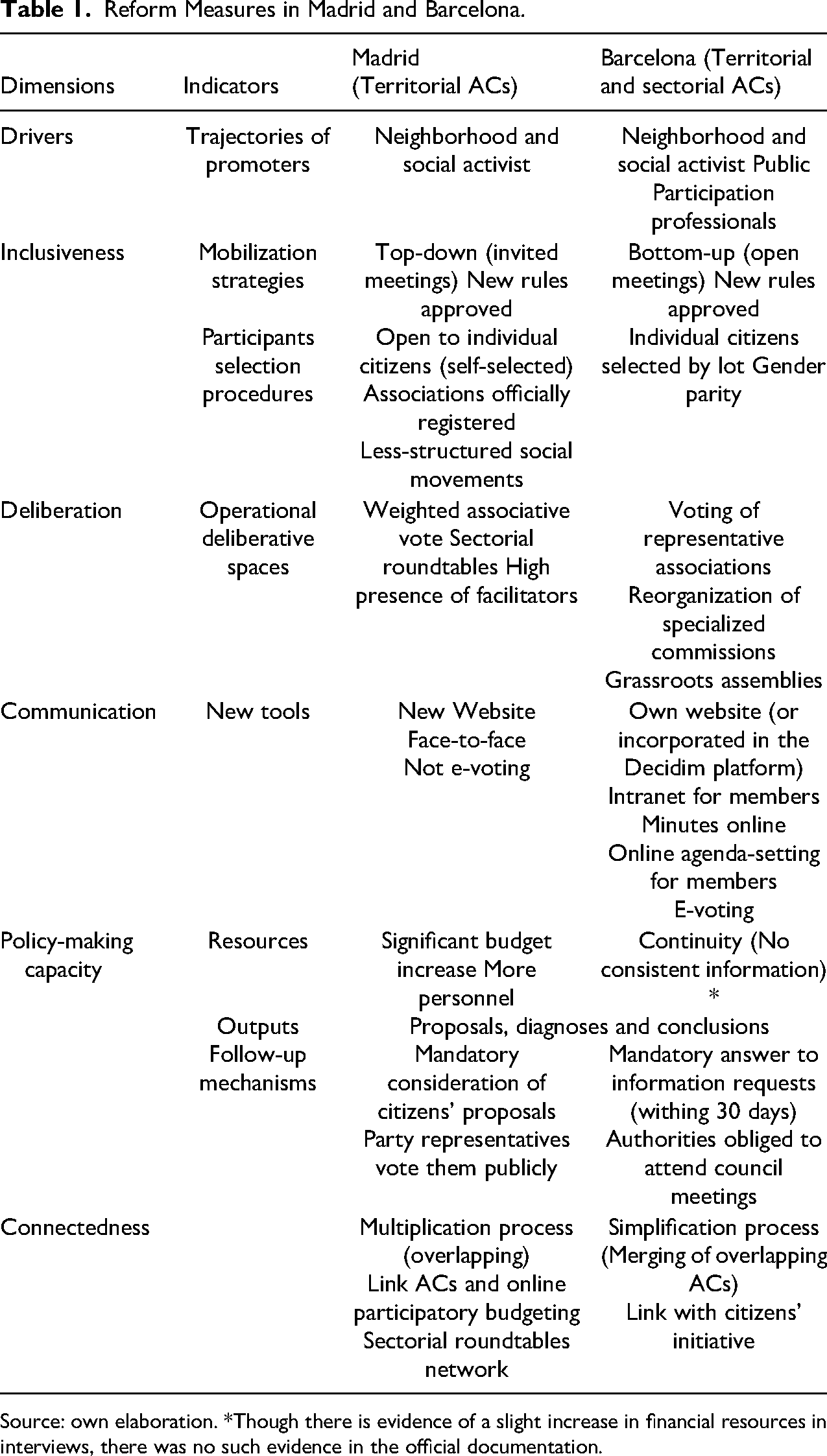
Source: own elaboration. *Though there is evidence of a slight increase in financial resources in interviews, there was no such evidence in the official documentation.
The ACs Reform Strategies in Madrid and Barcelona
Kick-Start: Promoters and Mobilization
In Barcelona, the Participation Department was headed by Gala Pin, a neighborhood and social activist, and its technical director was Fernando Pindado, a lawyer specialized in public participation who had previously been deputy director of the Regional Department of Participation and vice-president of the Federation of Neighborhood Associations. They proposed the reform of the entire participatory rules at local level which started in 2016 with the introduction of an open-source online platform to launch citizens’ proposals (Decidim.Barcelona). They also promoted citizens’ initiatives, online participatory budgeting (Charnock et al. 2021), and the Municipal and District Plans were the result of online participation combined with neighborhood meetings (Eizaguirre et al. 2017).
In the case of Madrid, the ACs reform was promoted by the Territorial Coordination and Associations Department which was headed by Nacho Murgui, an artist, social activist and ex-leader of the Regional Neighborhood Associations’ Federation. In parallel, the newly created Department of Citizen Participation, Transparency and Open Government approved measures such as popular online consultations, online participatory budgeting, public hearings, and citizen initiatives (Welp 2017). These processes were launched through the Decide.Madrid online platform, which was at the center of the city's official participatory activity at that time. Another innovation was the Observatory, a citizen jury comprising randomly selected citizens that contributed to the evaluation of local policies (Ganuza and Menéndez-Blanco 2019). In contrast to these democratic innovations, mostly online devices, the new system of district ACs (foros locales) was presented as the face-to-face dimension of the new participatory policy (Nez 2019).
In the case of Barcelona, there was an intense one-year participatory process to mobilize and gather proposals on reform. It included workshops with politicians and public officials, eleven open meetings in districts (under the rallying call “What participation do we want?”), and a parallel online inbox (through the Decidim.Barcelona website), which received 139 suggestions. The powerful Federation of Neighborhood Associations made relevant contributions to the design. Finally, in 2018, the new participation rules were adopted by a majority vote in the City Council.
In Madrid, the participatory process for this reform, which predates the one in Barcelona, was more limited. Early in 2016 the Madrid government decided to create a new system of district councils (discarding the old territorial ACs), and a first draft was written by Councilor Nacho Murgui and his academic consultants. The participatory phase took place mainly in the Associations’ Council which brought together a sample of traditional organizations. The social leaders discussed and amended the initial draft, which was later examined by the districts’ political representatives. In the last phase, it was submitted to public hearing, 5 and it ended with a final project which included the replacement of the old territorial ACs with a new kind of territorial body: the local forums. These were conceived as spaces for collective deliberation, diagnosis, and proposal making (Caballero Ferrándiz 2020; Medina-García et al. 2021). Their rules were finally approved in December 2016 by a majority vote in the City Council. 6
Both reform processes were preceded by a phase of associative mobilization, which must be understood in the broader context of a change of government after the elections in Madrid and Barcelona. Also, they can be interpreted as a consequence of the arrival of promoters (new councilors and their teams) with an intense participatory background inside and outside municipal institutions.
Participants’ Selection Procedures
Once the initial mobilization phase was completed and the new rules of operation were approved, the next step was to start the process of selecting the participants. Both reforms incorporated changes in the composition of ACs to foster the participation of individual members and social movement activists, beyond the traditional associative base. In Barcelona, the new regulation established selection by lots of individuals as a complement to associations’ voices. For example, in sectorial ACs, the idea was to draw lots from the population census (according to several criteria including age, gender and national origins). For each seat in a sectorial council, a lot is drawn from the people fulfilling the criteria laid down. If these people refuse, other citizens are called upon until all seats are filled. This draw mechanism is considered anti-oligarchic by political theorists in the sense that it is a counterweight to the traditional voices of the associations. Authorities consider that the introduction of people selected by lots may bring fresh perspectives into ACs, as this member of the government suggests, “I see that many associations, not the new ones that we are inviting, but the old ones that have been in the AC for a long time, are somehow settled in their views. It will not be easy to open the space to other perspectives.” Broadening the membership base may bring, as a side effect, new points of view into these spaces. Members of associations react to individuals’ participation arguing that since the ACs’ plenaries are already too large, broadening the membership may hinder deliberation. For example, the Immigration Council of Barcelona, with more than sixty associations, was to include around twenty individuals selected by lots. This enlargement was criticized by some members as an obstacle to debate: It is true that the participation of individual citizens needs to be managed somehow. Councils are very inclusive, the Citizens’ Council, for example, is gigantic, and the Immigration Council is very large too. Then… the participation of immigrants, the entities dedicated to working with them, plus drawing lots… It's complicated (Association representative).
In Madrid, the new policy also came from a commitment to include individual citizens into the dynamics of ACs. Consequently, for the plenaries of local forums, all residents over sixteen years of age can register. As well as this, all the associations working in a district can register their representatives. As this political cadre explains, “We wanted to create a shared space for civil society, and for people interested in community issues who are not yet organized in groups,” “We wanted a space that would be a meeting point.” The final composition of local forums depends on the associative fabric of the district: individual participants are frequently also members of associations or activists in social movements, even if they participate as individual neighbors. 7 Another aspect to consider is how their engagement fits in with traditional associations. In local forums, decisions are made through majority voting, so the vote of the members is weighted according to their profile: whether they participate individually or as representatives of associations. Thus, in the plenary meetings, an individual has one vote, an association with 100 or fewer, has two votes; if it has 101–500 members, it is granted five votes; and if it has more than 500 members, it gets six votes. Even though this combination of individual and association membership has been conflictive in other cases (Ganuza et al. 2014), our interviewees do not question the weighting of votes.
Another concern in Madrid was the inclusion of less formalized social movements, which frequently are not officially registered in the municipality. Previously, the rules were too strict in this regard: only associations listed in the official register could take part in ACs. This obstacle was removed in sectorial ACs, for example the Associations’ Council, which allowed informal entities such as social movements or youth assemblies to have access as full members. With these changes in membership, the Barcelona and Madrid governments increased the diversity of participants beyond the usual representation of associations. This opening was especially significant in Madrid, where individuals and activists (not organized in traditional groups) had an opportunity to engage in ACs. As an effect, the new participatory opportunities were exploited by members of the socio-political opposition to lobby against the government's measures. 8 More so in Madrid than in Barcelona, the enlargement of membership entailed the incorporation of voices not previously heard in district institutions. In this dimension of inclusiveness measures, path dependency affected strongly in Barcelona which adopted a controlled opening through citizen lots, while in Madrid the creation of a completely new structure with an open composition allowed the engagement of all self-selected entities and individuals.
Specialized Deliberative Bodies
The reforms also enhanced the performance of specialized and working commissions, which became the ACs’ deliberative core in Madrid and Barcelona. Because of the enlargement of plenaries, the governments had to boost other smaller deliberative enclaves. Working commissions became the central forum where reports and proposals are discussed before plenaries, and where experts may play a greater role in providing information. Though a simple measure, it has been positively received by the interviewed participants in Barcelona. This is because of the change in the usual top-down dynamics in which the authorities’ information predominates: It implies a more bottom-up approach, in the sense that from now on the AC is structured in work commissions. These commissions are freely elected, not rigid, and flexible over time, to deal with current issues in the field of education […] The plenary of the AC becomes a space where the commissions’ representatives inform and share their deliberations and reports with the other members. (Member of the government) The commissions are now becoming real work. (Association member)
Overcoming the habitual information and vertical dynamics was a central aim for authorities and has been received positively by participants. For example, with almost 100 members, discussions in the Municipal School Council were almost impossible. Formerly, there were three commissions, but they were not active. After the reform, the number of commissions increases since their creation becomes flexible (each AC can establish as many as are needed). Furthermore, other deliberative bodies are established: grassroot parents’ and students’ assemblies held in schools or in the districts to discuss specific issues (e.g., debates about council elections). These spaces, formed by specialized participants in the first case (commissions), and by community members with experiential knowledge in the second (assemblies) are intended to improve the formulation of proposals by providing room for discussion.
In Madrid, the quality of deliberations is also expected to increase in specialized commissions. Members of local forums are organized in ‘sectorial roundtables’: these can be set up by a minimum of five registered members and must be approved by the plenary. Sectorial roundtables are open to the forums’ officially registered participants and can also include individuals, experts, and other members of associations (with speaking but not voting rights). These are thought of as the foundation stone for deliberation and the space in which to elaborate proposals. Much work was undertaken by these roundtables in the 2017 − 2018 period when 275 of them were set up.
9
The roundtables on education were especially proactive in detecting critical issues. For example, they created a city-wide network for members of the educational community to meet and discuss city-level recommendations. As many participants are schoolteachers, or members of parents’ associations, they engage with expert and first-hand knowledge to discuss highly specific recommendations. Members of these roundtables explain the relevance of expert and experiential knowledge in the formulation of demands: We design projects, for example, counseling services in the district. We proposed this as a public initiative because… here, most people do not have money to pay for such services. As a teacher I say to many parents, “your child seems to be depressed, feeling bad, you need to go to a psychologist.” And where can the mom go if she does not have money? Then I thought, “the city should organize this service.” (Association member) It [the education roundtable] is like an expert panel. It is made up of teachers, people who know a lot, not only about the legislation […] they are impressively wise (Association member).
The reformers relied on the suitability of small groups (commissions, working groups, roundtables) of specialized community participants as the cornerstone of deliberation (Johnson and Gastil 2015). This approach is pragmatic as it aims to encourage the engagement of those who are highly interested in an issue to produce policy proposals which are informed by expert and experiential knowledge (Nez 2016). Additionally, the focus on specialized commissions allows in-depth debate, offsetting the enlargement of AC plenaries, where discussion may be superficial or complicated. Independently from the structural or partial reform, both cases relied on small group settings for deliberation.
New ICT Tools
Other tools widely introduced through the reform of ACs are Internet-based. They are proposed to ‘incorporate ACs into the 21st century’ as stated in Barcelona's first reform document. Internet-based tools are used for disseminating news (development of websites), intranet for members (internal communication) and e-platforms for the election of representatives. In the Barcelona's territorial ACs, for example, all the district bodies are on the Decidim.Barcelona e-platform, allowing the publication of minutes and the drafting of collaborative agendas. Sectorial ACs are equipped with similar tools, for example, the Municipal School Council now has a website to disseminate information and to facilitate the work of representatives (it includes a minutes repository). It also has an online electoral site (on the Decidim.Barcelona platform) to facilitate voting for parent and student representatives. 10 Under the previous regulation, the procedure required going in person to the polling-station to vote for one's favorite candidates; but turnout rates were low (from 2 percent to 17 percent, according to the secretariat). Online voting is expected to increase the turnout rates for social representatives, a central priority for the Barcelona government, as a leading member states, “The aim of the City Council is precisely to promote this. Implementing electronic voting systems to facilitate citizen participation […] It is not easy [for ACs], because the e-platform Decidim.Barcelona is for processes which involve thousands of people. It is too big for us [ACs]. We’re thinking how to adapt it.” Participants seem less concerned about ICT tools, though they evaluate positively the dissemination of information, the public visualization of their contribution and the outcomes of their voluntary work. Furthermore, as this associative member explains, they welcome online horizontal interaction in between face-to-face sessions, “They are opening a space to dynamize online discussions and that's great” (Association member).
The case of Madrid has been less innovative in this respect, where the activity of local forums can be followed via their own website, but no other tools for e-voting or internal communication have been implemented. In the latter case, the policy efforts were devoted to activating the new participatory structure with basic human and economic resources, while in Barcelona the improvement of existent relationships and the visibility of volunteer work were central objectives, which were pursued with the inclusion of ICT tools.
Resources
The reform implied a significant increase in resources in Madrid, while in Barcelona documentary evidence is vague, as noted in Table 1, reform policy in Madrid benefited from a remarkable growth in human and financial resources (Janoschka and Mota 2021). The budget assigned to local forums was €840,000 in the year 2017, so finance was available for new activities (campaigns, publicity on social media, bus adverts), and for hiring more personnel, specifically for the facilitation, coordination, and promotion of the new territorial ACs. This was a complete novelty for this type of institution: 21 facilitators were appointed to support and moderate sessions. They circulated the meeting details among the members and associations, organized the assemblies, wrote the minutes, and attended the meetings of the sectorial roundtables (the thematic commissions attached to local forums). They became the contact persons for citizens wishing to know more about the new institution and were also key agents in the recruitment of participants. However, as their work was limited to dynamization and mobilization, volunteer participants felt overloaded with the organization of other campaigns, as these volunteers observe: The organization of conferences has been a hard job [for volunteers]. You had to do everything from shopping, calling the caterers, looking for the conference speakers, facilitation of the discussion groups, and dynamization of discussions without professional support… After that, we had to collect the proposals, summarize them, present them, disseminate the results… And, what else? I mean, all the tasks of organizing a conference: you do it yourself (Association member). We should establish limits for volunteer work, because I had evaluated the sessions, we had organized working groups, we had prepared the sessions, and of course, this effort amounts to two months of professional work (Association member).
Not all forums were equally active, but members who were especially involved felt overburdened due to excessive voluntary work and the scarcity of administrative personnel dedicated to supporting their activity. These volunteers from the associations worked hard and suffered from fatigue and exhaustion. Thus, the amount of personnel was perceived as meagre, and the work overload was a central concern for local forum participants. While the creation of a new structure in Madrid was accompanied by a significant increase in human and economic assets – even if it was perceived as limited by participants – in Barcelona the continuity in structure and resources characterized the reform process: institutional efforts concentrated on the improvement of the ACs’ dynamics. ‘Path dependency,’ understood as the influence of previous structuration and distribution of resources (Moulaert et al. 2007), had a major influence in Barcelona, while the creation of new structures allowed a significant reallocation of resources in Madrid.
Intermediate Outputs and Follow-up Mechanisms
The AC reforms also covered the introduction of responsiveness mechanisms to further their policy-making capacity and strengthen the influence of their advice. In the case of Barcelona, participants from associations perceived that, under the previous regulation, their contribution to ACs was neglected: recommendations and proposals were not sufficiently considered by the local administration; nobody answered their reports and demands, and proposals were “left on the shelf” (Anonymized; Sarasa and Guiu 2001). As an association member argues, “Sometimes, it [the AC] is bereft [of authority]. People think that it should have more decision-making powers and more leverage to influence political decisions. Maybe the current rules will allow it.” (Association member)
Given this long-standing demand from associations, the reform incorporates two follow-up mechanisms. The first consists of the duty to reply within 30 days to information requests received, which compels the administration to provide the requested data to AC members. This is crucial for drafting proposals with sufficient information, or for holding the government accountable regarding previous demands. Second, also within a 30-day deadline, public authorities are obliged to attend meetings to explain the decisions taken. These measures do not change the advisory nature of ACs but do make a difference with regards to their policy-making capacity and citizen control if compared to earlier times when initiatives were not necessarily studied by the authorities.
In Madrid, the new system for submitting proposals in local forums also incorporated a follow-up mechanism which strengthened their advisory function. Under the new system, local forums put forward three types of outputs: proposals, diagnoses and conclusions. The proposals are recommendations which are submitted to the district government: a maximum of three proposals are presented to the District Representatives Council
11
each month, which means 33 per year. The political representatives in the District Council must publicly vote on the citizens’ submissions. These proposals are deemed “referential” because they must be discussed by the represented parties. The diagnoses are reports on thematic issues which are considered relevant by members of the forums. Finally, the conclusions are declarative recommendations: their purpose is to express the opinion of local forums regarding the local policy measures. In the end, it is the first output (citizens’ proposals) which reinforces the advisory function of the forums, as this participant suggests: In the District Council, all sessions have a time slot for local forum proposals. In that slot, the forum's vice-president presents the measures. There is a turn for the political groups to reply, a counter-reply for the forum itself, and then a vote is taken. I mean, there is a mini debate, and the proposal is voted on. So far, all our proposals have been approved (Association member). Really? Yes, all political groups voted in favor. They did not want to look bad, it's unpopular to vote against a proposal which comes from the forum. We take advantage of this.
These responsiveness measures compel the authorities to consider the participants’ petitions, and to offer a public answer to them. The advisory essence of these institutions does not change, but their function is clarified and reinforced: the “chain of sovereignty” (Baiocchi et al. 2011, p. 139) becomes more transparent. The main problem according to participants (both in Barcelona and Madrid) emerges when proposals exceed the scope of district powers or municipal administrations. In those cases, recommendations are reformulated, or they end up being declarations that higher levels of government do not necessarily study. Although this lack of acknowledgement by higher authorities is a critical issue for participants, 12 they still appreciate the ability to make local authorities more responsive than before. Here, the reform strategies of Madrid and Barcelona were concurrent: they incorporated responsiveness measures while preserving and enhancing the advisory function.
Connectedness of the Participatory Ecosystem
Finally, the proliferation of participatory mechanisms has led to the introduction of measures to aid coordination: connection instruments to overcome the fragmentation of the participatory channels. In this respect, the Barcelona reform implied a simplification process, targeting overlapping and obsolete ACs. As an example, while implementing the reform of the Municipal School Council (MSC), 13 overlaps were observed with other spaces, such as the commission for the Education Plan. This commission was absorbed by the MSC, which broadened its political scope to include new topics. 14 The promoters merged and connected intersecting ACs. Furthermore, territorial ACs are now connected to other participatory tools, namely, citizens’ initiatives (which enable signatures to be gathered for a proposal). Any district neighbor can launch an initiative and collect signatures so that the corresponding territorial AC meets and discusses the issue; similarly, AC members can boost initiatives. As an associative participant points out, this can be a new tool to press authorities to include new issues in their agenda. Connectedness, in this case, implied merging overlapping ACs, and coupling them with popular initiatives.
The Madrid case shows the effort made to connect online and off-line participation. First, district forums and sectorial roundtables were linked through the creation of networks (e.g., the education roundtables’ network which meets occasionally for city-level proposals and coordination). Second, the coupling of ACs and Internet-based participatory tools has been thoroughly reviewed. Thus, local forums can take part in online participatory budgeting by submitting collective proposals. Therefore, if a forum sends a project to the annual participatory budgeting process, it is shown as being backed collectively by that forum, unlike individual propositions. As this participant explains: On behalf of our local forum, we proposed two measures to the participatory budgeting process which were approved by citizens. They have been included in the city's budget, over €6 million in 2018 (Association member). The Madrid government is creating new councils, but previously there were more [sectorial ACs] … For example, how is the work of the local forums coordinated with the sectorial councils? There are different layers, the debate [regarding overlapping cases] was opened, but it was not closed (Association member).
These cases show that a combination of connection tools which takes advantage of the benefits of each participatory institution may be convenient: first, mechanisms for coordination and suppression of overlapping ACs; and second, their connection with other procedures such as popular initiatives or participatory budgeting. In this aspect, the logic of path dependency underscored a strategy of improvement and refinement in Barcelona (e.g., solving old burdens such as overlapping bodies), while in Madrid the innovation strategy led to dysfunctionalities (overlapping, again) which were not completely addressed.
Why Different Strategies? Path Dependency as Key Factor
It can be said that both reforms shared a common agenda which was preceded by participatory processes dominated by associative agents. Also, the two cases show some similarities in terms of the debates or measures which are approved: a concern regarding the inclusion of individual members and militants of social movements; the activation of new enclaves for specialized deliberation (in assemblies for affected groups, or in expert roundtables); the full incorporation of ICT tools as in other participatory institutions; follow-up mechanisms and a reflection on ACs connectedness with other bodies in the participatory ecosystem, overcoming the existing fragmentation.
However, the cases show dissimilarities which are connected to alternative reform strategies in the end. Thus, as described, in Barcelona authorities pursued a scheme based on the refinement of the vast system of ACs. The reform process was understood from the perspective of continuity and ‘path dependency’: permanency in general structure and distribution of resources. The logic was an improvement of already existing dynamics and conservation of the vast structure, due to the strong path dependency provoked by the previous existence of more than 150 bodies. In contrast, path dependency was not so powerful in the case of Madrid, where the previous territorial ACs were few and were discredited, even among the conservative leaders that created them. Thus, the new government adopted a scheme of new structuration (local forums), with its own dotation of human and economic resources, an experimental composition, a new policy capacity, and special procedures for the coordination with online participatory budgeting. As Janoschka and Mota (2021) have showed, the participatory agenda in Madrid was constrained by certain legal and financial aspects, but reformers had more room for transformation in this realm in comparison to other redistribute policies such as municipal budgets, housing or urban planning.
The scope for experimentation was greater in Madrid, while in Barcelona the logic was one of refinement. One case was characterized by restructuration, the other by slight improvement. Thus, path dependency (and its absence) contributes to understanding the alternative logics that these two governments followed, even when a common agenda and debate were at play. Other studies support this analysis: the rationale of strengthening already-existing participation has been highlighted in Barcelona, without being considered a complete novelty (Blanco et al. 2020; Bua and Bussu 2021). In contrast, the process of creating new participatory mechanisms in Madrid has been described as “hacking” the previous institutional framework (Medina-García et al. 2021).
Discussion
The Madrid and Barcelona cases point to new possibilities for the reform of urban ACs. Many cities around the world have ACs akin to those in Spain (Campos and Gonzalez 1999): spaces where a selection of associations meet (sometimes with experts, politicians, public officials and lay citizens), work permanently or at least steadily, and make informed recommendations, which are loosely connected to final political decisions (Cooper and Musso 1999; Sintomer and Maillard 2007; Piper and Lieres 2008; Schneider and Welp 2015). These institutions have been criticized for not being inclusive enough, for their lack of transparent links with policy-making, and due to the scarce consideration given to proposals which are placed under the category of advice. The cases of Madrid and Barcelona (2015–2019) point to a variety of practical solutions to deal with these concerns.
Comparing the two cases, a similar political context and a common agenda with specific measures can be distinguished. Firstly, the role of promoters is a controversial issue: some researchers have pointed out that very often organizers are recruited among local activists who, acting as mediators, bias the enrollment of participants (Montambeault and Goirand 2016). Beyond the impact of the mobilization bias, the promoters’ leadership is a fundamental piece for the creation – and in this case the reform and renewal – of a local participatory structure (Nez and Ganuza, 2020). From our cases, we can highlight its potential in terms of social mobilization and political commitment. The case of Madrid was characterized by a more decisive opening, however, in the case of Barcelona its promoters opted for a more controlled social renewal. Thus, sharing a similar personal trajectory and political agenda – in terms of citizen participation – does not always translate into identical reform strategies to revitalize existing participatory structures, as we saw in the cases of Madrid and Barcelona during the period of 2015−2019.
Regarding the changes in the selection procedures, the reformers in Madrid and Barcelona were innovative. Allowing the participation of individuals (selected by lots or self-selected) and of less formal organizations (for example, the social movements which sprang up during the Great Recession) was crucial for renewing the public of these institutions (Caballero Ferrándiz 2020), without diminishing the traditional role played by associations (Ganuza et al. 2014). Even if ACs are not the most inclusive institutions (they do not mobilize as many people as participatory budgeting assemblies or popular initiatives), governments’ efforts tended to broaden the opportunities for non-organized people, activists, and randomly selected citizens. The membership of ACs becomes (slightly) more diverse, despite a tendency for associative predominance and the professional profile of members (e.g., technical personnel from NGOs or other professionalized associations). The changes in membership revitalized attendance, also provoking also changes in deliberative dynamics.
Following with deliberation, authorities expected to attract more diverse voices by involving non-organized individuals and social movement activists in the ACs. The results of this measure in terms of voice diversity are still a matter of discussion. New people with different profiles coming from neighborhoods, schools, professional groups or social movements, participated and voiced their demands, especially in the case of Madrid. Future studies should examine the impact of randomly selected individuals on deliberations (as it has been the case in Barcelona). Our study cannot be conclusive about the deliberative benefits of including individual profiles throughout these mechanisms. Conversely, there are more certainties about the results of specialized deliberation through work commissions and roundtables. In these smaller structures, issue-interested people meet to discuss and draw up proposals. In Madrid, as in Barcelona, this measure has been received positively by participants who bring their expert and experiential knowledge to commissions, to enrich projects. The activity and functioning of roundtables depend considerably on the dynamism of the associative fabric which engages on a regular basis, and also on the support resources. However, this measure seems to have provoked satisfaction in participants who perceive their participation as useful. Closely related to the functionality of deliberation, participants also consider that the introduction of ICT tools for the election of members, as well as for communication and information aimed at the general public is relevant for their work to be valued (making their contribution publicly known). Furthermore, ICT tools allowed to incorporate ACs into the online participatory ecosystem, as has happened with other participatory institutions (Barros and Sampaio 2016).
As our cases show, ACs can produce a wide range of outputs: discussing proposals or evaluating policy measures; organizing conferences and campaigns; conducting surveys among neighbors; boosting popular initiatives, and other activities. Nonetheless, they require financial and administrative resources, and also personnel to avoid participant overload and, ultimately, frustration. Our cases show that resources are a critical aspect in AC reform. Members of associations (and other categories of participants) need to be supported with personnel, financial, and administrative resources to supplement their voluntary work. For example, the allocation of funds, administrative support, and hiring of facilitation experts in Madrid was crucial for meetings to be motivating and to mobilize participants.
With regarding to follow-up mechanisms, albeit limited, they are a significant step forward when compared to the scarce control powers granted to ACs in earlier times (Sarasa and Guiu 2001). Politicians being obliged to consider citizens’ proposals publicly, or answer the questions or the requests of participants, was not previously guaranteed. The lack of account when proposals are not implemented is one of the weaknesses of participatory institutions (Anonymized), which has been partially addressed by the reforms in Madrid and Barcelona. This measure contributes to the appreciation and acknowledgement of the work done by volunteers, together with other changes such as publicizing results via ICT tools. This is a relevant aspect that reforms of urban ACs could consider: even when constitutional or legal frameworks prohibit binding decision-making by these participatory spaces, authorities can introduce responsiveness and follow-up measures which reduce uncertainty regarding proposal-making, and acknowledge the efforts made by contributors.
Overall, the reform in Barcelona was dominated by path dependency and previous organizational inertia, while in Madrid the logic was more open to experimentation. Paradoxically, however, the reform continued developing in Barcelona after 2019, while in Madrid, local forums were substituted by a more traditional structure of associational ACs in 2021. Taking the theoretical proposal of Bua and Bussu (2021), these processes of reform illustrate two attempts to connect traditional governance institutions (municipal ACs) with the world of social movements, new critical associations, and non-oligarchic forms of drawing lots. In both cases, the incentives entailed the recognition of specialized deliberative enclaves and new responsiveness measures. However, while the case of Madrid clearly surpassed the traditional “governance” model of creating participatory spaces for the associative elites and the habitual associative clients (Navarro 1999; Martínez-Palacios 2021), local forums only lasted for three years. The long-term impacts of this reform will have to be analyzed in the memories of participants and associations. The case of Barcelona did not go beyond the traditional governance model (focused mainly on formal associations), but it did incorporate measures such as drawing lots which could open ACs to social demands and agents which were absent before. The effects of these measures will have to be addressed in the future, even when they are expected to be tentative and scarce.
Our work has built on those processes of municipal reform for the first time, but it does have certain limitations. First, future studies will need to analyze the consolidation of these changes, especially in Barcelona, and their practical implications and degree of success in different sectors. This prospective would be appropriate since the policies implemented in both cities have experienced different trajectories (further development in Barcelona, a new reformation in 2021 in Madrid). Second, our study is also limited with regards to international comparability (Wollmann 2004) since there is little research on the reform of urban ACs in other cities after local government changes. The problems of Spanish urban ACs are equivalent to those highlighted by international literature; consequently, we hope that as a result of the present work, researchers will pay more attention to the reform of these old-school participatory institutions.
Supplemental Material
sj-docx-1-uar-10.1177_10780874221109444 - Supplemental material for Assessing the New Municipalism Reform of Advisory Councils: The Cases of Madrid and Barcelona (2015–2019)
Supplemental material, sj-docx-1-uar-10.1177_10780874221109444 for Assessing the New Municipalism Reform of Advisory Councils: The Cases of Madrid and Barcelona (2015–2019) by José Luis Fernández-Martínez, Patricia García-Espín and Pau Alarcón in Urban Affairs Review
Footnotes
Acknowledgements
This paper is part of the project ASSODEM (CSO2015–66026-R), funded by the Spanish Ministry of Economy, Industry, and Innovation. We thank the other members of the Assodem research team for their suggestions: Joan Font, Carol Galais, Sara Pasadas, Carlos Ricos, Laurence Bherer, and Graham Smith.
Declaration of Conflicting Interests
The author(s) declared no potential conflicts of interest with respect to the research, authorship, and/or publication of this article.
Funding
The author(s) disclosed receipt of the following financial support for the research, authorship, and/or publication of this article: This work was supported by the Ministerio de Ciencia e Innovación, (grant number CSO2015-66026-R).

Supplemental Material
Supplemental material for this article is available online.
Notes
Author Biographies
References
Supplementary Material
Please find the following supplemental material available below.
For Open Access articles published under a Creative Commons License, all supplemental material carries the same license as the article it is associated with.
For non-Open Access articles published, all supplemental material carries a non-exclusive license, and permission requests for re-use of supplemental material or any part of supplemental material shall be sent directly to the copyright owner as specified in the copyright notice associated with the article.
