







Abstract
Recently, there has been renewed interest in engaging citizens locally. While political motivations vary, a common goal is to enhance participation and representation by creating formal bodies of community representatives to play an advisory role in policy processes. This paper integrates implementation feasibility and participatory theories to develop a theoretical framework for assessing the implementation of public participation mechanisms. It applies this framework in an analysis of Detroit, which adopted a charter-mandated Community Advisory Council system within the new city council districts in 2012. The research illuminates the limitations of Detroit's system, explaining why citywide implementation continues to lag. The findings underscore the importance of cohesive statutory objectives, institutional reform that supports the coordinated efforts of city agents, clarity of decision rules, dedicated city resources, and commitment on the part of community, political, and administrative leaders in such reforms.
Introduction
In 2012, Detroit enacted a new city charter that mandated a return to a district council system from the at-large system that had been in place since 1918. The charter reform reflected a renewed emphasis on localized representation and the role of public participation in urban governance. In addition to the district council system, the charter established a system of Community Advisory Councils (CACs) to provide stakeholder opportunities to communicate needs and preferences to the city government. This participatory reform occurred when Detroit was undergoing a recovery process following the filing of Chapter 9 bankruptcy in 2013, a moment in which participation had important value and faced critical barriers. The experience of Detroit can illuminate the potential for participatory governance in cities grappling with inequity and marginalization (Reckhow, Downey, and Sapotichne 2020).
There are challenges to creating equitable systems of public participation (Collins and Del Rey 2020). Participatory systems, even if well-intended, may reinforce rather than ameliorate patterns of marginalization (Clark 2018). This can be a particular issue in shrinking cities such as Detroit that experience disparities across local institutions (Markus and Krings 2020). Recognizing the importance of accessibility to resources among participants (Raco and Flint 2001), this research develops a theoretical framework for assessing the implementation of a participation system, focusing on the barriers and prospects for its success.
This research adopts Nabatchi and Leighninger's (2015) definition of public participation as “activities by which people's concerns, needs, interests, and values are incorporated into decisions and actions on public matters and issues” (6). Public participation can influence policy processes when it is “sustained by a robust participation infrastructure,” such as laws, processes, and associations (Nabatchi and Leighninger 2015, 6) that enable participatory governance. This study focuses on a specific form of participatory infrastructure: a participation system designed at the council district level to serve as a formal advisory mechanism in city governance.
To date, the CAC system remains partially realized, in no small part because many of the conditions that justified increased participation also constituted barriers to its implementation. These include weak systems of representation and disparities of power and capacity across neighborhoods. This paper considers the prospects of such a system playing a positive role in revitalization, identifying the theoretical value of place-based participation, and querying what is required to initiate and support a vibrant system of engagement. The analysis considers the extent to which the statutory design of the Detroit system and its nonstatutory political and social context appear to support successful implementation.
This paper integrates theories of implementation feasibility with participatory theories to develop a framework for implementation analysis. A qualitative assessment based on this framework highlights the importance of the clarity of statutory objectives, institutional reform to coordinate efforts, decision rules supportive of the objectives of the CAC system, and resources facilitating its activation as critical statutory factors in promoting participation. It also argues that the motivations of the community and political leaders play a vital role in its success. This study contributes to participation literature by exploring the design principles that support effective implementation and by emphasizing the need to account for the substantial costs and administrative burdens associated with activating participation mechanisms. The findings underscore the importance of thoughtfully designing participatory systems in contexts marked by underlying unequal access to resources in community organizing, demonstrating the particular importance of good statutory design to reduce administrative burden, making reform less dependent on nonstatutory factors. The proposed framework also offers a practical guide that can be used by scholars and practitioners in assessing the design and implementation of participation systems in urban governance.
Theory: Design and Implementation of Local Participatory Institutions
Classical theorists who view democracy as both means and ends argue for participation that promotes constitutive benefits. The rationale for participation at the local level is that it is central to the establishment and maintenance of a democratic polity (Pateman 1970). When citizens participate, they gain opportunities for deliberation and reflection, and in the process, become aware of how public and private interests are intertwined. Local participation is crucial because it is here that one develops the necessary capacities for self-governance, demonstrating the increasing reliance on participatory reforms to revitalize representative democratic systems (Jun and Musso 2013, Musso et al. 2011). From this view, efforts to strengthen representative democracy by increasing voter turnout are insufficient because voting is a solitary act that does not necessarily involve serious deliberation. A potential value of local participation is to rectify the democratic deficits in the representative system (Fung 2004).
Other supporting arguments focus on instrumental considerations, arguing that stakeholder input into the delivery of public services can help administrators manage the complexity of urban problems (Musso 1999). Neighborhood associations “often have goals aimed at the preservation or improvement of conditions in a geographically delineated area and typically are directed by local residents” (Meyer and Hyde 2004, 77S). The sharing of geographically demarcated space is recognized by previous literature, pointing out that this shapes the interests communities pursue (Martin 2003). Involving neighborhood associations systematically in urban governance, it is argued, can promote the “institutionalized role that the neighborhood associations play in transmitting the demands, preferences, and complaints of their constituents to various administrative agencies” (Berry, Portney, and Thomson 1993, 111).
The proponents of localized participation assert that benefits can be realized through proper institutional design and have identified various design factors of participation mechanisms (Bobbio 2019, Smith 2009, Warren and Pearse 2008, Clark 2018, Jo 2024, Fernández-Martínez, García-Espín, and Alarcón 2023, Bryson et al. 2013). What is lacking in the current literature is a focus on design guidelines specific to the implementation stage of participatory reforms. The design aspect is critical, as Eckerd and Heidelberg (2020) contend, “if participation is not formalized, it may well not occur, but when participation is formalized, it is shaped to fit within the administrative function” (144).
Design Requisites
Berry, Portney, and Thomson (1993) propose an ideal type of participatory mechanism that will lead to a strong democratic system by emphasizing the importance of both the breadth and depth of participation. Increasing the breadth of participation results in more people being involved in governance processes and systems that better represent the citizenry. To achieve this outcome, participatory mechanisms should facilitate citizen access to the decision-making process; the city should provide various resources such as information, budget, and staff, and should make outreach efforts within the communities. Enhanced depth of participation improves policy responsiveness by opening up the decision-making process. Deepening participation in decision-making requires providing more opportunities to involve residents in the budget process and a greater level of involvement from administrators as well (Berry, Portney, and Thomson 1993, 57–69). There are, however, various conditions to be met for the successful establishment of a formal citywide participation mechanism. Musso et al. (2011) point out that developing a strong democratic system requires attention to the design and implementation of participatory structures. The question, then, is whether the necessary conditions exist to support the successful implementation of features recognized as requisites of an effective participatory system. In general, policy literature stresses that programs are not self-executing and that design flaws or a poor fit between statutory features and the implementation environment may thwart successful execution (Pressman and Wildavsky 1984, Bardach 1977).
Sabatier and Mazmanian (1995) provide a framework for analyzing implementation that emphasizes the importance of problem tractability, statutory design, and nonstatutory features of the implementation context. The “tractability of the problem being addressed by the statute” has to do with the very nature of the public problem that the policy is trying to address (Sabatier and Mazmanian 1995, 154–157). As they point out, “some social problems are much easier to deal with than others” (154), suggesting the need for modesty in expectations regarding social problem-solving. It is safe to stipulate that strengthening local democracy is a challenge, particularly within a city experiencing the economic challenges confronting Detroit. That said, Sabatier and Mazmanian (1995) point out that “one should be cautious about placing too much emphasis on the tractability of the problem being addressed” (156).
Taking problem intractability as a given, the development of a strong democratic system in urban areas requires key statutory features as well as the likelihood of supporting nonstatutory conditions for implementation (also see Berry, Portney, and Thomson 1993, Sabatier and Mazmanian 1995, Bryson et al. 2013). Table 1 integrates these conditions identified by Sabatier and Mazmanian (1995) with theories of participatory design to develop a framework for analyzing the implementation of participatory mechanisms. Statutory factors involve the legal and formal framework of a program, coherently structuring the implementation process, whereas nonstatutory factors are exogenous features of the political and socioeconomic context that may interact with statutory features to support or constrain execution.
Implementation Framework for Strong Participatory Structure.
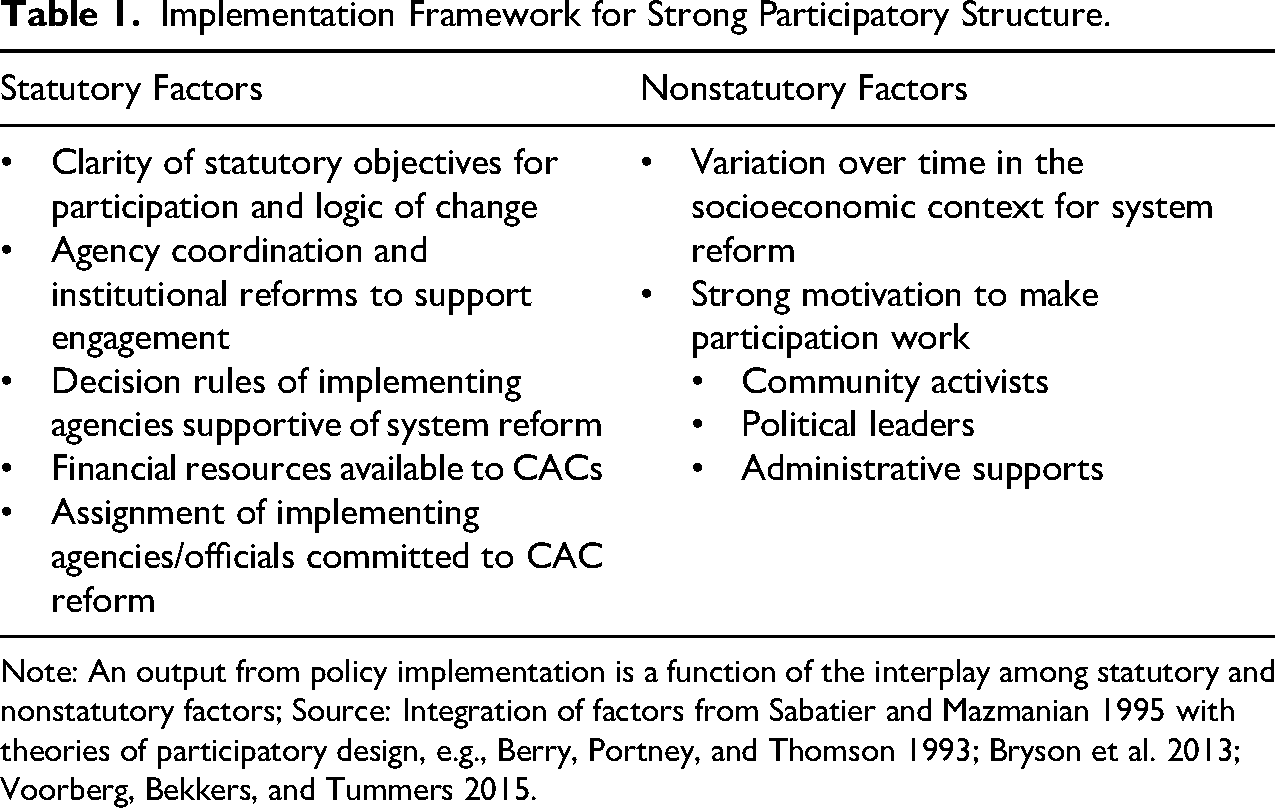
Note: An output from policy implementation is a function of the interplay among statutory and nonstatutory factors; Source: Integration of factors from Sabatier and Mazmanian 1995 with theories of participatory design, e.g., Berry, Portney, and Thomson 1993; Bryson et al. 2013; Voorberg, Bekkers, and Tummers 2015.
Statutory Features of Implementing Participatory Reforms
The first statutory factor concerns the clarity of the objectives underlying participatory reform. To ensure effective implementation, “the statute stipulates a set of clear and consistent objectives” by incorporating sound causal theory (Sabatier and Mazmanian 1995, 157–158). From a design perspective, Bryson et al. (2013) emphasize the importance of participation goals, noting that this step is “overlooked remarkably often in practice” (26). While Sabatier and Mazmanian (1995) highlight the extent to which statute enables hierarchical integration of agencies to support coordination, participation mechanisms also require institutional reforms that foster engagement between community organizers and city agencies, including “developing a systematic flow of information to the neighborhoods; supporting neighborhood outreach and communications; providing specific mechanisms for policy input on key development, planning, and budgeting issues” (Berry, Portney, and Thomson 1993, 50). As a design principle, Berry, Portney, and Thomson (1993) stress that these foundational innovations should be “present at the outset rather than added piecemeal as the system developed” to promote its sustainability (50).
The third statutory factor is whether “the decision rules of the implementing agencies are supportive of statutory objectives” (Sabatier and Mazmanian 1995, 159). Within the context of participation, this requirement critically relates to the institutional design of participation (Bherer 2010, Berry, Portney, and Thomson 1993, Smith 2009, Bryson et al. 2013). Specifically, Berry, Portney, and Thomson (1993) stress the importance of the initial design of the participatory mechanism. Their comparative work identifies several design features, most importantly: (1) a citywide system and (2) size and community identity. First, a citywide participation system should be established in the initial stage of its implementation. That is, no communities should be left out in the beginning when the system is launched, and all communities must be organized simultaneously. This is particularly important in cities where there is unequal access to resources in place-based reforms (Raco and Flint 2001). Second, participation should be based on a community—a small, natural neighborhood—to facilitate face-to-face communication through which social networks can emerge (Weare, Musso, and Jun 2009, Musso et al. 2006). As Levine (2017) cautions, the concept of community needs to be substantive, rather than a “vague ideal” that allows political officials to evade accountability to an identified group or population (1176). In theory, this should be accomplished through a place-based approach that embeds participation in smaller communities that are defined at the grassroots, as there is a positive association between community size and participatory behaviors (Smith 1994). Size is related to community identity and “the extent to which a community has developed characteristics that establish it as a well-defined unit” (Kweit and Kweit 1981, 115). Berry, Portney, and Thomson (1993) observe that the ideal size of a participatory infrastructure is to represent a community of 2,000–5,000 residents residing within natural neighborhood boundaries (49).
As shown in Table 1, also important are the resources available for the implementation of the system (Mathews 2023). A critical issue is whether there are financial resources and staff members dedicated to the implementation process, as well as the function of the new system. According to a 2009 State of Profession survey by the International City/County Management Association, approximately 31 percent of municipalities provided budgetary support for public participation in general. Among city resources committed to the implementation of the participatory system, providing support through city staff is critical. Berry, Portney, and Thomson (1993) argue that a key criterion to assess the “strength of a citywide effort” is “the number of full-time staff members devoted to citizen and neighborhood outreach” (61).
Nonstatutory Factors in the Implementation Stage
The framework in Table 1 stresses nonstatutory factors that interact with the basic legal structure of the participation mechanism and influence its success during implementation. 1 The first factor is the variation over time in socioeconomic contexts that impacts the achievement of statutory objectives by altering perceptions of the relative importance of the problem (Sabatier and Mazmanian 1995). These changes are linked to the issue-attention cycle of residents and the level and continuity of media attention to the participatory reform.
Ongoing political and administrative leadership is also critical and difficult to build into statutory designs, although it can be affected by the design itself. For example, if statutory designs are weak, greater support from the political and social environment will be required. In addition to establishing a well-structured plan for implementing the reform, Sabatier and Mazmanian (1995) stress that “the policy outputs of implementing agencies are essentially a function of the interaction between legal structure and political process” (162). On balance, various political variables are highly influential determinants in the implementation process, along with the legal framework of participation. Thus, the potential for success requires “strong motivation to make participation work” of various stakeholders (Berry, Portney, and Thomson 1993, 48). Political support for participatory innovation needs to come from both bottom-up and top-down. Citizens should demand a greater level of participation and be part of neighborhood governance. The role of political and administrative leadership, including extensive outreach by city officials and community leaders, is essential in these endeavors to involve citizens in decision-making processes (Voorberg, Bekkers, and Tummers 2015). This is particularly true for historically marginalized communities, where there may be distrust and skepticism about the motivations or willingness of local governments to engage community members (Parlow 2010).
Implementation of Detroit's Community Advisory Councils
The theoretical framework established in Table 1 can serve as a template for evaluating the design and implementation of participatory reforms. In the remainder of the paper, we utilize this model to explore the interplay of design, political support, and implementation of participatory reform undertaken in the City of Detroit—the creation of a CAC system in 2012—during a period when the local democratic process was temporarily suspended under the emergency manager system. 2 This case points to the potential benefits of participation under austerity, but also raises questions regarding the prospects for implementation under such conditions. Studies of community councils suggest that they can increase the quality of participation, build social capital, and assist political mobilization, all important goals in cities seeking revitalization (Musso et al. 2011). Parlow (2010) emphasizes that “the legal inclusion of neighborhood councils into local government structures may provide a new opportunity for increased civic participation for minority groups—providing them with the ability to become more ensconced and influential in local government decision-making” (86). In the words of a Detroit community organizer, “Ultimately, the revitalization of Detroit is tied to the success of our neighborhoods. We must respect and uplift the local expertise and knowledge of residents and invest in their capacity to determine the future of their communities” (Goodman 2014, para. 8). However, limited research exists on how participatory reforms are implemented in shrinking cities under austerity regimes (Markus and Krings 2020). This study addresses that gap through a qualitative analysis of Detroit's system, developing and applying an implementation framework to a participatory infrastructure adopted during a period of significant crisis and reform.
Case Context and Research Design
The participatory reform in Detroit occurred in a time of continued fiscal stress and economic downturn due to deindustrialization and disinvestment in the urban core. Detroit's population at its peak was 1,849,568 in the 1950s (Myler 2013), compared to less than 650,000 in 2024. This decline required the City to contend with blight and abandonment, including an area of vacant land that covered 20 square miles, approximately equivalent to the size of Manhattan (Davey 2014). According to the U.S. Census Bureau, Detroit's poverty rate in 2021 was estimated at 31.8 percent, the highest in the U.S. among cities with at least 100,000 people (Deloitte 2023).
In March 2013, just before Detroit's economic collapse, the Michigan governor appointed an emergency manager to take over the responsibilities of locally elected officials, a form of “democratic dissolution” that emphasizes the corporate status of the city while suspending democratic processes (Anderson 2012). In July 2013, Detroit filed for Chapter 9 bankruptcy and subsequently underwent a restructuring process with the emergency manager in charge. The Detroit Financial Review Commission 3 has overseen city finances since 2014. While dealing with the economic crisis, Detroit adopted a new city charter in January 2012 through the passage of Proposal D, a referendum that established a hybrid system for electing the City Council, replacing the at-large system the city had used since 1918. In 2013, Detroiters elected city council representatives from each of the seven districts and two additional members in at-large seats. Table 2, which presents the demographic characteristics by districts in 2022, shows that districts are comparable in size and socioeconomic characteristics.
Demographic Characteristics by Districts.
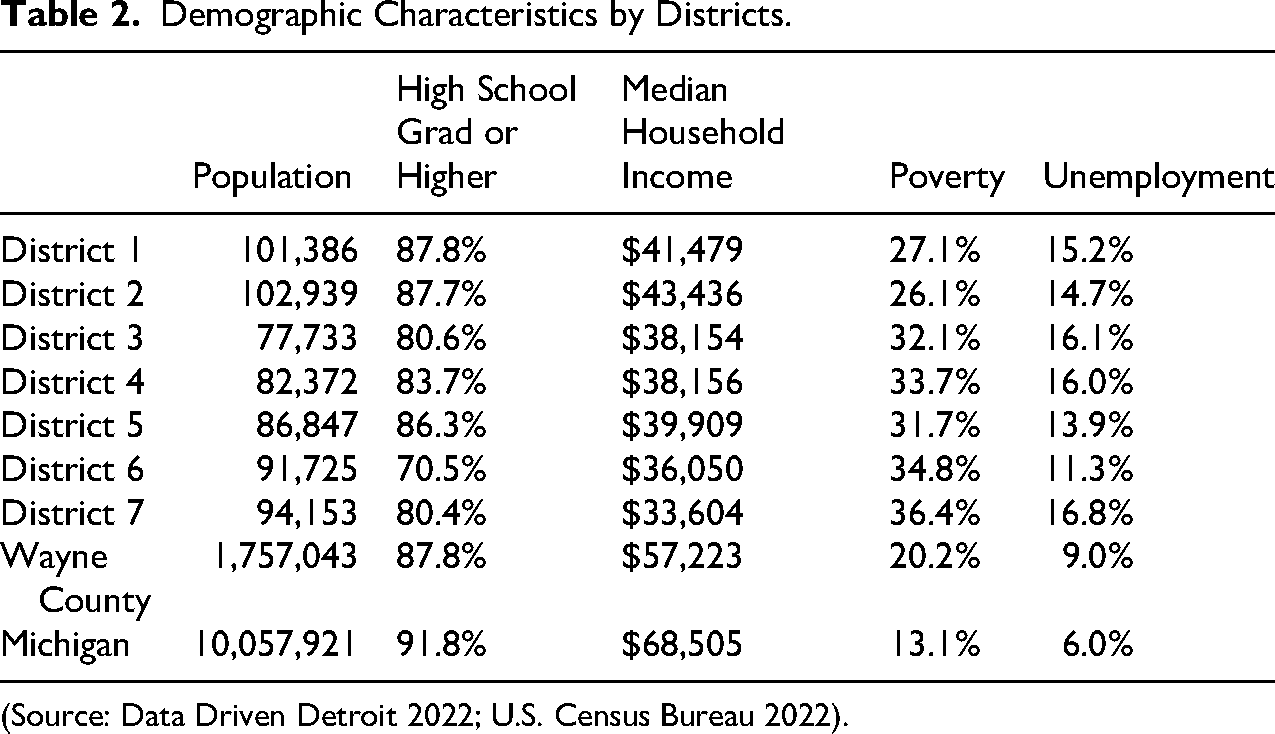
(Source: Data Driven Detroit 2022; U.S. Census Bureau 2022).
The new charter also required the creation of a CAC in each council district. This study conducts qualitative research on the implementation process of Detroit's CAC system, presenting an assessment of the rollout of this participatory mechanism, which was authorized in 2012 but has only been partially implemented in 2024. The primary sources of data are stakeholder interviews and secondary sources of data obtained from extensive archival research. Texts from these sources were coded and analyzed using ATLAS.ti software. In total, we examined 851 primary texts (see Table 3).
Data Sources.

First, archival research and documentary reviews were performed to collect secondary sources of information. Relevant policy documents, meeting minutes from the CACs, City Council, other city agencies, and the Charter Revision Commission, local newspaper articles, 4 podcasts, social media posts, communications among community activists, and newsletters from community organizations served as secondary data sources.
Next, primary data were gathered through interviews with community stakeholders, residents who are community activists in their respective districts, civic organizations, and elected CAC members. A majority of elected CAC members were community activists in their districts who gathered petition signatures in the initial stage of CAC creation. Some community activists were also part of civic organizations that supported the system's initial rollout. The main reason community activists were the focus of qualitative data collection was that, by design, the CAC system was implemented using a bottom-up process in which community members are responsible for system development. In this data collection stage, the initial interviewee recruitment focused on key activists who were first identified through archival research. This research also employed a snowball sampling technique to recruit additional stakeholders involved in the early outreach process in each district. From 2017 to 2024, 18 interviews were conducted with community activists, elected CAC members, and one city council staff member. The interviews were conducted in person, by phone, and in an online meeting format, with each interview lasting about 45 min to an hour. They were semi-structured in format, utilizing a questionnaire that focuses on the implementation barriers of the CAC system, based on the theoretical framework in Table 1 (see Supplemental Appendix 1 for interview questions).
The analytic approach to the study is a mixture of deductive analysis complemented by inductive reasoning to generate propositions that crystallize the factors in designing a successful participation mechanism. The analysis first employed a deductive approach based on the theoretical framework (Azungah 2018, Miles and Huberman 1994), adapted from implementation feasibility (Sabatier and Mazmanian 1995) and public participation literature (Berry, Portney, and Thomson 1993, Bryson et al. 2013). The theoretical framework presented in Table 1 was applied in the analysis to identify the core concepts in the data. This analytic approach was supplemented by inductive analysis to derive new concepts and themes from raw data and “not from a priori expectations or models” (Thomas 2006, 239). That is, the coding was an iterative process of integrating previous literature with an inductive reading of the text in consultation with our research questions. This part of the analysis was aided by in vivo coding utilizing ATLAS.ti software (Sybing n.d.).
Findings: Prospects for Detroit's Community Advisory Council System
The analysis of the implementation feasibility of Detroit's CAC system uncovers the importance of (1) design issues embedded in supporting decision rules and resources as statutory factors and (2) political motivation and leadership as nonstatutory factors. The findings suggest that these factors have contributed to the city's inability to fully implement the system to date.
Implementation Timeline and Progress
Figure 1 presents the progress made in implementing the CAC system. Following the charter reform's effective date of 2012, it was not until April 2014 that the new district-based City Council adopted the ordinance, launching the procedures for the creation and operation of CACs. In September 2014, District 7 was the only district that was successful in collecting sufficient signatures for the petition to establish a CAC in their community. Because of the tight July 22, 2014, deadline to submit petitions to run for CAC boards (Community Development Advocates of Detroit 2014b), District 7 CAC members were not elected for another two years, in 2016. In February 2019, the District 7 City Council member accepted nominations from their CAC and made senior and youth appointments (Detroit City Council 2019). In November 2021, District 7 also had its second election, electing five CAC members.
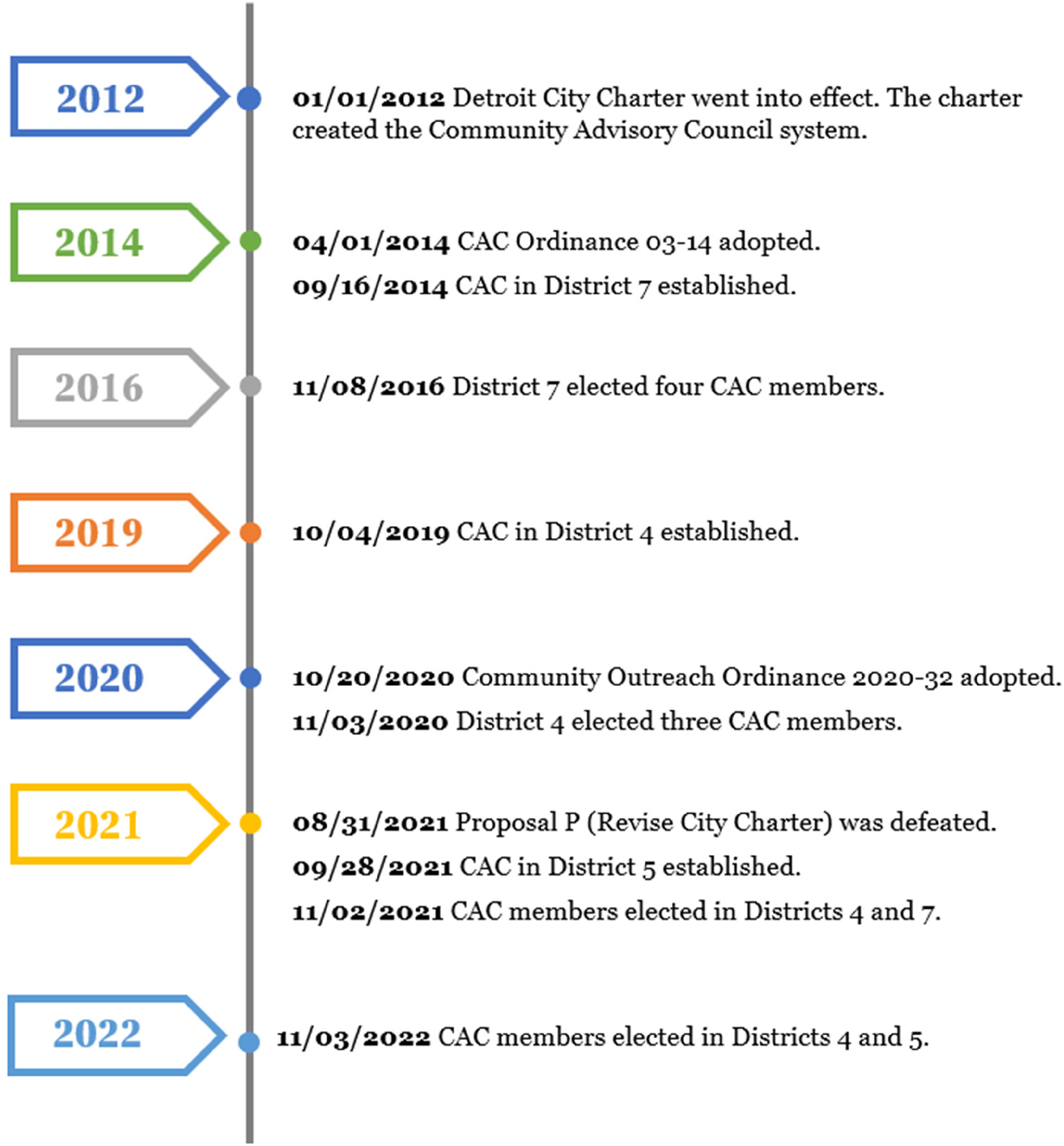
Community advisory council system implementation timeline.
From 2019 to 2022, there were further developments in Districts 4 and 5. In 2019, District 4 was the second out of seven districts to establish its CAC (Telegram Newspaper 2019), and in 2020 and 2021, District 4 residents elected their CAC members. As of April 2024, District 4 has a complete CAC board holding monthly meetings (City of Detroit 2024). According to their meeting agenda and minutes, District 4 CAC created working groups to tackle community issues and has been conducting meetings with the City Council and Mayor as mandated by the city charter. 5 In 2021, District 5 established its CAC, and in 2023, its residents elected five CAC members. District 5 CAC has a complete board with senior and youth members appointed by its city council member.
As noted in Figure 1, Detroit subsequently attempted to strengthen the role of CACs. For example, in 2020, the City Council enacted the Community Outreach Ordinance (No. 2020-32) “to demonstrate the city's commitment to community outreach that promotes transparency and accountability and ensures community awareness on legislation, contracts, agreements, and resolutions” (Detroit City Council 2021, 1). This ordinance specifically requires that city departments, in collaboration with the Department of Neighborhoods, provide “digital notification to city council members and the established Community Advisory Councils representing the impacted neighborhood” (Ordinance No. 2020-32) and that CACs forward city notices of the outreach process to community members in their district. More importantly, the 2018–2021 City Charter Revision Commission proposed a new charter (Proposal P), which would have significantly strengthened the CAC system by reducing the number of petition signatures, providing meeting stipends to CAC members, and allowing appropriations from city funds. However, Proposal P was defeated in the August 2021 election (Citizens Research Council of Michigan 2021).
Clarity in Statutory Objectives and the Logic of Change in Community Advisory Councils
As presented in Table 1, the statutory objectives and logic of change in the participatory infrastructure should be clear for the successful implementation of system reform. In the case of Detroit, the CAC system was adopted to advise the City Council and the Mayor on issues concerning district residents. The charter describes them as serving as mediating structures by “assisting groups, agencies, businesses, and residents in community problem solving by meeting with groups to (a) clarify issues; and (b) demonstrate proper procedural approaches to accessing city government” (City of Detroit 2012 Section §9–103). The charter envisions CACs having an instrumental role in primarily advising the City Council on community issues related to housing development, blight, public safety, and economic development. The charter also mandates that CACs annually meet with the City Council and the Mayor “to discuss the challenges confronting the district and resources required to advance the interest and support the viability of the district” (City of Detroit 2012 Section §9–103). In addition to information dissemination to residents in their districts, the CACs are expected to represent community interests to the City Council.
Despite these official goals of the system, several community activists noted that the importance and tangible benefits of the system were not clear to the residents. In particular, one interviewee stated: The system was too far removed from the daily issues and lives of citizens. And the rewards are delayed. The sense of urgency to organize and the relevance of the system were pretty low for the communities to initiate the process. (Community activist, personal communication, January 9, 2019)
Another related issue is overlap and confusion with the existing participation mechanisms, such as the Citizens’ District Council (CDC) system and other community-based organizations. Specifically, the CDCs are “advisory bodies created by State law enabling legislation to give a defined “community” a mechanism to voice its opinion about development activities going on in that community” (Detroit City Council 2014a, 1). 6 This confusion was not only expressed by the residents and community activists but also by the City Council. Before the City Council adopted the 2014 ordinance for CAC implementation, then Council President Pro-Tempore asked the Legislative Policy Division to clarify the role of CAC and CDC and to “address whether these boards may be combined or whether one can put in place of or in lieu of the other so as to avoid multiple elections” (Detroit City Council 2014a, 1).
Due to the lack of a clear perception of the role and function of the CACs, some residents believed it would compete with other community groups and “replace their favorite community group” (Telegram Newspaper 2019). One of the community activists who collected petition signatures encountered objections from residents and stated that: His objection is that we're trying to replace the homeowner associations…. I was not interested in doing that at all. I'm like, Oh, you know, that's a different thing. We're not trying to be a homeowner association. We are there for the purpose of improving communication between the city government and the people … we're a bridge, not a wall, or something like that, or a toll gate. In other words, it's kind of like you have one bridge to reach over to your City Council. And now you have another one. We're trying to improve. We're not trying to become gatekeepers to who gets to talk to their Council. (CAC member, personal communication, February 10, 2024) Proposition 1: Clear statutory objectives and the logic of change in improving public participation promote the successful creation of community advisory councils.
Institutional Reform and Coordinated Efforts
A key statutory feature essential for successful implementation is the hierarchical integration of stakeholders to orchestrate the newly adopted participation mechanism. In activating the CAC system, hierarchical integration through institutional reform is essential to facilitate coordinated action between community organizers and the city agencies, such as the City Council, City Clerk's Office, and Department of Elections, responsible for overseeing this process.
Two main challenges related to institutional reform for hierarchical integration have emerged during the implementation process. First, in the early stages following the adoption of the 2012 charter, delays in enacting the CAC ordinance and the absence of clear guidance from the City regarding petition and election procedures hindered the initial mobilizing efforts within Detroit communities. Interviewees echoed the lack of direction and communication from the City during this critical phase. Specifically, in a letter from a group of concerned citizens and organizations interested in establishing CACs to the City Council, community activists stated: We are asking for clarification on the required steps that need to be taken by citizens in council districts as well as by the City Council in order to bring the Community Advisory Councils into being. The 2012 Charter has been in effect for nearly two years, and Community Advisory Councils were one of the key reforms included to improve citizen engagement with city government and our elected officials. However, citizens still have received no guidance on how to establish Community Advisory Councils, and now that our newly elected District Council Members are ready to take office in January, accurate information on the implementation of this Charter requirement is urgently needed. (Community Development Advocates of Detroit 2013)
Second, once the CAC entity is successfully activated in the district, the next step is to establish the CAC board through elections and appointments, ensuring hierarchical integration with the city government. This integration enables the CAC to fulfill its statutory objectives and serve as a mediating structure between residents and city agencies. However, this second stage of establishing the CAC board and meeting the quorum requirements has been challenging, particularly regarding the issue of appointing vacant seats and youth and senior members by the City Council. For instance, in their initial elections, Districts 4 and 7 were unable to elect all five CAC members, and delays from their respective city council members in filling vacancies and appointing youth and senior members further stalled the process. One of the elected CAC members noted their frustration with the City Council's appointment process, stating that: Apparently, the quorum in their ordinance said that four, or their Law Department's interpretation, the ordinance was that the quorum would be four. Well, we can't very well have four people, if we don't have four people, then what? What are we, right? …So we were actually meeting without a quorum just to do something and try to get some things rolling along because we needed to have someone appointed. (CAC member, personal communication, February 10, 2024) Proposition 2: Subsequent institutional reform through hierarchical integration between community activists and city government that facilitates coordinated efforts is essential for the successful implementation of community advisory councils.
Statutory Factors: Institutional Design Elements
Several statutory features of Detroit's institutional design of CAC also influenced the delayed and partial implementation of the system. While Berry, Portney, and Thomson (1993) stress the importance of creating residential commitment by establishing a system that is “citywide from the start,” the Detroit design created opt-in rules that posed multiple hurdles for approval, placing the onus on citizens and slowing implementation. Specifically, the establishment of a CAC requires residents to overcome two hurdles with high participation costs posing a substantial administrative burden. First, for city council recognition, residents have to submit petitions signed by at least 10 percent of the district's registered voters in the last municipal general election (City of Detroit 2012 Section §9–102). The number of signatures required to establish CACs ranged from 1,194 to 2,508 in 2014 (Detroit City Clerk 2014). Second, only after the CAC is established in each district, candidates for the elected CAC members must collect at least 200 nominating signatures by July prior to the subsequent election. In 2014, this two-stage petition process with the July deadline meant that it was infeasible to elect CAC members in 2014, requiring the CAC to wait for the next election in 2016 (Community Development Advocates of Detroit 2014a). Only one council district, District 7, succeeded in obtaining the required signatures for the petition, and the City Council subsequently established CAC in District 7. No CAC members were elected in the 2014 general election. Several community stakeholders observed the difficulty in gathering the petition signatures to establish the CAC as a significant hurdle. For example, a community activist described the difficulties of the petition process: You try and explain this thing and that like a 10-second, 15-second elevator speech. It's almost impossible [to explain] to your neighbors what this is, because, you know, you're trying to say like: Listen, by signing this, you're not supporting me, and you're not supporting anybody individual. You're supporting the idea that it could get on the ballot…. It's a barrier that is in place to keep to make it more challenging for community engagement. (Community activist, personal communication, October 6, 2023)
Additionally, several interviewees noted the 180-day timeframe for collecting signatures as a critical barrier that required petition signatures to be collected within 180 days of filing to be considered valid (Ballotpedia n.d.). If a petition drive was not successful in one year, then the community would need to start the first process all over again.
The obstacles created by the petition requirement were foreseen by one of the members of the 2009–2012 City Charter Revision Commission in the Phase III—Writing Phase. In response to Commissioner Robinson's motion to “adopt the concept of the community advisory counsels [sic] as articulated in the repealed Article 9 of the Old Home Rule Charter of 1973,” Commissioner Myers-Phillips noted that “the outdated idea that the advisory councils would be established by petition may be unduly burdensome and the citizens should not have to petition to get it since districts will now exist” (City of Detroit 2011). These initial concerns were not addressed in the 2012 City Charter, however. Based on these findings, we assert that: Proposition 3: The adoption of decision rules supportive of statutory objectives and the assignment of implementing agencies are essential to the successful creation of community advisory councils.
The design of the Detroit system also failed to capture a second important feature that participation should be structured around small and self-defined communities to facilitate face-to-face communication and enable deliberation. With the electoral reform to change the city council election from an at-large system to a district system, the boundaries of the CACs were predetermined in a top-down fashion by the charter to follow city council districts. Based on 2010 U.S. Census data, the number of residents that each CAC represents ranged between 97,000 and 106,407. The geographic area that the CAC needs to cover and the number of residents that CAC members need to represent leads one to question the effectiveness of its statutory role in representing communities descriptively and substantively.
Field interviews suggest that community activists’ perspectives regarding the size of the CAC district were mixed. In the initial implementation stage, some viewed that creating another geographical boundary other than the council districts would have been too confusing to the residents as they were getting familiarized with the district system (Community activist, personal communication, September 20, 2018). One other activist stated that size mattered in terms of how the city council districts were drawn in the first place. That is, the current district boundaries did not always coincide with the boundaries of existing neighborhoods and communities in Detroit (Community activist, personal communication, August 2, 2018). In terms of equality in organizing, one other resident noted that smaller boundaries of CAC would have been better than huge districts (Community activist, personal communication, October 23, 2018).
Considering the history of CAC, the current design to align with city council district boundaries was path-dependent. Starting with the 1972 charter reform movement, multiple attempts to establish a district-based council system failed, and the CAC system was introduced as a supplementary structure. In the 1970s, the political motivation behind the CAC system was to decentralize city government by enhancing community representation through council districts. As part of the municipal decentralization movement, the community council or the community government 7 system was conceived as an additional layer of electoral representation in each district (1970–1973 Charter Revision Commission 1972). In the 1990s, the CAC system was once again adopted more as a representative mechanism with the assumption that city council members would be elected by district. However, voters again did not approve the district-based council system during the charter revision process. As a result, the CAC system was never activated by the community. That is, the original CAC system was not envisioned as a place-based participation mechanism in smaller-scale communities; rather, its boundaries have always been tied to the city council boundaries by design, as the main function of each CAC is to represent the entire district and assist the city council member in their district.
Therefore, several interviewees perceived the primary role of CAC to be working alongside their city council members in representing and communicating the needs of the residents in each district. As one of the CAC members states: “the legislative branch and the CAC should fit like a hand in gloves” (CAC member, personal communication, September 4, 2024). In this sense, Detroit's CAC system has replicated the City Council in its respective district, functioning as a formal representative structure. This finding reveals the importance of distinguishing between district-based and place-based participation mechanisms. One could argue that the CAC's trajectory of development as a district-based participation system may constrain its potential to serve as a place-based participatory structure that meaningfully involves residents in making decisions affecting their neighborhoods. It appears that the democratic deficit within the existing representative system at the local level is being addressed through reforms that establish an additional formal representational body, rather than through the development of a place-based participation system operating at a smaller geographic scale that is community-based. This echoes Berry et al.'s (1993) observation that the initial design of participation should be “based on small, natural neighborhoods where regular, face-to-face discussion of issues was possible by all who would take the time to be involved” (49). Based on these observations, we argue that: Proposition 4: The imposition of boundary decisions deters the successful creation of community advisory councils as a place-based participation mechanism.
Financial and Human Resources in the Implementation Process
The Detroit CAC system also faces constraints related to material support, financial and human resources available to the agencies in charge of implementation (see Table 1). Resource support is required to make the CAC system an arena for meaningful engagement and not an “empty ritual of participation” (Arnstein 1969, 216), offering tokenistic opportunities to participate in the decision-making process (Sirianni 2007). Detroit's system does not allow for any financial or staff support from the City. Both the 2012 city charter and ordinance state, “CACs shall receive no appropriations from city funds, but may accept donations or grants in accordance with state, federal or local law” (City of Detroit 2012, Section §9–103). Initially, in 2014, the Ford Foundation made a grant to a Detroit-based nonprofit organization to provide support in building CACs in seven districts (Ford Foundation 2014). Nevertheless, most interviewees noted the restriction on city support as a crucial limitation in the system. One elected CAC member mentioned that even after they created a working board, they had to “go through a struggle” to use city websites to share information about CAC with their residents. A CAC member stated: The purpose of Community Advisory Councils is to improve communication between the City Council and residents, but that job is undermined when someone looks us up on the City's website, to see if we are the real deal, and finds nothing there. This lie of omission is a great disservice to the people of Detroit. It's not for the benefit of CAC members; it's a matter of our local government accurately informing residents about their own government. (Telegram Newspaper 2020)
In October 2019, the City Council asked the Law Department to address the following questions: “(1) what general resources are available to CACs; and (2) do CACs have the ability to be promoted on the City of Detroit's website just as other elected officials?” (City of Detroit Law Department 2020). The corporation counsel responded that: While the Charter and Code clearly prohibit appropriations to CACs, ancillary expenditures of “City resources” such as office supplies should also be avoided pursuant to the Code at Section 2-5-63, Improper use of City property prohibited, as no City policy or procedure authorizes such expenditures particularly given the explicit prohibition cited above. City staff assistance to a CAC should be approached with extreme caution to avoid running afoul of the provisions of the Standards of Conduct contained in the 2019 Detroit City Code, Chapter 2, Administration, Article V, Ethics, Section 2-5-1, et seq. (3)
As presented in Table 1, the last statutory factor relevant to the successful implementation process is the assignment of agencies and officials committed to achieving statutory objectives. In general, City support has been limited, despite early efforts by community activists seeking assistance from the Clerk's office and the Department of Elections. On July 22, 2014, community activists sent a letter to the City Council stating that: Despite the good faith efforts of hundreds of citizens, they have not been properly supported by the City of Detroit agencies responsible for informing the general public about the process and timeline for establishing CACs. … There have been no clear guidelines posted in writing or effectively communicated to citizens by city officials. Questions arising from community members about the process have been met with differing answers depending on the person and/or department with whom a citizen speaks… the lack of clear communication about the process may well impede efforts to establish a CAC in a district, placing voters and canvassers at a disadvantage. (Community Development Advocates of Detroit 2014b, 1) Proposition 5: The success of bottom-up volunteer organizing depends on statutorily provided resources that are available during the activation stage of community advisory councils.
Nonstatutory Factors: Variation Over Time in the Community and Political Leadership
As shown in Table 1, one key nonstatutory factor influencing the successful implementation of the newly adopted participation mechanism is the evolving socioeconomic context, including media attention. A crucial consideration during the system's initial adoption in 2012 was Detroit's economic situation. In July 2013, Detroit filed for Chapter 9 bankruptcy—the largest municipal insolvency in U.S. history—while also operating under the control of a state-appointed emergency manager until December 2014. Interviews suggest that there was little widespread support for CACs, as the City was facing a fiscal crisis and bankruptcy when communities began organizing CACs in 2014. Several interviewees emphasized that broader public support was lacking due to the overwhelming fiscal challenges Detroit was experiencing at the time.
Between 2014 and 2016, in the second round of gathering petition signatures, residents’ interests in the CAC system waned, and other policy issues overshadowed the activation process. During the 2016 election, community organizing efforts shifted to different policy priorities. One interviewee noted, “Voters are easily distracted. For example, currently, the main issue is the community benefits ordinance. There are other issues in the community related to quality of life that will gain the attention of the residents” (Community activist, personal communication, July 30, 2018). With the election of the 2018 City Charter Commission, several community activists expressed hopes for renewed interest in the CAC system; however, to date, the lack of general interest in the system appears to be prevalent. Recently, one of the candidates running for District 5 CAC stated that “People don't even know what's on their ballot for the proposals. And there's information about it. Like, people barely know who we are even when we tell them who we are and what we do” (Carter 2022).
In terms of media attention, a content analysis of local newspapers revealed minimal coverage of the CAC system, reinforcing the community's limited interest. For example, from the 1970s to the present, only 10 of the 69 articles on CAC and related charter revisions focused on the 2012 CAC system. Based on these findings, we propose that: Proposition 6: The successful activation of community advisory councils is contingent upon hospitable socioeconomic conditions.
Finally, the remaining key nonstatutory factor for a sustainable citywide participatory system involves support from political and administrative leaders who seek to make participation work within the conditions structured by statutory factors. This seemed to be lacking from the outset in Detroit, where the main focus during the charter revision process in 2012 was the change to a district system of representation rather than the CAC. The chair of the 2009–2012 Charter Revision Commission stated that the commission revived the CAC system “to give citizens more input to city government” (Sands 2012). However, the CAC proposal was one of more than 550 proposals solicited from Detroiters.
The lack of enthusiasm in the system appeared to continue following the adoption of the new charter, as the City Council failed to take action to implement the CAC ordinance as required within 90 days after the effective date of the Charter in March 2012. Instead, the City Council deferred the decision to the new district council elected in November 2013 (Wright 2012). On November 26, 2013, community activists and residents from seven districts submitted a letter to the new City Council requesting immediate council action on the CAC system (Community Development Advocates of Detroit 2013). This request was referred to the Planning and Economic Development Committee in January 2014, and in April 2014, the city council finally passed City Ordinance No. 03-14 on the creation and operation of CACs. This significant delay meant that community organizers had to initiate the development of the CAC system, as Detroit was going through a fiscal crisis under emergency management between March 2013 and December 2014.
Historically, Detroit mayors have not been strong advocates of the CAC system. In the 1970s, the CAC system was regarded as a reform strategy to decentralize the city hall; hence, political leadership did not fully support the system in past reform efforts. For instance, in 1972, Mayor Roman Gribbs objected to the creation of the system, stating that “a major and unneeded form of decentralization of city government would result from the eight community councils” (Hallas 1972). In 1974, the newly elected Mayor Coleman Young did not support the CAC proposal because “the Mayor's position is that you don’t give up power given to you by the electorate,” and that “the new charter creates a strong mayor, and the establishment of community government would compromise that concept” (Boyer 1974).
In the case of the 2012 CAC system, there is no clear evidence regarding Mayor Dave Bing's official position based on the activities of the 2009–2012 Charter Revision Commission. During the revision process, the Commission received over 550 recommendations from elected officials, city administrators, and citizens who participated in the Charter Conventions held in November–December 2011 (Bejma and Derdelakos n.d.). A review of these recommendations suggests that the proposal of the CAC system came from several citizens, while Mayor Bing's primary focus was on streamlining city government.
The lack of political interest in the CAC system was also reflected in the system's omission in the 2013 neighborhood plan proposed by Mayor Mike Duggan. As Mayor-elect, Duggan created a Department of Neighborhoods detached from the CACs, based on a plan to create district offices in seven districts throughout the City aimed at fostering collaborative relationships with communities. According to Duggan's neighborhood plan, the mission of the Department of Neighborhood is “to operate on a decentralized basis, by city council district, in coordination with the community development organizations, neighborhood associations, volunteer block clubs, and faith-based organizations” (Duggan 2013, 5). One of the stated goals of the Mayor's Department of Neighborhoods is “to organize a block club on every block, with several block clubs forming a neighborhood association in every neighborhood” (Duggan 2013, 5). Some community activists perceive that the Department of Neighborhoods overshadowed the reform to a district council system (Community activist, personal communication, September 20, 2018), and a CAC member noted that district managers of the Department of Neighborhoods work for the Mayor as his political appointees (CAC member, personal communication, September 4, 2024). Similar to other political actors, the Mayor's Office had not provided direct support in the initial organizing process laid out by the city charter. The lack of mayoral enthusiasm for the CAC system may be structural. According to the current city charter, the CAC system is designed as an extension of the structure of the council districts. The statutory role of the Mayor is limited, primarily to participating in annual meetings (City of Detroit 2012, Sec. §9–103). Recently, the District 4 CAC organized charter-mandated meetings with the Mayor's office, and district managers regularly attend their meetings.
From a political perspective, it appears that aside from pursuing the official statutory objectives of the CAC system, the city council members’ interests in supporting CACs would be to garner electoral support from residents in their respective districts. However, the level of council member interest differs among districts according to the interviewees. Direct assistance from the City Council in the implementation process was restricted as the January 15, 2020 memo from the city Law Department clarified that city staff should avoid offering assistance to CACs (City of Detroit Law Department 2020, 4). Nevertheless, staff support appeared relevant to the creation of District 5, the most recently established CAC. Although the petition drive relied on volunteer efforts from their community, District 5 of the City Council informed community activists about community meetings where they could circulate the petitions (CAC member, personal communication, February 12, 2024). The current District 4 city council member also states that one of their priorities is to “help to build a robust Community Advisory Council for the District to facilitate community discussion” with a focus on transparency and accountability (City Council District 4 n.d.).
The council members in Districts 4 and 7 did not seem to have offered direct support in collecting petition signatures; rather, success rested on community activists with an interest in the City office. For example, District 7 was the first to establish the CAC in 2014 and elect members in 2016. The initial petition drive was led by an aspiring politician who had run for higher office. This was a similar case for Districts 3, 4, and 5, although District 3 was not successful due to logistical reasons. This finding suggests the importance of support from community activists in the face of disinterest and delays among political officials. This is not to say that there was a groundswell of support for CACs, given that the City was in the midst of a fiscal crisis and bankruptcy by the time communities were able to organize CACs in 2014. An interviewee noted that the system lacked mass support in the context of all the changes that the city was going through (Community activist, personal communication, September 14, 2018).
Despite the lack of widespread community interest, leadership from grassroots organizers with political aspirations was vital to community organizing in successful districts. It should be noted, moreover, that given the constraints in the statutory design of the system, this support was particularly integral to success, in a manner that might not have been the case had the system been better resourced or designed with fewer obstacles to participation. In light of the high administrative burdens placed on communities that wished to seek recognition as CACs, it appears that correspondingly elevated political ambitions were necessary to overcome them. Based on these observations, we conclude that: Proposition 7: The successful implementation of community advisory councils relies on the strong motivations of community leaders with political aspirations, particularly in systems that are under-resourced or impose high administrative burdens for participation.
Concluding Discussion
This research provides a qualitative analysis of the prospects of Detroit's CAC system based on an implementation feasibility framework. The experience of Detroit demonstrates the importance of statutory factors, especially the clarity of statutory objectives, the initial design of the participatory system, and the institutional reform to achieve coordinated efforts, based on the ideal participatory model proposed by various public participation scholars (Smith 2009, Clark 2018, Bryson et al. 2013, Berry, Portney, and Thomson 1993). A particular limitation is the design of the system to reflect city council district boundaries, rather than organizing smaller units, which Berry, Portney, and Thomson (1993) found in their work to be a significant feature of success. The conflation of CAC and city council boundaries seems to have led to confusion regarding their function and may have contributed in part to a perception that they would serve as gatekeepers between council members and stakeholders, as opposed to a community-based forum for deliberation and communication.
The implementation analysis suggests that the statutory rules that govern the establishment of the CAC system created significant barriers to residents without direct support from the City, indicating the dynamic interaction between statutory and nonstatutory factors of success. Specifically, the two-stage procedure of collecting petition signatures to first establish their CAC and second to run for the CAC board election has posed a substantial administrative burden (Halling and Bækgaard 2024) and costs to resident volunteers (Collins and Medrano 2022). This, in turn, seemed to imply that political ambition and considerable commitment were required to overcome these burdens. Considering the economic fiasco that Detroit has been addressing since 2012, it is reasonable that resources could not be provided for the development of the system that involves high participation costs (Irvin and Stansbury 2004). As Smith (2009) also points out: democratic innovations require citizens and officials to participate in new political practices and as such will involve civic costs as well as benefits. While theorists and practitioners are often quick to stress the virtues and benefits of participation for participants and sponsoring institutions, an assessment of innovations will also need to consider the demands they place on citizens and on other institutions and whether these are worth bearing individually and socially. Administrative costs and the burden placed on citizens can thus be a feasibility constraint on democratic innovations. (26)
More importantly, democratic innovations through place-based mechanisms must demonstrate how the reification of inequality or the inherent inequality embedded in communities and places can be addressed throughout the implementation process. Collins and Del Rey (2020) note “Whereas many scholars have advocated neighborhood governance as a way to improve equity by expanding participation, […] This kind of civic participation requires that citizens have significant time and resources to dedicate and thus does not necessitate greater equity” (1428). Therefore, designers of participatory governance systems should be cautious as to whether new participation mechanisms “merely replicate the underlying inequality of the city” (Collins and Medrano 2022, 3) and consider how this issue could be addressed through institutional design. In the case of Detroit, not only the creation but also the maintenance of the established CACs will be contingent on the availability of resources. That is, continued operation of CACs will depend heavily on community resources. This case reveals that districts led by community activists who have invested significant time and energy have successfully established CACs. In contrast, districts lacking comparable community resources and social capital may struggle to initiate and sustain such councils without political support and resources. As a result, these districts risk falling behind their CAC-represented neighbors, particularly if established CACs are able to function effectively and advocate for improved representation and city services. In this way, the uneven development of CACs has the potential to deepen existing inequalities across districts. This finding should inspire CAC designers across contexts to focus on ensuring statutory factors that support successful implementation, even under challenging conditions. Without these factors, implementation is likely to be insurmountably burdensome to lower-resourced communities. Consequently, outcomes are likely to be uneven and inequitable.
As for nonstatutory factors, strong support from political, administrative, and community leaders is fundamental to overcoming collective action problems (Olson 1965). Particularly where statutory designs are weak, dedicated political support and leadership are essential “to overcome the inertia and delay inherent in seeking cooperation and acquiescence among large number of people” (Sabatier and Mazmanian 1995, 162). Given the importance of community leaders, Detroit's CAC system has the potential to serve as an alternative arena for self-determination and political influence in creating participatory governance. One potential consequence of the implementation of the CAC system suggests that the system is serving as “a training ground for minority leaders, who may then seek elected office at the local and higher levels of government” (Parlow 2010, 97) and “incubators for political entrepreneurs” (Collins and Medrano 2022, 9). However, at the same time, the quality of the participatory system itself will depend on those who participate with the goal of improving their communities and not “just using the CAC as a political springboard to higher offices” (Wright 2012).
In conclusion, the implementation process of Detroit's CAC system illustrates the challenges that arise in establishing a participation infrastructure in a shrinking urban landscape. This research contributes to the public participation literature by developing and empirically exploring a theoretically informed implementation model that highlights the institutional design features required to make place-based participation work in urban governance. Theoretically, our study shifts attention to the implementation stage within the growing literature on participation mechanism design (Bobbio 2019, Smith 2009, Warren and Pearse 2008, Clark 2018, Bryson et al. 2013, Jo 2024, Fernández-Martínez, García-Espín, and Alarcón 2023). The ability to establish and sustain the system will continue to depend on the statutory and nonstatutory factors shaping place-based participation. The proposed framework also offers a practical guide that can be used for the effective design and implementation of a public participation system in urban governance. That is, from a practical perspective, if cities are genuinely motivated to create authentic participatory governance, participation mechanisms based on certain geographic boundaries of the city require consideration of high costs, administrative burden, and resource constraints with explicit attention to underlying inequality across communities.
Supplemental Material
sj-docx-1-uar-10.1177_10780874251412363 - Supplemental material for Ingredients for Success: The Implementation of the Community Advisory Council System in the City of Detroit
Supplemental material, sj-docx-1-uar-10.1177_10780874251412363 for Ingredients for Success: The Implementation of the Community Advisory Council System in the City of Detroit by Kyu-Nahm Jun and Juliet Musso in Urban Affairs Review
Footnotes
Acknowledgments
The authors thank the UAR editors and the reviewers for their constructive comments on this article and are also grateful to the Detroit community activists and volunteers who shared their perspectives and invaluable insights for this research.

Funding
The authors received no financial support for the research, authorship, and/or publication of this article.
Declaration of Conflicting Interests
The authors declared no potential conflicts of interest with respect to the research, authorship, and/or publication of this article.
Supplemental Material
Supplemental material for this article is available online.