







Abstract
With unsheltered homelessness on the rise across U.S. urban landscapes, many municipalities with and without emergency shelter capacity implement periodic and/or targeted encampment displacements, where law enforcement, social services, health department officials, and environmental remediation specialists forcibly remove people experiencing unsheltered homelessness from encampments. Research demonstrates that abatements impact the health and wellbeing of encampment occupants; however, little is understood about the social, emotional, and community ramifications of displacements on folks who witness and/or participate in these events. To understand these broader impacts, interviews with professionals and community members (n=12) who are involved in various aspects of encampment displacement revealed participant emotional responses ranging from empathy to anger, demonstrating the complex and painful nature of displacement practices and policies. Participants justified their continuing abatement work and proposed alternative approaches to these incredibly complex issues. Displacements harm everyone involved, highlighting the trauma involved and underscoring the importance of honoring their experiences.
Introduction and Literature Review
Unsheltered homelessness is a growing problem in the United States, with negative consequences for the individuals living in homeless encampments and the communities tasked with addressing this complex social problem. While much research exists on the impact of homelessness from the perspective of those experiencing it, the larger impacts of community response are less frequently studied. Community concerns about homelessness often revolve around the nebulous but seemingly salient concept of “social order,” before being narrowed down to focus more directly on issues of perceived crime, safety, health, and environmental sustainability, among others (Herring 2021; Johnsen, Fitzpatrick and Watts 2018; Mitchell 2020; Tsai et al. 2019). These concerns provide rationalizations for displacements without due consideration of the process which places emotional, ethical, and even physical burdens on those faced with carrying them out. In this study, originally intended to study agencies’ rationalizations for conducting encampment displacements, we explore the emotional consequences and responses to displacements for those who find themselves in a role of implementing and/or facilitating the displacement.
In order to grasp the encampment displacement phenomena more fully, we begin by reviewing the literature on urban homeless encampments, responses to them, and the emotional impacts associated with encampment displacements for people experiencing unsheltered homelessness (PEUH). This work establishes a critical foundation for understanding the roles and justifications of those responsible for carrying out displacement policies. Specifically, our research question asks how experiences of encampment displacements affect those who are actually leading, conducting, and witnessing these events, with a focus on the felt emotional impacts. By examining the perspectives of those responsible for carrying out displacements and identifying key themes emerging from their lived experiences, we can better understand the breadth and depth of trauma associated with displacements—especially in populations beyond those experiencing homelessness themselves. These data can powerfully inform our collective approaches to urban unsheltered homelessness.
Homeless Encampments
Homeless encampments, often colloquially referred to as unsanctioned “tent cities,” are increasing in number throughout the United States, with notable increases in western urban areas (Orr et al. 2024; Parker 2020). Encampments are thought to be indicative of the larger problem of unsheltered homelessness, which has a variety of factors contributing to its growth (Barile, Pruitt and Parker 2018). The most salient of these factors is the lack of affordable and attainable housing (Colburn and Aldern 2022; Glynn, Byne and Culhane 2021).
Official and popular responses to homeless encampments are wide-ranging, from somewhat supportive and even legally sanctioned to seeming indifference to outright rejection (Mokhtari et al. 2025; Orr et al. 2024). Despite these varied responses, there appears to be rising attention to the visible presence of unsheltered homelessness in U.S. cities, with particular attention to those in the western United States. For instance, concerns with encampments have raised attention in newspapers in urban places like Oakland, Los Angeles, San Jose, San Francisco, Long Beach, Ventura, San Diego, Sacramento, Chico, Anchorage, Las Vegas, Honolulu, Eugene, Portland, Olympia, Seattle, Spokane, Salt Lake City, Denver, and many others. There is even a “List of Tent Cities in the United States” Wikipedia page. Prominent encampments in these urban areas range in terms of total population, demographics, spatial size, duration, location, and other basic descriptors (Herring 2014; Pitas et al. 2024).
Homeless encampments in the United States often defy simple categorization. Often, encampments feature a variety of tents, tarps, and other rudimentary constructions that provide informal, unsanctioned, and often inadequate shelter for people who otherwise lack secure housing. These structures slightly differentiate this form of unsheltered homelessness from those who are “rough sleeping” (e.g. Pleace 2000), people with literally no shelter, formal or informal, who are more thoroughly exposed to the environmental elements. Encampments are often located in relatively unbuilt spaces associated with abandoned lots, greenfields, brownfields, and automobile and transit infrastructures, like underpasses, interchanges, trainyards (Parker 2021; Richards and Kuhn 2023; Wykes and Simpson 2025). PEUH often establish encampments in spaces that allow for access to services and supports (Aykanian 2023), where they can meet basic needs (Simon et al. 2019; Townley et al. 2016). As such, these are not wholly free choices, as patterns of location and mobility are negotiated and/or constrained by factors including zoning, community attitudes, local policing, service locations, and access to transportation, among others (e.g. Bourlessas 2018; Herring, Yarbrough and Alatorre 2020; Marr, DeVerteuil and Snow 2009; Martino, Dej and Sanders 2025; McLeod et al. 2017, Rehn et al. 2024). Among the academic literature concerning urban homeless encampments, there is consensus that these living situations illustrate community and societal failures that subject inhabitants to harsh, unsustainable, and often unhealthy living conditions (e.g. Mitchell 2020; Rose 2017; Sparks 2017; Speer 2017), while at the same time, disrupting “the aesthetic notion of stability and growth” (Parker 2020, 329) in contemporary urban environments.
A defining feature of urban homeless encampments is their impermanence. Most often, encampments are relatively quickly disrupted and disbanded by a variety of “pervasive penalty” policing tactics, including move-along orders, citations, threats of arrest, and actual arrests (Herring, Yarbrough and Alatorre 2020; Martino, Dej and Sanders 2025; Weaver et al. 2025). While there are limited accounts of cities enacting sanctioned encampments in recent academic scholarship (e.g. Olson and Pauly 2023; Orr et al. 2024; Przybylinski 2024), these urban experiments are regularly met with clear opposition from a variety of community actors, and even sanctioned encampment supporters acknowledge that these material structures and social arrangements are not sustainable endeavors (Orr et al. 2024). The vast majority of urban encampments are unsanctioned, functioning in either an explicitly illegal status, where residents live in a high degree of uncertainty and precarity, or in a regulatorily nebulous status, where responsibility for regulation is either uncertain between various agencies and consequently encampments are tacitly accepted, or encampments are relatively unnoticed by non-residents (e.g. Derrien et al. 2023; Neild and Rose 2018; Pitas et al. 2024).
For encampment residents, displacement events are extremely challenging and disruptive. There are significant associations among displacement events and several other adverse conditions, including increased infectious diseases, substance and alcohol use, climate-related conditions, and worsening mental health (Meehan et al. 2024). Healthcare providers have identified both material loss (e.g. personal possessions, medical items) and social instability as primary negative health impacts of displacements (Qi et al. 2022). Displacement events may predict significant increases in overdose and hospitalization, and subsequently, increased deaths (Barocas et al. 2023). Primary concerns PEUH who have been displaced include dehumanization, unjust legal treatment, mental health anxieties, and significant obstacles to work, education, and services (Darrah-Okike et al. 2018), as well as hazardous relocation experiences and increasing distrust of authorities and institutional systems (Chang et al. 2022). In sum, these events threaten the very existence of people who are insecurely housed, challenging their physical and ontological security (Goldshear et al. 2023). Because these impacts are so visible, they likely intensify the discomfort of those tasked with conducting displacements.
Responses to Encampments
Because most encampments are explicitly coded as illegal through various municipal ordinances, local governments and their partners regularly conduct displacement events (Mokhtari et al. 2025; Weaver et al. 2025), usually in coordination with local law enforcement (Derrien et al. 2024). Law enforcement officials have broad discretion in how they respond to encampments, within an eight-part typology that ranges from proactive approaches (laissez-faire, altruism, outreach liaise, and prevention safeguarding) to reactive approaches (de-escalation support, law enforcement action, parenting, partner inquiry), frequently with enforcement-level discretion to choose the appropriate approach (Hipple et al. 2025). Municipal actors often participate in two forms of displacement, discursive and material. Discursive displacement concerns the lack of representation through processes of “repression, denial, or disavowal” (Delaney 2004, 853), while material displacement is “about people being pushed around, expelled, removed, let go, given the bum's rush, kicked out” (Delaney 2004, 848). These events typically involve multiple local agencies, including health departments, parks departments, homelessness service providers, social services agencies, civic organizations, and community groups, who collectively enforce removal and frequently invoke a broad, ill-defined notion of “public health” as justification (Mokhtari et al. 2025; Weaver et al. 2025). Importantly, such interventions mirror larger national trends in which enforcement practices are intentionally opaque, highly discretionary, and difficult to trace across jurisdictions, rendering displacements seemingly “ad hoc” while in practice systematically targeting encampment residents (Giamarino and Loukaitou-Sideris 2024). This material displacement—as opposed to discursive displacement (Delaney 2004)—represents direct and often devastating disruption in the lives of encampment residents, forcing them to immediately find new spaces to live, and often with the loss of personal belongings and resources, in addition to the social and emotional disruption associated with the cleavages in community and relational bonds that previously may have existed in the encampments (Darrah-Okike et al. 2018). Given the scope, frequency, and disruptive nature of these practices, and the discretionary power municipal actors exercise in carrying them out, the emotional consequences are likely to be profound, not only for encampment residents but also for the officials and service providers tasked with enforcing displacements.
In the United States, homeless encampment displacement events have been given a number of terms and euphemisms in both popular and academic literature. Terms, nomenclature, and/or euphemisms found in the literature include: “involuntary displacements” (Barocas et al. 2023; Meehan et al. 2024); “sweeps” (Darrah-Okike et al. 2018; Goldshear et al. 2023; Qi et al. 2022); “cleanups” (Goodling 2020; Margier 2023; Rose 2017); and “abatements” (Chang et al. 2022). While there may be discursive differences associated with these terms, their practical material impacts are essentially the same for PEUH: disruption and spatial dislocation of encampment residents, their belongings, and the associated social and emotion relationships. In our work, we intentionally use “displacement” and “displacement events” given that the act displacing folks was a key source of difficulty for our study participants. The ramifications of these different discursive tools, both for encampment residents and others associated with encampment displacements, is in need of further inquiry.
Emotions and Homelessness
Beyond the clinical and medical literature on correlations of homelessness and health, there is limited research on the socioemotional dimensions of unsheltered homelessness for folks living it, folks witnessing it, and folks who are trying to regulate these spaces. Those experiencing homelessness face various forms of stigma and discrimination (Canham et al. 2024), with political exclusion being one such form. This political exclusion is rooted in issues such as misrecognition, reduced opportunities to challenge misperceptions, and physical displacement from areas of support, among other factors (Middleton 2014). These physical, social, and political realities also take an emotional toll. Folks who are experiencing homelessness often have negative emotional reactions toward social services providers, leading to the avoidance of such places (Fahnoe 2018). Encampment residents have indicated the deleterious effects of environmental conditions on their emotional health as well (Hardenbrook, DeMarco and Rose 2022), connecting an embodied experience with the psychological experience. These realities take on added significance given the emotional stability required to break free from homelessness. A sense of belonging is key among those experiencing homelessness, as well as for those seeking community after attaining housing (Fields 2011). People often must present their emotionally well-regulated “housing ready” selves to attain housing through state-sanctioned programs (Marquardt 2016).
There is also an extensive body of literature from social work, community psychology, and elsewhere concerning the emotional experiences of people working in homelessness service providing sectors. A systematic review of 228 studies found that there were substantial emotional burdens and self-care concerns associated with working in shelters, providing mental and physical health care, and other homelessness-focused services, indicating a need for more training and supervisory support (Peters, Hobson and Samuel 2022). Regular contact with individuals who are suffering (as those experiencing homelessness are) is a drain on workers’ ability to cope, maintain a sense of global optimism, and remain employed with an agency. Working with struggling populations including older folks, minors, people with serious mental health concerns, and people with limited economic resources are additional concerns, generating feelings of anger, sadness, fear, and concern (Ruiz-Fernandez et al. 2021). Self-care and specific mental health coping strategies may be needed to help workers maintain empathy, displayed positivity, and social engagement while working with the unhoused population (Mette et al. 2020). These studies indicate a likelihood that similar emotional challenges affect individuals actively involved in displacement; however, a gap remains in the existing literature.
Despite increased attention to unsheltered homelessness and its socioecological impacts in disciplines including sociology, geography, anthropology, urban studies, public health, political ecology, environmental justice, and Indigenous studies, among others (Land and Derrien 2025) the literature on those involved in displacements remains thin (cf. Neild and Rose 2018; Pitas et al. 2024). Understanding the experiences of displacement workers may prompt us to re-evaluate our responses to the complex social issue of homelessness, as its impacts extend beyond the population that has been displaced and unfairly blamed for their circumstances, rather than recognized as a natural consequence of a system structured by systemic inequality. This gap in the literature is of vital importance given the increasing prevalence of urban encampments (Orr et al. 2024), the suffering often associated with living there (e.g. Darrah-Okike et al. 2018), and the varied legal and municipal responses they elicit (e.g. Herring 2021). Accordingly, the purpose of this study is to examine the thoughts, feelings, and justifications of those involved in urban encampment displacement events. We ask how encampment displacements affect the homeless service providers and government organizations charged with enforcement, and how their experiences might inform collective, systemic approaches to urban unsheltered homelessness.
Methods
Study Area
Salt Lake City is the largest urban area and is the central point in Utah for homelessness services, including emergency shelters, meal and food provision, medical clinics, and workforce services (Garcia et al. 2025). We focus on displacement here due to our direct engagement with these events, both from our own experiences and those of our students in a university environmental justice course. Salt Lake City experiences a vast range of temperatures from hot summers with temperatures as high as 107°F and as low as −17°F, making it a challenging environment for those lacking shelter (e.g. Hardenbrook, DeMarco and Rose 2022; Rose 2022).
From the annual Point-in-Time (PIT) count, 1 in 2024, there were 980 individuals experiencing unsheltered homelessness in Utah, compared to 2,707 individuals experiencing sheltered homelessness in Utah. There were 435 people individuals experiencing unsheltered homelessness in Salt Lake County, compared to 1,862 individuals experiencing sheltered homelessness. 2 In 2023, Salt Lake City, with a median home value of more than $508,000 and a median rent of $1,628 per month, had a homeless rate of 166 people per 100,000, making it the 13th highest city in the United States for rates of homelessness (Raja, Saladino and Brown 2025). Local emergency shelters are regularly at or above capacity, meaning that unsheltered folks often have no other option than to sleep outside. Under Salt Lake City Municipal Code 11.12.080, it is “unlawful for any person to camp, lodge, cook, make a fire or pitch a tent, fly, lean to, tarpaulin, or any other type of camping equipment on any public grounds,” effectively criminalizing unsheltered homelessness. While each U.S. municipality has nuanced engagements with unsheltered homelessness, we imagine that there are also some commonalities of workers’ emotional experiences with displacement events echo beyond the specificities of Salt Lake City. Like many other cities, and particularly those in the western United States, homelessness is a major concern, featuring heavily in community concerns and in local electoral politics (Colburn and Aldern 2022), further supporting the need to better understand the dynamics concerning encampment displacements.
Study Participants
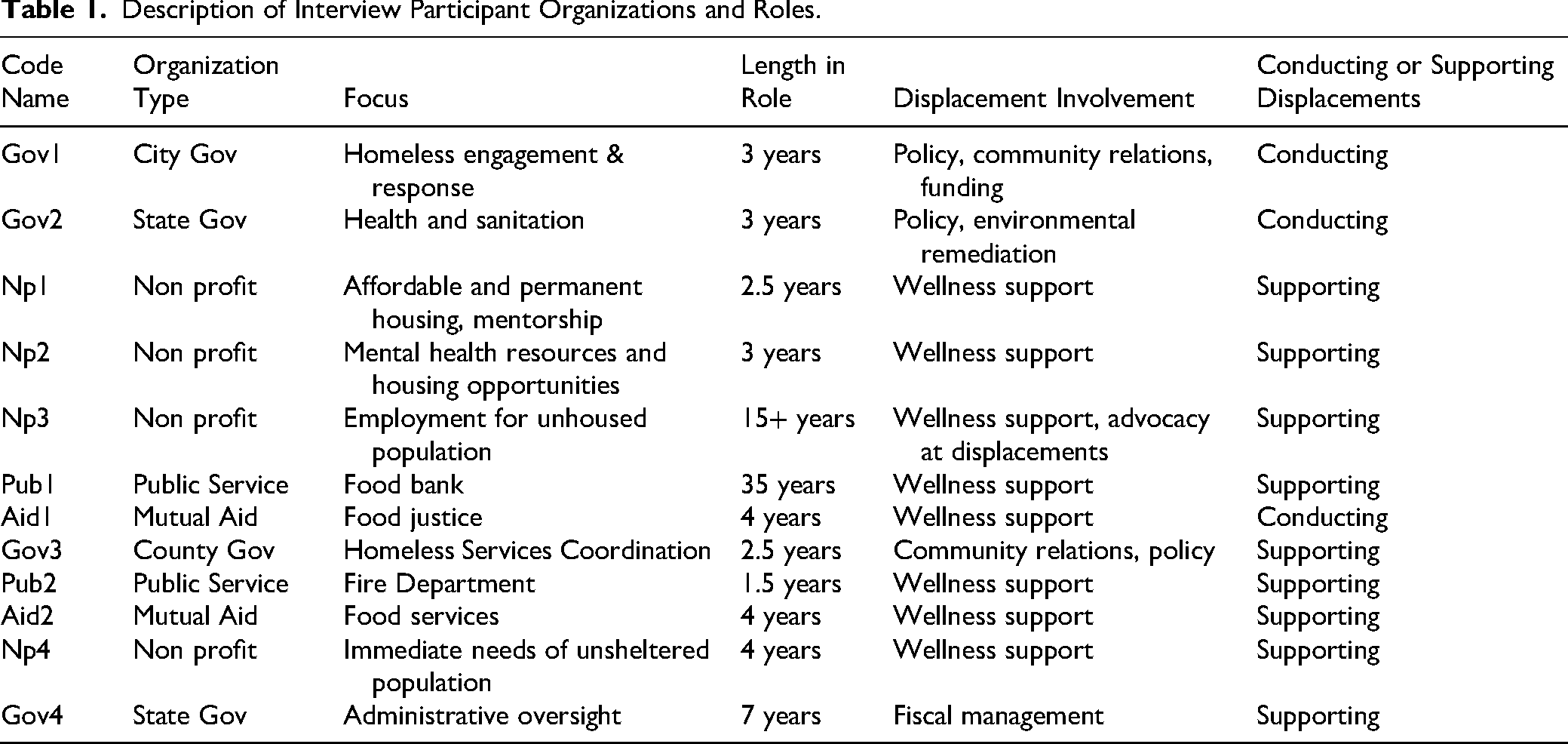
Urban homeless encampment displacements are common experiences in Salt Lake County. The county health department plays a large role in encampment displacements, as do law enforcement and social service organizations. Similar to Weaver et al. (2025) interviews with institutional “authorities” associated with homelessness, our participants were comprised of key informants who worked closely with the unhoused community, either in the displacement process itself or as directly involved advocates for the people actively being displaced. Some participants were professionals who worked in diverse roles at government agencies from the city, county, and state, and were responsible for the administration and oversight of the displacements. These participants worked for elected officials, for local health authorities, and other institutional roles. Additionally, we interviewed mutual aid workers and not-for-profit group members, most of whom were present at displacement events to offer care and services to the residents being displaced. Interviewees had different types of involvement in displacements, ranging from those who were materially conducting the displacements (e.g. on-site, removing tents and possessions) to those who were supporting PEUH (e.g. formulating displacement responses, spreading awareness about the difficulties experienced by PEUH, providing support to PEUH). Our research also sought representatives of law enforcement, sanitation workers, and environmental remediation services; however, these groups were unwilling to participate in our interviews despite repeated attempts and assurances of confidentiality. See Table 1 for interview participant roles.
Description of Interview Participant Organizations and Roles.
Data Collection
Our initial qualitative research project was designed to explore multiple rationalizations, roles, and perspectives on encampment displacements, leading our team to conduct 12 semistructured interviews both in-person and by phone. Each interview lasted from 40 to 67 min (M = 47 min), resulting in 184 total pages of transcribed interview data. The interview protocol included prompts adapted to the role of the individual and their organization, eliciting descriptions of the encampment displacement process, personal involvement, personal history of working with the unhoused populations, and general responses to homelessness and displacements overall. Notably, we did not begin this research by directly asking about emotional aspects of encampment displacements, instead focusing our interview questions on more functional questions about why, when, how displacements and their aftermaths occurred, yet the emotional aspects of responses was pervasive. Having reached thematic saturation (Wutich, Beresford and Bernard 2024)—the point at which additional interviews no longer yielded new insights or perspectives—and having conducted interviews with key informants from every organization and agency willing to participate, we determined that our data was both robust and sufficiently comprehensive for the purposes of this study.
Data Analysis and Interpretation
After transcribing all interviews, two researchers conducted a thematic analysis using ATLAS.ti to help organize the data. After familiarizing ourselves with data by reading and re-reading transcripts, codes were inductively identified through an open coding process since the nature of this study was largely exploratory. Coders looked for patterns that were expressed in the participants’ quotes, beyond the factual responses that merely answered the questions posed to them. Accordingly, many of the codes involved feelings, sentiments, and explicitly emotional responses. Subsequently a codebook was developed, with many of the codes emphasizing the emotional components of these displacement events. These smaller codes were then grouped into various themes and subthemes that logically aligned across codes (Saldana 2024). Themes reflect a broad, overarching category, concept, or idea that captures a key pattern found in the data. They represent the main section of a topic that we developed during our analysis. A subtheme is a more specific, detailed category within the overarching category. Only one subtheme was assigned to each unit of data, but we note in our analyses that emotions are often interconnected and overlapping with others.
While coding, we were attentive to the knowledge basis of the interviewees (e.g. first-hand observations, personal experiences, anecdotes shared with them as second-or third-hand retellings); we note these when presenting our findings because they offer insight on interviewees’ professional bases for knowledge and the type of knowledge their insights represent. To ensure consistency throughout the coding process, coders exchanged transcripts to support intercoder reliability (e.g. Rose and Johnson 2020). Further, we considered the positionality of coders, as researchers who identify as securely housed, and the ways this shaped the interpretations of the data, was continuously examined and discussed.
Results
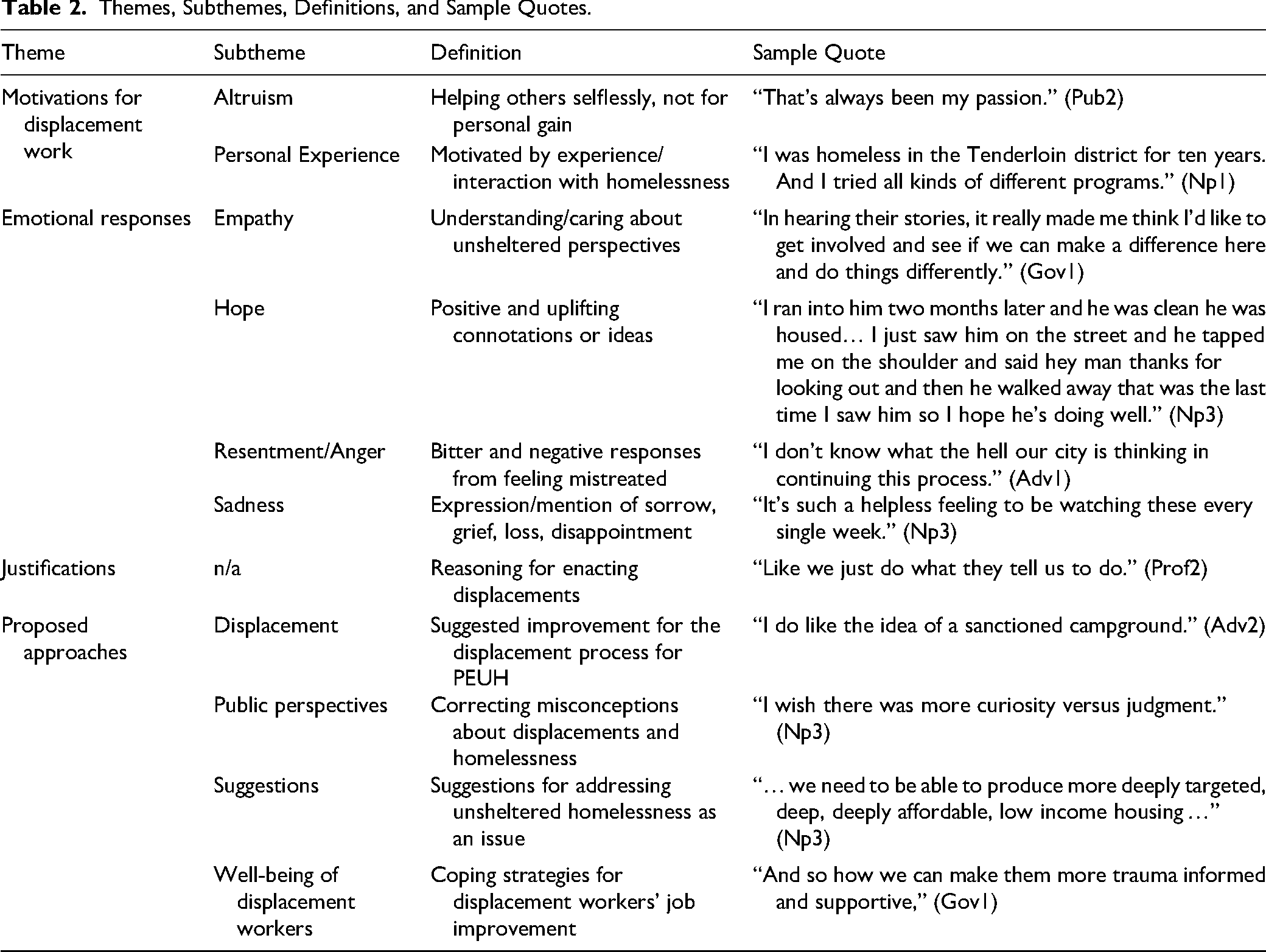
For people involved in conducting encampment displacements, emotions were salient across their interview responses. Here, we share interconnected themes that were found throughout the interviews, all of which were emotional in nature. Researchers identified four primary themes from the interview data, including motivations for doing displacement work, emotional responses to displacements, justifications for the continuation of displacements, and proposed approaches to this complex issue. To be clear, these themes were developed from participant interview responses that were not often in direct response to our interview questions, which were often more functional in nature. Within the primary themes we identified subthemes that provide additional insight (see Table 2). Because themes are not mutually exclusive (though subthemes are) we were able to explore the ways that themes were intertwined. For example, altruistic motivations for engaging with employment related to homelessness were often closely associated with emotional responses, such as hope. In the following sections, we discuss data within each of the four themes, subthemes, and prevalence of thematic co-occurrence.
Themes, Subthemes, Definitions, and Sample Quotes.
Motivations for Displacement Work
Our participants expressed a range of motivations for entering into a professional field that is associated with displacements. Often, the participants stated that they engaged in the process to foster change and support those people facing homelessness. Initially, we thought there would be individuals seeking these positions merely for stable employment. However, our analysis revealed that participants had either a distinct personal story that influenced their involvement in displacement work or a pull towards altruism. Notably, our data show that emotional aspects were connected to these motivations. Numerous participants reported beginning this work because of their own experiences with personal or familial homelessness. Others expressed having long felt a calling to human rights advocacy work. Overall, we describe individual motivations as either personal experience or altruism along with participants’ empathy, frustration, and other strong feelings towards the displacement of people experiencing homelessness.
Altruism
Here we define altruism as the drive to selflessly help the unsheltered population without reference to personal experience. We saw that many interviewees wanted to get into this kind of work from a genuine desire to help those in need. When asked about their primary motivation for getting into displacement work, one individual in wellness support and advocacy for people experiencing homelessness stated: I just felt so pulled to the program that I left [my paid position] and worked for [organization name] for over a year with no pay just to kind of build the program and try to figure out what was most needed. (Np3)
Personal Experience
When asked about their primary motivations for getting involved with displacement work, multiple interviewees discussed stories about personally experiencing unsheltered homelessness. For example, a person involved with both policy and environmental remediation told us: “My sister was homeless and struggled with addiction and mental health. So that really got me into it” (Gov2). The emotional responses coincident with personal experience were empathy, resentment, or hope.
Emotional Responses
Connected to workers’ motivations for engaging in this work, the emotional landscape of the displacement process is marked by a complex interplay of anger/resentment, empathy, hope, and sadness, reflecting the profound struggles faced by displacement workers, and communities alike. In this section, we detail the ways in which participants’ complex reactions to displacements involves subjective feelings and specific expressions brought on by an event or situation (Gross and D’Ambrosio 2004). Participants conveyed these emotional responses throughout the interviews, expressing powerful and difficult feelings experienced in professional fields associated with encampment displacements.
Resentment/Anger
Resentment/anger encompasses a bitter and negative feeling often arising when individuals feel mistreated or disrespected, and leading to a situation where they indicate that another group has caused them emotional strain. It reflects a broader sense of disenfranchisement, dissatisfaction with authorities, and intense social and emotional tension between different groups. One mutual aid worker's anger was expressed in their observation: Law enforcement tells individuals experiencing homelessness that they will give them hotel vouchers if they are kicked out of their tents and the shelters are full. This is not the reality of the situation … the law enforcement is supposed to leave them alone. They won't. you know. They'll just keep on telling them lies. (Aid2)
Empathy
Empathy involves recognizing and resonating with another person's emotions, allowing one to connect deeply with their experiences, regardless of the positive or negative valences associated with them. Empathy was often expressed when an individual acknowledged the unsheltered population's perspective and emotions as well as understanding, sharing, and/or reflecting this emotion. One wellness support participant noted, “these are their lives, and we're going in, and being disruptive when they're already living not a super stable life, and then this is one more thing that spirals them” (Pub 2). Empathy was most commonly coded with resentment, proposed solutions for worker wellness, and proposed solutions for unsheltered homelessness.
Hope
Hope was expressed in positive and uplifting ideas or actions or optimism pertaining to change towards responses to homelessness or PEUH. One participant working in affordable/permanent housing and mentorship, as someone who had himself experienced homelessness, noted that there needs to be more continued support in response to all the challenges of getting into a more stable situation. He felt that people would get their lives together with certain types of assistance: “We want you to get your life together, we want you to get away from that revolving door, right? And we're gonna walk you through this and show you what accountability looks like” (Np1). Participants expressed hopeful outlooks regarding the future of PEUH. It was often seen after they talked about their experiences working with people experiencing homelessness, community members, or other displacement workers. Hope was most expressed alongside proposed solutions for worker wellness, personal experience, and proposed solutions for unsheltered homelessness.
Sadness
We identified sadness as expressions or mentions of sorrow, grief, loss, and/or disappointment. Sadness was mentioned particularly when participants spoke about the loss of homes, belongings, lives, or hope for the future of the housing crisis. Many individuals expressed grief over the disruption to their lives caused by the displacement process, describing feelings of immense hopelessness and loss of dignity. An interviewee working in employment for the unhoused community they stated, “It's changed the perspective of the work that I do to like, the feeling of joy, to the feeling of helplessness. It's such a helpless feeling to be watching these every single week” (Np3). Sadness was most commonly coded with resentment, justifications, altruism, and proposed solutions to the public perceptions. This sadness reflects the broader psychological and societal challenges of homelessness, highlighting feelings of grief, disappointment, and powerlessness in response to displacement and inadequate support systems.
Justifications
Justification for enacting displacements included reasoning from systematic, individual, cultural, and corporate perspectives. There was no subcode for justifications because nearly all of the reasons were driven by safety or sanitary concerns, with the two often intertwined. Justifications commonly focused on fulfilling job roles such as responding to public complaints and city ordinances or highlighting the severity of conditions at encampments. Some respondents shared specific experiences where they felt displacement was necessary. For instance, an interviewee described a large encampment in a canyon that grew to be unsanitary: “So so much, like, body fluids everywhere, and then a lot of needles. So, for that one in particular that was the reason they were like ‘hey, this is actually unsafe now and unsanitary, we have to do this’” (Gov 4). This participant, like others, justified displacements with a regretful tone, acknowledging the harmful nature of them. Other justifications for carrying out displacements were more straightforward and indicative of adherence to the current approach. These rationales echo the perspective of cities’ infrastructures requiring “routine maintenance,” where a supposedly neutral aesthetic value leads to judgments that are rendered against informality associated with the poor and/or unhoused (Gordon and Byron 2021).
Proposed Approaches
Interviewees suggested approaches that fell into four different categories: improving the displacement process, addressing public concern, addressing homelessness overall, and enhancing the wellbeing and performance of displacement workers.
Displacement Process
A variety of approaches were proposed to reduce trauma and harm associated with the displacement process. Most commonly, interviewees advocated for sanctioned campgrounds, explaining how they can provide a structured environment that allows essential services and support to reach PEUH. One participant working in housing support explained: And essentially homeless camps, even though they're living outside, they do have a structure that's covered that's either heat or air conditioned, it's an opportunity for case managers to come in, they get a couple of meals a day, job placement, people come in, therapists come in. (NP 1)
Public Perceptions
Participants across all included professions viewed correcting public misconception about displacements and the homeless population as crucial in fostering informed, compassionate perspectives. Participants frequently expressed frustration and sadness over what they perceived as broad public opinion. For instance, interviewees felt that public opinion was misguided concerning various judgments and assumptions about the homeless population, about displacement processes and workers, and about systemic factors that contribute to homelessness. Similar to other interviewees, a worker in policy and environmental remediation said that they “wish people knew that the homeless population is more complex than you would imagine. And that the displacement process is also more complex” (Gov 2).
Additional proposed solutions for improving public perceptions included encouraging community members to participate in volunteer work and patronize businesses that support or employ PEUH. Overall, public concern was acknowledged as a common barrier to addressing the largely negative effects of displacements because understandings are so often incomplete.
Homelessness
Interviewees proposed solutions aimed to address the systemic issue of homelessness to reduce the numbers of unsheltered individuals and improve the lives of people experiencing homelessness. They consistently emphasized the need for more affordable housing and greater accessibility to jobs as crucial factors in supporting the unsheltered population in Salt Lake. One interviewee working with a local food bank stated: I think we need more adequate shelter opportunities for families that aren't overcrowded. And we need to be able to produce more deeply targeted, deep, deeply affordable, low-income housing, both for families, and in particular, permanently supportive housing, where people can have access to services. And also for people who are single and couples, so that there are more opportunities to get out of homelessness, and get out of the shelter system, and maybe move people from camps, into housing, into shelter, and then help work on issues they may have, like substance abuse and mental health, which are much easily easier to address. (Pub1)
Displacement Worker Wellbeing
Proposed solutions for the trauma and burnout expressed by those involved in displacement work include a diversity of coping strategies. Many interviewees mentioned the importance of managing their emotional well-being while doing this kind of work. One city government employee working in homeless engagement and response stated that it is important: to have a self-care plan, and you know, take the time off [to see] professional counselors and kind of talk through things to make sure you're there and take care of yourself and your health and emotions. Anytime you're seeing other humans in pain, it definitely affects you. (Gov1)
Discussion
A thoughtful and comprehensive approach to addressing the proliferation of homeless encampments is critical and should be informed by data reflecting the experiences of both those experiencing homelessness and those involved in responding to it. Homelessness is often perceived as a disruption to the social order, largely due to its visibility in public spaces and the challenges it poses to prevailing norms regarding urban cleanliness, safety, and property use—perceptions that frequently result in displacement. However, a deeper analysis is necessary. Under capitalism, public spaces are increasingly organized through exclusionary practices that prioritize commercial and residential interests, rendering the presence of unhoused individuals both a perceived disruption and a target for regulation (Mitchell 2020). This regulation is commonly enacted through spatial strategies and policies aimed at removing or containing homeless populations, thereby reinforcing social hierarchies and capitalist logics. Shelters, while ostensibly providing services, often function as instruments of social control embedded within complaint-driven systems that criminalize homelessness, reaffirm state authority, and address public discomfort with visible poverty (Herring 2021). Similarly, Johnsen, Fitzpatrick and Watts (2018) present a typology of social control mechanisms, demonstrating how both coercive and supportive interventions serve to regulate the behavior and location of homeless individuals in ways that uphold dominant norms of order and civility. Thus, homelessness is framed not only as a social issue but also as a disruption to the spatial and moral order that modern urban governance seeks to maintain. Given that prevailing social control mechanisms are grounded in narratives of individual failings rather than systemic factors, and that the impact of these mechanisms extends beyond those experiencing homelessness to those enforcing them, it is essential to incorporate insights from those working directly in these contexts.
Encampment abatements are emotionally traumatizing events, not only for the displaced residents but also for people conducting and witnessing them. The four themes identified from the data offer insights that can help shape more effective and compassionate responses to the complex issue of homelessness. Understanding displacement workers’ motivations for engaging with this work, their emotional responses to it, and proposed approaches to displacements specifically and homelessness more generally, not only aligns with and extends existing literature on the topic, it can also enhance both theoretical and practical applications. These broad but overlapping themes are necessarily interconnected, as, for instance, workers’ perspectives on encampment policy is likely tied to their emotional responses to witnessing displacements and their aftermaths. Participants’ motivations, responses, justifications, and proposed approaches are all infused with complex and varied emotions. In this section, we place our thematic findings and additional participant voices in the context of existing literature to make the case for additional care and consideration of the broad negative impacts of displacement events, on PEUH and housed individuals alike.
Honoring the Trauma
A growing body of literature demonstrates the harmful effects of displacements for encampment residents (Barocas et al. 2023; Chang et al. 2022; Darrah-Okike et al. 2018; Goldshear et al. 2023; Goodling 2020; Margier 2023; Meehan et al. 2024; Qi et al. 2022; Rose 2017). However, this study is the first to explore how displacement impacts the (presumably securely housed) community members observing it and carrying it out. While we know that displacement is often a crushing experience for those who are forced to leave—losing belongings, social connections, and the public spaces they have temporarily and often desperately claimed—our findings suggest that psychological trauma can also affect others whose homes, possessions, and social lives remain intact.
Common narratives about PEUH are deeply pathologizing, framing homelessness as the either personal depravity or victimization. The depravity narrative serves to justify regulatory and authoritarian approaches such as displacements rather than solutions rooted in functionality and effectiveness, or much less in compassion or attempts to dismantle the structural causes of homelessness. The latter perspective can be almost as damaging to displacement workers. For employees tasked with enforcing displacement, publics vilify not only the displacement process but the displacement professionals. If our society can rationalize violent and devastating displacements given these pathologized conceptions of community members experiencing homelessness, must we also rationalize the harm and trauma wrought on those (often public servants) carrying out these policies?
Displacement workers expressions of sadness, anger, and resentment provide a powerful lens for understanding the scale of these issues and the associated pain. For example, one participant noted: it's such a helpless feeling to be watching these [displacements] every single week and just not having any new answers for [PEUH] or any new ways to say it's going to be OK it's more like ‘you know the drill, get your shit … and we got to get out of here’. You know it' not like ‘I'm so sorry this is happening to you … what can I get for you to replace your items.’ It' not like that anymore it' … impossible to keep up … that has affected every organization that' boots on the ground [with] some of them completely dissipating due to burnout … I've transported women that were beaten with lead pipes and raped in these encampments by predators, and transported them all the way up to Farmington because that was the only place I could find the bed for them.
Rethinking Displacement Work
Despite noting how incomplete and dysfunctional the current displacement policies and practices are, displacement workers almost always led with deep empathy for PEUH, and this empathy is useful in considering better approaches to issues that impact PEUH and displacement workers. For example, one participant shared this anecdote: The shelters were at capacity that night and he couldn't really stand because he had just had surgery on his ankles, and he was in tears, and one of the volunteers that was there with me had started talking to him but he needed medical attention right? It got me thinking when I have these experience now in the position that I am…what can we do to make this work better? why are being people being released from the hospital right after surgery that are homeless?
Transforming the culture and stereotypes that external community members engage with was emphasized by almost all interviewees on both an individual and societal scale. For example, an interviewee highlighting the transformative power of community support advocated that we must: … change that mindset [that homelessness is] a moral failing, as well as like, you know, the whole American ego, lift yourself up by your bootstraps thing. We are a community, and we can lift each other up. (Gov1) I think what I’d like the [public] to know… is anyone can [become] homeless … I mean, I think all of us, myself included, are closer to homelessness. And we need to realize, it just takes one traumatic event, just a bad break, health wise or financially, for any of us to find [ourselves homeless]. (Gov3)
Finally, as noted earlier, many study participants had personal or familial experience with homelessness. Their insights are especially instructive regarding approaches to this epidemic. For example, one participant noted: “I'm seventeen years clean and sober. I smoked drugs for twenty years. … And I tried all kinds of different programs. Thirty, sixty, ninety days, which was a joke … I see firsthand now what I experienced then” (Np1). These displacement workers showed a deep frustration towards the existing system aiming to address the issue of homelessness, saying “That's the model that exists today. And I had access and plenty of housing vouchers, in the middle of my addiction” (Np1). They went on to say: That’d be part of my job responsibilities [now] to continue to be a mentor, continue to be a leader, and let these people know, hey, here's what the accountability piece looks like. That's the reality of I know, because I lived it, you're not going to get off the streets until you're ready. (Np1)
Just Say No to Displacements
Beyond the empathetic and compassionate rationales for ending displacement-driven responses to homelessness was the recognition that displacements simply do not solve the problem; this awareness was acknowledged not only by the displacement workers but also by community members watching the displacements. Practically, displacements are harmful to literally everyone involved. One participant noted: “It's like, are we abating the humans or are we abating the hazard? Because you left the hazard here, but you've pushed humans along. So, what exactly is the purpose?” (Np3). Other participants echoed the futility of displacement strategies saying things like: It's costing a lot of money. They'll come, and required by law, bulldozing. A couple months later, [PEUH] are back…So, it's a revolving door, we're spending these millions of dollars, you know, and the system is broken. (Np1)
While we have heard the ways employees of community organizations and agencies interacting with unhoused folks differ in their approaches, employees who display systems thinking are more likely to embrace innovative organizational adaptation and integrate complex responses into their agency's mission and activities in meaningful ways (Flanigan 2024). This differentiation is important in the context of this study given the many different organizations and agencies who may or may not be willing or able to respond beyond the scope of their mission. This tension between comprehensively attending to complex and integrated problems and adhering to an agencies mission has been explored by scholars who note that perhaps society's problems cannot be solved without mission drift (Flanigan 2024). Our participants were painfully aware of these complexities and wanted the public to be aware of them as well as represented in sentiments like: It's not just drugs. And giving these guys a job is not the one stop solution. There's a lot of trauma with this population. They've had a lot of people lie to them, a lot of people hurt them, a lot of people steal from them. And eventually, they just throw up their hands and they give up on society overall. (Np3)
This study's findings help us understand encampment abatements more broadly. As noted earlier, Salt Lake City is similar to many U.S. cities in its rates and responses to unsheltered encampments (Garcia et al. 2025; US HUD 2024), and it is likely that other municipalities and communities also have workers engaged in these displacement processes that are conflicted and, in many ways, emotionally traumatized. Each area has unique policies, politics, and locally contingent conditions, but it is reasonable to assume our participants’ approaches and reactions to displacements align with folks in other municipalities as well.
Ultimately, homeless encampment displacements are neither a natural nor necessary response to unsheltered homelessness. The National Alliance to End Homelessness (2024) recommends a range of options in responding to unsheltered homelessness, highlighting five practical and policies techniques that do not include displacements: noncongregate shelter (e.g. repurposed motel/hotel space); safe parking sites in sanctioned spaces; tiny home villages providing nonpermanent accommodation in small, private units; large tents or tent-like structures to provide quick, covered sleeping areas; and self-governed supported encampments that include resources and bathrooms so that PEUH can stabilize in place. Importantly, these options highlight the need to be person-centered, and they do not restrict individual choice and autonomy. Innovative, creative, and compassionate responses have demonstrated varying levels of success for both individuals and communities encountering unsheltered homelessness (e.g. Evans 2023; Orr et al. 2024; Przybylinski 2024), even with the recognition that increased housing supply and permanent supportive housing programs are the only way to address homelessness (Colburn and Aldern 2022). These perspectives align closely with findings from our interviews.
It should be noted that our interviews and analyses were conducted prior to the 2024 Johnson v. Grants Pass U.S. Supreme Court decision. This decision overturned the 2019 Ninth Circuit Court of Appeals Martin v. City of Boise case, which stated that municipalities could not arrest unsheltered folks if there were not resources available (i.e. sufficient bed space at area emergency shelters). The Grants Pass case has effectively legitimized the criminalization of unsheltered homelessness (Kpeebi and Evans 2025), further encouraging potentially punitive policies at the hands of municipalities and law enforcement. While it is unclear how this ruling will be implemented across the United States, this decision undoubtedly erodes what little protections existed for unsheltered community members and shifts the focus from more definitive and scientifically supported approaches to unsheltered homelessness like housing first programs (Kushel 2023; Padgett, Henwood and Tsemberis 2016). The case ultimately enables local, state, and federal actions that worsen homelessness, broadly, and unsheltered homelessness, specifically.
As communities consider how to best engage with the issue of unsheltered homelessness, our data suggest that the insights and needs of those engaged with displacement should be taken into consideration. The emotional toll of this work is substantial as is the material and discursive violence implemented at the hands of the state during displacements. While these impacts may most viscerally affect the unhoused, they also affect other community members as well, in this case those workers engaging with displacement events. Too often, the unhoused are positioned as unworthy of consideration and resources (i.e. Canham et al. 2024; Woolston and Mitchell 2025); our data suggest that similarly bankrupt rationalizations are also applied to those engaging with encampment displacements. It is imperative to note that professionals and engaged community members are also emotionally suffering by bearing witness to these disruptive displacement events. Therefore, future research should extend the initial findings in this study to consider even broader community effects of encampment displacements, considering the impacts on nearby neighborhoods, organizations, and businesses, among others. Such studies will provide empirical support for the clear understanding that insufficient and unaffordable housing has immediate and long-term negative impacts on all aspects of community life. In this way, the discursive displacement and ontological insecurity associated with unhoused encampment residents is likely extended to community members whose housing is less fraught.
The displacement of people and their belongings is deeply harmful, damaging them physically, psychologically, socially, and spatially. As our study reveals, these displacements also have far-reaching consequences, negatively affecting others who might have once been assumed unaffected. Given the depth and breadth of these harms, we must move away from disruptive and damaging removals and instead adopt creative, structural solutions that address the root causes of inadequate affordable housing. If the primary focus were on the individuals living through unsheltered homelessness—centering their needs, interests, and autonomy while implementing more comprehensive strategies—public health outcomes would improve not only for PEUH but also for displacement workers in the broader community.
Footnotes
Acknowledgments
The authors would like to acknowledge the work of students in the University of Utah's SPARC Environmental Justice Lab for their contributions to this research.

Ethics and Informed Consent
This research was exempted by the University of Utah's Institutional Review Board on October 18, 2023, study number IRB_00171839.
Funding
The authors received no financial support for the research, authorship, and/or publication of this article.
Declaration of Conflicting Interests
The authors declared no potential conflicts of interest with respect to the research, authorship, and/or publication of this article.
Data Availability
Transcribed and anonymized data are available upon reasonable request.