







Abstract
Crises affect researchers’ ability to conduct interviews, focus groups, and ethnographies. I discuss my interactions with participants to explain how I overcame the challenges of recruiting and building relationships in three predominantly Black neighborhoods on the South Side of Chicago: Greater Englewood, Bronzeville, and Calumet Heights. I detail experiences with the practice of participatory research across three distinct Black communities. I discuss what responsibilities were owed to these communities in exchange for their cooperation, and how these responsibilities varied by class and positionality among participants. This analysis introduces a broader discussion of practices, strategies, and obligations urban politics scholars can consider when conducting ethnographies, focus groups, and interviews in urban environments during times of crisis.
Introduction
Crises change the trajectory of research. A crisis can affect the feasibility and the cost of conducting research, as well as whom a researcher can reach. Focusing on reach, typically, discussions of hard-to-reach participants focuses on the most disadvantaged and underrepresented. This is especially true among Black urban communities. In urban environments, it is easy to lean on past lessons that describe Black communities as the truly disadvantaged (Wilson 1987)—communities that are often characterized by disorder (Skogan 1990), disinvestment (Wilson 1996), and limited economic expansion. Yet, Black urban communities are complex. Hard-to-reach is not just about destitution; it is about how policy and circumstance determine the rules, norms, and feasibility of reaching community members across diverse Black communities.
When I started the second iteration of my dissertation research in March 2020, there was no guide on navigating the COVID-19 pandemic. Many of my graduate colleagues who planned to visit archives, interview participants, and, in general, conduct qualitative research, found themselves having to abandon their projects. This was a great loss to the field of political science and for those who studied cities and urban scholarship as well. Yet I was stubborn, and in my determination to continue my project with the use of interviews, focus groups, and ethnography, I learned a great deal about how to reach Black community members who can feel impossible to reach, especially during a time of crisis.
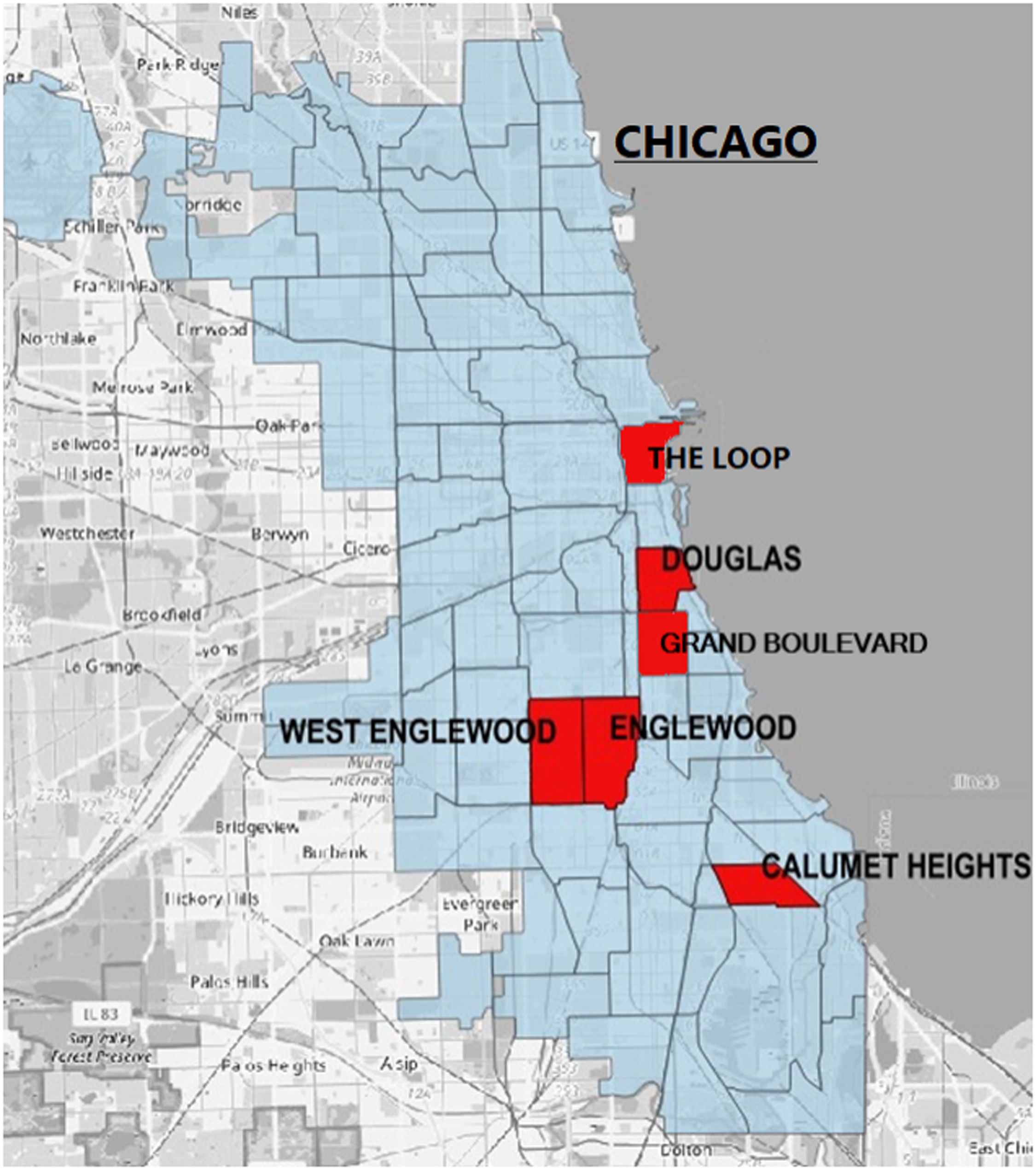
Chicago Neighborhood Map.
This manuscript discusses one main question: how can urban politics scholars reach, build trust, and gain rapport with potential participants during times of crisis? I answer this question with a conversation centered on the concept of Black participatory research and hard-to-reach populations. Specifically, I detail my experiences in three distinct Black neighborhoods on the South Side of Chicago: Greater Englewood, Bronzeville, and Calumet Heights (See Figure 1). I center this article around three necessities for developing more collaborative relationships with hard-to-reach participants during times of crisis: recognizing the diversity within and across urban Black communities that determines how they can be recruited and included in research, recognizing our responsibilities to each community and how those responsibilities may shift according to the class and positionality of the participant, and balancing our roles in such communities. In detailing my experiences, I believe it is important to include the participants’ words and perspectives. I include interactions with research participants as an illustration of the challenges of recruiting, maintaining relationships, and providing insight into responsibilities during a time of crisis, the COVID-19 pandemic.
Crisis Access and Participatory Research
My research started with an inquiry into how Black Chicagoans cooperated with traditionally distrusted institutions and neighbors to fight for an end to state violence and community violence. In my assessment, a study on trust, cooperation, and violence requires deep insight into a diverse array of participants in urban Black communities. These are communities that are often misunderstood and demonized. Simply reaching out with a survey does not allow community members to speak for themselves or for researchers to conduct accurate, nuanced research. Interviews, focus groups, and ethnography allow for detailed description and exploration of community members’ perspectives and considerations (LeCompte and Schensul 2010; Rogers 2013; Weiss 1993). The crisis of the COVID-19 pandemic created a predicament about how to reach and properly serve urban Black communities in my research.
The definition of hard-to-reach is often vague and lacks proper context (Ozawa et al. 2019). Some scholars, such as Tourangeau and Khoury, have offered a succinct categorization of hard-to-reach populations, which includes individuals who are highly mobile and have issues of risk and safety, as well as groups that represent a small number of a population, individuals who refuse to engage, and those who may face linguistic or mental challenges (Khoury 2024; Tourangeau 2014). Within this definition is a common assumption that hard-to-reach populations are typically impoverished and isolated from the greater community (Freimuth and Mettger 1990). Yet, “hard-to-reach” is a shifting categorization for a given population of study. Crisis, along with class, race, gender, and positionality, plays a role in the difficulty of reaching research participants. When I refer to hard-to-reach populations, I am speaking of risk and safety, as well as the various considerations that go into community members’ decisions to participate. Some of these safety concerns predate the pandemic, namely state and community violence, but the crisis of the COVID-19 pandemic exacerbated concerns and introduced new challenges for reaching certain community members, even if not victims of the worst instances of oppression.
In urban environments, threats to risk and safety can change the very rhythm of a city. Cities are dense and vast. They often rely on efficient public transportation (Souza Vieria 2025), resource sharing, though rarely equally distributed (Poppelaars 2007), and a steady stream of social events (Raychaudhuri, Davidson and Jones-Correa 2025). Yet, a crisis can throw off these typical expectations of a city and limit a researcher's ability to reach community member, exacerbating issues of inequality within cities.
Participatory research has often been used to remedy the challenges of inequality in the realm of research, with an inclusive approach to data collection. Rather than simply extracting from urban communities, community members are included in the research process (Brown et al. 2003; Cargo and Mercer 2008; Lee et al. 2024; Rappaport 2020). Universities have often pushed for a more collaborative relationship between researchers and community members (Lee et al. 2024). This is especially true when addressing sensitive public health topics, such as violence. Participatory research requires an understanding of power and positionality. The point is to give participants a greater say in how their communities are represented and discussed within the broader scientific community (Dieter et al. 2018).
Participatory research is, in many ways, about trust and a way forward with hard-to-reach participants in the hopes of learning from communities that have often not found themselves and their voices centered. Yet, a growing body of literature finds that even with the practice of participatory research, community members’ voices are often ignored or drowned out by universities and researchers (Lee et al. 2024). Researchers must remain cognizant and sensitive to participants’ vulnerability when they tell their stories (Head 2006, Subotić 2020).
Regarding Black urban communities, participatory research has often involved giving voice to Black communities that have found themselves victims of white supremacy, including in the practice of knowledge production. Many predominantly Black neighborhoods are no strangers to having researchers inquire about their communities, especially in Chicago. From DuBois's contributions to foundational insight into the lives of formerly enslaved Black Philadelphians (1889) to the Chicago School (Morris 2015), many researchers have had the power to shape perceptions of neighborhoods and the people who resided in the community. Early research on Black communities often came with negative connotations of those communities, with a focus on Black criminality and disorder, however (Morris 2015; Muhammad 2019). Throughout the country, researchers studied the “negro problem” to understand how newly freed Black people would acclimate into cities (Dubois 1899; Du Bois and Holloway 1903; Morris 2015). To be fair, the conclusions were not always factually incorrect. There was disinvestment in urban Black communities, poverty, and crime
Black participatory research is often framed within a push to empower Black communities that have historically been denied power through predatory policy research agendas and exploitation (Akom 2011; Breland-Noble, Streets and Jordan 2024; Harris and Janeé 2021; Mance et al. 2020). Yet, there is room for leaning into the complication of Black urban communities. Though much research has focused on the urban Black poor and on conducting research fairly with the group, more needs to be said about participatory research that centers on urban Black communities of varying socioeconomic backgrounds. Socioeconomic statuses, access to social and political capital, and variations in long-term wealth are not monolithic in Black communities (Lacy 2007), which adds a layer to how and under what terms community members decide to participate during times of crisis.
In detailing my experiences recruiting hard-to-reach participants during the COVID-19 pandemic, I provide three contributions to conducting Black participatory research in Black urban communities. First, I am adding to the strategies that can be used to engage hard-to-reach populations when the threat of infectious disease and violence remains. The pandemic required new approaches to conducting qualitative research and added to the community and state violence concerns that many participants were managing. For many researchers, conducting qualitative research did not seem feasible during the peak of the COVID-19 pandemic. I offer tools and strategies for still engaging the hard-to-reach during times of isolation. Secondly, I offer a different perspective on how hard-to-reach populations may view compensation, and what next steps are expected after the group has finally been reached during a time of crisis. Thirdly, I provide insight into reaching and collaborating with different types of Black communities within a single city. However, before diving deeper, it is important first to understand my initial research project and case study.
Case Study Selection
I centered my research on three predominantly Black communities on the South Side of Chicago: Greater Englewood, Bronzeville, and Calumet Heights. I chose these communities to gauge diversity in Black public opinion and strategies for pursuing policy, accountability, and community building to remedy state and community violence, and to examine whom they chose to cooperate with to accomplish these goals. The expectation is that class and the different realities in neighborhoods change how Black communities cooperate with certain institutions such as the police, nonprofits, elected officials, and their neighbors (Small and Calarco 2022).
I designated a community type for each neighborhood to further distinguish the communities. Bronzeville is categorized as a gentrifying neighborhood, Greater Englewood is an impoverished neighborhood, and Calumet Heights is an affluent neighborhood (see Table 1). These categorizations were based on several factors: the percentage of the Black population, median income, instances of community violence, and the number of police complaints recorded from each police district.
Neighborhood Characteristics.
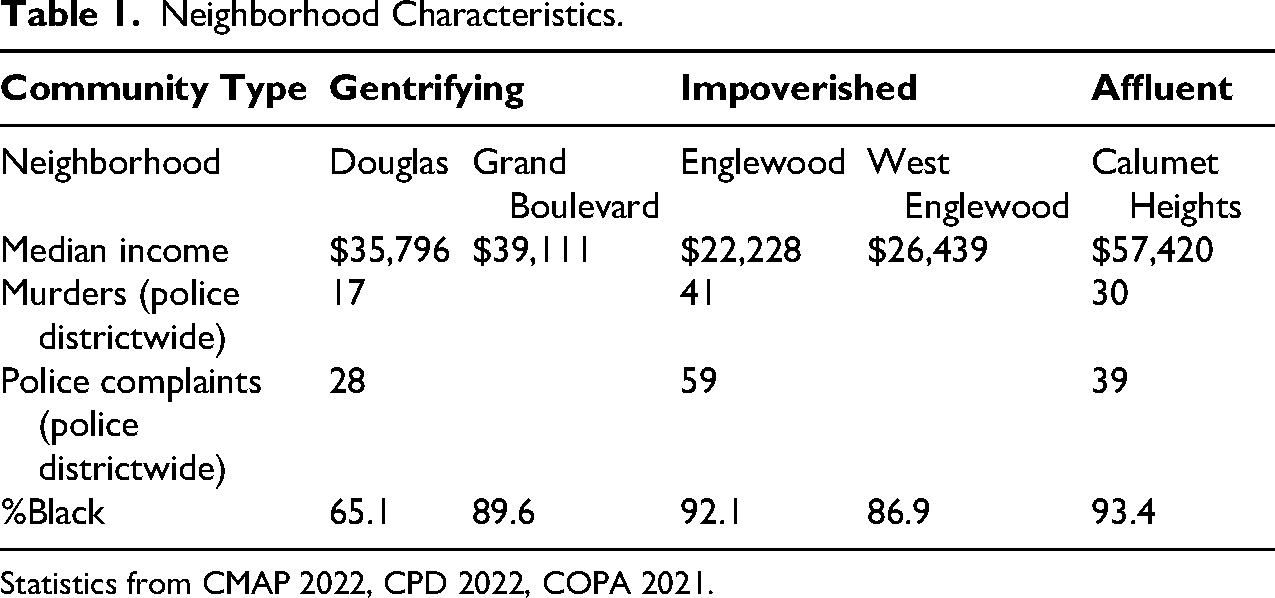
Statistics from CMAP 2022, CPD 2022, COPA 2021.
Greater Englewood is an impoverished community, Bronzeville is a gentrifying community, and Calumet Heights is an affluent community. Greater Englewood has one of the highest rates of poverty in Chicago, as well as high rates of community violence and state-sanctioned violence. Bronzeville is a neighborhood in transition with neighbors who see real economic prosperity and cultural capital developing in the city, while others feel left behind. Calumet Heights is a neighborhood that focuses on maintaining its solidly Black middle-class reputation. Calumet Heights is also an aging community with a high percentage of senior citizens. The distinct neighborhoods required a detailed strategy for recruiting participants and developing lasting, productive relationships with community members.
Shifting Methods and Strategies
I began my research with an ethnographic approach, anchored in face-to-face individual interviews with community leaders in Greater Englewood, conducted between February 2019 and August 2019. My initial motivation was to understand the persistence of state and community violence and to identify new themes and opinions within the community. I conducted 10 preliminary interviews and attended 10 community events, including townhalls, police beat meetings, and mayoral and aldermanic campaign events. The interviews were semi-structured, meaning I had a baseline of questions (see Appendix). From the initial interviews and ethnographies, I began to develop an in-person strategy to reach two additional neighborhoods, Bronzeville and Calumet Heights. The in-person strategy was scrapped before it began due to the pandemic.
Social distancing policy and concern of illness required imagination and flexibility. I expanded my methods to include interviews, focus groups, and community observations, all conducted predominantly in a virtual setting. To successfully make this transition to a virtual setting, I acquired Kindle Fire tablets equipped with the virtual meeting application Zoom and mailed them to community members who agreed to participate in a focus group or interview. At the time, Zoom was a relatively new resource to most participants. To mitigate technology issues, I sent a YouTube video showing how to log into Zoom.
From June 2021 to August 2022, I attended 14 community events and recruited 49 participants for interviews or focus groups. Of the 49 participants, 23 worked or resided in Bronzeville, 19 in Greater Englewood, and seven in Calumet Heights 1 . In my recruitment across the three communities, all participants self-identified their race as Black. I included a survey for the virtual focus groups and interviews to capture additional demographic information. Additionally, 61 percent of participants identified as female, 37 percent identified as male, and two percent (one person) as nonbinary. When asked about home or business ownership, 44 percent of participants affirmed they were homeowners, while 39 percent were business owners. Reaching such a diverse group of Black residents required an understanding of the shifting social and political capital of Black Americans in Chicago. I was successful in conducting research during a crisis, and Black participatory research played a key role, but it involved learning the complexities of recruiting such a diverse group of community members during a crisis.
Recruitment and Relationship Building
Cities are dense and require sharing space and navigating a diverse tapestry of people of different races, cultures, beliefs, worldviews, and policy preferences. Furthermore, within this tapestry are segregation (Massey and Denton 2003), instances of highly developed and repressive law enforcement (Balto 2019; Owens 2024; Soss and Weaver 2017), and an often oppressive governmental infrastructure that does not equally help everyone. Urban environments are ripe with inequality, and numerous institutions have played important roles in creating and maintaining such disparities. Within this urban machinery are complex laws and policies that can change how, when, and to what extent community members can and prefer to be contacted. Often, environmental and individual situations such as stress, policy demands, physical safety concerns, and distrust of researchers affect researchers’ ability to recruit, build rapport, and collect data (Bell 2016).
My first challenge centered around social distancing measures implemented during the COVID-19 pandemic, and how those measures affected certain Black communities. Many scholars have testified to the necessity of developing new strategies and processes for conducting research in the era of social distancing brought on by COVID-19 (Lobe, Morgan and Hoffman 2020; Adom, Osei and Adu-Agyem 2020; Roberts, Pavlakis and Richards 2021, ). The pandemic tested communities in how they interacted with one another, especially those that were often distrustful of certain individuals and their intentions. For participants dealing with the persistent stress of daily life and the shock of a pandemic, energy for new connections was in short supply, on top of the real concerns over safety and mortality.
My recruitment strategy also had to consider how I would be perceived by community members and the history they may have with my institution, which became even more challenging during the COVID-19 pandemic. Before the pandemic, I relied on many of the typical lessons learned in qualitative research. For the preliminary interviews, I recruited at community meetings and in institutions that attracted community members. I focused on community institutions where people gathered, debated, and strategized. In other words, I focused on navigating through the Black counterpublic. The Black counterpublic consists of the churches, social organizations, and media that help build Black political consciousness (Dawson 1994; Dawson 2001). My first community meeting was at a Black church that served as a touchpoint for Black political mobilization in the Greater Englewood community.
I introduced myself to community leaders there and asked for their participation in preliminary meetings. From the preliminary interviews, I established networks through snowball sampling and gathered information about additional community events, including police-community meetings, mayoral coffee socials, and aldermanic town halls. Community meetings helped to establish rapport with participants and to get to know the community. Through my initial contacts, I was introduced to other community members and invited to community events to understand the Greater Englewood community better. The advent of the COVID-19 pandemic would shift the dynamics of recruiting, building relationships, and understanding my participants and their communities.
Crisis involves a malleable approach. It was not just community violence and state violence that participants had to concern themselves with during the pandemic. It was how close to stand next to someone, the onset of a sudden cough, or a maskless passerby, which were added to ongoing safety concerns characterized by fear of perceived wayward teens, carjackings, and the 2020 uprisings. There was a real incentive for communities suffering from instances of violence and neglect to stay to themselves (Raudenbush 2016). Insecurity was exacerbated during the COVID-19 pandemic, and community members felt it in each of my case studies. Additionally, many of my participants were distrustful and disenchanted with efforts to keep their communities safe because of the abuses and lack of concern by law enforcement. There had to be a real effort to reach community members, and I had to explain clearly why their participation was needed at this time.
For COVID-19, many researchers speak of the pivot from in-person to virtual settings. Yet, much of these descriptions neglect participants’ having a say on the terms in which they participate. They have a say in whether they will engage in solely virtual, hybrid, or in-person interaction. Even after those social distancing policies were modified, participants’ habits and comfort levels did not necessarily align with the policy. Some participants adhered strictly to social distancing mandates, while others still wanted in-person interaction to assess me as a researcher and my intentions. This does not mean that I, as the researcher, did not consider maximizing safety, but that risk and safety were a negotiation between me, the researcher, and the participants.
Compensation, Expectation, and Connection
In discussing responsibilities, I have chosen to share excerpts from the interactions between me, as a researcher, and my participants. The excerpts are meant to move my discussion of participant interaction and consideration away from abstraction and into real dialogue, considerations, and responses between the participant and researcher. I chose these specific excerpts as they illustrate how community, trust, and cooperation are discussed between me as the researcher and the participants. In each neighborhood, I had varying levels of difficulty finding participants. Among participants who were the least well off in Greater Englewood and parts of Bronzeville, some took several email and phone conversations and months to agree to participate in an interview or focus group. Some of the difficulty stemmed from being perceived as an outsider, and during such a trying time, a question arose about my intentions and my ability to tell fair stories about their community.
Though I shared the same racial identity as the people I aimed to recruit, I am not from Chicago. I did not know these communities. My understanding of community and state violence was limited at the beginning of my project. Like many people outside of Chicago, I had heard of the victims of state violence like Laquan McDonald (United States Attorney's Office 2022) and the torture ring of Jon Burge (, Ralph 2020). I was aware of the community violence that had been satirized, breathlessly debated by politicians, and headlined by the media. What became apparent is that many residents were protective of their communities and how they were perceived, and that this protection meant that they had demands for making sure I was a researcher who could be trusted to research and report on their community with accuracy and be willing to take their thoughts seriously.
I had to acknowledge and recognize that the Black Chicagoans I intended to recruit saw me as a representative of a university, an institution they distrusted. Community members have long had a history of distrust toward educational institutions and researchers (Coker, Huang and Kashubeck-West 2009). For decades, academic institutions have had a rocky interaction with the people of Chicago. For many residents, it felt as if researchers were constantly extracting information and misrepresenting their communities. From the Tuskegee syphilis project (Coker, Huang and Kashubeck-West 2009) to the Broken Windows Theory (Wilson and Kelling 1982), researchers have often not given Black communities the respect and care needed to maintain trusting relationships. Modern-day researchers are often perceived as representatives of those violations and slights, especially in increasingly stressful, unsafe environments.
This distrust was made clear during my first community observations in the Greater Englewood community at a police department beat meeting. “Are you here to rape my community?” An older Black woman asked me after I told her I was a university researcher. She looked exasperated, suspicious of my presence. In her eyes, the 7th District beat meeting was for community members, and I was there imposing. The resident wanted to know if I was another researcher, journalist, or do-gooder there to observe her community like lab mice, get a career boost from a bit of insight into Englewood, and then leave, never to be seen again. This interaction occurred before the COVID-19 pandemic, and trepidation would persist due to the limited in-person access I had to community members. As is customary at the end of my interviews and focus groups, I asked a group of Bronzeville residents whom I should speak to next in the community. Below is their response: Brother, I don't know your background. I do know that you attend
The importance of in-person interaction was especially present in my interactions with violence interrupters. Violence interrupters are former gang members who go back into neighborhoods that are considered violent to counsel community members at risk of committing acts of violence. Violence interrupters strive to calm tensions among community members before they escalate into violence (Whitehall et al. 2014). The violence interrupters I contacted were distrustful of working with individuals not tied to the community of Bronzeville, particularly academics. I spent three months explaining my research to the point of contact before I was invited to meet in person with members to discuss my research plans and goals. I asked whether they were sure the violence interrupter team wanted an in-person meeting. The requested meeting took place in January 2022, during the COVID-19 Omicron surge, which disproportionately affected areas like Bronzeville. I had not met face-to-face with any potential participants since March 2020. The point of contact stressed that members wanted to meet me in person before agreeing to participate in a focus group. An in-person relationship was important because it allowed for a sense of familiarity. Though perceptions of rapport can be built through virtual settings, those feelings are higher with in-person interaction (Anthony et al. 2025). I was vaccinated and had just received my booster shot, so I agreed to meet in person while wearing a mask.
When I entered the office, I had to be buzzed in and was greeted by two members casually discussing their day. One of the leaders greeted me and escorted me into a windowless room with a long conference table, with seats lined up on each side by another leader. I counted nine members who shuffled into the room. I explained my research and why I wanted to hear their perspective on remedying state and community violence in the neighborhood. They asked me why I was highlighting Bronzeville, who would see my work, and what my next steps would be after completing my research. I stressed my care for the Black community and Black politics and even gave them examples of how I helped the Black community with my work on voting rights in a separate research project. These answers satisfied the group, and they agreed to participate in the focus group and took me on a ride-along to show me how they interact with the community.
Not all community members found it necessary for me to meet them in person. Yes, race mattered, but class and positionality matter in dictating the relationship and interaction in Black participatory research. Calumet Heights had resources and a practice of focusing on virtual interactions during the pandemic, given the advanced age of many residents. Ms. Thomas, an elder of the Calumet Heights community, explained to me how community members interacted with one another during the pandemic: Most of the meetings with my neighbors are now done outside of the home, and the weather is good so the fresh air. I still have to be very careful if they haven't been vaccinated, to make sure I put my mask on. So, if I'm out I usually have it on my person somewhere. I might not physically have it on. So, like Ms. Thomas, I think that our neighbors, we have been really intentional about the masks and the social distancing. So, I don't feel like there has been any change for us from when the pandemic first showed its face to now. I think we're all still being very careful and very intentional about making sure that we all remain safe.
I point to these interactions not to make absolute claims to how entire communities responded and assessed danger during the pandemic, but to illustrate how as a researcher, navigating individual community members’ needs becomes a real obstacle for reaching them and participatory research takes on the role of gauging risk and assessing what is needed for participants to feel comfortable in their interaction with the researcher while to remaining cognizant and responsible about the risks. For some community members in Bronzeville, initial face-to-face interactions were necessary for successfully reaching participants during a time of crisis, while for some community members, particularly in Calumet Heights, face-to-face interactions were a nonstarter for reaching those community members. Additionally, in times of crisis, compensation and service were defined by my research criteria, but it was still a matter of discussion among some participants.
There are benefits of giving some form of compensation to respondents (Goodman et al. 2004). Compensation in the form of payment can be an important method for incentivizing participation (Goodman et al. 2004; Weiss 1993). Good and bad outcomes can result from compensating participants, especially those who are hard to reach. Compensation can be seen as a justice issue, a way to provide needed resources to an individual (Goodman et al. 2004; Weiss 1993), or as a form of coercion (Goodman et al. 2004; Head 2006). However, when giving Kindle Fire tablets to my participants, my goal was to ensure they had access to the tools needed to participate in the focus groups and interviews, as well as a helpful tool they could use for years to come. Some of my participants were excited to receive Kindle Fire tablets, while others seemed unmotivated one way or the other by the compensation. A portion of participants clearly had the resources to buy their own tablets and asked that I donate the Kindle Fire; others saw it as adequate compensation, and some just wanted to tell their story regardless of the compensation. An example can be seen in my interactions with one Englewood resident as I explained the study and compensation for participation (the interaction has been edited for clarity): The main benefit of the study of the focus group is that you will be allowed…to keep the Kindle Fire (tablet). The what? The what? Kindle Fire. I got all kind of stuff. I don't need all this but go ahead. Yes, but compensation is important, for your time. No, my time is really $175 an hour, any part of the hour that you use.
The interviewee was a jokester, but he was also quite serious that the Kindle Fire tablet was not a motivating factor for agreeing to share his position on trust and the issues of state and community violence issues in the neighborhood. The lack of preferred compensation did not stop him from speaking for over an hour about wayward youth and the issues he perceived as plaguing his community. Instead, he was happy to share his perspective. This lack of care for a specific form of compensation was not meant as a slight. Part of my interaction with Black participants on the South Side of Chicago was an investment in understanding their communities with the goal of finding solutions to the pressing problems of violence. For instance, another participant in Englewood was interested in contributing to and understanding my broader research project as well, as seen in the following interaction: It means a great deal to me that you've taken time (to interview), because I know it's been a rough couple of years for everybody, so again just thank you. You're welcome…very welcome. If anything comes out of it, if some people really want to get together and discuss it further, I'm always available. Can we get a copy of the study? Can we get a copy of the study when you're done?
This interest in the broader study was not limited to Greater Englewood. During one call with a Calumet Heights participant, he asked if he could listen to other focus groups and interviews. I explained that it would not be in keeping with the participants’ privacy. However, he was invested in understanding the discourse on community violence in Chicago and in building unity within Black communities. Another resident in Bronzeville asked me to speak to their residential association after I completed my research. There was genuine interest in what I was finding and how it could help their communities. In interacting with my participants, the sentiment seemed to be, “Now what?” The Kindle Fire Tablet may not be enough to satisfy the expectations of all my participants. Participants in Chicago shared with me the unresponsiveness, harm, and broken promises they endured at the hands of local politicians, police, and nonprofits. They shared their traumas, hopes, and fears. Some participants in Bronzeville, Greater Englewood, and Calumet Heights wanted more than gadgets; they wanted lasting help with improving their communities.
Participants wanted to know whether there would be a follow-up to the policy change or whether this study was more for my selfish needs and ambitions. There is indeed tension in these conversations. As researchers, we may have genuine concerns for these communities while still needing to publish, graduate, and receive promotions. This inability or unwillingness to help may be why hard-to-reach groups remain hard to reach. I tried to be honest but not overpromise to participants who inquired about what I would do for the community. I explained the immediate tangible benefits of receiving a Kindle Fire tablet, while also expressing my hope that the research would yield a more complete understanding of Black politics and strategy, and that, when my research was complete, I would be willing to discuss the findings with them individually. I recently kept this promise when I shared with my participants that I had completed the dissertation and would be happy to share what I found. A few of my participants reacted with pride for me and excitement to further discuss violence and collaborate on solutions (see Appendix).
In reaching participants and maintaining relationships during times of crisis, it was less about empowerment and more about obligation and community building. These efforts allowed me to get a better foothold in individual communities and move beyond abandoning my research with a crisis such as the COVID-19 pandemic, which limits interaction. These considerations for recruiting hard-to-reach participants should not be seen as something limited to the COVID-19 era.
Discussion
The lessons learned from the COVID-19 pandemic extend beyond the pandemic itself. With the increasing surveillance of Black and Brown communities, the lawless invasion of marginalized communities by federal and local law enforcement, as well as the proliferation of diseases such as measles, the need to build relationships and recruit participants will remain a challenge. These crises require researchers to be empathetic and accommodating toward participants and to be radically clear and truthful in their intentions, especially when involving the participation of the most marginalized groups. These crises also frame participants’ willingness and ability to develop comfort in sharing their perspectives.
COVID-19 and the continuous instances of state and community violence in Chicago showed me that access and accessibility can shift dramatically, and that participatory research includes consideration of the positionality of a diverse collection of urban Black communities and individuals. Furthermore, neighborhood-level studies in major cities are especially susceptible to such challenges. Future pandemics and continuing instances of state violence will necessitate flexibility and perseverance in recruiting and building relationships with hard-to-reach populations. I have outlined the strategies and perspectives I used to reach hard-to-reach Black populations on the South Side of Chicago. Researchers focused on urban environments will need to continue seeking ways to provide access to those willing to participate, move beyond compensation, and consider the tangible solutions and interactions participants expect from the researcher.
Though conducting qualitative research with hard-to-reach populations can be challenging, especially during social distancing, the practice is worth the effort. The focus groups, interviews, and community observations allowed me to gain insight into why community members work with distrusted institutions to remedy state and community violence. If we, as researchers, want a more accurate understanding of the urban environment, interacting with the community is essential, and my strategies and insights provide a guide for effectively working with hard-to-reach communities.
Footnotes
Acknowledgments
Thank you to Traci Burch, Reuel Rogers, Alvin Tillery, and Sally Nuamah for guiding me through conducting thoughtful, ethical qualitative research. Thank you to Patricia Strach, Matt Ingram, and Tim Weaver for reading and providing feedback to multiple iterations of this manuscript.

Ethical Approval and Informed Consent Statements
The study was approved by the Northwestern University IRB Ethical Clearance Reference Number: STU00208732 on November 28, 2018. All participants provided written informed consent prior to participating.
Funding
The author received no financial support for the research, authorship, and/or publication of this article.
Declaration of Conflicting Interests
The author declared no potential conflicts of interest with respect to the research, authorship, and/or publication of this article.
Data Availability Statement
Due to the sensitive nature of my work, I will not share the entirety of my research data. However, I can provide portions of the data that deidentify the participants if necessary. Procedures for collecting data are detailed in the manuscript.
1.
Calumet Heights has the smallest population of the case studies, but through community observations, I was able to verify the concerns of the community
Author Biography
Justin Zimmerman is an assistant professor of American politics at UAlbany. His research aims to understand how Black Chicagoans work with institutions and neighbors they distrust to pursue common policy goals. His research on distrust and coalition building was recently published in Politics, Groups, and Identities and was awarded the best article for 2025. Justin received his PhD from Northwestern University in 2023.