







Abstract
Over the past eight decades, scholarship has demonstrated that racial attitudes are shaped by local demographic contexts. While this literature offers a sophisticated account of how interactions with proximate space structure racial attitudes, little is known about the impact of racialized perceptions of non-proximate spaces. This paper examines how racialized perceptions of distant cities influence perceptions of racial threat and policy preferences among white Americans. We advance two hypotheses: that racialized perceptions of cities can evoke racial threat even without geographic proximity, and that policy preferences are shaped by the racial groups respondents believe policies will benefit. We test these expectations using one observational study and two original survey experiments. Across all studies, whites view cities imagined as having larger Black populations as more threatening and less deserving of federal aid, particularly among respondents with limited familiarity with those cities, underscoring the importance of non-proximate space in structuring racial politics.
Since the beginning of the modern study of racial threat in the United States, scholars have been interested in the ways in which population ratios shape political behavior in relation to race (Key 1949). Specifically, the racial demographics of the physical space one inhabits—their neighborhood, their city, their state, etc.—has been treated as an important determinant of one's racial politics (e.g., Carsey 1995; Enos 2014; Key 1949). Resultingly, scholars have built a sophisticated theoretical model of how racialized understandings of space proximate to subjects shape social and political attitudes. A large body of work finds that a large presence or sudden influx of minority racial groups is associated with more hostile outgroup attitudes (Enos 2014; Hopkins 2010; Key 1949). Key (1949), for instance, finds that larger Black populations in southern states and counties were associated with greater political success of the then-explicitly white supremacist Democratic Party and a more demagogic style of political leadership. Hopkins (2010) finds that “when communities are undergoing sudden demographic changes at the same time that salient national rhetoric politicizes immigration, immigrants can quickly become the targets of local political hostility” (p.40). Similarly, Enos (2014) experimentally finds that a sudden influx of Spanish-speaking Confederates in the Boston Train System was associated with increased support for restrictionist immigration policies among regular train riders, suggesting a causal link between demographic shifts and outgroup attitudes. These patterns are typically understood through the lens of racial threat, defined here as the belief that racial outgroups endanger the dominant group's material interests (Bobo 1983), political influence (Giles and Hertz 1994), cultural values (Kinder and Sears 1981), or social status (Parker and Barreto 2014).
The racial threat literature also gives us a good understanding of why these demographic contexts may lead to a negative response from subjects. Diversity or sudden changes in demographic contexts may amplify perceptions of material threat posed by racial groups, explaining why stress on resources leads to more hostile intergroup relations (Ember 1982; Lindsay and Melcher 2024; Quillian 1995) and why diversity is more associated with intergroup hostility in low socio-economic contexts (Branton and Jones 2005). Perceived threats to the dominant group's numerical majority may trigger feelings that their status or influence is under threat, leading dominant group members to adopt more conservative or racially hostile political views (Craig and Richeson 2014; Parker and Barreto 2014). Changing demographic contexts have also been shown to evoke feelings of symbolic threat as seeing members of an outside group may trigger feelings that the in-group's values are under threat (see Kinder and Sears 1981; Riek, Mania and Gaertner 2006; Stephan and Stephan 2013). Local contexts may also shape perceptions of threat beyond contemporary demographic conditions; for instance, perceptions of racial threat may reflect intergenerational socialization rooted in historical racial contexts rather than present-day population composition (Acharya, Sen and Blackwell 2018). Threat may also be activated from local policy contexts that disproportionately affect individual groups such as mass school closures (Nuamah and Ogorzalek 2021).
Additionally, we have a strong understanding of how contact effects may influence intergroup relations. Intergroup contact is particularly effective at easing tensions when certain conditions are met (Allport 1954), particularly when the contact provides the opportunity to make friends (Paolini et al. 2004). Findings that behavioral contact creates more positive outgroup feelings are robust across a wide variety of research settings (Pettigrew and Tropp 2006). In a natural experiment using the draft lottery, Green and Hymen-Metzger (2025) find that randomized contact through military service had long-lasting positive effects on white racial attitudes, providing strong evidence that contact effects are causal and occur in real-world settings. Contact with one group can also have a “secondary transfer” effect, giving individuals more positive feelings towards other non-targeted groups in addition to the targeted group (Lindsay 2021; Pettigrew 2009).
We even have a strong understanding of how to reconcile differences between findings regarding contact and demographic contexts (Anoll, Davenport and Lienesch 2025; Pettigrew, Wagner and Christ 2010; Stein, Post and Rinden 2000). Contextual (or environmental) contact has a negative effect on outgroup attitudes, while behavioral contact has a positive effect on outgroup attitudes (Stein, Post and Rinden 2000). This is because demographic context and behavioral contact provide opposite pulls. Increases in an outgroup's presence in a given area have two contradictory effects: first, it creates greater potential for positive interactions between groups, which reduces outgroup hostility; second, it increases the perceived population of the outgroup, which increases perceptions of threat and in turn increases negative outgroup attitudes (Pettigrew, Wagner and Christ 2010). This may be due to simultaneous overlapping demographic contexts such as geographic and social contexts that may both simultaneously shape racial attitudes (Anoll, Davenport and Lienesch 2025).
Despite this sophisticated theoretical framework for understanding how racialized understandings of space proximate to subjects shape their attitudes, we lack a systematic account of how racialized perceptions of space that are not proximate to research subjects shape racial attitudes and policy preferences. Understanding how racialized perceptions of space that are not proximate to the subject may shape racial and political attitudes is important for a number of reasons. First, policies and political preferences shape a broad range of geographic spaces, including those that are not proximate to individual voters. In the American federal system, this provides distant voters with a meaningful policy lever. For example, Senators and representatives elected from specific states and localities vote on federal policies that affect the nation at large, including aid, infrastructure, or funding for distant cities. The voters of a state like Wyoming elect senators and congressmembers who then vote on policies that affect distant places such as New York. Additionally, voters in rural parts of states with ballot initiatives, like California, vote directly on policies that affect large urban centers, like San Francisco and Los Angeles, extending their influence far beyond their immediate locality. Therefore, non-proximate threat perceptions derived from imagining a city's racial makeup can be channeled directly into concrete policy consequences when voters evaluate these broader national or state-level policies, filtering their support through their racialized perception of who they imagine will benefit. Second, perceptions of group threat may derive from the perceptions of places that are not proximate to the subject. People may perceive group threat, not based on lived experience in their local community, but rather based on how news and other media portray groups and group relations in distant places. Importantly, instead of relying on perceptions rooted in on-the-ground realities, individuals must make assumptions about non-proximate spaces that may be more rooted in stereotypes or preexisting beliefs. Lastly, how we understand racial threat in the context of non-proximate space may be plausibly relevant to various social cleavages in American political life. It may help us understand how individuals perceive group threat in a wide variety of different contexts such as partisanship, religion, or the urban-rural divide.
The present study seeks to begin to fill this important gap in the literature. We argue that while both proximate space and non-proximate spaces can act as sources of threat, they function differently. While racial threat has traditionally been understood as, in large part, a product of proximate demographic context, we argue that non-proximate space generates threat through a distinct mechanism. In proximate settings, perceptions of outgroups are shaped—and potentially moderated—by direct experience, interpersonal contact (see Allport 1954), and observable realities (see Enos 2014). By contrast, non-proximate spaces are not subject to the same experiential constraints. As a result, individuals rely more heavily on media and other information, prior beliefs, and socially learned associations when forming perceptions of these places. This makes non-proximate spaces particularly susceptible to projection, stereotyping, and elite framing, allowing perceptions of threat to emerge even in the absence of direct contact.
In this paper, we advance two broad theoretical hypotheses regarding how racialized perceptions of non-proximate space shape attitudes. First, we hypothesize that people will derive a sense of threat from racialized perceptions of cities’ populations that are not proximate to them. We argue that non-proximate cities provide an outlet for threat to be projected onto. Because the space is not proximate to subjects, we argue that it is easier for them to rely on stereotypes, pre-existing beliefs, and other factors, such as media and elite messaging, which we argue play a key role in activating threat. Racial attitudes are often activated through elite communication, often via ostensibly race-neutral, place-based language (López 2013; Mendelberg 2001; Ware and Wilson 2009), which can shape whether individuals perceive particular groups’ interests as politically relevant to their own self-interests (Laird 2019). References to “urban” spaces, for example, frequently function as implicit racial cues that signal the presence of Black populations without explicitly invoking race. These forms of racialized political communication allow individuals to form and express attitudes about places—and their populations—through media-driven and socially learned associations, rather than direct experience. This dynamic is particularly relevant for non-proximate spaces, where individuals must rely more heavily on such cues when forming perceptions.
Second, we hypothesize that place-based policy preferences are shaped by the racial groups they are imagined to benefit. As Nelson and Kinder (1996) argue, political attitudes are “strongly influenced by the attitudes citizens possess toward the social groups perceived as the beneficiaries of the policy” (p. 1055). Therefore, respondents will be less supportive of place-based policies that they imagine will benefit less favored racial groups. We expect individuals to be less supportive of policies that are perceived to benefit cities with larger outgroup populations.
We conceptualize the process linking non-proximate space to political attitudes as occurring in three steps. First, individuals form racialized perceptions of distant places, drawing on media, elite cues, stereotypes, and prior beliefs rather than direct experience. Second, these perceptions shape evaluations of those places, as racialized understandings activate considerations related to threat, disorder, or social distance. Third, these evaluations inform policy preferences, as individuals use their perceptions of place to infer which groups are likely to benefit from geographically targeted policies. This framework brings together insights from the racial threat and group-centric public opinion literatures and applies them to how people form political judgments about distant places.
This paper proceeds as follows. First, we build a theoretical account of how we expect racialized perceptions of city populations to impact threat and policy preferences. We will present and justify the two hypotheses alluded to above. We then test those hypotheses using two original survey experiments and a large-scale observational study of white Americans. Lastly, we conclude by discussing the theoretical implications of our findings.
Racialized Perceptions of Localized Populations and Threat
Scholars of racial politics have long understood that experiences and perceptions of populations that are proximate to research subjects shape perceptions of threat. As discussed above, racial threat derives from the presence (Key 1949) or sudden influx (Enos 2014; Hopkins 2010) of minority groups. Intergroup contact mitigates perceptions of threat (Allport 1954; Green and Hymen-Metzger 2025; Pettigrew and Tropp 2006). Contextual and behavioral contact have divergent effects as being embedded in a social environment with a large presence of outgroups is likely to induce threat, whereas actual behavioral interaction with outgroup members is likely to ease intergroup tensions (Stein, Post and Rinden 2000). This can be explained by the racialized perception of one's community and actual behavioral interaction with outgroup members having opposing “push and pull” effects on racial attitudes and perceptions of threat (Pettigrew, Wagner and Christ 2010) and the fact that varying types of racial contexts (i.e., social, geographic, and psychological) may overlap and occur simultaneously (Anoll, Davenport and Lienesch 2025).
While little attention has been paid to non-proximate space in the context of racial attitudes, there has been a growing scholarly interest in place-based attitudes towards spaces that are not proximate to the subject. Cramer (2012, 2016) argues that the political attitudes of individuals living in rural areas are shaped by a “rural consciousness” that includes a resentment towards urban areas and their inhabitants. While Cramer asserts, and we do not dispute, that rural consciousness is distinct from racial resentment, she does note the potential racial undertones, writing, “the striking extent of racial segregation in Wisconsin makes it undeniable that when people refer to ‘those people in Milwaukee’ they are often referring to racial minorities” (Cramer 2012, p. 524). Building on this work, Munis (2022) finds evidence for place-resentment, or a “hostility toward place-based outgroups perceived as enjoying undeserved benefits beyond those enjoyed by one's place-based ingroup” (p. 1057). Notably, though a distinct concept, this place-resentment is correlated with racial resentment (Munis 2022). Similarly, Nelsen and Petsko (2021) argue that “rural consciousness may not be reducible to racism, racism certainly plays a central role” (p. 1205). Others have found rural consciousness to be an important political force, contributing generally to anti-intellectualism (Trujillo 2022), support for right-wing populists like Donald Trump (Trujillo and Crowley 2022), and a myriad of political behaviors, especially political participation (Lin and Trujillo 2023). Like Cramer and Munis, we argue that attitudes can be shaped and structured by perceptions of spaces not proximate to the subject. We focus, though, on how racialized perceptions of non-proximate space may shape perceptions of threat. Like Trujillo and their co-authors, we, too, argue that these perceptions have important implications for political behavior.
We argue that non-proximate space may be instrumental in structuring perceptions of racial threat for a number of reasons in ways that are distinct from how proximate space structures perceptions of threat. First, where the literature focuses on how perceptions of threat are shaped by experiences of real on-the-ground realities of spaces that subjects inhabit (Enos 2014; Hopkins 2010; Pettigrew, Wagner and Christ 2010; Stein, Post and Rinden 2000), for spaces that are non-proximate to the subject, individuals have little to no such experience with on-the-ground realities. This means that rather than relying on real-world experience to make judgments about a place, non-proximate space provides individuals with an outlet to project feelings of threat. Rather than relying on what they see and experience in the real-world, individuals may make judgments about non-proximate space based on preexisting beliefs, stereotypes, and media portrayals of spaces distant to them. To illustrate this point, for one to believe that the space that they inhabit is violent or in some type of moral decay, this belief must be submitted to constant scrutiny as they see and experience the world around them. They are confronted with real-world evidence that either reinforces or challenges these beliefs, and while obviously, individuals’ biases may nonetheless impact their judgments, beliefs must be reconciled with what they see and experience around them. For non-proximate space, these beliefs are not subjected to constant scrutiny in the same manner. It is easier to think of a place as violent or in moral decay if it is a place to which you never go.
Second, for various reasons, non-proximate space is likely to lend itself more easily to “otherization” than spaces that subjects inhabit. Theories of ethnocentrism suggest that some individuals are predisposed to viewing the world in us-versus-them terms, and that this worldview has downstream political implications (see Allen and Lindsay 2024; Kinder and Kam 2010; Sumner 1906). Social identities and thus perceptions of ingroups and outgroups stem from a process in which individuals first categorize groups by recognizing distinctions between individuals; second, come to identify with a group, a process in which they may adopt the perceived norms, values, and behaviors of that group; then lastly make comparisons between groups in which they often see their group as superior (Turner and Tajfel 1979). Perhaps one of the easiest dimensions through which one defines their social identities is where individuals live or come from. Proximity is thereby a heuristic through which one can easily define ingroups and outgroups, causing them to feel negatively about distant places, particularly those seen to be significantly different or foreign to them.
Relatedly, Anderson (1983) finds that national identities are often formed on the basis of “imagined communities” that are shaped by subjective understandings of shared experience, values, or identities. This is to say that people associate subjective values and identities with the spaces that they inhabit or are native to and ascribe different values and identities to other, distant, and foreign places. Anderson (1983) argues that communities are “imagined” in the sense that members will never know most of their fellow members, yet nonetheless conceive of themselves as part of a shared collective. Importantly, these imagined communities are not only symbolic, but also spatial: individuals attach shared values, norms, and identities to the places they understand as “theirs,” while constructing more distant places as fundamentally different. In this sense, geographic proximity is not merely physical but social and psychological, reflecting whether a place is incorporated into one's imagined community. Proximate spaces, those individuals experience directly, are more likely to be incorporated into these communities and therefore subject to more nuanced, constrained evaluations shaped by lived experience and interpersonal contact. By contrast, non-proximate spaces are less likely to be included within these imagined boundaries and are therefore more easily constructed as external, unfamiliar, and potentially threatening. Because these places exist largely outside of direct experience, individuals rely more heavily on media information, prior beliefs, and stereotypes when forming judgments about them. As a result, non-proximate cities are particularly susceptible to being perceived as homogeneous, socially distant outgroups, making them especially fertile ground for the projection of racial threat. Individuals’ understandings of “community” and its boundaries are themselves subjective and vary across people (Wong 2010; Wong et al. 2012). These perceived boundaries shape not only who is considered part of the ingroup, but also who is seen as outside the scope of social and political obligation. When distant places fall outside these perceived communities, individuals may feel less obligation toward them and be more likely to view them through the lens of outgroup threat. For these reasons, individuals may be more likely to otherize non-proximate spaces and to see those who inhabit those spaces as different and threatening.
Lastly, political and media elites may invoke racialized imagery of cities to activate latent racial attitudes for political gain. Public opinion is elite-driven (Zaller 1992), and a substantial body of research demonstrates that such appeals are often communicated through ostensibly race-neutral language, so-called “dog whistles,” that implicitly signal race without explicit reference (See Lopez 2013; Mendelberg 2001; Valentino, Hutchings and White 2002; Ware and Wilson 2009). References to “urban” spaces, for instance, frequently serve as proxies for Black populations in political discourse. These dynamics are particularly relevant for non-proximate spaces, where individuals rely more heavily on media cues and learned associations to form perceptions of place. This rhetorical strategy leverages the tension between place-based identities, allowing elites to channel place-based resentment (see Cramer 2012, 2016) into hostility toward distant, racialized spaces. Given the extent of the racialized rhetoric around cities that often seems to invoke threat, it seems likely that racialized imagery of American cities is sometimes used as dog whistles to craft an appeal to racially hostile voters.
Given the extent to which non-proximate space can serve as a blank canvas on which voters can project preexisting beliefs and stereotypes, the ways in which non-proximate space lends itself to otherization and elite rhetoric invoking racialized imagery of often distant cities, we argue that racialized perceptions of non-proximate space can be a source of racial threat. Therefore, we present the following hypothesis: Threat Hypothesis: Whites will derive a sense of threat from racialized perceptions of cities’ populations that are not proximate to them.
Racialized Beneficiaries and Policy Preferences
We argue that racialized perceptions of place, or more accurately, the populations that inhabit those spaces, will shape the place-based policy preferences of whites. Policies will be less favored by whites when they are perceived to benefit African Americans or other racial minorities. We argue that racialized benefits are a lens through which whites evaluate policy. Respondents will be more supportive of policies, including place-based policies, such as disaster relief, targeted infrastructure investment, sectoral job training, or other urban renewal programs, when they are understood to benefit their group than when the policies in question are understood to benefit racial outgroups.
Converse (1964) finds that the plurality of the American public and electorate conceptualize politics in terms of “group benefits” rather than ideologically. These findings have been supported by subsequent work (see Kinder and Kalmoe 2017). By and large, when the American public thinks about issues or evaluates candidates, they do not do so by evaluating whether such policies or candidates adhere to a consistent set of preexisting beliefs about the political world, but rather whether or not they see their group as benefiting.
Likewise, significant work in the field of racial politics has shown that racialized policies are often evaluated on the basis of what racial groups are perceived to benefit or suffer from said policies. Bobo and Hutchings (1996) argue that perceptions of racial threat are largely shaped by groups social position and involve “assumptions of proper or proprietary claim over certain rights, resources, statuses and privileges- those things that in-group members are duly entitled to” and “out-group member[s’] desire [for] a greater share of those rights, resources, statuses, or privileges that are ‘understood’ to ‘belong’ to the in-group” (p. 955, see also Blumer 1958). As a result, support for racialized policies, such as integrative busing, is often driven by a sense of self-interest rooted in group membership (Bobo 1983, see also Melcher 2023a).
Across the race and public opinion research, scholars have found that whites are less supportive of policies that they perceive as benefiting African Americans and other minority groups. As Nelson and Kinder (1996) argue, “public opinion on matters of government policy is group-centric: shaped in powerful ways by the attitudes citizens possess toward the social groups they see as the principal beneficiaries (or victims) of the policy” (p. 1055–1056). They find, experimentally, that attitudes on government assistance to the poor, government spending on AIDS and affirmative action were shaped by these group-based attitudes. This finding is consistent with subsequent work on the topic. For instance, Gilens (2009) finds that racialized misconceptions about who receives welfare undermine support for redistributive policies. Similarly, Peffley and Hurwitz (2007) find that white Americans become more supportive of the death penalty when told that it disproportionately affects African Americans. Sides, Tesler and Vavreck (2019) argue that support for Trump in 2016 was driven by perceptions of “racialized economics” in which working-class whites perceived undeserving groups as benefiting from Obama-era policies and new economic realities. Taken together, these findings and this literature tell us that whites are less supportive of policies that are perceived to benefit minority groups.
We assert just that in the context of place-based policy preferences. Therefore, we present the following hypothesis: Policy Preferences Hypothesis: Place-based policy preferences are shaped by the racial groups they are imagined to benefit. Therefore, whites will be less supportive of policies that they imagine will benefit places largely inhabited by less favored racial groups.
We note that perceptions of which groups benefit from a given policy are not exogenous to individuals’ underlying racial attitudes. Rather than treating these perceptions as independent causal forces, we conceptualize them as a mechanism through which racial attitudes are expressed in policy evaluations. In the context of place-based policies, individuals may rely on their racialized perceptions of a location to infer who is likely to benefit from government action. In this way, racialized understandings of place serve as a heuristic that links group-centric attitudes to geographically targeted policies.
Study 1
The data for the analyses provided here, across all three studies, were collected in the fall of 2025, with respondents recruited by the survey firm Prolific. 1 750 white Americans participated in the project, and the sample is representative of the population on the basis of gender, age, and political party identification. 2 In the first study, respondents were asked a series of questions about their broader perception of the city itself. Respondents were asked if they were likely to plan a trip to visit the city in the near future, whether or not they’d accept an invitation to visit the city if a close friend or family member paid for it, and whether they would encourage or discourage their (hypothetical) child from attending college in the city 3 (full survey and question wording in online Appendix C). Respondents were then presented with a list of 14 positive and negative adjectives from which they were to choose up to seven that they perceived as descriptive of the city. These questions served as dependent variables for our analysis. In this paper, we operationalize threat as negative evaluations of a city that reflect perceived danger, disorder, or undesirability, including beliefs that the city is violent, unsafe, or not suitable for oneself or one's family.
In addition to the questions regarding their interest in and perceptions of the cities, respondents were subsequently asked to predict the racial demographics of four of six major American cities. Presented with sliders ranging from 0 percent to 100 percent, respondents were asked what percent of the population of each city belonged to the following racial groups: white, African American, Latino/Hispanic, and Asian American. The cities included in the survey were chosen specifically to be either commonly understood to be white (i.e., cities that historically lack a large non-white population and currently maintain a large majority white population) like Seattle and Denver, or commonly understood to be Black (i.e., cities that have a historically large Black population and currently maintain a large or majority Black population) like New Orleans, Detroit, and Atlanta, or racially ambiguous, like Los Angeles. We want to note that the perceptions of these cities may be shaped not just by their past and present demographic patterns, but also by local, historical, and political contexts, in addition to stereotypes. Political and racial socialization likely play a strong role in the racialized perception of cities. All respondents were asked about Seattle and New Orleans as they are relevant to the experiment in study 3, whereas each was about asked about two of the four remaining cities (Detroit, Atlanta, Denver and Los Angeles) at random.
Our primary independent variable of interest in this analysis is the extent to which respondents overpredict the Black population of a city. Respondents’ estimate of the percentage of a city that is Black is subtracted from the actual percentage Black, leaving a measure of Black overprediction for each city. For instance, if a respondent predicted that 70 percent of Atlanta is Black, 47 percent (the actual proportion of Atlanta that is Black) was subtracted from that estimate, resulting in an overprediction of 23 percentage points. Figure 1 reports respondents’ predicted percent Black for each of the six cities used in this analysis. Interestingly, respondents tended to underpredict the proportion of a city's Black population in the cities that are commonly understood to have large Black populations, while they tended to (sometimes strongly) overpredict the Black population in cities that are understood to be predominantly white or racially ambiguous cities. This suggests that white Americans perceive of urban spaces, in general, as disproportionately Black spaces, even when they are overwhelmingly non-Black.
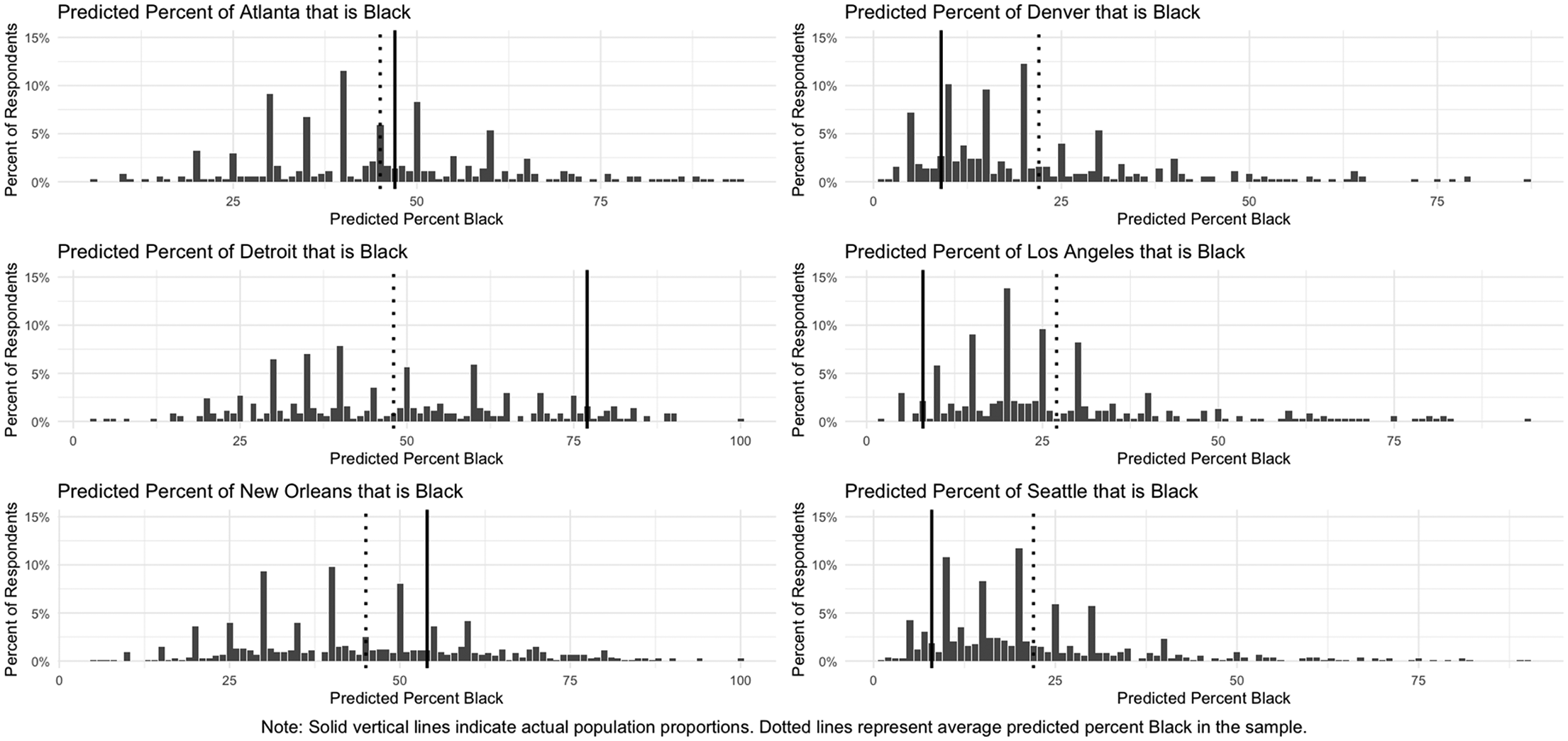
Predicted percent of population that is Black, Atlanta, Denver, Detroit, Los Angeles, New Orleans, and Seattle.
Next, we used these measures of Black overprediction to predict attitudes about the city itself. Perceiving the city as having a greater Black population relative to reality indicates that respondents perceive the city in more racialized terms than reality reflects. We theorize that more racialized perceptions of cities populations will lead respondents to perceive the city as more threatening. We expect that respondents who overpredict the Black population are more likely to perceive the city more negatively (or less positively), are less likely to visit the city (even if the visit was free), and to dissuade their hypothetical child from attending college in the city. These responses would indicate greater perceptions of threat. In general, this is what we find. Table 1 provides coefficient estimates for the effect of Black overprediction on each of these attitudes (models control for gender, education level, income, age, and political party identification; full regression outputs can be found in online Appendix A, Tables 1–24). Black overprediction significantly affects the use of negative adjectives to describe a city (like “crime-riddled,” “violent,” and “dirty”), for each city except Seattle. The Blacker respondents perceive a city as being, the more likely they are to describe it with a negative adjective. However, in general, Black overprediction does not affect the greater or lesser use of positive adjectives to describe the city (like “safe,” “clean,” and “friendly”), except in the case of Atlanta, where overprediction of the Black population is associated with a significant decrease in the use of positive adjectives.
Coefficient Estimates for Black and white Over-Prediction.
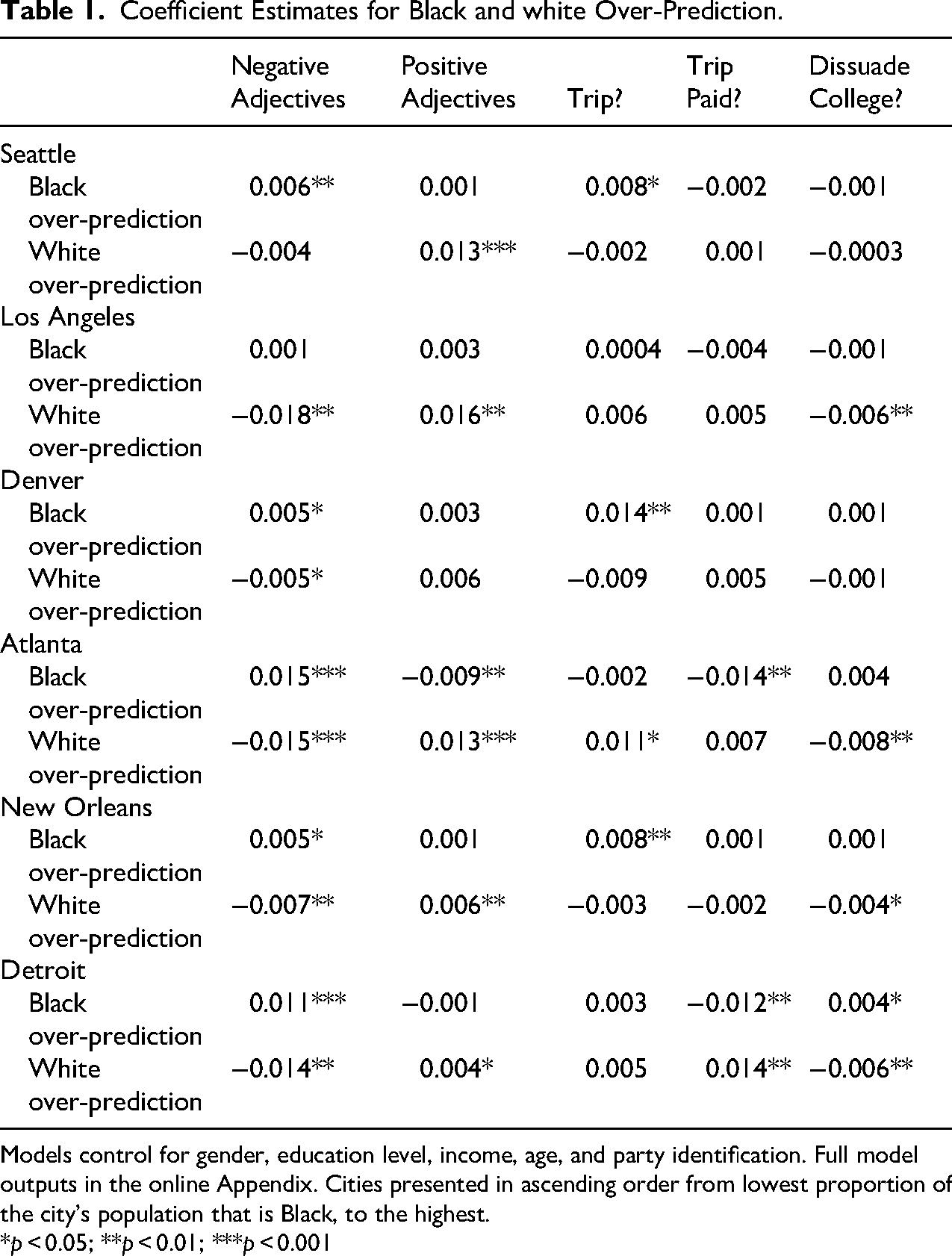
Models control for gender, education level, income, age, and party identification. Full model outputs in the online Appendix. Cities presented in ascending order from lowest proportion of the city's population that is Black, to the highest.
*p < 0.05; **p < 0.01; ***p < 0.001
Overprediction of the Black population unevenly affects whether respondents would like to visit the city, with overprediction actually increasing the likelihood that they will visit some cities (e.g., Seattle, New Orleans, and Denver), while Black overprediction decreases the likelihood that respondents would visit some cities even if it were cost-free (e.g., Atlanta and Detroit). In this case, it seems that white Americans will visit “white” cities even if they perceive it to be Blacker than it actually is, or, in the case of New Orleans, they will visit cities whose economy is primarily dependent on a tourism industry that has commodified a caricatured version of a “safe” Black culture (see Gotham 2007). At the same time, overprediction of the Black population in “Black” cities pushes white Americans away. Black overprediction similarly increases the likelihood that respondents will dissuade their hypothetical children from attending college in a commonly perceived Black city, like Detroit.
Table 1 also includes coefficient estimates for the effect of white overprediction on attitudes toward each city. When presented the race proportion sliders in the survey, respondents’ responses were not automatically calibrated so that the total equaled 100 percent. This was done purposefully given the expectation that respondents may have contradictory or non-logical perceptions of the racial demographics of a city. In other words, we found it plausible, if not likely, that respondents could over/under predict the proportion of each race of a city. This means that the prediction of the white population is not simply the inverse of the prediction of minority populations, but a substantively separate perception. White overprediction is negatively associated with a significant decrease in the use of negative adjectives to describe a city in five out of six cases (excepting Seattle), and is also significantly associated with an increase in the use of positive adjectives in five out of six cases (excepting Denver). White overprediction increased the likelihood of visiting Atlanta, while also increasing the likelihood of visiting Detroit if the trip was cost-free. White overprediction had a far greater association with dissuading a hypothetical child from attending college in the city than Black overprediction, with white overprediction predicting a lower likelihood of dissuading the child in five out of six cities (excepting Seattle). In general, then, we conclude that white Americans’ perceptions of the racial demographics of cities shape their perceptions of the city's themselves as “good” or “bad” places.
Study 2
In the second study, we experimentally manipulated racialized perceptions of one city, Chicago, and tested the extent to which our treatments affected perceptions of the city. Chicago was selected because its pronounced racial segregation, combined with long-standing patterns of political and social discourse, has led to divergent perceptions of the city as both predominantly white and predominantly Black. Given its large and largely separate Black and white populations, its racialized reputation has been portrayed variably (Schwarze 2022). Respondents were shown two nearly identical (AI-generated) tourism ads for the city. The words “Visit Chicago” were superimposed over an image of a family in the city. One ad contained a white family, while the other contained a Black family. To construct the experimental stimuli, we used AI-generated images to ensure that the treatment conditions were as similar as possible, varying exclusively in the race of the depicted family. This approach allows us to isolate the effect of racial cues while minimizing confounding differences in other visual features, thereby strengthening internal validity. Respondents were asked to look at the ads closely, then asked the same questions about Chicago as the cities in Study 1. The treatments can be seen in Figure 2.

Tourism ad treatments.
Among the full sample, respondents who received the Black Ad treatment perceived the city's population as being 1.8 percentage points Blacker, which approached but did not reach statistical significance (p = .13). However, among those with limited familiarity with the city of Chicago, defined as having spent a moderate amount of time there or less, the treatment effect was larger and statistically significant. Among those with limited familiarity, the Black Ad treatment was associated as perceiving the city's population as 2.1 percentage points Blacker, which was significant at p < .1. This indicates that, at least among those with limited familiarity of the city, the treatments were successful at shifting racialized perceptions of the city's population. Among the full sample, while not significant, the treatment is associated with altered racialized perceptions of the city's population in the hypothesized direction. This pattern is consistent with an information-based mechanism in which individuals rely more heavily on contextual cues when baseline knowledge is low. Full results for this manipulation check are available in online Appendix B, Table B13.
Here, we estimate the treatment effect of the Black tourism advertisement on respondents’ use of negative descriptors to describe Chicago. We predict that respondents who received the black treatment ad will perceive the city of Chicago as more threatening and thus more likely to describe it in negative terms. We present results for the full sample and for key subgroups, including respondents with limited experience in Chicago (again defined as having spent a moderate amount of time there or less), Democrats, Republicans, and those scoring above and below the median on racial resentment. All models control for education, income, ideology, gender, and age. We first test the treatment effect on an additive variable, counting how many negative attributes respondents used to describe Chicago. Respondents’ score on this variable is determined by whether they described the city as dirty, violent, or crime-riddled. The number of these negative adjectives the respondents used determines their score, such that a respondent who used none of those variables would score zero, and a respondent who used all three would score three. The treatment effects can be seen in Figure 3.
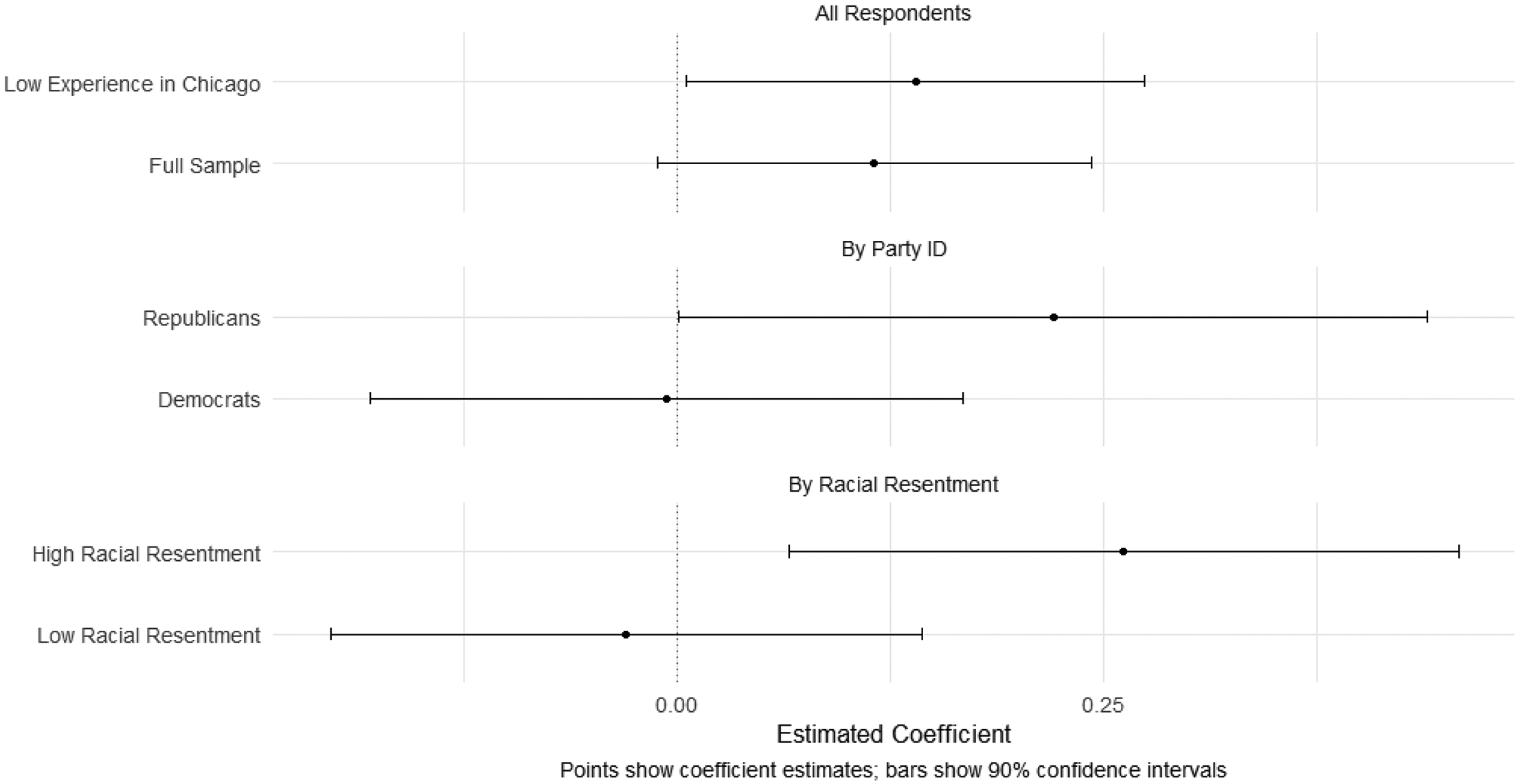
Effect of Black tourism ad treatment on attributing negative attitudes to Chicago.
Among all respondents, as expected, we see a positive coefficient, indicating that, descriptively, those who received the black tourism ad treatment attributed more negative descriptors to Chicago than those who did not. However, the effect approaches, but does not reach statistical significance (β = .12, SE = .08, p = .13). Among those who expressed low levels of familiarity with the city, however, we do see a positive and statistically significant effect (β = .14, SE = .08, p < .1). This indicates that those with lower levels of experience in the city of Chicago were more likely to attribute negative descriptors to the city when they received the black tourism ad treatment. It is particularly notable that while Chicago is a highly salient city and may evoke relatively well-formed attitudes for some respondents, the presence of treatment effects—particularly among those with lower familiarity—suggests that these perceptions remain responsive to racialized cues. Next, we analyzed the effects by partisan identification and levels of racial resentment to test the extent to which effects were concentrated in certain subgroups. Accordingly, we find that Republicans and those who were above the median in racial resentment were more likely to ascribe negative attributes to Chicago when receiving the black tourism ad treatment. Where the treatments appeared to have little to no effect on Democrats (β = −.01, SE = .11, p = .95), effects were significantly stronger among Republicans than the population at large (β = .22, SE = .13, p < .1). Similarly, we find little to no treatment effects among those low in racial resentment (β = −.03, SE = .11 p = .78). However, among those high in racial resentment we see considerably larger effects than among the population as a whole (β = .26, SE = .12, p < .05). Taken together, results indicate that those conditioned to see Chicago as Blacker were more likely to describe the city in negative terms if they had lower levels of familiarity with the city, if they were Republicans, or if they scored above average in racial resentment.
Next, we turn to analyzing the treatment effects on the violent attribute. This is the individual attribute in which we observed the strongest effects and may be of particular interest due to the fact that it most strongly signals perceived direct threats to physical safety. The treatment effects of the black tourism ad treatment on whether respondents described Chicago as violent can be seen in Figure 4. Here, as expected, we observe significant positive effects among both the full sample (β = .06, SE = .03, p < .1) and among those with lower levels of experience in the city (β = .07, SE = .04, p < .1). Again, we observe small and insignificant effects among Democrats (β = .01, SE = .05 p = .88) and those with below average levels of racial resentment (β = .03, SE = .05, p = .45). Again, we see that Republicans are responsive to the treatment (β = .10, SE = .06, p < .1). While the coefficient is positively signed among who are high in racial resentment, it approaches but does not reach statistical significance (β = .08, SE = .05, p = .11). Here we find that the sample as a whole, those with low levels of experience in the city and Republicans were more likely to describe Chicago as violent when conditioned to perceive the city as Blacker. The full models for Study 2 are available in online Appendix B, Tables 1B–6B.
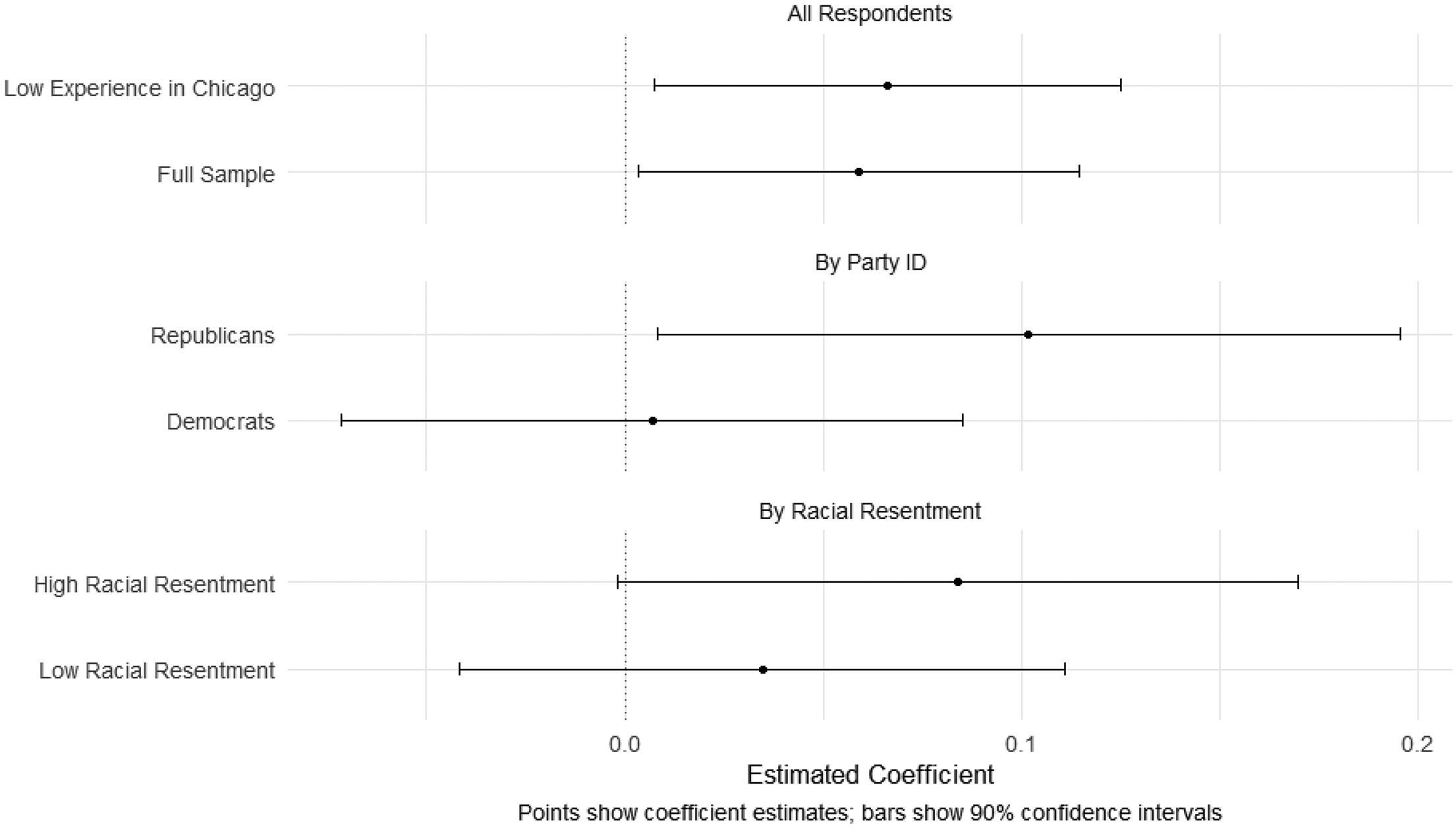
Effect of Black tourism ad treatment on perceiving Chicago as violent.
Taken together, this supports the hypothesis that perceptions of racial threat can derive racialized perceptions of spaces that may not be proximate to the subject. In this case, it appears effects may be particularly concentrated among Republicans and those who are higher in racial resentment.
It is worth noting, however, that while our manipulation check suggests that the treatment increased perceptions of Chicago's Black population, particularly among respondents with lower levels of familiarity with the city, the magnitude of this shift was relatively modest. As a result, changes in perceived demographics may not fully account for the treatment effects observed in Figures 3 and 4. We therefore cannot rule out the possibility that the treatment operated through multiple mechanisms. In addition to altering perceptions of the city's racial composition, exposure to a Black family may have increased the salience of race itself, thereby activating racialized considerations when evaluating the city. Future research should seek to more clearly disentangle these pathways. Importantly, both interpretations remain consistent with our broader argument that racialized cues shape evaluations of non-proximate places.
Study 3
In study 3, we test whether racialized perceptions of cities impact policy preferences. Specifically, we test whether respondents would be more willing to provide federal disaster aid for an earthquake in Seattle or a hurricane in New Orleans. These cities were chosen because of their susceptibility to major disasters and their racial makeup. Seattle is 59 percent white and just 6 percent African-American, as opposed to New Orleans, which is just 32 percent white and 55 percent African-American. While respondents did not precisely predict the racial makeup of the cities, they did correctly identify Seattle as having a larger white population (Seattle = 60.4 percent, New Orleans = 43.4 percent) and New Orleans as having a larger Black population (Seattle = 22.1 percent, New Orleans = 44.5 percent). Notably, in the empirical analyses that follow, we do not directly manipulate perceptions of policy beneficiaries. Instead, we examine how responses to place-based policy scenarios vary as a function of respondents’ pre-existing racialized perceptions of those places, allowing us to assess how such perceptions structure policy evaluations.
Respondents were randomly selected to receive one of two treatments describing the potential for disaster in a major American city. The Seattle treatment read: “Experts warn that the Pacific Northwest faces a growing risk of major seismic activity. Seattle is a city especially vulnerable to earthquakes due to its location along the Cascadia Subduction Zone.” Respondents were then asked to imagine a situation in which a magnitude 8.5 earthquake occurred. The New Orleans treatment read: “Forecasters predict that the upcoming hurricane season will be unusually intense. New Orleans is a city that is especially vulnerable to hurricanes due to its low elevation and proximity to the Gulf Coast.” Respondents were then asked to imagine a Category 5 hurricane that caused “widespread destruction to homes, infrastructure, and public services.” The magnitudes of the disasters (M8.5 vs. Category 5) were chosen both because they are realistic scenarios given the geographic realities of the cities in question and because they would both likely be comparably devastating disasters.
After reading the scenarios, respondents were asked: “Based on the scenario you just read, please indicate how much you agree or disagree with the following statement: ‘The federal government should provide substantial disaster relief to [New Orleans/Seattle], including funds for infrastructure repair, housing assistance, and long-term recovery’.” They then indicated their level of agreement with that statement on a 1 to 5 Likert scale. The control variables remain the same as in Study 2. We again analyze the full sample, those who expressed low levels of familiarity with the cities, this time meaning those who had little or no time at all in both Seattle and New Orleans, and respondents broken down by party identification and levels of racial resentment. The treatment effects can be seen visually in Figure 5.
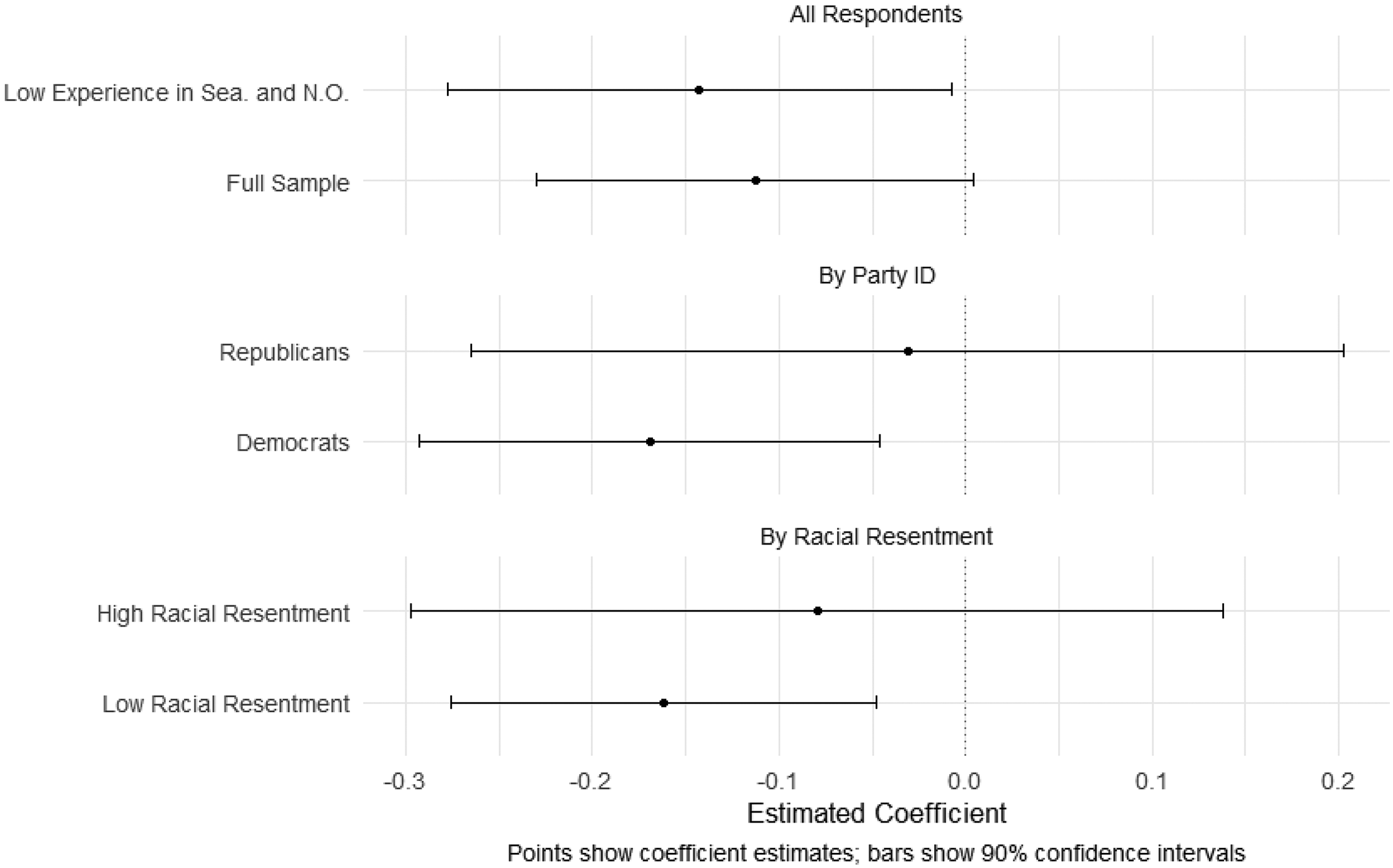
Effect of New Orleans treatment on support for federal relief.
As expected, we see descriptively that those who received the New Orleans treatment were less supportive of providing federal aid to support the city after the disaster. However, while the coefficient is signed negatively, as we expect, it again approaches but does not reach statistical significance (β = −.11, SE = .07, p = .11) However, among the portion of the sample with low levels of experience with Seattle and New Orleans, we see that the coefficient is negatively signed and significant (β = −.14, SE = .08, p < .1). This indicates that, among those with low levels of familiarity toward the cities in question, respondents were less willing to provide federal disaster relief to New Orleans (which respondents correctly perceive as being less white and Blacker) than Seattle.
Next, we examine the treatment effects across subgroups. Interestingly, while the coefficient is negative for all subgroups, this time, we see more significant effects among Democrats and those low in racial resentment. The New Orleans treatment is statistically significant among Democrats (β = −.16, SE = .08, p < .05), while effects among Republicans are smaller and statistically insignificant (β = −.03, SE = .14, p = .83). Similarly, we observe statistically significant effects among those who are below average in racial resentment (β = −.16, SE = .07, p < .05), while effects among those of above average racial resentment are smaller and lack statistical significance (β = −.08, SE = .13, p = .54). While coefficients were consistently negative across the board, we only observed statistically significant effects among those with low levels of familiarity with both Seattle and New Orleans, Democrats and those low in racial resentment. The full models for Study 3 are available in online Appendix B, Tables 7B–9B.
Why might the treatment effect be concentrated among Democrats and those with below-average levels of racial resentment? Perhaps it is the higher levels of support for baseline support for disaster relief that those two groups have. Democrats were nearly a full point more supportive of disaster relief than Republicans on a five-point scale (Democrats = 4.71, Republicans = 3.93). We also see a similarly large gap in support for disaster relief among those low in racial resentment, who scored 4.68 on the five-point scale on average, relative to those high in racial resentment, who scored just 4.02. Perhaps the higher levels of baseline support among these groups create more room for support to drop.
To further probe the mechanism underlying the treatment effects, we examine whether respondents’ pre-treatment perceptions of the racial composition of New Orleans condition their responses to the disaster relief scenario. Because these perceptions were measured prior to treatment exposure, they cannot themselves be caused by the experimental manipulation. Instead, they provide a means of assessing whether the treatment effect operates differently depending on how respondents racialize the city.
We find that the effect of the New Orleans treatment varies as a function of the perceived Black population of New Orleans. This interaction indicates that respondents who more strongly associate New Orleans with a larger Black population respond differently to the treatment than those who do not. Importantly, this pattern is inconsistent with an alternative account in which respondents simply react differently to hurricanes versus earthquakes. If that were the case, the treatment effect would be uniform across respondents. Instead, the heterogeneity we observe suggests that responses are filtered through respondents’ racialized perceptions of place, providing evidence consistent with our proposed mechanism. While the direction of the interaction suggests that the marginal effect of the treatment diminishes among respondents who already perceive New Orleans as heavily Black, the critical point is that the treatment effect is not uniform. Instead, it varies systematically with respondents’ racialized perceptions, which is precisely what we would expect if such perceptions are shaping how individuals interpret and respond to the scenario. The full results of this model are available in Table 14B of online Appendix B.
Notably, all respondents received the treatments for Study 3 after receiving treatments for Study 2. To account for the potential for confounding treatment effects, we estimated all of our Study 3 models including a control variable for the Study 2 treatment. In all of these models, neither the signage nor significance of any of our coefficients change and the estimates remain remarkably similar to those estimated without the Study 2 treatment control. The full models can be found in online Appendix B, Tables 10B–12B.
The results of this experiment are consistent with our second hypothesis. In the context of place-based disaster relief policy, it does appear that policy preferences are shaped by the racial groups they are imagined to benefit, at least in some circumstances.
Conclusion
Across these three studies, we find that racialized perceptions of cities that are not proximate to subjects shape both perceptions of threat and policy preferences of white respondents. Whites in both observational and experimental settings ascribe more threatening attributes to cities they perceive as being more Black or less white. This indicates that whether or not a distant place is seen as a threat is determined at least partly by who one imagines to live there. We have long understood that racial attitudes are far from rational, but these findings show that distant places can serve as blank canvases on which to project threat. Perhaps the “imagined other” is a more powerful enemy than for which it is given credit.
These findings also indicate that a sense of racial threat can be shaped by spaces that are not proximate to the subject. While, of course, threat can derive from factors not contingent on space, such as economic insecurity (Melcher 2021, 2023a, 2023b) or “socio-cultural learning” (Kinder and Sears 1981, p. 416), so much of the literature focused on space has focused on how the environment one inhabits impacts attitudes. Our findings suggest that threat is shaped by not only from the environment one inhabits, but also from racialized perceptions of distant places. This may explain why immigration can be such a salient issue in places that are distant from the border or why attacks on “blue cities” are so effective among people who don’t live anywhere near those cities. Threat stems not only from how one perceives their community, but it also stems from how they imagine other, distant communities.
Additionally, we find that policy preferences are structured by how individuals perceive the populations that benefit, with racialized perceptions of place serving as a key lens through which these judgments are formed. Whites who are unfamiliar with both cities are more willing to provide disaster aid to Seattle following an earthquake, a city with a disproportionately white population, than New Orleans following a hurricane, a city with a majority Black population. It would seem, therefore, that perceived threat associated with non-proximate space shapes policy preferences based on the population that is believed to benefit from said policies. Racialized perceptions of populations distant from the subject serve as a lens for them to evaluate policy. This is actually consistent with past findings (Gilens 2009; Peffley and Hurwitz 2007; Sides, Tesler and Vavreck 2019), but novel in that it extends the logic of white policy preferences being shaped by racialized beliefs about beneficiaries to place-based policies.
We acknowledge that the relationship between racialized perceptions of place and evaluations of those places may be bidirectional. Individuals who hold negative views of cities may be more likely to perceive them as having larger minority populations, just as racialized perceptions may shape evaluations. While our observational findings cannot fully disentangle these processes, our experimental results provide evidence that racialized cues can causally influence evaluations. By manipulating the racialized representation of a city while holding other features constant, Study 2 demonstrates that changes in perceived racial composition lead to shifts in how respondents evaluate that city, particularly among those with limited prior familiarity.
These findings have important implications for contemporary American politics. As political conflict increasingly centers on nationalized issues and geographically distant places, voters are routinely asked to evaluate policies that affect communities far removed from their own. Our results suggest that these evaluations are often filtered through racialized perceptions of who inhabits those spaces rather than through assessments of need, fairness, or shared fate. This has consequences not only for disaster relief and place-based policy, but also for understanding the durability of racialized political appeals that target cities, immigrants, and other spatially distant “others.” Future research should further explore how media consumption, elite rhetoric, and partisan identity shape racialized perceptions of non-proximate space, as well as whether similar dynamics extend beyond race to other social cleavages. By bringing non-proximate space into the study of racial threat, this paper highlights an underappreciated mechanism through which racial attitudes and policy preferences are structured in an increasingly nationalized political environment.
Supplemental Material
sj-pdf-1-uar-10.1177_10780874261462079 - Supplemental material for Racialized Perceptions of Cities and the Attitudes of White Americans
Supplemental material, sj-pdf-1-uar-10.1177_10780874261462079 for Racialized Perceptions of Cities and the Attitudes of White Americans by Spencer Lindsay and Cody R. Melcher in Urban Affairs Review
Supplemental Material
sj-pdf-2-uar-10.1177_10780874261462079 - Supplemental material for Racialized Perceptions of Cities and the Attitudes of White Americans
Supplemental material, sj-pdf-2-uar-10.1177_10780874261462079 for Racialized Perceptions of Cities and the Attitudes of White Americans by Spencer Lindsay and Cody R. Melcher in Urban Affairs Review
Supplemental Material
sj-pdf-3-uar-10.1177_10780874261462079 - Supplemental material for Racialized Perceptions of Cities and the Attitudes of White Americans
Supplemental material, sj-pdf-3-uar-10.1177_10780874261462079 for Racialized Perceptions of Cities and the Attitudes of White Americans by Spencer Lindsay and Cody R. Melcher in Urban Affairs Review
Footnotes
Acknowledgments
The authors would like to thank Brendan Anderson for his work as a research assistant on this project. ChatGPT was used to help copyedit the manuscript.

Ethical Considerations
This project was submitted to IRB review at the University of Arizona and Loyola University New Orleans and found to be exempt. All participants provided informed consent.
Funding
The authors received no financial support for the research, authorship, and/or publication of this article.
Declaration of Conflicting Interests
The authors declared no potential conflicts of interest with respect to the research, authorship, and/or publication of this article.
Data Availability Statement
All data and code used in this manuscript or supporting materials are available upon request to the authors.
Supplemental Material
Supplemental material for this article is available online.
Notes
Author Biographies
References
Supplementary Material
Please find the following supplemental material available below.
For Open Access articles published under a Creative Commons License, all supplemental material carries the same license as the article it is associated with.
For non-Open Access articles published, all supplemental material carries a non-exclusive license, and permission requests for re-use of supplemental material or any part of supplemental material shall be sent directly to the copyright owner as specified in the copyright notice associated with the article.
