






Abstract
Intraperitoneal chemotherapy, involving the administration of certain chemotherapeutic agents directly to the intraperitoneal cavity, was developed as a novel therapeutic strategy early in the 1950s. Intraperitoneal administration of chemotherapy results in higher intraperitoneal concentration of the cytotoxic medications and minimal systemic exposure than observed with intravenous administration, which in turn may increase the efficacy of these agents with substantial reduction in systemic toxicity. Intraperitoneal chemotherapy was used successfully in peritoneal surface malignancies, including malignant peritoneal mesothelioma, pseudomyxoma peritonei, malignant ascites, sarcomatosis, and peritoneal carcinomatosis from gastrointestinal and ovarian cancers. Pharmacists may play a major role in optimizing intraperitoneal chemotherapy through verification of chemotherapy order for proper doses, dilution, preparation, and administration. Moreover, pharmacists are medication experts who can provide other health care professionals with the necessary drug information.
Despite the local application of chemotherapy, intraperitoneal chemotherapy is not free of systemic side effects and can be associated with serious complications. The benefits of intraperitoneal chemotherapy should be weighed against its potential harm to maximize efficacy and to minimize morbidity and mortality as much as possible. The aim of this article is to review the current available literature regarding the safety and efficacy of intraperitoneal chemotherapy in cancer treatment.
Keywords
Introduction
The delivery of antineoplastic agents directly into the peritoneal cavity as a new treatment option for patients with certain types of malignancy confined to the peritoneal area was explored early in the 1950s. As a palliative tool, the main role of intraperitoneal chemotherapy (IPC) at that time was to control the formation of malignant ascites (MA). 1
Starting in the 1970s, IPC was used as a treatment modality, so high concentrations of cytotoxic drugs were given by the intraperitoneal (IP) route in large volumes to promote even distribution of the chemotherapy to the peritoneal cavity. 2
Peritoneal surface malignancies (PSMs) include peritoneal carcinomatosis (PC), which results from the dissemination of neoplastic diseases from abdominal, pelvic, or extra-abdominal organs; pseudomyxoma peritonei (PMP), a rare type of malignancy generally arising from a perforated appendiceal epithelial tumor; and primary peritoneal tumors, such as diffuse malignant peritoneal mesothelioma (DMPM) and peritoneal sarcomatosis (PS). These malignant diseases are generally characterized by unfavorable prognosis and some of them are regarded as terminal conditions. Cytoreductive surgery (CRS), followed by hyperthermic intraperitoneal chemotherapy (HIPEC) and/or early postoperative intraperitoneal chemotherapy (EPIC), is now advocated as the potential standard treatment in PSM.
3
Figure 1 illustrates the main subtypes of PSMs where IPC is indicated.
Clinical conditions where IPC can be used.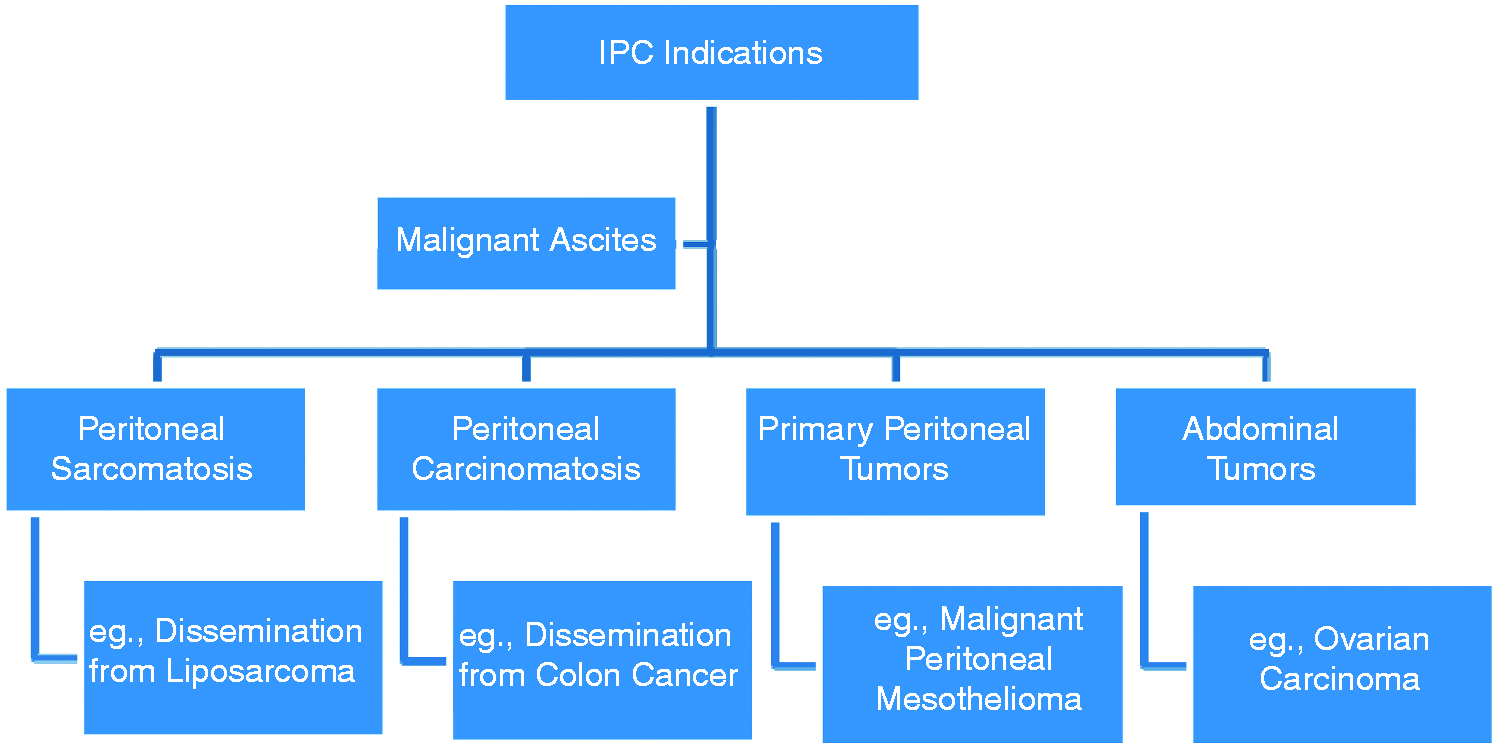
PC from gastrointestinal (GI) malignancies results from direct seeding of the primary tumor or by a surgical procedure through the spillage of malignant cells. Previously, PSMs were treated with palliative intent and were associated with poor quality of life and a high mortality rate. New treatment modalities combining surgery and IPC were then developed to improve clinical outcomes for patients with PSMs. 4
CRS with IPC is a complex intervention involving aggressive surgery, followed by IP administration of chemotherapy. IPC can be given as outpatient treatment, so the patient receives the IPC and is then discharged home or receives inpatient treatment, including intraoperative and/or early postoperative setting. 5
Rationale
IP delivery of chemotherapy has a proposed pharmacokinetic advantage over the systemic therapy, as explained by the presence of a peritoneal–plasma barrier that maintains a high concentration gradient of cytotoxic drug between the peritoneal cavity and the plasma compartment. Absorption of IPC to the systemic circulation depends on the molecular weight (MW) and charge of the drug; so highly charged hydrophilic large molecules are more effectively sequestered in the peritoneal cavity, resulting in a higher area-under-the-curve ratio of IP than that observed with systemic chemotherapy. Cisplatin and paclitaxel, commonly used agents in the treatment of ovarian cancer, have peritoneal-to-plasma concentration ratios of 20:1 and 1,000:1, respectively.6,7
Most cytotoxic medications used for IPC are macromolecules, and thus, the ability of the peritoneal–plasma barrier to retard the absorption of IPC to the systemic circulation will result in longer and more intense action of the chemotherapy at the peritoneal surfaces where cancer emboli are entrapped. 8 Blood drainage of the peritoneal surface via the portal vein to the liver offers a protective first-pass (detoxifying) effect, with increased exposure of potential hepatic micrometastases to chemotherapy. 5 Spontaneous tumor regression was observed in patients with hyperpyrexia, which led to the first clinical application of hyperthermia, performed by injecting pyrogenic substances to sarcoma patients. 9
The addition of hyperthermia to IPC is rationalized by the observed increase in response of the tumor to the cytotoxic drugs. This phenomenon is explained by the direct antitumor effect of heat, in addition to the hyperthermia-induced selective cytotoxicity of malignant cells. It was noticed that the cytotoxic effects of some chemotherapeutic agents (doxorubicin, cisplatin, mitomycin C, melphalan, docetaxel, irinotecan, and gemcitabine) are augmented by hyperthermia. 10
Procedure and techniques
IPC has many clinical applications in oncology practice. Awareness of treatment-related toxicity is an important factor and should be taken into consideration during the patient selection process. IPC can be administered in either the outpatient or inpatient setting. According to the GEICO study, 11 a modified outpatient IPC combining IV/IP therapy for optimally debulked stage III ovarian cancer patients resulted in decreased toxicity and a greater rate of treatment completion than previously reported. Another study found that an outpatient regimen of IV and IP platinum–taxane chemotherapy after CRS is well tolerated with acceptable toxicity, so most patients were able to complete all planned cycles of chemotherapy. 12 So the outpatient IPC regimen is an option, but an inpatient HIPEC regimen, eliminating multiple outpatient IP treatments with their associated complications, seems to be more convenient.
IPC is given by different schedules and techniques including perioperative HIPEC, EPIC, sequential intraperitoneal chemotherapy (SIPC), and bidirectional IPC. HIPEC is the only technique performed utilizing hyperthermia and administered in the operating room on the same day of surgery, while the EPIC and SIPC are both normothermic regimens administered for more than 1 day. EPIC is usually given for 4–6 days after surgery, while SPIC is a repetitive treatment administered over 6 months. 13 Bidirectional IPC is a new modality in which IPC and IV chemotherapies are administered concurrently. 5
Postoperative care, including total parenteral nutrition (TPN) and anticoagulation, is needed in HIPEC and EPIC regimens, 14 while it is not always indicated in outpatient IPC or SIPC. One small retrospective study found that HIPEC is associated with better overall survival and disease-free survival than SPIC at similar morbidity and mortality. The authors recommended HIPEC as the first-line treatment strategy in PC from colon cancer. 13
Another study retrospectively compared HIPEC with EPIC in the treatment of PC from colon cancer. Higher (but not significant P = 0.22) overall survival was reported in the HIPEC group (54% at 5 years versus 28% for EPIC). PC recurrence was seen more frequently in the EPIC group than in the HIPEC group (57 versus 26%). Based on these results, the authors concluded that HIPEC is better tolerated than EPIC and is twice as efficient in curing residual PC. 15
IPC can be administered using many techniques, including the closed intraoperative technique, the open or coliseum technique, and the laparoscopic technique. All techniques have been associated with low mortality and morbidity that is significant, but generally consistent with that of other major surgical procedures.
16
Figure 2 shows different types of common techniques for intraoperative IPC administration.
Commonly used techniques for intraoperative IPC administration. (a) The open abdominal technique or the “coliseum technique,” (b) the closed abdominal technique, and (c) the laparoscopic technique. Source: Wademan et al.
17

Pharmacy issues
The pharmacist plays an important role as a member of the IPC multidisciplinary team. Verification of the chemotherapy order with regard to proper indication, appropriate dosing, and preparation issues (such as concentration, stability, and compatibility) constitutes a vital part of the IPC treatment.
As part of this role, the pharmacist has the opportunity to provide high-quality pharmaceutical care to cancer patients receiving IPC, including chemotherapy-related education to patients and caregivers. Specialized training in oncology pharmacy practice and in clinical skills related to IPC administration is highly recommended to promote active participation of the pharmacists in the multidisciplinary care process. Additionally, a well-trained pharmacist will provide updated information regarding cytotoxic chemotherapy treatment (including via the IP route) to other health care providers; such information pertains to dosing, adverse effect prevention and management, and concomitant medication use and drug interactions. 18
The British Columbia Cancer Agency (BCCA) developed a clinical chemotherapy assessment and review checklist for use by oncology pharmacists for review and verification of oral, IV, and IPC orders. This clinical tool (Figure 3) is designed to ensure safe and effective chemotherapy treatment, including IPC.
19
BCCA clinical chemotherapy assessment and review checklist (oral, parenteral, and IP). Source: reproduced with permission from BCCA.
19

Drug regimen
Different drug regimens, including single-agent and combination regimens, have been used for IPC. Drug choice depends on its pharmacokinetics and pharmacodynamics properties, in addition to its suitability for IP administration. Choosing the appropriate cytotoxic agent is very important to deliver safe and effective IP therapy. Certain characteristics of the medication should be considered, such as its direct local toxicity, efficacy, and metabolism; prodrugs that require systemic metabolism to be active are not good candidates for IPC.5,20
Two FDA-approved cytotoxic agents have been used for IP administration: cyclophosphamide and nitrogen mustard. Currently, neither of these drugs is used to treat patients with PSM. 21
HIPEC dosing based on body surface area is an important issue to prevent toxicity. Fixed-dose HIPEC and drug dosing by liter of perfusate or by body weight are more prone to adverse effects, which result from potential overdosing of the chemotherapy. Commonly used cytotoxic agents for IPC are given in Table 3. A 33% dose reduction is an option for patients over the age of 60 who have been previously exposed to multiple lines of systemic chemotherapy, who need colony-stimulating factors therapy while on systemic chemotherapy, or who have received radiation therapy to the bone marrow. Recently, bidirectional HIPEC regimens using concurrent IP and IV chemotherapy have been used. 5 IV 5-Flourouracil (5-FU) and folinic acid prior to HIPEC with oxaliplatin (to avoid the instability of the mix of both) was the first regimen of bidirectional IPC. 22
Characteristics of the ideal IP cytotoxic agent:6,7,10,22
Local toxic effect to peritoneal cavity. Efficacy against the indicated type of malignancy. Availability of safe and convenient IP delivery system for that drug. Adequate distribution of the drug in the peritoneal cavity. Limited absorption to the systemic circulation. Drug with large MW.
Preparation and stability
Cytotoxic agents used in IPC. 26

Administration
IPC administration should be performed by expert health care professionals. Special precautions must be taken during IP administration for certain chemotherapeutic agents. For example, cisplatin can be administered in normal saline over 30 min using techniques and equipment similar to those used for IV infusions, while paclitaxel must be handled differently when administered via the IP route compared to IV. It should be given unfiltered by gravity flow rather than via infusion pump because the infusion pump may cause needle dislocation. Filtering will result in an unacceptably slow flow rate. 27
Administration of HIPEC using the open technique requires one inflow catheter and four drainage catheters. The chemotherapy solution is maintained at approximately 43℃ at the inflow catheter and at 41℃ throughout the whole abdomen. Four smoke evacuators are placed around the periphery of the open abdomen to minimize inhalation exposure from the chemotherapy solution. The surgeon’s double-gloved hand is used to maintain uniform distribution of the heated chemotherapy solution. 28 The chemotherapy drug is infused first. Then, to facilitate distribution, up to 1 l of warmed normal saline is infused. Some institutions prefer to mix the chemotherapeutic agent in a 1 l bag and follow that with an additional 1 l of distributional fluid. 27
Safety
When manipulating chemotherapy for IP administration, physicians and nurses are at increased risk of exposure to chemotherapy. Furthermore, in the Coliseum technique, the abdomen is open during the perfusion, so heated chemotherapy could give way to aerosol formation creating a risk of inhalation exposure.
One study measured the exposure of operating room personnel to chemotherapy during the Coliseum technique. Urine from members of the operating team was assayed for chemotherapy levels. Air below and above the plastic sheet was also analyzed. Sterile gloves commonly used in the operating room were also examined for permeability to chemotherapy. All assessments of potential exposures were found to be negative and in compliance with established safety standards. 29 In the HIPEC regimen, chemotherapy is diluted, so it is unlikely to have a major spill. However, safety precautions are nonetheless necessary to protect health care teams from exposure and to prevent contamination of the operating room. 5
Certain safety measures recommended during HIPEC administration in the operating room
30
are as follows:
Warning signs that HIPEC is in progress must be placed at the entrance of the area. Absorbent towels, a spill kit for possible spills, and leak-proof, rigid containers for biologically hazardous material properly labeled as “cytotoxic agents” should be at hand. All personnel should wear personal protective equipments (gowns, shoe covers, powder-free latex gloves, face masks, and eye goggles). Universal precautions for handling biological hazardous materials must be implemented and monitored continuously. A smoke evacuator is recommended during perfusion. Cleaning the operating room after HIPEC is important to prevent area contamination. Used instruments and trays should be washed three times with water and pure soap before leaving the working area.
Applications
Ovarian cancer
Epithelial ovarian cancer is a disease of the ovarian surface epithelium. In most cases, the disease is confined to the peritoneal cavity at initial diagnosis and in recurrence. 31 Thus, ovarian cancer is an ideal target for IPC. PC of the ovarian cancer results from dissemination of malignant cells into the peritoneal cavity. IPC administered after CRS and intraoperative HIPEC are two forms of IPC commonly used in the treatment of PC from ovarian cancer. 22 Based on randomized controlled trials, IPC is recommended by the National Comprehensive Cancer Network (NCCN) for patients with optimally debulked stage III ovarian cancer. The IPC regimen—using paclitaxel 135 mg/m2 IV infusion over 24 h on day 1, cisplatin 75–100 mg/m2 IP on day 2, and paclitaxel 60 mg/m2 IP on day 8—is recommended by NCCN guidelines as primary chemotherapy (category 1). Even though no randomized clinical trials have been published on patients with stage II disease, those patients can also receive IPC, according to NCCN guidelines. 32
IPC has been shown to be superior to standard IV chemotherapy in the treatment of optimally resected stage III ovarian cancer. Cytotoxic medications used in IPC for ovarian cancer include cisplatin, carboplatin, and paclitaxel. 33 One systematic review concluded that IPC for advanced ovarian cancer improves both overall and disease-free survival. 34 The Gynecologic Oncology Group conducted a randomized, phase III trial (GOG-172) that compared IV paclitaxel plus cisplatin with IV paclitaxel plus IP cisplatin and paclitaxel in patients with stage III ovarian cancer. The median duration of progression-free survival in the IV- and IP-therapy groups was 18.3 and 23.8 months, respectively. The median duration of overall survival in the IV- and IP-therapy groups was 49.7 and 65.6 months, respectively. Quality of life was significantly worse in the IP-therapy group before cycle 4 and 3–6 weeks after treatment, but not 1 year after treatment. This study showed that IV paclitaxel plus IP cisplatin and paclitaxel improves survival in patients with optimally debulked stage III ovarian cancer. 35
Pseudomyxoma peritonei
BCCA IPC protocol for PMP treatment.

Source: data reproduced with permission from BCCA. 40
IPC prepared using 1000 ml of 1.5% dextrose dialysis solution.
IP: intraperitoneal
Malignant ascites
MAs are defined as fluid accumulation in the peritoneal cavity consisting of different proteins, tumor cells, mesothelial cells, fibroblasts, macrophages, leucocytes, and cell detritus. Imbalance between production and resorption of plasma exudate in the peritoneal cavity is the main mechanism that explains the development of ascites. MAs are associated with low quality of life, poor prognosis, and a wide spectrum of symptoms including abdominal swelling, pain, nausea, dyspnea, early satiety, vomiting, constipation, and edema. 41
IP mitoxantrone therapy for MA in advanced breast and gynecologic pelvic cancers was found to be effective and well tolerated with a good palliative response. A dose of 30 mg mitoxantrone in 1000 ml diluents was used in phase II trials to achieve a concentration of at least 10 µg/ml. 42 Combined therapy of CRS and IPC using mitomycin C provided effective palliation by preventing recurrence of ascites in up to 75% of patients. 43 According to a phase II trial, IP bleomycin (given as 150 units in 2 l of 1.5% dextrose dialysis solution) was effective in eliminating MAs in 60% of patients. Compared to the systemic administration, bleomycin achieved a 400-fold difference in concentration when given via the IP route with minimal toxicity. 44
Laparoscopic intraperitoneal hyperthermia chemotherapy (LIPHC) has also been used in the treatment of MAs. Depending on the type of the primary tumor, LIPHC using cisplatin and doxorubicin or mitomycin was clearly effective in eliminating MAs without procedure-related morbidity or mortality. LIPHC is characterized by short operative times, short hospital stays, low complication rates, and—ultimately—symptomatic relief. Thus, LIPHC is a very successful palliative treatment modality for MAs. 45
Apart from the IPC, it is worth mentioning the trifunctional antibody called catumaxomab, which is a newly introduced immunotherapy given by the IP route to manage MAs. A clear clinical benefit was observed in patients with MAs secondary to epithelial cancers, especially gastric cancer, with acceptable toxicity. 46
Colon cancer
According to the natural history of the disease, patients with PC from colorectal cancer have a dismal median survival of 5–9 months, so this condition is generally considered a terminal disease equivalent to distant metastasis, with limited response to conventional therapeutic interventions. 47 Instead of distant metastasis, Sugarbaker described PC as a locoregional cancer invasion, suggesting that CRS combined with HIPEC is the only available option to eradicate microscopic residual disease and to achieve long-term survival benefits. 48
The most effective cytotoxic medications successfully used for PC from colorectal cancer are 5-FU, mitomycin C, and oxaliplatin. IPC for locally advanced colorectal cancer shows promising results in reducing the incidence of recurrences. Treatment with HIPEC was more effective with higher survival rates and a smaller number of recurrences compared to the postoperative IPC. 8
Verwaal et al. 49 conducted the only randomized controlled clinical trial on patients with PC from colon cancer; 105 patients were randomized to receive either standard therapy (5-FU/leucovorin and/or palliative surgery) or CRS and HIPEC with mitomycin C. In the standard arm, the overall survival time was 12.6 months, while it was 22.3 months in the HIPEC arm (log-rank test, P=0.032). On the other hand, increased morbidity was observed with a mortality rate of 8% in the HIPEC group (mostly due to bowel leakage). In addition, follow-up results of this study revealed that long-term survival was not improved using the CRS–HIPEC modality. 50
Performing the trial without using oxaliplatin, irinotecan, or monoclonal antibodies in the control group is another limitation of this study because these are well-known effective medications in the treatment of colon cancer. CRS with HIPEC is a promising therapeutic option for patients with PC from colorectal cancer, and it should be highly encouraged for candidate patients. 10 According to the NCCN guidelines, IPC for peritoneal metastases from colon cancer is not recommended outside a clinical trial setting. 51
Gastric cancer
Surgery followed by adjuvant systemic IV chemotherapy has been recognized as a standard treatment for gastric cancer. However, this treatment modality is not curative in all cases. In patients with PC from gastric cancer, systemic chemotherapy is generally ineffective because of the poor peritoneal penetration of the cytotoxic medications and its failure to produce clinical benefits to CP patients. 52
PC from gastric cancer is associated with poor prognosis, so IPC was explored as a potential treatment option. According to one systematic review, HIPEC after surgical resection of advanced gastric cancer improved overall survival rates. Unfortunately, however, risk of serious complications such as intra-abdominal abscess and neutropenia is increased. 53
So a risk versus benefit analysis should be taken into consideration before starting this treatment modality. A recent meta-analysis of a randomized controlled trial studied the benefits of HIPEC for patients with advanced gastric cancer who underwent a gastrectomy. A significant improvement in survival was observed in the HIPEC groups (mitomycin C and 5-FU groups) compared to the control group. A lower peritoneal recurrence rate was observed in the HIPEC group compared to the control group. Reported complications included bone marrow suppression, anastomotic leak, bowel fistula, adhesive ileus, and liver dysfunction. This meta-analysis demonstrated that HIPEC may improve patients’ overall survival and help to prevent peritoneal local recurrence among patients with serosal invasion in gastric cancer. However, according to this meta-analysis, 10 randomized clinical trials were included; none of the trials were blinded and a detailed randomization process was not reported in seven of them. 54
Mitomycin C, cisplatin, and etoposide were used with hyperthermia after CRS to treat PC from gastric cancer. In addition, docetaxel and carboplatin combined with IV methotrexate and 5-FU were used as neoadjuvant IPC for the same indication. 55 More high-quality research is needed to determine the usefulness of IPC in gastric cancer patients; currently available evidence is not strong enough to recommend this approach as a routine practice rather than as an investigational therapy. Moreover, clinical trials’ methodologies should be unified to avoid the wide variations between these studies in order to identify and apply clear recommendations.
Mesothelioma
DMPM was considered a preterminal condition that can be potentially fatal if not treated aggressively. Patients with this condition were treated by several modalities, including systemic chemotherapy, palliative surgery, and total abdominal radiation. Doxorubicin, mitomycin, cisplatin, 5-FU, and paclitaxel are among the most active medications in DMPM. 56 There is a clear improvement in survival rate with CRS followed by IPC, compared to conventional systemic therapy. 57
IPC, with doxorubicin and cisplatin in 1.5% dextrose peritoneal solution, after CRS was used for DMPM at approximately 42℃ for 90 min. IP paclitaxel administered in the early postoperative setting is a treatment option for patients with DMPM. 58 DMPM remains confined to the peritoneal cavity in most cases, so complete CRS is a major positive prognostic factor. 59
Favorable long-term outcomes were reported by a phase II study of 49 MPM patients using CRS followed by HIPEC (cisplatin 250 mg/m2). This approach resulted in progression free and overall survival durations of 17 and 92 months, 60 respectively. Yan et al. 61 conducted the largest multi-institutional clinical trial to date of patients with peritoneal mesothelioma treated by CRS with IPC. Of 405 patients, 318 (79%) had epithelial tumors and 48 (12%) had biphasic or sarcomatoid tumors; in total, 372 patients (92%) received HIPEC. One hundred twenty-seven patients (31%) had grades 3 and 4 complications. Nine patients (2%) died perioperatively. The mean length of hospital stay was 22 days (SD, 15 days). The overall median survival was 53 months (1–235 months), and 3- and 5-year survival rates were 60% and 47%, respectively. So, according to this study, CRS combined with HIPEC achieved prolonged survival in select patients with DMPM.
Pancreatic cancer
The role of IPC in pancreatic cancer has not been thoroughly studied. Currently, there are no well-designed clinical trials exploring the safety and efficacy of this approach, so clear recommendations regarding IPC in pancreatic cancer cannot be established. One phase II study and a few pharmacologic studies have described the use of IPC in pancreatic cancer. Due to its favorable pharmacokinetics, gemcitabine is considered an excellent drug for IP administration.
IP gemcitabine for resectable pancreatic adenocarcinoma was used as adjuvant therapy after surgical resection; 1000 mg/m2 in 1.5% dextrose peritoneal dialysis solution was given on days 1, 8, and 15 of the 4-week cycle. It was found that long-term IP gemcitabine is a well-tolerated therapy without grade III or IV toxicities. 28
Another study of nine patients with advanced pancreatic malignancy confirmed the safety of IP gemcitabine without significant toxicities. A rapid decrease in peritoneal concentration and low local toxicity support the IP use of gemcitabine. 62 However, this study is limited by the small number of patients and the lack of control group needed to address the clinical outcomes of IPC, so clear benefits from IPC over the conventional systemic chemotherapy cannot be established from such small and scattered clinical trials. Instead, large controlled clinical trials are necessary to assess the safety and the efficacy of this therapeutic option.
Sarcomatosis
PS is a rare subtype of PSM resulting from the dissemination of sarcoma into the IP cavity without significant extra-abdominal sites of disease. The most common types of sarcoma associated with PS are GIST, liposarcomas, and leiomyosarcomas. 63
In patients with PS treated with CRS followed by IPC, it was found that the peritoneal cancer index, a scoring system signifying the extent of metastasis into the peritoneal cavity, has a significant impact on the survival rate. A peritoneal index <13 at the time of exploration was associated with a 75% 5-year survival rate, while the same rate was only 13% in patients with a peritoneal index ≥13. Complete CRS was also a significant factor in improved prognosis. 64 Current available literature regarding the treatment of PS with IPC is very limited, so more clinical research is needed to identify the best approach in those patients.
Limitations
Regardless of its clear clinical benefits, many disadvantages limit IPC routine use. Potential disadvantages of this treatment strategy include the morbidity associated with extensive CRS done before IPC delivery, lack of standardization of IPC (optimal agents, proper doses, and administration technique), increased local toxicity, ineffectiveness against occult systemic metastases, 65 and the limited local penetration of the IPC into the tumor tissue, despite the high concentrations of the cytotoxic agents achieved by the IP administration. 6

Abdominal pain is a common and sometimes severe side effect seen in HIPEC during chemotherapy instillation caused by marked peritoneal inflammation and abdominal distension, 26 but incidence has not been numerically reported in clinical trials.
As part of preventive measures against complications, postoperative critical care should be offered to all patients receiving IPC after CRS. Nutritional support with TPN is recommended upon initial arrival to the critical care unit and should be switched to nasojejunal enteral nutrition after 2–3 days and continued until GI recovery. Patient-controlled analgesia for postoperative pain, IV proton pump inhibitor prophylaxis, nasogastric suction, and low MW heparin for prevention of venous thrombosis are commonly prescribed. 67
A standard management approach for IPC complications has not yet been established due to the lack of controlled studies in this field and to the broad variability in surgical technique, IPC regimen, patient selection criteria, complications classifications, and timing and duration of IPC. A well-trained multidisciplinary health care team and evidence-based clinical practice that is based on updated literature review are key factors in the prevention and management of IPC complications. 69
Suggested key points to prevent IPC complications:
Careful selection of patients with appropriate indications for IPC. Risk versus benefit analysis should favor IPC use. Multidisciplinary teamwork performed by well-trained and educated health care professionals is essential for successful IPC treatment. Choosing the appropriate procedure for IPC administration (open, closed, laparoscopic, etc.). Appropriate selection of cytotoxic agents that are safe, effective, and cost effective. Applying infection control precautions and guidelines to prevent infections.
Conclusion
IPC is an effective and clinically applicable therapeutic option that can be considered in clinical oncology practice as a rational rather than investigational therapy for select patients with PSMs. Due to the associated morbidity and mortality and the potential risk for procedural complications, however, the clinical benefits of the IPC must be weighed carefully against any potential harm. There is a growing need for well-designed clinical trials to determine the optimal IPC regimen for each type of malignancy and to evaluate the role of prophylactic IPC in patients at high risk for PC. A multidisciplinary approach is crucial to patient selection, timing of the surgery, and preparation and administration of IPC, so it is important to develop standard guidelines for physicians, pharmacists, and nurses regarding IPC.
Footnotes
Acknowledgments
We would like to thank Miss Yomna Al-Quteimat for her help and support throughout the completion of this work.
Conflict of interest
The authors declare no conflicts of interest.
Funding
This research received no specific grant from any funding agency in the public, commercial, or not-for-profit sectors.