







Abstract

To the Editor,
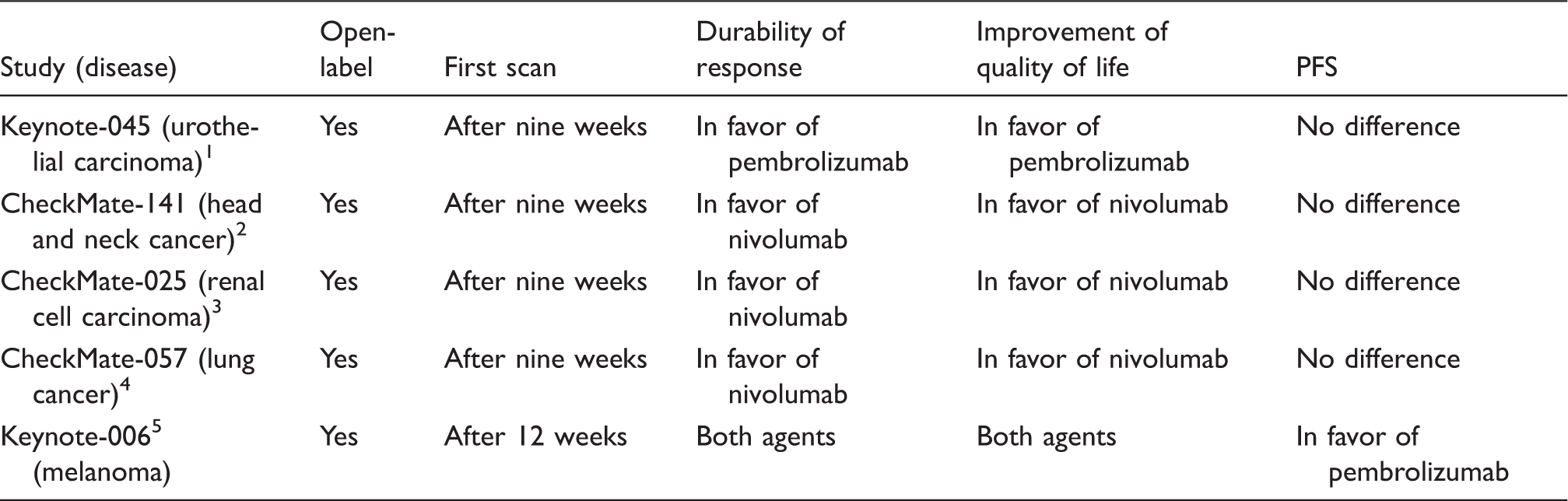
Interpretation of increased overall survival (OS) with lack of progression free survival (PFS) improvement in different recently published phase III trials treating their patients with program death-1 inhibitors (PD-1-Is) is challenging. The results of these studies in patients with different cancer types were consistent.1–4 Analyzing these phase III studies (Table 1) helps identifying potential explanation factors:
Four of five studies performed first FU-scans after only nine weeks. In contrast, in Keynote-006, scans were done after 12 weeks, minimizing the risk of misinterpretation of pseudo-progression in first weeks. Subsequently, both OS and PFS were significantly improved.
5
Unlike OS, PFS dependents on clinical and radiological findings which are biased by pseudo-progression. Anticipation on PD-1-Is might trigger investigators of these non-blinded studies for more frequent assessments leading to drop-off due to eventual initial pseudo-progression. None of these studies allowed cross-over. In 4/5 studies in Table 1, responses were more durable with PD-1-Is. However, durable responses in both arms of Keynote-006 allow better clarity. In this study, pembrolizumab showed significant improvement of OS and PFS.
5
Comparatively reported preservation of quality of life with PD-1-Is influences decisions in favor of further, eventually effective chemotherapy lines. Landscape of interesting phase III studies (patients with refractory/relapsed disease).
The above mentioned facts can influence interpretation of responses to PD-1-Is if done too early. Considering these points can help avoid premature termination of eventually effective therapy. Clinician should be aware about these critical points when discussing such study results.
We need to focus our future research on new assessment methods until availability of clearly progress in imaging methods.
Footnotes
Declaration of Conflicting Interests
The author(s) declared no potential conflicts of interest with respect to the research, authorship, and/or publication of this article.
Funding
The author(s) received no financial support for the research, authorship, and/or publication of this article.