






Abstract
Bruton tyrosine kinase plays a critical role in hastening cell proliferation. Bruton tyrosine kinase inhibitors are a class of immunotheraputic agents that disrupt this signaling pathway. Ibrutinib, a novel Bruton tyrosine kinase inhibitor approved by the Food and Drug Administration (FDA) for the treatment of Waldenstrom macroglobulinemia in patients who have failed treatment with other agents, has emerged as an important therapeutic agent in the management of Waldenstrom macroglobulinemia and other plasma cell dyscrasias. Ibrutinib has shown to increase progression free survival and improve overall mortality. We present a review of ibrutinib, beginning with an overview of the Bruton tyrosine kinase pathway and clinically relevant gene mutations impacting treatment and prognosis for patients with Waldenstrom macroglobulinemia, followed by evidence supporting therapeutic indications for ibrutinib, and detailing its safety and efficacy evidence, current clinical guidelines, adverse effects and their management, and finally challenges of drug resistance. We also present findings on newly developed Bruton tyrosine kinase inhibitors in the therapeutic pipeline to provide readers insight into this rapidly evolving corner of oncology pharmacy practice.
Introduction
Waldenstrom macroglobulinemia (WM)—also known as Lymphoplasmacytic lymphoma—is a rare B-Cell neoplasm, characterized by monoclonal IgM production, resulting in hyperviscosity and tissue infiltration by monoclonal cells. Bone marrow infiltration results in anemia and thrombocytopenia, and lymphatic tissue infiltration results in lymphadenopathy and hepatosplenomegaly. WM remains an incurable disease with a heterogeneous course, and relapse following initial treatment happens in virtually all patients. Disease rarity makes it challenging to conduct large randomized controlled trials on new treatments. Symptomatic patients require treatment based on symptoms severity and disease burden, while those who are asymptomatic (“Smoldering WM”) may be closely monitored without initiation of treatment. These treatments aim to control symptoms, decrease relapse, and improve survival. Autologous stem cell transplantation is the first line treatment option for eligible patients with symptomatic disease, both untreated and relapsed. Options for treatment include single- or multi-agent chemotherapy regimens in severe cases. Other therapies depending on the disease’s manifestations include parenteral iron in patients with anemia (due to hepcidin related iron deficiency), and plasmapheresis in patients with hyperviscosity.
Use of biological agents has led to improved survival for individuals with WM. Ibrutinib, a Bruton Tyrosine Kinase (BTK) inhibitor, is a promising drug used in treatment of WM, chronic lymphocytic leukemia (CLL), Mantle cell lymphoma, marginal zone lymphoma, and chronic graft versus host disease. It is approved in the US, Canada, and Europe as a single agent primary therapy in WM patients with relapsed disease. The use of ibrutinib in untreated WM patients, as a single agent or in combination, is still being trialed. This article will provide a brief review on the use of ibrutinib in WM.
Biochemical background
Bruton’s tyrosine kinase (BTK)
The BTK gene was first described in 1993 as member of the src family of proto-oncogenes, and was identified as the gene responsible for X-linked Agammaglobulinaemia (XLA), a disease in which pre-B cells in the bone marrow fail to develop into circulating mature B cells. 1 BTK-mediated B-cell receptor signaling appears to be required for the survival of immature B cells in the bone marrow that have performed successful immunoglobulin (Ig) L chain locus rearrangement, resulting in the expression of a non-autoreactive Ig on the membrane. BTK has also been shown to be involved in signaling pathways that govern the development of peripheral B cells, including follicular entry, follicular maturation, and plasma cell differentiation. 2
The BTK gene encodes a cytoplasmic non-receptor protein tyrosine kinase (BTK), which belongs to the Tec kinase family. 3 It is a kinase that is expressed exclusively in B cells and myeloid cells, and is lacking in T cells. BTK transmits signals from numerous surface molecules including growth factors, Toll-like receptors (TLRs), G protein-coupled receptors such as chemokine receptors (e.g. CXCR4 and CXCR5), antigen receptors (especially the B-cell receptor (BCR) and Pre-BCR), and integrins. BTK in turn activates numerous signaling pathways, including the phosphoinositol-3 kinase (PI3K)-AKT pathway, phospholipase-C (PLC), protein kinase C, and nuclear factor kappa B (NF-κB).4,5 BTK activation induces a range of protein interactions and the recruitment of signaling molecules, resulting ultimately in B-cell survival, proliferation, differentiation, production of antibodies, and inhibition of apoptosis through NF-κB activation.4,6–8
Additional genes responsible for the development of WM may have influence on the BTK pathway. Myeloid differentiation primary response 88 (MYD88) is a gene that encodes for a cytosolic protein that plays a central role in the immune system. Mutations in MYD88 have been associated with many malignancies (e.g. B-cell lymphoma, breast cancer, female genital tract lymphoma, CLL, and WM). MYD88 L265P is a somatic mutation that encodes a mutant MYD88 protein that activates BTK and subsequently stimulates NF- κB inhibiting apoptosis and supporting survival of lymphoplasmacytic cells in WM.9–11 MYD88 L265P mutation has been detected in the peripheral blood of 96.6% of untreated WM patients, 61.8% of treated WM patients, and 41.7% of IgM monoclonal gammopathy of undetermined significance (MGUS) patients but not found in polyclonal hyper IgM state or in healthy individuals, suggesting a role in the pathogenesis of disease. 12
Given the central role of BTK signaling in multiple hematologic disorders, it has emerged as a specific target for inhibition in WM. BTK inhibitors target the involvement of BTK in BCR signaling and in cell migration. 13 Ibrutinib (initially known as PCI-32765) was the first BTK inhibitor developed and described. Subsequently, newer drugs with similar structures have also been reported (see Section “Future therapeutic directions”).
Ibrutinib is an oral agent that serves as a potent inhibitor of BTK, acting through irreversible covalent binding to a cysteine residue (Cys 481) in the BTK active site, thus inhibiting auto-phosphorylation, phosphorylation of BTK’s physiological substrate PLCγ, and phosphorylation of ERK (downstream kinase). Ibrutinib does not inhibit Syk (an upstream kinase). Ibrutinib was first tested in patients with CLL and MCL, followed by trials in patients with WM, and now has subsequently emerged in investigations of autoimmune disease. 14
Other molecular signaling pathways in WM
CXC chemokine receptor 4 (CXCR4) is a G protein-coupled receptor, i.e. essential for migration of hematopoietic precursors to bone marrow. Its stimulation causes activation of Protein kinase B (commonly known as AKT) and extracellular signal-regulated kinases (ERK) after stromal derived factor-1a (SDF-1a) engagement of CXCR4. CXCR4 somatic mutations are the second most common mutations in WM following the MYD88 L265P described above. Two commonly recognized mutations include CXCR4 nonsense (NS) (also known as CXCR4 (S338X)) and CXCR4 Frameshift (FS). They are similar to nonsense and frameshift germline mutations found in warts, hypogammaglobulinemia, infections and myelokathexis (WHIM) syndrome, 15 and are associated with clinical resistance to ibrutinib.16,17
In vitro studies have shown that WM cells with CXCR4 (NS) mutation exhibited more proliferative changes than CXCR4 wild-type (WT) cells following SDF-1a stimulation, and they demonstrated sustained AKT and ERK activation, and subsequently decreased apoptotic changes. 16 Likewise, cells with CXCR4 (FS) mutation show resistance to ibrutinib-induced apoptosis, also due to enhanced AKT and ERK activation versus in CXCR4 (WT) cells. 17
CXCL-13 is a chemokine normally expressed in macrophages, lymph nodes, as well as WM cells. High CXCL13 levels before ibrutinib therapy are predictive of achieving at least partial remission after one year of treatment, and deep suppression of CXCL13 levels following treatment have been associated with major responses. 18
Ibrutinib is not entirely BTK selective, it also shows some inhibition of tyrosine phosphorylation of SYK (upstream from BTK) and PLCγ2 (downstream from BTK). 19 Interluekin-2 Inducible Tyrosine Kinase (ITK) is also a member of the Tec family of kinases and has homologous structure to BTK. It is expressed in T-helper cells, and is activated following the binding of antigen to T-cell receptor (TCR) resulting in T-cell activation, cytokine release, and rapid proliferation. Ibrutinib, similarly to BTK, binds ITK irreversibly at Cys 442 site and inhibits downstream TH2 cells activation. 20 Mutated MYD88 WM and Primary WM cells show enhanced activity of hematopoietic cell kinase (HCK). Ibrutinib inhibits HCK through binging of ATP-Binding pocket of HCK and blocks ATP binding, thus inducing apoptosis in MYD88 L265P WM cells. 21
Other drugs have shown synergistic effects when given with ibrutinib. FK866 is a selective inhibitor of nicotinamide phosphoribosyltransferase (NAMPT) and causes depletion of intracellular NAD+ levels, and subsequently blocks cellular metabolism, and has shown to overcome drug resistance at cellular level (i.e. exhibit toxicity to WM cells regardless of MYD88 or CXCR4 status 22 ). Treating WM cells with the AKT inhibitor MK2206, or the Bcl-2-specific inhibitor Venetoclax has a synergistic action when used in combination with ibrutinib. 19
Clinical data
Early safety trials
Phase Ia trials of ibrutinib were completed primarily in patients with B-Cell malignancies who were exposed to escalating doses of ibrutinib. 23 It was well tolerated without no dose limiting events up to dose levels of BTK active site full occupancy (12.5 mg/kg per day). Severe toxicities observed included neutropenia, thrombocytopenia, and anemia; the drug half-life was observed to be 2–3 h. 23
Case series reports of four patients with relapsed/refractory WM that were treated with ibrutinib, demonstrated Grade 3/4 adverse events, namely neutropenia (one patient) and thrombocytopenia (one patient), and serious adverse events included febrile neutropenia (two patients), pneumonia/pneumonitis (one patient), and atrial fibrillation (one patient). All adverse events resolved without sequelae and were thought to be unrelated to ibrutinib. 24
Efficacy
Ibrutinib has been studied in phase III clinical trial in patients with CLL. It has shown superior outcomes in terms of progression free survival and overall survival when compared to previous standard-of-care regimens in patients with relapsed/refractory disease, 25 and to chlorambucil in previously untreated patients. 26
Ibrutinib is active in patients with WM. The best responses have been observed in patients with MYD88 L265P mutation and CXCR4 wild-type, and conversely lower response rates and delayed responses to ibrutinib are associated with mutated CXCR4 in patients with WM.16,17,27
Ibrutinib has been studied in phase II trials for treatment of CLL/SLL, MCL, diffuse large B cell Lymphoma, and WM. Focusing on its role in WM, one landmark prospective trial investigated the efficacy of ibrutinib in 63 patients with symptomatic, previously treated WM with at least one treatment modality, including autologous transplantation, rituximab and chemotherapy. 27 Ibrutinib 420 mg was administered daily, and subjects were followed until either disease progression or the development of unacceptable toxicity. The primary objective of the study was to assess the overall response; the investigators defined a minor response as at least a 25% decrease in serum IgM level, a partial response as at least a 50% decrease, and the very good partial response as at least 90% decrease. Results showed median serum IgM levels decreased from 3520 mg/dl to 880 mg/dl, median hemoglobin levels increased from 10.5 g/dl to 13.8 g/dl, and bone marrow involvement with lymphoplasmacytic cells decreased from 60% to 25%. The median time to at least a minor response was four weeks. The overall response rate was 90.5%, and the major response rate was 73.0%. Response rates were highest among patients with MYD88 (L265P)—CXCR4 Wild Type gene (100% overall response rate and 91.2% major response rate), followed by patients with MYD88 (L265P)—CXCR4 (WHIM) (85.7% and 61.9%, respectively) and patients with MYD88 (WT)—CXCR4 (WT) (71.4% and 28.6%). The estimated two years progression-free rate was 69.1% and overall survival was 95.2%. 27
Ibrutinib was additionally studied in the specific population of rituximab refractory WM, defined by the lack of minor response or relapse within 12 months of completion of treatment. A multicenter open-label study of 31 rituximab refractory patients (median number of previous treatments = 4) showed that ibrutinib had 90% overall response, and 71% major response in this population. The estimated 18-month progression-free survival rate was 86%, and the estimated 18-month overall survival rate was 97%. Participants also experienced a significant rise in hemoglobin during the study. 28
Summary of clinical trials of ibrutinib in Waldenstrom macroglobulinemia.
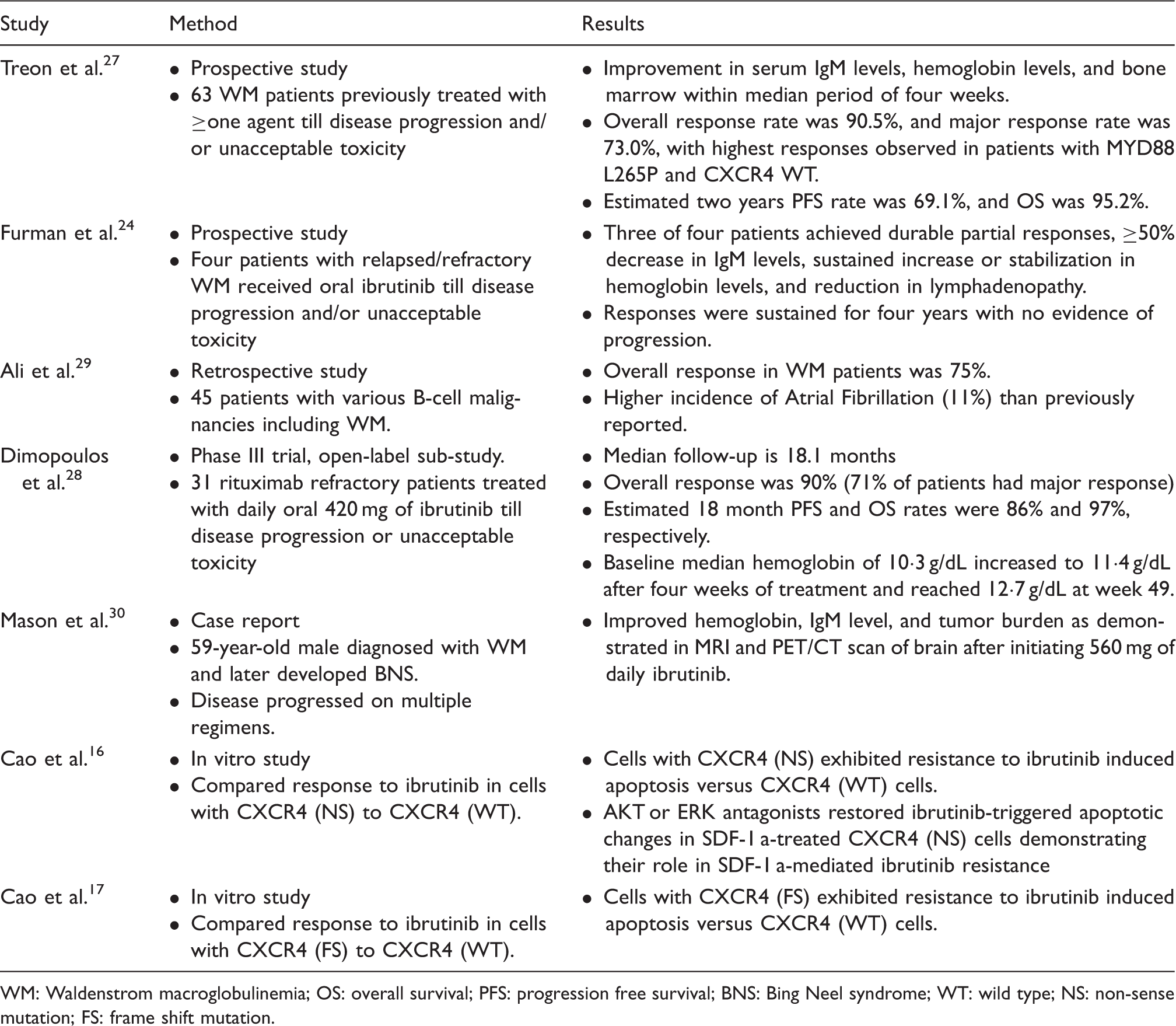
WM: Waldenstrom macroglobulinemia; OS: overall survival; PFS: progression free survival; BNS: Bing Neel syndrome; WT: wild type; NS: non-sense mutation; FS: frame shift mutation.
Ibrutinib resistance
Despite its therapeutic potential, some WM patients receiving ibrutinib still experience progression, and resistance to ibrutinib can develop while on treatment. One mechanism of resistance is a mutation that alters the active site of BTK at Cys481 causing disruption of the covalent bond between ibrutinib and BTK, conferring resistance by 25 fold. 31 It has been identified in up to 50% of patients who progress while on ibrutinib therapy; BTK Cys481 mutation was identified only in 5.1% of patients who did not show disease progression while on ibrutinib therapy; however, all of those patients eventually progressed. BTK Cys481 mutations were not detected in baseline samples or in 100 ibrutinib-naive WM patients suggesting that BTK Cys481 is acquired through ibrutinib therapy. 31
CXCR4 mutation is associated with decreased receptor downregulation, as well as activation of both AKT and ERK by SDF-1 a and confers resistance to ibrutinib-triggered cell apoptosis. 16 Eighty percent of patients with BTK Cys481 mutations express CXCR4 mutation suggesting a link between disease progression on ibrutinib therapy and CXCR4 mutation. 31 Additionally, ibrutinib resistance has been observed to emerge without CXCR4 or BTK mutations through activation of AKT signaling and reshuffling of Bcl-2 proteins maintaining cell survival. 19
Studies are ongoing to investigate the means to overcome ibrutinib resistance. Venetoclax (ABT-199) is a highly selective BCL-2 antagonist, i.e. active in B cell malignancies. It inhibits the anti-apoptotic functions of BCL-2. Combining it with ibrutinib confers synergistic action in CXCR4-WT and CXCR4-WHIM in WM cells.19,32 Also, combination with MK2206 (AKT inhibitor) potentiates ibrutinib action against resistant WM cells, suggesting that concurrent targeting of BTK and AKT can overcome AKT protective role to BTK. 19
AMD3100 is a CXCR4 antagonist that blocks SDF-1 a-triggered AKT and ERK activation, and thus is a potential treatment approach for WM patients with WHIM-like somatic mutations which are resistant to ibrutinib. The use of AKT or ERK antagonists has also been demonstrated to restore ibrutinib-triggered apoptotic changes in SDF-1 a-treated CXCR4 (NS) WM cells, indicating that ATK/ERK inhibition is a potential strategy in ibrutinib resistant cases. 16 Finally, the development of non-covalent binding BTK inhibitors is being investigated; GNE-431 is a non-covalent inhibitor that binds Cys481 residue of BTK and is promising in patients with acquired ibrutinib resistance. 33
Current role of ibrutinib in WM therapy
Guideline
The Eighth International Workshop on WM published its treatment recommendations in 2016. 6 WM is a rare disease and treatment guidelines have been adopted mostly from phase 2 studies and randomized controlled trials that have included only patients with WM or other indolent B-cell malignancies. Ibrutinib is currently approved by the US Food and Drug Administration, Health Canada, and the European Medicines Agency and indicated in treatment of symptomatic WM patients who are not candidates for chemotherapy and or immunotherapy. 6 Ibrutinib should not be stopped unless toxicity ensues or disease progresses. Interruption of daily ibrutinib can cause a rise in serum IgM and reduction in hemoglobin, and should not be considered treatment failure. Patients who experience disease progression on ibrutinib should not be retreated with it. Testing for MYD88 should be considered in all patients who are candidates for ibrutinib therapy.
Dosing
Currently, 420 mg PO daily is the standard dose for treatment of WM, administered until disease progression or development of unacceptable toxicity. Continuous daily dosing is necessary for continuous inhibition of BTK activity.
Ibrutinib is metabolized in the liver by CYP3A, as a result, doses should be reduced in patients with mild hepatic impairment and avoided in patients with liver cirrhosis. It is recommended to avoid the use of ibrutinib in patients who are on a strong CYP3A inhibitor and doses should be reduced if a moderate CYP3A inhibitor must be used. 34
Adverse effects
Ibrutinib is typically very well tolerated, and most adverse effects are self-limited. However, treatment discontinuation due to toxicity occur in up to 20%, and dose modification ranges from 19 to 26% (higher incidences are seen with prolonged treatment). As a “first generation” BTK inhibitor, ibrutinib is relatively non selective; its off-target effects on EGFR, ITK, and other Tec family kinases contribute to its adverse effects. The most common adverse effects include diarrhea, nausea, mild upper respiratory tract infection, dyspnea, edema, rash, and fatigue. Rates of discontinuation due to adverse effects increase with time, most commonly due to atrial fibrillation, bleeding, arthralgia, new malignancy, general debility, infection and pneumonitis. 35
The increased risk of bleeding is the most significant adverse effect of ibrutinib. A systematic review of four RCTs concluded that ibrutinib increases the risk of bleeding of all grades (ranging from bruises to intracranial bleeding) compared to placebo groups. 36 The mechanism is attributed to collagen-dependent platelet activation defects, absent adherence to von Willebrand factor, and impaired platelet aggregation. The risk of bleeding is higher if used with vitamin K antagonists, i.e. Warfarin or in patients with acquired Von-Willebrand disease but not if used with direct oral anticoagulants (DOAC). 35 Testing for von Willebrand activity in patients with a history of bleeding tendency before starting ibrutinib is reasonable. Holding ibrutinib 3–7 days prior to and after surgery (depending on the type of surgery and the patient’s risk of bleeding) is recommended. 6 Combined antiplatelet and anticoagulation therapy should be avoided along with ibrutinib treatment.
Cardiovascular adverse effects have also been observed in patients treated with ibrutinib. Atrial fibrillation developed in 5–9% of CLL patients on ibrutinib. 37 While the exact mechanism remains unknown, inhibition of cardiac PI3K-Akt signaling is thought to be the culprit. Nearly all patients who developed atrial fibrillation were able to manage with dose reduction or pharmacologic treatment and generally did not require discontinuation of treatment. 38 Once atrial fibrillation develops, stopping ibrutinib seems not to change its course, and thus discontinuation of treatment is not recommended. 37 Pharmacologic treatment of ibrutinib-associated atrial fibrillation should be through rate or rhythm control while avoiding digoxin, verapamil and diltiazem. If the risk of stroke is higher than risk of bleeding based on clinical scoring, anticoagulation should be initiated while continuing ibrutinib. Direct oral anticoagulants such as rivaroxiban and apixaban are favored over warfarin. 35
Other less commonly observed adverse effects of ibrutinib include infections, hypertension, and cytopenias. Additionally, given its known teratogenicity, ibrutinib is contraindicated in women considering pregnancy. It is recommended to avoid the use of ibrutinib in patients on strong CYP3A inducers. 34
Treatment interruption is indicated in case of Grade 3 or greater non-hematologic toxicities, Grade 3 or greater neutropenia with infection or fever, or Grade 4 hematologic toxicities. Treatment is withheld until resolution of toxicity or at least improvement to Grade 1 and then treatment may be resumed with 420 mg daily dosing. If toxicity recurs, ibrutinib is typically withheld again then resumed with a further dose reduction for up to two recurrences. Additional recurrences warrant stopping treatment. 39 Observations of withholding or dose-reducing ibrutinib prior to surgical procedures for three to seven days suggest its efficacy and progression free survival should not be affected. 35
Temporary holding of ibrutinib causes withdrawal symptoms in about 20% of patients including fever, headache, body aches, arthralgia, fatigue, night sweat, and chills. 40 Also a ≥25% increase in serum IgM level can ensue. 41 Incidence of withdrawal symptoms is lower in patients who had serum IgM level ≥4000 mg/dl upon initiation of treatment and CXCR4 mutation, and the incidence is higher in patients who experienced very good partial response. No withdrawal symptoms occur in patients with minor or no response. Symptoms typically appear two days following interruption and resolve promptly following resumption of treatment. Most of patients do not develop disease progression (decrease in hemoglobin, increase in IgM level, reappearance of lymphadenopathy); however in those who do, response to treatment is regained within 1–6 months following re-initiation. 40
Future therapeutic directions
Studies are ongoing comparing the efficacy of rituximab with and without ibrutinib in both relapsed and treatment-naive patients.6,42 Despite the strong therapeutic effects ibrutinib offers, given its non-selective inhibitory effects, more selective BTK inhibitors, so-called “second generation” compounds, have emerged.
Acalabrutinib (ACP-196) is a promising novel agent, i.e. more potent and selective than ibrutinib. It acts through irreversible covalent binding to Cys481 in BTK, and it is currently being trialed. Early studies have shown that it has similar effect to ibrutinib in primary CLL cells.43,44 It was trialed for treatment of relapsed/refractory mantle cell lymphoma and demonstrated both efficacy and durability, 45 and subsequently received FDA approval for that indication. 46 While off-target activity against certain kinases, such as epidermal growth factor receptor (EGFR) and interleukin 2-inducible T cell kinase (ITK) have been associated with other adverse effects such as rash and diarrhea,47,48 it offers a promising advance in the treatment of WM and similar diseases.
ONO/GS-4059 is another new agent which has undergone early testing. A phase 1 clinical trial studied this new agent in patients with CLL, MCL, and diffuse large B-cell lymphoma. Only three patients with WM were enrolled. Attributed to its better selectivity, ONO/GS-4059 is expected to have fewer adverse effects, particularly atrial fibrillation and cytopenias, 49 compared to ibrutinib.
CC.292 is another potent, selective covalent BTK Inhibitor that is being investigated as a possible treatment for WM, which has shown efficacy in CLL and MCL.50–52 Finally, BGB-3111 is a highly selective BTK inhibitor with lesser activity against ITK and superior bioavailability. Early clinical data suggests it has both a favorable safety and tolerability profile when compared to ibrutinib. 53
Conclusion
Given the central role of BTK in the pathophysiology of B cell malignancies, BTK inhibitors have emerged as a novel anti-cancer class in the fight against these challenging diseases. Ibrutinib was the first BTK inhibitor synthesized and acts through irreversible covalent bonding of BTK at its active site. Given the pathogenetic link between MYD88 L265P mutation and BTK, ibrutinib has shown a higher rate of response in patients with MYD88 L265P. CXCR4 mutations, the second most common mutations in WM cells, have also been associated with predicting responsiveness to ibrutinib. Ibrutinib is efficacious as a single agent in previously treated WM patients. It has shown to improve bone marrow function with decreased WM cells, increased hemoglobin, decreased IgM levels, and improved progression free survival and overall survival. Ibrutinib has also been demonstrated to be efficacious in rituximab refractory WM patients.
While it is usually well tolerated, adverse reactions may develop with longer treatment periods. Most commonly, adverse effects are mild and can be managed with dose reductions. Serious adverse effects include atrial fibrillation, increased risk of bleeding, and increased risk of infection.
As the clinical armamentarium for treating WM continues to develop, more selective second generation BTK inhibitors in the pipeline may offer additional treatment options for patients with WM and other B-cell related diseases offering new hope for making progress against these challenging diseases. At present, ibrutinib holds a major role in the management of this condition.
Footnotes
Declaration of Conflicting Interests
The author(s) declared no potential conflicts of interest with respect to the research, authorship, and/or publication of this article.
Funding
The author(s) received no financial support for the research, authorship, and/or publication of this article.