







Abstract
Purpose
Nurse practitioners, physician assistants, and pharmacists are advanced practice providers who are highly trained and qualified healthcare professionals that can help support traditional demands on oncologists' increased time in direct patient care. The purpose of this study was to detail and assess the creation of a privileging process for this group of medical professionals within an academic medical center. Obtaining the designation of limited oncology practice provider (LOPP) gives the right to modify chemotherapy orders and to order supportive care medications.
Methods
An interdisciplinary team developed a comprehensive training process inclusive of required educational domains, knowledge goals, and educational activities to become an LOPP. In 2018, five years after the implementation of the privileging process, a survey was distributed to assess perceptions of the training process and integration of LOPPs within oncology practice.
Results
Most oncologists noted that working with LOPPs is beneficial to oncology practice (94%) and that they make modifying chemotherapy orders more efficient (87%). Greater than 82% of LOPPs also reported that their privileges streamline the chemotherapy process and make them feel valuable.
Conclusion
The creation of the LOPP designation is an effective way to integrate nurse practitioners, physician assistants, and pharmacists within oncology practice. The inclusion of a focused privileging process ensures the safety of cancer care provided and has created a streamlined process for chemotherapy modifications and supportive care.
Background
Research over the past few years has identified the likelihood of a significant shortage of oncology professionals beginning as soon as 2020. 1 This is mostly due to the growing number of current oncology professionals in the workforce that are nearing retirement and the growing patient population that is anticipated to have cancer.1,2 The anticipated shortage has the potential to strain the quality of cancer care provided unless work demands and productivity can be optimized. With these concerns imminently on the horizon, the opportunity for advanced practice providers (APPs) to have expanded roles within oncology care models has become a more prominent discussion. 3 The inclusion of APPs in daily workflows could help alleviate some of the traditional demands on oncologists and allow for more direct patient care time, resulting in higher quality patient care and greater job satisfaction for practitioners.4–6
Historically, the APP designation has referred to either nurse practitioners (NP) or physician assistants (PA). 2 In more recent years, there has also been literature published to support the role of pharmacists to be recognized as APPs due to their expert knowledge of medications, including chemotherapy and the associated adverse effects.6–9 Overall, APPs are highly trained and qualified medical professionals that play a vital role in providing clinical care to patients with cancer.4,7,10 The American Society of Clinical Oncology's (ASCO) annual, national practice survey demonstrated that APPs are involved in providing care within various capacities to patients in the majority of oncology clinical practices across the nation. Their reported responsibilities included: ordering and administering chemotherapy, managing adjuvant therapies and providing primary care to cancer patients and survivors. 2 Individual institutions and healthcare systems have the ability to determine how best to integrate APPs into their oncology practice.
Hospitals may choose to offer credentialing and privileging opportunities for APPs to involve them in more complex roles in oncology patient care. 11 Credentialing, introduced in the 1989 accreditation standards by The Joint Commission (TJC), is the process utilized by hospitals to validate employees' licensure, experience, and preparation for specialty practice, usually prior to employment.3,12 Privileging is an additional process conducted by organizations to authorize and allow for additional job function privileges within an individual's specified scope of practice. 12 TJC details the components of a privileging process to include the creation of a procedures list, application process, evaluation process, specifying delineated privileges, notifying the relevant personnel of privileges, and monitoring of privileges and quality of care issues.3,11,12
One such complex role in oncology patient care, where privileging could be considered, is the process of ordering and modifying chemotherapy regimens. Managing chemotherapy orders presents a high level of complexity due to the risk for medication errors, the narrow therapeutic range of agents, the need for frequent dose adjustments, and the increasing number of regimens available. Each step from entering an order to the final administration to the patient represents a potential significant source of error.13–17
In 2013, our institution, an 803-bed academic medical center with a National Cancer Institute (NCI)-designated cancer hospital, initiated a privileging process for APPs to earn the additional designation of limited oncology prescribing provider (LOPP). LOPPs are allowed to modify and discontinue chemotherapy orders and prescribe supportive medications. Adjunctive medications added to chemotherapy orders must be signed by a physician. The need for the LOPP designation originated in the outpatient infusion clinic setting as the clinic was physically located on different floors than physician workspaces. Consequently, there was a consistently high volume of phone calls and pages to physicians. To alleviate the demand on physicians and to help improve infusion clinic efficiency, safety, and the patient care experience, it was determined that PA, NP, and oncology clinical pharmacy specialists (OCPS) may serve as LOPPs after undergoing a tailored training program and being granted the institutional designation by the Pharmacy and Therapeutics Committee. The implementation of the LOPP privileging process was so successful in the outpatient infusion clinic that it was further implemented in inpatient practices beginning in 2015 and in other outpatient oncology clinics in 2016.
Established in 1952, the University of North Carolina Medical Center (UNCMC) is home to a Cancer Hospital, which is the flagship site for our health system's Cancer Care. It is also the clinical home of the only public NCI-designated comprehensive cancer center in our state. Approximately 100,000 patients from all over the state visit the Cancer Hospital annually. The purpose of this article is to detail our institution's process for developing training competencies and implementing a privileging process for LOPPs to grant additional chemotherapy prescribing privileges.
Methods
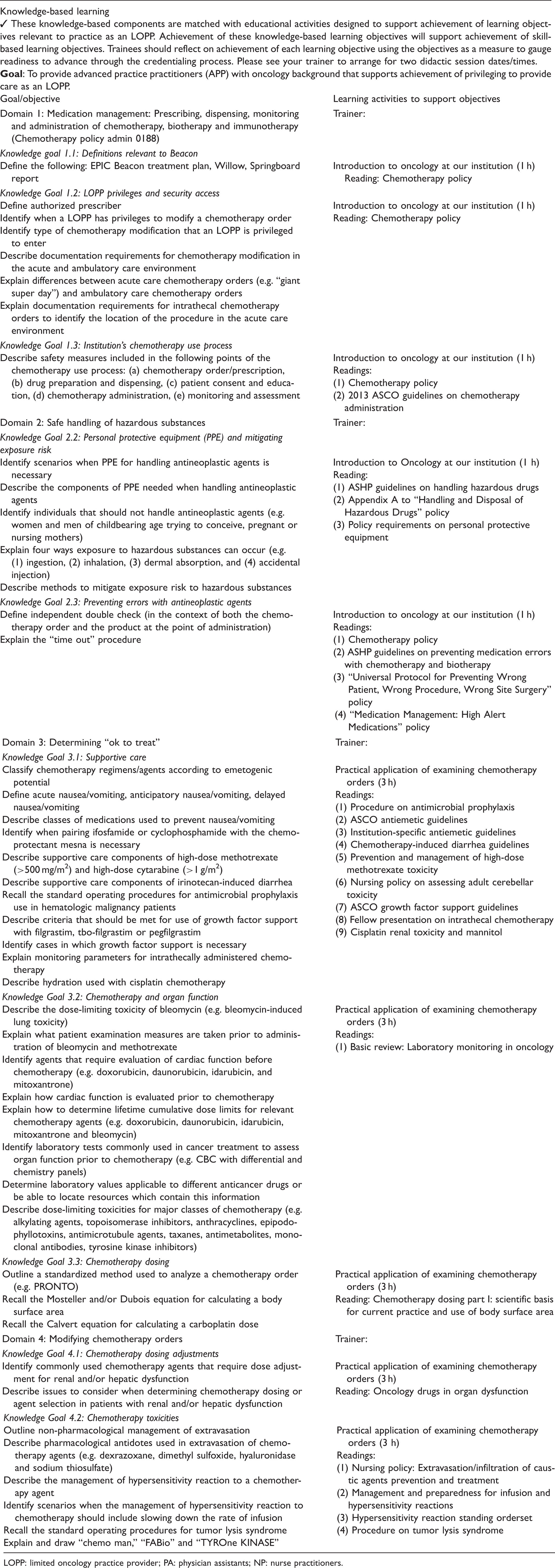
In order to successfully develop practitioners and ensure patient safety, an interdisciplinary team consisting of physicians and pharmacists collaborated to develop a robust training process. However, PA and NP were included in the program. The team developed the required process, educational domains, knowledge goals, and the educational activities needed to support the achievement of the learning objectives relevant to practice as an LOPP.
The privileging process for PAs and NPs included training with an OCPS, completion of readings pertaining to chemotherapy orders, a simulated clinical skills module for chemotherapy orders, and a written examination. In order for OCPSs to become LOPPs, they were required to be a Board Certified Oncology Pharmacist (BCOP) prior to taking the written examination. The BCOP designation demonstrates a pharmacist's advanced oncology knowledge and experience. Additionally, BCOP represents a high level of professional competence to recommend, implement, monitor, and modify chemotherapy orders. 18
The overall training process developed, as delineated in a stepwise process in Figure 1, was initiated by the Division Chief of Hematology/Oncology employing the provider or their designee and had to be approved by the Pharmacy and Therapeutics Committee. Completion of these items was coordinated by the Division Chief's designee, the Assistant Director, or Clinical Manager of the Hematology/Oncology Pharmacy Service Line. Successful completion of each step in the process was defined as receiving an 80% pass rate for each of the steps. Upon successful completion of the requirements, security access in the electronic medical record (EMR) was adjusted for individuals to reflect LOPP privileges.
LOPP privileging process.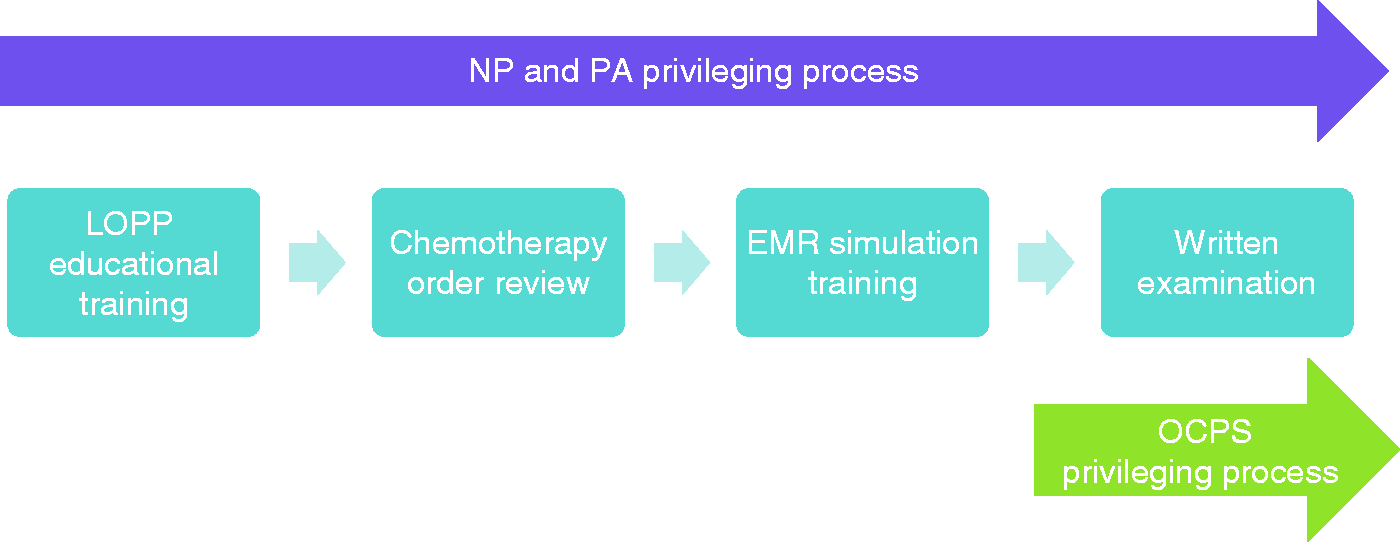
LOPP educational training
Knowledge-based learning checklist.
LOPP: limited oncology practice provider; PA: physician assistants; NP: nurse practitioners.
Chemotherapy order review
As part of the practical application activities to be completed, LOPP candidates had to practice reviewing chemotherapy written orders for accuracy. Objectives created for assessing the accuracy of each order are listed below:
Calculate body surface areas and carboplatin doses Calculate dose modifications (reduction/increase) based on percent desired by attending physician Review chemotherapy orders for accuracy and individualization for a given patient Understand intrathecal chemotherapy pharmacology and associated primary literature Design preventative antiemetic regimens appropriate for a given chemotherapy regimen Apply institution-specific policy for “Medication Management: Prescribing, Dispensing, Monitoring, and Administration of Chemotherapy, Biotherapy, and Immunotherapy” to practice.
EMR simulation training
After passing the educational portion of the LOPP privileging process, LOPP candidates were given access to a simulated EMR environment to learn how to navigate orders appropriately. The simulation consisted of three patient scenarios each with associated chemotherapy orders. The chemotherapy orders included errors of omission, dose, route, and dose adjustments for organ function. LOPP candidates were instructed to identify the errors and modify the orders as clinically appropriate with a passing score defined as an 80% or higher on the competency rubric.
Written examination
A 33-question multiple choice exam was developed to assess all of the knowledge goals. The exam was a mixture of knowledge-based questions and case-based questions. All questions included within the exam were based on the goals and learning objectives covered throughout the training process. LOPP candidates worked independently on the exam but were allowed to reference resources in order to mimic actual daily practice within the institution.
Survey
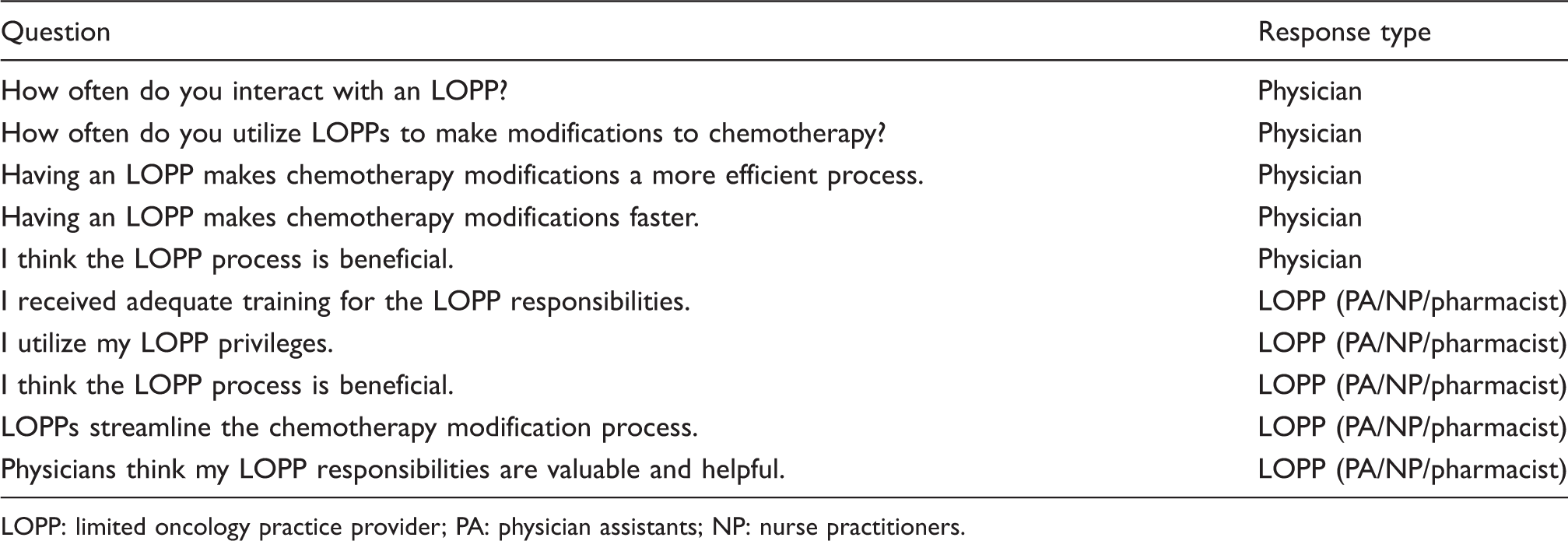
LOPP survey questions.
LOPP: limited oncology practice provider; PA: physician assistants; NP: nurse practitioners.
Results
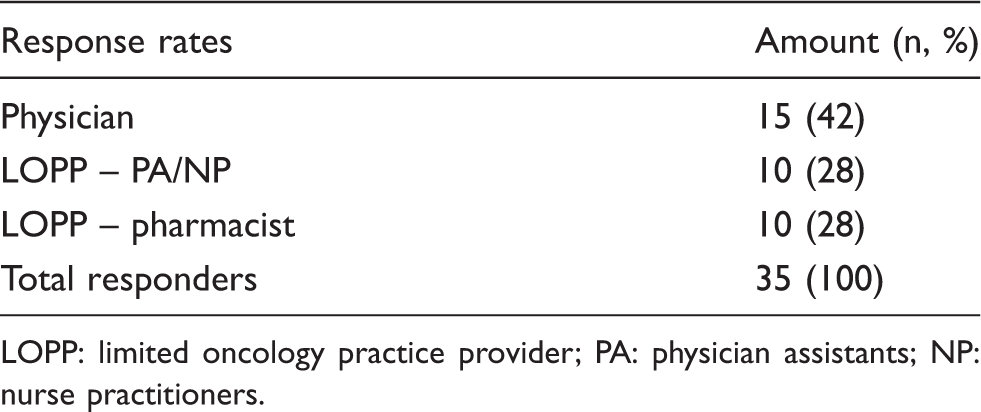
Survey responders.
LOPP: limited oncology practice provider; PA: physician assistants; NP: nurse practitioners.
The LOPPs provided similar perceptions about the program. The majority of LOPPs strongly agreed or agreed (8 responders, 47%, 8 responders 47%) that the training they received was adequate, while only one responder strongly disagreed (1 responder, 6%). The majority of LOPPs indicated that they use their LOPP privileges very often (9 responders, 53%) or often (5 responders, 29%), while few were neutral (3 responders, 18%). Similar to the physicians, the majority of LOPPs strongly agreed (11 responders, 65%) or agreed (5 responders, 29%) the privileges are beneficial. One responder (6%) somewhat disagreed the LOPP process is beneficial. When asked about the perceptions that LOPPs streamline the chemotherapy process, LOPPs noted that they strongly agreed (10 responders, 59%) or agreed (4 responders 23%) with the statement, and few were neutral (3 responders, 18%). Overall, the majority of LOPPs strongly agreed (9 responders, 52%) or agreed (6 responders, 36%) that their LOPP responsibilities are valuable. Some LOPPs were neutral (1 responder, 6%) or disagreed with the statement (1 responder 6%).
Discussion
Oncology practices continue to adapt and evolve to accommodate the growing population and needs of patients with cancer and the systemic changes in healthcare. The inclusion of APPs in oncology care models, as promoted by ASCO, provides the opportunity to directly address increased patient care demands. APPs can help streamline the requirements for patient care so that oncology physicians are able to focus more of their time and resources on patients. 2 Better integration of APPs could also improve patient outcomes and result in positive professional experiences for oncology care providers. 19
In order to best utilize APPs within oncology care, it is essential to ensure that APPs are appropriately qualified and trained to care for patients with cancer. 19 The American Society of Health-System Pharmacists recommends that all practice settings establish policies and procedures to ensure that healthcare providers that prescribe and manage chemotherapy are competent to perform these functions. 13 Similarly, ASCO promotes institutional privileging and credentialing as a best practice recommendation, for clinicians to have access to the order entry components for chemotherapy within the EMR. This promotes an environment of shared responsibility among providers and APPs and also ensures that only qualified and approved providers are able to order and manage chemotherapy. 20
The number of cancer survivors and patients is anticipated to continue to grow. APPs in oncology, including NPs, PAs, and pharmacists have the education and skills necessary to assist in filling the anticipated workforce shortage. 21 The creation of LOPP privileging has proved an effective way to integrate APPs into oncology practice while reducing some physician demands. As demonstrated by the survey results, LOPPs and physicians alike have benefitted. Additionally, the inclusion of the privileging process created a more streamlined process for chemotherapy modifications and contributed to an overall better patient experience by decreasing wait times and delays.
Chemotherapy prescribing and order management are not immune to errors. 22 Given the complex nature of cancer care, a focused effort to train and educate anyone with chemotherapy EMR editing privileges must be implemented to ensure the safety and quality of cancer care provided. 21 To ensure the safety of our patients, a requirement of an 80% pass rate for each step of the LOPP privileging process is required. Concerted efforts to fill educational gaps, by other institutions considering similar workflow implementations, are recommended for all interdisciplinary oncology team members with EMR chemotherapy privileges.
The results from this study support the use of APPs within an academic medical center's oncology practice model. Limitations of this study included the grouping together of NPs, PAs, and pharmacists within the LOPP survey. Differentiation of specialties may have assisted in identifying any current barriers to full optimization of the LOPP designation. As distributed, any potential differences of opinion between NP, PA, and pharmacists are unable to be identified. Further investigation is needed to quantify the impact on patient time savings, physician time savings, and the overall operational efficiency.
Conclusion
Privileging of APPs to manage existing chemotherapy orders can contribute to improved efficiency and patient care. Creation of the LOPP designation at our institution was the result of interdisciplinary collaboration that has assisted in streamlining the care workflow process so that providers can focus more of their time and efforts on direct patient care and so that nursing staff could more efficiently deliver patient care. The training required as part of the privileging process ensures that oncology care is offered in a safe, timely, and efficient manner.
Footnotes
Declaration of Conflicting Interests
The author(s) declared no potential conflicts of interest with respect to the research, authorship, and/or publication of this article.
Funding
The author(s) received no financial support for the research, authorship, and/or publication of this article.