







Abstract
The product monograph for reference bevacizumab (Avastin) and biosimilar bevacizumab (Mvasi) recommend to infuse the first dose of bevacizumab over 90 min, second dose over 60 min and third and subsequent doses over 30 min. Despite the product monograph recommendations, many institutions adopted an accelerated bevacizumab (Avastin) 0.5 mg/kg/min infusion time. Our province adopted the accelerated infusion time at time of biosimilar bevacizumab (Mvasi) adoption. Our experience with the accelerated infusion time was well tolerated in the first five months of biosimilar bevacizumab adoption across different tumor types.
Introduction
The biosimilar bevacizumab, Mvasi®, has been marketed in Canada since August 2019. As per the product monograph, the initial Mvasi® dose should be delivered over 90 min as an intravenous infusion. If the first infusion is well tolerated, the second infusion may be administered over 60 min. If the 60-min infusion is well tolerated, all subsequent infusions may be administered over 30 min. 1 These recommended infusion times are the same as recommended in the reference product’s (Avastin®) product monograph. 2 Reidy et al. published their experience infusing bevacizumab (Avastin®) 5 mg/kg over 10 min and demonstrated that administering bevacizumab at a rate of 0.5 mg/kg/min is safe. 3
The pan Canadian Oncology Biosimilars Initiative’s (pCOBI) Clinical Working Implementation Working Group released position statements regarding implementation of biosimilars. One of the key position statements recommended was “If the reference biologic has off-label administration evidence (e.g. infusion rate) that has been incorporated into clinical practice, these same practices may be used for the biosimilar in the same situations (e.g. first vs. subsequent doses).” 4
Our province adopted the off-label administration evidence for the reference product (Avastin®) and applied it to the biosimilar bevacizumab (Mvasi®). Each patient prescribed biosimilar bevacizumab received an infusion of 0.5 mg/kg/min corresponding to the following infusion times:
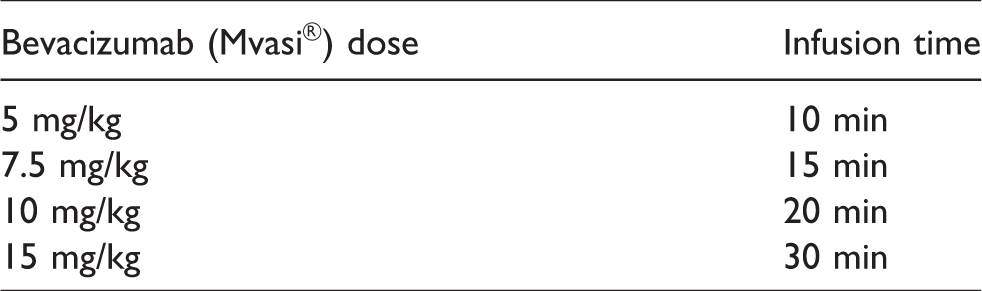
Our province adopted bevacizumab biosimilar (Mvasi®) since 23 September 2019.
Methods
Patients who were prescribed biosimilar bevacizumab with Mvasi® were identified in the electronic patient health record. Institutional Review Board Ethics approved this retrospective review. All new initiations of bevacizumab for metastatic colorectal cancer, Glioblastoma multiforme and hemangiopericytoma received biosimilar bevacizumab were captured from 23 September 2019 to 22 February 2020. All new bevacizumab initiations for treatment of first-line ovarian and metastatic cervix received biosimilar bevacizumab from 15 November 2019 to 22 February 2020. Patients who were receiving the reference product (Avastin®) at time of biosimilar implementation continued to receive the reference product until their treatment course was complete.
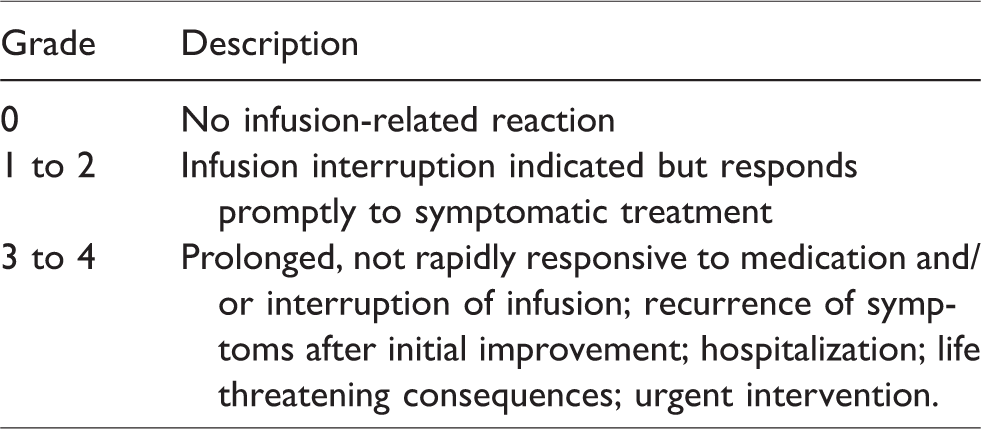
At each infusion, the treatment room nurse required to document if the patient experienced an infusion-related reaction. If an infusion-related reaction occurred, then the treatment room nurse is required to grade an infusion-related reaction. In addition, if a patient developed an infusion-related reaction, the nurse required to document if the full dose was administered (i.e. after rechallenge).
The following infusion-related reaction grading is used in our institution:
Results
We report our findings of off-label infusion times for biosimilar bevacizumab for the first five months since biosimilar implementation.
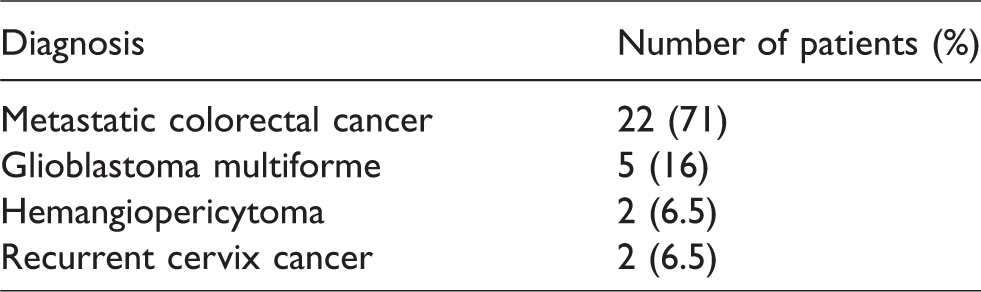
The largest patient group that received biosimilar bevacizumab was metastatic colorectal cancer patients followed by patients with Glioblastoma multiforme. There were two patients with hemangiopericytoma and two patients with recurrent cervix in our patient cohort.
There were four different infusion times depending on the dose in the protocol. The majority of patients received bevacizumab 5 mg/kg over 10 min.
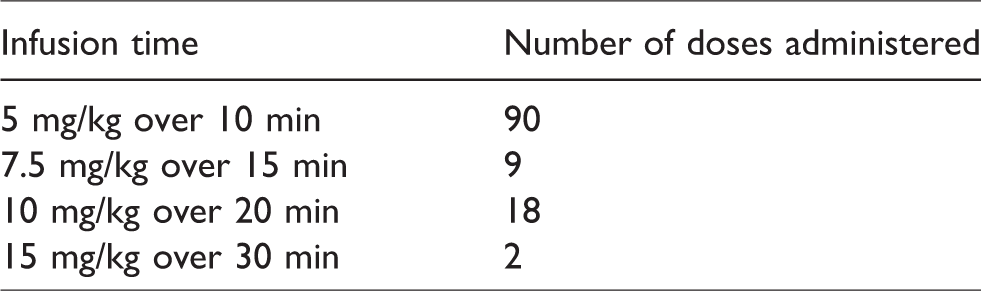
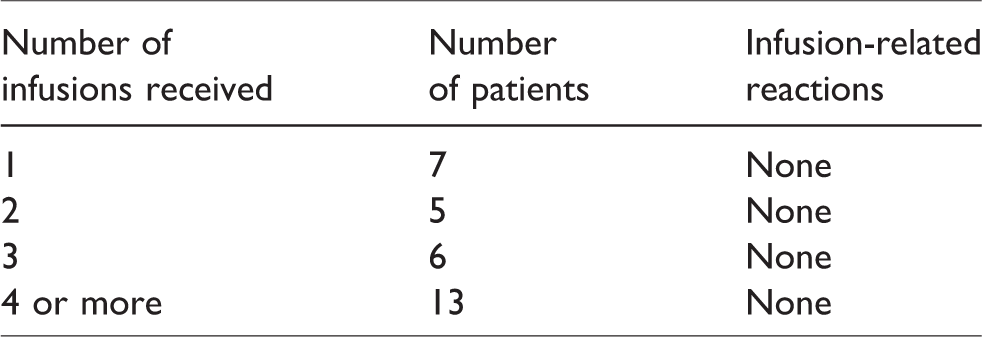
There were a total of 119 infusions of biosimilar bevacizumab administered over the five-month period. There were no infusion-related reactions observed and all patients were able to complete their biosimilar bevacizumab infusion.
Discussion
The use of off-label or rapid infusion rates of monoclonal antibodies in oncology and hematology have been well described in the literature for reference product monoclonal antibodies (i.e. Avastin®, Rituxan®).35 As biosimilar bevacizumab has recently been approved in North America since summer 2019, there was no experience in our center of using off-label infusions applied to reference products and apply them to the use of biosimilars. Our province followed the recommendation from pCOBI clinical working group to adopt off-label administration infusion rates of biosimilar bevacizumab as there were published data on the use of reference product bevacizumab infusion rates. The retrospective review was necessary to ensure the initial safety of off-label infusion rates and will continue as part of the pharmacovigilance required for the use of biosimilars. It was hypothesized that implementation of biosimilar bevacizumab off-label infusion rates should not cause an increase in infusion-related reactions as compared to the reference product.
There were some limitations to our retrospective review. First, our retrospective review did not identify any patients with ovarian cancer who received off-label infusion rates of biosimilar bevacizumab. Second, our sample size only included 31 patients and some tumor types accounted for a small percentage of the total cohort (i.e. cervix cancer and hemangiopericytoma). Lastly, our review was retrospective in nature; however, for each patient’s infusion, the treatment nurse did clearly document if the patient experienced an infusion-related reaction or not. Although our sample size was small, it was reassuring that for the first five months that there were no signals of increased infusion-related reactions with biosimilar bevacizumab infusion.
Conclusions
Our experience demonstrated that the biosimilar bevacizumab (Mvasi®) was safely administered at a rate of 0.5 mg/kg/min when used for different tumour types in our province. There was no signal of increased infusion-related reactions with biosimilar bevacizumab compared to what was previously reported with the reference product. The adoption of off-label administration schedules for biosimilars necessitates prudent pharmacovigilance reviews and continued monitoring to ensure patient safety.
Footnotes
Declaration of Conflicting Interests
The author(s) declared no potential conflicts of interest with respect to the research, authorship, and/or publication of this article.
Funding
The author(s) received no financial support for the research, authorship, and/or publication of this article.
