







Abstract
Introduction
In order to implement a centralized cytotoxic reconstitution unit (CCRU), a study was conducted to compare the implementation costs of a CCRU equipped with a cytotoxic safety cabinet (CSC) and one equipped with an isolator with negative pressure.
Materials and methods
This study compares items such as infrastructure, air treatment and CCRU qualification costs, equipment’s purchase and qualifications costs, as well as staff dressing costs. Two plans were elaborated according to the international recommendations in a way that they respond to the necessary requirements in both cases. Requests for quotes for the compared items were sent to different suppliers.
Results
The implementations’ cost of a CCRU equipped with a CSC is cheaper than the one equipped with an isolator. The price of an isolator is much higher than a CSC; its qualification is also more expensive. However, the requirements and the costs for the air treatment and the dressing of the staff are less in the case of an isolator. The overall cost of the CCRU’s implementation is approximately 1.3 times higher in the case of an isolator. However, by excluding the equipment purchase cost, the overall cost of a CSC’s implementation becomes higher.
Conclusion
For Tunisia, it seems that the CSC is the most adapted. However, this work should be completed by the comparison of the CCRU’s operating costs in order to optimize the resources and figure out the cheapest system.
Introduction
The generally used costs of the centralized cytotoxic reconstitution unit (CCRU) are calculated on the basis of the functioning unit cost. In order to implement a CCRU at the Bone Marrow Transplant Center of Tunis, a health technology assessment study was conducted by comparing the implementation costs of the different types of CCRUs before their use i.e infrastructure, air treatment and CCRU qualification costs, equipment’s purchase and qualifications costs as well as staff dressing costs. Our results will help to choose the type of the CCRU based on the overall implementation cost compared between a cytotoxic safety cabinet (CSC) and an isolator.
Objective
The study’s main purpose is to compare the implementation costs of a CCRU equipped with a CSC to those of a CCRU equipped with an isolator.
In addition to the implementation costs, the study accounted the main operational cost associated to staff clothing in both case scenarios.
Materials and methods
The study started by a review of the international guidelines relative to cancer drugs reconstitution as well as visits to existing CCRUs. Then, a multidisciplinary team of experts was asked to carry out the project. The study design is as follows:
Review of international guidelines
Due to the lack of Tunisian guidelines, international guidelines regarding oncology drugs’ preparation were reviewed and used as a reference for this study.1–9
Visits to existing units
Three drugs’ preparation units were visited: the CCRU of Salah Azaiez Institute, the clean room of Maternity and Neonatology center of Tunis, and the production unit of the Tunisian pharmaceutical industry UNIMED, as well as an online visit to Saint Louis Hospital’s CCRU in Paris (https://youtu.be/b8ex5QGpdz8).
Call for experts
A multidisciplinary team of experts was set up to carry out the project. The team involved three consultants, hospital pharmacists, suppliers and representatives from the following enterprises: «Cleanair», «SELIM», «Eurobioconcept», «Plasteurop», «Conception High technology & Manufacturing», «Bioquell», «JCE Biotechnology», «SOGESER», «La Calhene», «Faster», «Pharmalabo» and «COMECER». All of the previously stated experts and institutions participated in the project as volunteers. No compensation nor funding were provided.
Definition of expenses
The list of costs compared in this study encompasses:
Equipment purchase costs (CSC or isolator) Equipment qualification costs: design qualification, installation qualification, operational qualification and performance qualification. CCRU layout costs: different costs related to the structure of the UPCC, ie the wall, the floor and the ceiling cladding, the panels, the partitions, the doors, the double hatch passers, the plumbing system, etc. CCRU air treatment costs: the supply and installation of the air handling unit, partitions, ducts and HEPA filters, air conditioning installation system, pressure system, electrical network and regulations, tests and settings. CCRU qualification costs: conception, installation, operational and performance qualification. Staff clothing costs.
Equipment purchase costs
Quotes for the acquisition of a CSC and an isolator were collected from different suppliers. All of equipments are for one operator in order to ease the cost comparison.
Results
Equipment choice
After reviewing the different guidelines and visiting the units, we decided to include two types of equipment in this study: Cytotoxic Safety Cabinets (CSC) and isolators with negative pressure.
Unit’s design
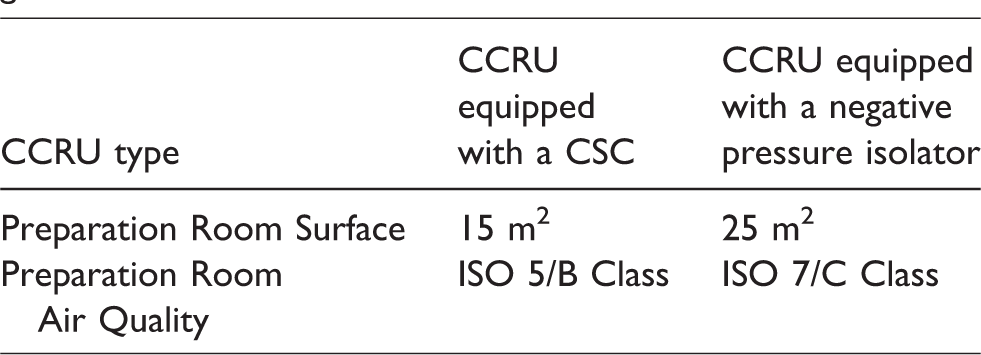
The recommendations of ONCOLOR, 9 SFPO, 2 AFNOR, 1 and the good manufacturing practices of the ANSM 3 regarding the surface of the preparation room as well as its air quality in the case of a CSC and a negative pressure isolator are summed up in the following Table 1.
CCRU requirements according to international guidelines.
CCRU plan
Two plans for two CCRUs were elaborated following the above stated international guidelines in a way that the first plan satisfies the necessary requirements in the case of a CSC and the second responds to those of a negative pressure isolator.
The plans are shown in the following Figures 1 and 2.
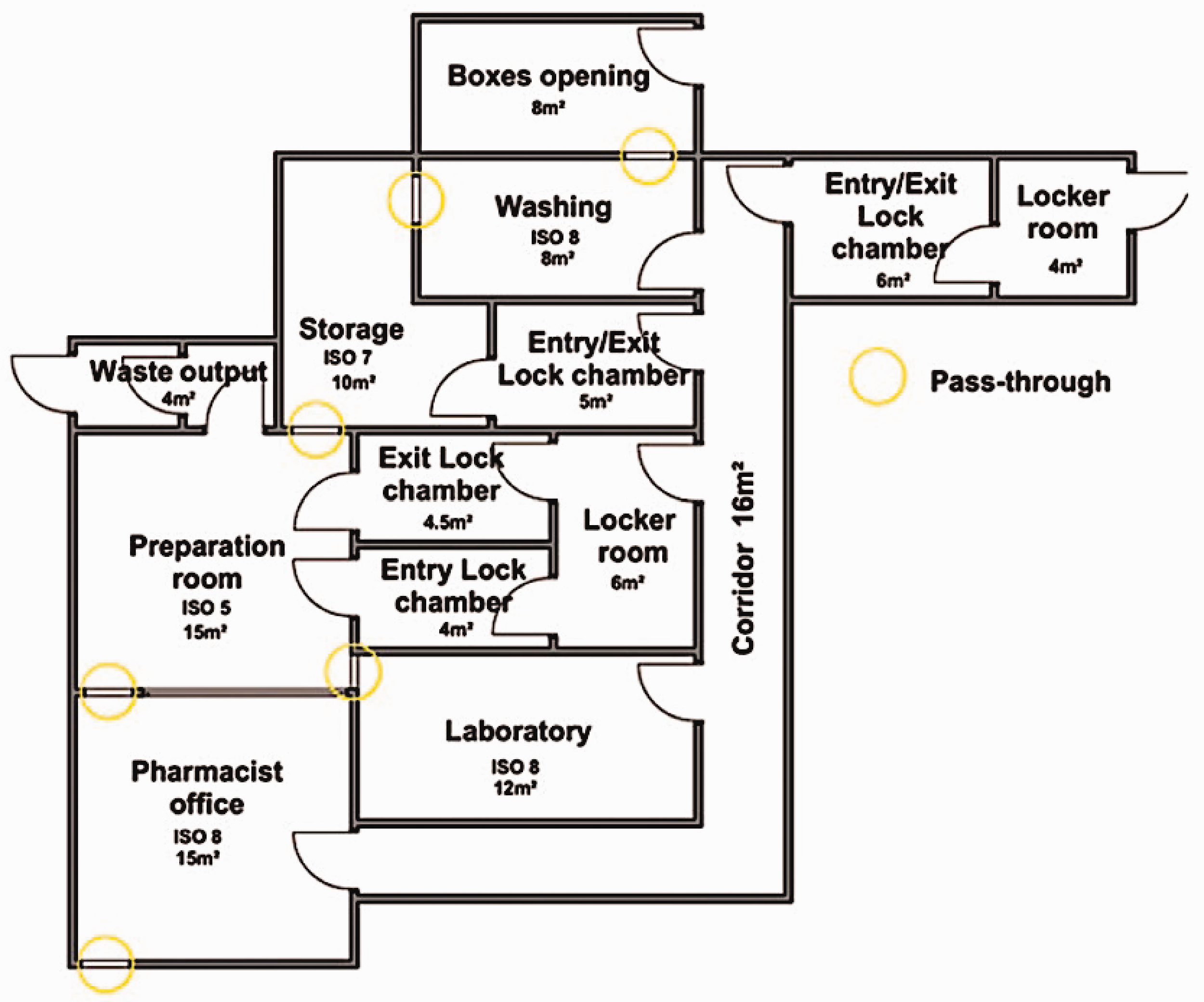
Plan of a CCRU equipped with a CSC.
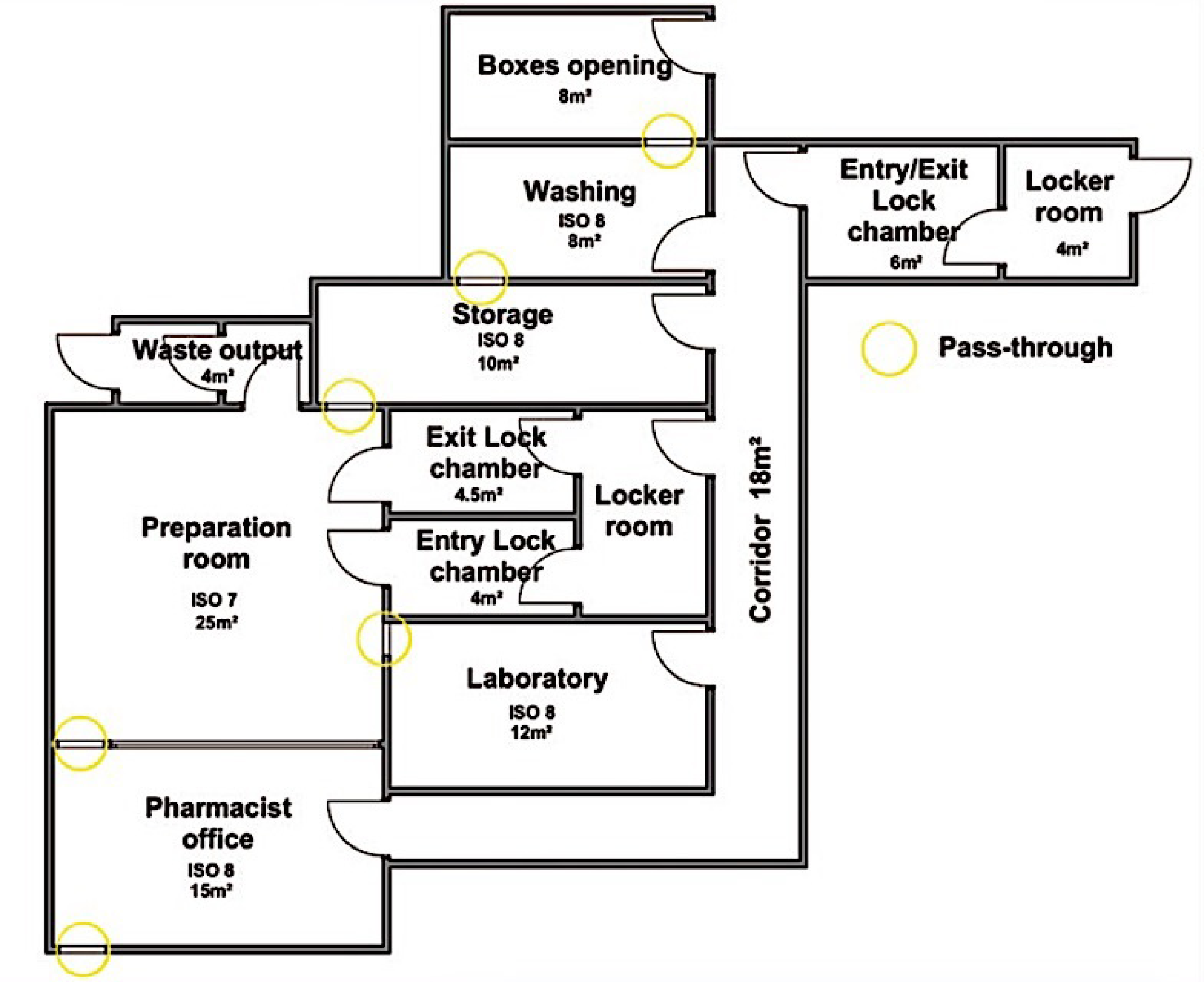
Plan of a CCRU equipped with a negative pressure isolator.
Staff clothing
Working in a CCRU requires a specific work outfit. According to the guidelines, the staff outfit depends on air quality in the preparation room.3,10 The staff clothing requirements are shown in the following Table 2.

The costs
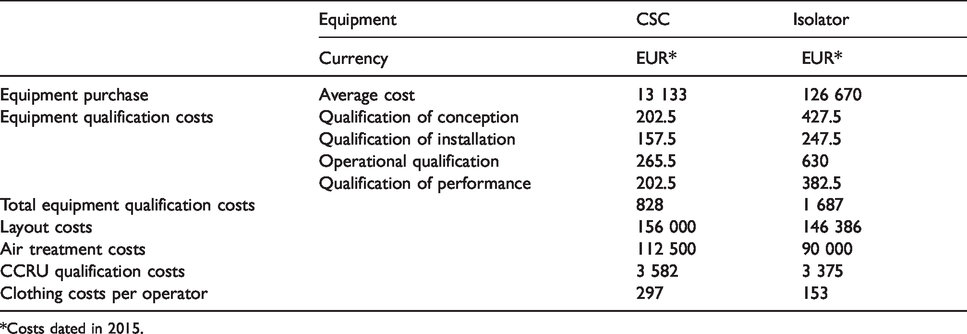
Equipment suppliers responded to the quote request in accordance with the requirements of the fact sheets prepared. The cost summary is represented in the below Table 3:
The total costs.
*Costs dated in 2015.
The total implementation costs of the two CCRUs which includes all of the above-mentioned costs except the staff clothing totals, are 281 629 EUR in the case of a CCRU equipped with a CSC and 368 113 EUR in the case of a CCRU equipped with a negative pressure isolator.
The cost distribution of the different implementation costs as a fraction of the total cost of implementation for each CCRU is shown in the Figure 3 below.
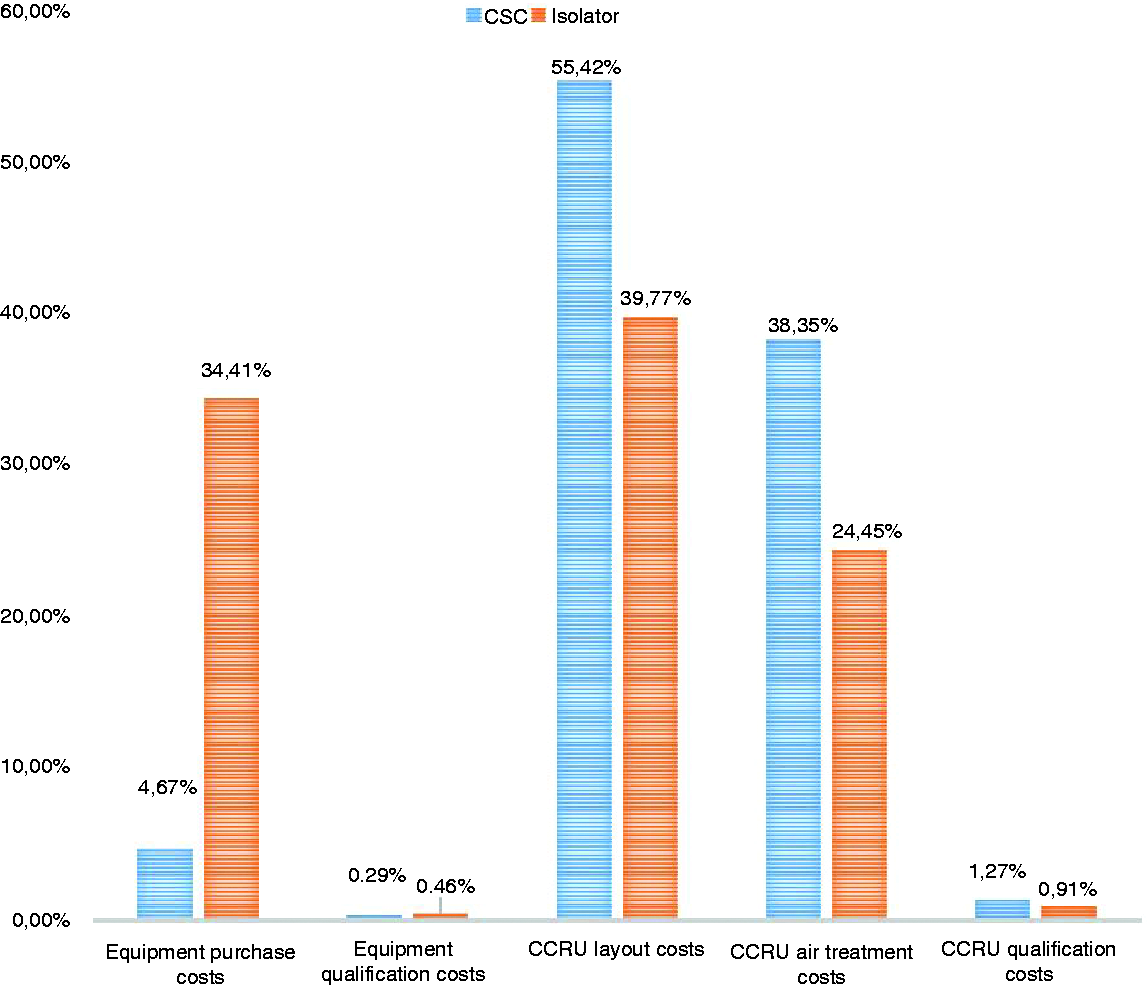
Cost distribution for the CCRU equipped with a CSC and with a negative pressure isolator.
Discussion
The average total implementation costs for a CCRU equipped with an isolator is 1.3 times higher than the total implementation costs in the case of a CSC. This is solely explained by the large difference in the equipment purchase price as an isolator costs nearly ten times as much as a CSC. The isolator’s qualification is also more expensive than that of a CSC. However, all the other costs are higher in a CCRU with a CSC than a CCRU with an isolator.
A study by Larrouturou et al. 11 has reached the same result of our study with an implementing cost of a CCRU equipped with an isolator 1.8 times as much as a CCRU equipped with a CSC.
A discordance between our study and the Larrouturou’s one is shown by the difference between the purchase costs of an isolator and a CSC. Indeed, our study found that the cost of buying an isolator is equal to ten times the cost of a CSC while the study by Larrouturou et al has found an isolator purchase cost is equal to only 5.5 times the CSC price.
For both of the CCRUs, the highest expense is the CCRU layout cost. Nevertheless, the second highest expense is the air treatment for the CCRU equipped with a CSC and the equipment purchase for CCRU with an isolator.
As for equipment qualification costs, according to SFPO Recommendations, 2 a qualification must be carried out at least every two years for an isolator. But in the case of a CSC, the requalification has to be done every year.
Comparing the cost of each of the different qualifications, one by one, we notice that the qualification of an isolator costs twice as much as a CSC. But by combining this data with data on the frequency of requalification, the qualification costs became equivalent whether it is a CSC or an isolator.
For the clothing, it should be noted that in the CCRU with CSC, Class B cloth must be sterile. Hence, in addition to the cost of the cloth, there is the cost of sterilization. As an indication and according to a consulting firm, an autoclave costs between 3 600 EUR and 18 000 EUR for the most sophisticated. In addition, there is the cost of sterilization agents for an isolator and the disinfectants for a CSC. In fact, differences can be detected especially in the case of use of isolator with peracetic acid sterilizer (APA) since a liter of APA costs 90 EUR. This cost corresponds to the acquisition cost of APA by the Salah Azaiez Institute. On the other hand, one liter of hydrogen peroxide (H2O2) costs approximately 11.25 EUR when using an isolator with H2O2 sterilizer. Regarding the CSC, the cost of a liter of alcohol at 70 v/v does not exceed 2.25 EUR.
In our study, we did not take into consideration the costs of sterilization that depends on the type of equipment (isolator or CSC) as we did a simulation on a theoretic CCRU and these costs can only be counted precisely on a functional CCRU.
While this study was solely based on simulations for a theoretic CCRU that is not functional yet, other studies were able to compare implementation and operating costs from a historic standpoint for functional CCRUs and found the following:
One oncology preparation in a CCRU, equipped with a CSC, costs 1.5 times as much as in a CCRU equipped with an isolator (46 U.S. Dollars vs 31 U.S. Dollars respectively). 12
Similarly, the study by Larrouturou et al., 11 performing a five-year activity simulation and combining start-up and operating costs, found that a CCRU with CSC would cost 1.5 times more than an CCRU with an isolator.
It should be noted that the staff expenditure represents according to the study by Galy et al. 8 the largest expense item of total set-up and operating costs combined. It was estimated at 66–78% of the total cost.
This result is in concordance with the study of Legat et al.,14 which showed that 64% of the average cost of a cytotoxic preparation in a CCRU is related to staff salaries.
Probably, this result would not be valid for Tunisia, since salaries in Europe are much higher than in Tunisia and the equipment costs a lot to Tunisia because they are imported. So, with their cost of purchase, we should take into account the costs of transport, delivery, customs taxes, currency rate exchange, etc.
This study deliberately ignores a number of aspects related to the preparation of injectable anticancer drugs such as the cost of active ingredients and the cost of medical devices, because these costs do not depend on the type of the chosen CCRU. In addition, these costs depend on the level of production of the CCRU. Nevertheless, it would still be interesting to count these costs to determine the cost of a preparation as it is in the study of Galy et al. 13
In addition to the costs of implementation and operation attributable to the choice of one or the other of the equipment, which is the major object of this study, other non-quantifiable criteria are also important and must be taken into account when choosing equipment such as dressing constraints and adaptation to emergency.
For the plans designed for our work, we did not include the emergency exits in the design of the premises. Indeed, it is a plan of a hypothetical CCRU. But it should be known that in a plan of a real CCRU it is mandatory to set up emergency exits.
Thus, safety and quality are major criteria to be considered. A sealed physical barrier isolating the manipulator from the preparation, as it is in the case of the isolator, is more effective than the partially open CSC air barrier.
As an indication, in France, the CCRUs equipped with an isolator are more numerous than those equipped with a CSC with a proportion isolator/CSC equal to 70%/30% (SFPO,2019).
Conclusion
The overall cost of implementing a CCRU, equipped with an isolator functioning in negative pressure is much higher than the one equipped with a CSC.
With the exception of the equipment purchase and qualification costs, all the other expenses are higher in the case of a CSC than an isolator.
The only operating cost calculated in this study is the staff clothing cost. This cost is much higher in a CCRU equipped with a CSC than one equipped with an isolator.
This work should be completed by a study of the operating costs of the different types of CCRUs in order to optimize resources and find the least expensive system.
In addition to the implementation and operating costs, the choice of the installation of one or the other equipment must take into account other criteria such as the ergonomics, the handling time, etc. For instance, too restrictive clothing, or a lot of change of clothes from one room to another within a CCRU, as in the case of the CCRU equipped with a CSC, can raise concerns of staff’s non-compliance to the rules.
In accordance with recommendation No. 2 of the French Society of Pharmaceutical Oncology “There is no need to recommend the use of a CSC rather than an isolator or vice versa. Both types of equipment are allowed and equivalent”.
Thus for Tunisia, it seems that the CSC is the most adapted. This is mainly for the cost of acquisition, which is lower than the cost of an isolator, CSC is better adapted to the emergency and unforeseen prescriptions than the isolator and it is more ergonomic for users while operating.
Précis
Health technology assessment based on cost implementation finds that an isolator functioning in negative pressure is much higher than that of a cytotoxic safety cabinet.
Footnotes
Acknowledgements
We thank Bernard Henri and Mohamed Ali Akkari for the contribution with their expertise to elaborate our study.
Declaration of Conflicting Interests
The author(s) declared no potential conflicts of interest with respect to the research, authorship, and/or publication of this article.
Funding
The author(s) received no financial support for the research, authorship, and/or publication of this article.
