







Abstract
Aim/Background
In this study, the prolonged physical and chemical stability of the anticancer agent cabazitaxel, commercially available as Jevtana®, was examined. Both concentrate-solvent mixture and infusion solution were examined with the aim to extend the use of multidose left-over cabazitaxel and infusion solutions and with that reduce financial and environmental waste.
Methods
A validated stability-indicating high-pressure liquid chromatography (HPLC) method with ultraviolet (UV) and photodiode array (PDA) detection was used to examine the purity and any degradation of cabazitaxel. The concentrate-solvent mixture and infusion solution samples that were tested had been stored out of the range of the criteria stated in the summary of product characteristics (SmPC). The concentrate-solvent mixtures were stored at 3–5°C, 18–21°C, and 40 °C, whereas the infusion solution was stored at 3–5°C. All samples were tested at t = 0, t = 1 week and t = 2 weeks.
Results
All samples showed that purity and concentration had remained within the criteria of <5% as stated in the European Pharmacopoeia. However, the concentrate-solvent mixtures stored at 18-21°C and 40 °C showed a degradation product forming in all the samples lowering the purity of the samples from 100% to 99.91% and 98.20% respectively, whereas all samples stored at 3–5°C remained at 100%.
Conclusion
Concentrate-solvent mixture and infusion solution of cabazitaxel, Jevtana®, can be used up to 2 weeks after preparation if stored at 3–5°C and prepared under aseptic conditions.
Keywords
Introduction
Jevtana® (Sanofi-Aventis) contains the active substance cabazitaxel ((2α,5β,7β,10β,13α)-4-(acetyloxy)-13-({(2R,3S)3-[(tertbutoxycarbonyl)amino]-2-hydroxy-3- phenylpropanoyl}oxy)-1-hydroxy-7,10-dimethoxy-9-oxo 5, 20-epoxytax-11-en-2-yl benzoate-propan-2-one (1:1), C45H57NO14. 1
Cabazitaxel is a taxoid antineoplastic agent that targets the microtubular network and inhibits the mitosis and interphase of the cell cycle which in turn leads to an arrest of cell growth.1,2 This drug is licensed for the treatment of hormone-refractory prostate cancer. This semi-synthetic drug was developed to overcome the problem of drug resistance of the congener drug docetaxel which has the same indication as cabazitaxel. When a patient has developed resistance towards docetaxel, cabazitaxel is instead used for the same tumour.1–3 The pharmaceutical formulation of cabazitaxel (Jevtana®) consists of concentrate for solution for intravenous (IV) infusion and requires prior dilution with a separate solvent solution added to the packaging. The concentrate of the highly insoluble compound cabazitaxel consists of 60 mg/1.5 ml (overfill 73.2 mg/1.83 ml) in 0.45 mg polysorbate 80 (overfill 0.55 mg) and citric acid. The solvent vial consists of 573.3 mg 96% ethanol and water for injections (WfI) in 4.5 ml (overfill 5.67). The vials are both overfilled to compensate for the fluid loss during the preparation.
Before use, the solvent solution is added to the vial containing the concentrate and mixed, resulting in a 10 mg/ml cabazitaxel concentrate-solvent mixture. 2 To obtain the final IV infusion solution, this concentrate-solvent mixture is further diluted with infusion fluid (0.9% saline or 5% glucose) to a concentration of 0.10–0.26 mg/ml. According to the manufacturer, the physicochemical stability of the concentrate-solvent mixture has been proven up to 1 hour after preparation when stored at room temperature. For the infusion solution, physicochemical stability was shown for 8 hours at room temperature and 48 hours when stored at 2–8°C. Use after these indicated periods is the responsibility of the user and also depends on e.g. the level of aseptic conditions used during preparation. 2 The recommended dose is 25 mg/m2, 1 however, depending on the body surface area (BSA) and the patient’s need, this dose differs between 15 mg/m2–25 mg/m2. Since the vial has a content of 60 mg of cabazitaxel, the leftover of the concentrate-solvent mixture can accumulate after opening a new vial for each individual patient.
In this article, we examined the physicochemical stability of the concentrate-solvent mixture beyond this 1-hour period, in order to substantiate the re-use of the mixture for another patient instead of discarding the left-over. Also, the physicochemical stability of the infusion solution was tested in order to examine possible re-use in case of e.g. an administration delay. For both the concentrate-solvent mixture as well as the infusion solution, stability was examined over a 2-week period, related to the patient-frequency at our Institute. The stability of the concentrate-solvent mixture was tested at refrigerated conditions (3–5°C), at room temperature (18–21°C), and elevated temperature (40°C). All samples were stored in ambient light. The stability of the Jevtana® infusion solution was examined at refrigerated conditions (3–5°C) at two different concentrations (0.10 and 0.26 mg/ml), covering the indicated dilution range. We examined only IV infusion solutions prepared using 0.9% saline, being the infusion fluid of choice at our Institute.
Materials & methods
The analytical method used in this study was previously developed and validated at our Institute. 4 In this study, forced degradation samples from the concentrate-solvent mixture together with reference standard cabazitaxel was used to develop a stability-indicating high-performance liquid chromatography (HPLC) with ultraviolet (UV) and photodiode array (PDA) detection as an assay. The method is validated based on the guidelines from The International Conference on Harmonization of Technical Requirements for Registration of Pharmaceuticals for Human Use (ICH).5–7
Chemicals
Formulated cabazitaxel product, Jevtana® was purchased from Sanofi-Aventis, Gouda, The Netherlands. Jevtana® has a concentration of 10 mg/ml cabazitaxel after concentrate (60 mg cabazitaxel in polysorbate and citric acid, total volume 1.5 ml) and solvent (ethanol and WfI, total volume 4.5 ml) are mixed. The infusion solution bags were prefilled Freeflex 0.9% saline and purchased from Fresenius Kabi, The Netherlands. Pure cabazitaxel reference standard (purity of 99.13%) was purchased from Bio-Connect, Huissen, The Netherlands. Ammonium acetate (NH4CH3CO2) with an analytical standard for LC/MS was purchased from Sigma Aldrich (St. Louis, MO). Water (H2O) with an analytical standard for LC/MS, acetonitrile (CH3CN/ACN), and methanol (CH3OH/MeOH), and ethanol (C2H5OH/EtOH) with ultra-performance LC (UPLC) standard were purchased from Biosolve Ltd (Valkenswaard, The Netherlands). Acetic acid (CH3COOH) was purchased from Merck (Darmstadt, Germany).
Sample collection and preparations
Eluent A was prepared to consist of 20 mM ammonium acetate buffer in water with a pH of 5. Eluent B consisted of MeOH – ACN (1:4, v/v).
Collection of vials and preparation of concentrate-solvent samples
Left-over cabazitaxel Jevtana® concentrate-solvent solutions in their original vials and prepared according to the SmPC were collected from the Central Preparation Unit of Cytotoxins (CPUC) of the Hospital Pharmacy of the Antoni van Leeuwenhoek hospital (AvL) on the day of preparation. In total, 41 vials were collected and stored under different conditions (28 vials at 3–5°C, 7 vials at room temperature (18–21°C), 6 vials at 40°C in an ICH60 Climate Chamber set at 40°C, 75% relative humidity (RH), Memmert GmbH, Büchenbach, Germany). All samples were stored in ambient light. Five vials were sampled at t = 0 and all other vials were sampled after one and two weeks. Samples were stored until analysis at −20°C. 4
Before every sampling, the concentrate-solvent mixture was visually inspected for precipitation, impurities and discolouration to determine the physical stability together with the HPLC method. The sampling was made by extracting the concentrate-solvent mixture with a needle and syringe and later pipet 50 µl of cabazitaxel into 950 µl Eluent A, to a final concentration of around 500 µg/ml. After the first two sampling sessions, the pipetted Jevtana® was also weighed due to the difficulties of pipetting the fluctuating high-viscosity of the concentrate-solvent mixture.
Preparation and sampling of infusion solution samples
The Jevtana® infusion solutions were prepared according to the SmPC in the CPUC. The infusion fluid for all preparations was saline 0.9% NaCl. One vial of the concentrate-solvent mixture was used to prepare six separate infusion solutions of which three bags at a concentration of 0.10 mg/ml and the other three at a concentration of 0.26 mg/ml (covering the concentration range as indicated in the SmPC). All the infusion bags were stored at refrigerated conditions (3-5°C), under ambient light and sampling, and testing was done on the day of analysis at t = 0, t = 1 week, and t = 2 weeks. Blank from the infusion solution was withdrawn from a pre-filled bag before any pharmaceutical product was added.
Formulation blank
A formulation blank was added to the experiments and prepared by mixing the excipients in water as indicated in the SmPC.
HPLC-UV method
The HPLC method used for all experiments is described in Arnamo et al. 4 This method was developed and validated for usage in this setting. “Gradient elution was applied at a flow rate of 250 µl/min: 0–2.5 min, 30% B; 2.5–10 min, 30–70% B; 10–18 min 70% B; 18–19 min 70-30% B; 19–22 min 30% B. The tray was kept at 4°C, and the column temperature was held at 40°C. The injection volume was set to 10 µl. Before every run, a system suitability test (SST) was performed to assure HPLC performance and the analytical batch could be started. Criteria for the SST was that the CV of the area of the peak in 6 measurements was ≤2%. The UV channel at 227 nm was used for the quantification. Also, the PDA spectra between 190 nm and 800 nm were obtained to check the peak purity as an indicator of potential co-eluting compounds were present. The peak purity is defined as the similarity of the spectrum in all wavelengths in the peak maximum and the leading edges the algorithm of the program then gives this value as a percentage. The chromatographic system consisted of a pump (Ultimate LPG-3400M), diode array detector (DAD) (Ultimate DAD-3000), autosampler (Ultimate WPS-3000TSL), and a column oven (TCC-3000SD) from Thermo Fisher Scientific Unity Lab Services (Breda, The Netherlands). A SymmetryShield™ (150×2.1 mm ID, 3.5 µm particle size) analytical column was used (Waters Corporation©, Milford Massachusetts, USA)”. 4 In this study, the calibration was extended to 750 µg/ml, to adjust for the higher concentrations to be studied in our current investigation. The concentrations of the calibrations were 0, 60, 150, 300, 450, 600 and 750 µg/ml. Duplicates of the calibration standards at each level were prepared freshly from a stock solution before every run. Triplets of quality control samples with concentrations 100, 400, and 700 µg/ml were freshly prepared from a second stock solution before every run. The calibration and quality control were proceeded as and following the requirements of the previous method based on ICH guidelines.4–7 Purity was redefined in this study as a relative percentage of the cabazitaxel peak in the sample.
Results
Concentrate-solvent mixture
None of the samples showed visible impurities or discolouration, and the solutions remained clear throughout the 2-week experimental timeframe. Cabazitaxel elutes at 13.00 min. Cabazitaxel peak purity ranged from 95.1–99.8% compared to the reference range of 95.0–99.9%. All chromatograms showed two very small additional peaks eluting at 10.63 and 12.04 min respectively before the cabazitaxel peak. For the t = 0 samples, the area percentage of these two peaks was 0.01% and 0.03% respectively. These two peaks were found to be part of the excipients when examining the formulation. The peaks eluting after cabazitaxel have already been proven to be part of the excipients. 4 No additional peaks, nor any growth or decrease in the peaks were recorded for any of the refrigerated samples concentrate-solvent mixtures (see Figure 1).
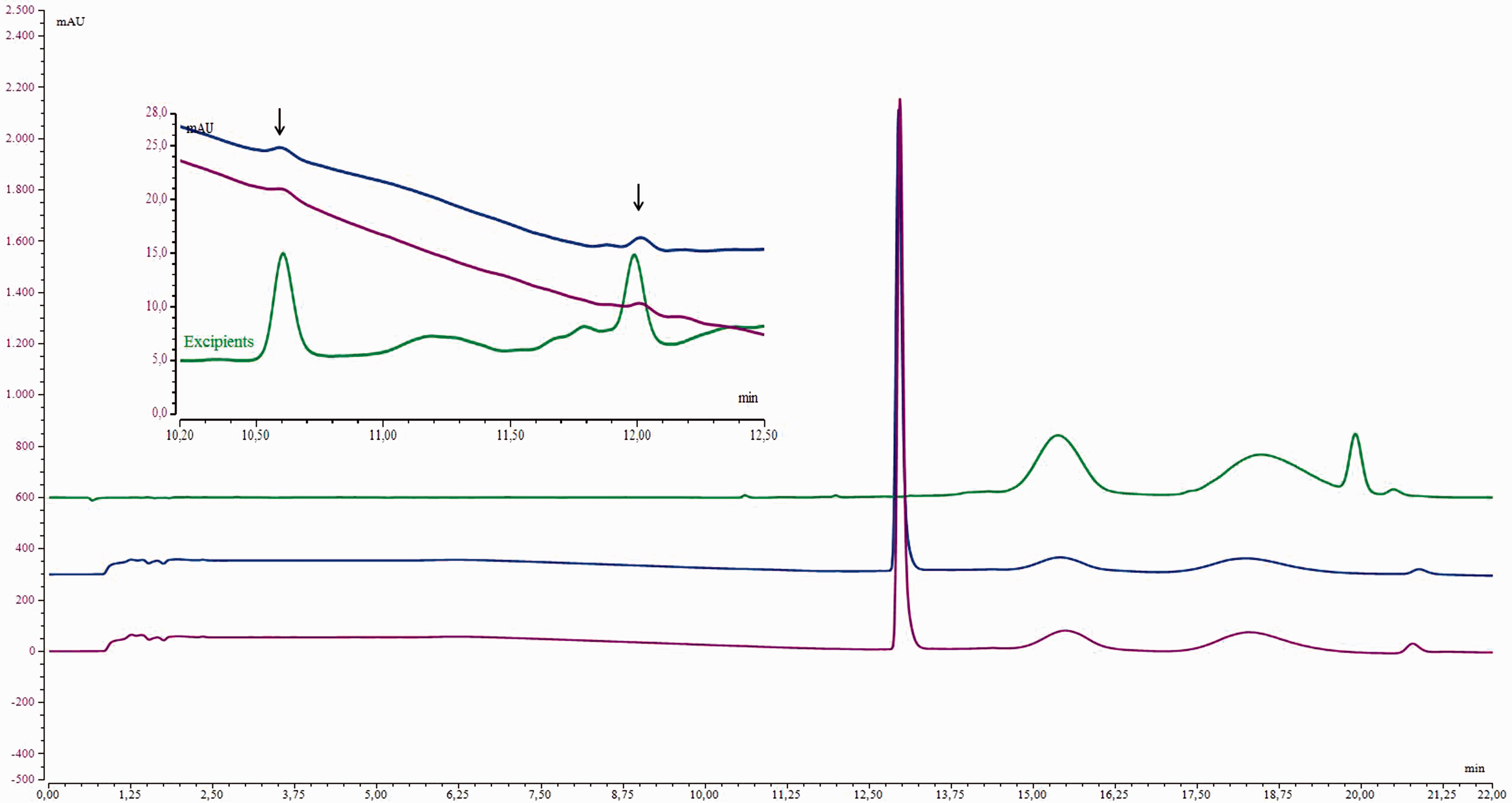
Chromatogram from concentrate-solvent samples stored at 3–5°C. From bottom-up: t = 0 (purple trace), t = 2 weeks (blue trace), formulation blank/excipients (green trace). The chromatograms for the concentrate-solvent mixture did not change over the 2 weeks’ time for all refrigerated samples.
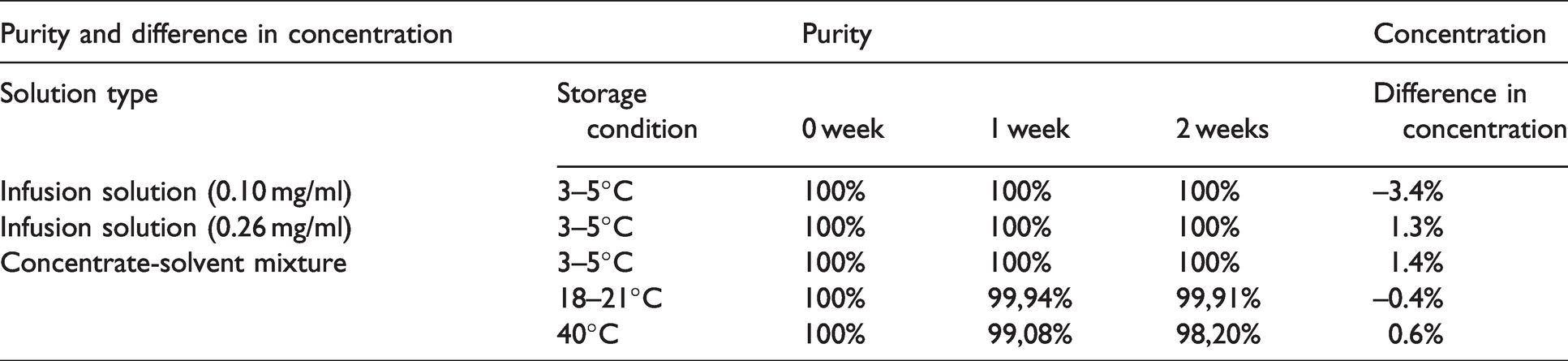
The samples stored at 18–21°C and 40°C developed one new peak that arises at 8.35 min which develops over time (see Figure 2), resulting in lowered purity. For full purity results and concentration results, see Table 1.
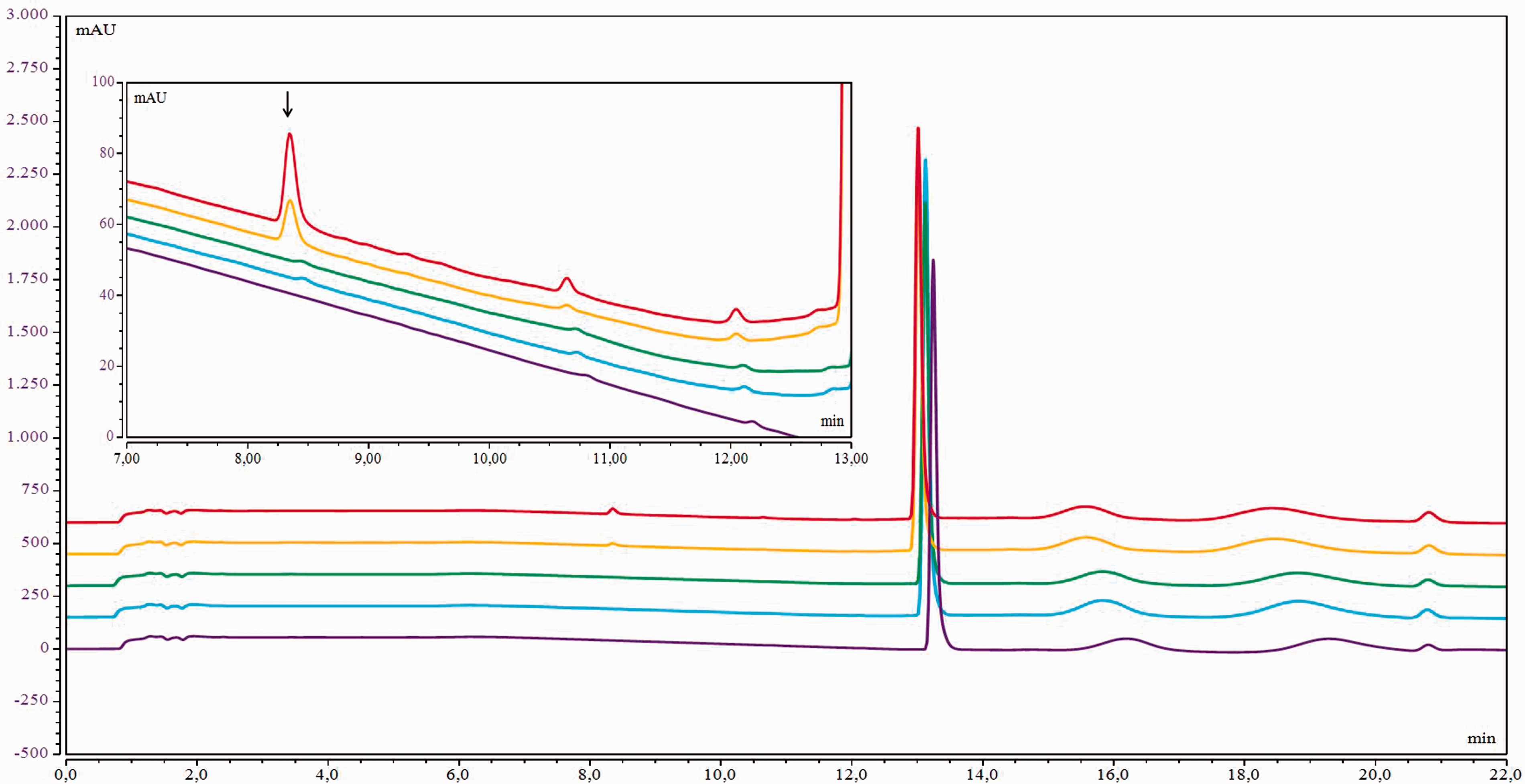
Chromatogram from concentrate-solvent samples stored at 18–21°C and 40 °C. From bottom-up: t = 0 (purple trace), t = 1 week at 18–21°C (blue trace), t = 2 weeks at 18–21°C (green trace), t = 1 week at 40 °C (yellow trace), t = 2 weeks at 40 °C (red trace). The four last-mentioned chromatograms show a new peak arising at 8.35 min.
Purity data based on the area% of cabazitaxel in each solution (concentrate-solvent mixture and infusion solution containing concentrate-solvent mixture diluted in 0.9% NaCl) stored under different conditions, 3-5°C, 18-21°C, and 40°C. Concentration data presented as an average of the difference between the measured concentration at week 1 and week 2.
Infusion solution
The peak purity of the cabazitaxel peak was within the range of 98.2–99.8%. Several small peaks were found eluting before the cabazitaxel peak. These were found to be present in the blank as well (see Figure 3) and could, therefore, be subtracted from the chromatograms of the tested solutions. The purity of infusion solutions, therefore, remained unchanged for all infusion solutions that had been stored in 3–5°C. For purity and concentration data, see Table 1.
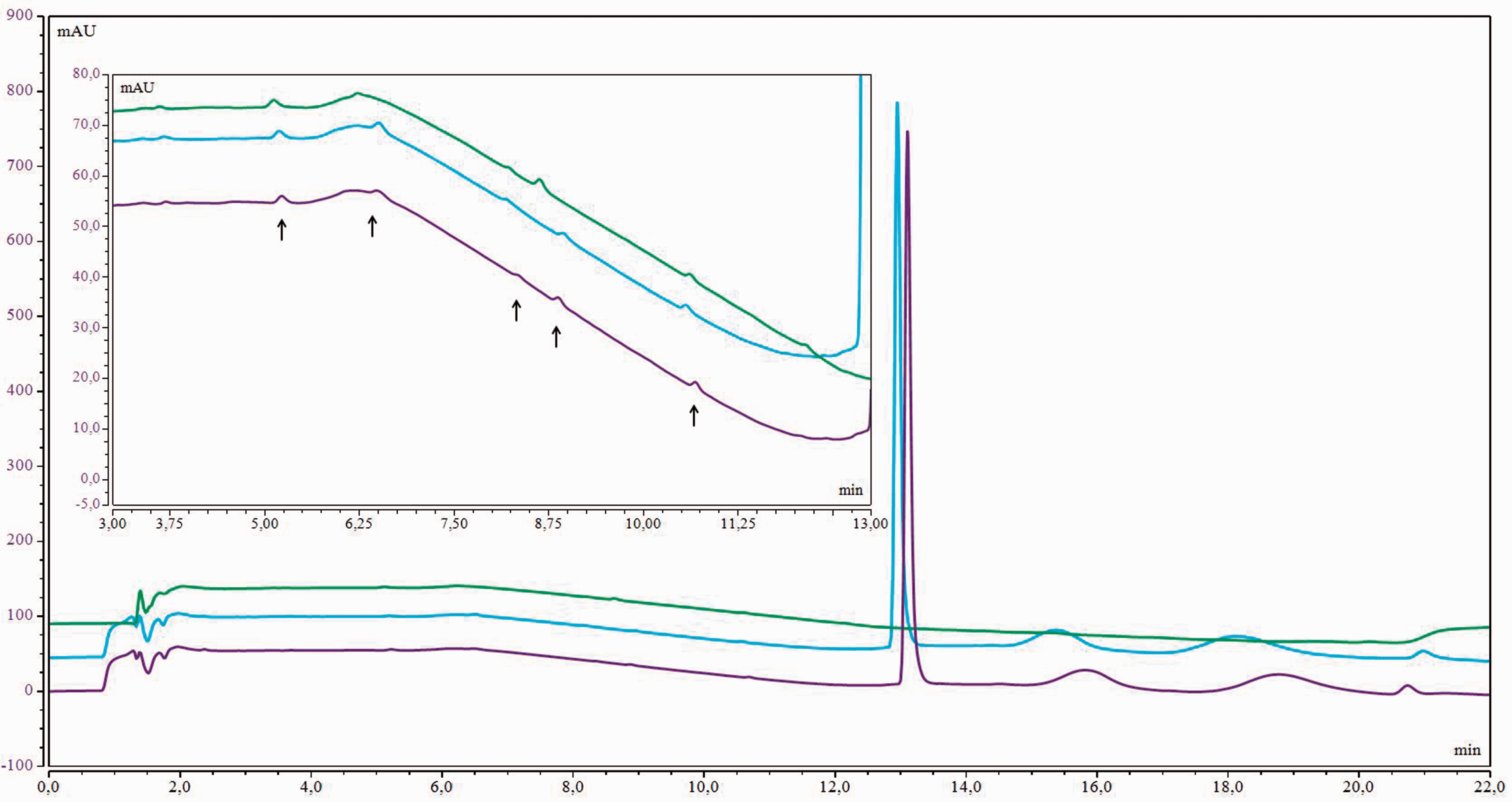
Chromatogram from infusion solution samples stored at 3–5°C. From bottom-up: t = 1 week (purple trace), t = 2 weeks (blue trace), infusion bag blank (green trace). The chromatograms for the concentrate-solvent mixture did not change over the 2 weeks’ time for all refrigerated samples. The arrows indicate infusion bag peaks.
Discussion
The HPLC method, as described, was previously developed and validated to be used in this study. The obstacle of fluctuating concentrations due to pipetting was attempted to be overcome by weighing the samples and calculating the concentrations based on weight. Nevertheless, this still led to a fluctuation in the concentration results due to the small viscous differences after preparation by hand on different days and operators. However, the stability-indicating capability of the method is the purity determination of the sample as previously concluded, where no other degradation/impurities are eluting at the same time as cabazitaxel. 4 This was also confirmed with the peak purity in this study. The purity results are here defined as the relative area of cabazitaxel, where the excipient peaks and blanks have been subtracted from the calculation. Meaning that if any other peaks arise or grew, the cabazitaxel’s relative area would decrease, leading to loss of purity. These results are more reliable than the concentration results, since the measurements within the sample set are slightly fluctuating, from the preparation and possibly because of the insolubility of cabazitaxel. From looking only at the concentration, we cannot see that any degradation has occurred since the concentration remains significantly the same. From previous research with forced degradation, it was found that all degradation products were eluting earlier than cabazitaxel, and all peaks eluting after cabazitaxel were part of the excipients. It was also found in this study with the help of a formulation blank, that two peaks eluting at 10.63 and 12.04 min were part of the excipients as well. The infusion solution samples showed a few more peaks eluting before cabazitaxel. These were found to be part of the infusion bag blank as well and therefore believed to be from the infusion bag since a 0.9% saline blank from a bottle did not show the same peaks.
For all refrigerated samples, both concentrate solvent mixture and infusion solution, the purity remained 100% since no additional peaks or growing impurities were detected. In all samples stored at room temperature (18–21°C) and elevated temperature (40°C), the purity was lowered after one week and continuously lowered after 2 weeks. This was due to degradation and a new compound had been formed resulting in a new peak in the chromatogram. The peak that is eluting around 8.35 min, which is seen more prominently in all the 40°C samples, has previously been identified as a degradation product and a chemical structure has been suggested with the help of mass spectrometry measurements. This degradation product had the highest abundance of forced degradation studies 4 and the only degradation product formed in this study. Impurities and metabolic pathways for cabazitaxel have previously been identified. Degradation products have been separated by other research groups, however, not been identified.8–11 A thorough degradation study with another cabazitaxel taxane derivate DS80100717 has also been conducted. 12 The stability in the form of concentration measurement for infusion solution stored in glass bottles has been examined previously as well. 11
The results demonstrate that the cabazitaxel maintains its stability from a physical and chemical point of view for up to 2 weeks after the concentrate-solvent mixture prepared and/or infusion solution is prepared for all storage conditions. However, since the SmPC states that cabazitaxel cannot be stored over 30°C, 2 the 40°C should not be re-used. Moreover, it is possible to store all samples in refrigerated temperatures (3–5°C) which is also preferred since no degradation occurs, therefore there is no need to store the samples at room temperature (18–21°C).
Furthermore, microbiological safety needs to be assured if prolonged usage is to be made possible. If not used immediately, the responsibility lies with the administrator to assure preparation has been made in controlled and validated aseptic conditions. 1 In our Institute, all cytotoxic pharmaceuticals are prepared for IV-administration at the CPUC under aseptic, Class A, conditions that are continuously tested for possible contamination. Additionally, the preparation is continuously monitored by broth simulation of the preparation method performed by each operator at the beginning of every day. The microbiological safety for storing opened vials and aseptic preparation has also been generically demonstrated with no signs of microbiological contamination after the tested storage conditions. 13 As an addition to the current study, 16 Jevtana® vials were included as well.
Conclusion
The results indicate that the physical and chemical stability remained for all Jevtana® concentrate-solvent samples and infusion solutions stored at 3–5°C, 18–21°C and 40°C for up to 2 weeks after preparation. However, storage at 2–8°C degrees is preferred. These findings demonstrate that we can re-use the cabazitaxel concentrate-solvent mixture and infusion solution bags up to 2 weeks after preparation if stored in refrigerated temperatures (3–5°C), if prepared and stored according to the established microbiological safety scheme previously developed. 13
Footnotes
Declaration of conflicting interests
The author(s) declared no potential conflicts of interest with respect to the research, authorship, and/or publication of this article.
Funding
The author(s) received no financial support for the research, authorship, and/or publication of this article.
