







Abstract
Introduction
Pharmacy staff are part of the healthcare delivery. In some cases, the patient goes to the pharmacy before the doctor and asks for a medicine suitable for his own complaint. The aim of this study is to evaluate the awareness about the importance of high fever in patients with leukemia and lymphoma receiving chemotherapy among healthcare professionals working in non-hospital pharmacies.
Material and method
The study is a survey study. 140 pharmacy employees working in non-hospital pharmacies in Ankara Province were included in the study. Volunteer participants were included in the study. Seven questions were asked to the participants.
Results
About 47.1% of the participants stated that they would advise patients to go immediately to the nearest hospital's emergency department when they presented to the pharmacy and said that they had high fever. It was stated by 56.5% of the participating pharmacy employees that high fever did not pose the same risk for a leukemia or lymphoma patient receiving chemotherapy as it did for a leukemia or lymphoma patient not receiving chemotherapy.
Conclusion
In this study, it was found that awareness about importance of high fever in leukemia and lymphoma patients receiving chemotherapy among healthcare professionals working in pharmacies other than hospital pharmacies was not very high. Providing necessary information to the pharmacy personnels and increasing the awareness about importance of high fever in leukemia and lymphoma patients receiving chemotherapy among the non-hospital pharmacy staff might also contribute to the reduction of negativities associated with infections in such patients.
Introduction
Febrile neutropenia continues to be an important complication of chemotherapy in cancer patients, despite prophylaxis and hygiene practices. 1 Myelosuppression is one of the main dose-limiting toxicities of systemic cancer chemotherapy in patients with hematological malignancies. 2 Febrile neutropenia may also affect long-term clinical outcomes of potentially treatable malignancies by causing dose reductions and treatment delays in chemotherapeutic agents.3,4
Infections are known to be among the common causes of mortality in leukemia and lymphoma patients who receive chemotherapy. Since fever may be a sign of infection, it is a symptom that requires immediate attention in febrile neutropenic patients. Pharmacy staff are part of the healthcare delivery. In some cases, the patient may visit a pharmacy before the doctor and may ask for a medicament suitable for his/her own complaints.
Todd et al. showed in their study that reaching to pharmacy was as possible as reaching to general practitioners. 5 Lum et al. reported that 70% of the pharmacists participating in their study were asked about possible cancer signs and symptoms by at least one patient in a month. 6 In their evaluation, Mensah et al. stated that the level of knowledge of community pharmacists about signs, findings and screening of breast cancer was moderate. 7
The aim of this study is to evaluate the awareness about importance of high fever in leukemia and lymphoma patients receiving chemotherapy among healthcare professionals working in pharmacies other than hospital pharmacies in a central Anatolian city. When the awareness level among the pharmacy staff is measured, necessary informations/health education need to be provided may be learned and may be given to the non-hospital pharmacy staff.
Material and methods
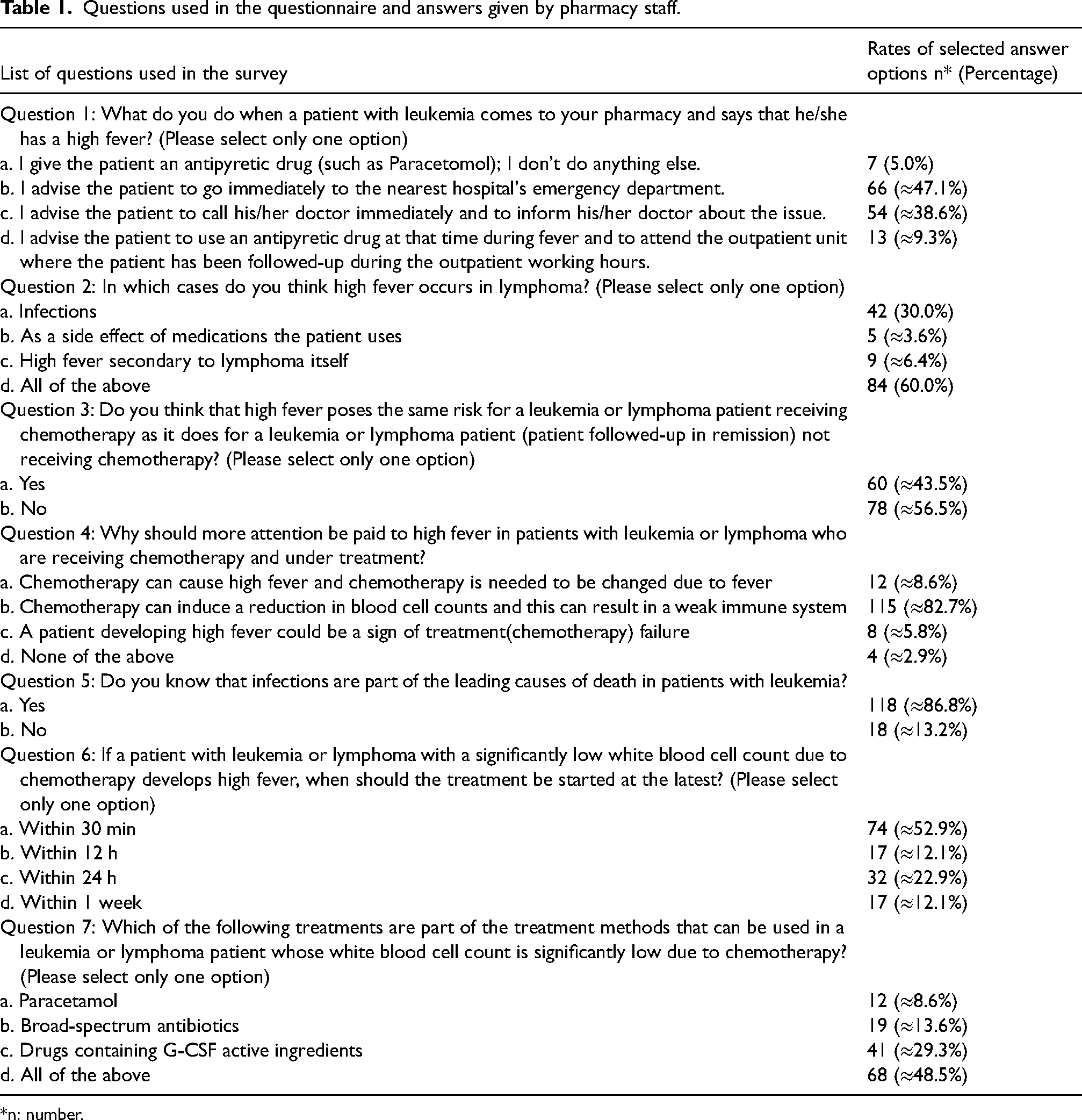
This research is a survey study. Prior to the study, a written approval was obtained from the Ethics Committee of University of Health Sciences Ankara Dr Abdurrahman Yurtaslan Oncology Training and Research Hospital (Approval date: February 5, 2020 and decision number: 2020-02/527). The study sample consisted of 140 pharmacy employees working in non-hospital pharmacies in Ankara Province, in Turkey. Participation in the study was voluntary. A written consent was obtained from all participants. The participants were asked seven multiple-choice questions. These questions are given in the Table 1.
Questions used in the questionnaire and answers given by pharmacy staff.
*n: number.
The answers to these questions have been analyzed. The frequencies of the answers given by the patients to the questions were evaluated and interpreted.
Inclusion criteria
Aged over 18 years, being at least a high school graduate, working in a pharmacy other than a hospital pharmacy (as a pharmacist or a pharmacy employee), currently working in Ankara Province.
Exclusion criteria
Previous work experience at a hospital, being a doctor or a nurse, being a lymphoma or leukemia patient or having a close relative with lymphoma or leukemia, being under 18 years of age.
Results
About 47.1% of the participants stated that they would advise patients to go immediately to the nearest hospital's emergency department when the patients came to the pharmacy and said that they had high fever (Table 1).
As for the common reasons of high fever in lymphoma disease, 60.0% of the participants chose the option “All of the above”, which included infections, side effects related to the medications patient use, and lymphoma itself (Table 1).
About 56.5% of the participants stated that high fever did not pose the same risk for a leukemia or lymphoma patient receiving chemotherapy as it did for a leukemia or lymphoma patient not receiving chemotherapy (Table 1).
When asked whether they were aware of the fact that infections were part of the leading causes of death in patients with leukemia, about 86.8% of the participants chose the answer “Yes”, meaning that they already knew this fact (Table 1).
As for the question regarding the ideal time to start the treatment in a patient with leukemia or lymphoma who has a significantly low white blood cell count due to chemotherapy and develops high fever, about 52.9% of the participants stated that the treatment should be started within 30 min at the latest (Table 1).
In the matter of treatments that can be used in a leukemia or lymphoma patient whose white blood cell count is significantly low due to chemotherapy, about 48.5% the participants chose the option “All of the above”, which included paracetomol, broad-spectrum antibiotics and drugs containing G-CSF active ingredients (Table 1).
Discussion
In their study, Lum et al. reported that patients could ask pharmacists about the signs and symptoms of cancer. 6 Mayer et al. suggested that community pharmacists could play a major role in patient education regarding the prevention of skin cancer. 8 In the survey study conducted by Al-Arifi, 35% of the participants stated that pharmacists played an active role in the treatment compliance and 43% of the participants accepted the role of the pharmacists’ in solving drug-related problems. 9 In a study conducted in Ghana, Mensah et al. reported that 65.3% of participant pharmacists had poor knowledge about causes and risk factors for cancer. 10 In their study conducted on community pharmacists in the districts of Hulu Langat and Sepang of Selangor State in Malaysia, Beshir et al. reported the mean overall knowledge regarding risk factors of breast cancer and screening recommendations was 56%. 11 Furthermore, Chua et al. stated that the main reasons of the people to visit community pharmacies around Klang Valley in Malaysia were to buy medications and to seek advice on minor health problems or health supplements. 12
Febrile neutropenia has been considered as a medical emergency and requires immediate medical attention and administration of empirical broad-spectrum antibiotics. 13 On the other hand, non-hospital pharmacies might be seen as part of the initial places of application in the search for therapeutic drugs. For this reason, it may also be important for those working in non-hospital pharmacies to be aware of the importance of fever, especially in patients with hematological malignancies such as leukemia and lymphoma.
When the frequency of the responses given in this study were analyzed, it was found that the awareness of pharmacy employees working in non-hospital pharmacies about the importance of high fever in leukemia and lymphoma patients receiving chemotherapy was not very high. Measuring the awareness of pharmacy employees may help to provide them necessary training and increase the awareness of non-hospital pharmacy staff on approaching febrile patients with hematological malignancies.
Footnotes
Author's contributions
D.M. was the designer, coordinator, data collector and corresponding author. A.M. was the designer, author and data collector of the study.
Declaration of Conflicting Interests
The author(s) declared no potential conflicts of interest with respect to the research, authorship, and/or publication of this article.
Funding
The author(s) received no financial support for the research, authorship and/or publication of this article.
