





Abstract
Objectives
Carbapenem antimicrobials are considered for the treatment of serious bacterial infections. The objective of this study was to review the use of meropenem in cancer patients and to evaluate the impact of clinical pharmacist's intervention in this practice to reduce possible risks associated with use of meropenem.
Methods
This retrospective study was conducted among 100 patients who received meropenem at hospital. A structured questionnaire was used to collect data. Descriptive statistics was used to analyze the collected data.
Results
A total of 100 patients were included in this retrospective study with aim to review rationality and possible side effects associated with meropenem use in our study population. It was revealed that meropenem used was associated with rise in bilirubin in many of our study patients. Pharmacist were found to be instrumental in placing timely interventions for either de-escalation or switch of meropenem to imipenem/cilastatin to reduce that risk. Interventions were accepted by physicians in most of the cases.
Conclusion
De-escalation and switching were performed in accordance with pharmacist recommendations in more than half of study population with empirically started/ study population in which meropenem was used.
Introduction
Antimicrobials are the most frequently prescribed drugs among all hospitalized patients as one-third of hospitalized patients get antibiotic treatment.1–3 The improper and unnecessary utilization of antimicrobials is a common practice in hospitals.4,5 Antimicrobials resistance (AMR) is one of the public health problem and is associated with over administration of unnecessary antimicrobials 6 which leads to genetic mutation in microbes.7,8 Multi drug resistance (MDR) bacteria are causing approximately 35,000 people death annually in America9,10 and European Union. 11 Death rate is very high (around 96,000 death each year) in other parts of world like Southern Asia due to MDR microorganisms. 12 Studies documented excessive irrational antimicrobial use in Pakistan but no data available on mortality rate associated with MDR infections.5,13,14 Drug therapy for infectious diseases is becoming complex in Pakistan due to escalating AMR.15,16 In 2015, World Health Organization (WHO) released Global Action Plan (GAP) to reduce the antimicrobial resistance. 17 One of basic element of GAP is Antimicrobial Stewardship Program (ASP) which has approach to improve prescription containing antimicrobial, reduce costs, and prevent adverse effects.18,19 The Infectious Diseases Society of America (IDSA) and Society for Healthcare Epidemiology of America (SHEA) published guidelines in 2007 on how to start ASP and enforce it in hospital settings. 20 The increase efforts behind the implementation of ASP is because of AMR causing morbidity, mortality and cost. 21 One of the best scheme to minimize the resistance is by reducing the exposure to antibiotics. 22
According to the antimicrobial de-escalation therapy guidelines,23,24 physicians must start the therapy with broad spectrum antimicrobials for severe infections and after bacteriological data and susceptibility test, reduce the number and spectrum of antimicrobials. In spite of benefits of de-escalation like patient's safety and prevention of antibiotic resistance, different clinical settings have not adopted this strategy.25–27 In addition to this, de-escalation has no clear definition and evaluation is difficult.28–30 De-escalation generally refers as either a switch to a narrower spectrum antibiotic or the reduction in the number of antimicrobials or the early arrest of antibiotic treatment. 31 This type of ASP help to ensure appropriate antibiotic therapy and its de-escalation upon culture test. 32 Pharmacists play an important role in suggesting antimicrobial de-escalation.32–34 In the same way, pharmacists have integral part in implementation of ASP.35–37 Meropenem is a β-lactam drug with activity against gram-negative, gram-positive, and anaerobic antimicrobials 38 and its de-escalation resulted in reduction of broad-spectrum antimicrobials exposure and effective treatment. 39 However, there is limited research on antibiotics de-escalation in Pakistan. Therefore, the aim of this study was to investigate the use of meropenem and impact of infectious diseases pharmacist recommendations in this regard.
Methods
This retrospective observational study was conducted over a 6 month period from January 2020 to July 2020 in Shaukat khanum Memorial Cancer Hospital and Research Centre (SKMCH) located in Lahore, Pakistan to explore the use of meropenem in hospital setting. The study design as well as ethics approval was granted by human ethical committee SKMCH. All the patients using meropenem were identified using the computerized information system of the hospital. Patients who were receiving more than 10 g dose of meropenem for a specific clinical disease or prophylaxis for more than 3 days were included. This dose was selected to see the clinical safety and efficacy of meropenem. Standardized data collection form was used to collect data of those 100 patients who received meropenem at hospital based on inclusion criteria. These 100 patients were taking more than 10 g dose of meropenem for more than 3 days. Different parameters in the data collection form were collected from the patient profiles including demographic variables (e.g. gender, age, weight etc.), meropenem dosage regimen and clinical data (e.g. hepatic and renal impairment), of a patients. The infectious disease pharmacist recommendations for antimicrobial therapy like the increase or decrease in doses, changes in dose frequency, switching or discontinuation of the drug were also monitored. De-escalation therapy was defined as either a switch to a narrower spectrum agent or the reduction in the number of antibiotics or the early arrest of antibiotic treatment. Patients who died after the start of meropenem therapy and patients who were switched to narrow spectrum due to toxicity reason were also included in de-escalating analysis. Descriptive statistics were used to summarize patient demographics and clinical data.
Results
A total of 100 patients who used meropenem during hospitalization were analyzed. Majority of them were male (55%). Mean age and weight of patients were 37.35 ± 20.36 and 53.35 ± 21.03 respectively. 72% patients were using meropenem three time a day. When examining patients medical conditions, 10% of the study participants reported having chronic kidney disease and 49% were suffering from respiratory infections (Table 1).
Sociodemographic characteristics and medical condition.

Meropenem use outcomes
In all study patients meropenem therapy was started empirically. Almost 41% our patient population reported experiencing LFT derangement while in 20% of patients with renal problem, kidney function slowed down. LFT derangement resulted in high bilirubin level in such patients. On the other hand, serum creatinine level increased due to renal function problem. Some Patients (11%) died after the meropenem use (Figure 1).

De-Escalation after empirical meropenem therapy.
Pharmacist interventions
Interventions were made by the pharmacist on meropenem outcomes. Pharmacist recommended de-escalation therapy. Switching and discontinuation of meropenem was suggested for the patients with high bilirubin level (Table 2 and 3). To avoid renal dysfunction dose frequency changes and discontinuation was recommended. Meropenem was discontinued in expired patients.
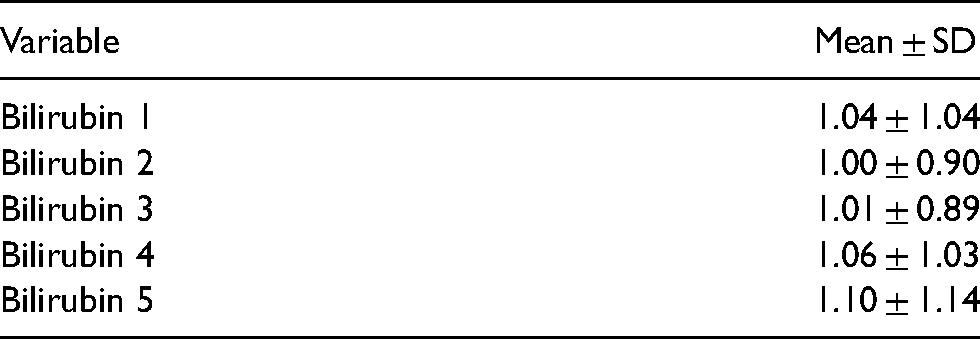
Bilirubin level over treatment of 5 days.
Examples of pharmacist intervention.
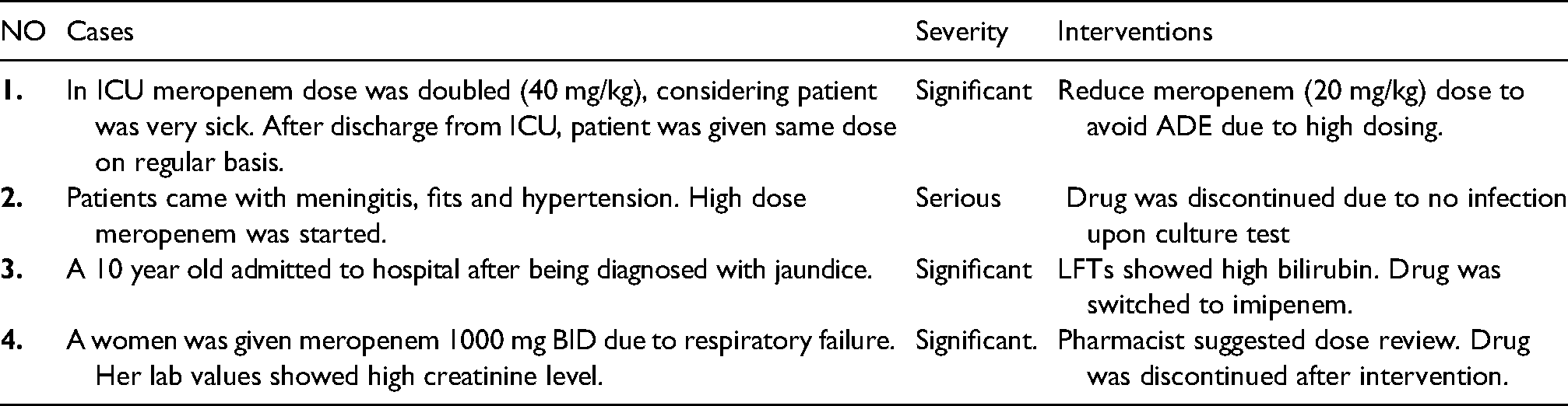
Pharmacist recommendation
In 11% patients’ drug was switched to narrow spectrum antibiotics, however therapy was arrested in 33% patients. Out of the 60 pharmacist recommendations proposed, 58 (97%) were finally accepted by attending physicians. 40% patients received the regular care. Examples of pharmacist recommendation are shown in table 3.
Discussion
This study was conducted to get the data on the use of meropenem in patients admitted to SKMCH. Carbapenems (meropenem and imipenem) have same spectrum. 40 However difference between Carbapenems exist Meropenem is more favorable because of its in vivo activity against gram negative pathogens and tolerability by central nervous system with respect to seizures.40,41
In our study, majority of patients received meropenem were old. This might be due to
excellent safety profile of meropenem in elderly. 42 Based on our literature review, previously available data showed meropenem tolerability and efficacy for respiratory tract infections. 43 Our study reported the same results as meropenem was started to almost half of the study patients who were suffering from respiratory infections.
As in previous study, 44 this study also revealed that meropenem was used empirically for patients without culture. It means that meropenem was utilized based on physician experience or decision, but not on culture based. In this study most of the patients reported LFT derangement after meropenem use. This is due to the adverse effect of meropenem that resulted in elevated liver function tests. 41 Studies also observed meropenem associated cholestatic jaundice and elevated conjugated bilirubin.45,46 Study reported dose adjustment of meropenem in patients with renal dysfunction because almost 70% drug eliminated through kidney. 47 Long term broad spectrum antimicrobial therapy result in renal injury, electrolyte abnormalities, antimicrobial resistance.48,49
Pharmacists have broad knowledge regarding antimicrobial therapy and can help providers to make decision on drug dose, strength, route, and length of therapy as well as when it may be appropriate to de-escalate the drug. Different studies have reported that pharmacists have important contribution at ASP.50–52 According to a study, interventions related to antimicrobial prescription can reduce the unnecessary utilization of antimicrobials. 53 A study suggested that daily visits of clinical pharmacist at wards is vital for timely antimicrobials de-escalation. 51
The major limitation of the study is small sample size. Another limitation is that data has been collected only from one center. The strength of study is its findings that pharmacist guided the de-escalation for antimicrobial therapy.
Conclusion
In conclusion, we found that de-escalation of empirically started meropenem was performed in more than half of study population in accordance with pharmacist recommendations. Overall pharmacist given suggestions have potential to reduce the antimicrobial exposure.
Footnotes
Acknowledgements
Authors acknowledge the contributions of all the participants.
Grants
Research project did not receive any grant from governmental or non-governmental organizations.
Declaration of Conflicting Interests
The author(s) declared no potential conflicts of interest with respect to the research, authorship, and/or publication of this article.
Funding
The author(s) received no financial support for the research, authorship and/or publication of this article.
