






Abstract

Our institution recently transitioned to rituximab-pvvr (Ruxience®), a biosimilar of rituximab (Rituxan®). Nursing staff anecdotally reported an increase in infusion reactions since this transition. Infusion reactions are potentially multifactorial and other factors may also predispose their occurrence. We, therefore, sought to assess potential predictors for infusion reactions following rituximab-pvvr or rituximab administration.
This retrospective chart review was performed at a single academic medical center with an affiliated outpatient cancer center. This project was given an exemption by the institutional review board. Patients given at least one dose of rituximab-pvvr or rituximab over a one-year period were identified through an electronic medical record query. An infusion reaction was defined as any reaction attributed to rituximab-pvvr or rituximab in the electronic medical record. The data points collected were potential predictors for infusion reactions. Potential predictors were selected based on institutional experience and previous literature.1–3 All data analysis was performed using SPSS Version 28 (IBM Corp., Armonk, NY). Continuous variables were presented as median and interquartile range (IQR) and compared using the Mann-Whitney U test Categorical variables were presented as number and percentage and compared using Pearson's chi square or the Fisher exact test Variables with a p ≤ 0.25 were entered into a logistic regression. All statistical analyses were two-tailed and p < 0.05 was considered statistically significant.
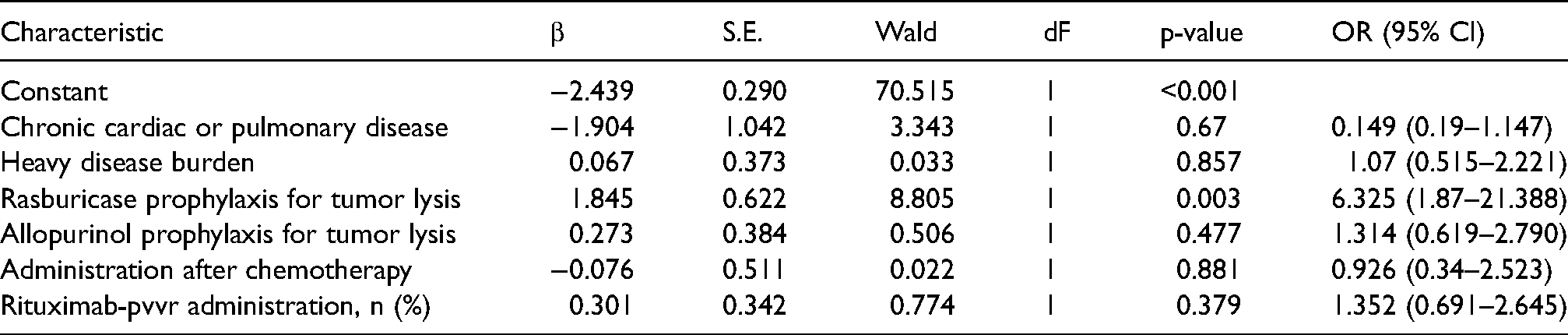
In total, 490 patients were included in this analysis, of which 55 had a documented infusion reaction and 435 did not. Rituximab was administered in 168 patients, and the other 322 patients received rituximab-pvvr. Table 1 shows potential predictors for infusion reactions following rituximab-pvvr or rituximab administration. Rasburicase administration for tumor lysis syndrome prophylaxis and administration after chemotherapy were the only significant predictors on univariable analysis. Both were positive predictors for infusion reaction. Chronic cardiac and pulmonary disease, heavy disease burden, rasburicase prophylaxis for tumor lysis, allopurinol prophylaxis for tumor lysis, administration after chemotherapy and rituximab-pvvr administration had p-values ≤ 0.25 on univariable analysis and were included in the logistic regression (Table 2). Rasburicase prophylaxis for tumor lysis was the only significant predictor for rituximab-pvvr or rituximab infusions reactions on logistic regression. Rituximab-pvvr administration was not a significant predictor for infusion reactions on univariable analysis or logistic regression and the frequency of infusion reactions were not statistically different following rituximab-pvvr or rituximab administration (rituximab-pvvr: 12.4% (40/322) versus rituximab: 8.9% (15/168), p = 0.245).
Potential predictors of infusion reactions following rituximab-pvvr or rituximab administration.

Logistic regression.
Infusion reactions occur after 12.5% of rituximab administrations, which approximates the rates seen with rituximab-pvvr and rituximab in our study. 1 There is limited information comparing the frequency of infusion reactions with rituximab-pvvr and rituximab. In our study, rituximab-pvvr was not an independent predictor for infusion reactions and infusion reactions occurred at similar rates with rituximab-pvvr and rituximab. These findings were shared with our nursing staff and have helped address their potential concern rituximab-pvvr may increase infusion reactions. However, it should be noted that our results can only suggest rituximab-pvvr may not increase infusion reaction rates. Due to limitations inherent to a retrospective study, further high-quality studies are necessary to confirm our results. We, however, felt it was important to share our findings in case other institutions have similar perception, as it could limit rituximab-pvvr adoption and effect administration practices.
Footnotes
Declaration of Conflicting Interests
The author(s) declared no potential conflicts of interest with respect to the research, authorship, and/or publication of this article.
Funding
The author(s) received no financial support for the research, authorship, and/or publication of this article.
