







Abstract
Background
Health care professionals are potential to be in contact with cytotoxic drugs during their daily work activities. The study aimed to assess the practice of health professionals to care for cytotoxic drugs and associated factors in the University of Gondar Specialized Hospital.
Methods
Cross-sectional study design was employed. EPI Info 7 was used for data entry and then exported into SPSS 20 for statistical analysis. Frequencies and mean with standard deviation were computed. Logistic regression had been performed to find out associated factors. Crude’ and adjusted Odds’ ratio with 95% uncertainty interval was done. Variables with a p < 0.05 were declared as significant factors for practice of cytotoxic drug handling.
Results
The study used four-hundred and twelve health professionals took part in the study with 97.4% response rate. The mean age of study participants was 29.9 years ranging from 20–60 years and twenty (53.4%) participants were males. One hundred and fifty-five (37.6%) health professionals had good cytotoxic drug handling practice. Attending an average of 4–9 patients per day (AOR = 2.12, 95% CI: 1.05, 4.22), Medium work stress (AOR = 2.01, 95% CI: 1.04, 3.90), availability of cytotoxic drug handling manual (AOR = 2.51: 95% CI: 1.22, 5.12), and good knowledge (AOR = 4.09, 95% CI: 2.35, 7.11) were significantly associated with cytotoxic drug handling practice.
Conclusion
The practice of cytotoxic drug handling care was low. It demands the engagement of the health sector to avert such inadequate practice and has to focus on delivering knowledge and logistics for the practice of cytotoxic drug handling.
Introduction
Anticancer drugs (chemotherapeutic agents) are used as treatment options for oncologic cases. Evidence for continued risk of occupational exposure is abundant. 1 Poor management of waste is a potential risk to healthcare workers and the community. 2 In Ethiopia, the growing population with lifestyle changes showed an increasing burden of cancer. 3 In an earlier study, cervical cancer was the major cause of mortality in Ethiopia. 4 Chemotherapeutic drugs are cytotoxic substances that can be used for the treatment of cancer. Exposure to cytotoxic drugs 5 may occur during drug preparation, mixing,6,7 drug administration, 8 transportation, and cleaning spills and waste disposal. 9 Significant amounts of CD can enter into the body via inhalation of the powder and liquid aerosols, unprotected skin and mucous membranes, oral exposure may occur from hand-to-mouth contact or ingestion or drinks and needle stick injury10–12 for staff exposed to antineoplastic agents exists in the workplace. 13
In many countries, national health authorities focus on promoting actions aimed to protect individuals who are potentially in contact with CD.14–17 Health professional organizations and government agencies have developed guidelines in the past 2 decades, concerned about the health risk of occupational exposure to hazardous drugs to protect health care workers from cytotoxic effects of antineoplastic drugs.16,18 Most published guidelines on safe handling of cytotoxic drugs addressed the hospital setting, but lack practical guidelines for use within an oncology office. 19 Although there has been a significant increase in the availability and use of CDs, the guidelines regarding safe handling are still evolving. 20 Several studies revealed that CDs are hazardous to healthcare workers, particularly Nurses, Pharmacists and Cleaners who may come in contact with these CDs during their daily activities. 21 Other studies have assessed work exposure to CD could result in various toxicological effects that can potentially damage health professionals during their activities.20,22 As stated by previous studies, one of the reasons for CD exposure is due to inappropriate use of personal protective equipment and wrong cleaning procedures. 18 Priorities have to be given to reduce major work-related health risks and associated factors and to plan possible management mechanisms. 23 Cancer treatment services are insufficient, and it is observed that no cancer related activity documentation and less staff are involved in cancer treatment centers. 3 Even though there has been an improved concern and responsiveness about the issue of safe handling of CDs, many health professionals still do not follow the adopted guidelines and procedures in the hospital settings and are not using the recommended personal protective equipment. 24 For that reason, health professionals’ practice needs understanding of toxicities and the protection measures used while preparing and administering these CDs.17,25–27 This study was the first of its type to assess the practice of health professionals to care for cytotoxic drugs and possible associated factors in University of Gondar Specialized Hospital.
Methods
Study setting, design, and period
Institutional based cross-sectional study was employed at the University of Gondar Specialized Hospital, northwest Ethiopia, which is located 728 Km away from Addis Ababa, the capital city of Ethiopia. University of Gondar Specialized Hospital is a teaching Hospital which acts as a referral center for the nearby General Hospitals. It provides referral services for over 5 million inhabitants in the northwest region of Ethiopia. The data collection period was from June to August 2019.
Population
We used all University of Gondar Specialized Hospital Health professionals working in different departments of the Hospital including cancer treatment center as source population. The study populations were all University of Gondar Comprehensive Specialized Hospital Health professionals working in different departments of the Hospital including cancer treatment center who were present at the time of data collection.
Inclusion and exclusion criteria
All Health Professionals working in University of Gondar Specialized Hospital were included. Health Professionals who were severely ill during the data collection period, who had never been assigned to a cancer treatment center and those Health Professionals who had confirmed cancer were excluded.
Sample size calculation and sampling technique
The sample size (n) was calculated using a single population proportion formula with the assumptions of the proportion = 0.5 (no previous study in Ethiopia), 95% uncertainty interval, and margin of error (d) = 5%. After adding a non- response rate of 10%, the final sample size was 423
Instruments
We used a semi-structured, pretested self-administered questionnaires to collect the required data after preparing the questionnaire by reviewing different literature.18,28–30 The questionnaire consisted of different items regarding Sociodemographic characteristics and practice of health professionals on cytotoxic drug handling. The overall reliability of the items used for CD handling practice was performed, and we found a Cronbach's alpha of 0.87 which is good reliability. Four professional nurses were recruited to distribute and return the questionnaire and facilitate the collection process.
Variables of the study
Operational definition
Statistical analysis
Epi-info 7.1 was used for data entry and then exported into SPSS version 20 for computing, recording, and statistical analysis. Mean with standard deviation (SD) and frequency with percent were computed to descriptive results of the study. Logistic regression was used to explain the relationship between practice of drug handling and independent variables. Bi-variable analysis was executed to determine crude association between practice and each independent variable. An independent variable with a p-value of < 0.2 was selected for multivariable logistic regression. A variable with a p-value of ≤ 0.05 with 95% uncertainty interval was treated as a significant factor for practice towards cytotoxic drug handling.
Data quality control
Quality control was considered starting from questionnaire design until the analysis process. It was pretested and facilitators were trained about the purpose of study and ethical issues in the process of data filling. Pretest was done among 30 health professionals outside the study area, and we amended the questionnaire based on difficulties we faced during the pretest
Results
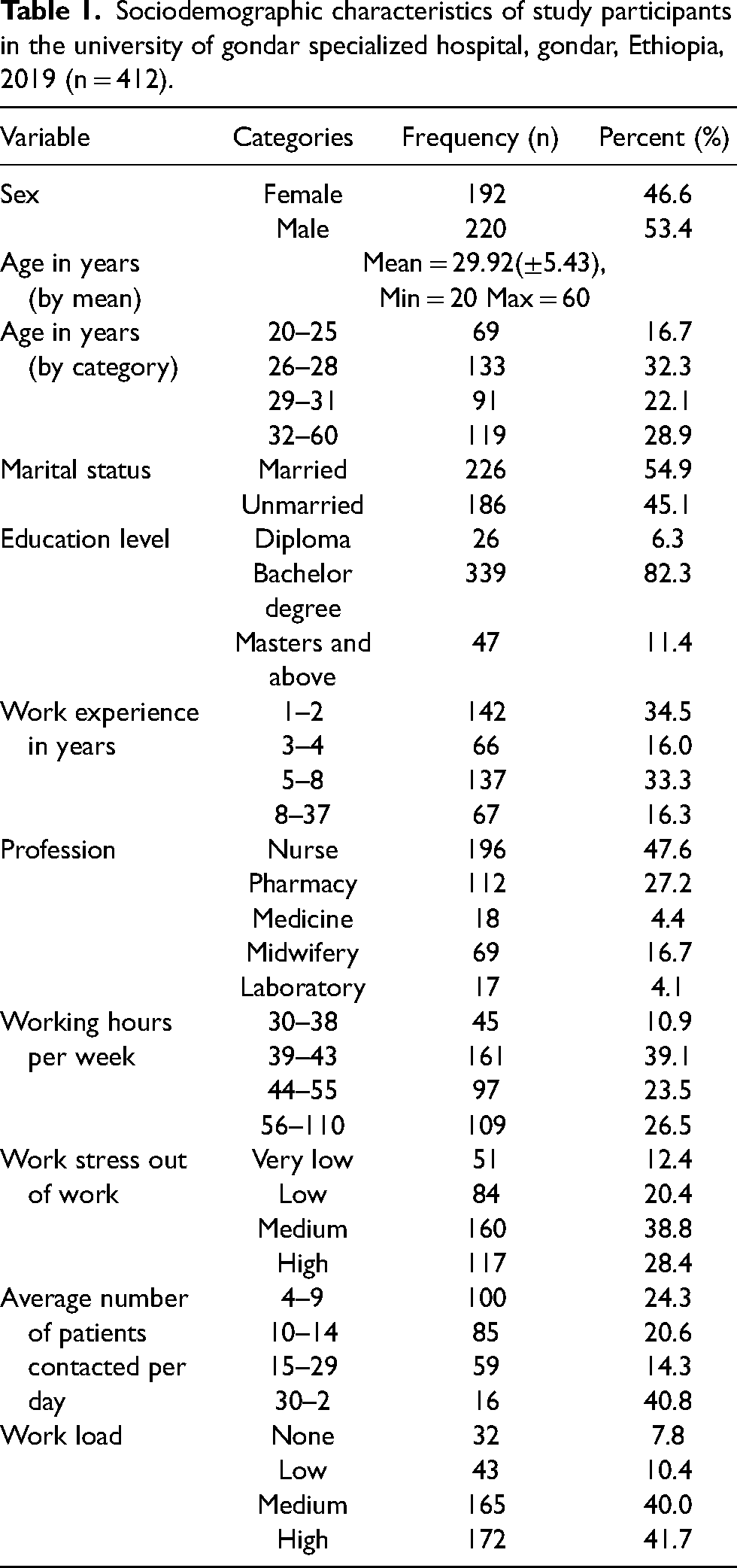
The study used four-hundreds and twelve health professionals with a 97.4% response rate. The mean age of respondents was 29.9 years
Sociodemographic characteristics of study participants in the university of gondar specialized hospital, gondar, Ethiopia, 2019 (n = 412).
Cytotoxic drug handling practice
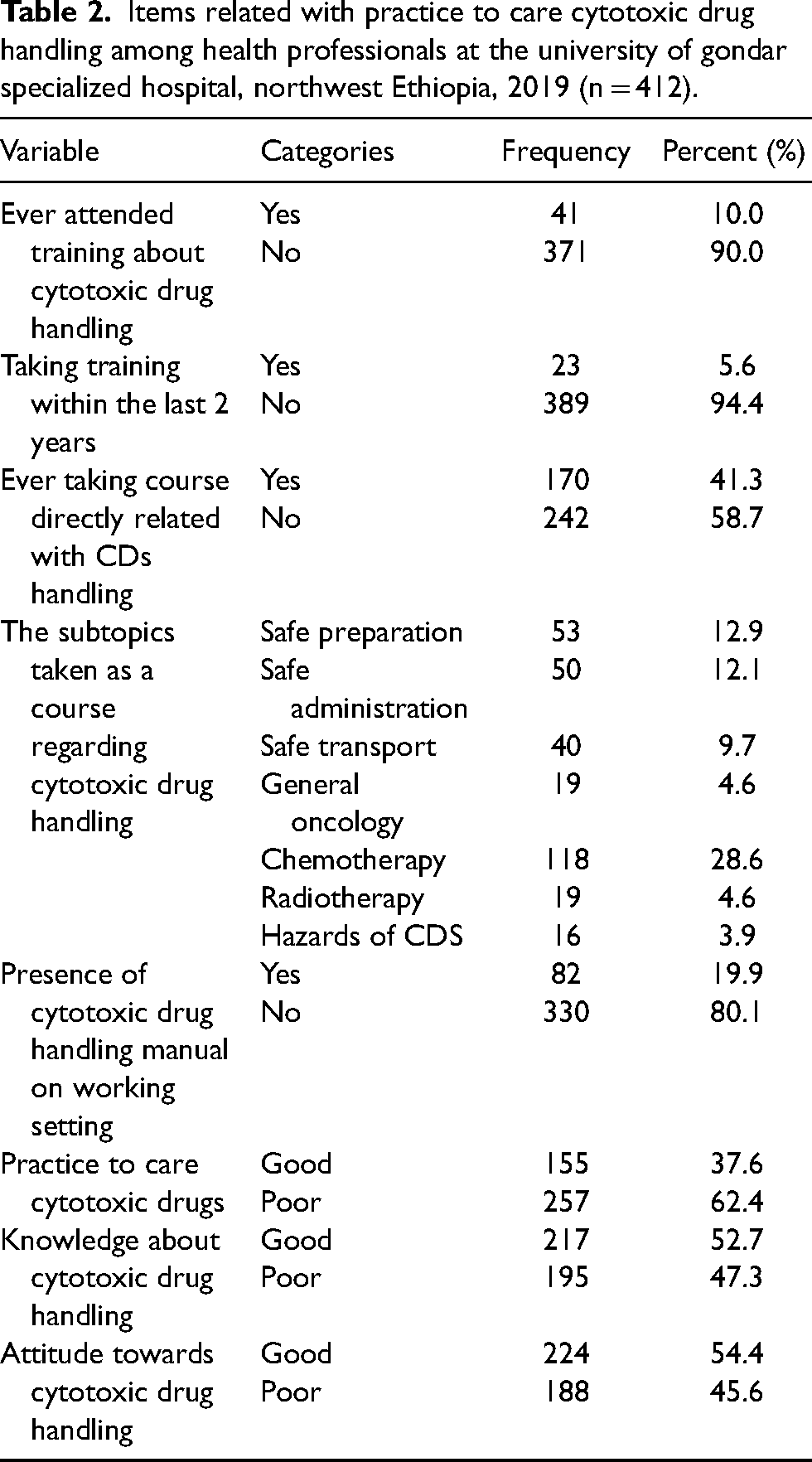
One-hundred and seventy (41.3%) health professionals had taken courses directly related to cytotoxic drug handling. From these related courses, chemotherapy related was reported to be the highest 118 (28.6%). Forty-one (10%) participants attended training about cytotoxic drugs, with 23(5.6%) health professionals attending training in the last 2 years. Eighty-two participants (19.9%) reported the availability of a cytotoxic drug handling manual in their work setting. From the participants, 155(37.6%) had good cytotoxic drug handling practice (Table 2).
Items related with practice to care cytotoxic drug handling among health professionals at the university of gondar specialized hospital, northwest Ethiopia, 2019 (n = 412).
Associated factors of good practice to care handling of cytotoxic drugs
Age, educational level, profession, average patients attended per day, work stress, ever attending training on cytotoxic drugs within the last two years, ever taking courses related to cytotoxic drugs, Presence of a cytotoxic drug handling manual at working setting, and knowledge of cytotoxic drugs were candidate variables for the final model and entered into multivariable logistic regression.
In the final model; health professionals who were attending an average of 4–9 patients per day had 2-fold (AOR = 2.12, 95% CI: 1.05, 4.22) better practice than those who attended 30–200 patients per day. Participants who experienced very low workload out of work had 3.5 times (AOR = 3.52, 95% CI: 1.45,8.56) better practice of CD handling than those who reported high work load out of work, health professionals who had low work load out of work had 6 times (AOR = 6.47, 95% CI: 3.00,13.97) better practice than those who had high work stress, and those with medium work stress had 2 times (AOR = 2.01, 95% CI: 1.04,3.90) better practice than those health professionals who reported high work stress. Health professionals who worked in units where there are cytotoxic drug handling manuals had 2.5 times (AOR = 2.51: 95% CI: 1.22, 5.12) better cytotoxic drug handling practice than those who worked in units without cytotoxic drug handling manual. Participants who had good knowledge experienced 4-fold (AOR = 4.09, 95% CI: 2.35, 7.11) better practice than those with poor knowledge about cytotoxic drug handling (Table 3).
Associated factors of good practice to care cytotoxic drug handling among health professionals at the university of gondar specialized hospital, gondar, northwest Ethiopia, 2019 (n = 412).
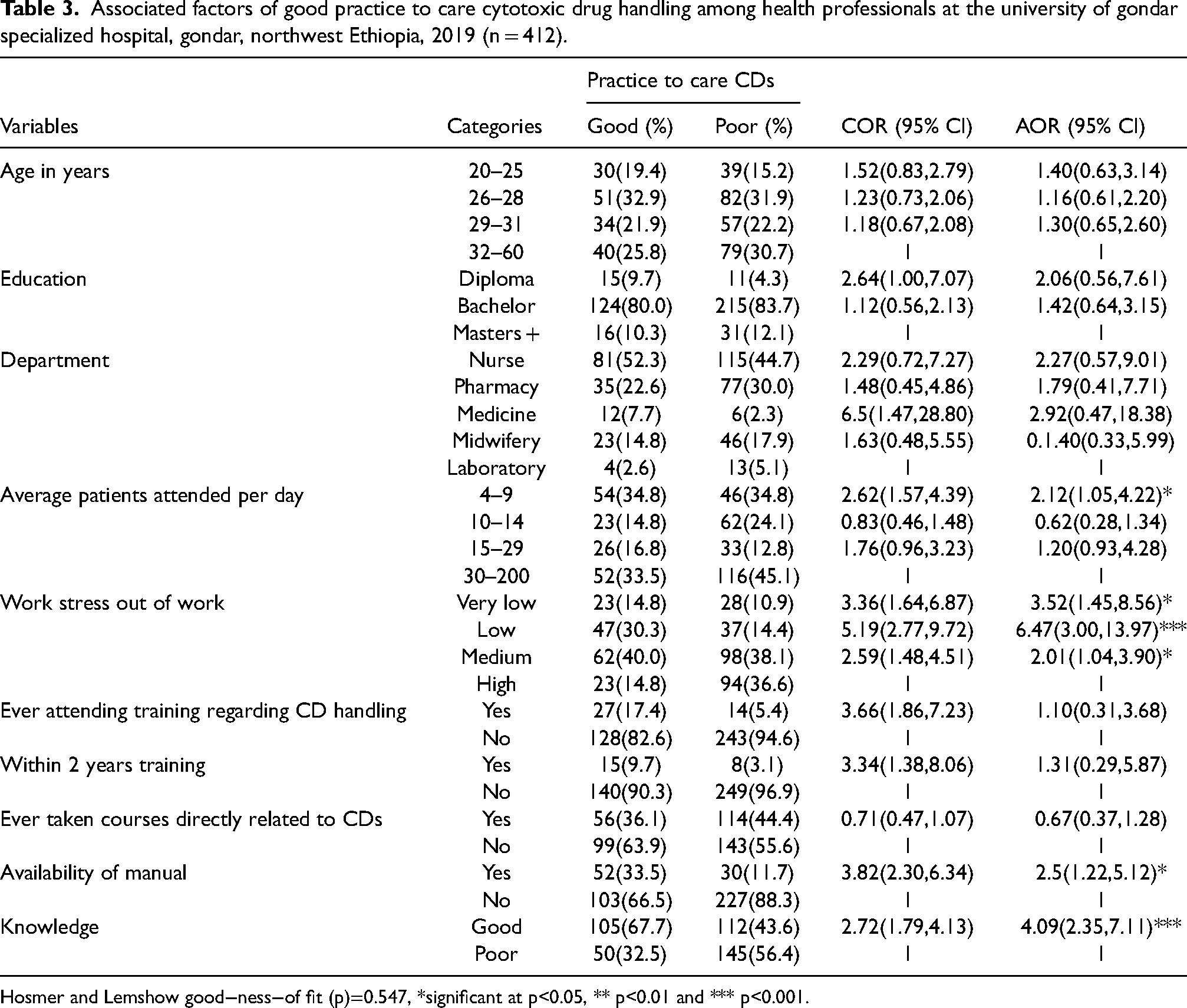
Hosmer and Lemshow good−ness−of fit (p)=0.547, *significant at p<0.05, ** p<0.01 and *** p<0.001.
Discussion
The current study was the first in its kind to assess the practice of health professionals to care for cytotoxic drugs in Ethiopia. The aim of the study was to assess practice to care cytotoxic drugs and find out associated factors of it.
In the current study, the good practice to care for cytotoxic drugs among health professionals was 37.6% (95% CI: 32.92%-42.28%). This is consistent with other cross-sectional studies in Egypt, 28 Pakistan, 32 and Turkey. 17 Other studies reported a higher percentage of health professionals with good cytotoxic drug handling, as evidenced in Nairobi 30 and Iran. 29 This could be due to differences in the study setting in that the cancer treatment units had been recently established and not advanced in the university of Gondar Specialized Hospital, training about safe handling practice of cytotoxic drugs were not adequately given to those health care professionals as well as the health education system of the country might not adequately address the risk of cytotoxic drug side effects.27,33
In the final model, average number of patients contacted per day, work stress out of work (None, Low and Medium), availability of cytotoxic drug handling manual and good knowledge were significantly associated with good care of cytotoxic drug handling practice.
Health care professionals having a lower number of patients contacted per day (4–9) had 2-fold good cytotoxic drug handling practice as compared to those health professionals contacting a higher number of average patients (30–200) per day. This association might be because health care professional having lower number of contacted patients are free to observe better techniques, give expected cares and required procedures as compared to those health care professionals having a high number of patients contacted per day as they are crowded to deal with expected activities to achieve good practice 27 Participants having lower work stress out of the hospital had good level of cytotoxic drug handling practice as compared with participants having higher work stress. This might be because health professionals who had stress out of the regular working area could not read or seek knowledge regarding drug handling, or could have inadequate general knowledge. 27 The other possible reason might be the tension of house related work leading health professionals not to focus on their professional work responsibilities. The crowded work at home could have implication for the individual's quality of working life. 34
Study participants who accessed the availability of cytotoxic drug handling manual had 2-fold better cytotoxic drug handling practice than others who did not access cytotoxic drug handling manual. This might be because good practice can be achieved through the availability of manuals related to cytotoxic drug handling, and it is obviously true to say manuals are very important to follow procedures and expected techniques so that a good level of practice can be achieved. 27 Health professionals with good knowledge have 4-fold better cytotoxic drug handling practice as compared to those who have poor knowledge of cytotoxic drug handling. Several previous studies supported that good knowledge of cytotoxic drug handling can improve good practice of cytotoxic drug handling.29,30,32 It is not amazing that having good knowledge of cytotoxic drug handling could have a good level of cytotoxic drug handling practice, as knowledge is the base for practice to be taken place and adequately addressed. 35 Similarly, good practice was also significantly associated with good knowledge of CDs in previous published articles which was part of this project. 31 In this study, attitude was not significantly associated with practice of CDs. However, practice was significantly associated with attitude of CDs in a previous published article which was the parts of this project. 36
The possible limitations in the current study include social desirability and recall bias. Besides, the cause-effect relationship cannot be established as this is a cross-sectional study. The study was self-reported and might not indicate the actual practice they did in the workplace.
Conclusion
The study showed that the practice of cytotoxic drug handling in Gondar University specialized hospital was poor. Regardless of the constricted scope of the study and the various constraints, the results of the current study may be assumed to be an important addition to the existing body of cytotoxic drug handling practice in Ethiopia. Increasing utilization of chemotherapeutic agents in treating patients with malignancy has led to the potential for widespread exposure of healthcare workers who come into contact with patients or these agents in the workplace. It is therefore recommended to access cytotoxic drug handling manual, reduce average patients contacted per day by increasing number of staffs, train health professionals to the specific job area before beginning duties and incorporate CDs handling related course contents while revising curricula to raise the skills thereby improving good practice to appropriate cytotoxic handling by health professionals so that reduction of possible adverse effects of cytotoxic drugs. The authors recommend future projects regarding the practice of cytotoxic drug handling by direct observations of workplace contamination.
Footnotes
Acknowledgements
The authors are grateful for study participants, University of Gondar and data collectors.
Ethical approval and consent to participate
Ethical approval was gained from the ethical committee of School of Pharmacy, University of Gondar with ethical review protocol number: SOP/559/2019. Written consent was given to each participant to assure their willingness of participation, and no identifiers were listed in the questionnaire to make it confidential.
Consent for publication
Not applicable
Availability of data and materials
The dataset is found and can be obtained at the corresponding author upon reasonable request
Authors’ contributions
All authors made a significant contribution to the work reported, whether that is in the conception, study design, execution, acquisition of data, analysis and interpretation, have drafted or written, or substantially revised or critically reviewed the article, have agreed on the journal to which the article will be submitted, reviewed and agreed on all versions of the article before submission, during revision, the final version accepted for publication, and any significant changes introduced at the proofing stage. All are agreed to take responsibility and be accountable for the contents of the article.
Declaration of Conflicting Interests
The author(s) declared no potential conflicts of interest with respect to the research, authorship, and/or publication of this article.
Funding
The author(s) received no financial support for the research, authorship, and/or publication of this article.
