







Abstract
Introduction
Cyclin-dependent kinase (CDK) 4/6 inhibitors are widely used in combination with aromatase inhibitors or fulvestrant for the treatment of locally advanced or metastatic hormone receptor-positive (HR+), human epidermal growth factor 2-negative (HER2-) breast cancer. Hematological toxicities (e.g. neutropenia, thrombocytopenia, anemia, lymphopenia, or febrile neutropenia), infections, decreased appetite, exhaustion, headache, dizziness, cough, nausea, vomiting, diarrhea, alopecia, rash, increased alanine aminotransferase and aspartate aminotransferase levels, and QT interval prolongation are frequent side effects associated with the use of CDK 4/6 inhibitors. However, to our knowledge, no case of hallucination associated with CDK 4/6 inhibitor use has been described in the English-language literature.
Case report
We report a case of a 72-year-old woman with metastatic breast cancer who developed visual hallucinations after receiving ribociclib, a CDK 4/6 inhibitor, and letrozole for 3 days. Cranial imaging and blood tests did not reveal the cause of the hallucinations.
Management and outcome
The visual hallucinations completely resolved within 4 days after the ribociclib treatment was terminated. The patient received only letrozole for 2 weeks, and ribociclib treatment was restarted 2 weeks later. Visual hallucinations recurred on the third day of treatment, and ribociclib treatment was discontinued again. The patient recovered completely from visual hallucinations 4 days after discontinuation. Subsequently, treatment was continued with letrozole and palbociclib, another CDK 4/6 inhibitor. Hallucinations did not recur during follow-up.
Discussion
To our knowledge, this is the first reported case of hallucinations caused by ribociclib; notably, it shows that symptoms may develop in the early stage of treatment.
Introduction
Cyclin-dependent kinases (CDKs) are important regulatory enzymes that manage cell cycle transitions and eventual cell division. Selective inhibition of CDK 4/6 causes cell cycle arrest from the G1 phase, resulting in reduced cell viability and tumor growth. 1 Three different CDK 4/6 inhibitors, ribociclib, palbociclib, and abemaciclib, have been approved by the Federal Drug Administration and European Medicines Agency for the treatment of patients with locally advanced or metastatic hormone receptor-positive (HR+) and epidermal growth factor 2-negative (HER2-) breast cancer, in combination with specific endocrine therapies. 2 In addition to common side effects such as hematological toxicities (e.g. neutropenia, thrombocytopenia, anemia, lymphopenia, or febrile neutropenia), gastrointestinal system-related complaints (e.g. nausea, vomiting, abdominal pain, taste disturbance, or diarrhea), infections, fatigue, weakness, anorexia, alopecia, increased alanine aminotransferase (ALT) and aspartate aminotransferase (AST) levels, and QT interval prolongation, neuropsychiatric side effects such as dizziness, headache, depression, and insomnia have been reported in the landmark CDK 4/6 inhibitor studies.3–9 However, to our knowledge, no case of hallucinations caused by CDK 4/6 inhibitors has been reported in the recent literature.
Clinically, hallucinations, which are frequently encountered in neuropsychiatry practice, are defined as perceptions of unreal sensations felt only by the subject in the absence of a specific stimulus. Hallucinations may be auditory, visual, tactile, olfactory, and/or gustatory. Known causes of hallucinations include stroke, infectious disease, drugs, immune-mediated damage, vitamin deficiency, structural lesions, metabolic disease, narcolepsy, excessive physiological or psychological stress, and alcohol or toxic substance exposure.10,11 Definitive diagnosis is based on a comprehensive history and physical examination, complete psychiatric and neurological evaluation, serum biochemistry, and neuroimaging tests.12,13
In this case report, we present a patient with visual hallucinations secondary to ribociclib use in whom cranial lesions and ischemic or hemorrhagic injuries were excluded radiologically.
Case report
A 72-year-old woman with known chronic renal failure, congestive heart failure, hypertension, and type-2 diabetes mellitus. The patient was admitted to the hospital with worsening dyspnea for the past month. Imaging revealed a 43 mm × 35 mm mass in the upper outer quadrant of the left breast, bilateral axillary lymphadenopathy, massive effusion extending to the apex in the right pleural space, and diffuse ascites in the abdomen. Tru-Cut biopsy of the left breast mass performed for diagnostic purposes revealed invasive HER2-ductal breast carcinoma with estrogen and progesterone receptor status of 100%. Fluid drainage was performed by thoracentesis and paracentesis, and fluid samples collected from the patient for simultaneous cytological examination were compatible with invasive ductal carcinoma metastasis of the breast. The patient, who was diagnosed with stage 4 metastatic breast carcinoma, was started on 600 mg ribociclib for 21 days (with a 7-day break) and 2.5 mg letrozole daily. The patient presented to the outpatient clinic 3 days after treatment initiation with complaints of visual hallucinations, which manifested as seeing other people on the walls of the room and on the balcony, occurring approximately 5–6 times per day and resolving spontaneously within a few minutes.
Investigations and differential diagnosis
The results of the physical examination, including psychiatric and neurological examination, were unremarkable. Electrolyte, acute phase reactant, liver, and thyroid function test results were within the normal reference ranges. There was no increase in renal function tests compared to baseline values (blood-urea-nitrogen, 18.5 mg/dL; creatinine, 1.19 mg/dL; creatinine clearance, 60 ml/min). Brain metastasis was excluded by neuroimaging. The patient had no symptoms apart from visual hallucinations. No cause for the hallucinations was found except for the initiation of ribociclib and letrozole. Besides, there was no interaction between the drugs (carvedilol, candesartan/hydrochlorothiazide, furosemide, metformin) taken by the patient and ribociclib. Because the patient stated that these complaints developed after the last dose of ribociclib, we concluded that the patient's current visual hallucinations could be related to ribociclib treatment.
The treatment and outcome
The decision was made to interrupt the ribociclib treatment for 2 weeks. The patient's visual hallucinations resolved completely within 4 days after ribociclib treatment was terminated. After 2 weeks, ribociclib treatment was restarted at the same dose. The patient's visual hallucinations started again on the third day of treatment. Ribociclib treatment was again discontinued, and at 4 days after discontinuation the patient's visual hallucinations resolved completely. During this period, letrozole treatment was continued at the same dose, without interruption. Thus, the patient's visual hallucinations were associated with ribociclib treatment. After discussion with the patient, 125 mg pablociclib replaced the current ribociclib treatment for 21 days with a 7-day break. The patient has been on palbociclib and letrozole for approximately 2 months, and the hallucination symptoms did not recur during the follow-up period (Figure 1).
The course of adverse effects of ribociclib.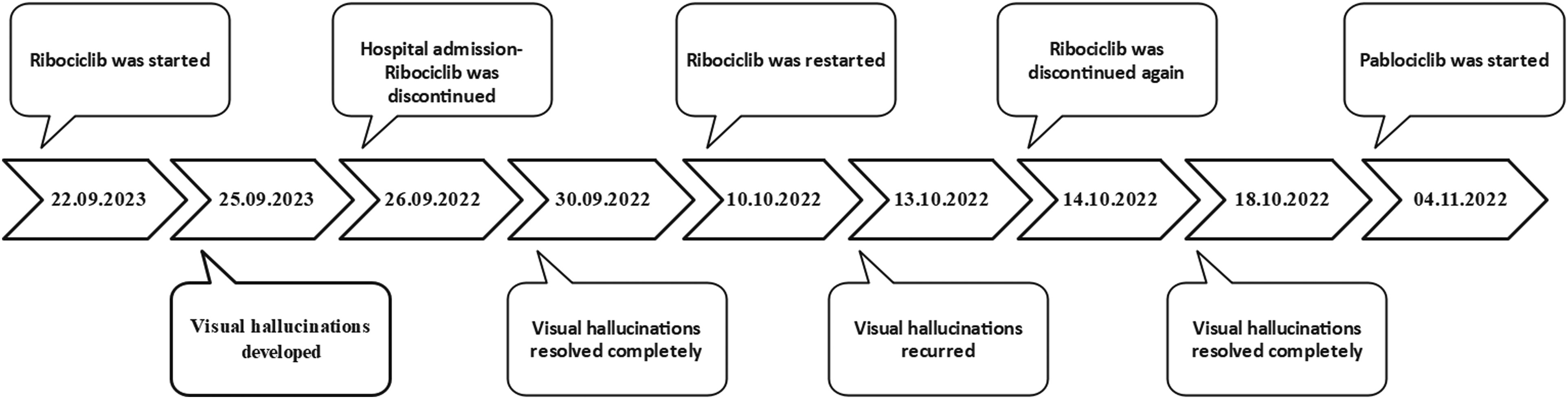
Discussion
CDK 4/6 inhibitors provide significant clinical benefits to patients with locally advanced or metastatic breast cancer. Three CDK 4/6 inhibitors (ribociclib, palbociclib, and abemaciclib) are applied for the treatment of metastatic hormone-positive metastatic breast cancer.14,15 CDK 4/6 inhibitors are continued as long as clinical benefits are observed or intolerable toxicity develops.16,17 Side effects of CDK 4/6 inhibitors are mainly hematological toxicities, gastrointestinal system-related complaints, infections, fatigue, weakness, anorexia, alopecia, increased ALT and AST levels, and QT interval prolongation. In addition, neuropsychiatric side effects such as dizziness, headache, depression, insomnia, anxiety, sedation, psychotic disorder, and suicide attempts have been observed, albeit rarely.6,9,17–19 However, to our knowledge, no case of hallucination due to CDK 4/6 inhibitors has been reported in the English-language literature.
Hallucinations in cancer patients are more likely to arise from organic causes, such as brain damage or brain metastases, or in association with the neurotoxic drugs used for cancer treatment.20–22 Occasionally, neuropsychiatric diseases and metabolic or toxic conditions can also cause hallucinations.23,24 Our patient presented with visual hallucinations that developed 3 days after the initiation of ribociclib and letrozole treatment, without any neuro-/geropsychiatric or metabolic cause. Assuming that the half-life of ribociclib in the blood is 32.6 h, 25 theoretically, ribociclib reached its optimum level in the blood during the same period that the patient began to develop hallucinations. After we had interrupted our patient's ribocicilib treatment and continued letrozole treatment 2 weeks later, we re-added ribocicilib to the treatment and the hallucinatiıons recurred within 3 days. We found only one case report of visual hallucination following letrozole use in the literature. 26 However, we exclude the possibility of letrozole as the cause of hallucinations in our patient because the hallucinations recurred after the initiation of ribociclib treatment, twice with a 2-week interval, while letrozole treatment was not interrupted and the patient achieved complete clinical recovery after the interruption of ribociclib treatment. To confirm the relationship between the suspected drug and the adverse event, we calculated the Naranjo probability score, which was +8. According to this score, the hallucinations appear to have been related to ribociclib use (Table 1). 27 In addition, the patient had been using letrozole together with palbociclib for approximately 2 months, with no recurrence of visual hallucinations detected during this period.
Adverse drug reactions probability scale.
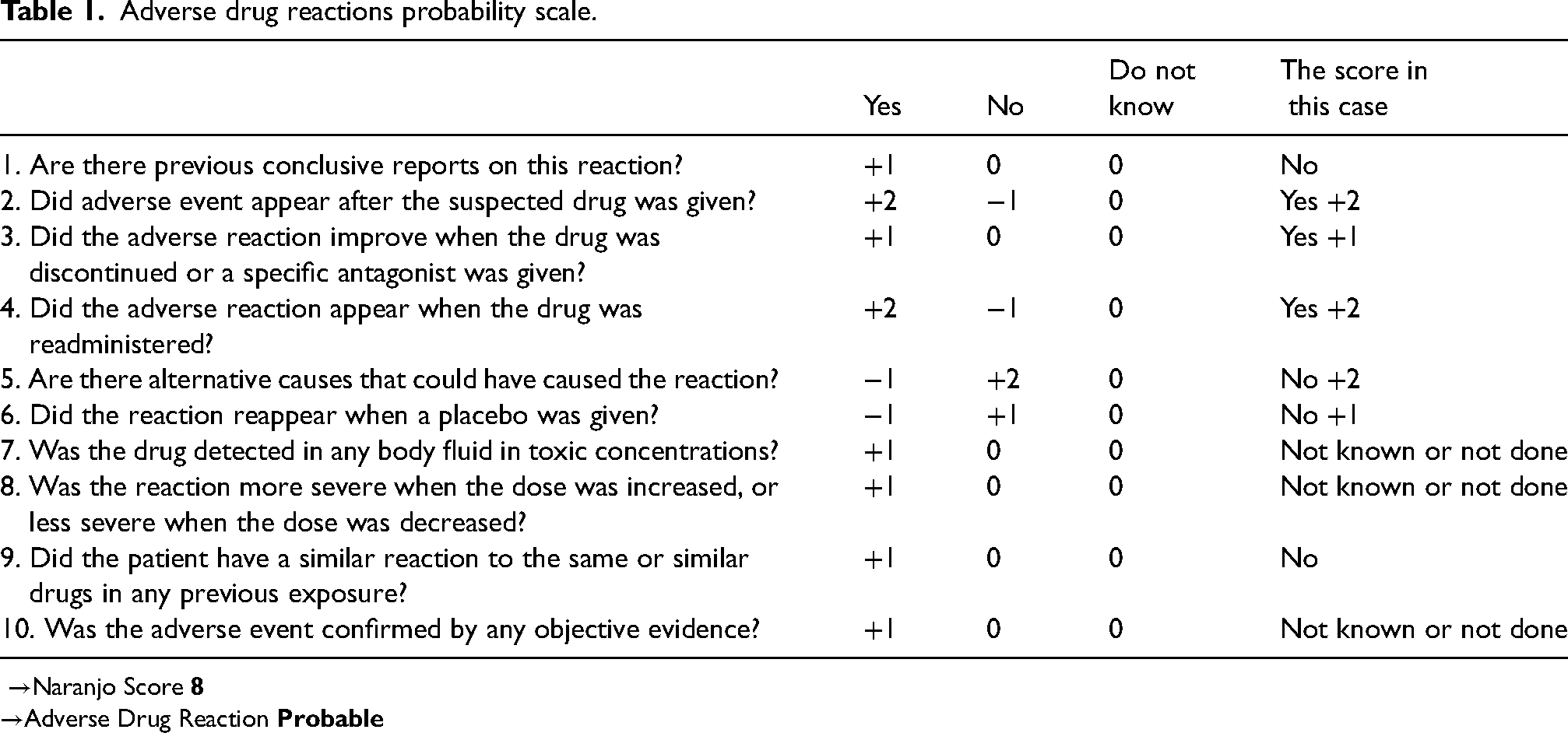
→Naranjo Score
→Adverse Drug Reaction
Conclusion
When evaluating a cancer patient with visual hallucinations, structural damage to the brain, brain metastases, drug intake, metabolic causes, schizophrenia, and dementia should be considered. The patient should be carefully evaluated for all of these factors. However, to avoid misdiagnosis, unnecessary investigation, and inappropriate treatment, it is important to be aware that visual hallucinations are a rare and completely reversible side effect of ribociclib that can develop in the early phase of treatment.
Footnotes
Author contributions
TK and GUE researched literature and conceived the study. NB and SD wrote the first draft of the manuscript. All authors reviewed and edited the manuscript and approved the final version.
Declaration of conflicting interests
The author(s) declared no potential conflicts of interest with respect to the research, authorship, and/or publication of this article.
Funding
The author(s) received no financial support for the research, authorship, and/or publication of this article.
