







Abstract
Objective
To evaluate adherence and persistence to palbociclib treatment in patients with advanced HR+/HER2– breast cancer in real-world clinical practice.
Methods
This observational, retrospective study was conducted using electronic medical records from two regional hospitals. Patients with locally advanced or metastatic HR+/HER2– breast cancer who initiated palbociclib treatment between January 2017 and December 2024 were included. Adherence was assessed using the medication possession ratio (MPR), and persistence was evaluated through the Kaplan–Meier method.
Results
Eighty-two patients were included, with a median age of 69 years. Treatment adherence was 92.7% (MPR ≥80%). Median treatment persistence was 40.9 months (IQR: 3.3), with rates of 83.2% at 6 months, 72.2% at 12 months, and 57.9% at 24 months. A total of 47.6% of patients discontinued treatment, mainly due to disease progression (37.8%) or toxicity (9.8%). The most frequent adverse events were neutropenia (72.0%) and anemia (63.3%).
Conclusions
Palbociclib demonstrated high adherence and persistence in real-world clinical practice, with a discontinuation rate comparable to that of previous clinical trials.
Introduction
Breast cancer is one of the most prevalent malignancies among women worldwide and represents a major cause of morbidity and mortality. 1 Among tumor subtypes, over two-thirds are hormone receptor-positive (HR+), making endocrine therapy the first-line treatment of choice. 2 In this setting, the introduction of palbociclib, a cyclin-dependent kinase 4/6 (CDK4/6) inhibitor, has marked a major advance in the management of advanced HR+/HER2– breast cancer. 3
When combined with endocrine therapy, palbociclib significantly improves progression-free survival (PFS) in phase III clinical trials,4,5 establishing it as a cornerstone in the treatment of this disease. However, despite promising results in clinical trials, real-world effectiveness must also consider adherence and persistence. 6
Adherence—defined as the extent to which a patient follows a prescribed regimen—and persistence—the duration of treatment until discontinuation—are key indicators that directly impact long-term clinical outcomes. 7 Persistence is particularly relevant in assessing the real-world effectiveness of palbociclib, as it reflects sustained treatment and its clinical impact. The relevance of persistence is scored by the 6P Medicine framework (Personalized, Predictive, Preventive, Participatory, Precision, and Persistent), which considers persistence and adherence as central to personalizing therapy and achieving optimal long-term outcomes. This model advocates for comprehensive assessment integrating persistence, adherence, and behavioral factors into clinical and policy decision-making. 8
While persistence is well-established in fields such as rheumatology and dermatology to assess the duration of biological therapies, 9 its integration in oncology is still emerging. Evaluating persistence in palbociclib use may offer valuable insights into treatment patterns, identify factors associated with early discontinuation, and help optimize therapeutic management in patients with HR+/HER2– breast cancer.
This study aims to assess treatment adherence and persistence to palbociclib in a real-world setting, exploring its utility as an indicator for evaluating effectiveness, safety, and long-term management.
Methods
This was an observational, retrospective study based on electronic medical records from two regional hospitals. Patients aged ≥18 years with unresectable locally advanced or metastatic HR+/HER2– breast cancer who initiated palbociclib treatment between January 1, 2017, and December 31, 2024, and completed at least one month of treatment were included.
Collected variables included age, sex, menopausal status, site of metastasis (bone, visceral, or brain), date of CDK4/6 inhibitor initiation, dosing regimen, and reasons for discontinuation (disease progression, adverse events, or other causes). Major adverse events leading to treatment discontinuation were also documented.
Adherence was assessed using the medication possession ratio (MPR), calculated as the total number of days with medication supply divided by the total follow-up days. Patients were considered adherent if MPR was ≥80%.
Persistence was defined as the time from treatment initiation to discontinuation. Treatment start was defined as the date of first drug dispensing; discontinuation was defined as the date of the last dispensation. Persistence was measured in months. For patients still on treatment at the end of follow-up (December 31, 2024), persistence was calculated up to that date. Patients lost to follow-up—defined as not visiting their oncologist or pharmacist for one year—were censored in the analysis.
Clinical and demographic data were extracted from hospital electronic medical records. Persistence data were collected through the Abucasis® outpatient hospital pharmacy software used at both centers.
Continuous variables were described using medians and interquartile ranges (IQR), while categorical variables were summarized as frequencies and percentages. Kaplan–Meier methodology was used to estimate persistence. All statistical analyses were performed using SPSS® software (version 25.0).
The study was approved by the institutional Ethics Committee and conducted in accordance with the Declaration of Helsinki. Informed consent was not required due to the use of de-identified patient data.
Results
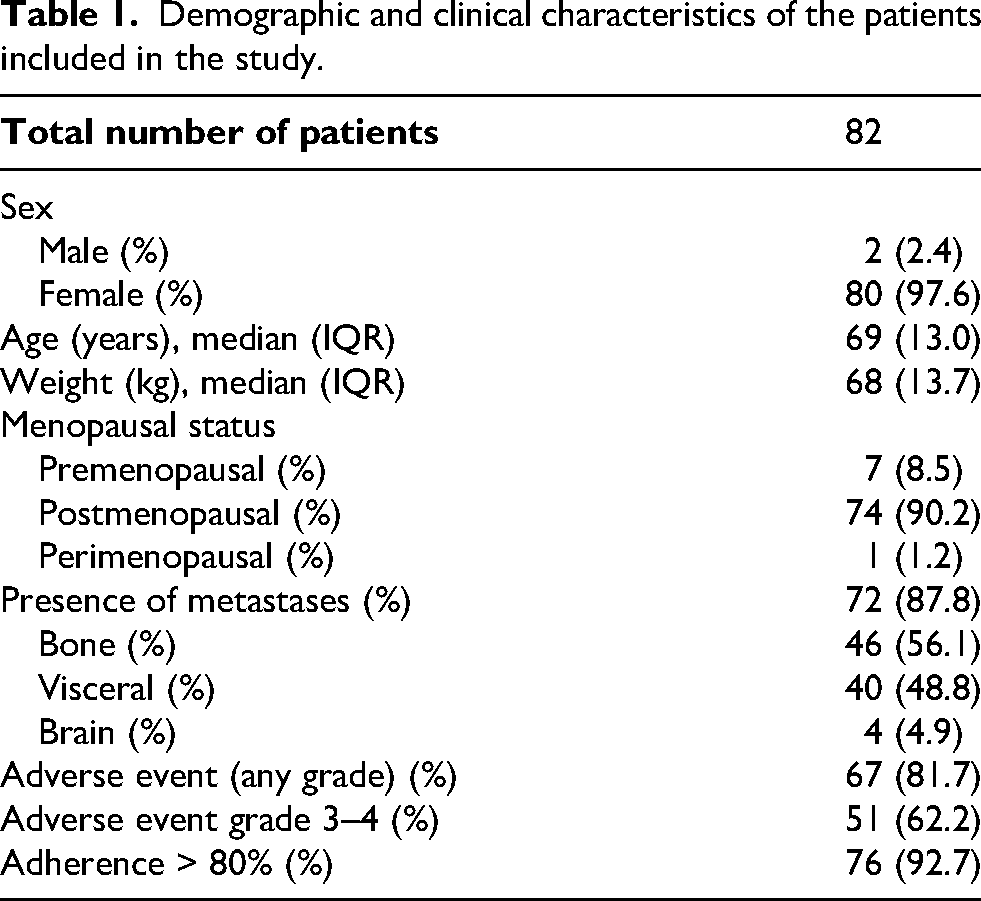
Eighty-two patients with unresectable locally advanced or metastatic HR+/HER2– breast cancer who received palbociclib were included in the analysis; 97.6% were women. The median age was 69 years (IQR: 13.0), with a mean weight of 68 kg (IQR: 13.7). Regarding menopausal status, 90.2% were postmenopausal, 8.5% premenopausal, and 1.2% perimenopausal (Table 1).
Demographic and clinical characteristics of the patients included in the study.
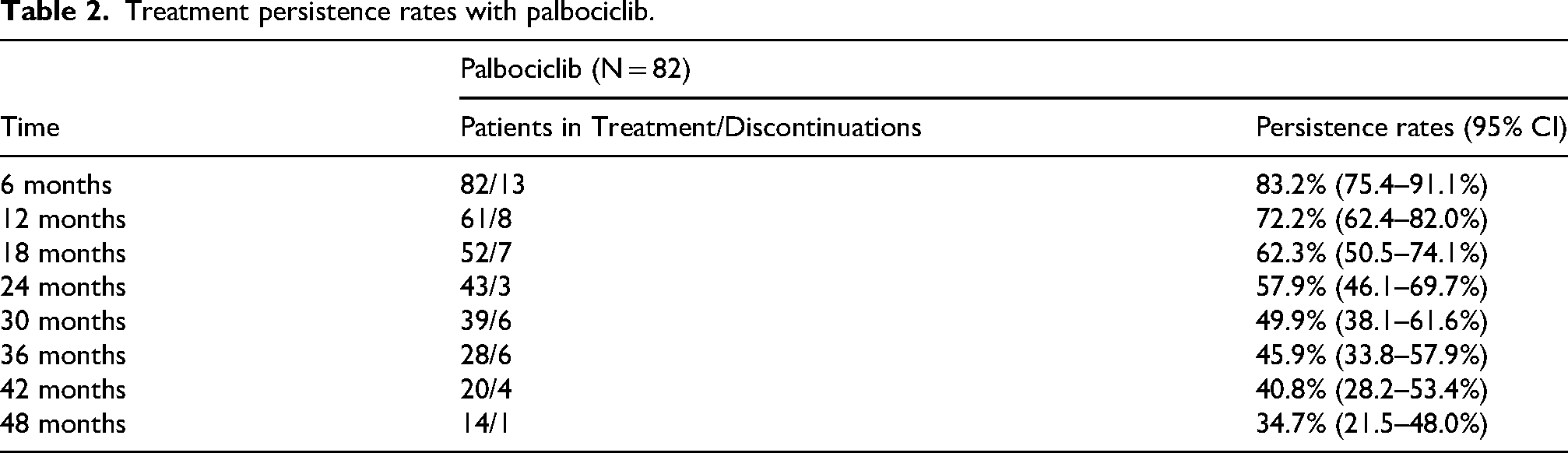
The overall median treatment persistence was 40.9 months (IQR: 3.3) (Figure 1), with a gradual decline over time. Persistence rates were 83.2% (95% CI: 75.4–91.1%) at 6 months and 72.2% (95% CI: 62.4–82.0%) at 12 months. At 18 months, persistence was 62.3% (95% CI: 50.5–74.1%) and decreased to 57.9% (95% CI: 46.1–69.7%) at 24 months. Rates at 30, 36, 42, and 48 months were 49.9%, 45.9%, 40.8%, and 34.7%, respectively (Table 2).
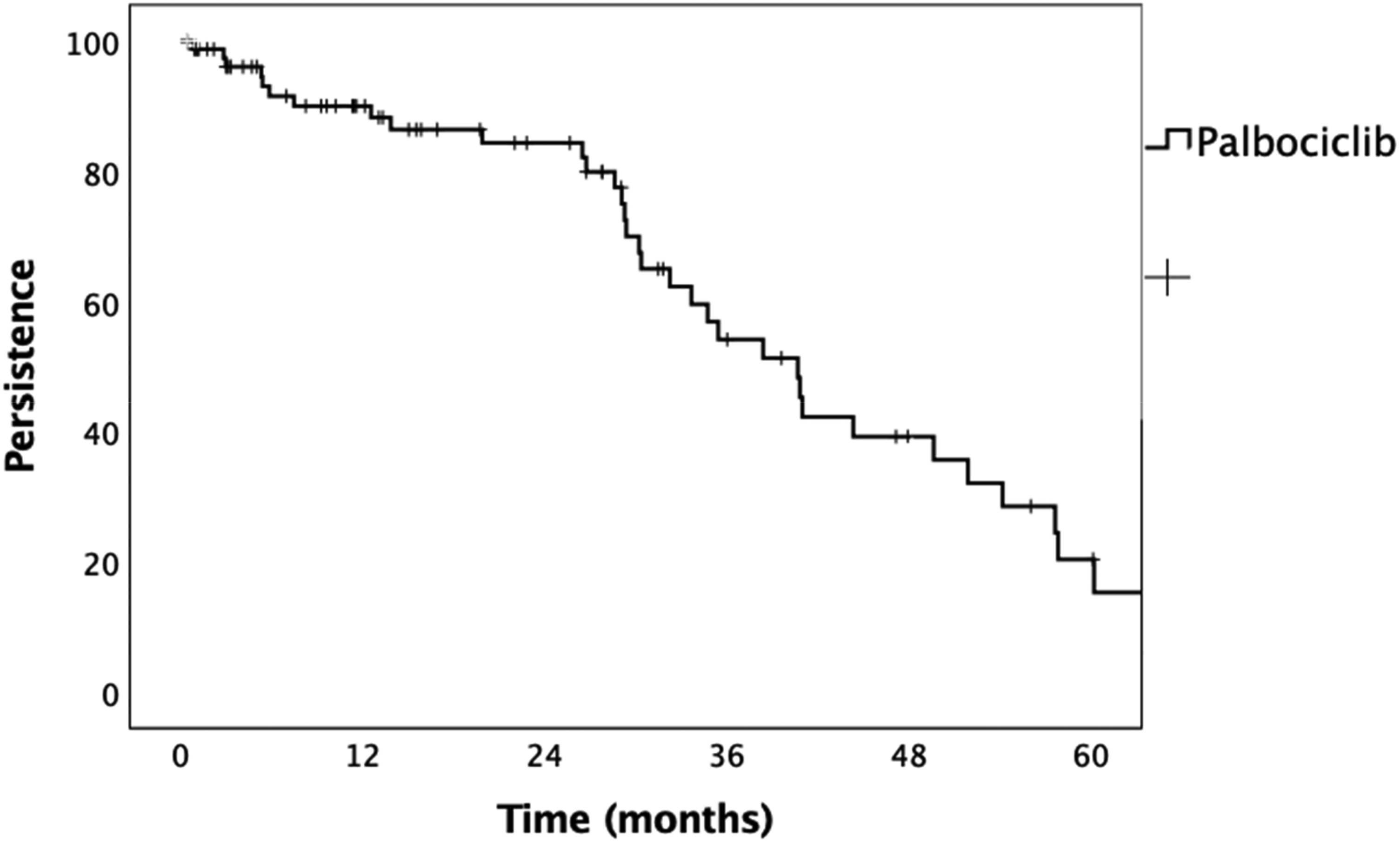
Persistence of Palbociclib.
Treatment persistence rates with palbociclib.
Dose reduction was required in 32.9% of patients. Treatment was temporarily or permanently discontinued in 47.6% of patients, mainly due to disease progression (37.8%) or toxicity (9.8%).
Regarding safety, 81.7% of patients experienced at least one adverse event of any grade. The most common toxicities were neutropenia (72.0%), anemia (63.3%), asthenia (21.9%), and thrombocytopenia (18.3%). Grade 3–4 adverse events occurred in 37.8% of patients, with neutropenia (35.4%) and thrombocytopenia (2.4%) being the most frequent. No treatment-related deaths were reported.
Despite toxicity and persistence challenges, adherence remained remarkably high, with 92.7% of patients achieving an MPR ≥80%.
Discussion
Ensuring high persistence to palbociclib is essential to optimize treatment outcomes in patients with advanced HR+/HER2– breast cancer. As a key indicator of effectiveness and safety, persistence is associated with therapeutic success and treatment tolerability. From the patient's perspective, persistence implies better convenience and satisfaction, which may positively influence adherence and continuity. Moreover, persistence may correlate with patient-reported outcomes (PROMs), providing a comprehensive evaluation of the drug's impact on quality of life. Therefore, optimal persistence should be aligned with achieving therapeutic goals and tailored to each patient's clinical setting and treatment line. 10
Persistence results in our study at 6 months (83.2%) and 12 months (72.2%) are comparable to those reported by Engel-Nitz et al., 10 who found persistence rates of 80.3% at 6 months and 68.7% at 12 months. Both cohorts showed a gradual decline in persistence over time, a typical pattern in oncology due to disease progression or treatment-related toxicity. Our slightly higher persistence rates may reflect differences in treatment protocols or patient profiles, although trends in persistence decline were similar.
Adherence in our study was 92.7% (MPR ≥80%), exceeding the 79.9% reported by Engel-Nitz. 10 This difference may be due to more effective treatment management in our setting 11 or financial barriers in the Engel-Nitz cohort that impacted adherence.10,12 Nevertheless, both studies reported adherence above the 80% threshold, indicating generally favorable patient engagement with treatment.
In our cohort, 47.6% of patients discontinued treatment, mostly due to disease progression (37.8%) and, to a lesser extent, toxicity (9.8%). These findings are consistent with the PALOMA-2 trial, 4 where 50.8% of patients discontinued therapy, primarily due to disease progression. The dose reduction rate in our study was 32.9%, similar to the 32.5% reported for non-Asian patients in PALOMA-2. 4
Regarding toxicity, 81.7% of patients experienced adverse events of any grade, with neutropenia (72%) and anemia (63.3%) being the most frequent.13,14 These results align with PALOMA-2 4 and PALOMA-3, 5 where neutropenia was also a predominant adverse event. However, our rate of grade 3–4 toxicity (37.8%) was lower than in previous trials, which reported grade 3–4 neutropenia rates of 63–65%.4,5
It is essential to implement strategies that promote treatment continuity. Early identification of patients at risk of discontinuation, along with interventions aimed at improving tolerability and adverse event management, may significantly enhance palbociclib's clinical benefit. Future studies could also explore the influence of quality of life and psychosocial support on adherence 11 and persistence in this population.15,16
Lastly, this study has limitations, including its retrospective design, which may introduce data collection bias and variability in clinical practice. Factors such as quality of life and comorbidities were not systematically assessed and may have influenced outcomes. Despite these limitations, the findings underscore palbociclib's role as an effective and well-tolerated therapeutic option, highlighting the need to optimize management strategies to improve real-world treatment experience.
Footnotes

Author contributions
AVR and DRR designed the study. AIS and AN-B collected the data. LP and JBB performed the analysis and interpreted the results. AVR drafted the manuscript. All authors reviewed, revised, and approved the final version of the manuscript.
Funding
The authors received no financial support for the research, authorship, and/or publication of this article.
Declaration of conflicting interests
The authors declared no potential conflicts of interest with respect to the research, authorship, and/or publication of this article.