







Abstract
Background:
In 2008, the American Psychiatric Nurses Association and the International Society for Psychiatric Nursing jointed developed Psychiatric Mental Health Nursing competencies for BSN students. In the newly created accelerated track of the BSN program, students spend less time than traditional students in psychiatric mental health (PMH) clinical practica.
Objectives:
The primary objective was to discover how the PMH practicum experience influences BSN students’ perceptions of their confidence in performing PMH clinical skills.
Design:
An evaluation design was used in this study.
Results:
There was significant improvement in students’ confidence performing PMH clinical competencies after completing the PMH nursing practicum. The current structure of clinical provides students with experiences that promote their confidence.
Conclusions:
Students self-assessment about learning needs and skill level should be assessed preclinically to allow for practice to gain confidence.
Keywords
In 2008, the International Society for Psychiatric Nursing (ISPN) and the American Psychiatric Nurses Association (APNA) published The Essentials of Psychiatric Mental Health Nursing in the BSN Curriculum (hereafter referred to as the Essentials Document), a consensus statement on the educational preparation of prelicensure nurses for the practice of psychiatric nursing (APNA and ISPN, 2008). The Essentials Document contains recommendations for specific curriculum content to include in didactic courses and clinical competencies that students should acquire during their psychiatric mental health (PMH) clinical practicum. We know very little about students PMH competency attainment during nursing education. Nursing researchers have considered how select teaching-learning models influence particular PMH skills such as reflection (Crowe & O’Malley, 2005; O’Donovan, 2006) and clinical reasoning (Bartlett et al., 2008). A study in Australia documented the influence of the PMH clinical practicum on nursing students’ confidence in performing a broad range of clinical skills (Henderson, Happel, & Martin, 2007), but sparse research exists in the United States on how clinical practicum affects students’ confidence in their ability to perform particular PMH competencies (Gilje, Klose, & Birger, 2007). Confidence refers to the dynamic and maturing set of beliefs held by professionals or students around their understanding of the function or scope of practice associated with the role (Holland, Middleton, & Uys, 2012). As Holland et al. (2012) explain, these beliefs focus on the professional role, scope of practice, and significance of the profession and reflect the individuals’ capacity to competently fulfill these expectations.
Literature Review
The majority of the research on students’ attainment of confidence to perform PMH skills has occurred in Australia. When Bell, Horsfal, and Goodin (1998) set out to quantify the attainment of students’ confidence in PMH skills, the educational research in this area had occurred in general medical settings. Bell et al. noted that there was little agreement on what PMH skills students should be acquiring during their clinical placement. In response, the investigators designed the Mental Health Nursing Confidence Scale to examine the specific impact of the PMH clinical practicum on student confidence. In this study, confidence was characterized as the students’ sense that they could perform a specific task to successful completion. Furthermore, student confidence was seen to emerge from the interaction of the students with their clinical environment and practicum experiences.
They found the scale did detect significant positive change in students’ self-reported confidence and that it detected differences between cohorts of student. A similar study also confirmed increases in students’ confidence in providing mental health care following clinical practicum experiences but noted that students did not perceive themselves fully prepared to practice in mental health (Wynaden, Orb, McGowan, & Downie, 2000).
Using a slightly different method, Henderson et al. (2007) investigated students’ perceptions of their knowledge, skills, and attitudes (KSAs) around specific PMH skills prior to entry and following completion of their PMH theory course and clinical practicum. To assess any changes in perceived KSAs, prior to the course or practicum, the investigators asked students to identify on a 4-point scale (1 = very true, 2 = fairly true, 3 = somewhat true, 4 = not true at all) how accurately statements of specific PMH skills reflected their perception of their KSAs around each of the 22 items. For instance, the survey asked students to rate on a 4-point scale an item, “I am skillful in assessing potential for violence.” Following the theory course and then following the practicum, the students rated their perceptions of their KSAs on the same list of 22 PMH skills. Based on the aggregate response, the investigators rank ordered the PMH skills from items students endorsed with high confidence in their KSA versus ones the students associated with low perceived KSA. Following clinical courses and practicum, the students self-reported KSAs did increase, particularly around specialist mental health knowledge and skills. The data also revealed that length of time in the theory portion of the course influenced students’ ranking of specific KSAs around skills such as mental status assessment and risk assessment. While the authors of this study equate higher KSA scores on items with higher confidence in particular skills, they do not explore the relationship between a student’s self-perceived KSA and confidence.
All these studies worked with PMH skill lists that the researchers drew up or were PMH skills abstracted from Australian PMH standard setting documents. To date, there are no U.S. studies examining students’ perceptions of confidence in performing PMH clinical skills. Yet this is an important area for several reasons. First, students’ confidence in their ability to carry out a skill directly affects their performance (Leigh, 2008). Second, gaining confidence in a particular skill influences the performance of that skill (Townsend & Scanlan, 2011). White (2003) examined nursing students’ clinical decision making and found that gaining confidence in these skills allowed students to shift their focus from their own needs to those of the patients they cared for. Furthermore, as confidence grew, students could embrace the nursing role and begin to care for patients. Finally, researchers have demonstrated that the growth in students’ professional confidence can be identified as they proceed through the nursing curriculum and the development of confidence was related to their ability to examine nursing practice and defend their decisions (Crooks et al., 2005). For these reasons, one goal of PMH faculty should be building students’ confidence in performing PMH skills (Henderson et al., 2007).
In this study, confidence is used to refer to students’ beliefs in their ability to perform a specific set of skills associated with a particular nursing role (e.g., PMH). Since the focus is on PMH nursing skills, confidence is conceptualized in line with students’ sense of professional or clinical confidence. This sense of confidence can be nurtured and fostered through the students’ experiences in their professional education (Crooks et al., 2005; Holland et al., 2012).
Background to Study
The PMH nursing course is placed toward the end of the BSN curriculum. The course includes a theory class and clinical practicum that run simultaneously over the 10-week quarter. Having the class and clinical simultaneously allows students to put into practice and reinforce what they learn each week in class. Students attend the PMH class 1 day each week and participate in clinical on a weekly basis. Students are randomly assigned to clinical groups and remain together at the same clinical site for the whole quarter. All but one of the clinical facilities were in patient psychiatry units in a general hospital. The other clinical site was a residential facility for women with HIV/AIDS, chemical dependency, and/or mental illness. A PMH clinical faculty member at each site facilitated students’ learning the KSAs of PMH nursing through patient care assignments and overseeing students’ practice. In addition to direct patient care, students are required to complete weekly paperwork and submit it to their clinical faculty for comment and approval. The paperwork includes a comprehensive psychiatric assessment of their assigned patient, a weekly reflective journal of their clinical experiences, and a process recording to mastery. Students must meet the PMH clinical objectives to be successful in the PMH course.
The Essentials Document contains a list of PMH skills that have been recently vetted by educators throughout the country (APNA & ISPN, 2008). Our faculty decided to use the PMH skills list as a framework to evaluate undergraduate clinical students’ experiences in PMH practicum. Students’ proficiency in particular skills was already being assessed via a comprehensive tool where faculty rated students’ performance on the use of the nursing process in psychiatry, medication administration, and communication skills. But since another critical aspect of clinical training is increasing students’ sense of confidence in performing a skills (Leigh, 2008), a faculty team formed to evaluate the skills listed in the Essentials Document by gauging changes in students’ sense of confidence in performing the skills. Specifically, faculty questioned how the clinical practicum influenced student’s confidence in performing the distinct set of skills listed in the Essentials Document. Furthermore, since the College had recently developed an accelerated BSN track, and the length of time in PMH practicum decreased, an additional question the faculty examined was if time spent in clinical influenced students’ sense of confidence in their skill attainment.
The primary evaluation question addressed in this study was the following: How does the PMH nursing practicum experience influence BSN students’ confidence in performing the range of PMH clinical skills identified in the Essentials Document? Secondary research questions addressed included the following: (a) What are the differences in PMH nursing perceived confidence scores between accelerated and traditional BSN students prior to the clinical experience? (b) Is there improvement in perceived confidence scores for both groups from pre to post clinical?
Method
Site
The study site is a health professions higher education institution located in an urban setting; the College of Nursing (CON) is one of the university’s four colleges. CON programs are offered in nursing from the baccalaureate through the doctoral levels. Students participating in this study were recruited from the baccalaureate nursing program. All the inpatient clinical practicum sites treat patients with serious mental illness and all are staffed by a mixture of nurses and mental health technicians. The community site is a residential complex providing permanent housing for women who are homeless or facing homelessness. Staff includes counselors in mental health and substance abuse and individual case managers. One nurse specializing in psychiatric mental health nursing is available on a part-time basis.
Sample
A convenience sample of 103 nursing students participated in the study. They were concurrently enrolled in a PMH nursing didactic course and clinical practicum. Approximately 45% of the sample was students matriculating in the traditional track and 55% were in the accelerated track of the BSN program. The curriculum is essentially the same for both tracks, although the accelerated students spend less time in the PMH practicum than the traditional students: 80 hours compared to 120 hours. One difference between the programs is an admission requirement that accelerated students have a bachelor’s degree in another field.
Evaluation Tool: Perceived Confidence
To evaluate the impact of the clinical practicum experiences on students’ confidence in specific skills, the faculty placed the 16 competencies delineated in the Essentials Document using a Likert-type scale that asked students to rate their confidence in performing each of the 16 skills from 1 (not at all confident) to 5 (totally confident). This straightforward method of asking students to rate their confidence level on specific skills has been frequently used in research designed to gauge changes in confidence following clinical practicum (Clark, Owen, & Tholcken, 2004; Farrand, McMullan, Jowett, & Humphries, 2006; Lauder et al., 2008). The items in the tool were taken directly from the competencies listed in the Essentials Document since these competencies has been vetted by the two national PMH professional organizations (APNA & ISPN, 2008). The evaluation tool was reviewed by an expert in confidence measurement as well as the course directors and clinical instructors in the psychiatric didactic and clinical course. Cronbach’s alpha for the scale in this study is .92.
Based on literature demonstrating that students sometimes leave PMH practicum nursing feeling unprepared to practice PMH nursing (Wynaden et al., 2000) and that PMH clinical practicum sites often lack role models for inpatient practice (Patzel, Ellinger, & Hamera, 2007), we also asked three open-ended questions: (a) Are there any additional skills you wished you had more experience with? (b) Other than your instructor, were there nursing role models in your area that helped clarify your role? (c) Do you feel you understand the psychiatric-mental health role? Responses to these questions were reviewed to support the quantitative findings.
Procedures and Analysis
Approval was obtained from the institutional review board. Clinical practicum faculty distributed the perceived confidence scale to students on the first day and the last day of the clinical practicum. Students were informed that their participation was optional. Students created unique identifiers to ensure anonymity. All quantitative data were entered and analyzed using SPSS version 16. Total scale means were compared and analyzed for significant change from pre to post clinical and differences between groups by using a mixed model analysis of variance using time (pre to post) and group (accelerated vs. traditional).
Results
Nursing students (N = 103) from 16 clinical sites agreed to participate in the pre and post assessment of perceived confidence of clinical competence. The total number of students in all clinical groups was 115; students who completed pre and post responses were included in the analysis; therefore, 90% of the students participated. Fifty-seven accelerated track students and 46 traditional track students participated. The groups did not differ on age, race, or gender. Both groups were predominately female, Caucasian, with a median age of 26 years. The accelerated track students all enter the program with a bachelor’s degree, whereas 42% of the traditional track students had completed a bachelor’s degree on admission.
Improvement in Perceived Confidence From Pre to Post Clinical
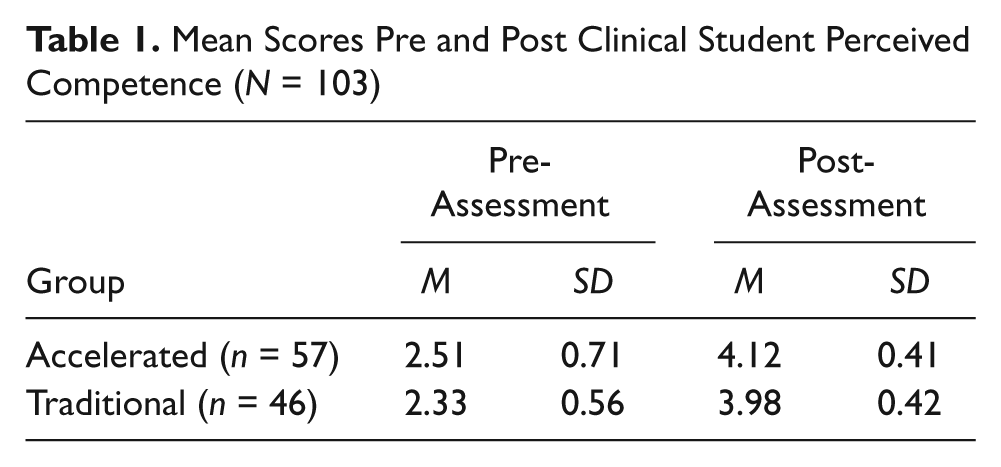
There was a significant difference in mean scores from pre to post for both groups, F(1, 102) = 5.36, p < .00; see Table 1). In the open-ended comments, students frequently commented that they needed more time practicing therapeutic communication, administrating medications, and with handling acute situations. Also in their open-ended responses, students identified their role models were sometimes nurses and sometimes the mental health counseling or adjunct therapy staff. Several students viewed nursing roles as more difficult to understand and viewed nurses as focused on non-patient-related tasks.
Mean Scores Pre and Post Clinical Student Perceived Competence (N = 103)
As mentioned above, one group of students was at a community site. This site lacked a defined milieu and structured group program or schedule. As reported by the clinical instructor, during the PMH nursing practicum, students often verbalized difficulty in meeting with the residents because they had various outside appointments, jobs, and volunteer activities, or just did not come out of their apartments. On the perceived confidence evaluation tool, by the end of clinical, these students indicated that they felt less confident in evaluating the client’s medication regimen, demonstrating a therapeutic use of self, teaching the patient/family about the psychiatric illness, evaluating care according to anticipated outcomes, and assessing the tone of the milieu.
Difference Between Perceived Confidence in Performing Specific PMH Clinical Skills of Accelerated and Traditional Students
There was no significant difference in perceived confidence of clinical competence between the two groups at the pre or post clinical time point.
Discussion
The primary purpose of this study was to understand how the PMH nursing practicum experience influenced BSN students’ confidence in performing the clinical skills delineated in the Essentials Document. This evaluation study found significant improvement in students’ confidence performing PMH clinical skills after students completed the PMH nursing practicum. Students in the accelerated program spent approximately one third less time in the PMH clinical practicum than the traditional program students yet there was no significant difference in the students’ confidence ratings. This finding is consistent with previous research (Happell, Robins, & Gough, 2008) that reported time spent in clinical did not significantly influence acquisition of clinical competencies or perceived preparedness.
Not surprisingly, both groups of students believed they lacked PMH nursing knowledge and skills prior to their clinical practicum. Although some students previously worked in psychiatry, their positions were commonly that of a psychiatric aide or technician. Perese’s (1996) qualitative study on students’ experiences with mental health clinical placement found that students initially perceived difficulty with clinical skills required of them in PMH practicum. Based on our evaluation it would appear that the current structure of clinical, particularly those conducted on inpatient units, affords students with experiences that promotes their confidence in performing essential PMH skills.
Limitations
This evaluation study has several limitations. First, we used a convenience sample of BSN students enrolled in the psychiatric nursing clinical; therefore, the findings may not generalize outside of this setting. Second, the study comparisons were based on two groups of students who were enrolled in different prelicensure programs, thus an additional limitation is that students were not randomized to conditions. Additionally, 100% of students in the accelerated BSN track and 42% in the traditional BSN track held a bachelor’s degree. The presence of a previous degree in the traditional track could potentially confound the results comparing the two groups. However, we were unable to make a statistical comparison of those with and without previous degrees as we deidentified all student data to protect anonymity. Finally, the perceived confidence scale is a newly developed tool that will and is still being tested. While the literature suggests a linkage between confidence and the development of clinical competence, this association has not been empirically tested in nursing.
Implications for Using the Essentials Document
Undergraduate clinical practicum can be fairly prescriptive but there should be mechanisms for students’ feedback on their learning needs and identifying what skills they perceive to be capable of performing at a beginner level and what ones they see as needing more practice with to gain confidence. The systematic evaluation of students’ confidence pre and post clinical will provide insight into what skills are difficult for students to gain a level of confidence in performing. By detecting patterns in what skills students find difficulty in attaining, educators can create additional opportunities for practicing specific skills. Using the competencies outlined in the Essentials Document, educators could begin to explore these questions across programs and increase understanding of the specific skills that seem more difficult for students. In turn, there could be development and sharing of the methods faculty have devised for students to practice these skills (Scott-Tilley, 2008).
In this study, students in the community placement site indicated that following PMH clinical practicum they were less confident in several skills, that is, medication administration, de-escalation. With the increasing lack of availability of inpatient clinical sites (Patzel et al., 2007), movement to community-based placements is a logical and to some extent a desirable option. If in any clinical site there is a lack of opportunities for students to practice select skills, faculty will need to create other venues/simulations for these skills. Currently, we are exploring building simulations and lab experiences that augment clinical practicum experiences, particularly in the areas of de-escalation, communication, and psychotropic medication administration. This approach to competency-based education should free faculty from the traditional model of clinical education where skill development depended on random access to learning opportunities (Gubrud-Howe, & Schoessler, 2008) and move us to a more planned approach to providing experiences necessary to reach specific outcomes and competencies.
In their open-ended responses, students identified their role models were sometimes nurses and sometimes the mental health counseling or adjunct therapy staff. Several students viewed nursing roles as more difficult to understand or focused on non-patient-centered tasks. This finding echoes Patzel et al. (2007), who documented that one issue with the quality of PMH placement sites was the lack of prominent nursing role models displaying a full breadth of desired inpatient nursing skills. Inpatient nurses are often unfairly held accountable for everything wrong in psychiatric hospital care, from poor relationships to the nontherapeutic aspects of the environments (Brennan, Flood, & Bowers, 2006). Recognizing the unit’s quality and climate as a learning environment influences the students’ attitudes toward mental health, their learning, and eventual career choices (Chan, 2004; Happell, 2008a, 2008b; Happell et al., 2008), faculty should partner with PMH staff to help develop their plans and ideas for creating enriched inpatient environments (Brown, Nolan, Davies, Nolan, & Keady, 2008); environments that will positively influence nursing students’ attitudes and learning, which in turn will grow the profession. Using the skills delineated in the Essentials Document, PMH educators and inpatient nurses could begin to explore the relationship between the practice climate on units where students are placed and their subsequent learning. They might also begin to investigate how creating enhanced practice environments improves both the clients’ experiences and students’ learning (Brown et al., 2008). Such research partnerships between educators who bring students to the unit and the psychiatric nurses practicing on the unit could facilitate positive changes in inpatient psychiatric care yielding benefits for both our clients and students.
Footnotes
Acknowledgements
The authors wish to acknowledge Olimpia Paun, PhD, RN, and Alison Ridge, DNP, RN, CNE, for their contributions to the study and the manuscript, and the nursing students for their participation in this study.
Author Roles
Fiedler, Breitenstein, and Delaney formulated the study. Delaney and Breitenstein analyzed the results. All authors contributed to the writing of this article.
Declaration of Conflicting Interests
The author(s) declared no potential conflicts of interest with respect to the research, authorship, and/or publication of this article.
Funding
The author(s) received no financial support for the research, authorship, and/or publication of this article.