






Abstract
The protection of the rights of persons with mental illness (PWMI) is a global and national issue of concern to nurses who are often caregivers to PWMI (Rossetti, Fox, & Burns, 2005). On an international level there are standards and principles guiding care for PWMI, such as the United Nations’ (1991) Principles for the Protection of Persons with Mental Illness and for the Improvement of Mental Health Care and the World Health Organization’s (1996) Mental health care law. In the United States, there are state mental health codes, and advocacy organizations such as the Human Rights Authority (HRA), that protect the rights of PWMI. Currently, the state Mental Health Code (Mental Health and Developmental Disabilities Code; Illinois General Assembly, n.d.), the American Nurses Association (2011) Code of Ethics for Nurses With Interpretive Statements and the American Nurses Association (2007) Psychiatric-Mental Health Nursing: Scope and Standards of Practice guide nursing practice in the area of patients’ rights. Yet, in spite of these protections, the rights of PWMI continue to be violated by those who care for them (HRA, 2008; World Health Organization, 1996).
In the United States, protection of rights of PWMI includes not only standards, guidelines, and laws but also a framework for investigating alleged rights violations. Each state has a protection and advocacy agency that receives funding from the Federal Center for Mental Health Services. Agencies are mandated to protect and advocate for the rights of PWMI and to investigate reports of abuse and neglect in facilities that care for or treat individuals with mental illnesses. In Illinois, the HRA division of the Guardianship & Advocacy Commission (2012) is “mandated to investigate allegations of rights violations committed against both children and adults with disabilities, by service providing agencies” (p. 14). These investigations are a matter of public record and can provide valuable information about the types of violations that PWMI report and the patterns related to judgment outcomes.
In psychiatric inpatient settings, nurses assume a vital role in upholding patients’ rights and are accountable to practice according to current laws and standards (Barloon, 2003). Yet the context, including both the environment and the circumstances in which these laws and standards must be applied by nurses, is complex. Lutzen (1998) contended that the type of rights issue can involve different types of reasoning by nurses, such as contextual versus rule-based reasoning because a patient’s “competency can vary from context to context because the criteria are relative to the specific task” (p. 102). Due to the complex and contextual nature of nursing care for PWMI in psychiatric settings, there is a risk of violating patients’ rights.
To navigate the difficult territory of patients’ rights, to act in the interest of patients, and to minimize the risk of violating patients’ rights, nurses will benefit from knowledge related to the types of violations reported by PWMI and their outcomes. Specific information, such as the types of allegations of violation of rights made by PWMI, the level of substantiation of allegations, and the demographics associated with PWMI who have brought the allegations, can help guide nursing care related to those areas of patient care in which there is a greater risk for a breach of patients’ rights. If violations are occurring, or are perceived as occurring, nurses need to closely examine those areas of nursing practice in which they occur. Information related to the level of substantiation of allegations can suggest areas of nursing practice that are at the highest risk for rights violations. Data pertaining to the demographics associated with allegations may increase nurses’ sensitivity to issues such as gender and setting related to risk for rights violations in caring for PWMI. Understanding the contextual aspects involving patients’ rights regarding PWMI in inpatient psychiatric setting can inform nurses regarding areas of nursing practice that are at risk for patients’ rights violations in their unique work situations.
No studies using data from public records of allegations of rights violations by PWMI were identified in the published literature. Therefore, the aim of this study is to describe the findings from the HRA investigations related to the types of allegations of violations of patient rights by PWMI, those allegations that were substantiated, and the demographics related to the allegations and to determine significant implications of this data for psychiatric nursing practice.
The following research questions will be addressed.
Method
Study Design and Sample
We conducted a retrospective review of Investigatory Reports from the Illinois Guardianship & Advocacy Commission HRA from fiscal year 2008 (N = 129 case reports). This included reports from the following Illinois regions as determined by the HRA (HRA, 2008): Chicago, East Central, Egyptian, Metro East, North Suburban, Peoria, Rockford, Springfield, and South Suburban. All of the reports were available online for public access; therefore, institutional review board approval was waived. The reports were printed for each nurse researcher to examine.
Procedures
Two nurse researchers coded case reports obtained from the 2008 HRA web page. Each case contained information about the client as well as information about one or more allegations made by or on behalf of the client. To facilitate analyses, each allegation type was classified into one of the following three categories: inadequate treatment, restriction/failure of notification of rights (e.g., restriction of rights related to restraint, medication, communication, or visitation), or other (e.g., confidentiality, personal property, appeal process, accessibility). When coding the rights violations in this study, those allegations that did not clearly fall under other rights, and instead involved complaints about some other aspect of care, whether psychiatric or medical, were labeled as “inadequate treatment.” Each geographical location was classified into one of three larger geographic regions: Chicago (Chicago, Rockford), Suburban Chicago (North Suburban, South Suburban), or Central/South (Springfield, East Central, Egyptian, Peoria, Metro East). Also, among the four possibilities for type of service provider (all state-operated psychiatric hospitals, private psychiatric hospitals, medical hospitals, and other), the category “other” included providers such as centers for independent living, community-integrated living arrangement centers, and special education program settings. As a reliability check, both coders independently coded n = 8 randomly selected cases, and their codes were compared. Computed interrater reliability (kappa) indices were 1.00 for region, 1.00 for diagnosis type, 1.00 for type of facility, 0.80 for allegation type, and 0.75 for substantiation. The remaining cases were coded by one of the two coders only.
Statistical Analysis
Frequency distributions were constructed for the allegation type, gender of client, location of service provider, and type of service provider. The relationship between substantiation of the allegation and type of allegation was then assessed using a chi-square test of independence. Because a particular client may have alleged more than a single event, the first-order Rao–Scott (modified) correction (Rao & Scott, 1981, 1984, 1992) was applied to the chi-square statistic to account for these dependencies in the data. Effect sizes (Cramér’s V) were additionally computed to assess the magnitude of each relationship. In a similar manner, the Rao–Scott statistic was used to assess the relationships between allegation substantiation and (a) geographic location, (b) gender, (c) provider type, and (d) diagnosis type.
Results
Of the completed reports, 35.7% were related to female clients, 56.6% were related to male clients, and for the remaining cases sex was unspecified. More than one third (35.7%) came from the North Suburban Chicago area, and a similar percentage (37.2%) were from state-operated facilities. The observed diagnosis type categories were mood disorder (42.0%), schizophrenia or related (30.0%), and dual diagnosis (28.0%). The mean number of allegations per case was M = 1.92 (SD = 1.27). Table 1 shows the number and percentage of allegations in each category and the overall rate of substantiation.
Distribution of Allegation Type and Substantiation.
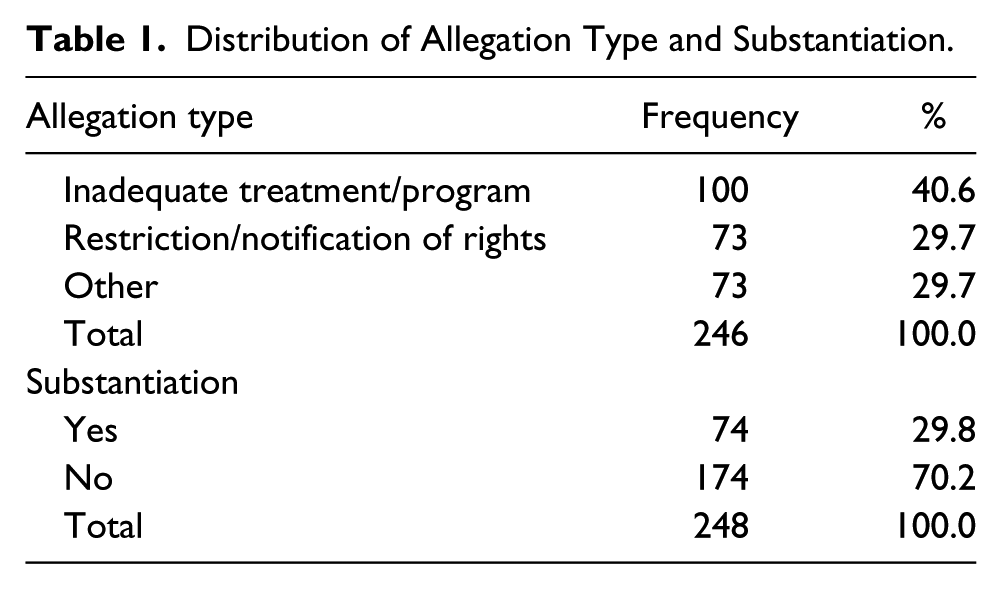
Allegation Type and Substantiation
Results from a chi-square analysis employing the modified Rao–Scott correction showed that allegations of restriction/notification of rights were significantly more likely to be substantiated than allegations of inadequate treatment,
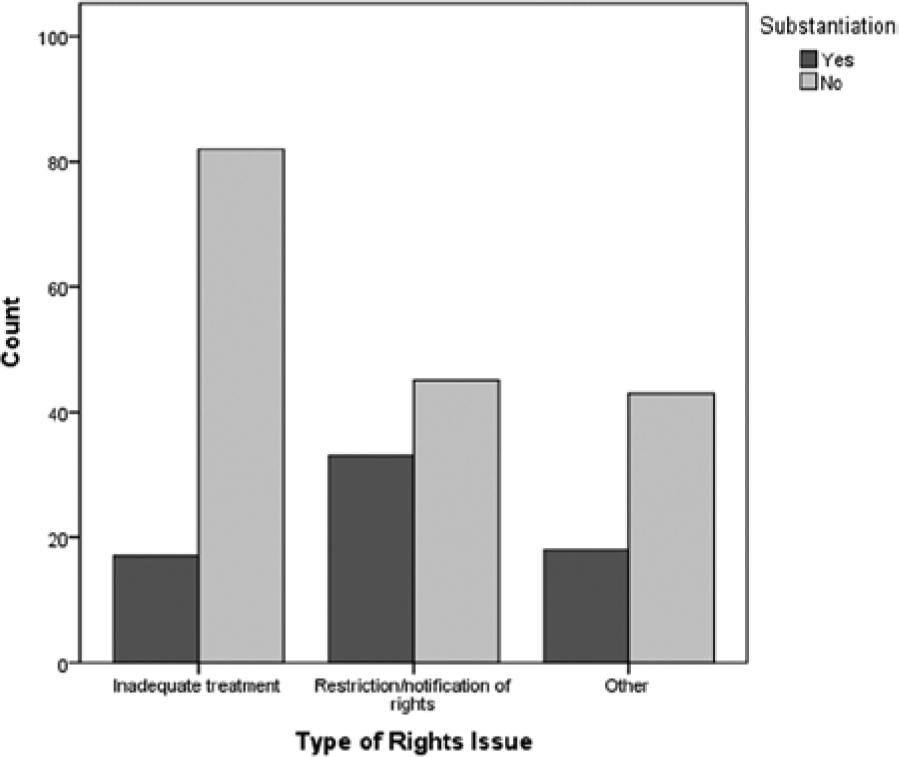
Frequency distribution of allegations by type of rights issue and substantiation.
Examples of inadequate treatment allegations included failure to include patient’s guardian in treatment planning; failure to been seen by a physician in a timely manner after admission for a medical issue; services not provided in the least restrictive environment; inadequate clothing; intrusiveness by staff; unsafe environment; taunting or rudeness, threatening, or disrespectful staff behavior; failure to address patient’s needs; an unsanitary environment; and excessively restrictive rules.
Substantiation of Allegations, Provider Characteristics, and Patient Characteristics
Results showed a statistically significant,
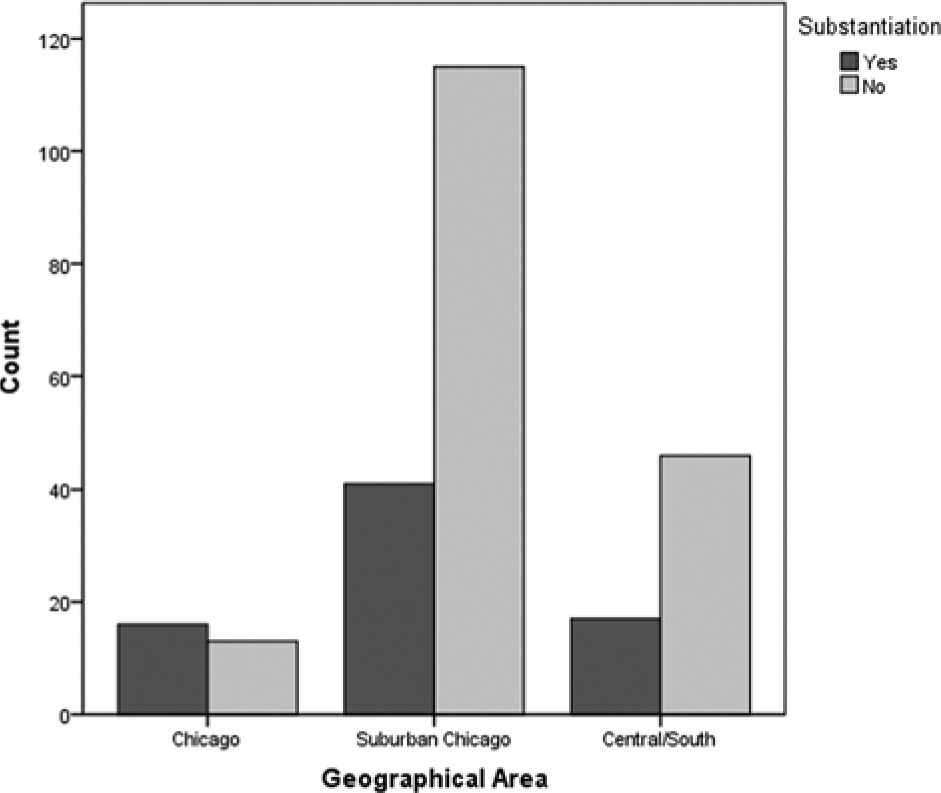
Frequency distribution of allegations by geographical area and substantiation.
Allegation Type, Provider Characteristic, and Patient Characteristics
Chi-square analyses employing the Rao–Scottcorrection showed a statistically significant,
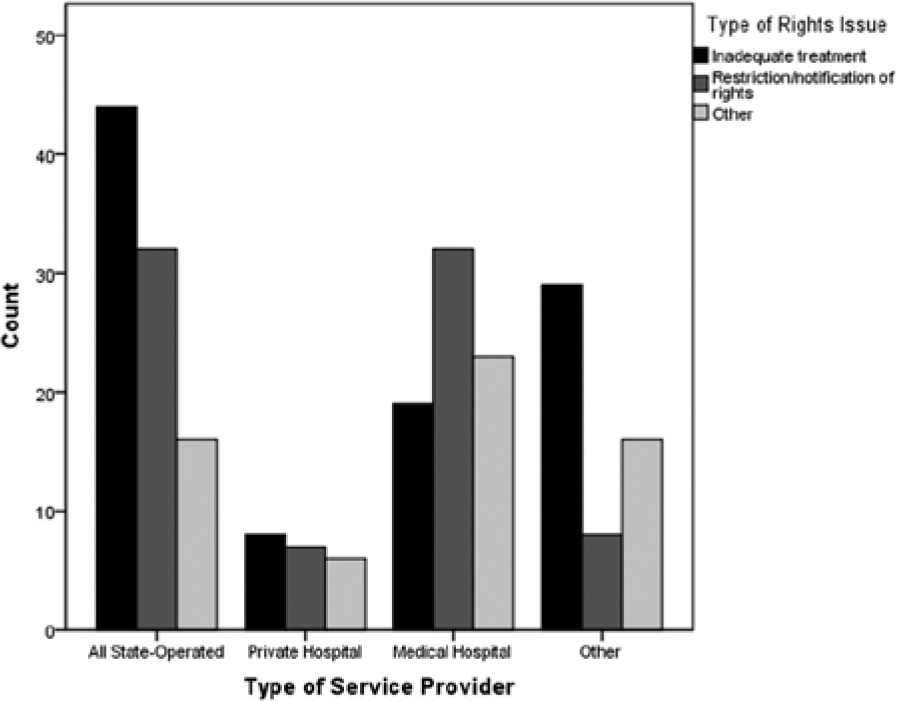
Frequency distribution of allegations by type of service provider and type of rights issue.
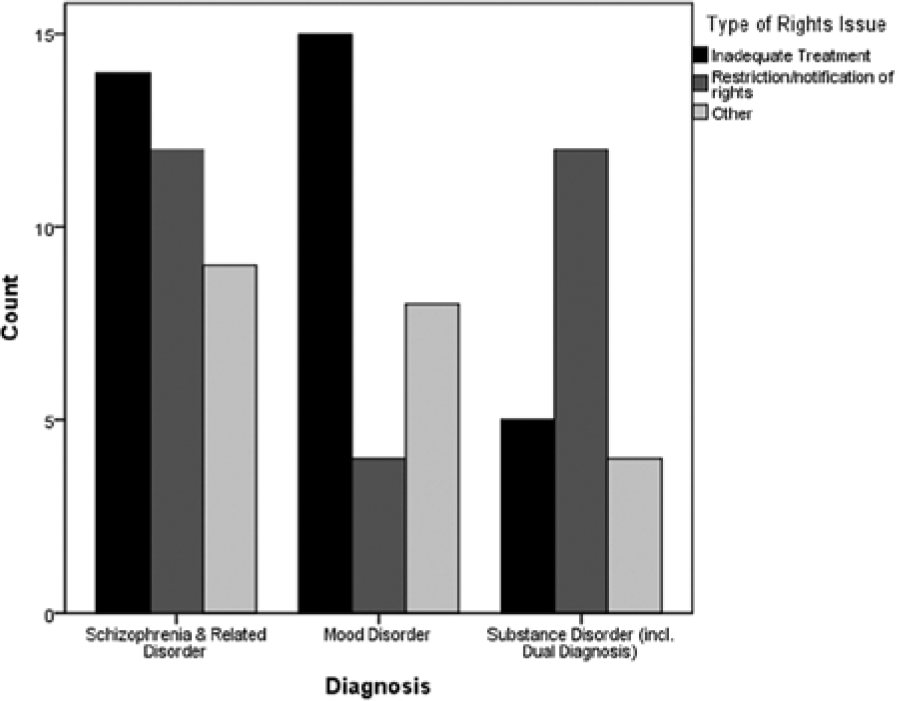
Frequency distribution of allegations by diagnosis type and type of rights issue.
Discussion
This study described the types of allegations pertaining to rights violations of PWMI who received care in Illinois in 2008 and the outcomes of the investigations into these allegations completed the Guardianship & Advocacy Commission. Results showed that rights violations most likely to be substantiated were related to restriction/notification of rights. State hospitals were found to be less likely than medical hospitals to have allegations made against them. Medical hospitals were less likely to have inadequate treatment allegations made than state hospitals, although they were more likely to have restrictions/notification of rights allegations made against them. These findings have implications for nurses as caregivers of PWMI. They highlight the importance of nurses knowing areas of risk for violations of the rights of PWMI related to nursing practice.
The results of the present study indicated that restriction of rights allegations were significantly more likely to be substantiated than inadequate treatment allegations. It is important to note that patient rights fall into clearly identified categories as defined by a state’s mental health code and that nurses follow specific hospital policies and procedures related to the documentation of patient rights. Therefore, this may explain the significantly higher likelihood of substantiation for rights/notification allegations. That is, because of the clarity of definition and documentation regarding patient’s rights, investigators are perhaps better able to identify evidence that supports the substantiation of allegation.
The lower likelihood for substantiation of inadequate treatment allegations by patients could be related to a lack of clarity, and at times, confusion, regarding what exactly constitutes adequate treatment—as well as the difficulty in investigating this allegation. Some of these allegations were substantiated, but not all. Although some examples of inadequate treatment may appear to be quite clear, there is often discord in understanding between the patient and/or staff member. For example, decisions concerning the amount of time needed to see a physician for a medical issue are often left up to clinical judgment.
Often, nurses make subjective evaluations regarding a patient’s condition, competency for self-care, and needs (Lutzen, 1998). This type of “contextual reasoning” is different from the rule-based reasoning that may be involved in other types of rights issues. Therefore, providing “adequate care/treatment” and proving “inadequate care/treatment” may be difficult. It may be that these issues fall under ethical principles rather than clear legal guidelines. For example, in a study of subtle coercion by nurses, Lutzen (1998) found that a nurse’s judgment might override a patient’s known preferences in ways that were not always in the interest of the patient but were justified by the nurse as helping, persuading, or encouraging the patient. These actions might fall under the category of inadequate treatment, as a patient who is aware that his or her preferences are being ignored could perceive a violation of this right. Yet identifying such a situation and proving the nurse or facility in error would be difficult and probably dependent on eyewitness reports rather than on clear documentation of a violation of rights. There are fewer objective measures of “adequate” treatment due to the need to use subjective evaluation in the process of nursing care. Persuading or encouraging might not be viewed by a nurse as a form of coercion needing documented justification. This use of covert coercion stands in contrast to the use of overt coercion, which a nurse might employ in clear cases of danger of harm, and which would require justification in documentation.
A significant and moderate relationship was observed between the type of service provider and substantiation of the allegation. Specifically, state hospitals were less likely than medical hospitals to have allegations against them substantiated. Possible rationales for this finding are that state hospitals provide specialized psychiatric services that include specialty units and tend to have nursing staff with more years of service and expertise than medical hospitals. In addition, state hospitals may provide more extensive continuing education to maintain and update staff’s skill and knowledge base than medical hospitals. Furthermore, in a medical facility, patients with psychiatric illness are found in the emergency room, on medical units, and on psychiatric units. In medical facilities, it is imperative to have adequate staff training with regard to caring for PWMI. This includes properly defined policies, procedures, and treatment strategies, so patients can receive suitable psychiatric care (Agency for Healthcare Research and Quality, 2011).
Findings from this study also suggested that allegations from the Chicago area were more likely to be substantiated than allegations from Suburban Chicago or Central/South Illinois areas. Chicago is a large urban area with a diverse population and a plethora of medical facilities. This is congruent with the researchers’ previous finding that allegations were more likely to be substantiated in medical facilities than in state psychiatric facilities. It was interesting to note that the relationship between gender and substantiation of the allegation, although not statistically significant, approached significance, with allegations by females more likely to be substantiated than allegations by males. Perhaps this observation might be informed by Wolfe and Powell’s (2006) study exploring the stereotype that women complain more than men. No evidence to support this stereotype was found—that is, women and men complained in equal amounts. However, the reasons for complaining differed by gender. Men were found to excuse their behavior by making complaints or as a way to appear superior. Women were found to make complaints as an indirect request for action. If this gender distinction occurred in the present population, with women with mental health problems complaining to seek action, their allegations may be more specific about actions that violated their rights than those of men, and thus more likely to be substantiated.
Medical hospitals were significantly less likely than state-operated hospitals, private medical hospitals, or “other” providers to have inadequate treatment allegations. Although the reasons for this are not entirely clear, we speculate that it may be related to the previous observation concerning the expertise and ongoing training of state facility staff, whereby state hospital patients may be more aware of their rights to make the allegation in the first place, as well as the in-place systems for documentation in state facilities that provide increased clarity of evidence in investigations. The relationship between allegation type and diagnosis type was not statistically significant, although it approached significance and the effect size was moderate. Here, at the sample level, persons with substance disorder (including dual diagnosis) were more likely to allege restriction/notification of rights and less likely to allege inadequate treatment, whereas persons with mood disorder were more likely to allege inadequate treatment and less likely to allege restriction/notification of rights. The researchers found no rationale for these findings in the literature; however, there are potential implications for nursing regarding these findings.
Limitations and Recommendations for Future Study
The findings of this report should be interpreted in the context of its limitations. The relatively small sample size, which was limited to a specific geographic area (state of Illinois), limits generalization of these findings. Another limitation was the lack of consistency/standardization of regional investigatory reporting. For example, few reports included age of the person making the allegation and not all included diagnoses. Also, the specific types of health care providers involved in the alleged violation of rights were not always indicated.
Future research could include a replication of this study with a larger sample size inclusive of a broader geographic region. Further studies might also employ qualitative methods to explore and illuminate the findings of this study. Currently, a qualitative study is being conducted to follow up on and explore the recommendations and suggestions of the HRA reports. Additional studies may provide needed evidence regarding adequate treatment from both nurses’ and patients’ perspectives. This in turn will provide a basis for facilitating a truly respectful nursing practice and improved patient recovery.
Clinical Implications and Conclusion
The results of this research study inform psychiatric nurses of the findings of the reports by the HRA and expand nursing knowledge regarding the types of patients’ rights violations reported at the state level and the outcomes of investigations into the allegations. Findings from the current study underscore the importance of educating nurses regarding the mental health code, patient rights, patient advocacy and the importance of thorough and accurate documentation. This is important not only for nurses specializing in mental health but also for nurses in other health care areas who may be caring for patients with mental health issues, such as emergency department nurses who often care for PWMI in crisis.
It is also important for nurses to have training regarding what constitutes adequate treatment, the importance of documentation (since this was noted to have a lack of clarity and at times confusion during the investigation), and areas of greatest risk for violation of patients’ rights in psychiatric nursing practice in inpatient settings. In addition, ensuring that patients are aware of their rights and that they can make allegations if they feel their rights have been violated is an important consideration for nursing staff.
In conclusion, it is a nurse’s role to promote recovery of persons with a mental health problem while protecting their rights. Rights of patients undergoing psychiatric care are sometimes challenging to navigate, and understanding areas for risk of violations of rights is important in nursing care for PWMI. This knowledge, in addition to national and professional guidelines for respecting patients and their rights, can provide a framework for psychiatric nursing practice in inpatient psychiatric settings, in which the risk for violating patients’ rights is diminished and possibly eliminated.
Footnotes
Author Roles
Jeanette Rossetti is the principal investigator of the study and writer of the article. Kathleen Musker is the coinvestigator of the study and writer of the article. Thomas Smith is the statistician and the writer of the results. Shelly Santo conducted and wrote the literature review.
Declaration of Conflicting Interests
The author(s) declared no potential conflicts of interest with respect to the research, authorship, and/or publication of this article.
Funding
The author(s) received the following financial support for the research, authorship, and/or publication of this article: The researchers have received funding from Sigma Theta Tau International, Beta Omega Chapter to financially support the research study.