






Abstract
The United States is in the midst of a national mental health dilemma. Nearly 57.4% of all Americans experience some form of mental illness in their lifetime (Leong & Kalibatseva, 2011), and one quarter of afflicted adults have more than one mental disorder (Karg et al., 2014). In 2014, 34 million adults, almost 17% of all American adults, reported comorbid mental health and medical conditions (Druss & Reisinger Walker, 2011). Even if the mental health condition is identified, mental health treatment is often delayed, from 6 to 8 years for mood disorders and 9 to 23 years for anxiety disorders (Wang et al., 2005). Tragically, less than half of those affected by coexisting major depression and substance use receive any form of mental health or substance use treatment (Han, Compton, Blanco, & Colpe, 2017). Psychiatric-mental health (PMH) nurses are ideally suited for identification and management of mental illness but are hampered by the lack of data about workforce effectiveness, interventions, and outcomes (Rice, 2018).
Disparate Treatment
Current estimates indicate 89.3 million Americans live in mental health professional shortage areas (Health Resources and Services Administration [HRSA], 2015). More than 77% of all U.S. counties report a shortage of any type of mental health worker and 96% of all counties have an unmet need for mental health prescribers (Thomas, Ellis, Konrad, Holzer, & Morrissey, 2009). This national need is exacerbated by the disproportionate impact on racial, cultural, and ethnic minorities who have higher levels of unmet mental health needs (Leong & Kalibatseva, 2011). Even with targeted efforts to address care disparities, between 2004 and 2012 there were no reductions for African Americans and Hispanics experienced an increase in unmet needs (Cook, Trinh, Li, Hou, & Progovac, 2017).
Inadequate Care Models
Inadequate mental health treatment is often compounded by undetected comorbid medical conditions. Sixty-eight percent of those suffering with mental health disorders have at least one medical condition, with mental health conditions being the second most frequently co-occurring illness in Medicare populations (Centers for Medicare & Medicaid Services [CMS], 2014). Evidence suggests a link between inflammatory cytokines, psychiatric illnesses, and undetected medical conditions that increases the risk of poor outcomes (Santos & Pyter, 2018). While one would anticipate mental health conditions are routinely identified during visits for physical illnesses, reports show the current system of care models do not address mental health care issues. Ironically, the reverse is also true for the percentage of undetected medical conditions among those suffering from mental illnesses (Cranwell, Polacsek, & McCann, 2016).
The American Psychiatric Nurses Association argues screening for mental health and substance abuse disorders should be included in an integrated care model (American Psychiatric Nurses Association—Board of Directors, 2017). Evidence from integrated behavioral health care models do demonstrate effective outcomes and cost containment at several levels. Integrated mental health care in primary care settings are projected to save between $26 and $48 billion annually (Melek, Norris, & Pailus, 2014). This matches the Substance Abuse and Mental Health Services Administration’s (SAMHSA) fiscal projections through 2020, which move costs away from specialty providers to nonspecialty mental health providers. SAMHSA models also decrease mental health care spending from 2009 to 2020 by 2%, through continued reduction of psychiatric hospital beds (SAMHSA, 2014).
Workforce
While health care costs can be decreased using integrated behavioral health care models, the need for psychiatric-mental health providers across the nation, such as psychiatrists, is expected to grow 6% by 2025 (HRSA, 2016). At the same time, there is an expected 69% increase in the need for mental health services due to a rapidly growing and aging population (HRSA, 2016). This need generates a psychiatric workforce shortage during a period of increasing need for services (Rice, 2018).
The 2010 Institute of Medicine (IOM) Future of Nursing report served as a starting point for many nursing workforce initiatives (IOM, 2010). However, the follow-up reanalysis (IOM, 2016), continues to encourage more effective use of nurses to meet evolving health care needs. There are also strong recommendations that the nursing workforce place a greater emphasis on generating a more diverse nursing workforce, particularly in the areas of gender and race/ethnicity, in order to match population parameters (IOM, 2010). The underlying assumption is that a more representative mental health workforce will attract talent, promote participation, and lead to attention in high need areas (Sherbin & Rashid, 2017).
While both IOM reports note a need for more effective use of nurses, it is unclear exactly how much impact changes in the nursing workforce would have on psychiatric-mental health care. The IOM reports suggest that nurses will be able to address some of the workforce issues supported by federal regulatory changes. The Affordable Care Act currently prohibits insurers from discriminating against various types of health care providers acting within their state regulated scope of practice (CMS, 2014). The CMS regulations also support requiring nurse practitioners to use their full scope of practice for both inpatient and outpatient services (CMS, 2014). However, much of the data on the distribution and outcomes of the nursing workforce, even the advanced practice workforce, is fragmented, has not been collected, or is simply not available (Rice, 2018).
The absence of this workforce data complicates the ability to identify changes in regulations needed to have a substantive impact on psychiatric-mental health care. One of the most visible limitations to psychiatric mental health nursing are variations in legal and regulatory barriers between states (Phoenix, 2018). While a total of 49 states permit advanced practice registered nurses some level of prescribing authority, only 22 states allow full independent practice, 15 states limit practice, and 13 states severely restrict scope of practice (American Academy of Nurse Practitioners, 2016). Within states with a restricted scope of practice, “Supervision” is mandated by written agreements that are variably enforced, if enforced at all (IOM, 2010).
Variation in state regulations are also partially based on variations across advanced practice psychiatric nursing training programs. While educational programs generally follow a set of accreditation guidelines, enough variation exists between programs to hamper interstate licensing. The differences in educational outcomes are exacerbated by the rapid expansion of new programs offering psychiatric nurse practitioner education (Delaney, Drew, & Rushton, 2018). Delaney et al. (2018) report 33 programs expanded to offer psychiatric nurse practitioner programs, perplexingly, in the face of declining numbers of qualified faculty (Kaplan, Klein, Skillman, & Andrilla, 2016).
Data-Driven Policy Platform
The critical issues on psychiatric mental health nursing’s role in addressing national mental health care needs cannot be answered with a general consensus of opinion and beliefs. The paucity of data is widespread across the workforce, educational outcomes, patient care outcomes, and policy positions. The current status of the profession substantiates a need for the development of a comprehensive database on the impact of the psychiatric mental health nursing workforce on health care. The foundation of this database must address the treatment effect size of relationships between patients and providers on health outcomes. Recent studies indicate that a failure to engage in relationships, individually and on a community basis, is the major factor limiting health and wellness (Iyer, Pancake, Dandino, & Wells, 2015).
One of the major limitations to generating the database is the use of multiple terms and variables for the same phenomena. This makes findings from any set of studies useless when addressing care needs. For example, the Agency for Health Research Quality recently completed a systematic review of strategies and programs to reduce patient aggression. The report examined data from 29 primary studies; 11 were controlled trials with 4 of these trials occurring in the United States (Gaynes et al., 2017). The results were limited by a lack of comparability and common variables, even across well-designed studies (Gaynes et al., 2017). The development of a common database of variables and terms shared by all psychiatric-mental health nurses would provide a platform for defining comparable outcomes. If the databases are also developed using shared industry business terms, outcomes can also be compared across studies and used in large-scale cost analytic studies. At a minimum, research studies and practice settings should use common terms to report cost, cost-effectiveness, and treatment outcomes.
Restructuring Workforce
Bottlenecks in developing a psychiatric-mental health workforce begin with addressing the stigma against psychiatric-mental health care in undergraduate nursing programs (Delaney et al., 2018). These bottlenecks begin with the stigma against psychiatric-mental health care in undergraduate nursing programs and the associated absence of mental health care content and clinical competencies (Delaney et al., 2018). Analysis in commonalities and differences in baccalaureate course work suggests that career models benefit from the use of foundational courses (Giddens & Meyer, 2016). This approach suggests developing foundational content applied across educational levels and systems (Table 1). The foundation course should contain tiered competencies that progress as the level of education progresses. The content should also be mandatory similar to the standards for cardio pulmonary resuscitation (Kane et al., 2012). The minimum skills should include the following:
Standardizing whole health assessments
Lifespan family communications ranging from postpartum depression to dementia
Safety modules on suicide, homicide, firearms, substance abuse, and trauma
Basic economics/liability and positioning of the politics of the role
Mandatory use of technology in delivering relationship-based care
Building community engagement relationships on mental health
Building relationship data and outcomes on the value to the role
Educational Data-Driven Policy Solutions.
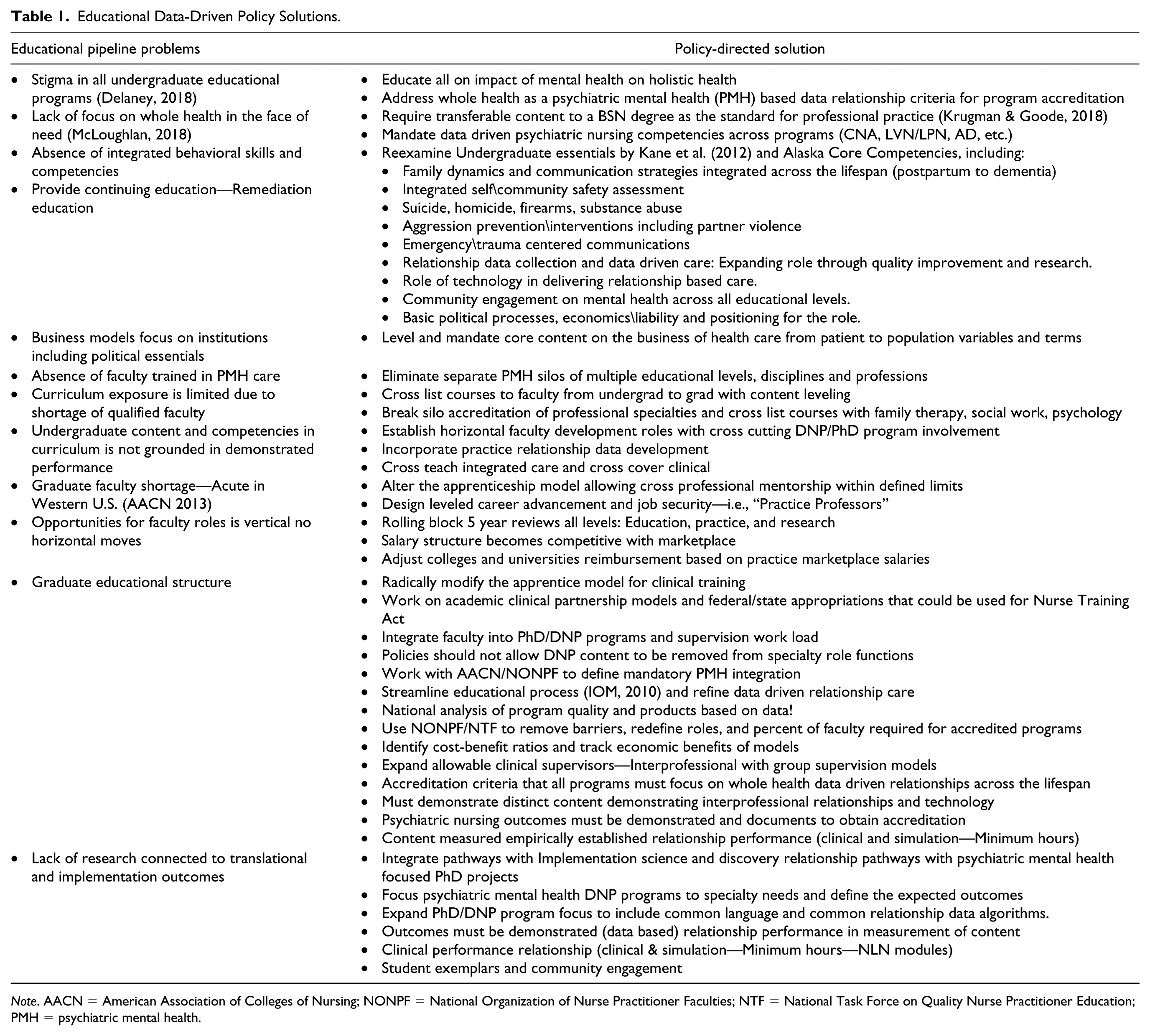
Note. AACN = American Association of Colleges of Nursing; NONPF = National Organization of Nurse Practitioner Faculties; NTF = National Task Force on Quality Nurse Practitioner Education; PMH = psychiatric mental health.
Facilitating tiered content for psychiatric mental health nursing must be accompanied by structural changes in the current educational system (Table 1). The first stage is opening the pipeline for those interested in psychiatric mental health nursing using a career ladder educational framework (Rice, 2018). The career ladder model provides a pathway for promotion and recruitment of nursing assistants, licensed vocational nurses, associate degree nurses, and bachelor-degree nurses currently working in psychiatric mental health care settings. The inability to engage these individuals in the field is an oversight which narrows the workforce pipeline and hampers psychiatric mental health nursing education, practice and research. Use of the career ladder should be accompanied by educational structural changes including the following:
Defining accreditation criteria for tiered student performance competencies
Developing cross listed courses with social work and psychology on brief psychotherapies and integrated care models to expand utilization of faculty
Eliminating salary barriers to increase compensation and attract qualified faculty
Encouraging doctorate of nursing practice and philosophy doctorate (PhD) collaboration on psychiatric mental health database projects
Expanding PhD programs to include discovery of relationship data
Special note must be made that the lack of adequately prepared psychiatric mental health nursing faculty hampers all levels of undergraduate and graduate programs (American Association of Colleges of Nursing, 2015). In terms of advanced practice nurses and PhDs, currently only 3.8% of the total nursing population are psychiatric oriented (American Academy of Nurse Practitioners, 2016). The total number of PhD prepared psychiatric mental health nurses is debatable but limit the specialty’s contribution to the science of psychiatric mental health care (Rice & Cunningham, 2014). The use of a career ladder for interested professionals opens the pipeline and will increase the available students for all levels of educational preparation.
Inherent in this discussion is the educational program accreditation standards and the performance competencies required of the students. For example, there is increasing discussion about whether to retain psychotherapy as a performance competency in nurse practitioner curriculums (McCoy, 2018; Wheeler, 2014). The current evidence shows that nurse practitioners are more likely than other professionals to use psychotherapy interventions with the most vulnerable populations (Cohen-Mansfield, Jensen, Resnick, & Norris, 2012) and even masters prepared practitioners can use the intervention effectively (Fields, Schutte-Rodin, Perlis, & Myers, 2013). Yet, variation in graduates’ preparation for psychotherapy fuels scope of practice debates across state boards of nursing (McCoy, 2018).
Practice
At the practice level, psychiatric mental health nurse practitioners must participate in addressing the lack of clinical training sites, contributing to building an outcomes database and help construct post graduate residency programs. The first step is changing the focus of clinical training sites. Continuing to focus on inpatient settings as the preferred training site places all professional training in competition with medical residency programs, medical students, and other professions. Psychiatric mental health nursing must seriously consider the alternative model of academic–clinical partnerships, which depend heavily on the advanced practice nurses (Table 2). These academic–clinical partnerships can be encouraged by calculating the agency’s cost savings through elimination of costs for recruitment, the reduced costs of orientation, reduced costs of human resources for onboarding, and the increased billing from new hires requiring minimal orientation. This move would be also consistent with the financial move away from psychiatric hospitals toward integrated care settings.
Practice Data-Driven Policy Solutions.
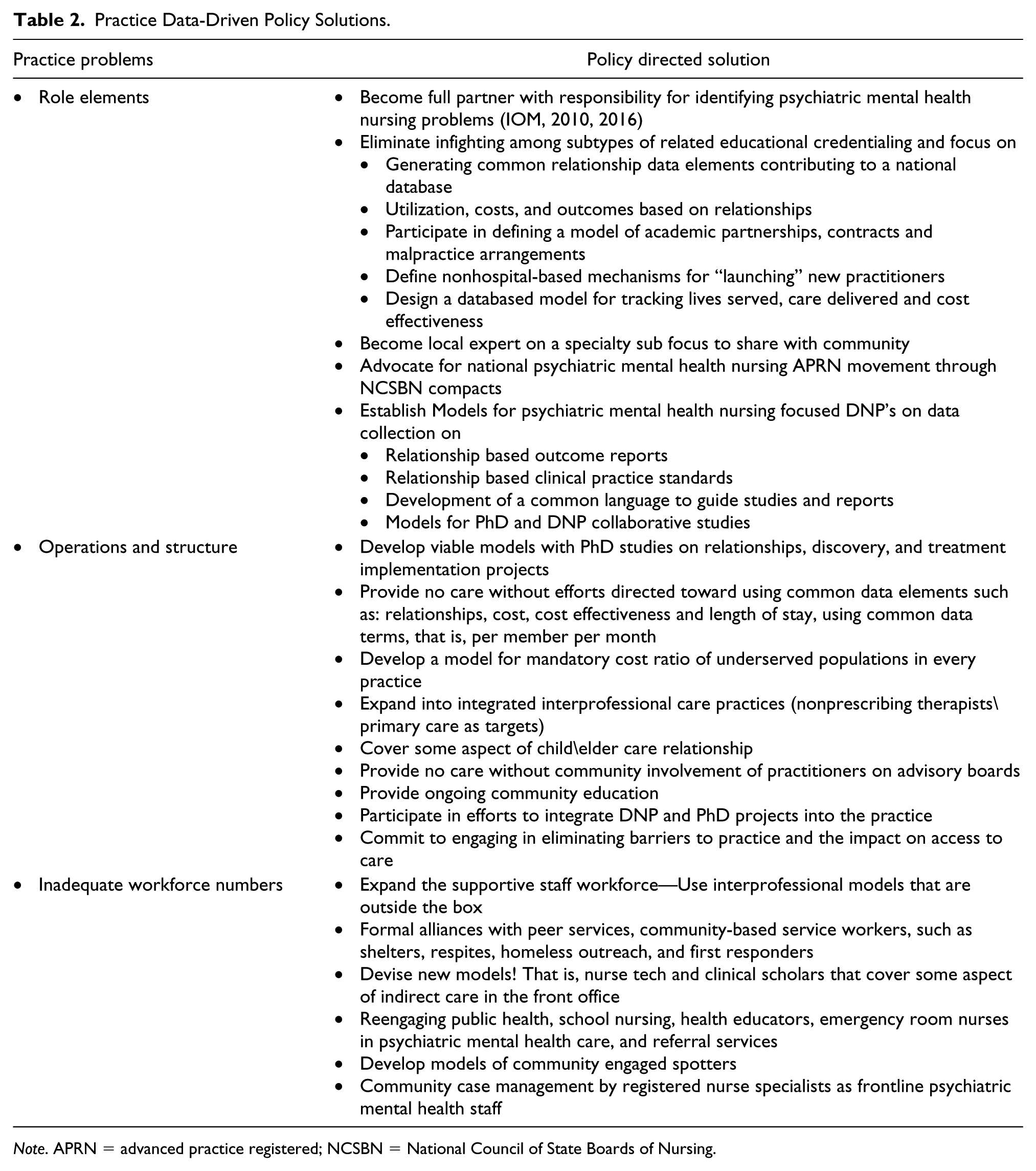
Note. APRN = advanced practice registered; NCSBN = National Council of State Boards of Nursing.
Psychiatric mental health nurse practitioners must participate in the development and growth of the workforce and outcomes databases. No single group of psychiatric mental health nurses has a better grasp of the success of treatments, treatment limitations, and cost effectiveness. Core data elements on the treatment models must be built through collaboration with DNP- and PHD-oriented projects. Only through practitioner input will the common data elements be accurately defined. This requires use of the databases in tracking that data during patient visits. The outcome provides a stable common database that can be tapped for DNP and PhD projects and larger databased studies.
Advanced practice nurses must also join in the discussion about the form and value of accredited post graduate nursing residency programs, particularly when merged with DNP programs. Advanced practice residency programs offered by schools of medicine and public health organizations do not advance psychiatric nursing, but the disciplines offering those programs. This type of post graduate residency programs also run the risk of adding more levels, more credentialing and more confusion about psychiatric mental health practice roles. Nurse residency programs for baccalaureate, masters and DNP graduates must also be legitimized by building nursing accreditation standards in order to advance psychiatric mental health nursing and not another discipline.
Graduate Database Projects
One of the largest unanswered questions posed by the IOM (2010, 2016) reports is, “Will the nurse researchers respond?” The question must now be expanded to include the question, “Will the DNP nurses respond?” Both are the most highly educated nurses within the specialty and have the preparation and skills to define and generate the proposed workforce databases. It is worth noting that this is not consistent with the mission of either form of doctoral education. PhD prepared nurses focus on the science of discovery while DNP prepared nurses focus on advancing practice. The element missing from both levels of preparation is the development of the specialty. This suggests that the content and focus of both forms of doctoral preparation must be changed to include a commitment to the specialty’s professional development.
At the most fundamental level, DNP and PhD programs must include educational outcomes on discovering care metrics and assuring practice quality for patient health (Table 3). Collaborating with all psychiatric mental health nurses on defining and building the database are not distractions, but open doors for new discovery and methods of examining care. This also opens practice sites to collaborations between PhD and DNP projects that would only further the opportunities for discovery and improving care delivery. Only through collaboration with all psychiatric mental health settings, will it be possible to identify common data elements that have the greatest impact on health.
Research Data-Driven Policy Solutions.
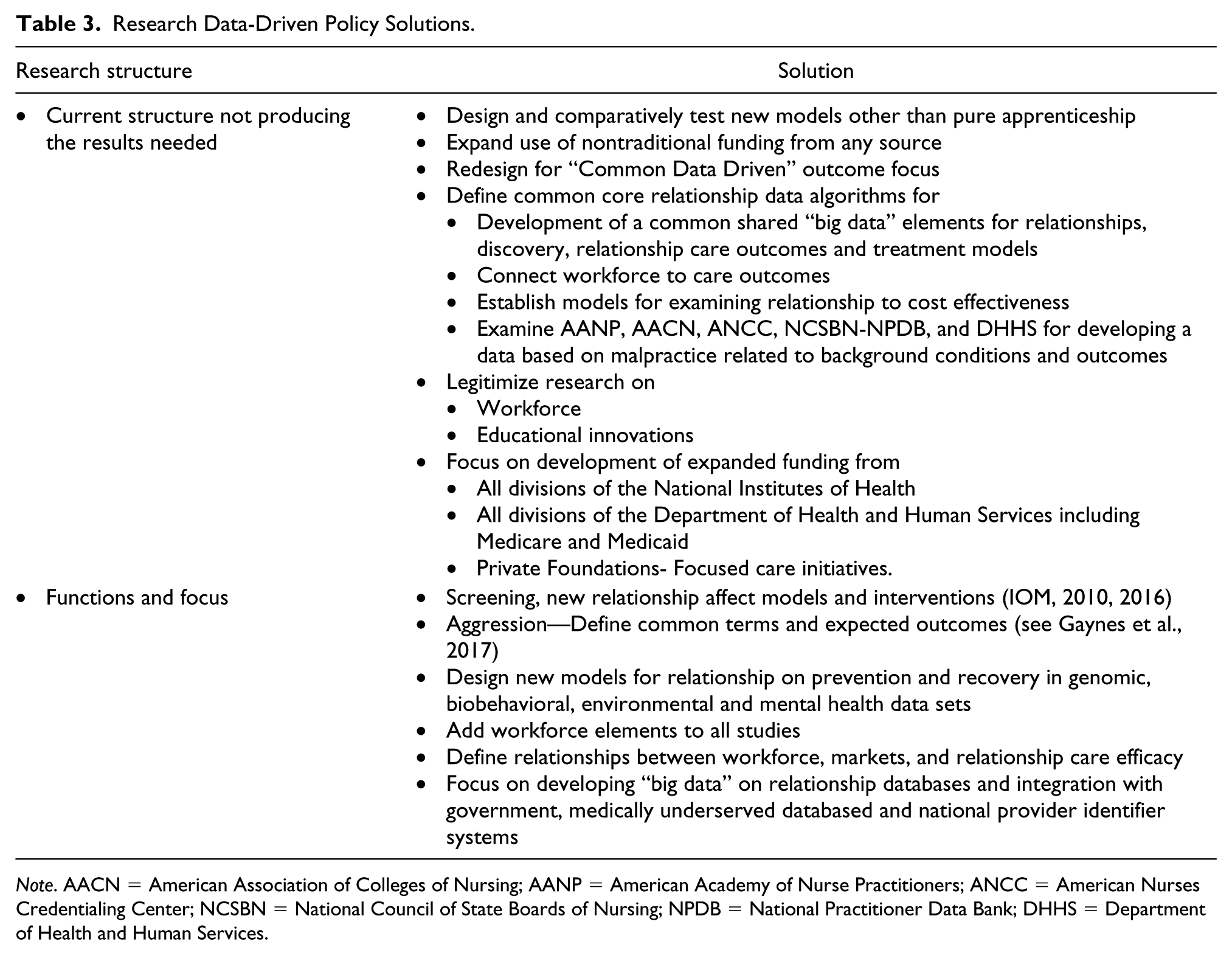
Note. AACN = American Association of Colleges of Nursing; AANP = American Academy of Nurse Practitioners; ANCC = American Nurses Credentialing Center; NCSBN = National Council of State Boards of Nursing; NPDB = National Practitioner Data Bank; DHHS = Department of Health and Human Services.
A final cautionary note must be made about the utility of the common data elements to psychiatric mental health nursing and the national health care debate. The common data elements currently used by psychiatric mental health nursing do not contain business elements used to publicly validate the value of the profession. The common databases must reflect elements of the financial industry supporting the “business and social value” of relationships to mental health care. This includes using terms few nurses are familiar with, such as per month per member, nonqualified treatment limitations (identified as NQTLs), lives served, units of care, and intervention cost effectiveness. The effort to address these elements must include contexts and relationships outside the paradigm of the hospital-clinic box, in order to collect data on care delivered in services with peers, community service workers in shelters, law enforcement, police, emergency medical technicians, and firemen. These are the lost data points of psychiatric mental health nurses’ roles limiting the role’s social value.
Political Action
On a policy front, the psychiatric mental health nursing must look at using the common language relationship database in all communications to ensure accurate representation of the psychiatric mental health care workforce (Table 4). Policy needs may initially require psychiatric mental health nursing to develop its own workforce database to share with government agencies and organizations. The collection and use of the data must be consistently used as a reference point to direct workforce development efforts on education, practice, research, and policy.
Data-Driven Policy Solutions.
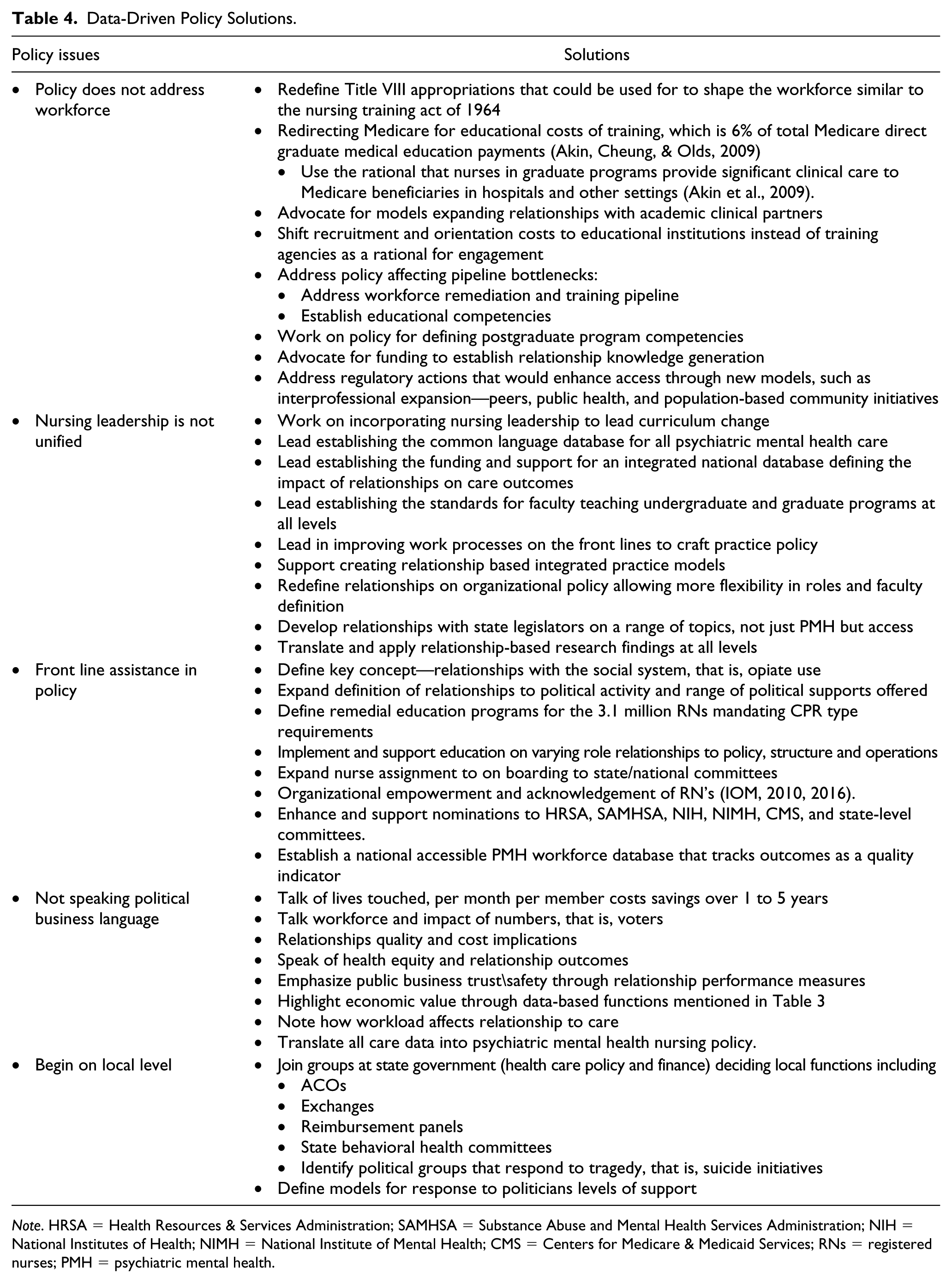
Note. HRSA = Health Resources & Services Administration; SAMHSA = Substance Abuse and Mental Health Services Administration; NIH = National Institutes of Health; NIMH = National Institute of Mental Health; CMS = Centers for Medicare & Medicaid Services; RNs = registered nurses; PMH = psychiatric mental health.
Policy leaders must also become more proactive to ensure psychiatric mental health nursing is identifiable and visible. This includes proactively advocating for nurses of all levels of preparation to participate on local, state, and national committees. The IOM (2010, 2016) recommends proactively identifying participant’s roles as mediators, collaborators, and followers. These levels of involvement must include crafting practice policy, creating integrated practice models, working on organizational policy, working with state legislators, leading curriculum change, and translating and applying research findings (IOM, 2010). Psychiatric mental health nurses must engage in state committees and discussions with state agencies to demonstrate psychiatric mental health care is interested and involved. Policy strategies must strategically target organizations and agencies with pivotal roles in the decision-making process. To obtain key positions, psychiatric mental health nurses must support all levels of nominations to governmental positions in HRSA, SAMHSA, National Institutes of Health, National Institute of Mental Health, and CMS. While some of the roles may only be as a participating member, their presence at the table provides evidence that psychiatric mental health nurses are involved!
Policy leaders must also push for the advancement of the psychiatric mental health nursing workforce with professional and accrediting organizations (Table 4). These efforts must include work with the American Association of Colleges of Nursing, National Organization of Nurse Practitioner Faculties, and relevant specialty professional organizations to define performance competencies and integration into general health care. This sets the cornerstone for accreditation criteria focusing on the whole health of individuals across the lifespan beginning with identification and detection of mental illness during childhood.
Summary
Psychiatric mental health nursing faces many challenges in developing a workforce to address current and future mental health challenges. From education through practice, and research to policy, the specialty must build a data-driven, relationship-to-care platform emphasizing how psychiatric mental health relationships affect health outcomes. The use of this data-based platform should engage the public and define the impact on health. The evolving public opinion would anchor psychiatric mental health care as an integral part of all health care. The support of public opinion would eventually lead to eliminating barriers through modification of scope of practice regulations. Psychiatric mental health nursing must also interact with the various nursing organizations to modify the attitude toward mental health care using the common language database. This strategy must be developed because even the best evidence-based strategies fail to solve mental health care problems when no provider is available to provide that care.
Footnotes
Author Roles
This article is based on a policy development presentation at an APNA workforce summit in Falls Church, Virginia, on February 21, 2018. The author (MJR), with the assistance of two APNA Board of Directors Scholars (JS and AM) surveyed relevant literature on census distributions, and statistical and workforce trends of the current psychiatric mental health nursing workforce. The author also drew on personal experience through several decades serving as a professor of psychiatric nursing to identify data-driven policy platforms to train, promote, and elevate the profession to address national mental health care needs.
Declaration of Conflicting Interests
The author(s) declared no potential conflicts of interest with respect to the research, authorship, and/or publication of this article.
Funding
The author(s) disclosed receipt of the following financial support for the research, authorship, and/or publication of this article: This article was supported by funds from the APNA.
