







Abstract
Objective:
The purpose of this study was to examine the relationships among undergraduate class status, risky behaviors (i.e., alcohol and marijuana use, sexual activity), life satisfaction, and ability to cope.
Methods:
Undergraduate students (N = 2,961) completed an electronic survey to assess for mental health status and risky behaviors.
Results:
Compared with others, first-year students reported fewer days of having at least one alcoholic drink, fewer days of having five or more alcoholic drinks in a row, and less frequency of marijuana use. First-year students reported fewer sexual partners and less frequency of sexual activity compared with others. First-year students were more likely to report greater life satisfaction, being able to cope with difficult situations, and greater self-worth, compared with others.
Conclusions:
As undergraduate students progress through their academic career, they are more likely to engage in risky behaviors and experience life dissatisfaction.
Introduction
With an increase of intense schedules, more difficult course loads, and a new sense of responsibility as young adults, undergraduate students are experiencing mental health challenges such as anxiety and depression. In fact, a recent study reported that from March to May 2020, 31% of undergraduate students reported having anxiety and 41% reported having depression (American College Health Association, 2020). Additionally, suicide is the second leading cause of death in individuals ages 15 to 24 years in the United States (National Institute of Mental Health, 2021); and suicide rates among this population have increased by 33% from 1999 to 2017 and may continue to increase because of the rising costs of living and education (Glenn et al., 2020; Hedegaard et al., 2018; Weir, 2019).
Mental health problems and suicide may be attributed to the unique risk factors that undergraduate students face including academic performance, relationship stressors, and financial issues. As adolescents enter a new world with large amounts of peers, minimal direct parental oversight, and more access to alcohol and illicit substances, undergraduate students may engage in risky behaviors (i.e., binge drinking, marijuana use, sexual activity), with a lack of immediate consequences in mind. Indeed, studies have indicated that adolescents who attend college are at an increased risk of engaging in risky behaviors, compared with those who do not attend college (Schulenberg et al., 2018).
With the co-occurrence of greater prevalence rates of anxiety and depression and increases in risky behaviors, undergraduate students have a greater risk for impaired cognitive functioning and behavioral inhibition which may lead to suicidal ideation and attempts (Gili et al., 2019; Oh et al., 2021). Moreover, this population may engage in maladaptive coping mechanisms such as risky behaviors to self-manage their depression, anxiety, stress, and dissatisfaction with their life (DiBello et al., 2018; Kenney et al., 2018; Russell et al., 2017; Walters et al., 2018; Yang et al., 2019).
The purpose of this study was to examine the relationships among undergraduate class status, risky behaviors (i.e., alcohol and marijuana use, sexual activity), life satisfaction, and ability to cope. By comparing incoming first-year students with those who are returning (i.e., 2nd-, 3rd-, and 4th-year students), we hoped to obtain insights about differences in risky behaviors (i.e., alcohol and marijuana use, sexual activity), life satisfaction, and ability to cope across the 4-year undergraduate experience. Such knowledge may inform stakeholders such as administration and health care providers about resources needed to promote mental health and decrease risky behaviors among undergraduate students as they progress through their four college years.
Method
Participants
This cross-sectional study used data from undergraduate students who participated in one of two electronic Qualtrics surveys on risky behaviors and mental health status. One survey was administered by the University Health Services to incoming first-year undergraduate students (N = 3,313) during Summer 2020, and completion rate was 51.4% (n = 1,702). The second survey was adapted from the University Health Services’ survey and administered to non-first-year undergraduate students (N = 9,898) in August 2020, and completion rate was 34.3% (n = 3,398). Inclusion criteria were at least age 18 years and undergraduate student status. For this study, 454 first-year students were excluded because they were younger than the age of 18 years and 1,685 respondents from the adapted survey were excluded because of missing data (>75%). A total of 2,961 respondents were included in the present analysis.
Procedure
The institutional review board of a university in the Northeast approved this study. Incoming first-year students were asked to complete the University Health Service survey as part of the required steps for all full-time undergraduate students. Deidentified data were provided by University Health Services on request and confirmation of institutional review board approval. For the second survey adapted from the University Health Service survey, eligible non-first-year undergraduate students were invited by email to complete the survey. Participation was voluntary, and students were assured that the survey was anonymous and there were no identifiable data collected. Students participating in the adapted survey had the option to enter a raffle for a $25 gift card.
Instrument and Variables
Both surveys included questions about demographics, alcohol, tobacco and substance use, sexual activity, eating behaviors, sleep and physical activity, life satisfaction and self-esteem, stressors, coping skills and support system, and suicidal ideation.
Substance use variables were assessed using the following questions: (1) During the past 30 days, on how many days did you have at least one drink of alcohol? (2) During the past 30 days, on how many days did you have five or more drinks of alcohol in a row, that is, within a couple of hours? (3) During the past 30 days, how many times did you use marijuana? Response options for the two alcohol-related questions ranged from 1 (0 days) to 7 (all 30 days). Response options for the marijuana use questions ranged from 1 (0 times) to 6 (40 or more times).
Sexual behavior variables were assessed using the following questions: (1) During the past 3 months, how many partners did you engage in sexual activity with? with response options ranging from 1 (1 partner) to 6 (6 or more partners) and (2) During the past 3 months, how many times did you engage in sexual activity? with response options ranging from 1 (0 times) to 6 (20 or more times).
Life satisfaction was assessed using the following three statements: I am satisfied with my life in the past; I am satisfied with my current life; I am satisfied with my life in the future. Coping was assessed with the statement I am unable to cope with difficult situations. For all statements, response options ranged from 1 (strongly disagree) to 4 (strongly agree). Self-worth was assessed using the statement, “My current feelings about my own self-worth are . . . ,” and response options ranged from 1 (nonexistent) to 6 (excellent).
Data Analysis
Data analyses were conducted using SPSS v.26. For all analyses, significance level was set at .05. Descriptive analyses were performed. Normality and homogeneity of variance were tested. One-way analysis of variance models were used to evaluate differences in mental health status and risky behaviors by undergraduate class status, controlling for gender, race, and full-time status, with Bonferroni adjusted pairwise differences.
Results
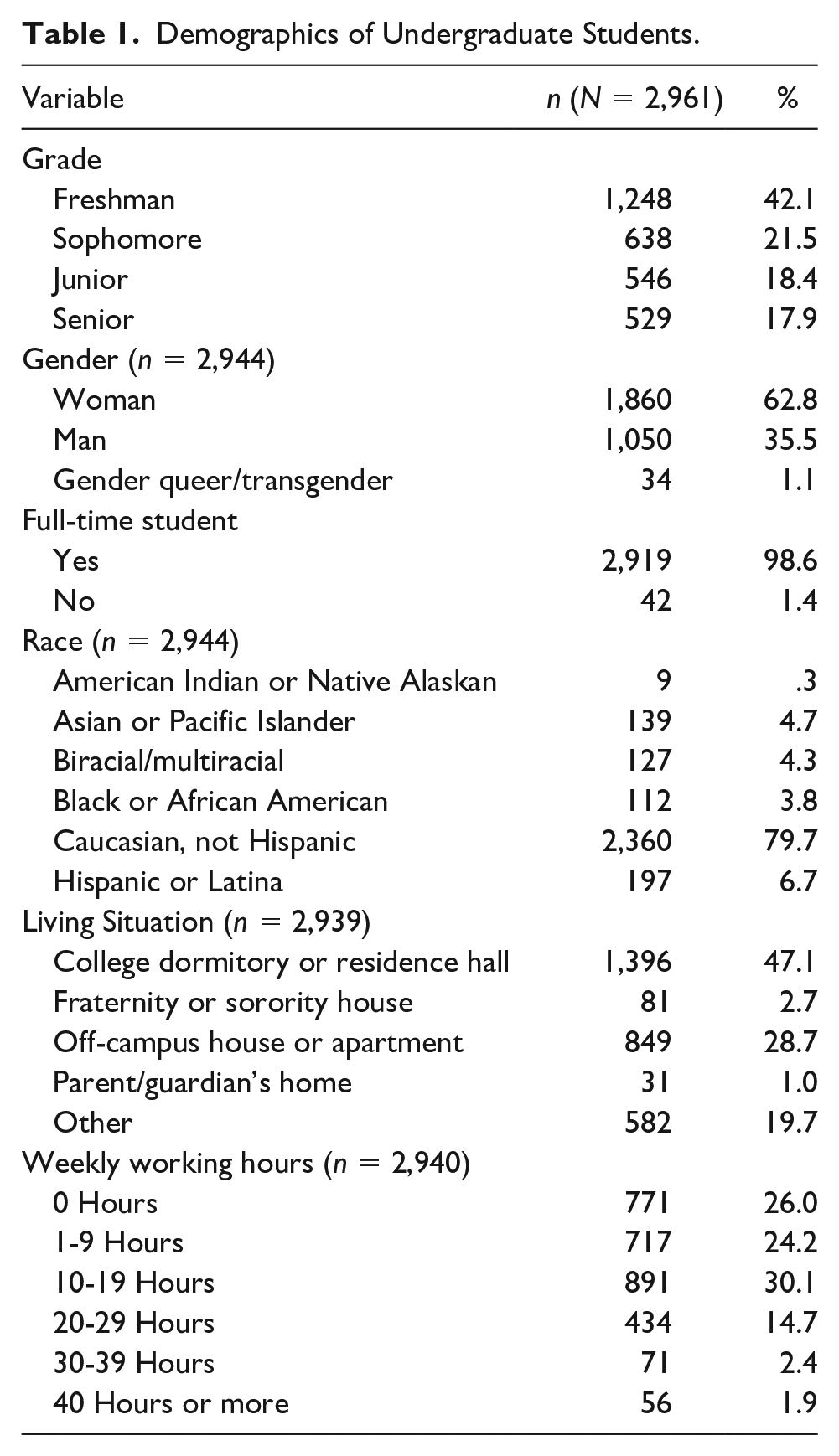
Table 1 provides descriptive statistics for demographic variables. Among participants, students primarily identified as women (n = 1,860; 63.2%), Caucasian, non-Hispanic (n = 2,360; 80.2%), full-time student status (n = 2,919; 98.6%), and living in a college dormitory/resident hall (n = 1,396; 47.5%).
Demographics of Undergraduate Students.
Details about the differences between student class statuses are available in Table 2. There was a significant difference between student class statuses and the number of days of having at least one drink of alcohol during the past 30 days, F(3, 323.36) = 216.32, p < .001, partial η2 = .182, with a large effect size. Further analysis indicated that first-year students reported fewer days of having at least one drink of alcohol in the past 30 days, compared with sophomores, juniors, and seniors. There was a significant difference between student class statuses and the number of days of having five or more drinks of alcohol in a row, F(3, 601.59) = 187.65, p < .001, partial η2 = .162, with a large effect size. Further analysis indicated that first-year students reported fewer days of having five or more drinks of alcohol in a row, compared with sophomores, juniors, and seniors. There was also a significant difference between student class statuses and frequency of marijuana use during the past 30 days, F(3, 84.31) = 49.59, p < .001, partial η2 = .049, with a moderate effect size. Further analysis indicated that first-year students reported less frequency of marijuana use compared with sophomores, juniors, and seniors.
Summary of Means and Standard Deviations for Behaviors and Beliefs by Undergraduate Class Status.
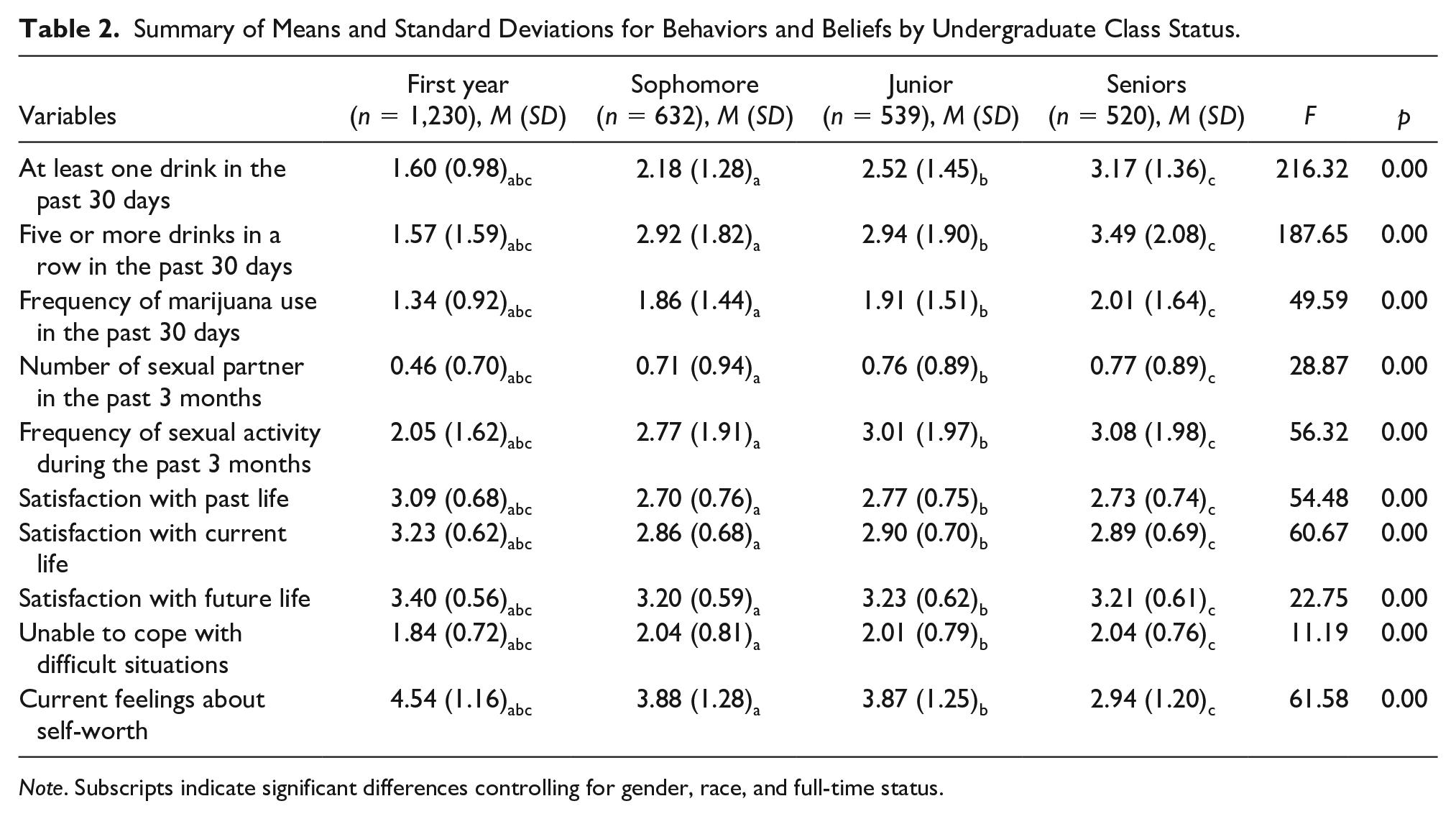
Note. Subscripts indicate significant differences controlling for gender, race, and full-time status.
Between student class statuses, there was a significant difference in number of sexual partners during the past 3 months, F(3, 19.63) = 28.87, p < .001, partial η2 = .029, with a small effect size, and frequency of sexual activity during the past 3 months, F(3, 184.84) = 56.32, p < .001, partial η2 = .055, with a moderate effect size. Further analysis indicated that first-year students reported fewer sexual partners and less frequency of sexual activity during the past 3 months compared with other undergraduates.
There was a significant difference in being satisfied with one’s past life, F(3, 29.27) = 56.48, p < .001, partial η2 = .055, with a moderate effect size; current life, F(3, 26.27) = 60.66, p < .001, partial η2 = .059, with a moderate effect size; and future life, F(3, 7.82) = 22.75, p < .001, partial η2 = .023, with a small effect size. Further analysis indicated that first-year students were more likely to agree with being satisfied with their past, current, and future lives, compared with sophomores, juniors, and seniors. There was also a significant difference between the student class statuses and being able to cope with difficult situations, F(3, 6.35) = 11.19, p < .001, partial η2 = .011, with a small effect size and feelings of self-worth, F(3, 89.20) = 61.58, p < .001, partial η2 = .060, with a moderate effect size. First-year students were more likely to disagree with the statement, “I am unable to cope with difficult situations,” and reported higher feelings of self-worth, compared with other students.
Discussion
Based on our findings, as undergraduate students progress through their academic careers, they are more likely to form maladaptive behaviors and experience life dissatisfaction. In fact, students reported increases in alcohol consumption and marijuana use as well as decreases in life satisfaction as they progressed toward their senior year. Despite these changes, participants in this study drank alcohol on fewer days in the past month (2 days) compared with the national average of 6.4 days per month for full-time college students (Lipari & Jean-Francois, 2016). One explanation may be that this survey was administered during the summer months and students may decrease their alcohol consumption outside of the academic year (Miller et al., 2016; Schuckit et al., 2016). However, 7.6% of participants (n = 225) reported using marijuana “20 or more times” in the past month compared with the national average of 6% among college students (Schulenberg et al., 2018). Consistent with existing research (Bae & Kerr, 2020), the legalization of marijuana use may be contributing to greater increases in marijuana use among college students including this sample.
As mentioned above, participants in this study completed the survey prior to starting their academic year, which may have influenced the results. According to the National Institute on Alcohol Abuse and Alcoholism (2021), during the first 6 weeks of the first year, college students are at high risk for heavy alcohol use and alcohol-related consequences because of expectations and social pressures. Moreover, a recent study indicated that 9.9% and 6.0% of full-time college students aged 18 to 22 years drank alcohol and used illicit drugs, respectively, for the first time in the past year (Lipari & Jean-Francois, 2016). Thus, in this study, prevalence of alcohol and marijuana use may have been lower for incoming first-year students because they had not started college and had yet to experience the first 6 weeks of their first year and the social pressures and personal expectations that increases risk for substance use.
Incoming first-year students reported greater life satisfaction, greater ability to cope with difficult situations, and greater self-worth, compared with other students. It is important to note that the effect size was small for being satisfied with their future life and having the ability to cope with difficult situations, suggesting that the differences may be negligible even through statistically significant. However, satisfaction with past and current life as well as self-worth had moderate to large effect sizes, indicating the differences can be attributed to class status. It is possible that incoming first-year students were more optimistic about their past and current lives because they had recently graduated from high school, were excited to start college, and had not encountered the unique challenges of higher education (e.g., increase of intense schedules, more difficult course loads, distance from home, new environment). Unlike incoming first-year students, other students (i.e., sophomores, juniors, seniors) had experienced the first 6 weeks of the first year and at least one full academic year, including the challenges of higher education, social pressures, and their personal expectations being met or unmet. Research suggests that higher stress is associated with lower academic performance (Chisholm-Burns et al., 2021; Spivey et al., 2020). Thus, compared with incoming first-year students, other students in this study may have been less satisfied with their past and current lives and reported lower self-worth because they were experiencing more stressed which negatively affected their academic performance (perceived and/or actual) and subsequently influenced their life satisfaction and self-worth.
There were several limitations to this study. First, the current study relied on self-report of behaviors over time, and participants’ ability to accurately recollect frequencies of use may have been diminished. Second, the study was cross-sectional which limited our ability to examine participants’ trajectories throughout their college experience. Future work could include longitudinal approaches as well as ecological momentary assessment to provide information about changes in behaviors and cognitions over time. Additionally, findings from this study have limited generalizability because participants were from one public northeastern university in the United States, and mostly identified as White, non-Hispanic women who lived in a college dormitory/resident hall. Future research could be multisite and include commuter and online schools as well as oversample for underrepresented racial/ethnic populations, men, and transgender and other gender identities. Finally, this study did not assess for consequences from risky behaviors and perceptions of the pros and cons of behaviors and consequences, which are relevant to understanding participants’ willingness to change behaviors and/or seek professional help. Despite these limitations, this study contributes to the literature because the sample size was relatively large, and we compared undergraduate students by class status.
This study indicates that undergraduate students may need adaptive coping skills and strategies to address their substance use and mental health needs beyond their first year. Colleges and universities should consider multi-tiered intervention and prevention programs for students that bring more awareness and support to mental health throughout all years of college. For example, continuation of development courses beyond first-year orientation may be beneficial in addressing challenges unique to each college year to optimize students’ experiences throughout their years in college. Furthermore, universal mental health screenings should be integrated into university health services for every college year, which has the potential to identify those at-risk for mental health issues and risky behaviors (binge drinking, illicit drug misuse) as well as those who may need additional supports from the counseling centers.
Implications
University health services are ideal for universal mental health screening because many students use these services throughout the academic year. In fact, through university health services, more students can be reached with the goal of identifying individuals who are at risk for mental health problems and risky behaviors (Frick et al., 2021; Shepardson & Funderburk, 2014). Psychiatric nurses are well-positioned to lead initiatives within university health services to integrate mental health into this primary care setting and offer new approaches to campus-wide efforts in prevention and interventions related to mental health problems. Moreover, psychiatric advanced practice nurses are uniquely qualified to develop and implement screening programs because they have the knowledge and skills to perform mental health screenings, assessments, and brief interventions as well as lead efforts to monitor and evaluate the impact of mental health screenings on student outcomes and satisfaction as well as provider practices and documentation.
Footnotes
Authors’ Note
Results were presented at the virtual Eastern Nursing Research Association Annual Scientific Sessions, March 25-26, 2021.
Author Roles
All authors contributed to the conception or design of the study or to the acquisition, analysis, or interpretation of the data. All authors drafted the manuscript, or critically revised the manuscript, and gave final approval of the version that was submitted for publication. All authors agree to be accountable for all aspects of the work, ensuring integrity and accuracy.
Declaration of Conflicting Interests
The author(s) declared no potential conflicts of interest with respect to the research, authorship, and/or publication of this article.
Funding
The author(s) disclosed receipt of the following financial support for the research, authorship, and/or publication of this article: This work was supported by the University’s Office of Undergraduate Research and Innovation.
