







Abstract
BACKGROUND:
Individuals with schizophrenia spectrum disorders have a chronic disease process that is difficult to manage. Medication nonadherence increases the risk for relapse and subsequent rehospitalization. Long-acting injectable (LAI) antipsychotics have greater effectiveness in promoting medication adherence.
AIMS:
To determine whether text message reminders for LAI antipsychotic administration improve medication adherence.
METHODS:
The setting is a community mental health clinic in the west Texas region. Reminders deliver upon scheduling the appointment 3 weeks, 3 days, and 3 hr before the medication is due. This project aimed to determine the effectiveness of text reminders for LAI compliance in patients with schizophrenia spectrum disorders. Primary outcome measures include compliance percentage and target day variability. After exclusion criteria, there was a sample size of 49 patients.
RESULTS:
This pre- and post-intervention study utilized descriptive statistics and nonparametric analysis. Pre-intervention metrics outline 84.39% compliance with 3.55 target day variability. Post-intervention data resulted in a significant increase in compliance percentage to 91.24% (p = .014) and a decrease in target day variability to 1.33 days (p < .05).
CONCLUSION:
Text message reminders may be an effective intervention in increasing LAI compliance for individuals with schizophrenia spectrum disorders.
Introduction
Individuals with schizophrenia spectrum disorders experience a chronic disease process that is difficult to manage. The health care system is not optimized for people with schizophrenia spectrum disorders, diagnoses characterized by severe and persistent cognitive impairments (Vöhringer et al., 2013). Unintentional medication nonadherence is common in schizophrenia and may be secondary to prospective memory impairment (Lam et al., 2013). Medication nonadherence significantly increases their risk for relapse and subsequent rehospitalization (Velligan et al., 2017).
The project implemented text message reminders for patients with schizophrenia spectrum disorders who present to the outpatient clinic for long-acting injectables (LAIs) administration. This study aimed to determine if text message reminders lead to increased medication adherence with LAIs. Patients receiving LAIs in the outpatient clinic with a schizophrenia spectrum disorder began receiving injection text message reminders in February 2022.
Patients with schizophrenia spectrum disorders must be consistently treated with medications to achieve disease remission. Antipsychotic (APS) agents are the established first-line treatment for schizophrenia (Furukawa et al., 2015). Treatment with APS medications significantly reduced relapse at 1 year for patients with schizophrenia (Correll & Lauriello, 2020). Consistent administration of APS medication causes a reduction in symptom severity in acute and baseline schizophrenia and relapse prevention (Furukawa et al., 2015). Remission is challenging to achieve in schizophrenia, partially due to social and occupational impairments in conjunction with poor access to resources.
In those with schizophrenia, the use of LAIs has better medication adherence with a lower discontinuation rate compared to oral APS monotherapy (Greene et al., 2018). LAIs have greater effectiveness in preventing hospitalizations and reducing the number of hospitalizations (Kane et al., 2020). Kishimoto et al. (2018) conducted a meta-analysis of cohort studies comparing LAI antipsychotics to oral antipsychotics and found LAIs superior in the treatment of patients with schizophrenia. Evidence consistently supports LAIs as a tool for reduction in medication nonadherence.
Emsley et al. (2015) conducted a survey of international nurses (N = 4120) with 43% of participants describing most of their patients with schizophrenia relying on professionals to remind them to take their medications. Most surveyed nurses (92%) believed that continuing LAIs would provide long-term patient benefits. A randomized control trial compared text message oral antipsychotic medication reminders to the control group, significantly improving medication adherence for the intervention group (Correll & Lauriello, 2020). A multifactorial response is the most effective strategy to improve medication adherence in schizophrenia (Phan, 2016). Both text message reminders and LAIs promote adherence in patients with schizophrenia (Dufort & Zipursky, 2019). Literature on text reminders shows improved adherence to medications and appointments (Bashur et al., 2016). However, limited studies examine text reminders concurrently with LAIs to increase medication adherence.
Method
Design
This single-center and single-group pre- and post-intervention study utilized data collected through the clinic’s behavioral health-specific electronic health record (EHR). Patient demographic and descriptive data including age, gender, race, primary diagnosis, medication details, and insurance status were obtained through the EHR. Patients excluded from the study were identified through the EHR based on exclusion criteria. Data were collected on LAI administration dates pre- and post-intervention to track quantitative outcomes. Data were analyzed through descriptive statistics and non-parametric analysis.
Setting
A local mental health clinic in the west Texas region accepts uninsured and insured patients. The clinic is a non-profit state-certified community mental health clinic serving multiple counties and funded by several state grants through the Texas Health and Human Services. Individuals are not denied care based on insurance status or inability to pay for services. The local mental health resources are limited, and many of the region’s severely mentally ill individuals seek care at the community clinic.
Sample
Initial data collection included all patients who had received an LAI administration in the preceding 3 years. The data collection included patients who were no longer prescribed LAIs, or possibly no longer receiving services from the community mental health clinic. After review, 53 patients were excluded as their last injection was prior to the pre-intervention study period defined as the 12 weeks preceding the intervention implementation in February 2022. Non-schizophrenia spectrum disorders accounted for 24 patients who were excluded from the study. An additional 19 patients were excluded for medication discontinuation during the pre-intervention study period. Three patients were excluded from the study due to medication frequencies greater than 4 weeks due to a post-intervention analysis period of 12 weeks. The application of exclusion criteria resulted in a pre-intervention sample size of 61 patients (N = 61). Inclusion criteria required patients to have one Diagnostic and Statistical Manual of Mental Disorders (5th ed.; DSM-5; American Psychiatric Association, 2013) schizophrenia spectrum disorder and be over 18 years of age. Additional inclusion criteria required a prescription for an LAI with administration at the clinic, and a mobile device with text message capabilities. After intervention implementation, an additional 12 patients were excluded for medication discontinuation or during the post-intervention period resulting in a final sample size of 49 patients (N = 49). An electronic list reflected all included patients for the study with deidentified patient information and demographics.
Intervention
Long-acting injectable (LAI) antipsychotic medications are administered at the outpatient clinic. Pre-intervention, patients did not have scheduled appointments for their LAI administrations. Patients were provided with a reminder card for their next injection after each LAI administration. The intramuscular injections are given as frequently as every 2 weeks up to 3 months, depending on the medication. Patients often forget to present for their injection on the correct date, may present a week later, or do not show up for their injection. The clinic had difficulty keeping patients accountable to present for LAI administration on the correct schedule.
A patient engagement platform was recently implemented to serve as an automated text message reminder system. The clinic was using this technology for routine outpatient appointments. The clinic director approved utilizing this existing system to provide text message reminders to patients receiving LAIs. Text message reminders occurred immediately upon scheduling, 3 weeks, 3 days, and 3 hr prior to a scheduled appointment.
Study of the Intervention
The quantitative study outcome was the compliance percentage calculated by dividing actual doses by expected doses per patient and obtaining a mean of the project participants. The mean compliance percentages pre-intervention and post-intervention determined if the intervention provides any clinical benefit. The secondary outcome tracked target day variability calculated by the target day plus or minus the actual dose day per patient. The target day is determined by the medication frequency, such as 14-days for bi-weekly dosing. This finding served as a secondary outcome tracking intervention effectiveness.
Statistical Analysis
Microsoft Excel 16.0 (2019) for Windows 10 and IBM’s Statistical Package for the Social Sciences (SPSS) were utilized for data collection, storage, and analysis. Deidentified data were entered into Microsoft Excel for review and data cleaning. Duplicates were removed, and outliers were reviewed for validity. Data were formatted for analysis through SPSS. Quantitative methods compared measurable data such as counts and percentages. Descriptive statistics were performed for the entire sample (N = 49). Continuous variables were summarized descriptively, mean, standard deviations, medians, minimum, and maximum. Retrospective pre-intervention data were compared to post-intervention quantitative data to determine any clinical improvement in this single-center and single-group design. The paired samples t-test and nonparametric Wilcoxon signed-rank test compared means and statistical significance between the pre- and post-intervention data.
Ethical Considerations
There are no financial considerations or conflicts of interest to disclose. This study was approved by the Texas Tech University Health Sciences Center Quality Institutional Review Board on January 6, 2022, and conducted within the parameters of HIPPA guidelines.
Results
Demographics
Demographic data (see Appendix A) were computed to trend counts and percentages. The mean age for all study participants (n = 49) was 44 years (range of 21–68 years). Eighteen females (36.7%) and 31 males (63.3%) were included in this study. Most of the sample comprised Caucasians (77.5%), followed by African Americans (20.41%). A minority of patients were uninsured (16.33%), with the majority of patients closely split between Medicaid (44.90%) and Medicare (34.69%). Only two patients (4.08%) had private insurance. The two more frequent primary diagnosis were schizophrenia (40.82%), followed by schizoaffective disorder, bipolar type (36.73%). The remaining patients carried a diagnosis of schizoaffective disorder, depressive type (14.29%), or schizophrenia, unspecified (8.16%) (see Appendix A). Paliperidone palmitate (Invega Sustenna) was the most used LAI (46.94%), trailed by Haldol Decanoate (20.41%). Most medication frequencies were every 4 weeks (65.31%) followed by every 2 weeks (30.61%). Every 3-week dosing made up the remaining sample (4.08%).
Outcomes
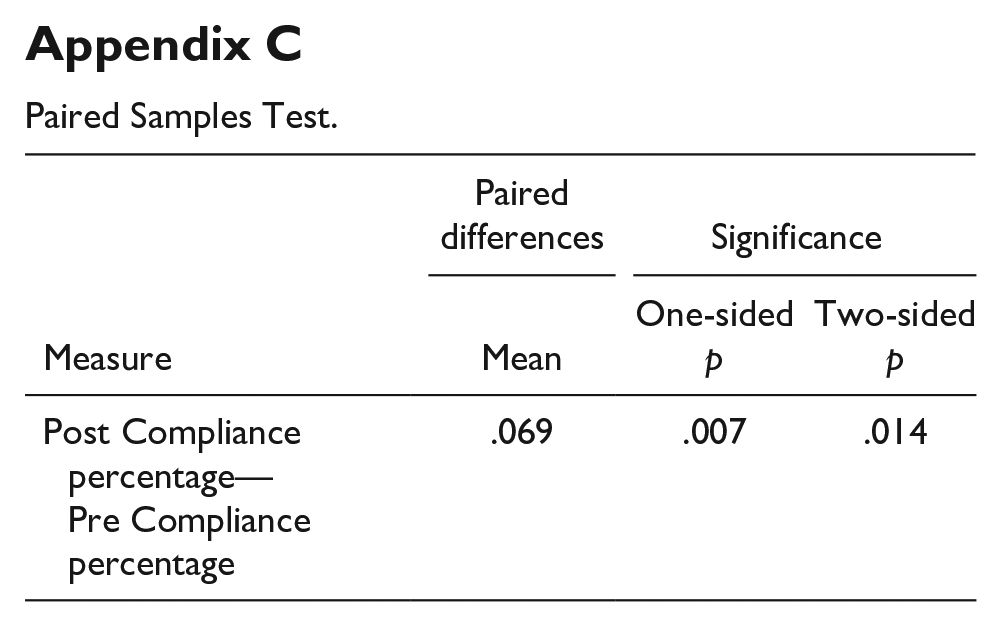
Descriptive statistics analysis (see Appendix B) showed a pre-intervention compliance of 84.39% and post-intervention compliance of 91.24%. Pre-intervention mean target day variability was 3.55 days compared to a post-intervention mean target day variability of 1.33 days. Non-parametric analysis was used to compare target day variability pre- and post-intervention. A Wilcoxon signed-rank test also resulted in a statistically significant change in target day variability (Z = -2.10, p < .04). A paired t-test (p = .014) examined pre- and post-intervention compliance percentages resulting in significant improvement with a 6.9% mean increase in compliance (see Appendix C). Descriptive frequencies showed 24 pre-intervention patients (49%) had a baseline compliance percentage of 100%. Post-intervention, that number increased to 35 patients (71.4%). Pre-intervention, only 10 patients (20.4%) had a mean target day variability of zero, compared to an increase of 17 patients (34.7%) post-intervention.
Discussion
The results suggest an improvement in medication adherence for study participants with the implementation of text reminders for LAI appointments. There was no significant difference in outcomes between genders. A decrease in compliance percentage was seen in the 65+ years category from 87.50% to 83.30%. This may be attributed to the lack of patients in this category (n = 2) or considering older generations may be less familiar with new electronic health care technology.
In contrast, the age group 30–49 years (n = 23) reflected the largest improvement with a jump from 84.70% to 94.57%. This finding is consistent with younger generations adapting to and accepting the implementation of new technology in health care. Future trials should strive to be more inclusive of older patients who may be less familiar with the technology.
Lack of funding or insurance frequently plays a significant role in access to health care. Most patients (n = 39; 79.59%) were insured by Medicare or Medicaid, with a smaller portion of patients (n = 8, 16.33%) without insurance. According to the Centers for Medicare & Medicaid Services (2017), antipsychotics are a protected drug class that must be covered under all plans. However, there was no significant difference in compliance between uninsured patients (91.67%) and those insured by Medicare (92.40%) or Medicaid (90.91%). Of note, 75% of uninsured patients (n = 6) were treated with paliperidone palmitate compared to 41.2% (n = 7) and 40.9% (n = 9) of Medicare and Medicaid patients respectively. One study suggests the utilization of Invega Sustenna increased medication compliance with lower mean hospitalization days (Pesa et al., 2017).
Mental health disparities are recognized throughout literature and are often attributed to poor access to health care. Behavioral health technology interventions have documented efficacy in racial and ethnic minorities (Ramos & Chavira, 2022). Of the three races represented in this study, African Americans showed the most improvement in medication adherence. Of this study’s African Americans (n = 10), seven were insured through Medicaid, and three were insured through Medicare. Their pre-intervention compliance percentage was 83.80%, with a post-intervention increase to 96.7%. Target day variability decreased from 6.47 mean days to 0.56 mean days. Nationally, 99% of African Americans own a cellphone (Pew Research Center, 2018). These findings suggest that African Americans have a positive treatment response when provided with adequate resources and access to care. Despite the high rate of mobile device ownership among African Americans, there is a limited representation of African Americans in associated mobile health technology research (James et al., 2017). Future research should consider engaging the African American patient population to increase representation and increase efforts to resolve health care disparities.
Limitations
Limitations and barriers include patients who do not have access to a mobile device to receive text messages or difficulty obtaining transportation to medication appointments. The facility’s electronic health record did not allow easy collecting of this limiting information which provided a hindering contextual element. However, 95% of Americans own a mobile device (Pew Research Center, 2018).
Initial intervention implementation was delayed due to a peak in COVID-19 cases in January 2022. This contributed to a shorter post-intervention data collection period of 12 weeks. Further research should investigate the intervention’s effectiveness over a more extended period. Patients continued to present to the outpatient clinic for LAI administration despite the clinic transitioning follow-up appointments virtually until the end of February 2022. It is unknown whether this surge in COVID cases influenced medication compliance in January 2022.
Missing data entries were investigated and linked to medication discontinuation or patient discontinuation from services. The inpatient psychiatric hospital adjacent to the community clinic is the only inpatient unit in the surrounding multi-county region it serves. When the adjacent hospital is at its maximum census, patients are frequently transported to different regions for hospitalization, often several hours away by ambulance. Other facilities utilize different electronic health record systems, which prove a barrier to following up on patients. This may have contributed to outliers in data or missing data entries.
While this study evaluated the relationship between text reminders and medication adherence, it did not examine its effect on patient outcomes. The literature suggests an implied influence on quantifiable patient outcomes such as hospital readmissions, symptom severity, and cognitive impairment. Further research should consider assessing symptom burden with the Positive and Negative Syndrome Scale (PANSS), which utilizes a 7-point Likert-type scale.
Conclusion
Text reminders may be an effective tool for increasing LAI medication adherence in patients with schizophrenia spectrum disorders. Results showed an improvement in compliance demonstrated by an increase in compliance percentage (p = .014) and a decrease in target day variability (p < .04). There was also an increase in patients meeting 100% compliance percentage and zero target day variability. Encouraging the use of a Health Insurance Portability and Accountability Act (HIPAA)-compliant patient engagement platform for automated text message reminders promotes LAI medication adherence for individuals with psychotic disorders. In such a medication-dependent patient population, improved adherence impacts symptom burden, quality of life, relapse prevention, and hospital readmissions.
Limited research examines the effectiveness of text message reminders in severe mental illnesses such as schizophrenia spectrum disorders. Demographic variables were essential in this study to recognize an improvement in the African American population. There is an opportunity to increase mental health promotion in a commonly disadvantaged population. Additional consideration should include various levels of health literacy and comfort with technology. Further research with a larger sample size, more extended intervention period, and multi-center design is recommended to determine if there are positive changes in patient outcomes.
Footnotes
Appendix
Paired Samples Test.
| Measure | Paired differences | Significance | |
|---|---|---|---|
| Mean | One-sided p | Two-sided p | |
| Post Compliance percentage—Pre Compliance percentage | .069 | .007 | .014 |
Acknowledgements
The authors wish to acknowledge Lisa Davenport for her role in data collection and project advocacy.
Author Contributions
C.J.C. conceived the study and determined the methodology. C.J.C. collected, analyzed, and interpreted data. W.H. contributed to data and result interpretation. C.J.C. drafted the manuscript which was edited and revised by W.H. Both authors reviewed the manuscript before submitting for publication.
Declaration of Conflicting Interests
The author(s) declared no potential conflicts of interest with respect to the research, authorship, and/or publication of this article.
Funding
The author(s) received no financial support for the research, authorship, and/or publication of this article.
